
Need assistance? We're here to help with support, guidance, and resources. Reach out to us anytime.

A regional trucking and logistics company serving shippers and brokers across three states faced growing pressure on its operations team. With inbound call volume averaging 700 to 900 calls daily, and spiking during morning and late afternoon peaks, dispatchers struggled to keep up. The team was responsible for pricing, dispatch, and driver support, yet much of their time was consumed by phone queues, voicemail, and repetitive status updates.
This not only delayed service but also eroded customer experience. Leadership needed a way to reduce hold times, resolve common requests faster, and give staff more bandwidth for exceptions and higher-value work. They also wanted reliable reporting to track KPIs like abandon rates, handle times, and first-contact resolution without overburdening managers.
At peak hours, the phone system simply could not keep pace with demand. Callers often sat in menus or on hold for over a minute and a half before reaching a dispatcher. Many gave up, contributing to a 19% abandon rate and increasing frustration among shippers and brokers who expected timely updates on loads and pricing. These delays not only risked customer satisfaction but also created inefficiencies in operations. Dispatchers had to spend additional time returning missed calls, often repeating the same information that could have been resolved instantly. The perception of unresponsiveness made the company less competitive against rivals who offered quicker service.
Once business hours ended, incoming calls rolled directly to voicemail. Shippers needing status updates or pricing information were left waiting until the next morning, with urgent cases delayed by as much as eight hours. This delay strained relationships with brokers managing time-sensitive freight and increased the risk of SLA breaches. By the time dispatchers began their day, they faced a backlog of voicemails that had to be triaged, slowing down their ability to handle live inquiries. The lack of real-time after-hours support created inefficiencies for both customers and internal staff, reinforcing the perception that the company wasn’t as available as competitors.
Each call required manual effort to capture and re-enter notes into both the Transport Management System (TMS) and CRM. Dispatchers had to type the same information twice, a process that was both slow and error-prone. Typos, omissions, or mismatched records created downstream issues for sales, operations, and customer service teams. Over time, this led to wasted hours correcting errors and duplicating work. With call volume continuing to climb, this inefficiency consumed valuable dispatcher time that could have been better spent solving exceptions, planning routes, or supporting drivers in the field. The manual workflow was not scalable and was already costing the company significant productivity.
Leadership lacked a reliable way to monitor call performance metrics such as average handle time, abandon rate, or first-contact resolution. Existing reports were patchy, often compiled manually, and lacked real-time accuracy. This left managers without the data they needed to spot recurring issues or measure SLA compliance. Without clear insights, performance improvements were reactive rather than proactive. Leaders knew the calls were consuming enormous amounts of dispatcher time, but without clean, consistent reporting, they couldn’t quantify the business impact or identify where automation could deliver the most value.
Hiring more dispatchers or extending shifts wasn’t an option for a cost-conscious regional business. Adding headcount to handle peaks and after-hours coverage would have increased payroll without solving the inefficiencies of manual workflows. Leadership wanted a solution that could flex with call volume, provide real-time responses to customers, and reduce repetitive admin without overwhelming the existing team. In short, they needed a scalable way to meet demand without ballooning costs or sacrificing service quality.
Answer and understand – The AI dispatcher greets callers instantly, eliminating long menus and long hold times. It detects intent in plain language, allowing shippers and brokers to speak naturally rather than navigating complex phone trees. This immediate recognition creates a smoother caller experience and prevents early hang-ups.
Verify and fetch – Known contacts are identified automatically, and the system pulls account or load status details directly from the transport management system. This reduces dispatcher workload and removes the need for repetitive manual lookups. Customers get faster answers, and staff gain back time otherwise spent digging through records.
Resolve or route – Common requests like rate checks, status updates, or scheduling are resolved on the spot. When a human is needed, the agent books a callback or warm-transfers the call to the right dispatcher with full context. This eliminates caller frustration from having to repeat details multiple times.
Notes and analytics – Structured notes are written automatically into both the TMS and CRM. Every call is logged, ensuring accurate, consistent data across systems. This eliminated duplicate typing, reduced errors, and provided leadership with clean records they could rely on for decision-making.
KPI quality check – A weekly quality gate reviews a sample of calls against rules for greeting, verification, resolution, and handoff. The results are compiled into a short quality report, which helps managers pinpoint gaps, refine flows, and ensure the AI continues to meet operational standards. These guardrails maintain trust while enabling scale.
Smart reporting – Instead of patchy manual reports, the AI dispatcher creates detailed, structured logs that feed directly into dashboards. Leaders now see real-time trends in average handle time, first-contact resolution, and abandon rates. This level of visibility was not possible before and has empowered proactive improvements.
Continuous improvement loop – Insights from weekly reports and dispatcher feedback are used to refine prompts, scripts, and routing flows. Over time, the system becomes smarter, more efficient, and better aligned with customer needs. This ensures performance stays strong even as call volumes fluctuate.
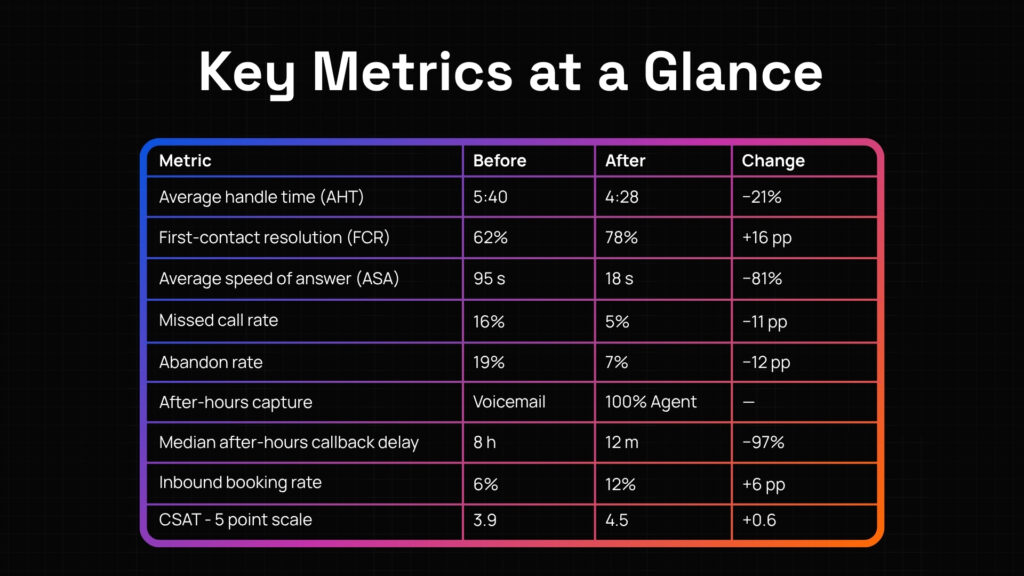
The AI blogging agent significantly improved both efficiency and impact:
Average handle time (AHT) dropped from 5:40 to 4:28 (−21%), reducing strain on dispatchers and accelerating resolution.
First-contact resolution (FCR) improved from 62% to 78% (+16 pp) as repeat booking and status requests were automated by the ai dispatcher.
Average speed of answer (ASA) fell from 95 seconds to 18 seconds (−81%), cutting early hang-ups and improving customer experience.
Missed call rate decreased from 16% to 5% (−11 pp), ensuring more inquiries were addressed without delay.
Abandon rate fell from 19% to 7% (−12 pp), reflecting faster responses and smoother workflows.
After-hours capture shifted from voicemail to 100% answered by the agent, with smart callbacks reducing median delay from 8 hours to 12 minutes (−97%).
Weekly retyping time saved reached 32 hours, freeing dispatchers to focus on complex tasks rather than duplicate data entry.
Inbound booking rate doubled from 6% to 12% (+6 pp) as callers reached the right resolution path quickly.
Customer satisfaction (CSAT) rose from 3.9 to 4.5 out of 5 (+0.6) in just 90 days, reflecting the combined impact of faster service and reliable answers.
With Autofuse’s AI dispatcher, this trucking company cut wait times, improved first-contact resolution, and freed dispatchers from repetitive admin,all while delivering a smoother experience for shippers and brokers.
Not every process needs AI. We help you find where it delivers the most impact — and fuse it seamlessly into your workflows.
Copyright © 2025 All Rights Reserved.
Project by Adler One
