

- Project Name :How Teams Uncovered a 90% Faster Workflow – AI Business Requirement Gathering Agent
- Company :Autofuse
- Client :Ecommerce Firm
- Date :3 October, 2025
We're here help!
Need assistance? We're here to help with support, guidance, and resources. Reach out to us anytime.

Company & Context
A mid-sized ecommerce and professional services company was struggling to capture and document its internal business processes. Each department, from finance to fulfillment, had its own version of “how things worked.” The lack of clarity made automation projects slow and painful, with analysts spending weeks in interviews and producing incomplete maps.
To overcome this, leadership deployed an AI Business Requirement Gathering Agent designed to conduct structured discovery sessions, gather detailed insights, and automatically generate professional documentation. The system combined GPT-4’s conversational ability with workflow orchestration through N8N, Firebase data sync, and Mermaid.js flowchart generation to deliver full reports in less than an hour, no meetings required.
According to Harvard Business Review, companies adopting AI-driven process automation reduce operational bottlenecks by up to 60%. The firm wanted to achieve similar gains through automation-driven process documentation.
The Challenges
Time-consuming and Inefficient Documentation
Traditional requirement gathering was a slow, fragmented process. Each workflow took nearly eight hours to document, involving multiple meetings, back-and-forth emails, and unclear note-taking. Analysts spent more time chasing clarity than actually mapping processes. Team members often used inconsistent terminology or skipped crucial steps, leaving analysts to make assumptions that later caused errors. Even after documentation was completed, reports needed to be rewritten for accuracy or formatting, leading to redundant work. Without a clear, repeatable framework, the documentation backlog kept growing, and automation projects were delayed for weeks. Leadership realized that for process transformation to scale, they needed a structured, intelligent system.
Incomplete Visibility Across Departments
Each department operated like its own island. Sales used one process for onboarding, operations had a different system for tracking fulfillment, and customer support relied on undocumented shortcuts. There was no unified map of how work actually moved across the company. When analysts tried to create process diagrams, they often discovered contradictions, two teams describing the same process in completely different ways. These inconsistencies made it impossible to spot bottlenecks or automation opportunities. The absence of an end-to-end view also meant leadership couldn’t measure where time and resources were being lost. By introducing the AI Business Requirement Gathering Agent, the firm aimed to unify these silos into a centralized, verifiable source of truth.
High Error Rates and Limited Scalability
Human analysts, though experienced, struggled with consistency as documentation demands increased. Misheard details, skipped steps, or ambiguous phrasing led to conflicting reports. Even small inaccuracies cascaded into major automation issues later on, where processes failed due to unclear requirements. As the company expanded, these problems multiplied. Each new department or workflow added more hours of manual effort, making scalability nearly impossible. Hiring additional analysts only increased costs without fixing the root problem, humans were not equipped to capture complex, evolving workflows at scale. The AI Business Requirement Gathering Agent offered a new path forward: a way to handle hundreds of process mappings with precision, consistency, and zero fatigue.
Lack of Engagement and Data Consistency
Capturing accurate process information required employees to be engaged, but traditional interviews often discouraged them. Staff either oversimplified their explanations or avoided mentioning inefficiencies to protect their departments from scrutiny. Analysts were left piecing together incomplete stories from vague notes. Even when data was collected, it lived in multiple formats, Excel sheets, Word documents, and emails, each telling a slightly different version of events. This fragmented approach made merging information a tedious and error-prone task. The AI Business Requirement Gathering Agent solved this by acting as a neutral, judgment-free interviewer. It encouraged employees to describe their real workflows honestly and in detail, while ensuring every response was stored in a consistent, structured JSON format.
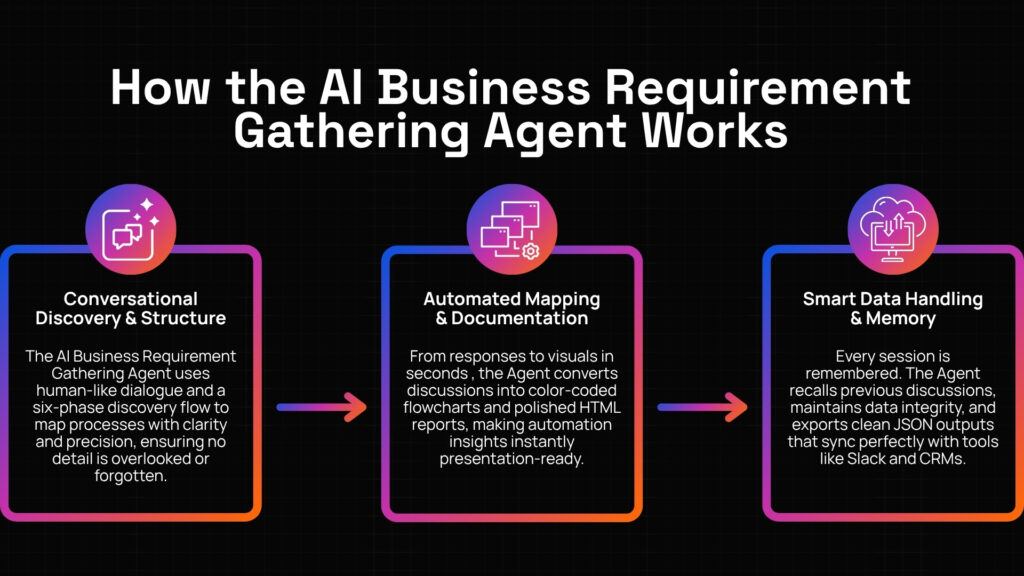
The Solution: How the AI Business Requirement Gathering Agent Works
Conversational Discovery and Structure
Human-like dialogue – The AI Business Requirement Gathering Agent uses a 3,000-word prompt that defines its tone as calm, conversational, and analytical. It asks one question at a time, avoids jargon, and encourages open dialogue. This conversational style helps participants share authentic details and pain points they might hide from a human analyst.
Structured six-phase discovery flow – The system guides users through company discovery, department mapping, process selection, deep process analysis, sub-process exploration, and documentation generation. Each phase builds logically on the previous one, ensuring no critical step is skipped or forgotten.
Automated Mapping and Documentation
Mermaid.js visualization – The AI Business Requirement Gathering Agent automatically transforms responses into color-coded flowcharts using Mermaid.js, clearly showing decision points, owners, and automation opportunities. This replaces manual diagramming entirely.
Professional HTML reporting – Each session generates a formatted HTML report that includes pain points, business impact, automation recommendations, and ROI analysis. Reports are clean, branded, and ready for leadership review within minutes.
Smart Data Handling and Memory
Persistent context and recall – Using Firebase, the AI Business Requirement Gathering Agent retains conversation history and previous session data. When a user returns, it recalls prior discussions to avoid repetition, ensuring continuity across sessions.
Reliable JSON output – The system’s N8N workflow manages clean JSON parsing and ensures only complete datasets are output at the end of the process. This guarantees accuracy across reports and supports integration with automation tools like Slack or CRM systems.
The Results
The AI Business Requirement Gathering Agent significantly improved both efficiency and impact:
Documentation time dropped by 90%, from eight hours of meetings to just 45 minutes of guided conversation.
Complete process maps were produced for three departments, replacing weeks of fragmented work.
12 automation opportunities were identified and scored by effort and impact.
Error rate reduced by 80%, as the AI Business Requirement Gathering Agent standardized every conversation.
Stakeholder satisfaction increased, with participants describing the process as “relaxed, natural, and surprisingly engaging.”
Stop Losing Weeks Documenting Processes Manually.
With the AI Business Requirement Gathering Agent, teams capture detailed workflows, identify automation gaps, and generate professional documentation, all in under an hour.