
Need assistance? We're here to help with support, guidance, and resources. Reach out to us anytime.

A Series A B2B SaaS company selling to mid-market teams faced a critical bottleneck in content production. Their lean content team struggled to maintain a steady publishing cadence, with just a few posts going live each month. Leadership knew that inbound search traffic was a valuable pipeline driver, but the team was unable to match demand for in-depth, keyword-targeted blog content that reflected the brand voice.
Instead of adding new headcount, which would raise costs and lengthen ramp-up time, the company sought a more scalable way to build a consistent production engine. They wanted blog posts that weren’t just fast to produce, but also matched search intent, aligned with brand tone, included the right structure, and tied directly to revenue pipeline. The leadership team realized they needed an AI blogging agent that could consistently deliver depth, structure, and search-optimized posts without scaling payroll.
The team was drowning in a growing list of content ideas. While brainstorming and strategy sessions generated plenty of relevant topics, the limited bandwidth of the writers meant many of these ideas sat untouched. Publishing was inconsistent, with gaps of weeks between posts. This lack of consistency hurt SEO momentum and made it difficult to build a loyal readership. The marketing team knew the pipeline impact of search-driven content, but they simply couldn’t execute fast enough to keep up with demand.
Each blog post required multiple rounds of manual optimization before it could go live. Writers had to research keywords, insert them carefully, ensure metadata was aligned, create internal links, and clean up formatting. These tasks often stretched an article’s production timeline from hours into days. Worse, the process left room for human error. Some posts were well-optimized, while others missed key opportunities, leading to uneven search performance. Over time, this inconsistency weakened the overall authority of the blog.
Short, surface-level content was another recurring problem. Competing SaaS blogs were producing long-form content, often exceeding 2,000 words, that thoroughly covered topics, offered frameworks, and included actionable insights. Meanwhile, this company’s posts averaged far shorter and lacked a consistent structure. Without clear subheads, strong visuals, and checklist-style takeaways, posts struggled to hold reader attention or rank highly for competitive keywords. An AI blogging agent could help standardize structure and deliver the kind of long-form content readers and search engines prefer.
Older blog posts that had once generated strong traffic were now underperforming. Algorithms had changed, competitors had refreshed their content, and search intent evolved. Yet the company had no system in place to track, refresh, or repurpose existing articles. As a result, some of their most valuable assets quietly declined in relevance and visibility. The team saw opportunities slipping away but lacked the bandwidth to tackle refresh cycles while also creating new content.
The obvious fix, hiring more writers or editors, wasn’t realistic. As a Series A startup, the company needed to balance aggressive growth goals with lean operating costs. Leadership couldn’t justify the expense of expanding headcount for content production alone. What they required was a scalable system that could dramatically increase output while keeping quality high, ensuring brand voice alignment, and fitting into existing workflows.
Plan the topic – The system selects high-intent ideas from keyword clusters, ensuring every article serves a clear audience and business objective. This removed guesswork and gave writers confidence they were working on content that mattered.
Research and outline – Trusted sources are scanned and synthesized into a clear H2/H3 outline before drafting. This gave each article a strong backbone and reduced the time writers spent chasing scattered references.
Draft with SEO – Posts are written in full brand voice, automatically incorporating headers, metadata, and internal links. This streamlined SEO alignment while ensuring content felt natural and authoritative.
Brand pass and KPI QA – A secondary agent reviews every draft against tone rules, fact checks claims, and measures performance against preset KPIs. It produces a quality report with “pass” or “fix” items, allowing editors to focus on nuance instead of fundamentals.
Add visuals – The system proposes one featured image and two in-article visuals per post. This reduced the design team’s workload and ensured every article shipped with supporting assets.
Publish as draft – Clean HTML, title, slug, and meta data are pushed directly to the CMS. Human editors retain final approval, but formatting bottlenecks were eliminated.
Track and update – Performance monitoring ensures strong posts are refreshed on schedule while weaker posts are optimized. This closed the loop, keeping the blog competitive in fast-changing search landscapes.
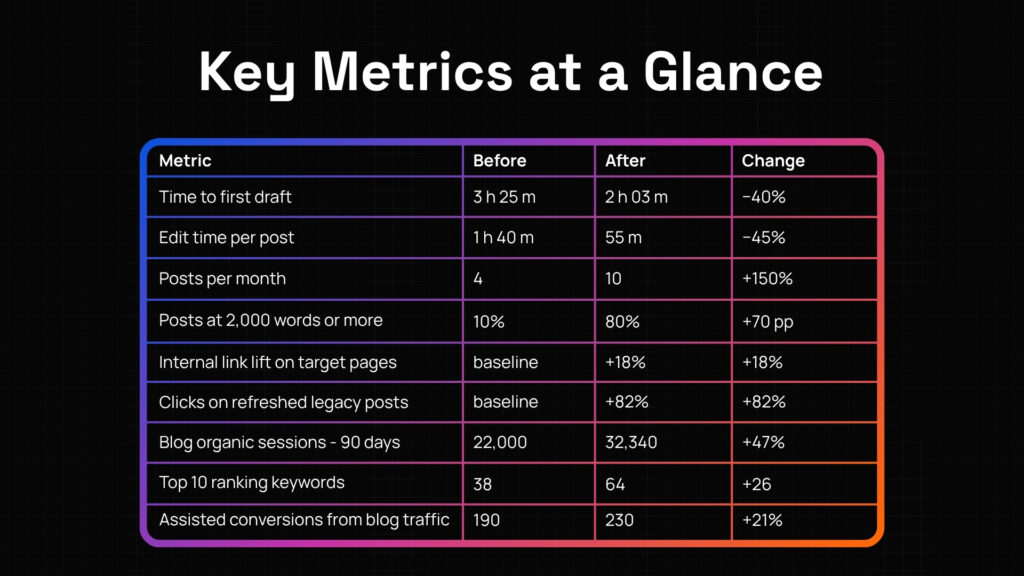
The AI blogging agent significantly improved both efficiency and impact:
Time to first draft dropped from 3h 25m to 2h 03m (−40%), allowing writers to move from idea to article much faster.
Edit time per post decreased from 1h 40m to 55m (−45%), freeing editors to focus on clarity and storytelling instead of formatting.
Posts per month grew from 4 to 10 (+150%), creating a steady publishing cadence that built SEO momentum.
Long-form depth surged, with posts at 2,000+ words rising from 10% to 80% (+70 pp), ensuring content matched competitive search intent.
Internal linking lifted organic clicks on target pages by a median 18% within 8 weeks, making important pages more discoverable.
Refreshed legacy posts saw a median 82% increase in clicks over 60 days, breathing new life into older assets.
Blog organic sessions grew from 22,000 to 32,340 in 90 days (+47%), signaling stronger inbound reach and visibility.
Top 10 ranking keywords climbed from 38 to 64 (+26), giving the blog broader search coverage.
Assisted conversions from blog traffic increased from 190 to 230 in 90 days (+21%), directly tying content to revenue impact.
By deploying an AI blogging agent with Autofuse’s quality guardrails, this B2B SaaS company scaled content velocity, lifted SEO performance, and tied blog traffic directly to pipeline, all without adding new headcount.
Not every process needs AI. We help you find where it delivers the most impact — and fuse it seamlessly into your workflows.
Copyright © 2025 All Rights Reserved.
Project by Adler One
