
Need assistance? We're here to help with support, guidance, and resources. Reach out to us anytime.

A mid-market B2B SaaS vendor selling to operations and finance teams was hitting a ceiling in outbound performance. The company had a small SDR (Sales Development Representative) team whose bandwidth was already stretched thin. Manual list building, generic cold emails, and uneven follow-ups limited pipeline growth and left opportunities untapped.
Despite strong product-market fit, the outbound motion was inefficient. SDRs were bogged down with repetitive research, copying data between tools, and drafting generic outreach. Leadership wanted a solution that would let the team scale efforts without burning through domains, damaging deliverability, or losing the human touch. They needed a repeatable, AI-driven approach to list quality, personalized messaging, and safe sending practices that could reliably turn cold contacts into warm booked meetings.
The team’s outbound approach was producing minimal traction. With reply rates stuck under 1% and positive replies at just 0.3%, prospects weren’t engaging. Emails often read like copy-paste templates, failing to resonate with recipients’ specific roles or pain points. In an industry where inboxes are saturated with cold outreach, standing out required relevance and timing, both of which the team struggled to deliver. Sporadic meetings booked left sales leaders frustrated, and pipeline goals consistently lagged behind targets. Without a major improvement in reply quality, outbound risked becoming a cost center instead of a growth driver.
SDRs spent countless hours each week compiling lists from LinkedIn, scraped databases, and spreadsheets. Despite this manual effort, enrichment coverage sat at just 45%, meaning more than half of the outreach went to poorly matched or incomplete records. Bounce rates exceeded 5%, wasting sends and damaging domain reputation. Worse, valuable time was lost double-checking emails or chasing dead contacts. For a team already stretched thin, this inefficiency meant fewer conversations with qualified prospects and more wasted effort on low-fit accounts.
Even when SDRs did manage to build campaigns, poor sending practices put the program at risk. Domains weren’t consistently warmed, inboxes weren’t rotated, and daily send volumes were often exceeded. The result was bounce rates creeping upward and spam complaints reaching 0.14%, dangerously close to thresholds that could cripple domain reputation. Leadership knew that if deliverability collapsed, it could take months to recover, making it impossible to scale outbound reliably. Safe sending practices were critical, but the team lacked both tooling and expertise to enforce them consistently.
Outbound success doesn’t end with a reply, it depends on what happens next. But the SDR team lacked a consistent system to detect, route, and follow up on positive replies. Some prospects waited days for a response, while others slipped through the cracks entirely. Meetings weren’t always booked, and context was often lost between SDRs and AEs. This inefficiency undermined trust with prospects and meant genuine buying signals weren’t being capitalized on. Without a structured follow-up process, valuable opportunities continued to die in the inbox.
The cumulative effect of these challenges was severe. Each SDR was spending nearly 30 hours a week on list-building, manual research, drafting emails, and chasing low-fit leads. That left little time for live conversations with warm prospects, the part of the job that actually moves pipeline forward. As a result, outbound efforts generated far less pipeline than leadership expected given the effort invested. The team needed a way to redirect SDR time toward conversations and trust that the foundational tasks , list quality, safe sending, and message personalization, were handled systematically.
Define ICP and segments – The system started by codifying the company’s ideal customer profile, defining roles, industries, tech stacks, and trigger events. This moved list building away from guesswork and toward structured targeting.
Build and enrich lists – Our AI Outreach and Lead Engine validated each email, enriched contacts with company and role data, and added live signals like job changes or tool adoption. This increased enrichment coverage from 45% to over 90%, eliminating wasted sends and improving connect rates. Lists that previously took hours to compile could now be built in minutes, with far greater accuracy and fit.
Signal-based messaging – The AI Outreach and Lead Engine agent drafted openers tied directly to each contact’s live signals, such as a recent role change or industry announcement. This made messages feel personal and relevant, not templated.
Value-driven sequencing – Campaigns were sequenced across both email and LinkedIn, spaced with humane timing and adjusted based on engagement. Instead of blasting generic emails, prospects received thoughtful touchpoints that respected their attention and built trust.
Domain warming – New domains were gradually scaled to sending volume, reducing risk of spam filtering.
Inbox rotation and caps – The AI Outreach and Lead Engine staggered sends across multiple inboxes with strict daily caps, ensuring no single account was overused.
Health monitoring – Bounce and complaint rates were continuously tracked, with campaigns automatically paused if thresholds were exceeded. These measures ensured that scaling outbound didn’t come at the cost of inbox placement.
Reply detection – AI distinguished between positive, neutral, and negative replies, so SDRs no longer had to manually sift through inbox noise.
Context-rich handoff – Replies were routed to the right SDR or AE with full history attached, avoiding the common problem of prospects having to repeat themselves.
Auto-booking holds – The system temporarily reserved meeting slots for high-intent replies, reducing delays and preventing leads from going cold. This alone recovered opportunities that would have otherwise slipped away.
KPI quality check – Before launch, each campaign was checked against reply targets, safe sending rules, and clarity of booking paths. This ensured every sequence met defined standards before hitting inboxes.
Learning loop – Results from every campaign were logged and analyzed. Winning subject lines, openers, and sequences were promoted, while underperforming variants were retired. Over time, campaigns improved iteratively, creating a self-reinforcing cycle of higher engagement and better meetings.
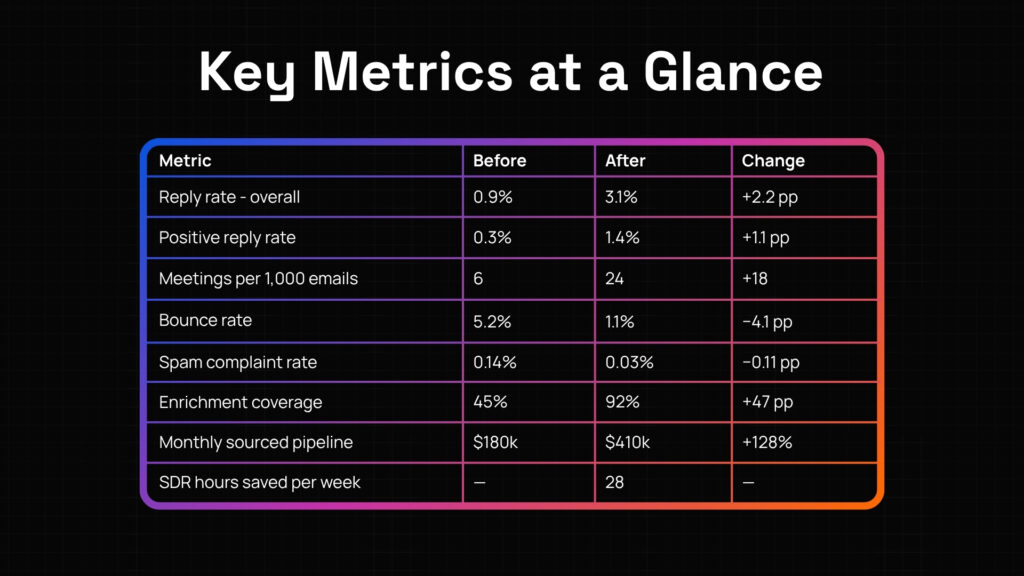
The AI Process Mapping significantly improved both efficiency and impact:
Overall reply rate rose from 0.9% to 3.1%, tripling engagement across campaigns and proving that signal-based personalization could break through inbox noise.
Positive reply rate climbed from 0.3% to 1.4%, showing that higher-quality, contextualized outreach created genuine conversations instead of polite rejections.
Meetings booked per 1,000 emails increased from 6 to 24, a fourfold lift that gave SDRs a steadier flow of qualified sales opportunities.
Bounce rate dropped sharply from 5.2% to 1.1%, reflecting the stronger validation and enrichment of contact data.
Spam complaint rate fell from 0.14% to 0.03%, protecting domain reputation and ensuring consistent inbox placement.
Enrichment coverage improved from 45% to 92%, meaning SDRs worked with more complete, accurate records and fewer wasted sends.
Monthly sourced pipeline grew from $180k to $410k, a 128% increase that tied outreach performance directly to revenue impact.
SDRs saved about 28 hours per week that had previously been lost to manual research and drafting, freeing them to focus on live conversations and deal progression.
With Autofuse’s AI outreach and lead generation engine, this SaaS company tripled replies, quadrupled meetings, and doubled sourced pipeline, all while protecting deliverability and freeing SDRs to focus on real conversations.
Not every process needs AI. We help you find where it delivers the most impact — and fuse it seamlessly into your workflows.
Copyright © 2025 All Rights Reserved.
Project by Adler One
