Company & Context
A 120-person professional services firm was scaling quickly, but growth brought operational complexity. Processes lived in people’s heads rather than shared documentation. Each team followed its own version of onboarding, billing, and approvals, creating inconsistency and confusion. Work often stalled when the person who “knew the steps” was out of office, and new hires had difficulty navigating scattered instructions.
Leadership recognized that this “tribal knowledge” model was no longer sustainable. They wanted a structured, scalable way to capture processes, identify automation opportunities, and keep documentation fresh as workflows evolved. The goal was to create a foundation for AI and automation initiatives without relying on incomplete or outdated maps.
The Challenges
Inconsistent Workflows Across Teams
Onboarding, billing, and approvals varied not only by client but also by team. Employees followed different steps for the same tasks, which caused confusion and led to unnecessary delays. A lack of standardization made it nearly impossible to scale operations efficiently. New hires in particular struggled, often relying on peers for guidance rather than following a clear, consistent process.
Scattered and Outdated Documentation
Critical instructions lived in private documents, email threads, or hallway conversations. Finding the right version of a checklist often took hours, and in many cases, there was no up-to-date checklist at all. This slowed down everyday work, caused repeated errors, and undermined confidence in existing documentation. Without a single source of truth, staff wasted valuable time hunting for answers instead of executing work.
Failed Handoffs and Stalled Work
Because responsibilities weren’t clearly mapped, tasks frequently fell through the cracks. Projects stalled when someone was out of office or when steps weren’t clearly handed over to the right owner. These failed handoffs created costly rework loops and frustrated both staff and clients. The lack of visibility into ownership meant accountability was weak and bottlenecks persisted.
Fragile Automation Efforts
Some teams attempted to automate parts of their workflows, but because the underlying process maps were incomplete or inconsistent, these automations quickly broke whenever a step changed. This created mistrust in automation and wasted development time. Leadership realized that without stable, accurate process maps, scaling automation would continue to fail.
Difficulty Identifying Quick Wins
While leaders wanted automation, they lacked a structured way to evaluate which opportunities would deliver the most value. Effort and impact weren’t systematically measured, so automation roadmaps were more guesswork than strategy. This slowed progress and made it hard to justify investment.
The Solution: How AI Process Mapping Works
Structured Process Mapping Sessions
Choose the process – Each session began by naming the start and end points of a process, along with the success metric. This framed the scope and kept the team focused on measurable outcomes.
Map in one session – In just three hours, a facilitator worked with the process owner and two frontline experts to capture inputs, steps, owners, and systems in plain language. This rapid session ensured alignment without weeks of back-and-forth.
Flag risk points – Loops, manual retyping, and bottlenecks were clearly noted on each map. This gave teams immediate visibility into inefficiencies that had previously been hidden.
Automation Opportunity Scoring
Score opportunities – At the end of each session, the team identified automation opportunities and scored them by effort and impact. This structured scoring created a prioritized roadmap of quick wins and longer-term opportunities.
Stabilize and ship – Two high-value quick wins were stabilized immediately, showing the business measurable results within weeks rather than months. These early successes built confidence in the mapping process and AI-led automation strategy.
Continuous Improvement and Governance
Document and publish – Every process map was versioned, tagged, and stored in a shared location accessible to all staff. Each included owners, systems, risk points, and success metrics, ensuring the entire team worked from the same playbook.
Review on a cadence – Monthly reviews were scheduled to revisit metrics, fix drift, and update the map as processes evolved. This governance model ensured automation stayed aligned with reality, preventing the “set and forget” pitfalls of past efforts.
The Results
The AI Process Mapping significantly improved both efficiency and impact:
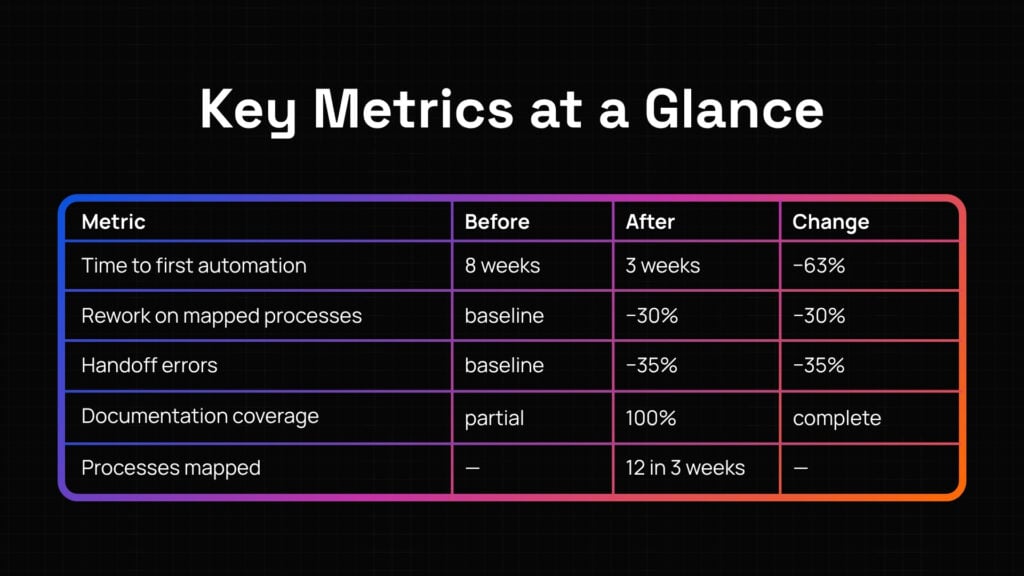
Time to first automation dropped from 8 weeks to 3 weeks (−63%), as requirements were clear and stable from the outset.
Rework on mapped processes fell by 30%, thanks to standardization, versioned checklists, and clearer ownership.
Handoff errors decreased by 35%, as process maps assigned explicit owners to each step and removed guesswork during transitions.
Documentation coverage improved from partial and scattered to 100% of core processes, with version tags and change logs providing ongoing visibility.
Processes mapped – Twelve core processes were mapped in just three weeks, creating a library of usable, reliable workflows for teams to follow.
From Tribal Knowledge to Automation-ready Processes.
With Autofuse’s AI-powered process mapping, this professional services firm created a single source of truth, cut rework and errors, and built a reliable foundation for automation, all in under a month.