
When you’re vetting an AI automation company, the question isn’t “Which one has the slickest demo?” it’s “Which one helps us reach our goals, with trust and clarity?”. With AI automation services becoming table-stakes, knowing what truly matters helps you avoid investment pitfalls.
This is your straight-talk guide to evaluating vendors ruthlessly; but respectfully.
Why This Choice Matters for Your Business
- Productivity gains aren’t speculative. Organizations leveraging AI automation report 20–40% improvements in operational efficiency, especially when paired with employee enablement and oversight (McKinsey).
- Automation scales, but governance lasts. Without transparency and control, even high-performing workflows break trust and stall adoption.
- Human-in-the-loop delivers better outcomes. AI that empowers and is empowered by humans drives more reliable results than unchecked automation.
- ROI is real when intelligently deployed. Firms that pilot thoughtfully and expand via feedback loops often see ROI within the first year.
- Leadership alignment is key. AI automation projects succeed 2x more often when objectives map directly to business OKRs.
Choosing the right partner is not a cost, it’s an investment that amplifies strategy, not shadows it.
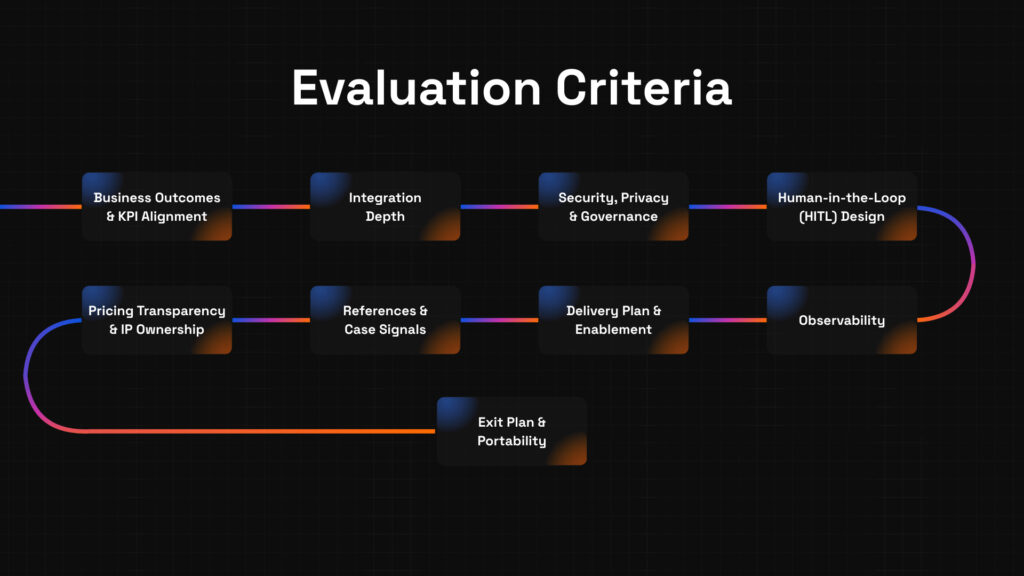
Key Criteria: What to Evaluate First
Business Outcomes & KPI Alignment
Vendors should ask, “What metrics will prove value?”; be it reduced error rate, improved SLA, or saved minutes per task.
Integration Depth
Your automation must ride on real data paths read/write access, CRM, help desks, ERP, or TMS without awkward workarounds.
Security, Privacy & Governance
Demand clarity on encryption, access control, audit logs, and compliance (GDPR, HIPAA). These need to be operational, not optional.
Human-in-the-Loop (HITL) Design
Critical workflows need fallback paths. AI should supplement decision-making not replace it entirely.
Observability & Rollback
Dashboards, trace logs, alerts, and rollback tools give transparency into what the AI did and how you can fix it.
Delivery Plan & Enablement
Look for playbooks, training sessions, and handoff documentation, not one-time installs.
References & Methodology
Don’t settle for buzzword-filled case studies. Look for similar use cases, quantifiable results, and evidence that speaks the language of your business.
Pricing Transparency & IP Ownership
Understand cost drivers up front and who owns your workflows, prompts, or models post-launch.
Exit Plan & Portability
Ensure you can export your work in case you change vendors or want leverage. Plans without portability end up as sunk costs.
Example in Action:
A customer success team paired an AI automation workflow with CRM and support systems, including HITL for flagged cases. Within two months, ticket load dropped 30%. Dashboards alerted the team to misrouted items in real time, keeping SLA intact and building trust.
Pitfalls to Avoid (Bolded Trap → Fix)
- Trap: Flashy demos, no metrics → Fix: Always ask for actual impact (e.g., resolution time improvements of X%).
- Trap: Integration underestimated → Fix: Audit systems early don’t assume plugs alone.
- Trap: Skipping governance → Fix: Demand policies & proof of security.
- Trap: Ignoring HITL → Fix: Mandate human fallback when confidence is low.
- Trap: No visibility → Fix: Require dashboards and rollback from day one.
- Trap: Weak enablement → Fix: Validate training before signing.
- Trap: Vendor lock-in → Fix: Lock in exit clauses early.
- Trap: Hidden or flexible pricing → Fix: Request transparent cost models now.
5-Step Framework to Evaluate with Confidence
- Define KPI & Scope
Example: Reduce order entry errors by 25% in 60 days.
Pro tip: Pilot a small but high-impact workflow. - Shortlist with Scorecard
Score vendors on integration, governance, HITL, visibility, and training. Weight criteria based on your environment (e.g., compliance-heavy vs speed-focused). - Discovery & Access Audit
Map out data, systems, and access needs hands-on with your IT/security teams. - Pilot with HITL & Observability
Launch a mini workflow, monitor outcomes, tweak thresholds, and capture lessons. - Decide, Scale & Review Quarterly
Scale based on positive pilot results, with governance and retraining embedded in quarterly rhythms.
Sample Vendor Interaction Tools
- Vendor Questions (copy/paste ready):
- How will your services align with our KPIs?
- What systems do you integrate with and at what depth?
- How do you support governance, auditability, and compliance?
- When and how does escalation to human agents occur?
- What visibility tools are available dashboards, logs, rollback?
- What enablement do you include?
- Can you share relevant results from similar clients?
- What pricing assumptions apply?
- Who owns AI assets we build?
- What’s your exit strategy for asset portability?
- Quick RFP Snippet:
Hi [Vendor],
We’re exploring AI automation consulting to optimize [workflow]. Please share how you tie success to KPIs, integrate with systems, support human oversight, and enable our team including pricing, references, and governance details.
Thanks,
[Your Name]
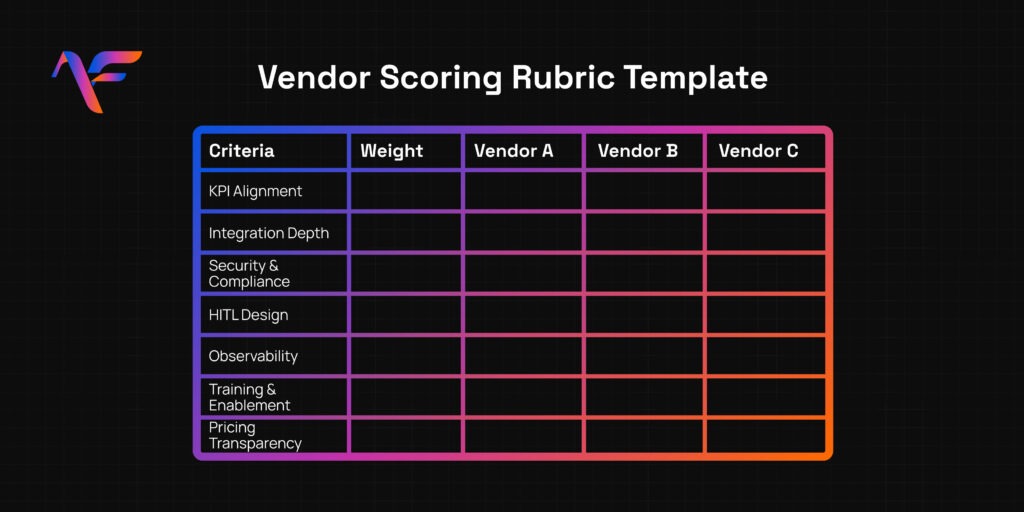
- Scorecard Layout:
| Criteria | Weight | Vendor A | Vendor B |
| KPI Alignment | 25% | ||
| Integration Depth | 20% | ||
| Governance & HITL | 15% | ||
| Observability | 15% | ||
| Training & Enablement | 15% | ||
| Pricing & Exit | 10% |
The Real Work: Evaluating an AI Automation Company Without Guesswork
Once you’ve identified a shortlist of AI automation companies, it’s time to move beyond vague promises and glossy sales decks. The right partner won’t just talk about “efficiency” they’ll show you exactly how they’ll help you deliver it.
This section gives you a five-step, practical evaluation process designed for ops leads, tech heads, and founders alike. It works whether you’re selecting your first AI automation partner or replacing one that over-promised and under-delivered.
Step 1: Define KPIs and Scope Before You Contact Vendors
Skip this, and everything else becomes guesswork.
Start by defining what success looks like. It’s not “automate support.” It’s “reduce median resolution time by 40%” or “cut order rework rates by half.” Be specific and measurable.
Example:
Instead of “improve onboarding,” say:
→ “Reduce manual data entry time by 60% for new hires, across HRIS and provisioning.”
Pro tip:
Tie the AI use case to a measurable, business-owned OKR not just IT convenience.
Stat:
Firms that link automation to defined KPIs are 2.3x more likely to report ROI within the first 6 months (Gartner).
Step 2: Shortlist Vendors Using a Scorecard
Once you’ve scoped the work, apply a structured lens. Keep emotion and demo glitz out of it.
Build a weighted scorecard that includes:
- Alignment to business KPIs
- Integration capabilities (read/write, event-driven, cross-system)
- Governance features (logging, access control, compliance)
- Human-in-the-loop design
- Observability (dashboards, alerts, rollback)
- Enablement & training
- Transparency on IP and portability
- Culture and communication fit
Example:
Vendor A shines on tech but lacks HITL. Vendor B has great enablement but no rollback logs. Your scorecard keeps bias in check.
Pro tip:
Involve at least one stakeholder from IT, ops, and the end-user team when scoring.
Step 3: Run a Discovery + Access Audit
Now it’s time to dig in with your top 1–2 vendors.
Run a joint discovery session that covers:
- Systems that need to be touched
- Data locations, types, and formats
- Who owns what (RACI)
- Access control needs (OAuth, service accounts, SOC 2, etc.)
- Where human decisions are required
- Failure and escalation paths
Example:
For a customer support routing automation, you may need:
- Zendesk (read/write, tagging, custom fields)
- CRM (lookup and enrich)
- Slack (notifications)
- Escalation policy for edge cases or AI uncertainty
Pro tip:
Create a shared doc that defines all dependencies. If vendors skip this, that’s a red flag.
Step 4: Pilot with HITL and Real Dashboards
A pilot is not a sandbox demo it’s a contained, live test on real workflows.
Minimum bar:
- HITL in place for high-uncertainty cases
- Real dashboards tracking throughput, accuracy, and failure
- Alerting if things go wrong
- Rollback mechanism, even if manual
- Training and team walk-throughs
Example:
A RevOps team piloted AI-triggered account enrichment from inbound demos. When confidence was under 80%, a human reviewed it. Dashboards helped them see exactly where the AI missed and where the model was improving.
Pro tip:
Use a single Slack channel or doc for pilot feedback from your team. Speed matters.
Stat:
AI pilots that include HITL and real metrics are 3.8x more likely to scale successfully (Forrester).
Step 5: Decide, Scale, and Review Quarterly
A great vendor won’t disappear post-pilot. You want structured rollouts tied to performance checkpoints.
What to lock in:
- Shared OKRs and timeline
- Quarterly governance review
- Model retraining if applicable
- New workflows or expansions based on performance
- Knowledge base updates and staff onboarding
Example:
One logistics firm built quarterly AI reviews into their normal business ops, treating it like they would a sales forecast or NPS meeting.
Pro tip:
Include success signals (like time saved, tickets resolved, or rework avoided) in your executive review deck to build internal buy-in.
Real Talk: What Separates a Solid AI Automation Vendor?
1. They speak your language.
If the vendor talks more about LLM fine-tuning than actual workflow outcomes, move on.
2. They don’t dodge your IT or compliance team.
Security is a feature not a footnote.
3. They build with you, not at you.
You want playbooks, training, and feedback loops not just a file drop of prompts and hope.
4. They’re ready to walk away if the fit isn’t right.
Surprisingly, the best vendors will help you disqualify them if the match isn’t there. That’s a sign of maturity.
5. They prioritize observable impact over “AI magic.”
Look for clear measurement paths and rollback plans not vague “next-gen intelligence.”
Optional Copy/Paste: Internal Kickoff Email Template
Subject: AI Automation Pilot – Internal Brief
Hey team,
We’re kicking off a pilot with [Vendor X] to test automation for [specific workflow].
Goals:
- [KPI 1]
- [KPI 2]
Scope:
- Live data from [systems]
- HITL fallback included
- Dashboards to track metrics
If you’re involved in the workflow, expect invites and Slack pings next week.
[Your Name]
Final Due Diligence: Questions, Templates, and How to Decide
By now, you’ve narrowed down a few serious contenders for your AI automation project. You’ve scoped your workflows, run pilots, and seen early signals of what works.
What’s left? Tighten your evaluation with smart questions, lock in buy-in across your org, and scale confidently with the right structures in place.
This section delivers:
- Copy/paste vendor questions
- Two quick templates (scoring rubric + RFP email)
- Final decision tips
- A clear, low-pressure next step
Copy/Paste: 10 Smart Questions to Ask Any AI Automation Company
Use these to push past the marketing layer and get to real fit.
- What measurable outcomes have you delivered in similar orgs or workflows?
- Can you describe your approach to human-in-the-loop design for edge cases?
- What systems do you integrate with natively (read + write)?
- How do you handle observability and failure alerts in live environments?
- What’s your process for access audits and data privacy (e.g., SOC 2, SSO, RBAC)?
- How do you ensure that prompts, policies, and configs stay portable if we exit?
- Who owns the automation IP code, workflows, or fine-tuned models if we part ways?
- What does a handoff look like post-deployment? Do we get playbooks or just code?
- How do you train non-technical teams to use and adapt the system?
- What’s your process for ongoing review or retraining if our business evolves?
Pro tip:
Run these in a joint review session with your ops, security, and user teams present. If the vendor can’t answer confidently across functions, that’s your answer.
Quick Template: Vendor Scorecard Rubric
Use this to normalize input from different stakeholders. Keep weights flexible by org.
Scoring Rubric (Max 100 Points)
- Business fit (OKR alignment) – 20 pts
- Integration capability – 15 pts
- Governance & security – 15 pts
- Human-in-the-loop coverage – 10 pts
- Observability & rollback – 10 pts
- Team enablement – 10 pts
- Past results / references – 10 pts
- Transparency (IP, pricing, portability) – 5 pts
- Cultural fit & communication – 5 pts
Quick Template: Internal RFP Kickoff Email
Use this to align internal teams before you send anything to vendors.
Subject: AI Automation RFP – Stakeholder Alignment
Hey team,
We’re preparing to issue an RFP for AI automation vendors focused on [insert workflow or function].
Goals:
- Solve for [KPI or process bottleneck]
- Ensure security and audit requirements are met
- Deliver results within [timeline]
If you’re involved in [systems / data / outcomes], expect a quick intake call this week.
[Your Name]
What the Best AI Automation Companies Won’t Do
A solid vendor won’t:
- Dodge your IT team. They lean into security and architecture conversations.
- Promise magic results without a pilot. Real partners want proof before scale.
- Sell you black-box solutions. You get observability, not mystery.
- Avoid portability discussions. The best vendors design for future exit.
- Rely on non-technical support paths. Expect Slack channels and async docs not just tickets.
Your Final Checklist Before Signing
Use this to pressure-test vendor fit and internal alignment.
- Pilot delivered measurable outcome against defined KPIs
- Access, privacy, and integration concerns resolved
- Escalation paths for edge cases tested
- Rollback or audit functionality in place
- Team trained and confident
- IP, portability, and governance clarified
- Scorecard confirms top vendor fit
- Exec sponsor and user lead aligned
If most of these are a “no” pause. You’re not ready to scale.
Final Thoughts
The right AI automation company won’t just plug into your tech stack. They’ll plug into your business your workflows, your metrics, your people.
The real magic isn’t in the models. It’s in how well they understand your goals, handle complexity, and help your team scale without chaos.