
The Power of AI Voice Agent: Why Real-Time Integration Matters
AI voice agent has evolved from simple IVR replacements into mission-critical call handling systems that define operational success in modern contact centers. Teams implementing professional AI voice agent are fundamentally transforming how call management operates, how customer interaction executes, and how service delivery maintains effectiveness without creating frustrated callers or excessive costs. Advanced AI voice agent now requires complete system design from speech processing and intent detection to business logic integration and human escalation, enabling operations leaders to focus on strategic initiatives while intelligent voice systems handle systematic call engagement that once consumed hours during manual agent operations.
The data supporting strategic voice agent design continues to strengthen across operational functions. According to McKinsey research, contact centers using AI-driven voice automation can reduce handling costs by 25 to 40 percent when integrated properly, demonstrating that systematic design determines value as voice remaining the highest-volume channel for many businesses while also being most expensive requiring intelligent automation reducing costs through proper integration. BCG reports that call abandonment drops significantly when conversational routing replaces menu-based IVR, proving that natural interaction improves experience as fixed menus with rigid routing create high drop-off while AI voice agents with natural conversation and dynamic routing maintain engagement.
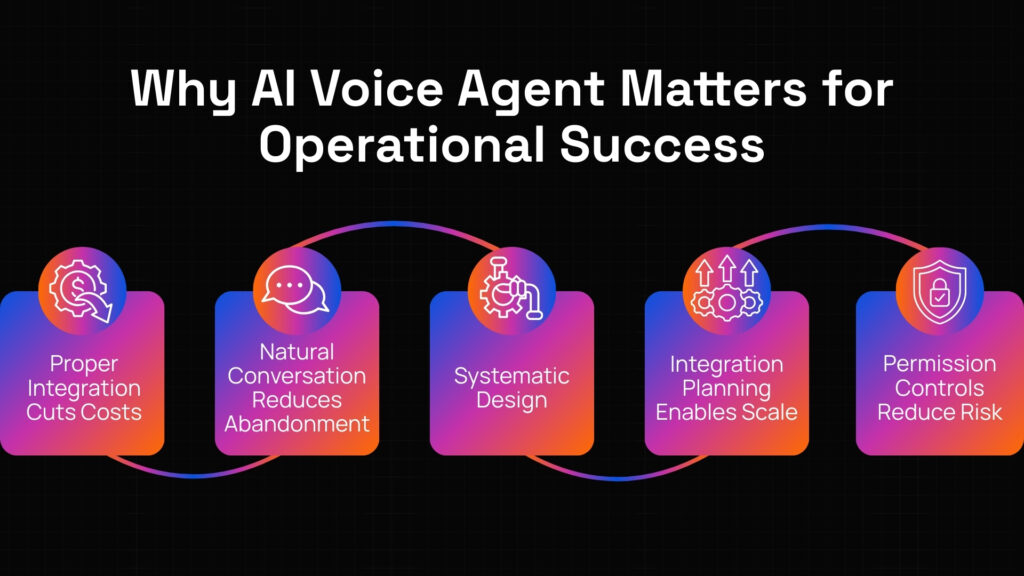
Why AI Voice Agent Matters for Operational Success
AI voice agent extends beyond simple call answering; it transforms how operations organizations manage customer service, maintain call efficiency, and ensure resolution quality across all voice touchpoints. Traditional IVR systems that once created bottlenecks through fixed menus, rigid routing, and high drop-off can now be executed with intelligence and precision through comprehensive AI voice agent that compounds effectiveness over time. From achieving 25-40 percent handling cost reductions through proper integration to resolving 20-30 percent of calls without human agents through systematic design, strategic AI voice agent delivers measurable outcomes that strengthen both operational efficiency and customer satisfaction.
For operations leaders evaluating AI voice agent strategies, real-time integration design provides five critical benefits:
- Proper Integration Cuts Costs: McKinsey shows that contact centers using AI-driven voice automation can reduce handling costs by 25 to 40 percent when integrated properly, proving that systematic design determines value as voice being highest-volume and most expensive channel requiring intelligent automation managing call load through comprehensive integration addressing speech processing, intent detection, and system connectivity.
- Natural Conversation Reduces Abandonment: BCG reports that call abandonment drops significantly when conversational routing replaces menu-based IVR, demonstrating that interaction quality improves engagement as fixed menus with rigid routing creating high drop-off while AI voice agents with natural conversation, dynamic routing, and context-aware responses maintain caller persistence.
- Systematic Design Enables Self-Service: PwC finds that well-designed voice agents resolve 20 to 30 percent of inbound calls without human agents, validating that comprehensive design enables autonomy as speech-to-text and text-to-speech with intent detection, business logic, system integrations, and escalation paths create capable systems liberating capacity through intelligent automation.
- Integration Planning Enables Scale: Deloitte research shows that integration gaps are the top reason voice automation pilots stall, proving that connectivity architecture determines success as inadequate system design creates deployment paralysis requiring thorough planning addressing CRM access, ticketing connectivity, read/write permissions, and event-driven workflows preventing scale failures.
- Permission Controls Reduce Risk: Accenture reports that proper permission scoping reduces automation risk significantly, demonstrating that governance architecture enhances safety as systematic access controls defining boundaries, enforcing validation, and maintaining audit trails prevent unauthorized operations requiring comprehensive security design.
Understanding AI voice agent is not about voice technology alone; it is about establishing call handling systems systematically through real-time integration design, enabling operations professionals to focus capacity on appropriate system connectivity, comprehensive planning, and controlled implementation that delivers actual value rather than IVR replacements with better phrasing creating limited improvement.
Understanding AI Voice Agent: 3 Common Proven Use Cases
Before launching any AI voice agent initiative, organizations must thoroughly understand proven patterns and practical applications. These are the scenarios where voice agents deliver real value as validated use cases enable informed design. When operations teams recognize examples, they accelerate appropriate implementation, maintain realistic expectations, and avoid expensive failures from experimental approaches creating unreliable systems.
- Customer Service Use Cases: Call triage directing inquiries appropriately, status updates providing information automatically, and basic issue resolution handling simple problems as customer service voice agents enable efficient support through intelligent automation managing call volume.
- Sales and Scheduling Use Cases: Appointment booking coordinating schedules automatically, lead qualification assessing fit systematically, and callback handling managing outreach efficiently as sales voice agents enable conversion through intelligent qualification and systematic coordination.
- Internal Operations Use Cases: IT help desk handling technical requests, HR inquiries answering policy questions, and policy explanations providing organizational information as PwC shows that well-designed voice agents resolve 20 to 30 percent of inbound calls without human agents through systematic automation.
Pro Tip: Common use cases include customer service call triage, sales and scheduling appointment booking, and internal operations IT help desk. PwC shows well-designed voice agents resolving 20-30 percent of inbound calls without human agents through systematic design.
Common AI Voice Agent Pitfalls
AI voice agent promises efficiency and better service, but poor design and inadequate integration can create expensive failures instead of caller satisfaction. Many operations organizations make avoidable mistakes during implementation that delay value realization and erode both caller trust and operational confidence. To discover proven methodologies tailored for your voice agent design and integration requirements, explore our AI Workflow Automation Services page for detailed AI voice agent frameworks and real-world implementation guidance.
- Replacing Humans Too Early: Attempting complete automation immediately creates trust issues. Start with triage handling initial classification requiring human agents for resolution, as gradual capability expansion builds confidence through demonstrated reliability preventing resistance from excessive autonomy undermining adoption.
- No Fallback Plan: Operating without human transfer creates quality risk. Always support live transfer incorporating escalation where complexity requires judgment, as systematic routing maintains standards while preventing autonomous errors in ambiguous situations requiring contextual interpretation beyond voice agent capability.
- Latency Issues: Deploying without performance validation creates poor experience. Test real-world conditions validating response speed, as excessive delays create unnatural pauses frustrating callers requiring technical optimization ensuring conversational flow maintaining engagement.
- Static Scripts: Operating without continuous improvement creates accuracy degradation. Continuously refine intents updating detection logic systematically, as evolving understanding maintains relevance while static classification creates misinterpretation requiring ongoing refinement ensuring reliable purpose detection.
- Vendor Lock-In: Accepting platform control creates dependency. Own flows and prompts through explicit contractual terms, as intellectual property clarity enables operational independence preventing vendor lock-in when relationships change or requirements evolve requiring migration capability.
- Insufficient Integration: Deploying without system connectivity creates limited capability. Connect to CRM and ticketing accessing business data, as Deloitte shows that integration gaps are top reason stalls requiring comprehensive connectivity enabling contextual responses not isolated call handling.
- Poor Permission Design: Granting excessive access creates security risk. Implement least privilege first starting with minimal permissions, as systematic permission progression validates behavior safely before expanding access preventing unauthorized operations from over-permissioned automation.

The Impact of Integration Readiness
Before launching any AI voice agent initiative, organizations must thoroughly assess their system architecture, telephony infrastructure, and call flow maturity. Integration readiness evaluates how well existing operational systems, phone platforms, and support processes can support AI voice agent without creating technical debt or execution gaps. When operations teams conduct integration audits in advance, they uncover system limitations and connectivity issues early, align stakeholders around integration requirements, and minimize wasted time during design and deployment phases.
Example: A software company preparing for AI voice agent mapped their integration readiness and system preparedness, discovering they were replacing humans too early requiring triage start, had no fallback plan requiring live transfer support, had latency issues requiring real-world condition testing, had static scripts requiring continuous intent refinement, and had vendor lock-in risks requiring flow and prompt ownership. Addressing these integration readiness issues before implementation engagement reduced the overall deployment timeline by six weeks.
Pro Tip: Map systems and permissions understanding connectivity comprehensively. Use least privilege first starting with minimal access like CRM read-only with ticket creation enabled. Apply CRM read-only with ticket creation enabled demonstrating granular controls as Accenture shows proper permission scoping significantly reducing automation risk through controlled validation.
Evaluating AI Voice Agent ROI
Quantifying the benefits of AI voice agent helps secure executive buy-in and refine future investments in call handling technology. Measuring ROI goes beyond simple call automation; it captures improvements in handling cost reduction, call velocity, self-service resolution, and operational efficiency. Without clear financial modeling during evaluation, AI voice agent projects risk becoming expensive implementations that fail to justify ongoing operational expenses and platform maintenance costs.
Key considerations for financial analysis include:
- Handling Cost Reduction Value: Track expense decrease when voice automation targets cost savings, calculating efficiency as McKinsey shows that contact centers using AI-driven voice automation can reduce handling costs by 25 to 40 percent when integrated properly through systematic call load management.
- Resolution Rate Enhancement: Monitor self-service achievement when systematic design enables autonomy, quantifying gains as PwC finds that well-designed voice agents resolve 20 to 30 percent of inbound calls without human agents through comprehensive speech processing and intent detection liberating capacity.
- Abandonment Rate Improvement: Calculate engagement enhancement when conversational interaction maintains persistence, measuring improvement as BCG reports that call abandonment drops significantly when conversational routing replaces menu-based IVR through improved caller experience.
- Call Handling Velocity: Track efficiency increase when voice agent accelerates resolution, quantifying improvement as faster handling demonstrates value through increased capacity enabling more calls with same agent resources improving throughput.
- Deployment Success Enhancement: Monitor launch achievement when thorough planning prevents stalls, calculating success as Deloitte shows that integration gaps are top reason failures requiring comprehensive connectivity architecture addressing CRM access, ticketing connectivity, and permission management enabling scale.
- Total Cost of Ownership: Include platform licensing fees, telephony integration costs, speech processing expenses, plus ongoing intent refinement, call recording storage, and governance overhead in comprehensive analysis. Understand that proper integration requires realistic cost modeling accounting for complete system architecture beyond simple voice agent subscriptions.
McKinsey shows that contact centers using AI-driven voice automation can reduce handling costs by 25 to 40 percent when integrated properly. BCG reports that call abandonment drops significantly when conversational routing replaces menu-based IVR. PwC finds that well-designed voice agents resolve 20 to 30 percent of inbound calls without human agents. Deloitte research shows that integration gaps are the top reason voice automation pilots stall. Accenture reports that proper permission scoping reduces automation risk significantly. When every AI voice agent implementation includes comprehensive system design with speech processing, intent detection, business logic, system integrations, and escalation to humans, every deployment follows thorough integration planning addressing connectivity, permissions, and latency management.
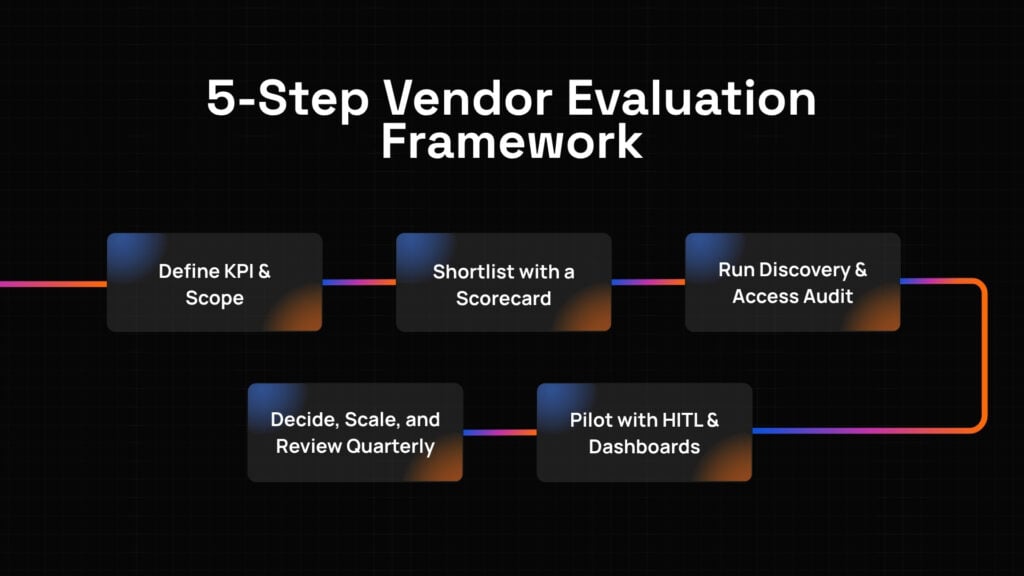
5-Step Framework for Launching AI Voice Agent
Implementing AI voice agent should follow a disciplined, structured process that aligns with your organization’s operational goals while accounting for both integration requirements and real-time performance needs. Instead of focusing solely on impressive voice demonstrations or agent feature promises, implementation should weigh how well the AI voice agent solution supports measurable outcomes, integrates with existing systems, and enables call handling value through appropriate design.
1. Define KPI & Scope
Start by identifying specific measurable outcomes with narrow scope that enables quick value proof. Remember to choose one call type avoiding cross-departmental complexity, as focused implementation proves voice agent value. Defining concrete targets helps align all stakeholders including contact center leadership, IT infrastructure, telephony teams, and governance functions. Your goal might be reducing average handle time by 20 percent, improving resolution rates, or decreasing handling costs, but it must be quantifiable with clear operational impact.
Example: A technology company defined its KPI as “reducing average handle time by 20 percent within 90 days while maintaining customer satisfaction above 4.0 out of 5.0 and achieving 25 percent self-service resolution rate.” This metric guided every voice agent discussion, shaped integration design with clear system requirements, and became the success measurement. They avoided multi-department rollouts maintaining focused deployment.
Pro Tip: Document one primary operational outcome before requesting proposals. Choose one call type like customer service triage or appointment scheduling to enable clear attribution, and define specific percentage improvement targets with timelines that enable objective go/no-go decisions during voice agent evaluation, as concrete goals prevent scope expansion from ambitious transformation attempts.
2. Shortlist Vendors with Scorecard
Once objectives are clear, move to structured vendor comparison emphasizing delivery capability over voice quality. Remember to focus on delivery, not voice demos, as execution ability determines success beyond impressive speech quality. This evaluation allows teams to quantify how well each AI voice assistant software supports successful implementations including asking how misclassification is handled to understand error management, production references, integration depth, and proven methodology.
Example: One enterprise prioritized vendors demonstrating voice agent expertise including focusing on delivery, not voice demos to assess capability beyond speech quality, asking how misclassification is handled to understand recovery procedures and intent refinement, reviewing integration architectures to evaluate connectivity, and demanding transcript access requiring actual conversation review validation not just voice quality demonstrations.
Pro Tip: Turn evaluation criteria into delivery validation so voice agent decisions remain defendable beyond impressive voice demonstrations. Focus on delivery, not voice demos, requiring proven track records with contact center references. Ask how misclassification is handled including detection, escalation, and continuous refinement procedures. Demand transcript access validating actual conversation quality and intent accuracy not just speech naturalness.
3. Discovery & Access Audit
Before contracts are signed, a structured discovery phase maps systems and permissions, documenting every integration touchpoint and voice agent requirement. During this phase, teams validate system connectivity, surface call flow dependencies, and confirm security capabilities with appropriate controls. Start with least privilege first to validate approach safely.
Example: A financial services company conducted discovery for AI voice agent, revealing that their systems required comprehensive mapping including CRM read-only for customer data with ticket creation enabled for issue logging demonstrating initial permission scoping, their telephony needed SIP trunk configuration for connectivity, their call flows required routing rules to support teams, their security needed permission controls before voice agent access, and their integration demanded thorough connectivity planning for successful deployment requiring preparation before implementation.
Pro Tip: Ensure the vendor provides voice agent architecture diagrams before proposals to validate approach. Map systems and permissions including CRM, ticketing platforms, telephony infrastructure, and business databases comprehensively. Use least privilege first starting with minimal access like CRM read-only with ticket creation enabled, as Accenture shows that proper permission scoping significantly reduces automation risk through controlled validation.
4. Pilot with HITL & Dashboards
A well-designed pilot validates both voice agent performance and business value under real operational conditions. Remember to launch safely with actual callers and real conversations. Instead of full deployment immediately, run with human review to maintain quality assurance while proving voice agent capability. Incorporating comprehensive measurement ensures that pilot demonstrates returns building investment confidence.
Example: A retail company piloted AI voice agent with comprehensive oversight, launching safely by reviewing first 100 calls to assess quality, intent accuracy, and caller satisfaction. They tracked cost per resolved call measuring unit economics demonstrating financial viability, achieving 18 percent handle time reduction approaching 20 percent target with positive caller feedback scores. Human oversight maintained quality during validation phase monitoring transcripts.
Pro Tip: Execute pilots reviewing first 100 calls validating quality through human oversight including transcript review, establishing clear success criteria including satisfaction benchmarks and intent accuracy targets, and tracking measurable KPIs weekly. Launch safely with real callers and actual conversations proving capability under operational conditions. Track cost per resolved call measuring unit economics. Test real-world conditions validating latency performance ensuring conversational flow as controlled testing builds confidence.
5. Decide, Scale, & Review Quarterly
After the pilot proves both operational value and positive caller feedback, use findings to guide the final decision about controlled expansion, validating sustainability. Remember to scale what works after validation demonstrates returns. Scaling should be deliberate, expanding to one new call flow after previous implementation demonstrates sustained value. Continuous quarterly reviews maintain voice agent discipline, ensuring automation continues delivering returns and intents remain accurate justifying operational expenses.
Example: A technology company conducted quarterly reviews with its AI voice agent partner, scaling what works after validation over 12 months. They expanded to one new call flow after value proof including adding appointment scheduling after customer service triage success, identified optimization opportunities improving handle time by additional 7 percent, and retired low-performing intents when call patterns changed eliminating classifications no longer relevant providing diminishing accuracy.
Pro Tip: Treat vendor reviews as voice agent governance sessions focused on value delivery and caller satisfaction, not just performance metrics. Scale what works expanding after validation demonstrates sustained returns and positive feedback. Expand to one new call flow proving capability before comprehensive deployment. Retire low-performing intents as call patterns change requiring ongoing assessment ensuring continued accuracy and value justifying expenses.
Next Steps in Your AI Voice Agent Evaluation
By now, you should have a clear understanding of what to prioritize when implementing AI voice agent. Bringing these insights together creates a structured evaluation flow that de-risks investment and accelerates value realization while ensuring integration quality and caller satisfaction.
- Align with operational metrics: Ensure that every voice agent component connects to specific KPIs like handle time, resolution rate, or handling costs tied to operational impact, not just voice quality that is disconnected from actual business outcomes and measurable efficiency results.
- Evaluate comprehensive design: Confirm that AI voice agent includes speech-to-text and text-to-speech processing audio, intent detection understanding purpose, business logic applying rules, system integrations connecting platforms, and escalation to humans routing complexity, as all five components must exist for complete call handling systems not IVR with better phrasing.
- Focus on system integration: Prioritize connectivity as integration determines capability beyond voice quality, requiring comprehensive integration accessing CRM, ticketing, and business data enabling contextual responses creating complete workflows not limited call navigation as Deloitte shows gaps causing stalls.
- Review latency performance: Test real-world conditions validating response speed as excessive delays create poor experience, requiring technical optimization ensuring conversational flow as natural interaction depends on real-time processing maintaining engagement preventing frustrating pauses.
- Test with real conditions: Always run pilots launching safely with actual callers and real conversations, frozen scope on specific call types enabling clear attribution, least privilege permissions validating safely, and comprehensive measurement before scaling to validate voice agent effectiveness, business value, and caller satisfaction under real-world conditions with actual complexity.
With these criteria in place, you are better equipped to identify AI voice agent solutions that not only handle calls but also create service systems, deliver measurable ROI, maintain integration quality, and amplify your team’s capacity to focus on complex customer issues that require human expertise that automated voice responses cannot capture.
Vendor Questions to Copy and Paste
To make the most informed decision during your AI voice agent evaluation, be sure to ask these essential questions:
- How does the voice agent handle uncertainty, including confidence thresholds, escalation procedures, and live transfer mechanisms that maintain quality when situations require human judgment?
- What latency should we expect in real calls, including speech processing delays, intent detection speed, and response generation time that determine conversational naturalness?
- How are calls logged and reviewed, including transcript storage, conversation tracking, and quality monitoring that enable ongoing improvement and compliance validation?
- Who owns call flows and prompts, ensuring operational independence at engagement end, including intellectual property rights and design control that prevent vendor lock-in?
- How do we exit without rework, enabling portability without starting over or losing call flow designs, intent configurations, and operational knowledge?
- Can you provide two customer references in similar industries who can discuss voice agent effectiveness, integration quality, caller satisfaction, and ongoing partnership quality?
- What integration effort is required, including telephony connectivity, system integration work, and permission configuration that represent true deployment complexity?
- How are intents managed, including classification updates, accuracy monitoring, and continuous refinement that ensure reliable purpose detection maintaining relevance?
- What happens during misclassification, including error detection, fallback procedures, and recovery mechanisms that maintain caller experience when understanding fails?
- How do you measure success, including KPI tracking, dashboard capabilities, and reporting infrastructure that enable ongoing value validation supporting continued investment?
Transform Operations with Strategic AI Voice Agent
AI voice agent is not voice technology alone; it is a strategic call handling system that requires careful integration design, comprehensive connectivity planning, and continuous intent refinement. The right approach brings 25-40 percent handling cost reductions through proper integration, 20-30 percent call resolution through systematic design, and maintained satisfaction through conversational interaction, while poor implementation creates frustrated callers and operational waste that undermine trust and investment.
Ready to transform your operations with strategic AI voice agent? Book a Free Strategy Call with us to explore the next steps and discover how we can help you design voice agents, plan integration, and deploy the right AI voice agent solution for your unique call handling environment, system architecture, caller expectations, and measurable outcome goals.