

AI voice agents are transforming how companies handle customer interactions. By automating routine calls and assisting live agents, these solutions save time, cut costs, and improve customer satisfaction. But finding the right AI voice agent for your business can feel overwhelming. This section breaks down why AI voice agents matter and the core challenges they solve.
Why AI Voice Agents Matter for Operations
For founders, COOs, and operations leaders, the promise of AI voice agents lies in their ability to streamline workflows that traditionally demand high human effort and cost.
- Reduce call center volume: AI voice assistants can handle common queries like order status, password resets, or appointment scheduling, freeing agents for complex tasks.
- Speed up response times: Instant AI responses shorten customer wait times and reduce frustration.
- Increase agent productivity: AI can assist live agents with real-time prompts, relevant information, and next-best actions during calls.
- Improve consistency: AI ensures standardized service quality across every interaction, reducing human error and variability.
A Forrester study found that companies deploying AI voice assistants reported up to a 25% reduction in average call handling times, driving notable operational efficiencies (forrester.com ).
Common Use Cases of AI Voice Agents
Understanding where AI voice agents add value helps pinpoint which solutions to consider.
- Customer Service Automation: Automate frequently asked questions, order tracking, or account management with AI voice agent software.
- Sales and Lead Qualification: Screen inbound leads, collect information, and route qualified prospects to human reps.
- Appointment Booking and Reminders: Reduce no-shows by automating appointment scheduling and reminders via voice calls.
- Technical Support Triage: Gather problem details and either resolve simple issues or escalate complex ones to specialists.
- Outbound Notifications and Surveys: Deliver personalized voice messages for promotions, alerts, or customer feedback.
Each use case benefits differently from AI voice agents, so clarity on your primary goals helps narrow vendor options.
Key Metrics to Track AI Voice Agent Success
Choosing an AI voice agent means committing to measurable outcomes. Here are critical metrics to monitor:
- Average Handle Time (AHT): How much time the AI saves per call. Shorter times can mean cost savings and quicker service.
- Containment Rate: Percentage of calls fully handled by AI without needing escalation. Higher rates indicate effective automation.
- First Call Resolution (FCR): Percent of issues resolved in the initial call, whether by AI alone or combined with live agents.
- Customer Satisfaction (CSAT): Customer feedback scores specific to AI interactions help evaluate service quality.
- Escalation Rate: How often AI passes calls to human agents. This reveals AI’s limitations and informs training needs.
Example: An insurance company using AI call center automation saw a 20% increase in FCR and 15% improvement in CSAT within six months (gartner.com).
AI Voice Agent Handoff Patterns: When and How to Escalate
Effective AI voice agents know when to transfer a caller to a human agent. Poor handoff experiences cause frustration and negate AI’s benefits.
- Confidence Threshold: AI triggers handoff if it’s uncertain about the caller’s intent or solution.
- Call Complexity: For multi-issue or sensitive calls, AI escalates early to avoid errors.
- Customer Request: If the caller asks for a human agent, AI should comply immediately.
- Duration Limits: Long calls exceeding AI’s scope are passed to agents proactively.
- Real-time Agent Assist: Some systems allow agents to join calls before full handoff, ensuring smoother transitions.
Good handoff patterns combine technology with human empathy, maintaining caller trust and satisfaction.
Why Vendor-Neutral Evaluation Matters
With many vendors offering AI voice agent solutions, it’s tempting to choose based on demos or sales pitches. Instead, take a vendor-neutral approach focused on your specific operational needs and KPIs.
Avoid vendor hype by focusing on:
- Real-world use cases and proven results.
- Integration capabilities with your existing tech stack.
- Security and compliance fit for your industry.
- Flexibility in escalation and agent collaboration.
- Transparent pricing and ownership terms.
This approach ensures the AI voice assistant software you select is a tool that genuinely fits your workflows and drives value.
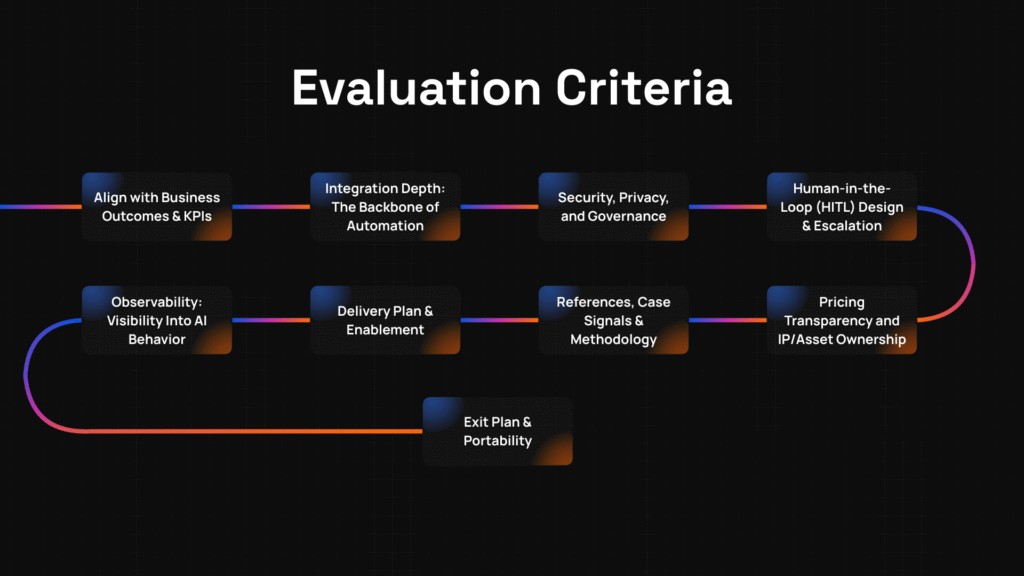
Evaluation Criteria for Choosing AI Voice Agents
Picking the right AI voice agent isn’t just about features, it’s about fit. The best solutions align tightly with your business goals, integrate smoothly into your tech stack, and offer transparent governance. Here’s a vendor-neutral checklist to guide your evaluation.
1. Align with Business Outcomes & KPIs
Your AI voice agent should be a tool for achieving measurable improvements, not just a shiny new toy.
- Define clear KPIs upfront whether it’s reducing average handle time, boosting containment rate, or increasing customer satisfaction.
- Look for vendors who demonstrate case studies or references with outcomes matching your goals.
- Ensure the solution can report on these metrics with transparency and frequency that suits your operational cadence.
Pro tip: KPIs should be tracked in real time or near real time to enable quick adjustments.
2. Integration Depth: The Backbone of Automation
AI voice agents live in complex environments. Seamless integration is critical.
- Check if the AI voice agent supports read/write access to core systems like your CRM, help desk, phone system, ticketing system (TMS), or ERP.
- Confirm event-driven triggers and data syncing happen bi-directionally. For example, if the AI updates a ticket, your CRM should reflect it instantly.
- Evaluate whether the vendor’s platform supports open APIs or standard integration protocols to avoid lock-in.
Example: A customer service leader told us that poor CRM integration was the single biggest barrier to scaling their AI voice assistant software.
3. Security, Privacy, and Governance
Handling customer data via voice raises serious privacy and compliance concerns.
- Verify that the vendor meets industry-specific standards like GDPR, HIPAA, or PCI DSS depending on your sector.
- Confirm data encryption both in transit and at rest, with strong access controls.
- Look for audit logs and governance tools to monitor AI decisions and handoffs.
- Assess how the vendor handles data retention, deletion, and customer opt-out requests.
A recent IBM report showed 78% of organizations see data security as their top barrier to AI adoption (ibm.com/security).
4. Human-in-the-Loop (HITL) Design & Escalation
AI voice agents aren’t set-it-and-forget-it. The best systems combine automation with smart human intervention.
- Confirm that escalation to live agents is seamless and respects caller preferences.
- Check if the AI provides agents with contextual insights and suggested next actions during handoffs.
- Evaluate whether your team can intervene mid-call to take over or assist.
- Ensure the system supports ongoing human review and training of AI models to improve accuracy.
Pro tip: Look for “real-time assist” features to reduce agent ramp-up time during escalations.
5. Observability: Visibility Into AI Behavior
Operational control demands observability into AI decisions.
- Seek dashboards showing call volumes, escalation rates, containment, and error patterns.
- Ensure the platform offers call transcripts and evaluation sets for post-call analysis.
- Look for tools to trace AI decision paths and roll back problematic models or scripts.
- Verify that performance data can export to your existing analytics tools.
Clear observability helps your team spot issues before customers do and continuously refine AI performance.
6. Delivery Plan & Enablement
Rolling out AI voice agents requires more than tech; it demands clear training and support.
- Ask about vendor-provided playbooks covering deployment, troubleshooting, and scaling.
- Confirm availability of training sessions or resources for your ops and support teams.
- Check for knowledge transfer and documentation, so your team owns day-to-day management post-launch.
- Assess vendor responsiveness and ongoing support models.
Example: Teams that invest in enablement reduce support tickets by 30% within the first three months post-deployment.
7. References, Case Signals & Methodology
Solid vendors openly share references and validation methods.
- Request customer references relevant to your industry and use cases.
- Inquire about methodologies for testing AI accuracy, bias mitigation, and continuous improvement.
- Look for third-party certifications or benchmarks when available.
References can reveal real-world strengths and limitations beyond glossy demos.
8. Pricing Transparency and IP/Asset Ownership
Understanding cost and ownership upfront avoids surprises later.
- Expect vendors to provide transparent pricing ranges with clear assumptions.
- Clarify who owns conversational data, custom prompts, training datasets, and any AI-generated IP.
- Ask about exit plans if you decide to switch vendors, can you export your data, models, or scripts?
Transparent terms build trust and facilitate long-term partnerships.
9. Exit Plan & Portability
AI voice agents are strategic investments. Your future options matter.
- Confirm portability of assets like prompt libraries, evaluation sets, and policy documentation.
- Check for vendor support in migrating workflows or scaling beyond initial pilots.
- Verify contractual terms around data deletion and transition assistance.
An exit plan is not just about leaving; it’s about retaining operational control and flexibility.
Common Pitfalls to Avoid When Choosing AI Voice Agents
Even seasoned operators stumble on common traps when adopting AI voice agents. Knowing these upfront can save headaches down the line.
- Overpromising ROI → Set realistic expectations
AI voice agents can improve efficiency, but immediate, dramatic ROI is rare. Start with achievable KPIs and scale gradually. - Ignoring integration complexity → Map your tech stack early
Don’t assume plug-and-play. Confirm all integrations before signing on, especially CRM, phone, and help desk systems. - Neglecting human-in-the-loop design → Plan escalation workflows
AI isn’t perfect. Ensure live agent handoffs are smooth and your team can intervene anytime. - Overlooking governance → Prioritize data privacy and auditability
Customer trust hinges on compliance. Don’t skip security reviews or forget audit trails. - Skipping observability → Demand transparency
Without visibility into AI decisions, you risk hidden failures. Require dashboards and traceability. - Failing to prepare teams → Invest in training and playbooks
Automation affects workflows. Provide training to ease adoption and empower your team. - Accepting opaque pricing → Insist on transparency
Hidden fees or unclear IP terms can cost more later. Clarify everything upfront. - No exit plan → Secure portability and data ownership
Always ask how you’d switch vendors if needed. Own your data and assets.
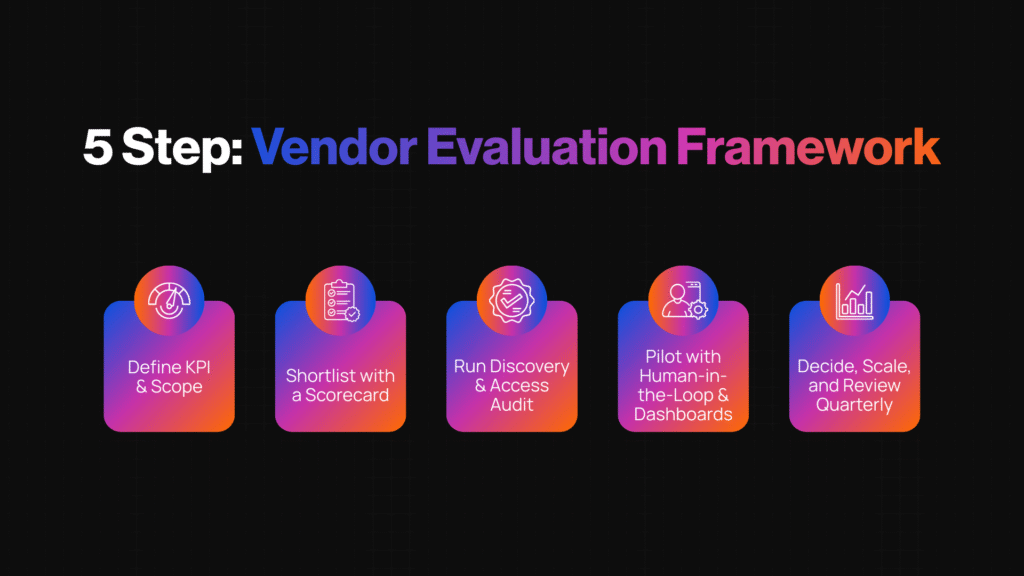
A Five-Step Vendor Evaluation Framework
Breaking down your vendor selection into clear steps makes the process manageable and less risky.
Step 1: Define KPI & Scope
- Example: Reduce average call handle time by 20% within 6 months.
- Pro tip: Involve key stakeholders early to align goals.
Step 2: Shortlist with a Scorecard
- Build a scorecard based on evaluation criteria from Section 2.
- Rate vendors objectively on integration, security, HITL, and observability.
- Pro tip: Use a weighted scoring system reflecting your priorities.
Step 3: Run Discovery & Access Audit
- Engage vendors with detailed discovery calls.
- Audit their integration capabilities with your current stack.
- Ask for security certifications and compliance documentation.
Step 4: Pilot with HITL & Dashboards
- Run a pilot focused on human-in-the-loop workflows.
- Use dashboards to monitor KPIs and AI behavior in real time.
- Collect qualitative feedback from agents and customers.
Step 5: Decide, Scale, and Review Quarterly
- Based on pilot data, decide to scale or reassess.
- Establish quarterly reviews to adjust KPIs and workflows.
- Keep communication open with your vendor for continuous improvement.
Vendor Questions to Ask
When talking with AI voice agent vendors, keep these questions handy:
- How do you align your solution with our specific KPIs?
- What integrations does your AI voice agent support out of the box?
- Can you describe your data security and privacy policies?
- How does human-in-the-loop escalation work in your system?
- What observability tools do you provide for AI decision tracking?
- What training and enablement resources do you offer?
- Can you provide references from similar industries or use cases?
- How transparent is your pricing model, and what assumptions underlie it?
- What happens to our data and models if we decide to switch vendors?
- What is your typical delivery timeline and post-launch support?
Quick Templates You Can Use
RFP Email Template:
Subject: Inquiry on AI Voice Agent Solution for [Company Name]
Hi [Vendor Name],
We are exploring AI voice agent solutions to improve our customer service operations. Could you please provide information on your product’s integration capabilities, security compliance, human-in-the-loop design, and pricing transparency?
We are particularly interested in references from similar use cases and your approach to data portability.
Looking forward to your response.
Best,
[Your Name]
[Your Role]
[Company]
Scorecard Rubric Template:
| Criteria | Weight | Vendor A | Vendor B | Vendor C |
| KPI Alignment | 25% | |||
| Integration Depth | 20% | |||
| Security & Privacy | 15% | |||
| Human-in-the-Loop Design | 15% | |||
| Observability | 10% | |||
| Enablement & Support | 10% | |||
| Pricing Transparency | 5% |
Final Thoughts
Selecting the right AI voice agent is a strategic move that can transform customer interactions and operational efficiency. The key is a methodical approach align KPIs, insist on strong integrations and governance, and keep humans in the loop.
Taking the time upfront to vet vendors with clear criteria and a structured framework reduces risk and sets you up for success.
If you’re considering AI voice agent automation, booking a free strategy call can help you clarify your goals and readiness. Let’s talk through your options and next steps.