

The Power of AI Process Automation: Why It Matters
AI process automation has emerged as a defining capability for organizations seeking to transform written procedures into intelligent, executable workflows. Companies implementing intelligent process automation are not simply digitizing manual tasks; they are fundamentally reimagining how standard operating procedures translate into scalable, observable, and auditable systems. Automated workflows now execute complex multi-step processes that once required extensive coordination, enabling teams to focus on exception handling, strategic improvements, and high-value activities that require human creativity and judgment.
The evidence supporting this operational transformation continues to strengthen across industries. According to McKinsey’s 2024 State of AI Report, 65 percent of firms report regular generative AI use, reflecting widespread adoption of intelligent automation. IBM’s 2024 CEO Study found that chief executives increasingly link AI leadership to competitive advantage, emphasizing the strategic importance of scaling automation with governance rather than hype. Forrester Total Economic Impact analyses consistently demonstrate that observability-aligned automation programs see significant MTTR and downtime reductions when properly implemented. These AI automation benefits demonstrate more than tactical efficiency gains; they represent a fundamental shift in how organizations execute processes, maintain compliance, and scale operations without proportional increases in operational overhead.
Why AI Process Automation Matters for Businesses
AI process automation goes beyond simple task digitization; it transforms how organizations execute standard operating procedures, maintain consistency, and scale operations. Manual workflows that once required extensive coordination and oversight can now be executed with intelligence and precision through process automation. From customer intake and vendor onboarding to finance reconciliation and compliance checks, AI automation use cases deliver measurable outcomes that strengthen both operational efficiency and audit readiness across all business functions.
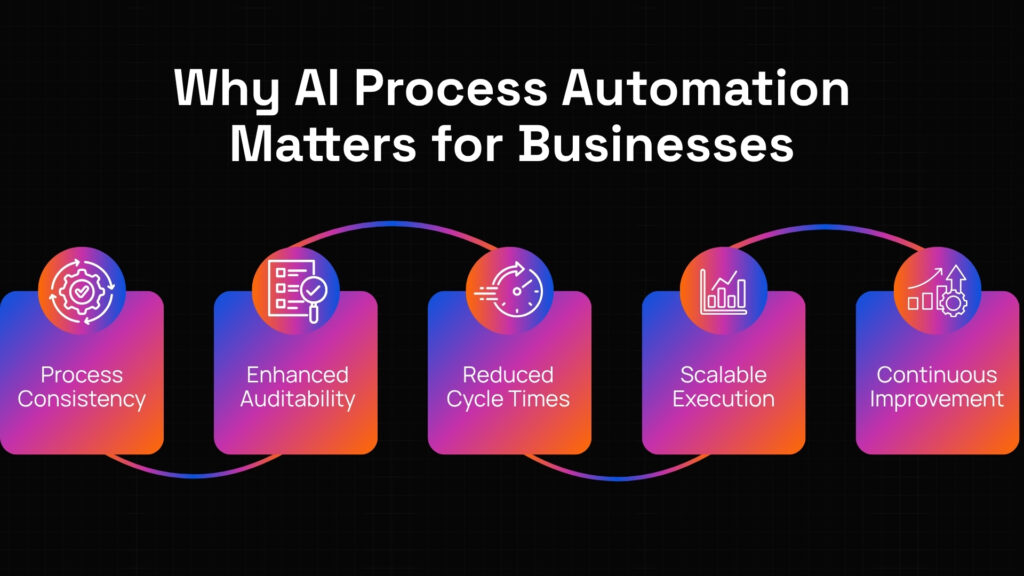
For business leaders evaluating automation strategies, the AI automation benefits manifest in five critical ways:
- Process Consistency: Process automation ensures every workflow step executes according to defined standards, eliminating the variability that comes from manual interpretation, training gaps, or human fatigue.
- Enhanced Auditability: Intelligent systems create comprehensive audit trails with decision logs, confidence scores, and versioned policies, providing complete visibility into how processes execute and why decisions were made.
- Reduced Cycle Times: AI process automation eliminates manual handoffs and delays, accelerating workflows from days to hours or minutes while maintaining quality and compliance standards.
- Scalable Execution: Unlike manual processes, process automation scales instantly to handle volume increases during peak periods, organizational growth, or market expansion without proportional staffing increases.
- Continuous Improvement: Automated workflows capture exception patterns and outcome data, enabling teams to refine processes systematically based on evidence rather than anecdotal feedback or periodic reviews.
Understanding AI process automation is not about eliminating human judgment; it’s about codifying institutional knowledge, ensuring consistent execution, and freeing professionals to focus on complex cases that require contextual understanding and strategic decision-making.
Key Considerations When Choosing AI Automation Services
Selecting the right partner for AI process automation requires careful alignment between vendor capabilities and your organization’s process maturity and operational requirements. The most successful process automation projects are built on a foundation of transparency, deep system integration, and measurable impact on critical KPIs like cycle time, error rates, and SLA adherence.
Below are the core factors that should guide every process automation decision:
- Business Outcomes & KPI Alignment: Every AI process automation initiative must connect directly to tangible operational metrics, whether that’s reducing cycle time, improving SLA hit rates, lowering error rates, or increasing deflection rates. Vendors should demonstrate a clear methodology for linking their solutions to your specific process KPIs, not generic efficiency benchmarks.
- Integration with Existing Systems: Effective process automation depends on seamless connectivity with your CRM, ITSM, ERP, data warehouses, and communication platforms. The ideal partner ensures smooth bidirectional data flow and event streaming so automated workflows have complete context and can update systems without manual intervention or data synchronization delays.
- Security and Compliance: AI process automation handles sensitive operational data including customer information, financial records, and access credentials. Confirm that vendors maintain strict adherence to frameworks like ISO 27001, SOC 2, GDPR, or industry-specific requirements, with encryption in transit and at rest, role-based access controls, and comprehensive audit logs.
- Human-in-the-Loop (HITL) Flexibility: Successful AI automation use cases always include human oversight mechanisms for high-risk or low-confidence decisions. Ensure that workflows incorporate built-in escalation pathways, approval gates, and feedback capture mechanisms that allow subject matter experts to review exceptions and teach the system.
- Observability and Analytics: Transparency is essential when scaling process automation across departments. A capable vendor provides dashboards that surface automation accuracy, decision confidence scores, execution traces, and version history in real time, allowing teams to identify issues, roll back changes, and maintain quality standards continuously.
- Pricing Transparency and Flexibility: Insist on clear, predictable pricing models that scale logically with process volumes, system integrations, and user seats. The right AI process automation solution grows with your organization without unexpected fees for additional workflows, connectors, or expanded scope.
Choosing process automation partners with these capabilities ensures your investment delivers sustainable operational improvements rather than creating technical debt or vendor dependency.
The Impact of Integration Readiness
Before launching any AI process automation initiative, organizations must thoroughly assess their system landscape and data accessibility. Integration readiness is the process of evaluating how well existing systems, API documentation, and data structures can support intelligent workflows without creating context gaps or execution failures. Skipping this assessment leads to incomplete process context, inaccessible data sources, and automated workflows that lack the intelligence needed for accurate decision-making. When teams conduct integration audits in advance, they uncover API limitations early, align IT and operations stakeholders around data governance, and minimize wasted time during vendor discovery. This preparation is especially critical when implementing process automation across multiple systems or business units.
Example: A healthcare organization preparing for AI process automation discovered inconsistent patient identifier formats and missing API documentation across six legacy systems. Addressing these issues before vendor engagement reduced the overall project timeline by seven weeks and improved workflow accuracy by 42 percent during the pilot phase.
Pro Tip: Create an internal integration readiness checklist that evaluates API completeness, assesses data quality across source systems, confirms authentication methods, and documents approval workflow requirements. Share this assessment with process automation vendors during initial conversations to ensure proposals address your actual technical environment and operational constraints.
Common Pitfalls in AI Process Automation
AI process automation promises consistency and efficiency, but poor planning and ambiguous processes can create new AI automation challenges instead of solving operational problems. Many organizations make avoidable mistakes during implementation that delay value realization and erode stakeholder confidence. To discover proven methodologies tailored for your organization’s unique workflows and compliance requirements, explore our AI Workflow Automation Services page for detailed process automation frameworks and implementation best practices.
- Starting with Ambiguous SOPs: Some organizations attempt AI process automation before clearly documenting decision criteria, data sources, and exception handling rules. Always force processes into explicit checklists with defined owners and escalation paths before attempting automation.
- Underestimating Change Management: A technically sound process automation rollout can still fail if process owners and end users are not prepared or resistant to automated workflows. Introduce training, pilot demonstrations, and feedback sessions early so teams build confidence in automated decisions.
- Neglecting Quality Monitoring: Successful AI automation use cases require continuous evaluation against test sets with weekly pass/fail gates. Without systematic quality monitoring, process automation drifts over time as data patterns shift or business rules evolve.
- Choosing Tools Before Mapping Processes: Many teams evaluate AI process automation vendors before thoroughly documenting current workflows, decision points, and exception patterns. Always map processes end-to-end with explicit decision criteria before requesting vendor proposals.
- Ignoring Escalation Design: Full automation may sound efficient, but some process steps always require human judgment, especially those involving financial approvals, customer relationships, or regulatory compliance. Look for solutions that integrate approval workflows and feedback capture seamlessly.
- Accepting “Happy Path” Demos Only: Vendors demonstrating process automation often showcase ideal scenarios with complete data and straightforward logic. Demand to see how solutions handle malformed inputs, multi-intent requests, and partial data that occur in real-world operations.
Evaluating the ROI of AI Process Automation
Quantifying the AI automation benefits helps secure executive buy-in and refine future investments. Measuring ROI goes beyond simple time savings; it captures gains in consistency, auditability, scalability, and strategic capacity. Without clear metrics during evaluation, process automation risks becoming a feature-heavy project with unclear business outcomes.
Key metrics to monitor include:
- Cycle Time Reduction: Track average process completion time before and after implementing process automation to calculate efficiency gains and capacity creation across teams.
- Error Rate Improvement: Measure the decrease in process errors, rework incidents, or compliance violations following deployment to evaluate quality improvements and risk reduction.
- SLA Adherence: Compare service level agreement hit rates before and after AI process automation to assess reliability improvements and customer impact.
- Manual Effort Saved: Evaluate the reduction in manual minutes per process instance to determine labor savings and resource reallocation potential.
- Exception Rate: Assess what percentage of process instances complete without human intervention to measure automation coverage and maturity over time.
- Audit Readiness: Review the time and effort required to prepare for audits before and after process automation to quantify compliance efficiency improvements.
According to Forrester Total Economic Impact analyses, organizations implementing observability-aligned automation programs achieve significant reductions in operational overhead and incident response times. IBM’s CEO Study emphasizes that successful organizations scale AI with governance frameworks rather than pursuing automation for its own sake. Beyond quantitative metrics, AI process automation also delivers transparency and predictability, two pillars of operational excellence. When every process step is logged, every decision is traceable, and every exception is captured, organizations build audit-ready operations that scale without increasing compliance risk.
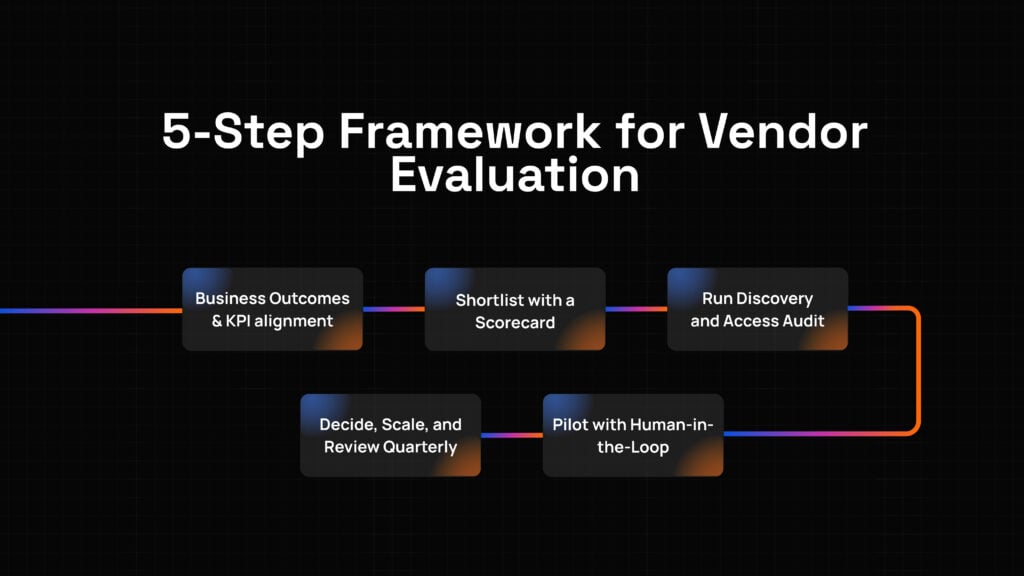
5-Step Framework for Vendor Evaluation
Selecting an AI process automation vendor should follow a disciplined, structured process that aligns with your organization’s operational goals while accounting for both technological depth and long-term partnership potential. Instead of focusing solely on price or surface-level features, evaluation should weigh how well the vendor’s solution supports process excellence, integrates with existing systems, and adapts to evolving business requirements.
1. Business Outcomes & KPI Alignment
Start by clearly outlining what success looks like and how it will be measured in operational terms. Defining specific KPIs and project scope early helps align all stakeholders including operations leadership, process owners, and IT, ensuring that expectations are realistic and trackable. Your goals might include reducing cycle time, improving SLA adherence, lowering error rates, or increasing process throughput, but they must be tied to measurable outcomes. This clarity becomes the foundation for every subsequent decision about process automation, shaping both vendor conversations and internal buy-in. Without defined KPIs, teams often drift toward evaluating features instead of focusing on the business value those features deliver.
Example: A financial services operations team defined its KPI as “reducing billing email first-response time by 50 percent in one region within three months.” This metric guided every vendor discussion and became the benchmark for pilot success.
Pro Tip: Document 3 to 5 measurable process outcomes before requesting proposals. It keeps evaluation grounded in impact rather than feature lists, and helps vendors tailor demonstrations to your actual operational challenges.
2. Shortlist with a Scorecard
Once objectives are clear, move to structured vendor comparison using a weighted scorecard for evaluating AI process automation solutions. This tool allows teams to quantify how well each vendor aligns with their priorities from system integration and rollback capabilities to observability and portability. By assigning weights to each factor, decision-makers can balance technical capability with operational relevance. A disciplined scorecard approach removes subjectivity and ensures that even non-technical stakeholders understand trade-offs when selecting process automation platforms. It also simplifies executive approvals by providing a transparent rationale for every shortlisting decision.
Example: One enterprise assigned 35 percent weight to integration depth across CRM, ITSM, and ERP systems, and 25 percent to human-in-the-loop design, which helped eliminate vendors lacking robust approval workflows early.
Pro Tip: Keep the scorecard fully quantitative to ensure fairness in evaluation. Rate each criterion on a defined scale (1 to 5 or 1 to 10) so decisions are driven by data, not personal bias or vendor presentation style.
3. Run Discovery and Access Audit
Before contracts are signed, a structured discovery phase ensures that all technical and operational details are surfaced early when implementing process automation. During this phase, vendors should gain a thorough understanding of your system architecture, data sources, authentication protocols, and existing process documentation. It’s the stage where assumptions about AI automation use cases get tested and integration complexity becomes visible. Running an access audit alongside discovery verifies API scopes, data access permissions, and least-privilege requirements, preventing security gaps and costly change orders later. Transparency here not only minimizes risk but also builds trust between vendor and operations teams.
Example: A healthcare operations organization invited shortlisted AI process automation vendors for a one-week sandbox assessment, exposing missing API documentation and authentication scope limitations before signing contracts.
Pro Tip: Ask vendors to deliver a brief “readiness summary” at the end of discovery that identifies technical blockers, data quality issues, and timeline estimates. This document becomes a reference for project planning and helps teams understand realistic implementation paths.
4. Pilot with Human-in-the-Loop (HITL) and Dashboards
A well-designed pilot validates both performance and safety under real-world operational conditions when exploring process automation. Instead of full-scale deployment, focus on a limited, high-impact workflow to test accuracy, reliability, and user adoption. Incorporating human-in-the-loop (HITL) approval gates ensures that AI process automation outcomes align with compliance requirements and operational policies, while dashboards provide quantifiable visibility into cycle times, accuracy rates, and exception volumes. This phase is critical for identifying edge cases and ensuring that automation works across process variations, data quality issues, and system integrations, not just in controlled test scenarios.
Example: A logistics company piloting vendor onboarding automation for one supplier category achieved a 48 percent reduction in cycle time within 30 days, with 94 percent field extraction accuracy and 4.3 out of 5 process owner satisfaction scores.
Pro Tip: Use pilots to gather process owner and end-user feedback through surveys and retrospectives. Early adoption feedback often surfaces workflow gaps, escalation issues, or training needs that technical audits miss.
5. Decide, Scale, and Review Quarterly
After the pilot proves value, use its findings to guide the final decision and create a phased rollout plan for AI process automation. Scaling should be deliberate, expanding only after processes are refined and user adoption is stable. Continuous quarterly reviews between your operations team and the vendor maintain alignment, ensuring the technology evolves alongside business priorities, regulatory changes, and system upgrades. These sessions are not just for troubleshooting; they’re opportunities to assess ROI, plan expansions to adjacent workflows, and refine policies and escalation rules. Ongoing collaboration transforms the vendor relationship into a true strategic partnership that continuously drives operational excellence.
Example: A healthcare organization conducted quarterly check-ins with its process automation vendor, identifying policy optimization opportunities that reduced exception rates by 22 percent over the first year.
Pro Tip: Treat vendor reviews as strategic sessions focused on expanding capabilities and addressing AI automation challenges, not just maintenance calls. Shared metrics, improvement targets, and policy refinement plans foster long-term partnership accountability.
Next Steps in Your Evaluation Process
By now, you should have a clear understanding of what to prioritize when selecting an AI process automation partner. Bringing these insights together creates a structured evaluation flow that de-risks investment and accelerates deployment while ensuring long-term operational excellence.
- Align with process goals: Ensure every feature and function supports specific operational KPIs and measurable outcomes, not just generic automation capabilities.
- Evaluate system integrations: Confirm that solutions work smoothly with your CRM, ITSM, ERP, and data platforms without requiring extensive custom development or middleware.
- Focus on security and governance: Choose vendors with documented SOC 2, ISO 27001 frameworks, verifiable audit trails, and robust approval workflow capabilities.
- Review support and enablement: Favor partners who provide continuous training for process owners, workflow development assistance, and optimization support, not one-time onboarding.
- Test with a pilot: Always run a controlled pilot before full deployment to validate automation accuracy, safety, and user adoption under real-world operational conditions.
With these criteria in place, you are better equipped to identify process automation vendors who not only automate workflows but also improve process consistency, reduce cycle times, and amplify your team’s capacity to scale operations efficiently.
Vendor Questions to Ask
To make the most informed decision during your AI process automation evaluation, be sure to ask these essential questions:
- How does your solution link outcomes to measurable process KPIs like cycle time, SLA adherence, and error rates?
- Which native integrations are supported out of the box for CRM, ITSM, ERP, and data platforms, and what is the typical timeline for custom connectors?
- What security certifications and audit results can you provide, and how do you handle data governance and access control?
- How do you handle low-confidence decisions or high-risk process steps, and what triggers human approval gates?
- What is your average implementation timeline from contract signing to production deployment for process automation projects?
- How do you structure post-implementation support for operations teams expanding automation capabilities and addressing AI automation challenges?
- Are all automation assets, workflows, policies, and evaluation sets fully exportable if we move providers or bring capabilities in-house?
Transform Processes with AI Process Automation
AI process automation is not just a technological investment; it’s an operational excellence strategy that requires careful planning, vendor selection, and continuous optimization. The right implementation brings consistency, auditability, and scalability across your operations, while poor execution creates technical debt and process fragmentation.
Ready to transform your standard operating procedures with AI process automation? Book a Free Strategy Call with us to explore the next steps and discover how we can help you select, pilot, and scale the right solution for your unique operational requirements and compliance needs.