

The Power of AI Process Automation KPIs: Why They Matter
Understanding and tracking AI process automation KPIs has become essential for organizations seeking to prove value and scale intelligent workflows beyond initial pilots. Companies that establish clear measurement frameworks are not simply monitoring performance; they are fundamentally transforming how business cases get built, investments get justified, and automation programs get expanded. Well-defined metrics now separate successful enterprise deployments from stalled experiments, enabling leaders to demonstrate tangible business impact through speed, cost, quality, and satisfaction improvements that matter to executives and stakeholders.
The evidence supporting measurement-driven automation continues to strengthen across industries. According to McKinsey’s 2024 State of AI Report, 65 percent of organizations reported regular use of generative AI in 2024, nearly double from 2023, with leaders consistently measuring and moving while laggards struggle with unclear success criteria. Deloitte research indicates that ROI leaders pair quick-win use cases with disciplined enablement and KPI taxonomies, with 20 percent reporting greater than 30 percent ROI on advanced initiatives. These AI automation benefits demonstrate more than theoretical potential; they represent measurable business outcomes that result from systematic tracking of the right metrics at the right time.
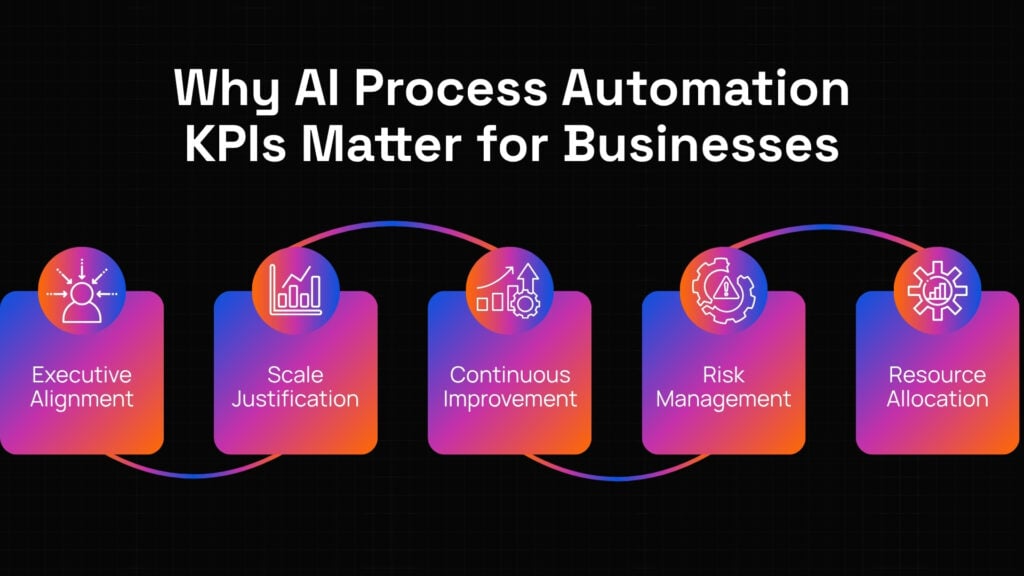
Why AI Process Automation KPIs Matter for Businesses
Tracking AI process automation KPIs goes beyond simple performance monitoring; it transforms how organizations justify investments, scale successes, and maintain stakeholder confidence. Metrics that matter connect directly to financial outcomes, operational efficiency, and customer experience rather than technical vanity metrics. From cycle time reduction and deflection rates to accuracy improvements and cost savings, the right AI automation examples deliver measurable proof points that strengthen business cases and secure funding for expanded deployments across departments and workflows.
For business leaders evaluating automation success, the importance of proper KPIs manifests in five critical ways:
- Executive Alignment: Clear AI process automation KPIs tie automation outcomes to business objectives that executives understand and value, such as cost reduction, revenue acceleration, and customer satisfaction improvements.
- Scale Justification: Measurable AI automation benefits provide the evidence needed to expand from pilot to production, demonstrating that automation delivers consistent value across volumes, geographies, and teams.
- Continuous Improvement: Systematic tracking of automation metrics enables teams to identify drift, optimize workflows, and refine processes based on data rather than intuition or anecdotal feedback.
- Risk Management: Monitoring accuracy, compliance, and exception rates ensures automation maintains quality standards and regulatory requirements as it scales across sensitive workflows.
- Resource Allocation: Quantified AI automation use cases help leadership prioritize which processes to automate next based on demonstrated ROI rather than subjective assessments or vendor promises.
Understanding which AI process automation KPIs to track is not about creating dashboards for their own sake; it’s about building measurement frameworks that prove value, guide decisions, and enable systematic scaling of intelligent workflows across the enterprise.
Key Considerations When Choosing AI Automation Services
Selecting the right partner for implementing measurable automation requires careful alignment between vendor capabilities and your organization’s KPI requirements. The most successful deployments are built on a foundation of transparency, real-time instrumentation, and clear connections between technical metrics and business outcomes that matter to stakeholders and executives.
Below are the core factors that should guide every automation decision when KPIs matter:
- Business Outcomes & KPI Alignment: Every AI process automation initiative must connect directly to tangible business metrics rather than technical vanity measures. Vendors should demonstrate a clear methodology for instrumenting cycle time, deflection rates, accuracy, and cost per transaction from day one, not promising measurement capabilities that arrive months later.
- Integration with Existing Systems: Effective KPI tracking depends on seamless connectivity with your systems of record where event timestamps, completion data, and quality signals originate. The ideal partner ensures smooth data flow from CRM, ITSM, ERP, and operational platforms so AI process automation KPIs can be computed automatically without manual reporting overhead.
- Security and Compliance: Measuring AI automation benefits requires access to operational data including process outcomes, decision logs, and audit trails. Confirm that vendors maintain strict adherence to frameworks like ISO 27001, SOC 2, and GDPR while providing the observability needed for comprehensive KPI tracking and compliance reporting.
- Human-in-the-Loop (HITL) Flexibility: Successful AI automation examples include escalation metrics that track when and why automation defers to humans. Ensure that workflows instrument confidence thresholds, approval rates, and override frequencies so teams can measure human-AI collaboration effectiveness systematically.
- Observability and Analytics: Transparency is essential for tracking AI process automation KPIs at scale. A capable vendor provides dashboards that surface cycle times, deflection rates, accuracy scores, and cost metrics in real time, with drill-down capabilities that allow teams to understand performance variations across segments, channels, or time periods.
- Pricing Transparency and Flexibility: Insist on clear, predictable pricing models that scale logically with usage so cost-per-transaction calculations remain accurate and reliable. The right partner enables you to track AI automation benefits financially without unexpected fees that distort ROI calculations and business case justifications.
Choosing partners who excel in these areas ensures your automation investment delivers measurable, provable value rather than creating reporting overhead or measurement gaps that undermine stakeholder confidence.
The Impact of Integration Readiness
Before launching any measurement-focused automation initiative, organizations must thoroughly assess their data infrastructure and event instrumentation capabilities. Integration readiness is the process of evaluating how well existing systems capture timestamps, completion events, and quality signals needed to compute AI process automation KPIs accurately. Skipping this assessment leads to incomplete data, manual reporting overhead, and business cases built on estimates rather than system-generated facts. When teams conduct instrumentation audits in advance, they uncover data gaps early, align IT and business stakeholders around measurement requirements, and minimize wasted effort building custom reporting layers during vendor implementation. This preparation is especially critical when proving AI automation benefits to executives who require auditable, system-generated metrics rather than subjective assessments.
Example: A financial services operations team preparing to track AI process automation KPIs discovered that their ticketing system lacked completion timestamps and their CRM did not capture first-response events. Addressing these instrumentation gaps before vendor engagement reduced manual reporting overhead by 75 percent and improved KPI reliability throughout the pilot phase.
Pro Tip: Create an internal instrumentation readiness checklist that evaluates which systems capture event timestamps, assesses data quality for completion signals, confirms API access to operational metrics, and documents baseline measurement periods. Share this assessment with vendors during initial conversations to ensure proposals address your actual measurement capabilities and reporting requirements.
Common Pitfalls in AI Process Automation KPIs
Tracking AI process automation KPIs promises clarity and accountability, but poor metric selection and inadequate instrumentation can create misleading narratives instead of actionable insights. Many organizations make avoidable mistakes during measurement design that undermine business cases and erode executive confidence. To discover proven methodologies for selecting and instrumenting the right metrics, explore our AI Workflow Automation Services page for detailed KPI frameworks and AI automation examples with measurement strategies.
- Measuring Model Scores Instead of Business Outcomes: Some organizations track technical metrics like confidence scores or accuracy rates without connecting them to business KPIs executives care about. Always start with cycle time, cost, quality, and satisfaction metrics, using model metrics only as supporting detail for troubleshooting.
- Lacking Baseline Measurements: A successful pilot requires comparing automation performance against pre-automation baselines. Freeze a 2 to 4 week baseline period before any changes to establish credible before-and-after comparisons that prove AI automation benefits convincingly.
- Accepting “Happy Path” Metrics Only: Vendors demonstrating AI process automation often showcase metrics from ideal scenarios with clean data and straightforward cases. Demand to see how performance metrics change with malformed inputs, multi-intent requests, and edge cases that occur in production environments.
- Ignoring Adoption Metrics: Technical performance means nothing if users resist or circumvent automation. Track user opt-in rates, assisted action acceptance, edit frequencies, and override patterns to measure whether automation actually gets used as intended.
- Overfitting to Pilot Conditions: A pilot that performs well in one month or region may fail when conditions change. Validate AI automation use cases on holdout data from different time periods, geographies, or customer segments before declaring success.
- Creating Opaque Measurement Systems: Executives and auditors require transparency into how metrics get calculated. Ensure that AI process automation KPIs come from system-generated events with decision logs, confidence scores, and version history that support audit requirements and troubleshooting.
Evaluating the ROI of AI Process Automation KPIs
Quantifying the business value requires selecting metrics that connect directly to financial outcomes, operational efficiency, and customer satisfaction. Measuring ROI goes beyond simple time savings; it captures gains in throughput, quality, risk reduction, and strategic capacity. Without the right AI process automation KPIs during evaluation and deployment, automation risks becoming a feature-heavy project with unclear business impact that struggles to secure expansion funding.
Key metrics to monitor include:
- Cycle Time and SLA Adherence: Track time from request to resolution and percentage within SLA to measure speed improvements that compound satisfaction and throughput. Target example: reduce first-response time by 50 percent for billing emails in one region.
- Deflection or Auto-Resolution Rate: Measure percentage of requests resolved without human intervention to quantify direct labor savings and capacity unlocks. Forrester TEI evidence shows automation programs achieving 40 percent lower average handling time when properly instrumented.
- Accuracy and Error Rate: Compare automation decisions against ground truth or human judgments to measure trust and safety improvements. Define critical errors by domain context, as finance postings and knowledge answers carry different risk profiles.
- Cost Per Transaction: Calculate fully loaded cost to process each unit of work to link directly to ROI narratives. Forrester TEI on Microsoft Power Automate found 248 percent ROI when workflow automation gets properly measured and scaled.
- Throughput and Backlog Burn: Track items processed per period and backlog changes to show whether automation keeps up with demand. Remember to account for seasonality, as end-of-quarter volumes can mask true performance gains.
- Customer and Employee Experience: Monitor CSAT, NPS, CES, or internal requester satisfaction scores because speed and accuracy without satisfaction represents only partial success. McKinsey estimates broader AI productivity potential in the trillions, but value realization depends on end-user adoption and quality.
According to Forrester TEI research, composite organizations report 15 percent fewer misroutes and 20 percent first-contact resolution improvement with decision support automation. Deloitte finds that 20 percent of organizations report greater than 30 percent ROI on advanced initiatives when they pair quick wins with disciplined KPI tracking. Beyond financial metrics, the right AI process automation KPIs also deliver transparency and predictability, two pillars of operational excellence. When teams can see exactly how automation performs across segments, channels, and conditions, they can optimize systematically instead of relying on intuition or anecdotal feedback.
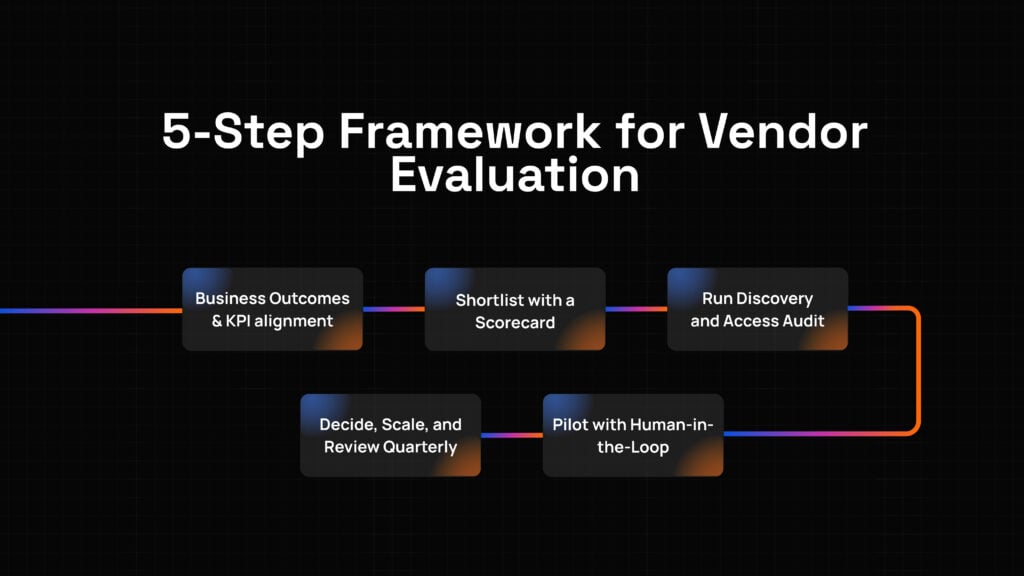
5-Step Framework for Vendor Evaluation
Selecting a vendor capable of delivering measurable automation should follow a disciplined process that prioritizes instrumentation, observability, and clear connections between technical performance and business outcomes. Instead of focusing solely on automation capabilities, evaluation should weigh how well vendors enable systematic measurement of AI process automation KPIs that prove value to executives and stakeholders.
1. Business Outcomes & KPI Alignment
Start by clearly outlining which AI process automation KPIs will define success and how they connect to business objectives that executives care about. Defining specific metrics and targets early helps align all stakeholders including operations leadership, finance, and IT, ensuring that measurement frameworks focus on outcomes rather than activities. Your goals might include reducing cycle time by specific percentages, improving deflection rates to target thresholds, lowering error rates below acceptable limits, or decreasing cost per transaction to competitive benchmarks, but they must be tied to system-generated measurements. This clarity becomes the foundation for instrumentation decisions, dashboard designs, and scaling criteria. Without defined KPIs, teams often track vanity metrics that fail to demonstrate business value or secure expansion funding.
Example: A customer service operations team defined its primary KPI as “reducing first-response time for billing emails by 50 percent in APAC region within 60 days.” This single metric guided instrumentation requirements, pilot design, and success criteria that executives understood and valued.
Pro Tip: Document 3 to 5 measurable business outcomes before requesting proposals, focusing on one workflow, one region, and one primary metric. It keeps evaluation grounded in provable impact rather than technical capabilities, and helps vendors tailor demonstrations to your actual measurement requirements.
2. Shortlist with a Scorecard
Once measurement objectives are clear, move to structured vendor comparison using a weighted scorecard that prioritizes instrumentation and observability capabilities. This tool allows teams to quantify how well each vendor supports AI process automation KPIs through native integrations, real-time dashboards, and audit trail capabilities. By assigning higher weights to integration depth and observability than UI polish, decision-makers ensure selections support measurement requirements. A disciplined scorecard approach removes subjectivity and ensures that even non-technical stakeholders understand which vendors enable credible ROI tracking versus those offering only surface-level reporting.
Example: One enterprise assigned 40 percent weight to integration depth across systems of record and 30 percent to observability and rollback capabilities, which helped eliminate vendors lacking real-time KPI instrumentation early in evaluation.
Pro Tip: Keep the scorecard fully quantitative to ensure fairness. Rate each criterion on a defined scale (1 to 5 or 1 to 10) so decisions are driven by measurement capabilities, not vendor presentation quality or subjective impressions.
3. Run Discovery and Access Audit
Before contracts are signed, a structured discovery phase ensures that all measurement and instrumentation details are surfaced early. During this phase, vendors should gain thorough understanding of your system architecture, event schemas, timestamp availability, and existing reporting infrastructure. It’s the stage where assumptions about AI automation benefits tracking get tested and data availability becomes clear. Running an access audit alongside discovery verifies API access to operational metrics, confirms least-privilege scopes for data collection, and identifies gaps that require custom instrumentation. Request a 48-hour integration gap report listing APIs, scopes, events, and retries to understand true measurement readiness.
Example: A healthcare operations organization invited shortlisted vendors for a one-week sandbox assessment, exposing missing event timestamps and incomplete audit trails before signing contracts, which prevented months of post-implementation reporting workarounds.
Pro Tip: Ask vendors to deliver a brief “instrumentation summary” at the end of discovery that identifies which AI process automation KPIs can be computed from existing data, which require new instrumentation, and what timeline and cost implications exist for comprehensive measurement.
4. Pilot with Human-in-the-Loop (HITL) and Dashboards
A well-designed pilot validates both automation performance and measurement accuracy under real-world conditions. Instead of full-scale deployment, focus on a limited workflow to test whether AI process automation KPIs can be computed reliably from system-generated events. Run 3 to 4 weeks in shadow mode with a single KPI dashboard that shows cycle time, deflection rate, accuracy, escalation frequency, and cost per transaction. Incorporating human-in-the-loop oversight ensures measurement captures both automated and escalated work accurately. This phase is critical for proving that metrics remain stable, auditable, and credible when presented to executives who will decide on expansion funding.
Example: A logistics company piloting email triage published a single executive dashboard showing SLA adherence, deflection rate, accuracy against human review, and estimated cost savings, which secured expansion approval within 45 days based on clear, system-generated proof points.
Pro Tip: Review the KPI dashboard daily during pilots with both operators and executives present. Early visibility builds confidence in measurement accuracy and surfaces data quality issues or instrumentation gaps before they undermine the business case.
5. Decide, Scale, and Review Quarterly
After the pilot proves both automation value and measurement reliability, use findings to guide final vendor selection and create phased expansion plans. Scale to adjacent workflows only after AI process automation KPIs hold steady for 6 to 8 weeks, proving that performance is sustainable rather than pilot-specific. Continuous quarterly reviews between your team and vendor maintain measurement discipline, ensuring KPIs remain accurate as data patterns shift, policies evolve, and volumes change. These sessions should assess whether metrics still connect to business outcomes, identify new measurement opportunities, and refine dashboards based on executive feedback. Treat automation like a product with versioned changes, regression tests, release notes, and deprecation policies.
Example: A financial services organization conducted quarterly KPI reviews with its vendor, identifying metric drift issues early and optimizing instrumentation to maintain ROI tracking accuracy as seasonal volume patterns changed throughout the year.
Pro Tip: Maintain measurement discipline by treating AI process automation KPIs as product requirements. Version dashboards, regression test metric calculations before changes ship, and maintain rollback plans if quality or performance metrics fall below acceptable thresholds.
Next Steps in Your Evaluation Process
By now, you should have a clear understanding of which AI process automation KPIs to prioritize when selecting automation partners and designing measurement frameworks. Bringing these insights together creates a structured approach that proves value, guides scaling decisions, and maintains stakeholder confidence through transparent, auditable metrics.
- Align on business metrics: Ensure vendors instrument cycle time, deflection rates, accuracy, and cost per transaction from day one, not just technical performance indicators.
- Evaluate instrumentation depth: Confirm that solutions compute metrics from system-generated events across your CRM, ITSM, ERP, and operational platforms without manual reporting overhead.
- Focus on measurement transparency: Choose vendors who provide decision logs, confidence scores, version history, and audit trails that support credible ROI tracking and compliance requirements.
- Review dashboard capabilities: Favor partners who deliver executive-ready dashboards with drill-down capabilities, not just aggregate statistics that hide performance variations.
- Test with baseline comparisons: Always establish pre-automation baselines and validate that pilot metrics prove improvements convincingly before committing to enterprise-wide deployment.
With these criteria in place, you are better equipped to identify vendors who enable systematic tracking of AI automation benefits, support credible business cases, and provide the measurement foundations needed to scale automation programs confidently.
Vendor Questions to Ask
To make the most informed decision during vendor evaluation focused on measurement and ROI, be sure to ask these essential questions:
- Which AI process automation KPIs will you instrument on day one, and where do those signals originate in our systems of record?
- How do you compute cost per transaction and attribute savings credibly to automation versus other factors?
- What sample decision logs can you show with confidence scores, inputs, outputs, and policy versions for audit requirements?
- How do you define and measure human-in-the-loop escalation thresholds, and what metrics track human-AI collaboration effectiveness?
- What regression tests run before prompt or policy changes ship to ensure AI automation use cases maintain quality standards?
- How do we export prompts, flows, policies, and KPI history if we exit your platform or bring capabilities in-house?
- Can you share anonymized before-and-after metrics from customers with similar volumes, processes, and measurement requirements?
Prove ROI with AI Process Automation KPIs
Tracking AI process automation KPIs is not just a reporting exercise; it’s a strategic capability that enables organizations to prove value, secure expansion funding, and maintain stakeholder confidence as automation scales. The right measurement framework brings clarity, accountability, and continuous improvement across automated workflows, while poor metric selection creates misleading narratives that undermine business cases and stall scaling efforts.
Ready to implement measurable automation with clear AI process automation KPIs? Book a Free Strategy Call with us to explore the next steps and discover how we can help you select the right metrics, instrument your systems, and build business cases that secure expansion funding confidently.