

The Power of AI Automation for Marketing: Why It Matters
AI automation for marketing has transformed from an experimental technology into a revenue-critical capability that defines competitive advantage in modern marketing organizations. Teams implementing intelligent marketing automation are not simply speeding up production cycles; they are fundamentally reimagining how campaigns get developed, approved, and optimized. Automated workflows now manage tasks that once created bottlenecks in creative production, enabling marketers to focus on strategy, messaging, and channel optimization that drive measurable business results and customer engagement.
The data supporting this transformation continues to strengthen across industries. According to McKinsey’s 2025 Personalization Report, companies that excel at personalization see 5 to 15 percent revenue uplift and 10 to 30 percent higher marketing ROI, with high-growth firms deriving 40 percent more revenue from personalization capabilities. Think with Google reports that advertisers adopting automation strategies achieve approximately 25 percent more profits in specific search optimizations. These AI marketing automation examples demonstrate more than tactical efficiency improvements; they represent a fundamental shift in how marketing organizations allocate resources, maintain brand consistency, and scale personalized experiences without proportional headcount increases.
Why AI Automation for Marketing Matters for Businesses
AI automation for marketing goes beyond simple task automation; it transforms how organizations manage creative workflows, maintain approval governance, and deliver personalized experiences at scale. Manual processes that once created bottlenecks in brief intake, asset production, and campaign reporting can now be executed with intelligence and precision through marketing automation. From structured brief capture and approval routing to personalized content generation and performance reporting, AI for marketing delivers measurable outcomes that strengthen both campaign velocity and return on investment across all marketing functions.
For marketing leaders evaluating automation strategies, the benefits manifest in five critical ways:
- Accelerated Campaign Velocity: Marketing automation reduces cycle times by automatically capturing complete briefs, routing approvals to the right stakeholders, and eliminating delays caused by missing information or unclear ownership.
- Enhanced Brand Consistency: Intelligent systems enforce brand guidelines, legal requirements, and compliance policies systematically across all assets, eliminating the variability that comes from manual review or inconsistent interpretation.
- Scalable Personalization: AI automation for marketing enables segment-specific messaging with guardrails, allowing teams to deliver personalized experiences that drive 5 to 15 percent revenue lift without manual customization overhead.
- Improved Approval Governance: Automated routing ensures high-risk claims, budget thresholds, and regulatory requirements trigger appropriate reviews, maintaining compliance while accelerating low-risk approvals.
- Data-Driven Optimization: AI process automation consolidates fragmented performance data into unified reporting, surfacing insights about what’s working, what’s wasting budget, and what actions to take next.
AI automation for marketing is not about replacing creative professionals; it’s about amplifying their effectiveness, ensuring governance, and enabling marketing teams to focus on strategy, messaging, and channel innovation that drive measurable business outcomes.

Key Considerations When Choosing AI Automation Services
Selecting the right partner for AI automation for marketing requires careful alignment between technology capabilities and marketing operations requirements. The most successful marketing automation projects are built on a foundation of transparency, deep tool integration, and measurable impact on critical metrics like approval lead time, cost per asset, and campaign ROI.
Below are the core factors that should guide every marketing automation decision:
- Business Outcomes & KPI Alignment: Every AI automation for marketing initiative must connect directly to tangible marketing metrics, whether that’s reducing approval lead time, lowering cost per asset, improving campaign velocity, or increasing incremental ROI. Vendors should demonstrate a clear methodology for linking their solutions to your specific marketing KPIs, not generic efficiency claims.
- Integration with Existing Systems: Effective marketing automation depends on seamless connectivity with your CRM, marketing automation platform, ad platforms, digital asset management, project management tools, and finance systems. The ideal partner ensures smooth bidirectional data flow so automated workflows have complete campaign context and can update systems without manual data entry.
- Security and Compliance: AI automation for marketing handles sensitive brand assets, customer data, campaign strategies, and budget information. Confirm that vendors maintain strict adherence to frameworks like SOC 2, GDPR, CCPA, and brand-specific requirements, with encryption in transit and at rest, role-based access controls by brand and region, and comprehensive audit logs.
- Human-in-the-Loop (HITL) Flexibility: Successful AI for marketing always includes human oversight mechanisms for high-risk claims, legal reviews, and brand approvals. Ensure that workflows incorporate built-in escalation pathways for sensitive content, budget thresholds, and regulatory compliance that require contextual judgment.
- Observability and Analytics: Transparency is essential when scaling AI process automation across marketing operations. A capable vendor provides dashboards that surface automation accuracy, approval bottlenecks, asset production metrics, and campaign performance in real time, allowing teams to identify issues and optimize workflows continuously.
- Pricing Transparency and Flexibility: Insist on clear, predictable pricing models that scale logically with asset volumes, campaign counts, and team size. The right AI automation for marketing solution grows with your organization without unexpected fees for additional workflows, platform integrations, or user seats.
Choosing marketing automation partners with these capabilities ensures your investment delivers sustainable campaign improvements and measurable ROI rather than creating workflow complexity or governance gaps.
The Impact of Integration Readiness
Before launching any AI automation for marketing initiative, organizations must thoroughly assess their marketing technology stack and data architecture. Integration readiness is the process of evaluating how well existing platforms, creative systems, and approval workflows can support automation without creating context gaps or data silos. Skipping this assessment leads to incomplete campaign data, inaccessible brand guidelines, and automated workflows that lack the intelligence needed for accurate routing and compliance checking. When marketing operations teams conduct integration audits in advance, they uncover data quality issues early, align IT and marketing stakeholders around governance requirements, and minimize wasted time during vendor discovery.
Example:
A global consumer brand preparing for AI automation for marketing discovered inconsistent campaign identifiers and missing budget approval thresholds across five regional marketing automation platforms. Addressing these issues before vendor engagement reduced the overall project timeline by nine weeks and improved approval routing accuracy by 51 percent during the pilot phase.
Pro Tip:
Create an internal integration readiness checklist that evaluates marketing automation platform API completeness, assesses digital asset management connectivity, confirms brand guideline accessibility, and documents approval matrix requirements. Share this assessment with marketing automation vendors during initial conversations to ensure proposals address your actual technical environment and governance constraints.
Common Pitfalls in AI Automation for Marketing
AI automation for marketing promises faster production and better governance, but poor planning and inadequate guardrails can create brand risk instead of velocity improvements. Many marketing organizations make avoidable mistakes during implementation that delay value realization and erode creative team confidence. To discover proven methodologies tailored for your marketing workflows and brand requirements, explore our AI Workflow Automation Services page for detailed AI marketing automation frameworks and implementation best practices.
- Starting with Vague Briefs: Some organizations attempt marketing automation before establishing required fields and validation rules for campaign briefs. Always force complete information capture and auto-collect missing details before work begins to prevent downstream rework and delays.
- Underestimating Change Management: A technically sound AI automation for marketing rollout can still fail if creative teams and brand managers are not prepared or resistant to automated workflows. Introduce training, pilot demonstrations, and feedback sessions early so teams build confidence in automated routing and content generation.
- Neglecting Brand Governance: Successful AI for marketing requires systematic enforcement of brand guidelines, legal requirements, and compliance policies. Choose vendors who provide versioned prompts by channel, region, and regulatory class with mandatory review checkpoints for high-risk content.
- Choosing Tools Before Mapping Workflows: Many teams evaluate AI automation for marketing vendors before thoroughly documenting current approval matrices, escalation rules, and exception patterns. Always map workflows end-to-end with explicit routing criteria and approval thresholds before requesting vendor proposals.
- Ignoring Audit Trail Requirements: Full automation may sound efficient, but brand governance requires complete traceability. Look for marketing automation solutions that log every decision with policy citations, approver history, version tracking, and immutable audit records for legal and compliance reviews.
- Accepting “Happy Path” Demos Only: Vendors demonstrating AI process automation often showcase ideal scenarios with complete briefs and straightforward approvals. Demand to see how solutions handle malformed inputs, multi-intent requests, last-minute scope changes, and budget threshold triggers that occur in real-world marketing operations.
Evaluating the ROI of AI Automation for Marketing
Quantifying the benefits of AI automation for marketing helps secure executive buy-in and refine future investments. Measuring ROI goes beyond simple time savings; it captures gains in campaign velocity, creative quality, personalization effectiveness, and marketing efficiency. Without clear metrics during evaluation, marketing automation risks becoming a feature-heavy project with unclear business outcomes.
Key metrics to monitor include:
- Approval Lead Time: Track the reduction in days from brief submission to final approval following automation of routing, escalation, and stakeholder coordination.
- Cost Per Asset: Measure the decrease in fully loaded cost to produce each creative asset, including brief clarification, production cycles, and rework incidents.
- Campaign Velocity: Compare how many campaigns launch per quarter before and after implementing marketing automation to assess scalability improvements and market responsiveness.
- Rework Rate: Evaluate the reduction in assets requiring revisions due to missing information, brand guideline violations, or approval gaps.
- Personalization Impact: Assess revenue lift and conversion improvements when AI for marketing enables segment-specific messaging at scale with appropriate governance.
- Marketing ROI: Review overall return on marketing spend improvements when automation eliminates waste, speeds optimization cycles, and enables data-driven resource allocation.
According to McKinsey research, companies excelling at personalization see 5 to 15 percent revenue uplift and 10 to 30 percent higher marketing ROI. Think with Google reports approximately 25 percent profit improvements for advertisers adopting automation strategies. Forrester TEI studies show triple-digit ROI for marketing workflow platforms, with one composite achieving 285 percent ROI over three years. Beyond quantitative metrics, AI automation for marketing also delivers consistency and auditability, two pillars of brand governance. When every asset follows approval protocols, every claim cites policy versions, and every decision creates audit trails, organizations build compliant marketing operations that scale without increasing legal risk.
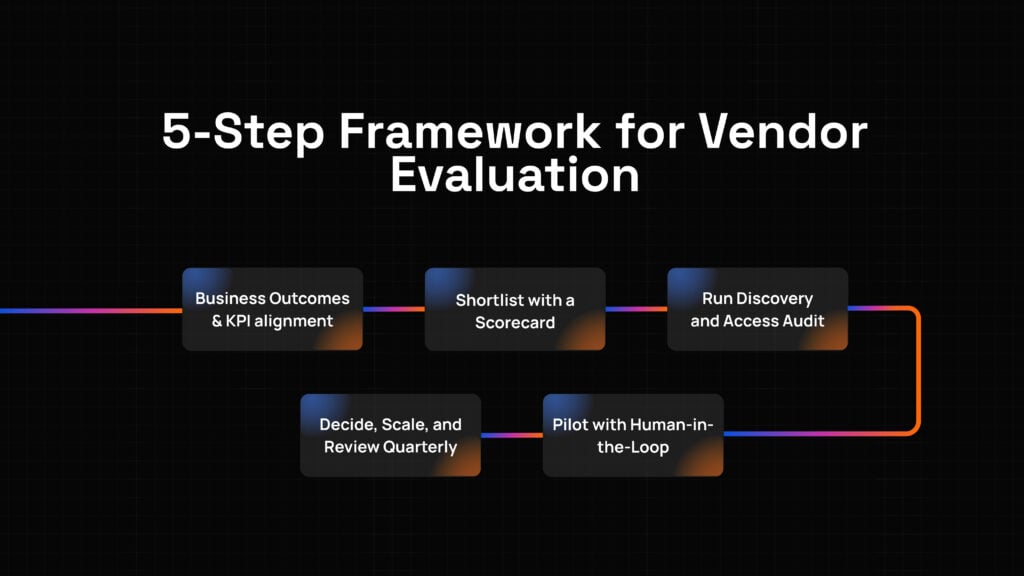
5-Step Framework for Vendor Evaluation
Selecting an AI automation for marketing vendor should follow a disciplined, structured process that aligns with your organization’s brand governance goals while accounting for both technological depth and long-term partnership potential. Instead of focusing solely on price or surface-level features, evaluation should weigh how well the vendor’s solution supports creative velocity, integrates with existing platforms, and adapts to evolving brand requirements.
1. Business Outcomes & KPI Alignment
Start by clearly outlining what success looks like and how it will be measured in marketing operations terms. Defining specific KPIs and project scope early helps align all stakeholders including marketing leadership, brand managers, legal, and IT, ensuring that expectations are realistic and trackable. Your goals might include reducing approval lead time, lowering cost per asset, improving campaign velocity, or increasing personalization effectiveness, but they must be tied to measurable outcomes. This clarity becomes the foundation for every subsequent decision about marketing automation, shaping both vendor conversations and internal buy-in. Without defined KPIs, teams often drift toward evaluating features instead of focusing on the business value those features deliver.
Example: A technology brand defined its KPI as “reducing approval lead time by 40 percent for paid social ads in North America within 60 days while maintaining zero policy violations and under 2 percent manual rework.” This metric guided every vendor discussion and became the benchmark for pilot success.
Pro Tip: Document 3 to 5 measurable marketing outcomes before requesting proposals. It keeps evaluation grounded in impact rather than feature lists, and helps vendors tailor demonstrations to your actual creative workflow challenges.
2. Shortlist with a Scorecard
Once objectives are clear, move to structured vendor comparison using a weighted scorecard for evaluating AI automation for marketing solutions. This tool allows teams to quantify how well each vendor aligns with their priorities from marketing platform integration and approval workflow design to observability and portability. By assigning weights to each factor, decision-makers can balance technical capability with brand governance relevance. A disciplined scorecard approach removes subjectivity and ensures that even non-technical stakeholders understand trade-offs when selecting marketing automation platforms. It also simplifies executive approvals by providing a transparent rationale for every shortlisting decision.
Example: One enterprise assigned 35 percent weight to marketing platform integration quality and 30 percent to human-in-the-loop approval workflow design, which helped eliminate vendors lacking robust brand governance capabilities early.
Pro Tip: Keep the scorecard fully quantitative to ensure fairness in evaluation. Rate each criterion on a defined scale (1 to 5 or 1 to 10) so decisions are driven by data, not personal bias or vendor presentation style.
3. Run Discovery and Access Audit
Before contracts are signed, a structured discovery phase ensures that all technical and operational details are surfaced early when implementing AI for marketing. During this phase, vendors should gain a thorough understanding of your marketing automation platform architecture, digital asset management structure, approval matrix complexity, and brand guideline documentation. It’s the stage where assumptions about marketing automation get tested and integration complexity becomes visible. Running an access audit alongside discovery verifies API scopes, data access permissions, and least-privilege requirements by brand and region, preventing security gaps and costly change orders later. Request a 48-hour gap report listing APIs, scopes, events, retries, and sample decision traces.
Example: A retail marketing organization invited shortlisted AI automation for marketing vendors for a one-week sandbox assessment, exposing missing DAM webhook support and incomplete approval matrix documentation before signing contracts.
Pro Tip: Ask vendors to deliver a brief “readiness summary” at the end of discovery that identifies technical blockers, data quality issues, governance requirements, and timeline estimates. This document becomes a reference for project planning and helps teams understand realistic implementation paths.
4. Pilot with Human-in-the-Loop (HITL) and Dashboards
A well-designed pilot validates both performance and brand safety under real-world marketing conditions when exploring AI automation for marketing. Instead of full-scale deployment, focus on a limited, high-impact workflow such as paid social approvals or email brief intake to test accuracy, compliance, and team adoption. Incorporating human-in-the-loop (HITL) approval gates ensures that AI process automation outcomes align with brand standards and legal requirements, while dashboards provide quantifiable visibility into cycle times, approval bottlenecks, and rework rates. This phase is critical for identifying edge cases and ensuring that automation works across channels, regions, and brand guidelines, not just in controlled test scenarios.
Example: A financial services marketing team piloted automated approval routing for 100 paid social assets and achieved a 55 percent reduction in approval lead time within 30 days, with zero policy violations and 4.6 out of 5 creative team satisfaction scores.
Pro Tip: Use pilots to gather creative team and brand manager feedback through surveys and retrospectives. Early adoption feedback often surfaces workflow gaps, tone issues, or escalation needs that technical audits miss.
5. Decide, Scale, and Review Quarterly
After the pilot proves value, use its findings to guide the final decision and create a phased rollout plan for AI automation for marketing. Scaling should be deliberate, expanding only after processes are refined and team adoption is stable. Continuous quarterly reviews between your marketing operations team and the vendor maintain alignment, ensuring the technology evolves alongside brand guidelines, regulatory changes, and campaign strategy shifts. These sessions are not just for troubleshooting; they’re opportunities to assess ROI, plan expansions to landing pages or email nurtures, and refine approval policies and content generation prompts. Ongoing collaboration transforms the vendor relationship into a true strategic partnership that continuously drives marketing velocity.
Example: A consumer goods company conducted quarterly check-ins with its marketing automation vendor, identifying prompt optimization opportunities that reduced rework rates by 28 percent over the first year.
Pro Tip: Treat vendor reviews as strategic sessions focused on expanding capabilities and adapting to brand evolution, not just maintenance calls. Shared metrics, improvement targets, and policy refinement plans foster long-term partnership accountability.
Next Steps in Your Evaluation Process
By now, you should have a clear understanding of what to prioritize when selecting an AI automation for marketing partner. Bringing these insights together creates a structured evaluation flow that de-risks investment and accelerates deployment while ensuring long-term brand governance and campaign velocity.
- Align with marketing goals: Ensure every feature and function supports specific marketing KPIs and measurable outcomes, not just generic automation capabilities.
- Evaluate platform integrations: Confirm that solutions work smoothly with your marketing automation platform, DAM, project management tools, and ad platforms without requiring extensive custom development.
- Focus on brand governance: Choose vendors with documented approval workflow capabilities, versioned brand guidelines, and robust audit trail features for legal and compliance requirements.
- Review support and enablement: Favor partners who provide continuous training for marketing operations teams, workflow development assistance, and optimization support, not one-time onboarding.
- Test with a pilot: Always run a controlled pilot before full deployment to validate automation accuracy, brand compliance, and creative team adoption under real-world marketing conditions.
With these criteria in place, you are better equipped to identify marketing automation vendors who not only automate workflows but also improve campaign velocity, reduce brand risk, and amplify your team’s capacity to deliver personalized experiences at scale.
Vendor Questions to Ask
To make the most informed decision during your AI automation for marketing evaluation, be sure to ask these essential questions:
- How does your solution link outcomes to measurable marketing KPIs like approval lead time, cost per asset, and incremental campaign ROI?
- Which native integrations are supported out of the box for marketing automation platforms, DAM, and ad platforms, and what is the typical timeline for custom connectors?
- What security certifications and audit results can you provide, and how do you handle brand asset privacy and regional data requirements?
- How do you handle low-confidence content or high-risk claims, and what triggers legal and compliance approval gates?
- What is your average implementation timeline from contract signing to production deployment for marketing automation projects?
- How do you structure post-implementation support for marketing operations teams expanding automation capabilities and adapting to brand guideline changes?
- Are all automation assets, workflows, prompts, and approval policies fully exportable if we move providers or bring capabilities in-house?
Accelerate Marketing with AI Automation for Marketing
AI automation for marketing is not just a technological investment; it’s a strategic capability that requires careful planning, vendor selection, and continuous optimization. The right implementation brings velocity, governance, and scalability across your marketing operations, while poor execution creates brand risk and creative team frustration.
Ready to transform your marketing operations with AI automation for marketing? Book a Free Strategy Call with us to explore the next steps and discover how we can help you select, pilot, and scale the right solution for your unique brand requirements and campaign objectives.