

The Power of AI Automation for Data Analysis: Why It Matters
AI automation for data analysis has transformed from an experimental capability into a strategic necessity for organizations seeking to convert scattered dashboards into revenue-driving decisions without overwhelming analyst teams. Companies implementing intelligent data analysis automation are not simply speeding up reporting cycles; they are fundamentally reimagining how insights get generated, validated, and translated into business actions. Automated workflows now manage tasks that once consumed entire analyst teams, enabling data professionals to focus on strategic problem-solving, hypothesis testing, and high-value interpretation that drives measurable business outcomes.
The evidence supporting this transformation continues to strengthen across industries. According to McKinsey’s 2025 State of AI Report, 78 percent of organizations were using AI in at least one function by early 2025, up from 65 percent in mid-2024, reflecting accelerated adoption of intelligent automation. Forrester’s Total Economic Impact study on Microsoft Fabric reported 20 percent increase in analyst output and 25 percent productivity uplift for data engineering after platform consolidation, with 379 percent ROI over three years. These findings demonstrate more than tactical efficiency improvements; they represent a fundamental shift in how analytics organizations allocate resources and the critical importance of implementing AI automation benefits with appropriate guardrails and quality frameworks.
Why AI Automation for Data Analysis Matters for Businesses
AI automation for data analysis goes beyond simple report generation; it transforms how organizations move from passive dashboards to active decision-making with measurable business impact. Manual processes that once created bottlenecks in data preparation, quality validation, and insight generation can now be executed with intelligence and precision through data analysis automation. From automated ingestion and quality checking to insight generation and action triggers, AI process automation delivers measurable outcomes that strengthen both analytical velocity and decision confidence across all business functions.
For data and analytics leaders evaluating automation strategies, the benefits manifest in five critical ways:
- Accelerated Decision Cycles: Data analysis automation reduces time-to-insight by automatically fetching data, normalizing schemas, enriching with lookups, and generating draft narratives without manual analyst intervention.
- Enhanced Data Quality: Intelligent validation systems catch missing keys, schema drift, and statistical outliers before reports update, eliminating the errors that undermine stakeholder confidence in analytics.
- Scalable Analysis Capacity: Unlike manual teams, AI automation for data analysis scales instantly to handle volume increases during planning cycles, campaign launches, or market events without overwhelming analyst bandwidth.
- Proactive Action Triggers: Automated workflows create tickets, update CRM fields, or launch marketing segments when business thresholds trigger, enabling organizations to respond to opportunities and risks in real time.
- Strategic Analyst Focus: By automating repetitive data preparation and validation, data analysis automation frees analysts to focus on hypothesis development, causal investigation, and strategic recommendations that require human expertise.
AI automation for data analysis is not about replacing analysts; it’s about amplifying their effectiveness, ensuring data quality, and enabling analytics teams to focus on interpretation and decision support that drives measurable business value.

Key Considerations When Choosing AI Automation Services
Selecting the right partner for AI automation for data analysis requires careful alignment between technology capabilities and analytics operations requirements. The most successful data analysis automation projects are built on a foundation of transparency, comprehensive data integration, and measurable impact on critical metrics like cycle time, error rates, and dollars moved by analytics-driven decisions.
Below are the core factors that should guide every data analysis automation decision:
- Business Outcomes & KPI Alignment: Every AI automation for data analysis initiative must connect directly to tangible business decisions you want to accelerate, whether that’s lead scoring uplift, churn risk triage, inventory reorder alerts, or forecast accuracy improvements. Vendors should demonstrate hypothesis trees that link each automation step to metrics you actively track, not generic efficiency claims.
- Integration with Existing Systems: Effective data analysis automation depends on seamless connectivity with your data warehouse, lakehouse, spreadsheet sources, APIs, CRM, marketing automation, finance systems, and ticketing platforms. The ideal partner ensures bidirectional data flow with read and write capabilities, eventing support, idempotency, and backfill handling for reliable execution.
- Security and Compliance: AI automation for data analysis handles sensitive business intelligence, customer data, and proprietary analytics logic. Confirm that vendors maintain strict adherence to frameworks like SOC 2, ISO 27001, and GDPR with data residency options, secrets management, comprehensive audit logs, fine-grained PII handling, and field-level masking capabilities.
- Human-in-the-Loop (HITL) Flexibility: Successful data analysis automation always includes human oversight mechanisms for high-impact actions. Ensure that workflows incorporate approval stages where consequences are significant or data is noisy, with safe defaults, reversible steps, and playbooks for on-call analysts.
- Observability and Analytics: Transparency is essential when scaling AI process automation across analytics operations. A capable vendor provides traces for each run, evaluation sets for quality monitoring, dashboards for latency tracking, and fast rollback capabilities with versioned prompts, datasets, and policies.
- Pricing Transparency and Flexibility: Insist on clear, predictable pricing models with explicit assumptions about data volumes, query complexity, and compute usage. The right AI automation for data analysis solution grows with your organization without unexpected fees for additional connectors, user seats, or data processing that distort ROI calculations.
Choosing data analysis automation partners with these capabilities ensures your investment delivers sustainable analytical improvements and measurable business impact rather than creating technical debt or data quality issues.
The Impact of Integration Readiness
Before launching any AI automation for data analysis initiative, organizations must thoroughly assess their data infrastructure, schema documentation, and quality controls. Integration readiness is the process of evaluating how well existing data sources, transformation pipelines, and business systems can support automation without creating context gaps or quality degradation. Skipping this assessment leads to incomplete data contracts, undetected schema drift, and automated insights that lack the reliability needed for confident decision-making. When analytics teams conduct data audits in advance, they uncover quality issues early, align data engineering and business stakeholders around governance requirements, and minimize wasted time during vendor discovery.
Example:
A retail analytics team preparing for AI automation for data analysis discovered inconsistent customer identifiers and missing join keys across five data sources. Addressing these issues before vendor engagement reduced the overall project timeline by ten weeks and improved automated insight accuracy by 48 percent during the pilot phase.
Pro Tip:
Create an internal data readiness checklist that inventories tables, documents join relationships, maps PII fields, and establishes data minimization requirements. Create a red list of fields that never leave the warehouse and enforce masking in development environments. Share this assessment with data analysis automation vendors during initial conversations to ensure proposals address your actual data landscape and quality constraints.
Common Pitfalls in AI Automation for Data Analysis
AI automation for data analysis promises faster insights and better decisions, but poor planning and inadequate quality controls can create unreliable analytics instead of trusted intelligence. Many analytics organizations make avoidable mistakes during implementation that delay value realization and erode stakeholder confidence. To discover proven methodologies tailored for your analytics workflows and data complexity, explore our AI Workflow Automation Services page for detailed data analysis automation frameworks and implementation best practices.
- Automating Broken Processes: Some organizations implement AI automation for data analysis before fixing underlying workflow problems. Always create decision maps that document desired outcomes, required inputs, and approval criteria before attempting automation of analytical processes.
- Starting with Mega Use Cases: A technically ambitious project spanning multiple departments and data sources often stalls during implementation. Break data analysis automation into 2-week increments that ship measurable value, not multi-month initiatives that delay feedback and learning.
- Lacking Ground Truth Data: Successful AI process automation requires clear acceptance criteria and sample evaluation sets before development begins. Without ground truth examples, teams cannot measure accuracy improvements or validate that automation delivers reliable insights.
- Model-First Thinking: Many teams evaluate AI automation for data analysis by comparing model capabilities rather than starting with business metrics and constraints. Always begin with decision requirements and quality thresholds, not model selection or technical architecture.
- Ignoring Change Visibility: Full automation without transparency creates blind spots when data patterns shift or logic fails. Require run logs and diff views for every automated step, ensuring analysts can audit what changed and why.
- Missing Rollback Capabilities: Production analytics automation requires instant recovery mechanisms when quality degrades. Keep kill switches and manual fallback paths, not just forward-only automation that lacks recovery options.
Evaluating the ROI of AI Automation for Data Analysis
Quantifying the AI automation benefits helps secure executive buy-in and refine future investments. Measuring ROI goes beyond simple time savings; it captures gains in analytical velocity, decision quality, data reliability, and strategic capacity. Without clear metrics during evaluation, data analysis automation risks becoming a feature-heavy project with unclear business outcomes.
Key metrics to monitor include:
- Time to Insight: Track the reduction in cycle time from data request to actionable recommendation following automation of preparation, validation, and narrative generation workflows.
- Data Preparation Hours: Measure the decrease in analyst time spent collecting, cleaning, and formatting data to calculate capacity freed for strategic analysis and interpretation.
- False Alert Rate: Evaluate the reduction in incorrect insights or recommendations when automated quality checks validate data completeness, freshness, and referential integrity systematically.
- Decision Velocity: Compare how quickly business actions get triggered after threshold breaches before and after implementing data analysis automation with automated alerting and ticketing.
- Analyst Output: Assess the increase in analyses, experiments, or recommendations delivered per analyst per period once AI automation for data analysis eliminates repetitive preparation work.
- Rollback Frequency: Monitor how often automated workflows require manual intervention or reversal to measure reliability and confidence in automated decision support.
According to Forrester’s Total Economic Impact study on Microsoft Fabric, organizations achieved 379 percent ROI with 20 percent higher analyst output and 25 percent data engineering productivity uplift when consolidating and automating analytics tooling. The same study cited up to 90 percent reduction in time spent searching, integrating, and debugging data. McKinsey reports 78 percent of organizations now use AI in at least one function, creating conditions to standardize KPIs and share best practices. Beyond quantitative metrics, AI automation for data analysis also delivers consistency and auditability, two pillars of trusted analytics. When every automated insight includes lineage traces, quality check results, and approval history, organizations build analytics operations that scale without sacrificing confidence or governance.
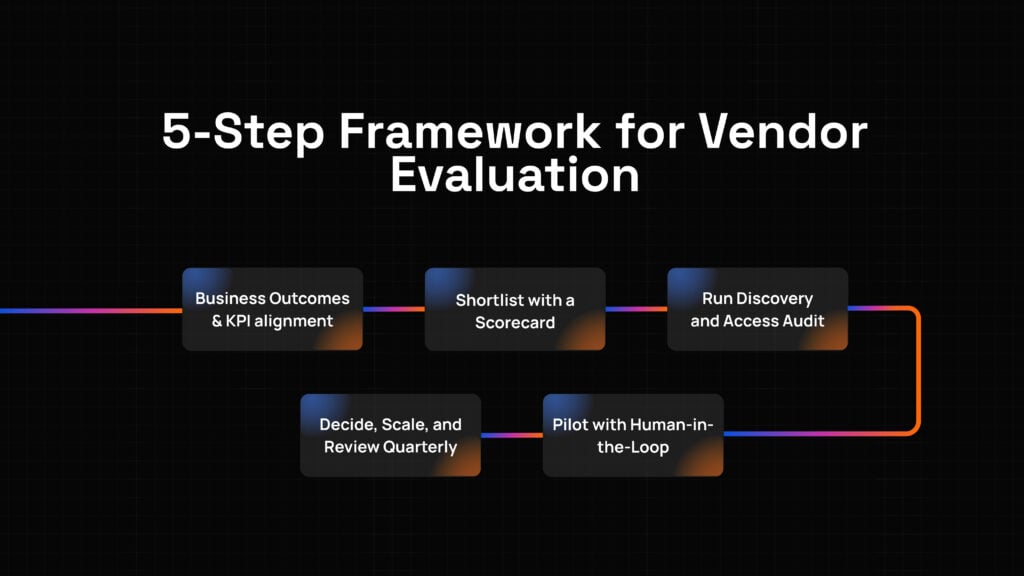
5-Step Framework for Vendor Evaluation
Selecting an AI automation for data analysis vendor should follow a disciplined, structured process that aligns with your organization’s analytical goals while accounting for both technological depth and long-term partnership potential. Instead of focusing solely on analytical capabilities, evaluation should weigh how well the vendor’s solution supports decision velocity, integrates with existing data infrastructure, and adapts to evolving business requirements.
1. Business Outcomes & KPI Alignment
Start by clearly outlining which repeating decision you want to accelerate and how success will be measured through baseline KPIs. Defining specific targets like time-to-insight reduction, data preparation hours saved, or false alert rate improvements helps align all stakeholders including analytics leadership, data engineering, and business decision-makers. Your goals might include reducing weekly revenue forecast cycles from 2 days to 2 hours, automating cohort refresh for growth reviews, or triggering inventory alerts with 95 percent accuracy, but they must be tied to measurable baselines. Declare hard stops such as “no auto-sync to finance unless reconciliation passes” to ensure automation respects critical quality gates.
Example: A SaaS analytics team defined its KPI as “reducing weekly revenue forecast cycle from 2 days to 2 hours while maintaining quality gates at each data join and requiring analyst approval before finance sync.” This metric guided every vendor discussion and became the benchmark for pilot success.
Pro Tip: Document one decision that repeats weekly or monthly before requesting proposals. Set baseline KPIs covering cycle time, preparation effort, and quality metrics. It keeps evaluation grounded in business impact rather than analytical sophistication.
2. Shortlist with a Scorecard
Once objectives are clear, move to structured vendor comparison using a weighted scorecard that prioritizes risk mitigation and value delivery. This tool allows teams to quantify how well each AI automation for data analysis vendor aligns with priorities including business outcomes, integrations, security, human-in-the-loop design, observability, delivery, references, pricing clarity, and portability. Weight by risk and value, not feature completeness. Short demonstrations should map to real data flows with actual schemas and join complexity, not sanitized CSV examples. A disciplined scorecard approach removes subjectivity and ensures that even non-technical stakeholders understand which vendors enable reliable automation versus those offering impressive demonstrations without production-grade quality controls.
Example: One enterprise created a 30-point scorecard with pass/fail requirements for SOC 2 certification, column-level lineage tracking, and event-based retry mechanisms, then asked vendors to demonstrate a failing test and rollback procedure, not just sunny-day scenarios.
Pro Tip: Keep the scorecard fully quantitative with explicit pass/fail criteria for non-negotiable requirements. Rate each criterion on a defined scale so decisions are driven by demonstrated capability, not vendor presentation quality or relationship strength.
3. Run Discovery and Access Audit
Before contracts are signed, a structured discovery phase ensures that all data architecture and operational details are surfaced early when implementing data analysis automation. During this phase, vendors should gain thorough understanding of your table schemas, join relationships, SLA requirements, data owners, PII field locations, and quality expectations. It’s the stage where assumptions about data readiness get tested and integration complexity becomes visible. Running an access audit alongside discovery verifies least-privilege roles, service account permissions, and data minimization requirements, preventing security gaps and compliance violations. Conduct a 2-hour workshop to establish data contracts for the top 10 tables in your analytical pipeline.
Example: A financial services analytics organization invited shortlisted AI automation for data analysis vendors for technical assessments, exposing missing referential integrity constraints and undocumented PII fields before signing contracts, which prevented months of post-implementation quality issues.
Pro Tip: Ask vendors to deliver data contract proposals that specify schema expectations, freshness SLAs, quality thresholds, and lineage requirements. This document becomes a reference for implementation planning and ongoing quality monitoring.
4. Pilot with Human-in-the-Loop (HITL) and Dashboards
A well-designed pilot validates both performance and reliability under real-world analytical conditions when exploring AI automation for data analysis. Instead of toy demonstrations, run 4 to 6 weeks on one flow end-to-end including data quality checks, exception queues, and analyst approvals. Track cycle time, acceptance rate, and rollback frequency to measure whether automation delivers reliable insights that analysts trust. Incorporating human oversight ensures measurement captures both automated and escalated work accurately. Pair every automated action with measurable business proxies such as pipeline advanced or cost avoided to demonstrate tangible value. This phase is critical for proving that data analysis automation maintains quality, respects governance boundaries, and provides troubleshooting visibility analysts need when patterns shift unexpectedly.
Example: A retail analytics team piloted automated cohort refresh and narrative summary generation for weekly growth reviews, achieving 65 percent cycle time reduction within 45 days with 4.5 out of 5 analyst satisfaction scores and zero quality incidents.
Pro Tip: Use pilots to gather analyst feedback through surveys and retrospectives. Early adoption insights often surface data quality gaps, workflow mismatches, or approval friction that technical audits miss completely.
5. Decide, Scale, and Review Quarterly
After the pilot proves value, use its findings to guide the final decision and create a phased rollout plan for AI automation for data analysis. Move to production with change management and training that prepares analysts for new workflows and approval responsibilities. Expand to adjacent decisions using the same patterns, maintaining exit plans and running quarterly audits to ensure quality remains stable as data volumes and business rules evolve. Hold quarterly “drill” sessions to simulate failures, practice rollback procedures, and refresh evaluation sets with recent edge cases. Scaling should be deliberate, adding three more dashboards only after initial patterns prove sustainable and reliable.
Example: A technology company conducted quarterly reviews with its data analysis automation vendor, rotating on-call analyst responsibilities and identifying prompt optimization opportunities that reduced false alert rates by 32 percent over the first year.
Pro Tip: Treat vendor reviews as operational readiness sessions, not just status calls. Practice failure scenarios, validate rollback procedures, and refresh evaluation sets to ensure automation adapts as business conditions and data patterns change.
Next Steps in Your Evaluation Process
By now, you should have a clear understanding of what to prioritize when selecting an AI automation for data analysis partner. Bringing these insights together creates a structured evaluation flow that de-risks investment and accelerates deployment while ensuring long-term analytical reliability and business impact.
- Align with decision velocity: Ensure every feature and function supports specific analytical decisions and measurable business outcomes, not just generic automation capabilities.
- Evaluate data integration: Confirm that solutions handle your actual data sources, schemas, and quality challenges with appropriate connectors, transformation logic, and quality validation frameworks.
- Focus on quality governance: Choose vendors who provide data contracts, column-level lineage, schema validation, and distribution checks, not black-box systems that lack transparency.
- Review approval workflows: Favor partners who enable human-in-the-loop checkpoints for high-impact actions with clear escalation paths and correction feedback loops.
- Test with production complexity: Always pilot with real data including missing values, schema drift, and referential integrity issues before committing to enterprise-wide deployment.
With these criteria in place, you are better equipped to identify data analysis automation vendors who not only automate workflows but also improve decision velocity, reduce analyst toil, and amplify your team’s capacity to deliver strategic business impact.
Vendor Questions to Ask
To make the most informed decision during your AI automation for data analysis evaluation, be sure to ask these essential questions:
- What business KPI will move first and by how much, based on implementations with similar data complexity and analytical maturity?
- Which data connectors will be native, which require custom development, and who maintains them as schemas and APIs evolve?
- How does your system enforce data contracts, field-level masking, and column-level lineage for audit and compliance requirements?
- What are your default quality checks for freshness, referential integrity, and distribution drift, and how are thresholds tuned for specific business contexts?
- How does human approval work and where are automated actions blocked if quality checks fail or confidence scores fall below thresholds?
- Walk through traces, error handling, retry mechanisms, and rollback procedures from a real incident where automation quality degraded.
- What is your approach to versioning prompts, policies, and evaluation sets across development, staging, and production environments?
Transform Analytics with AI Automation for Data Analysis
AI automation for data analysis is not just a technological investment; it’s an operational transformation that requires careful planning, vendor selection, and continuous quality monitoring. The right implementation brings velocity, reliability, and scalability across your analytics operations, while poor execution creates unreliable insights and erodes stakeholder confidence.
Ready to transform your analytics operations with AI automation for data analysis? Book a Free Strategy Call with us to explore the next steps and discover how we can help you map decisions, connect data sources, and ship safe automation with clear governance frameworks and measurable business impact.