
The Power of AI Automation in Finance: Why It Matters
AI automation in finance has evolved from experimental pilots into mission-critical infrastructure that defines operational excellence in modern financial operations. Finance teams implementing intelligent automation are fundamentally reimagining how organizations handle reconciliations, exception triage, and risk flagging workflows. Automated systems now manage tasks that once consumed entire accounting departments, enabling finance professionals to focus on strategic analysis, root cause investigation, and control improvements that drive accuracy and accelerate close cycles.
The data supporting this transformation continues to strengthen across finance functions. According to Deloitte CFO Signals research, 79 percent of CFOs say it is likely they will use generative AI in their operations within 24 months, demonstrating executive commitment to automation. KPMG reports that nearly half of finance leaders have already deployed or are actively piloting generative AI solutions. However, McKinsey’s State of AI research reveals that only 11 percent of organizations report using generative AI at scale, while 40 percent cite explainability as a top risk, underscoring the importance of transparent AI process automation with complete audit trails and decision traceability.
Why AI Automation in Finance Matters for Finance Teams
AI automation in finance goes beyond simple task processing; it transforms how organizations manage close cycles, maintain control environments, and ensure audit readiness. Manual workflows that once created bottlenecks in bank reconciliations, vendor matching, and exception review can now be executed with intelligence and precision through finance automation. From transaction matching and duplicate detection to policy violation flagging and risk alerts, AI process automation delivers measurable outcomes that strengthen both control quality and operational efficiency across all accounting functions.
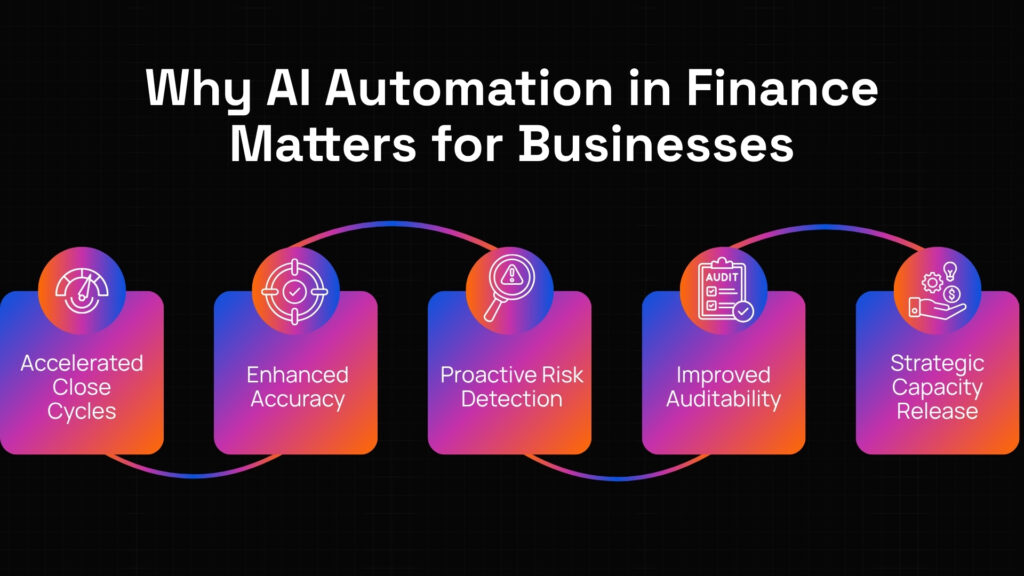
For finance leaders evaluating automation strategies, the benefits manifest in five critical ways:
- Accelerated Close Cycles: AI automation in finance reduces days-to-close by automating transaction matching, surfacing only true exceptions, and enabling continuous reconciliation throughout the month rather than compressed period-end rushes that strain teams and increase error risk.
- Enhanced Accuracy and Control: Intelligent systems apply consistent matching logic with configurable thresholds, eliminating the variability that comes from manual interpretation, analyst experience gaps, or fatigue-driven errors during high-volume periods that compromise control effectiveness.
- Proactive Risk Detection: Finance automation flags anomalies like duplicate invoices, vendor mismatches, policy violations, and unusual transaction patterns in real time, enabling early intervention before small issues compound into material audit findings or financial restatements.
- Improved Auditability: AI process automation maintains comprehensive audit trails with traceable prompts, policy citations, confidence scores, and decision rationale for every matched transaction and escalated exception, supporting both internal control testing and external audit requirements.
- Strategic Capacity Release: Automated reconciliation coverage frees analysts from repetitive copy-paste work to focus on investigating root causes, improving upstream processes, and developing controls that prevent exceptions rather than simply processing them after the fact.
AI automation in finance is not about replacing accounting professionals; it is about amplifying their effectiveness, ensuring control consistency, and enabling finance teams to focus on strategic activities that improve data quality and business partnership.
Key Considerations When Choosing AI Automation Services
Selecting the right partner for AI automation in finance requires careful alignment between technology capabilities and financial operations requirements. The most successful finance automation projects are built on a foundation of explainability, deep ERP integration, and measurable impact on critical metrics like auto-reconciliation rates, exception volumes, and days-to-close.
Below are the core factors that should guide every AI automation in finance decision:
- Business Outcomes & KPI Alignment: Every AI automation in finance initiative must connect directly to tangible accounting metrics, whether that is reducing days-to-close, improving auto-reconciliation percentages, accelerating exception SLA performance, or lowering write-off rates and audit findings. Vendors should demonstrate a clear methodology for linking their finance automation solutions to your specific operational KPIs with baseline measurements and quantified forecasts tracked weekly, not vague efficiency promises.
- Integration with Existing Systems: Effective AI process automation depends on seamless connectivity with your ERP, treasury management systems, accounts payable and receivable platforms, and bank feed providers. The ideal partner ensures smooth bidirectional data flow with read and write capabilities, event-driven triggers for new statements and journal entries, and support for your identity model so automated workflows have complete transaction context and can update records without manual intervention.
- Security and Compliance: AI automation in finance handles highly sensitive financial data including bank account details, vendor information, transaction records, and internal control documentation. Confirm that vendors maintain strict adherence to data residency requirements, key management protocols, purpose-bound data use policies, policy-enforced PII redaction, and comprehensive audit trails that align with model risk management frameworks and internal control standards.
- Human-in-the-Loop (HITL) Flexibility: Successful finance automation always includes accountant oversight mechanisms for high-risk decisions affecting financial reporting, vendor payments, or control effectiveness. Ensure that workflows incorporate built-in role-based review queues for threshold breaches and sensitive vendors, one-click escalation pathways with complete audit trails, and clear fallback rules when confidence scores drop below acceptable levels.
- Observability and Analytics: Transparency is essential when scaling AI automation in finance across accounting operations. A capable vendor provides dashboards that surface automation accuracy with traces for every decision showing features, prompts, and verdicts, evaluation metrics covering precision and recall on historical reconciliations, and rollback capabilities with feature flags that enable fast containment when issues emerge.
- Pricing Transparency and Flexibility: Insist on clear, predictable pricing models with transparent assumptions around data movement volumes, inference counts, and team implementation time. The right AI process automation solution grows with your organization without unexpected fees for additional accounts, entity expansions, or system connectors, with explicit clarity on who owns prompts, policies, evaluation sets, and operational runbooks.
Choosing finance automation partners with these capabilities ensures your investment delivers sustainable operational improvements and strengthens control environments rather than creating model risk or vendor dependency that limits audit defensibility and future flexibility.
The Impact of Integration Readiness
Before launching any AI automation in finance initiative, organizations must thoroughly assess their ERP data quality, system integration landscape, and control documentation completeness. Integration readiness evaluates how well existing financial systems, reconciliation procedures, and data structures can support automation without creating control gaps or audit risks. When finance teams conduct integration audits in advance, they uncover data quality issues early, align IT and accounting stakeholders around governance requirements, and minimize wasted time during vendor discovery.
Example: A manufacturing company preparing for AI automation in finance discovered inconsistent vendor identifier formats across two ERP instances, missing event webhooks for real-time bank feed processing, and incomplete threshold documentation for exception escalation across five subsidiaries. Addressing these integration issues before vendor engagement reduced the overall project timeline by six weeks and improved auto-reconciliation coverage by 52 percent during the pilot phase, while ensuring all prompts and policies remained portable across future platform changes.
Pro Tip: Create an internal integration readiness checklist that evaluates ERP API completeness with event-driven capabilities for statements and journal entries, assesses reconciliation procedure documentation with explicit matching rules and thresholds, confirms transaction data quality across key fields, and documents approval workflow requirements for controllers and audit teams. Share this assessment with AI automation in finance vendors during initial conversations to ensure proposals address your actual technical environment and control framework requirements.
Common Pitfalls in AI Automation in Finance
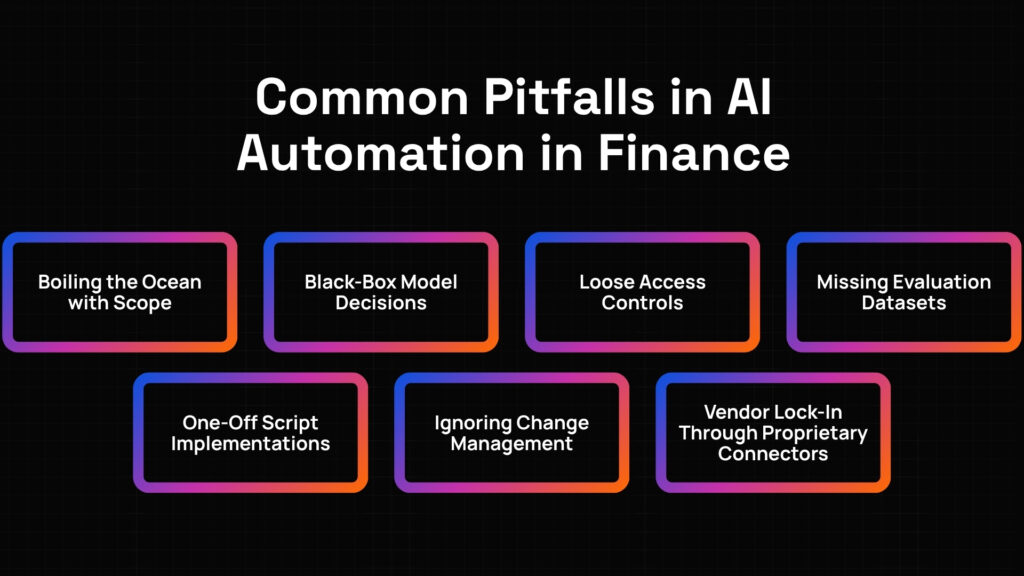
AI automation in finance promises consistency and efficiency, but poor planning and inadequate control design can create audit risk instead of operational improvements. Many finance organizations make avoidable mistakes during implementation that delay value realization and erode controller trust. To discover proven methodologies tailored for your accounting workflows and regulatory requirements, explore our AI Workflow Automation Services page for detailed finance automation frameworks and real-world AI automation examples.
- Boiling the Ocean with Scope: Some organizations attempt comprehensive AI automation in finance before proving value on a single high-impact workflow. Always start with one reconciliation type like bank-to-GL or AP vendor matching, demonstrate measurable coverage improvement, then expand to adjacent processes once patterns and thresholds are validated.
- Black-Box Model Decisions: A technically sound finance automation rollout can still fail audit scrutiny if decision logic lacks transparency. Require complete decision traces that show inputs, features, confidence scores, and policy citations for every matched transaction and escalated exception to support internal control testing and external audit walkthroughs.
- Loose Access Controls: Successful AI process automation requires strict role-based permissions aligned with segregation of duties principles. Bind system access to finance roles with least-privilege enforcement, ensure all write-back actions log user context, and implement approval workflows that maintain control separation between preparation and review functions.
- Missing Evaluation Datasets: Many teams launch AI automation in finance without establishing performance baselines from historical data. Curate three to six months of reconciliations with documented ground truth outcomes to benchmark precision, recall, and false positive rates before deploying automation to production close processes.
- One-Off Script Implementations: Organizations implementing finance automation without productization create maintenance nightmares and knowledge concentration risk. Codify standard operating procedures, confidence thresholds, and review steps into documented playbooks so any team member can execute reconciliations consistently and audit can validate control design.
- Ignoring Change Management: Controllers and AP/AR teams resistant to automation can undermine technically sound implementations. Pair pilots with desk-level training sessions, provide review checklists that build confidence in automated matching, and incorporate feedback loops that allow accountants to refine thresholds and escalation rules based on domain expertise.
- Vendor Lock-In Through Proprietary Connectors: Full automation dependency on vendor-specific integration patterns creates portability risk and negotiating weakness. Favor open adapter architectures that keep prompts and policies portable, ensure all automation artifacts are exportable, and maintain connector documentation that enables future platform migrations or in-house development.
Evaluating the ROI of AI Automation in Finance
Quantifying the benefits of AI automation in finance helps secure executive buy-in and refine future investments in financial operations technology. Measuring ROI goes beyond simple time savings; it captures gains in close speed, control quality, analyst capacity, and audit readiness. Without clear metrics during evaluation, finance automation risks becoming a feature-heavy project with unclear business outcomes that fail to justify ongoing operational expenses.
Key metrics to monitor include:
- Auto-Reconciliation Coverage Percentage: Track the increase in transactions matched automatically without manual intervention following implementation of AI process automation, with leading implementations achieving 60 to 80 percent coverage on high-volume accounts within 8 to 12 weeks.
- Days-to-Close Reduction: Measure the decrease in calendar days required to complete monthly or quarterly close processes as automated reconciliation enables continuous matching throughout the period rather than compressed period-end processing that delays reporting.
- Exception Volume Reduction: Evaluate the decrease in items flagged for manual review following AI automation in finance deployment, as intelligent matching with configurable confidence thresholds surfaces only true discrepancies rather than noise from formatting differences or timing mismatches.
- Rework Rate and False Positives: Compare the percentage of automated matches requiring reversal or correction before and after finance automation implementation, as high false positive rates indicate poorly calibrated thresholds that erode controller trust and waste analyst capacity.
- Write-Off and Adjustment Frequency: Assess reductions in unreconciled items written off or forced through journal entries when AI process automation flags anomalies early, enabling investigation and resolution while supporting documentation remains accessible rather than after trails go cold.
- Audit Finding and Control Exception Rates: Review improvements in internal control effectiveness and external audit results following implementation of finance automation with comprehensive audit trails, as consistent application of matching logic and complete decision documentation strengthen control environments.
According to Deloitte CFO Signals research, 79 percent of CFOs plan to use generative AI in operations within 24 months, demonstrating widespread recognition of automation value. KPMG reports that 72 percent of CEOs prioritize generative AI investments as strategic imperatives. However, McKinsey notes that only 11 percent of organizations operate AI at scale, with 40 percent citing explainability as a top concern. This gap underscores the importance of transparent AI automation in finance with complete decision traceability. When every matched transaction logs matching features and confidence scores, every exception documents escalation rationale, and every policy change maintains version history, organizations build audit-ready accounting operations that scale without increasing control risk or regulatory exposure.
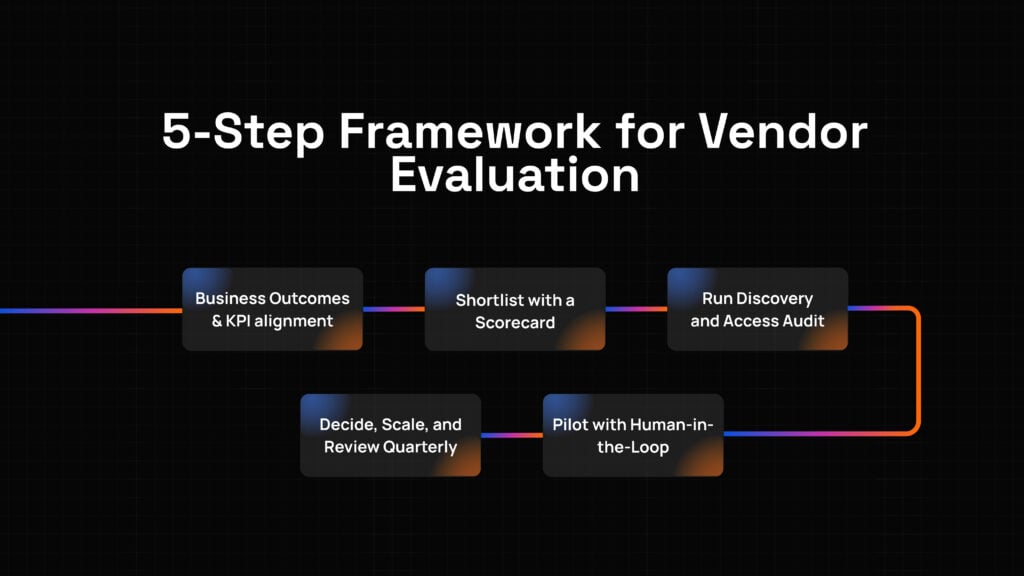
5-Step Framework for Vendor Evaluation
Selecting an AI automation in finance vendor should follow a disciplined, structured process that aligns with your organization’s accounting goals while accounting for both technological depth and long-term partnership potential. Instead of focusing solely on price or impressive demonstrations, evaluation should weigh how well the vendor’s finance automation solution supports control objectives, integrates with ERP systems, and adapts to evolving accounting standards.
1. Business Outcomes & KPI Alignment
Start by clearly outlining what success looks like and how it will be measured in financial operations terms. Defining specific KPIs and project scope early helps align all stakeholders including controllers, treasury teams, IT departments, and internal audit. Your goals might include achieving 60 to 80 percent auto-reconciliation on a high-volume account, reducing exception queues by 30 percent, or cutting days-to-close by specific calendar days, but they must be tied to measurable outcomes. This clarity becomes the foundation for every subsequent decision about AI automation in finance, shaping both vendor conversations and internal buy-in.
Example: A retail company defined its KPI as “achieving 70 percent auto-reconciliation coverage on bank-to-GL for the top 50 vendors using a rolling 90-day transaction window within 8 weeks.” This metric guided every vendor discussion, shaped pilot design, and became the benchmark for success measurement. The business case anchored on hours saved plus error reduction, not just SLA speed improvements. KPMG research shows nearly half of finance leaders have deployed or are piloting generative AI solutions.
Pro Tip: Document 3 to 5 measurable accounting outcomes before requesting proposals. Create a KPI tree that shows success metrics, control guardrails, and key risks so evaluation stays grounded in financial impact rather than technology feature lists, and helps vendors tailor demonstrations to your actual reconciliation challenges and ERP environment.
2. Shortlist with a Scorecard
Once objectives are clear, move to structured vendor comparison using a weighted scorecard for evaluating AI automation in finance providers. This tool allows teams to quantify how well each vendor aligns with their priorities from ERP integration depth and HITL control design to observability capabilities and asset portability. By assigning weights to each factor, decision-makers can balance technical capability with control effectiveness and audit defensibility. A disciplined scorecard approach removes subjectivity and ensures that even non-technical controllers understand trade-offs when selecting finance automation platforms.
Example: One financial services firm assigned 35 percent weight to SAP write-back capabilities with event-driven triggers and traceability for audit, and 30 percent to observability with complete decision traces and rollback mechanisms, which helped eliminate vendors with shallow API connections or black-box matching logic early in evaluation.
Pro Tip: Keep the scorecard fully quantitative to ensure fairness in vendor evaluation. Rate each criterion on a defined scale such as 1 to 5 where 1 is poor, 3 meets requirements, and 5 exceeds expectations, so decisions are driven by control requirements and business relevance rather than demo polish. Weight observability and portability higher than presentation quality.
3. Run Discovery and Access Audit
Before contracts are signed, a structured discovery phase ensures that all technical, control, and operational details are surfaced early when implementing AI process automation. During this phase, vendors should gain thorough understanding of your ERP architecture, bank feed providers, treasury systems, reconciliation procedures, and existing approval workflows. Running an access audit alongside discovery verifies data flows, permission structures, PII handling protocols, and role-based access controls, preventing control weaknesses and costly change orders later in implementation.
Example: A manufacturing company invited shortlisted AI automation in finance vendors for a two-week technical discovery with masked transaction samples, exposing read-only constraints on bank feeds that prevented real-time matching, missing role-bound approval capabilities in the ERP, and gaps in threshold documentation for policy violation escalation before signing contracts or allocating controller time.
Pro Tip: Ask vendors to deliver a brief “readiness summary” document at the end of discovery that identifies technical blockers like missing event webhooks, data quality issues in vendor masters or account hierarchies, model risk considerations, and realistic timeline estimates. Map each proposed control to an audit point to reduce year-end testing scramble and ensure control design documentation is complete.
4. Pilot with Human-in-the-Loop (HITL) and Dashboards
A well-designed pilot validates both performance and control effectiveness under real-world accounting conditions when exploring AI automation in finance. Instead of full-scale deployment, focus on a limited, high-impact workflow such as bank-to-GL reconciliation or AP vendor matching to test accuracy, control design, and team adoption. Incorporating human-in-the-loop review queues ensures that finance automation outcomes align with control standards and accounting judgment, while dashboards provide quantifiable visibility into precision, recall, false positive rates, and rework metrics.
Example: A healthcare organization piloted automated bank reconciliation for 10,000 transactions over three weeks with confidence thresholds set at 0.85 and achieved 73 percent auto-reconciliation coverage, with 96 percent precision, 4 percent false positive rate requiring reversal, and 4.2 out of 5 controller satisfaction scores. Track rework rate and false positives as these predict scale success. PwC research shows 49 percent of CEOs expect generative AI to increase profitability in the next 12 months.
Pro Tip: Use pilots to gather controller and analyst feedback through surveys and weekly review sessions. Create exception queue playbooks that document review steps and escalation criteria. Early adoption feedback often surfaces matching logic gaps, threshold calibration needs, or policy interpretation issues that precision metrics alone miss completely.
5. Decide, Scale, and Review Quarterly
After the pilot proves value, use its findings to guide the final decision and create a phased rollout plan for AI automation in finance. Scaling should be deliberate, expanding only after matching logic is refined, team training is complete, and performance metrics remain stable for two to three consecutive close cycles. Continuous quarterly reviews between your finance operations team and the vendor maintain alignment, ensuring the technology evolves alongside accounting policy changes, ERP upgrades, and organizational growth. These sessions assess ROI against initial KPI targets and plan expansions.
Example: A technology company conducted quarterly model and process reviews with its finance automation vendor, identifying policy optimization opportunities and adding duplicate invoice detection plus vendor risk alerts in Q2 that reduced exception volumes by 41 percent and improved days-to-close by 2.5 days over the first year while gradually raising confidence thresholds as controller trust grew.
Pro Tip: Treat vendor reviews as strategic sessions focused on expanding AI automation in finance use cases like risk flagging and policy violation detection, not just maintenance calls about system uptime. KPMG reports 72 percent of CEOs prioritize generative AI investments strategically. Treat prompts and policies like code with version control, change logs, and rollback capabilities to support control testing and continuous improvement.
Next Steps in Your Evaluation Process
By now, you should have a clear understanding of what to prioritize when selecting an AI automation in finance partner. Bringing these insights together creates a structured evaluation flow that de-risks investment and accelerates deployment while ensuring long-term control effectiveness and audit readiness.
- Align with accounting goals: Ensure every feature and function supports specific financial KPIs like auto-reconciliation coverage, days-to-close, and exception volumes, not just generic automation capabilities or impressive technology demonstrations that lack accounting relevance.
- Evaluate ERP and system integrations: Confirm that finance automation solutions work smoothly with your ERP, treasury management, AP/AR platforms, and bank providers through event-driven webhooks and bidirectional updates without requiring extensive custom development or ongoing maintenance overhead.
- Focus on control design and auditability: Choose vendors with documented decision traces, comprehensive audit trails, policy-enforced PII handling, and robust HITL workflow capabilities that enforce role-based review for high-risk transactions and maintain segregation of duties principles.
- Review enablement and change management: Favor partners who provide continuous training for controllers and analysts, reconciliation playbook development assistance, threshold calibration support, and operational rhythm documentation, not one-time technical onboarding sessions that leave teams unprepared.
- Test with a controlled pilot: Always run a controlled pilot with real transaction data and actual close processes before full deployment to validate matching accuracy, control effectiveness, team adoption, and audit defensibility under real-world accounting conditions with representative exception patterns.
With these criteria in place, you are better equipped to identify AI process automation vendors who not only automate reconciliations but also improve control quality, reduce audit findings, strengthen days-to-close performance, and amplify your team’s capacity to focus on strategic analysis and business partnership that drive enterprise value.
Vendor Questions to Ask
To make the most informed decision during your AI automation in finance evaluation, be sure to ask these essential questions:
- What KPIs will you own in the first 90 days including auto-reconciliation coverage and exception reduction, and how will we establish baselines from historical data?
- Which ERPs, treasury management systems, and bank providers do you support with read-write capabilities and event-driven triggers for statements and journal entries today?
- How do you enforce data minimization, PII masking, and purpose limitation in compliance with data privacy requirements and model risk management frameworks?
- Show a full decision trace for a reconciled transaction and a rejected exception with inputs, features, confidence scores, and policy citations visible for audit review?
- What evaluation set and metrics covering precision, recall, and false positives will we use before go-live, and how often will we refresh these benchmarks?
- How do rollbacks, feature flags, and kill switches work in production environments, and what monitoring alerts trigger automatic containment when accuracy degrades?
- Who owns prompts, policies, evaluation sets, and reconciliation playbooks at contract end, and how do we export all automation artifacts including connector configurations?
- What are the main model risks including explainability and monitoring gaps, and how do you mitigate these through control design and observability features?
- Can we run a 6 to 8 week pilot with human-in-the-loop review and target precision and recall metrics before committing to enterprise deployment?
- What are the assumptions behind your cost model including data volumes and inference counts, and what variables drive pricing variance as transaction volumes grow?
Transform Finance Operations with AI Automation in Finance
AI automation in finance is not just a technological investment; it is a strategic accounting capability that requires careful planning, vendor selection, and continuous control optimization. The right implementation brings consistency, audit readiness, and scalability across your reconciliation workflows, while poor execution creates model risk and controller resistance that undermines adoption and control effectiveness.
Ready to transform your finance operations with AI automation in finance? Book a Free Strategy Call with us to explore the next steps and discover how we can help you select, pilot, and scale the right finance automation solution for your unique reconciliation workflows, ERP environment, and control framework requirements.