

The Power of Understanding The Difference Between AI and Automation: Why It Matters
The difference between AI and automation has become a critical strategic question for modern enterprises navigating digital transformation. Organizations evaluating AI process automation are not simply choosing between technologies; they are fundamentally deciding how to balance predictable rule execution with intelligent decision-making in contexts requiring judgment. Understanding when to deploy classic automation versus artificial intelligence, or how to combine both approaches effectively, now determines which companies achieve measurable operational improvements versus those trapped in pilot purgatory with impressive demonstrations but unclear business outcomes.
The data supporting the urgency of this distinction continues to strengthen across industries. According to McKinsey research, 65 percent of surveyed organizations reported using generative AI in at least one business function in early 2024, up sharply from 2023, demonstrating rapid mainstream adoption. However, Deloitte findings reveal that only 38 percent of enterprises systematically track productivity outcomes from generative AI initiatives in 2024, highlighting measurement gaps. U.S. Census Business Trends and Outlook Survey data show low single-digit to low-teen current-use rates of AI across many industries in 2024, indicating that adoption remains uneven despite hype, making disciplined scoping and clear understanding of AI and automation differences essential for success.
Why the Difference Between AI and Automation Matters for Business Leaders
Understanding what is the difference between AI and automation goes beyond simple technology definitions; it transforms how organizations approach process improvement, risk management, and capability building. Classic automation and artificial intelligence solve fundamentally different problems, requiring distinct implementation approaches, governance frameworks, and success metrics. From rule-based workflow orchestration and structured data processing to probabilistic decision-making and unstructured content interpretation, AI process automation delivers measurable outcomes only when leaders match the right technology approach to specific business contexts and constraints.
For executives evaluating automation strategies, the AI automation benefits and tradeoffs manifest in five critical ways:
- Rule-Based Execution Strengths: Classic automation excels at repeatable workflows with structured inputs, delivering speed, consistency, and low variance that simplifies auditing and certification, while maintaining predictable costs based on transaction volumes and enabling straightforward ROI calculations.
- Adaptive Intelligence Capabilities: AI and automation handle ambiguous contexts like email classification, document extraction, and summarization where rigid rules fail, learning patterns from feedback data to improve coverage over time and unlocking outcomes like personalized responses at scale that static logic cannot achieve.
- Governance and Trust Requirements: AI process automation requires human-in-the-loop oversight, confidence thresholds, and transparency mechanisms like decision traces with rationale to build trust for decisions affecting customers, compliance, or financial commitments, respecting that 64 percent of customers prefer human opt-out options for AI-powered service.
- Cost Structure Considerations: Traditional automation charges predictably based on transaction volumes and system connections, while AI and automation combinations introduce variable costs from token usage, model inference, and compute resources that require monitoring, caching strategies, and cost optimization as volumes scale.
- Implementation and Autonomy Patterns: AI process automation requires progressive autonomy patterns starting with read-only observation, advancing to propose-and-approve modes, then graduating to auto-approval for low-risk decisions only after accuracy proves reliable, while classic automation can deploy fully autonomous workflows when rules are comprehensive and exception rates are low.
Understanding what is the difference between AI and automation is not about choosing one technology over another; it is about matching capabilities to business contexts, designing appropriate governance for probabilistic decisions, and measuring outcomes systematically rather than chasing impressive demonstrations without clear KPIs.

Key Considerations When Choosing AI and Automation Solutions
Selecting the right approach for AI process automation requires careful alignment between business requirements, risk tolerance, and technology capabilities. The most successful implementations balance automation’s predictability with AI’s adaptability, establishing clear boundaries where each technology excels while maintaining human oversight for high-stakes decisions.
Below are the core factors that should guide every decision about what is the difference between AI and automation for your specific use cases:
- Business Outcomes & KPI Alignment: Every AI process automation initiative must connect directly to one measurable business metric, whether that is cost per ticket, cycle time reduction, customer satisfaction score improvement, SLA hit rate increases, or cash applied per full-time equivalent. Vendors should demonstrate clear methodology for establishing baselines and target improvement ranges with confidence levels, not vague transformation promises disconnected from operational reality.
- Integration with Existing Systems: Effective AI and automation depends on seamless connectivity with your CRM, help desk, phone systems, treasury management platforms, ERP, productivity suites, and data warehouses. The ideal partner ensures smooth bidirectional data flow with read and write capabilities, real-time event triggers, retry logic, and idempotency guarantees so automated workflows can fetch context, execute actions, and maintain audit trails without manual intervention or data corruption risks.
- Security and Governance: AI process automation handles sensitive business data including customer information, financial records, and operational metrics that require strict controls. Confirm that vendors maintain data residency options, retention policies aligned with regulations, PII redaction capabilities, model isolation for multi-tenant environments, key management for secrets, and comprehensive audit logs that support both internal controls and regulatory compliance frameworks.
- Human-in-the-Loop (HITL) Flexibility: Successful AI and automation always includes human oversight mechanisms for decisions affecting customers, compliance obligations, or financial commitments. Ensure that workflows incorporate approval gates, route-to-human escalation pathways, reversible actions with undo capabilities, and safe defaults when confidence scores fall below thresholds, respecting customer preferences as 64 percent prefer human opt-out options for AI-powered service.
- Observability and Analytics: Transparency is essential when scaling AI process automation across business functions. A capable vendor provides full decision traces showing inputs, tool calls, outputs, confidence scores, and human approvals, plus pre-deployment and post-deployment evaluation harnesses with test sets, canary deployment patterns, rollback capabilities, and versioned prompts and policies that allow teams to identify drift and restore previous configurations immediately.
- Pricing Transparency and Flexibility: Insist on clear pricing models with explicit drivers including transaction volumes, system integration counts, model usage tokens, and support tier requirements. Understanding what is the difference between AI and automation economically helps forecast costs accurately, as AI introduces variable expenses from inference that classic automation avoids, requiring different budgeting approaches and cost optimization strategies.
Choosing partners who understand what is the difference between AI and automation ensures your investment delivers sustainable improvements rather than creating technical debt, vendor lock-in, or governance gaps that limit future flexibility and increase operational risk.
The Impact of Integration Readiness
Before launching any AI process automation initiative, organizations must thoroughly assess their systems architecture, process documentation quality, and data readiness. Integration readiness evaluates how well existing platforms, workflow definitions, and information structures can support the blend of automation and AI without creating context gaps or execution failures. When business teams conduct integration audits in advance, they uncover API limitations early, align IT and operations stakeholders around data quality requirements, and minimize wasted time during vendor discovery and pilot phases.
Example: A financial services company exploring what is the difference between AI and automation for customer service discovered that their CRM lacked webhook support for real-time case updates, their knowledge base articles contained inconsistent formatting that confused AI extraction, and their approval workflow documentation mixed deterministic rules suitable for classic automation with judgment-heavy decisions requiring AI assistance. Addressing these integration readiness issues before vendor engagement reduced the overall project timeline by nine weeks and improved classification accuracy by 43 percent during the pilot phase, while clarifying which workflow steps needed automation guardrails versus AI perception.
Pro Tip: Create an internal integration readiness checklist that evaluates API completeness with event-driven capabilities, assesses process documentation distinguishing deterministic rules from judgment-heavy decisions, confirms data quality across key entities, and documents risk levels for different action types. Start with read-only system access to validate data availability, then graduate to write permissions behind approval workflows for low-risk intents first, expanding autonomy only as accuracy and trust build systematically.
Common Pitfalls When Evaluating AI and Automation
Understanding what is the difference between AI and automation conceptually is insufficient; organizations must avoid common implementation mistakes that create risk instead of value. Many companies make avoidable errors during evaluation and deployment that delay benefits and erode stakeholder trust. To discover proven methodologies tailored for your specific workflows and risk profile, explore our AI Workflow Automation Services page for detailed frameworks distinguishing automation and AI use cases with real-world implementation guidance.
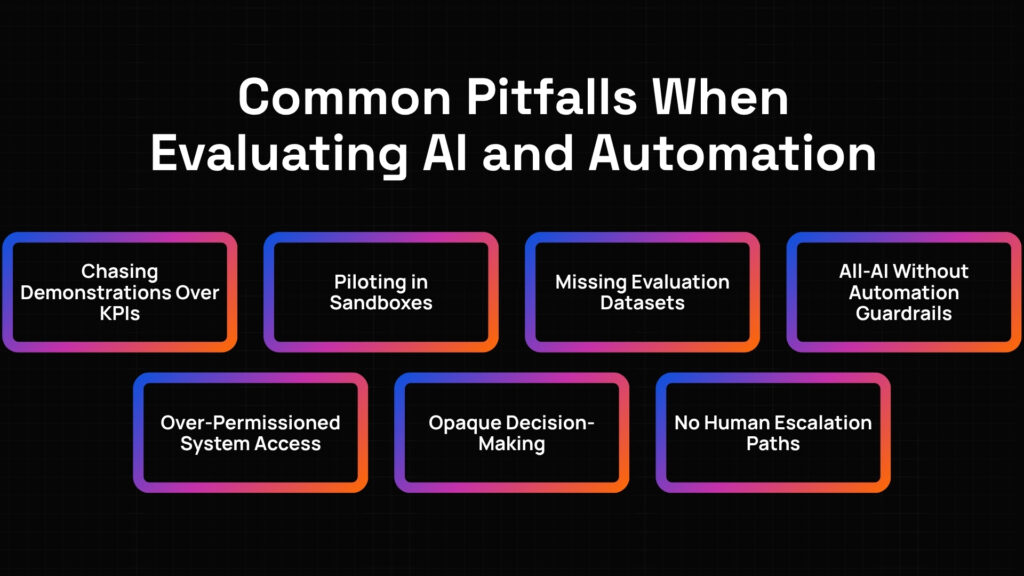
- Chasing Demonstrations Over KPIs: Some organizations evaluate AI process automation based on impressive vendor demos rather than measurable business outcomes. Always anchor every use case to one target metric with baseline measurements and defined success criteria before considering technology capabilities or provider selection.
- Piloting in Sandboxes: A common mistake is testing AI and automation in isolated environments with clean data rather than production systems with real complexity. Pilot in actual production workflows with narrow blast radius containing risk while validating performance against genuine operational conditions including messy data and edge cases.
- Missing Evaluation Datasets: Many teams deploy AI process automation without creating representative test sets covering expected inputs and pass-fail rules. Build 50 to 200 real examples with documented ground truth before any development work to establish evaluation harnesses that detect accuracy degradation throughout the lifecycle.
- All-AI Without Automation Guardrails: Organizations implementing AI without automation controls for data access, validation checks, and rollback mechanisms create governance gaps. Use classic automation to provide hard constraints, audit trails, and safety boundaries while AI provides perception and decision-making within those guardrails.
- Over-Permissioned System Access: Granting AI process automation broad write permissions from day one introduces risk when models hallucinate or drift. Start with read-only access to validate information retrieval, then graduate to write actions behind human approval gates for low-risk operations, expanding autonomy only after accuracy metrics prove reliable.
- Opaque Decision-Making: Successful AI and automation requires transparency for trust building and continuous improvement. Demand complete decision traces showing inputs, reasoning, confidence scores, and rationale for every action to support troubleshooting, audit requirements, and ongoing refinement of prompts and policies.
- No Human Escalation Paths: Deploying AI process automation without clear route-to-human mechanisms creates customer frustration and compliance risk. Add one-click escalation pathways and undo capabilities from day one, respecting that 64 percent of customers prefer human opt-out options for AI-powered service interactions.
Evaluating When to Use Automation, AI, or Both
Quantifying what is the difference between AI and automation helps determine the right technology approach for specific business contexts. Measuring this decision goes beyond simple capability comparisons; it requires assessing input structure, rule completeness, exception rates, risk levels, and regulatory constraints. Without clear evaluation frameworks, AI process automation initiatives drift toward using advanced technology for problems that simple automation solves better, or vice versa, wasting resources and creating unnecessary complexity.
Key decision factors to evaluate include:
- Input Structure and Consistency: Use classic automation when inputs follow structured formats with predictable fields and values, as rule-based processing delivers speed and consistency without inference costs, while AI and automation combinations excel when handling unstructured emails, documents, images, or natural language that resist rigid parsing logic.
- Rule Completeness and Exception Rates: Deploy traditional automation when business logic covers 90-plus percent of scenarios with explicit decision trees, as deterministic execution provides audit clarity and predictable costs, whereas AI process automation fits when rules are incomplete, exceptions are frequent, or decision criteria involve judgment that experts struggle to codify exhaustively.
- Risk Level and Reversibility: Favor automation for low-risk, easily reversible actions like data synchronization, status updates, or routing based on exact field matches, while AI and automation with human-in-the-loop approval gates suit high-risk or irreversible decisions affecting customer finances, compliance obligations, or contractual commitments that require judgment and documentation.
- Regulatory Scrutiny and Explainability: Choose deterministic automation when regulatory requirements demand complete auditability and explainability with minimal variance, as rule-based systems produce clear compliance documentation, whereas AI process automation requires additional governance including confidence thresholds, decision traces, and human oversight to satisfy scrutiny in regulated contexts like credit decisions or medical advice.
- Volume Economics and Cost Structure: Deploy classic automation for high-volume, repetitive tasks where predictable per-transaction costs enable straightforward ROI calculations, while understanding that AI and automation introduce variable inference expenses requiring monitoring and optimization strategies as token usage scales with complexity and volume.
- Learning and Adaptation Requirements: Use traditional automation when business rules remain stable over time with infrequent updates, as maintaining explicit logic is straightforward, whereas AI process automation delivers value when processes need continuous adaptation based on feedback, changing patterns, or personalization requirements that rigid rules cannot accommodate without exponential complexity.
According to McKinsey research, 65 percent of organizations used generative AI in at least one function by early 2024, showing mainstream adoption. However, Deloitte findings reveal only 38 percent systematically track productivity outcomes, while just 44 percent report transformative impact despite 67 percent increasing investment. These statistics underscore that understanding what is the difference between AI and automation practically, not just conceptually, determines success. When every technology choice connects to measurable KPIs, every AI decision includes confidence scores and human review options, and every automation maintains complete audit trails, organizations build scalable operations that balance efficiency with trust and adapt without creating ungoverned risk.
5-Step Framework for Deciding Between AI and Automation
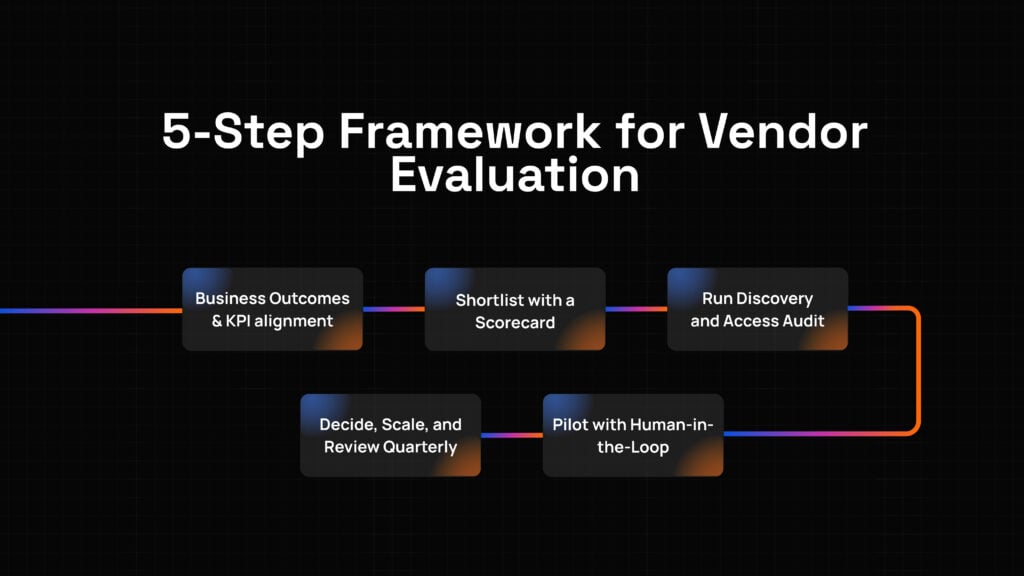
Selecting the right approach between AI process automation and classic automation should follow a disciplined process that prioritizes business outcomes over technology capabilities. Instead of choosing based on vendor demonstrations or technology trends, evaluation should assess specific workflow characteristics, risk profiles, and measurable success criteria that determine optimal technology fit.
1. Business Outcomes & KPI Alignment
Start by clearly outlining what success looks like with one measurable metric tied to a specific workflow step. Defining the KPI and documenting before-state versus after-state helps align all stakeholders including operations leadership, IT teams, and compliance officers. Your goal might be reducing average handle time for password resets by 25 percent, improving invoice processing cycle time, or increasing first-contact resolution rates, but it must be quantifiable. This clarity becomes the foundation for deciding what is the difference between AI and automation for your specific context.
Example: A technology company defined its KPI as “reducing average handle time for password reset requests by 25 percent within 90 days.” Analysis revealed that 80 percent of resets followed deterministic rules based on account status, suitable for classic automation, while 20 percent required judgment about security exceptions, indicating AI assistance needs. If you cannot measure the KPI today, fix instrumentation first before evaluating technology. Deloitte reports only 38 percent of enterprises systematically track productivity outcomes from generative AI initiatives.
Pro Tip: Document the single metric and one workflow step before requesting vendor proposals. Map which portions involve structured inputs with complete rules versus unstructured content requiring interpretation to determine whether automation, AI, or AI process automation blending both approaches fits your requirements and risk tolerance.
2. Shortlist with a Scorecard
Once objectives are clear, move to structured comparison using a weighted scorecard for evaluating providers. This tool allows teams to quantify how well each vendor aligns with priorities including integration depth, governance frameworks, human-in-the-loop design, and observability capabilities. By assigning weights to each factor, decision-makers can balance technical capability with business risk management and cost structure considerations specific to understanding what is the difference between AI and automation economically.
Example: One financial services firm assigned 30 percent weight to integration depth with read-write capabilities and rollback mechanisms, 25 percent to governance controls and KPI alignment methodologies, 25 percent to human-in-the-loop patterns with configurable approval thresholds, and 20 percent to pricing transparency with clear cost drivers, which helped eliminate vendors lacking proof of write actions with safety controls.
Pro Tip: Keep the scorecard fully quantitative to ensure fairness. Rate each criterion on a defined scale such as 1 to 5 so decisions are driven by operational requirements rather than sales presentation quality. Ask vendors for proof of write actions with rollback capabilities, not just read-only demonstrations that avoid addressing governance complexity.
3. Run Discovery and Access Audit
Before contracts are signed, a structured discovery phase maps the complete process including triggers, inputs, systems, approval requirements, SLAs, and risk levels. During this phase, teams document which steps involve deterministic logic suitable for automation versus ambiguous contexts requiring AI perception. Running an access audit verifies API capabilities, permission structures, and data quality, while clarifying what is the difference between AI and automation requirements for your specific systems and controls.
Example: A retail company mapped their customer inquiry process as: intake email, classify intent (AI for ambiguity), fetch customer data (automation for structured lookup), propose reply (AI for personalization), human approve high-value cases (HITL governance), send response (automation for delivery), log to CRM (automation for audit trail). This mapping clarified technology boundaries and governance requirements before vendor engagement.
Pro Tip: Start with read-only system access to validate that AI can retrieve necessary context and automation can access required data sources. Promote to write permissions for low-risk intents first like password resets or address changes, expanding to higher-risk operations only after accuracy metrics and approval workflows prove reliable across representative volumes.
4. Pilot with Human-in-the-Loop and Dashboards
A well-designed pilot validates both technology performance and governance effectiveness under real-world conditions. Instead of full-scale deployment, focus on a limited, high-impact workflow to test the boundary between AI and automation with actual data complexity and edge cases. Incorporating human-in-the-loop review queues ensures outcomes align with business standards and risk tolerance, while dashboards provide quantifiable visibility into accuracy, escalation rates, and cost metrics that inform scale decisions.
Example: A software company piloted AI process automation for password reset chats, containing 30 percent of volume with AI classification and automated execution while escalating the remaining 70 percent to human agents. Pre-approved actions executed automatically up to confidence threshold 0.85, requiring human review above that level. Results showed 91 percent accuracy for auto-handled cases with 23 percent average handle time reduction. Deloitte findings show 67 percent of organizations increased generative AI investment in 2024, but only 44 percent reported transformative impact, highlighting the importance of measurement.
Pro Tip: Launch pilots with guardrails and live metrics tracking accuracy, escalation frequency, cost per interaction, and customer satisfaction. Run AI in shadow mode for 2 to 4 weeks alongside human agents to compare outcomes before granting autonomous execution authority, establishing evaluation-as-code practices with versioned test sets to detect drift continuously.
5. Decide, Scale, and Review Quarterly
After the pilot proves value, use findings to guide the final decision about which portions warrant automation, which require AI, and where human oversight remains essential. Scaling should be deliberate, expanding successful patterns while killing underperforming approaches and adding one adjacent workflow step at a time. Continuous quarterly reviews maintain alignment as business rules evolve, model performance drifts, and new use cases emerge that benefit from understanding what is the difference between AI and automation applied to changing contexts.
Example: A financial institution conducted quarterly model and prompt reviews after successful password reset automation, expanding to account unlocks and MFA troubleshooting in subsequent quarters. Reviews identified prompt optimizations that improved accuracy by 8 percentage points and reduced token costs by 31 percent while catching model drift that would have degraded customer experience if undetected.
Pro Tip: Treat quarterly reviews as strategic sessions focused on expanding successful AI process automation patterns, refining the boundary between automation and AI as understanding deepens, and optimizing cost structure as volumes scale. Ship what works, kill what doesn’t, and keep measurement discipline to avoid pilot purgatory where initiatives never graduate to measurable production impact despite ongoing investment.
Next Steps in Your Evaluation Process
By now, you should have a clear understanding of what is the difference between AI and automation and how to apply that distinction to your specific business context. Bringing these insights together creates a structured evaluation flow that matches technology capabilities to workflow requirements while de-risking investment and accelerating value delivery.
- Align with measurable outcomes: Ensure every use case connects to one specific KPI with baseline measurements and target improvements, not generic efficiency claims or impressive demonstrations disconnected from operational metrics that stakeholders track.
- Map workflow boundaries: Document which process steps involve structured inputs with complete rules suitable for classic automation versus unstructured content with ambiguous contexts requiring AI perception, and where human judgment must remain in the loop for risk management.
- Evaluate integration depth: Confirm that solutions provide read-write access with event triggers, retry logic, and idempotency guarantees for your specific systems, starting with read-only access and graduating to writes behind approval workflows as accuracy proves reliable.
- Focus on governance and transparency: Choose vendors who provide complete decision traces with confidence scores, pre-deployment evaluation harnesses, versioned prompts and policies, rollback capabilities, and human escalation pathways that respect customer preferences for AI opt-out.
- Test with progressive autonomy: Always run controlled pilots with narrow scope and guardrails before full deployment, starting with shadow mode observation, advancing to propose-and-approve patterns, then graduating to autonomous execution only for low-risk decisions after accuracy metrics stabilize.
With these criteria in place, you are better equipped to understand what is the difference between AI and automation for your organization and identify partners who deliver measurable outcomes rather than technology demonstrations, balance efficiency with trust and governance, and enable scaling without creating ungoverned risk or vendor lock-in.
Vendor Questions to Ask
To make the most informed decision when evaluating what is the difference between AI and automation for your use cases, be sure to ask these essential questions:
- How do you align use cases to a single measurable KPI and establish baseline performance before pilot launch?
- What systems do you read from and write to, and how are write actions approved with rollback capabilities if automation or AI makes incorrect decisions?
- Show me complete decision traces for real scenarios including inputs, tools called, outputs, confidence scores, and documentation of human approval when required?
- What is your evaluation methodology including test set creation, pass-fail rubrics, and continuous monitoring for drift as data patterns or business rules change?
- How do you handle personally identifiable information including redaction, retention policies, data residency requirements, and model isolation to prevent cross-tenant data leakage?
- What is the escalation path and undo story for incorrect actions, and how do customers reach humans when they prefer not to interact with AI?
- Which assets do we own at handover including prompts, policies, evaluation sets, process diagrams, and integration code to enable vendor switching or in-house development?
- How do we port automation workflows and AI models to another vendor or platform if needed without losing capabilities or rebuilding from scratch?
- What are the price drivers including transaction volumes, model inference tokens, and system integration counts, and how do costs scale as usage grows?
- Can I speak to two customer references with similar systems, risk profiles, and use cases who can discuss measured outcomes and implementation challenges?
Transform Operations by Understanding AI and Automation
Understanding what is the difference between AI and automation is not just a technical distinction; it is a strategic capability that requires careful analysis, disciplined scoping, and continuous measurement. The right implementation balances automation’s predictability with AI’s adaptability, establishes clear governance for probabilistic decisions, and scales based on measured outcomes rather than technology enthusiasm or vendor pressure.
Ready to transform your operations by understanding what is the difference between AI and automation for your specific context? Book a Free Strategy Call with us to explore the next steps and discover how we can help you scope, pilot, and scale the right blend of automation and AI for your unique workflows, risk profile, and measurable business outcomes.