
The Power of Understanding AI Automation vs RPA: Why It Matters
The choice between AI automation vs RPA has become a critical strategic decision for modern enterprises navigating digital transformation and process optimization. Organizations evaluating hybrid AI process automation are not simply choosing between technologies; they are fundamentally deciding how to balance deterministic execution with intelligent decision-making in workflows requiring both structured actions and unstructured interpretation. Understanding when to deploy classic robotic process automation versus artificial intelligence capabilities, or how to combine both approaches effectively in an AI automation platform, now determines which companies achieve measurable operational improvements versus those struggling with brittle screen-scrapers and edge cases that never quite resolve.
The data supporting the urgency of this distinction continues to strengthen across industries. According to McKinsey research, generative AI’s economic potential is estimated at $2.6 trillion to $4.4 trillion USD annually across functions, with much of the value coming from automated knowledge work that combines structured and unstructured processing. Healthcare RPA case studies show approximately 80 percent reduction in task time for repetitive electronic health record operations, while multi-industry reviews report up to 94 percent time reduction in certain deterministic UI tasks, though these extreme results require validation in specific contexts.
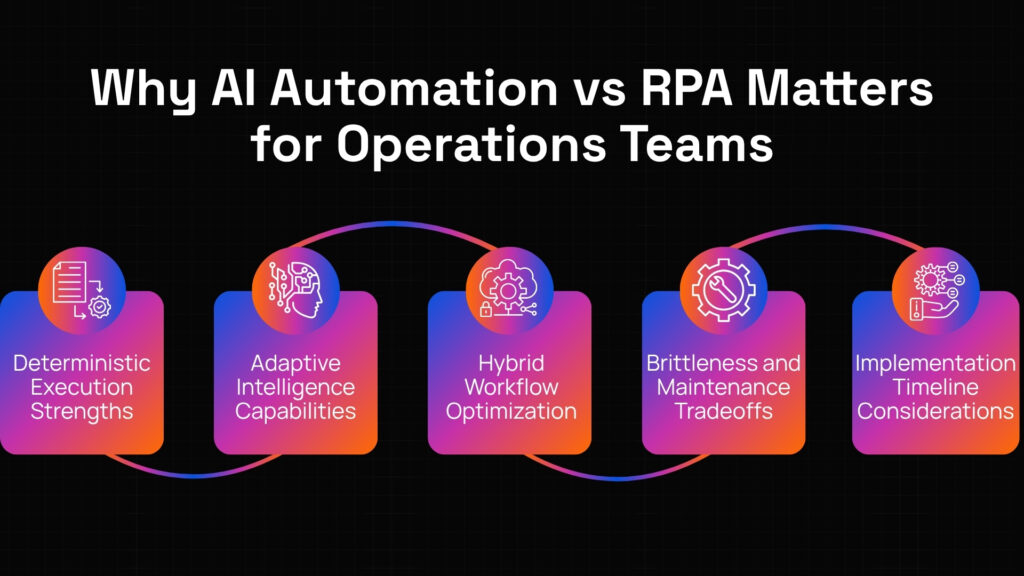
Why AI Automation vs RPA Matters for Operations Teams
Understanding AI automation vs RPA goes beyond simple technology definitions; it transforms how organizations approach process improvement, resilience planning, and capability building. Classic RPA and AI process automation solve fundamentally different problems, requiring distinct implementation approaches, governance frameworks, and success metrics. From deterministic UI interactions and structured data entry to probabilistic interpretation of emails, documents, speech, and contextual decisions, hybrid AI automation platforms deliver measurable outcomes only when leaders match the right technology approach to specific workflow characteristics and operational constraints.
For operations leaders evaluating automation strategies, the distinction manifests in five critical ways:
- Deterministic Execution Strengths: Classic RPA excels at stable user interface navigation with clear rules, executing clicks, keystrokes, and data transfers with speed, consistency, and low latency that simplifies auditing and certification, while maintaining predictable costs based on bot licenses and infrastructure without variable inference expenses.
- Adaptive Intelligence Capabilities: AI process automation handles unstructured inputs including emails, PDFs, calls, chats, images, and ambiguous contexts where rigid rules fail, learning patterns from examples to improve coverage over time and unlocking outcomes like intelligent triage and contextual extraction that deterministic logic cannot achieve without exponential complexity.
- Hybrid Workflow Optimization: Most real-world business processes are mixed, combining structured inputs requiring deterministic actions with unstructured context needing interpretation, as exemplified by reading vendor emails to extract line items then posting to ERP systems, where AI automation platform architectures combining both technologies deliver superior resilience compared to pure-play approaches.
- Brittleness and Maintenance Tradeoffs: RPA implementations fail when user interfaces change or exception rates rise beyond rule coverage, requiring frequent maintenance and updates, whereas AI process automation adapts to input variance but introduces model drift risks, hallucination potential, and variable costs that require continuous evaluation, monitoring, and governance.
- Implementation Timeline Considerations: Classic RPA can deploy rapidly for well-defined UI automation when interfaces remain stable and exception rates stay low, while AI automation vs RPA hybrid approaches require longer initial development including training data curation, evaluation set creation, and confidence threshold tuning, but deliver greater long-term resilience as business contexts evolve.
Understanding AI automation vs RPA is not about choosing one technology over another; it is about matching capabilities to workflow characteristics, designing appropriate governance for both deterministic and probabilistic components, and measuring outcomes systematically through cycle time, error rates, and cost per transaction rather than chasing impressive demonstrations without clear operational KPIs.
Key Considerations When Choosing AI Automation Platforms
Selecting the right approach for AI process automation requires careful alignment between business requirements, process characteristics, and technology capabilities. The most successful implementations balance RPA’s deterministic reliability with AI’s adaptive intelligence, establishing clear boundaries where each technology excels while maintaining human oversight for high-stakes decisions that affect compliance, customer relationships, or financial commitments.
Below are the core factors that should guide every decision about AI automation vs RPA for your specific workflows:
- Business Outcomes & KPI Alignment: Every AI process automation initiative must connect directly to measurable operational metrics, whether that is reducing invoice cycle time from 5 days to 36 hours, lowering cost per transaction by specific percentages, improving error rates below 1 percent thresholds, or increasing net promoter scores through faster resolution. Vendors should demonstrate clear methodology for defining targets with baseline measurements and pass-fail criteria, not vague efficiency promises.
- Integration with Existing Systems: Effective AI automation platforms depend on seamless connectivity with your CRM, help desk, phone systems, treasury management platforms, ERP, and line-of-business applications. The ideal partner ensures smooth bidirectional data flow with read and write scopes, event-driven webhooks, retry logic, and comprehensive audit logs so automated workflows can fetch context, execute actions across both modern APIs and legacy UIs, and maintain compliance documentation.
- Security and Governance: AI process automation handles sensitive business data including customer information, financial records, protected health information, and payment card data that require strict controls. Confirm that vendors maintain single sign-on integration, comprehensive audit logging, PII and PHI controls aligned with regulatory requirements, data residency options, key rotation schedules, and threat models addressing both RPA credential management and AI prompt injection risks.
- Human-in-the-Loop (HITL) Flexibility: Successful AI automation vs RPA hybrid implementations always include human oversight mechanisms for decisions affecting customers, compliance obligations, or financial commitments. Ensure that workflows incorporate approval gates for high-risk actions, exception queues routing edge cases to subject matter experts, safe fallback mechanisms to saved responses when confidence drops, and escalation pathways with complete context for human review.
- Observability and Analytics: Transparency is essential when scaling AI process automation across business functions. A capable vendor provides complete decision traces showing inputs, tool calls, outputs, confidence scores, retry attempts, and human approvals, plus evaluation frameworks detecting drift, dashboards surfacing performance metrics, versioned prompt and policy management, and instant rollback capabilities restoring previous configurations when issues emerge.
- Pricing Transparency and Flexibility: Insist on clear pricing models with explicit assumptions around transaction volumes, bot licenses, AI inference usage, and system integration counts. Understanding AI automation vs RPA economically helps forecast costs accurately, as AI introduces variable expenses from token usage while RPA maintains predictable per-bot pricing, requiring different budgeting approaches and cost optimization strategies as volumes scale.
Choosing AI automation platform partners who understand the distinction between deterministic and probabilistic automation ensures your investment delivers sustainable improvements rather than creating technical debt, vendor lock-in, or governance gaps that limit future flexibility and increase operational risk when business processes or system interfaces change.
The Impact of Integration Readiness
Before launching any AI process automation initiative, organizations must thoroughly assess their systems architecture, process documentation quality, and data readiness. Integration readiness evaluates how well existing platforms, workflow definitions, and information structures can support hybrid automation combining RPA and AI without creating context gaps or execution failures. When business teams conduct integration audits in advance, they uncover API limitations and UI stability issues early, align IT and operations stakeholders around data quality requirements, and minimize wasted time during vendor discovery and pilot phases.
Example: A healthcare organization exploring AI automation vs RPA for claims processing discovered that their electronic health record system lacked webhook support for real-time updates requiring RPA screen-scraping, their claim documents contained inconsistent formatting that confused simple optical character recognition, and their approval workflow documentation mixed deterministic rules suitable for classic RPA with medical coding decisions requiring AI interpretation. Addressing these integration readiness issues before vendor engagement reduced the overall project timeline by eleven weeks and improved extraction accuracy by 51 percent during the pilot phase, while clarifying which workflow steps needed RPA deterministic actions versus AI process automation intelligence.
Pro Tip: Create an internal integration readiness checklist that evaluates API completeness with event-driven capabilities versus UI stability requiring RPA automation, assesses process documentation distinguishing deterministic rules from judgment-heavy decisions, confirms data quality across key entities and document formats, and documents risk levels for different action types. Grant read-only system access first to validate data schemas, rate limits, and authentication scopes before deploying any automation, and include red-team prompt testing to surface potential jailbreak risks when AI components handle sensitive data.
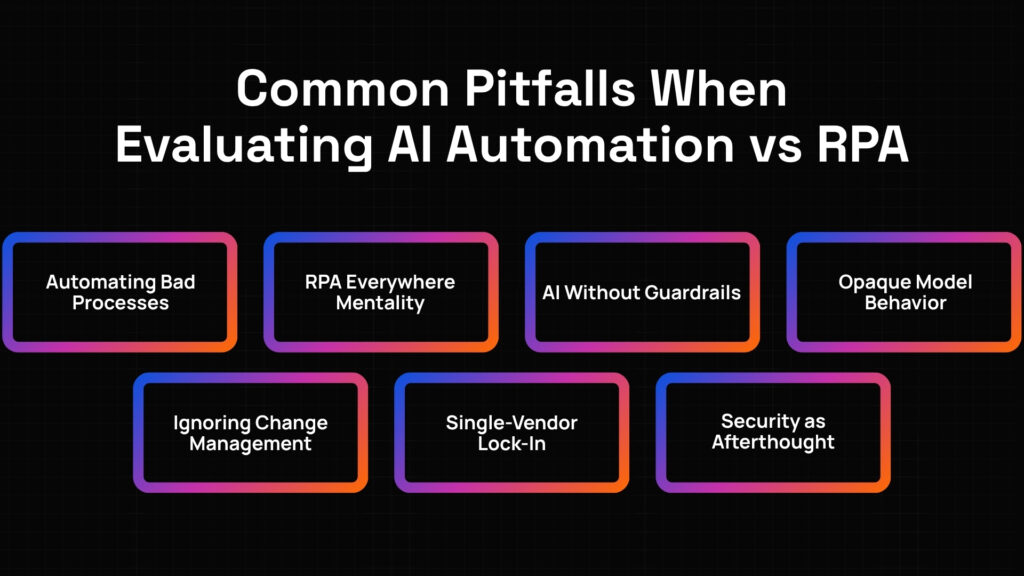
Common Pitfalls When Evaluating AI Automation vs RPA
Understanding AI automation vs RPA conceptually is insufficient; organizations must avoid common implementation mistakes that create maintenance burden instead of operational value. Many companies make avoidable errors during evaluation and deployment that delay benefits and erode stakeholder trust. To discover proven methodologies tailored for your specific workflows and risk profile, explore our AI Workflow Automation Services page for detailed frameworks distinguishing RPA and AI automation platform use cases with real-world hybrid implementation guidance.
- Automating Bad Processes: Some organizations rush to automate existing workflows without questioning their efficiency. Always run 2-week discovery sessions to remove unnecessary steps, consolidate approvals, and eliminate workarounds before building any automation, whether RPA, AI, or hybrid approaches.
- RPA Everywhere Mentality: A common mistake is deploying classic RPA for workflows with unstable user interfaces or high document variance. Reserve RPA for stable UI automation with clear rules and low latency requirements, routing unstructured work like email interpretation and document extraction to AI process automation services.
- AI Without Guardrails: Organizations implementing AI automation platforms without safety controls create governance gaps and hallucination risks. Add human-in-the-loop checkpoints for high-value decisions, implement auto-fallback mechanisms to saved responses when confidence scores drop below thresholds, and maintain approval workflows for actions affecting customers or compliance.
- Opaque Model Behavior: Successful AI process automation requires transparency for trust building and continuous improvement. Require comprehensive evaluation frameworks with test sets, drift detection alerts comparing current performance to baseline metrics, versioned releases with change documentation, and complete traces showing decision rationale for every automated action.
- Ignoring Change Management: Controllers and operations teams resistant to automation can undermine technically sound implementations. Train subject matter experts early in pilot phases, publish concise runbooks for each automated workflow with troubleshooting steps, and incorporate feedback loops allowing operators to refine rules and thresholds based on domain expertise.
- Single-Vendor Lock-In: Organizations implementing AI automation vs RPA solutions without portability planning create long-term dependency and negotiating weakness. Keep prompts, evaluation sets, and system connectors portable in standard formats, ensure all automation artifacts including process diagrams and test harnesses are exportable, and maintain architecture documentation enabling future platform migrations.
- Security as Afterthought: Deploying automation without credential management and access controls from day one creates compliance risk. Gate secrets using vault infrastructure, rotate API keys and RPA credentials on regular schedules, log all access attempts with user context, and implement least-privilege principles for both bot accounts and AI service permissions.
Evaluating When to Use RPA, AI, or Both
Quantifying AI automation vs RPA helps determine the right technology approach for specific business contexts. Measuring this decision goes beyond simple capability comparisons; it requires assessing input structure, rule completeness, UI stability, exception rates, and latency requirements. Without clear evaluation frameworks, AI process automation initiatives drift toward using advanced technology for problems that simple RPA solves better, or vice versa, wasting resources and creating unnecessary complexity or brittleness.
Key decision factors to evaluate include:
- Input Structure and Variance: Use classic RPA when inputs follow structured formats with predictable fields, stable user interfaces, and consistent data quality, as deterministic automation delivers speed and reliability without inference costs, while AI automation platforms excel when handling unstructured emails, scanned documents, natural language, or images that resist rigid parsing logic and require contextual interpretation.
- Rule Completeness and Exception Rates: Deploy traditional RPA when business logic covers 90-plus percent of scenarios with explicit if-then-else decision trees and user interface changes occur infrequently, whereas AI process automation fits when rules are incomplete, exceptions are frequent, UI elements shift regularly, or decision criteria involve judgment that subject matter experts struggle to codify exhaustively into deterministic flowcharts.
- UI Stability and Change Frequency: Favor RPA for applications with stable interfaces, consistent element identifiers, and infrequent version updates where screen-scraping and click automation remain reliable, while AI automation vs RPA hybrid approaches suit environments with frequent UI changes, dynamic content, or multiple system versions requiring adaptive navigation that brittle element selectors cannot maintain without constant updates.
- Latency Requirements and Volume: Choose deterministic RPA when microsecond response times are critical and transaction volumes justify dedicated bot infrastructure with predictable per-transaction costs, understanding that AI process automation introduces variable latency from inference plus token costs that scale with input complexity, making economic tradeoffs different at various volume levels.
- Adaptability and Learning Needs: Use traditional RPA when processes remain stable over time with infrequent policy updates that are simple to encode as new rules, whereas AI automation platforms deliver value when workflows need continuous adaptation based on feedback, changing document formats, or personalization requirements that rigid deterministic logic cannot accommodate without exponential rule complexity and maintenance burden.
- Audit Trail and Compliance Requirements: Deploy classic RPA when regulatory requirements demand complete deterministic auditability with minimal variance and full reconstruction of every decision step, as rule-based systems produce clear compliance documentation, whereas AI process automation requires additional governance including confidence scores, decision traces with rationale, and human oversight records to satisfy scrutiny in highly regulated contexts.
According to McKinsey research, generative AI could unlock $2.6 trillion to $4.4 trillion annually in economic value across functions. IBM’s 2024 index shows 45 percent of large enterprises already use AI in key workflows. These statistics underscore that understanding AI automation vs RPA practically, not just conceptually, determines success. When every technology choice connects to measurable cycle time and error rate KPIs, every AI decision includes confidence scores and human review options for edge cases, every RPA bot maintains comprehensive execution logs, and hybrid workflows combine both approaches where appropriate, organizations build scalable operations that balance efficiency with resilience and adapt to changing business contexts without creating ungoverned risk or brittle dependencies.
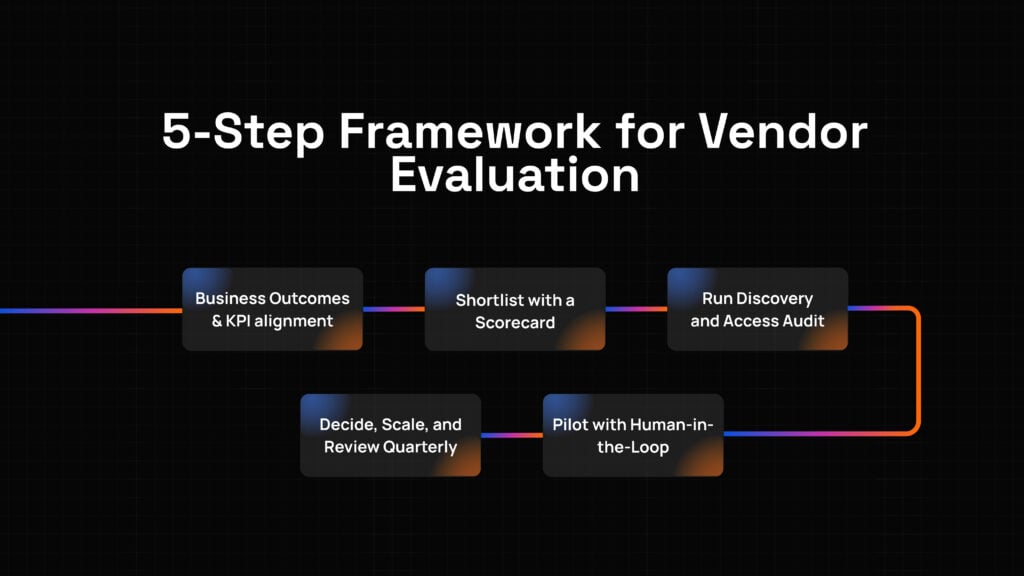
5-Step Framework for Deciding Between RPA and AI
Selecting the right approach between AI process automation and classic RPA should follow a disciplined process that prioritizes business outcomes over technology capabilities. Instead of choosing based on vendor demonstrations or technology trends, evaluation should assess specific workflow characteristics, input variance, UI stability, and measurable success criteria that determine optimal technology fit for each process component.
1. Business Outcomes & KPI Alignment
Start by clearly outlining what success looks like with one measurable metric tied to a specific workflow. Defining the KPI and documenting before-state versus after-state helps align all stakeholders including operations leadership, IT teams, subject matter experts, and compliance officers. Your goal might be reducing invoice processing cycle time from 5 days to 36 hours with less than 1 percent exception rate, improving order-to-cash speed, or cutting cost per transaction by specific percentages, but it must be quantifiable. This clarity becomes the foundation for deciding AI automation vs RPA for your specific context.
Example: A financial services company defined its KPI as “reducing vendor invoice processing cycle time from 5 days to 36 hours while maintaining exception rate below 1 percent within 90 days.” Analysis revealed that 70 percent of invoices followed standard formats suitable for RPA data entry, while 30 percent required interpretation of unstructured email attachments indicating AI process automation needs for extraction before deterministic posting.
Pro Tip: Document the single metric and one to two workflows before requesting vendor proposals. Cap pilots at limited scope with clear pass-fail thresholds measured over defined periods. Map which portions involve structured UI interactions with stable interfaces versus unstructured content requiring interpretation to determine whether RPA, AI, or AI automation platform architectures blending both approaches fit your requirements and risk tolerance.
2. Shortlist with a Scorecard
Once objectives are clear, move to structured comparison using a weighted scorecard for evaluating AI automation vs RPA providers. This tool allows teams to quantify how well each vendor aligns with priorities including integration depth covering both APIs and UI automation, governance frameworks addressing credential management and model risk, human-in-the-loop design, and observability capabilities. By assigning weights to each factor, decision-makers can balance technical capability with business risk management and cost structure considerations specific to understanding deterministic versus probabilistic automation economically.
Example: One healthcare organization assigned 30 percent weight to integration depth including both modern API connectors and stable RPA UI automation capabilities, 25 percent to governance controls addressing both credential rotation and AI prompt security, 20 percent to observability with complete traces showing retries and rollbacks, and 25 percent combined for delivery speed and reference validation, which helped eliminate vendors lacking proof of hybrid workflow orchestration.
Pro Tip: Keep the scorecard fully quantitative to ensure fairness. Rate each criterion on a defined scale such as 1 to 5 so decisions are driven by workflow requirements rather than sales presentation quality. Ask vendors for live trace demonstrations showing logs, retry logic, rollback procedures, and how systems handle rate limits and back-pressure during volume spikes to validate operational claims.
3. Run Discovery and Access Audit
Before contracts are signed, a structured discovery phase maps the complete process including system access patterns, UI stability assessment, and data quality validation. During this phase, teams document which steps involve stable interfaces with clear rules suitable for RPA versus ambiguous contexts requiring AI perception. Running an access audit verifies API capabilities versus UI automation requirements, validates data schemas and rate limits, confirms authentication scopes, and clarifies AI automation vs RPA technology boundaries with governance requirements for each component type.
Example: A manufacturing company mapped their vendor onboarding process as: receive email with attachments (AI for extraction), classify vendor type (AI for categorization), validate tax documentation (AI for document interpretation), enter master data (RPA for deterministic form filling), trigger approval workflow (RPA for routing), send confirmation (RPA for email template). This mapping clarified technology boundaries and helped right-size the AI automation platform scope before vendor engagement.
Pro Tip: Grant read-only system access first to validate that AI can retrieve necessary context and RPA can identify stable UI elements reliably. Include red-team prompt testing to surface potential jailbreak risks when AI components will handle sensitive data. Validate rate limits and back-pressure handling procedures for both API integrations and bot execution during expected peak volumes to prevent production failures.
4. Pilot with Human-in-the-Loop and Dashboards
A well-designed pilot validates both technology performance and governance effectiveness under real-world conditions. Instead of full-scale deployment, focus on limited workflow scope routing 10 to 20 percent of volume to the hybrid automation flow while maintaining baseline processes for comparison. Incorporating human-in-the-loop review queues ensures outcomes align with business standards and risk tolerance, while dashboards provide quantifiable visibility into cycle time improvements, cost per transaction, error rates, and exception patterns that inform scale decisions.
Example: A logistics company piloted AI process automation plus RPA for shipment exception handling, routing 15 percent of volume through the hybrid flow for 6 weeks and achieving 68 percent cycle time reduction, 0.4 percent error rate, and 4.1 out of 5 operations team satisfaction scores while identifying 8 edge cases requiring additional rules. Freeze the baseline for two weeks so improvements are measurable through A/B comparison on time, cost, and errors.
Pro Tip: Launch pilots with guardrails and live metrics tracking cycle time, cost per transaction, error rates, and human escalation frequency. Evaluate both RPA execution logs and AI decision traces to identify brittleness from UI changes or accuracy degradation from input drift. Route one process per quarter through refactor sessions to reduce technical debt and incorporate learnings from production edge cases.
5. Decide, Scale, and Review Quarterly
After the pilot proves value, use findings to guide the final decision about which portions warrant RPA deterministic automation, which require AI process automation intelligence, and where human oversight remains essential. Scaling should be deliberate, expanding to 80 percent of volume only after performance metrics remain stable for quarterly evaluation periods with documented rollback plans. Continuous quarterly reviews maintain alignment as business rules evolve, system interfaces change, and new workflow variants emerge that benefit from understanding AI automation vs RPA applied to changing contexts.
Example: A healthcare payer conducted quarterly process reviews after successful claims adjudication automation, expanding from simple claims to complex cases requiring medical coding interpretation in subsequent quarters. Reviews identified opportunities to shift certain stable decisions from AI to RPA rules as patterns became clear, reducing variable inference costs by 29 percent while improving overall cycle time by 72 percent over the first year.
Pro Tip: Treat quarterly reviews as strategic sessions focused on optimizing the boundary between RPA and AI as understanding deepens, retiring underperforming components, and planning technology refresh for workflows where UI changes have degraded RPA reliability or where new AI capabilities enable better outcomes. Maintain prompt and policy version control with rollback capabilities, and keep test harnesses and evaluation sets current to detect performance drift early.
Next Steps in Your Evaluation Process
By now, you should have a clear understanding of AI automation vs RPA and how to apply that distinction to your specific business context. Bringing these insights together creates a structured evaluation flow that matches technology capabilities to workflow requirements while de-risking investment and accelerating value delivery.
- Align with measurable outcomes: Ensure every use case connects to specific KPIs including cycle time reduction, error rate improvement, and cost per transaction targets with baseline measurements, not generic efficiency claims or impressive demonstrations disconnected from operational metrics.
- Map workflow boundaries: Document which process steps involve stable UIs with deterministic rules suitable for classic RPA versus unstructured inputs with ambiguous contexts requiring AI process automation intelligence, and where human judgment must remain in the loop for risk management.
- Evaluate integration capabilities: Confirm that AI automation platforms provide both modern API connectivity with event-driven webhooks and stable UI automation for legacy systems, starting with read-only access to validate schemas and rate limits before deploying writes behind approval workflows.
- Focus on hybrid governance: Choose vendors who provide complete traces for both RPA executions and AI decisions, comprehensive evaluation frameworks detecting drift, versioned configuration management, rollback capabilities, and human escalation pathways that maintain subject matter expert oversight for edge cases.
- Test with progressive deployment: Always run controlled pilots with 10 to 20 percent of volume and clear pass-fail criteria before full deployment, freeze baselines for measurable comparison, and scale gradually to 80 percent only after quarterly reviews confirm stable performance with documented rollback plans.
With these criteria in place, you are better equipped to understand AI automation vs RPA for your organization and identify AI automation platform partners who deliver measurable outcomes rather than technology demonstrations, balance efficiency with resilience through appropriate hybrid architectures, and enable scaling without creating brittle dependencies or ungoverned risk.
Vendor Questions to Ask
To make the most informed decision when evaluating AI automation vs RPA for your workflows, be sure to ask these essential questions:
- What are the top three KPIs you will move in phase one including cycle time and error rate targets, and how will you measure them against frozen baselines?
- Which native connectors cover our CRM, help desk, ERP, and phone stack, and what are the read-write authentication scopes and rate limits for each?
- Walk me through a production trace showing both RPA execution logs and AI decision rationale including retries, guardrails, and rollback procedures when errors occur?
- How do you design human-in-the-loop checkpoints and escalation paths for edge cases, and what thresholds trigger automatic fallback to human review?
- Who owns prompts, evaluation sets, RPA scripts, and process diagrams if we switch vendors, and how do we export all automation artifacts in standard formats?
- What is your threat model for PII and PHI handling across both RPA credential management and AI prompt injection risks, and how is access logged?
- How do you handle system rate limits and back-pressure during volume spikes, and what monitoring alerts trigger automatic throttling or failover?
- What is your migration plan if underlying models change performance characteristics or if target application UIs undergo version updates that break RPA selectors?
- Can I speak to two customer references with similar process complexity and system landscapes who can discuss what broke during implementation and how you fixed it?
Transform Operations by Understanding AI Automation vs RPA
Understanding AI automation vs RPA is not just a technical distinction; it is a strategic capability that requires careful analysis, disciplined scoping, and continuous measurement. The right implementation balances RPA’s deterministic reliability with AI’s adaptive intelligence, establishes clear governance for both rule-based and probabilistic components, and scales based on measured outcomes rather than technology enthusiasm or vendor pressure.
Ready to transform your operations by understanding AI automation vs RPA for your specific context? Book a Free Strategy Call with us to explore the next steps and discover how we can help you scope, pilot, and scale the right hybrid approach combining RPA and AI process automation for your unique workflows, system landscape, and measurable business outcomes.