

The Power of AI Voice Agents: Why They Matter
AI voice agents have evolved from rigid interactive voice response menus into intelligent conversational systems that define operational excellence in modern contact centers. Customer service teams implementing professional AI voice agent for customer service solutions are fundamentally reimagining how organizations handle inbound calls, qualify inquiries, and resolve routine issues around the clock. Advanced AI call center automation now manages conversations that once required entire agent departments, enabling human teams to focus on complex escalations, relationship building, and strategic activities that drive customer loyalty and satisfaction scores.
The data supporting this transformation continues to strengthen across call center environments. According to OpenAI research, GPT-4o voice achieves response times around 320 milliseconds, which is within human-like turn-taking expectations for smooth natural dialogue that customers perceive as responsive rather than robotic. Wall Street Journal reporting on Forrester research reveals that while 71 percent of firms integrate chatbots into support operations, only 16 percent of customers use them regularly, highlighting a significant usability gap that quality design and appropriate use cases must close. Salesforce data cited by Reuters shows holiday season 2024 saw 42 percent rise in chatbot usage by shoppers, indicating growing consumer comfort with AI-led interactions when experiences are well-designed and appropriately scoped.
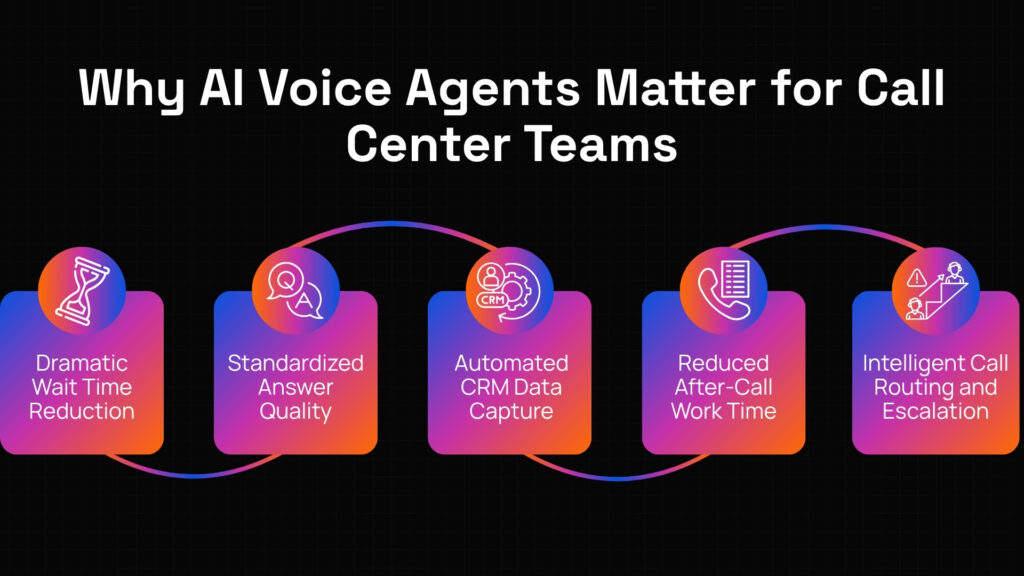
Why AI Voice Agents Matter for Call Center Teams
AI voice agents go beyond simple automated menus; they transform how organizations manage call volume, maintain service consistency, and ensure customer satisfaction across voice channels. Manual phone support workflows that once created bottlenecks in triage, authentication, and routine inquiries can now be executed with intelligence and precision through AI call center automation. From shrinking wait times and standardizing answers to capturing structured data and cutting after-call work, AI voice agent for customer service deployments deliver measurable outcomes that strengthen both operational efficiency and customer experience across all contact center functions.
For call center leaders evaluating AI voice agents strategies, the benefits manifest in five critical ways:
- Dramatic Wait Time Reduction: AI voice assistant software answers inbound calls immediately without queue delays, triaging inquiries during volume spikes, peaks, and seasonal surges when human staffing cannot flex quickly enough, eliminating hold music frustration and abandoned call rates that drive customer dissatisfaction.
- Standardized Answer Quality: Intelligent systems apply consistent policy interpretation and response scripts across all shifts, locations, and agent experience levels, eliminating the variability that comes from training gaps, rushed answers during busy periods, or inconsistent application of evolving procedures that create customer confusion.
- Automated CRM Data Capture: AI call center automation extracts structured information from natural conversations including account identifiers, issue categorization, sentiment indicators, and resolution outcomes, automatically populating CRM systems without manual after-call data entry that delays agent availability and introduces transcription errors.
- Reduced After-Call Work Time: Voice agents handle documentation, ticket creation, and system updates during or immediately following calls without requiring agents to type notes and select disposition codes, freeing human capacity for next call immediately and improving occupancy rates without sacrificing data quality.
- Intelligent Call Routing and Escalation: AI voice agent for customer service platforms classify caller intent with 80 percent or higher accuracy based on Verizon’s reported results, routing to appropriate skill groups with complete conversation context, warm handoff capabilities, and intelligent escalation when confidence drops below acceptable thresholds or policy requires human judgment.
AI voice agents are not about replacing contact center teams; they are about amplifying their effectiveness, ensuring service availability, and enabling human agents to focus on complex cases requiring empathy, negotiation skills, and creative problem-solving that machines cannot replicate effectively.
Key Considerations When Choosing AI Voice Agent Software
Selecting the right AI call center automation requires careful alignment between technology capabilities and contact center requirements. The most successful AI voice agent for customer service implementations are built on a foundation of low latency, deep telephony integration, and measurable impact on critical metrics like average handle time, first-call resolution, and customer satisfaction scores.
Below are the core factors that should guide every AI voice agents decision:
- Business Outcomes & KPI Alignment: Every AI voice assistant software initiative must connect directly to tangible call center metrics, whether that is reducing average handle time from 6 minutes to 3.5 minutes, improving first-call resolution percentages, increasing customer satisfaction scores to 85 percent or higher, achieving 45 percent call containment rates, or lowering cost per contact. Vendors should demonstrate clear methodology for mapping to specific KPIs with baseline measurements, not vague efficiency promises.
- Integration with Existing Systems: Effective AI call center automation depends on seamless connectivity with your telephony infrastructure, help desk platforms, CRM systems, ERP, and treasury management systems. The ideal partner ensures smooth bidirectional data flow with read and write capabilities, event-driven triggers, secure comprehensive logging, and idempotent update operations so automated workflows can authenticate callers, look up account data, create tickets, and execute policy-approved actions.
- Security and Governance: AI voice agents handle highly sensitive customer data including personal identifiers, account details, payment information, and call recordings that require strict controls. Confirm that vendors maintain role-based access controls, comprehensive audit trails, real-time and stored PII redaction capabilities, SOC 2 and ISO attestation compliance, and documented threat models addressing breach risks that IBM research shows average $4.88 million in costs.
- Human-in-the-Loop (HITL) Flexibility: Successful AI voice agent for customer service always includes agent oversight mechanisms for conversations requiring human judgment, empathy, or specialized expertise. Ensure that workflows incorporate clear rules for warm handoff with complete conversation context, conference-in capabilities allowing supervisors to join calls, fallback phrases customers can use to request human agents immediately, and confidence thresholds triggering automatic escalation.
- Observability and Analytics: Transparency is essential when scaling AI voice assistant software across call volume. A capable vendor provides complete conversation traces with transcripts, intent classification logging, evaluation frameworks with pass-fail scoring rubrics, PII redaction verification, real-time dashboards tracking containment and satisfaction, rollback capabilities for prompt versions, and call replay functionality for quality assessment and training.
- Pricing Transparency and Flexibility: Insist on clear pricing models with explicit usage drivers including call minutes, speech-to-text and text-to-speech model costs, inference expenses, and telephony carrier charges. Understanding AI call center automation economics helps forecast costs accurately as volumes scale, requiring different budgeting approaches than fixed per-agent seat licenses with predictable monthly expenses.
Choosing AI voice agents partners who understand these requirements ensures your investment delivers sustainable improvements rather than creating technical debt, vendor lock-in, or governance gaps that limit future flexibility when telephony platforms or call center strategies evolve.
The Impact of Integration Readiness
Before launching any AI voice agent for customer service initiative, organizations must thoroughly assess their telephony architecture, system integration landscape, and call flow documentation completeness. Integration readiness evaluates how well existing contact center platforms, authentication procedures, and knowledge structures can support intelligent voice automation without creating caller frustration or compliance risks. When call center teams conduct integration audits in advance, they uncover API limitations and latency issues early, align IT and operations stakeholders around data access requirements, and minimize wasted time during vendor discovery and pilot phases.
Example: A telecommunications company preparing for AI call center automation discovered that their IVR system added unexpected latency to speech processing pipelines, their CRM lacked webhook support for real-time account status updates during active calls, and their authentication procedures required manual agent override for multi-factor verification scenarios. Addressing these integration readiness issues before vendor engagement reduced the overall project timeline by eight weeks and improved call containment rates by 38 percent during the pilot phase, while clarifying which call types needed AI voice agents versus human escalation with context.
Pro Tip: Create an internal integration readiness checklist that validates read-write access to CRM and help desk systems, tests worst-case end-to-end latency including IVR, speech-to-text, language model inference, and text-to-speech components in realistic network conditions, confirms identity verification process automation capabilities with security team approval, documents PII redaction requirements at capture and in stored logs, and establishes single sign-on integration for administrative access with comprehensive audit trails.
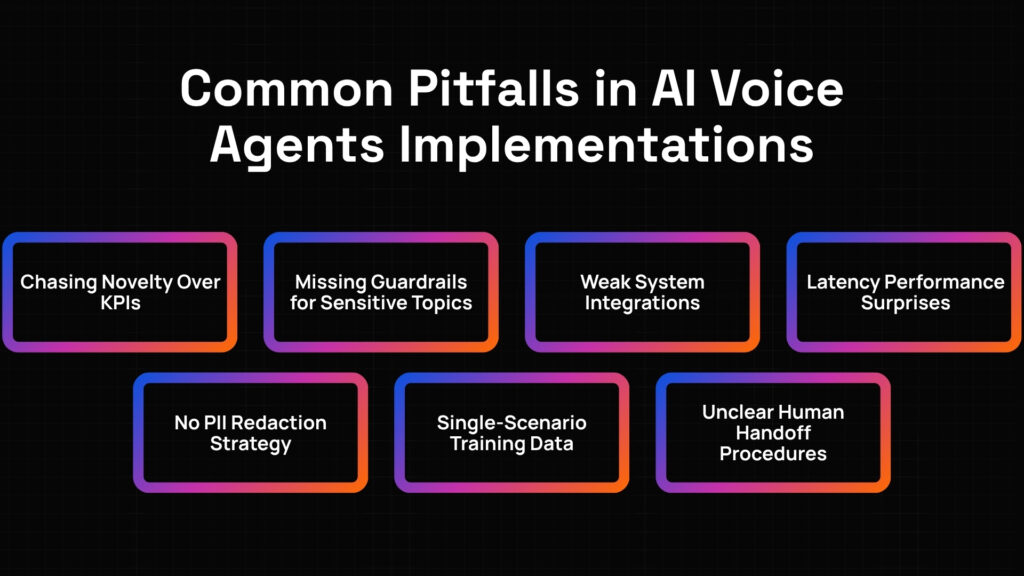
Common Pitfalls in AI Voice Agents Implementations
AI voice assistant software promises efficiency and availability, but poor planning and inadequate call flow design can create caller frustration instead of satisfaction improvements. Many organizations make avoidable mistakes during implementation that delay value realization and erode both customer and agent trust. To discover proven methodologies tailored for your call center workflows and telephony requirements, explore our AI Workflow Automation Services page for detailed AI voice agent for customer service frameworks and real-world implementation guidance.
- Chasing Novelty Over KPIs: Some organizations deploy AI call center automation based on impressive demonstrations rather than measurable business outcomes. Anchor every implementation to 3 specific metrics including containment rate, average handle time reduction, and customer satisfaction score maintenance to ensure technology serves business objectives.
- Missing Guardrails for Sensitive Topics: A technically impressive AI voice agents deployment can still create compliance harm without proper controls. Add explicit policy checks for regulated topics, implement escalation phrases customers can use to reach humans immediately, and maintain human oversight requirements for decisions affecting accounts, payments, or legal matters.
- Weak System Integrations: Many teams launch AI voice agent for customer service with read-only access when bidirectional write capabilities exist for ticket creation and account updates. Prioritize native CRM and help desk actions over email-based “ticket” creation that delays response and loses conversation context.
- Latency Performance Surprises: Organizations implementing AI voice assistant software often test only model response times without measuring complete system performance. Load-test end-to-end latency including IVR routing, speech-to-text processing, language model inference, text-to-speech generation, and network transmission to ensure sub-600-millisecond performance that feels natural to callers.
- No PII Redaction Strategy: Deploying AI call center automation without data protection creates breach risk averaging $4.88 million according to IBM research. Mask personally identifiable information at capture point in real-time processing and in all stored transcripts and logs with field-level redaction rules validated through security review.
- Single-Scenario Training Data: Voice agents trained only on ideal conditions fail during peak periods with background noise and varied accents. Train systems on representative samples including volume peaks, regional accent variations, background noise scenarios, and edge cases to ensure robust performance across actual caller population.
- Unclear Human Handoff Procedures: Organizations implementing AI voice agents without explicit escalation protocols create agent confusion and caller frustration. Define clear confidence thresholds triggering automatic transfer, document warm handoff procedures passing complete conversation context, and establish fallback phrases enabling immediate human connection when callers request it.
Evaluating the ROI of AI Voice Agents
Quantifying the benefits of AI voice agent for customer service helps secure executive buy-in and refine future investments in contact center technology. Measuring ROI goes beyond simple call deflection; it captures gains in average handle time, first-call resolution, agent capacity, and customer satisfaction. Without clear metrics during evaluation, AI call center automation projects risk becoming feature-heavy implementations with unclear business outcomes that fail to justify ongoing operational expenses and licensing costs.
Key metrics to monitor include:
- Call Containment Rate: Track the percentage of inbound calls resolved autonomously without agent escalation following AI voice assistant software implementation, with leading deployments achieving 45 percent or higher containment on targeted call reasons within 60 days while maintaining satisfaction scores above baseline performance levels.
- Average Handle Time Reduction: Measure the decrease in minutes required to resolve calls when AI voice agents handle routine inquiries instantly, with successful implementations reducing average handle time from 6 minutes to 3.5 minutes or better representing 42 percent improvement by eliminating hold times and manual data lookup.
- First-Call Resolution Improvement: Evaluate the percentage of issues resolved in initial contact without callbacks or escalations when AI call center automation provides complete answers from integrated knowledge bases and system access, as automated data retrieval eliminates incomplete information requiring follow-up interactions.
- Customer Satisfaction Score Maintenance: Compare post-call survey scores before and after AI voice agent for customer service deployment to ensure automation maintains or improves experience quality, targeting 85 percent or higher satisfaction rates by combining speed with accuracy and clear human escalation options.
- Cost Per Contact Reduction: Review total operational costs including telephony expenses, AI inference and speech processing fees, and remaining agent touches divided by handled calls to calculate unit economics showing substantial savings compared to fully-staffed human-only models.
- Agent Capacity Release: Assess improvements in complex case handling when AI voice assistant software contains routine inquiries like password resets and status checks, measured through tickets per agent, occupancy rates, and time allocated to escalations requiring empathy, negotiation, and specialized expertise.
According to OpenAI research, GPT-4o voice achieves approximately 320-millisecond response times enabling natural turn-taking. IBM data shows average breach costs of $4.88 million emphasizing security importance. Forrester research via Wall Street Journal reveals 71 percent of firms integrate chatbots but only 16 percent of customers use regularly, highlighting quality importance. Salesforce data shows 42 percent rise in holiday chatbot usage indicating growing comfort. When every AI voice agents interaction logs call reason classification, confidence scores, system actions, escalation triggers, and PII access with redaction, every prompt change maintains version history with rollback capabilities, and every caller has clear human escalation phrases, organizations build trusted voice operations that scale without sacrificing experience quality.
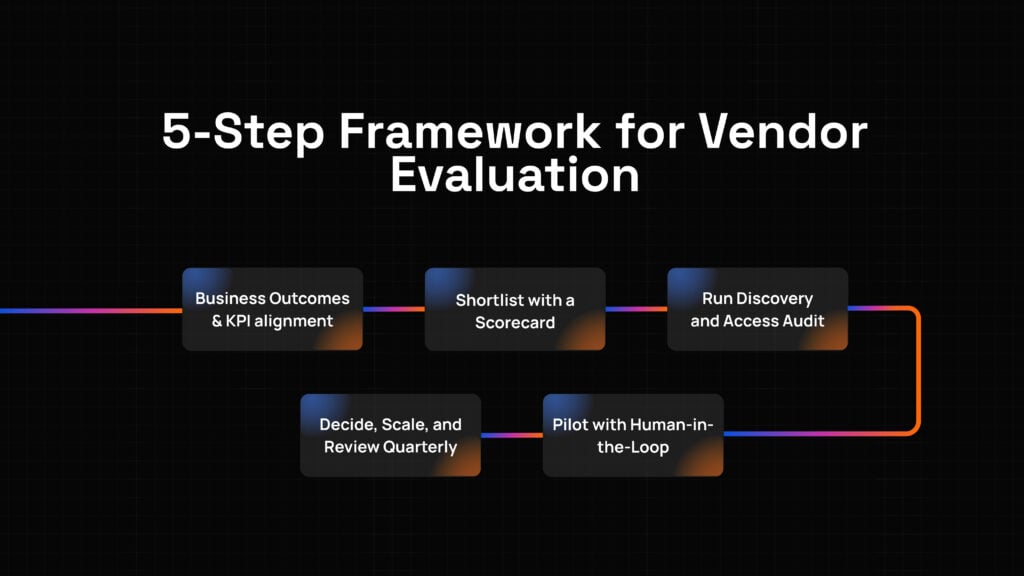
5-Step Framework for Vendor Evaluation
Selecting an AI call center automation vendor should follow a disciplined, structured process that aligns with your organization’s contact center goals while accounting for both technological depth and long-term partnership potential. Instead of focusing solely on impressive voice quality demonstrations or lowest price, evaluation should weigh how well the vendor’s AI voice agent for customer service solution supports call flow standards, integrates with telephony infrastructure, and adapts to evolving caller expectations.
1. Business Outcomes & KPI Alignment
Start by clearly outlining what success looks like with specific, measurable targets tied to call center performance. Defining primary KPIs helps align all stakeholders including contact center leadership, quality assurance teams, IT departments, and customer experience officers. Your goals might include reducing password reset call average handle time from 6 minutes to 3.5 minutes while hitting 85 percent customer satisfaction, achieving 45 percent containment on targeted call reasons, or improving first-call resolution rates, but they must be quantifiable. This clarity becomes the foundation for every subsequent decision about AI voice assistant software, shaping both vendor conversations and internal buy-in.
Example: A financial services company defined its KPI as “reducing password reset and account verification call average handle time from 6 minutes to 3.5 minutes while maintaining customer satisfaction scores at 85 percent or higher and achieving 45 percent call containment within 90 days.” This metric guided every vendor discussion, shaped pilot design, and became the benchmark for success measurement. Pick one call reason with consistent policy first to prove value. Wall Street Journal citing Forrester found 71 percent of firms integrate chatbots but only 16 percent of customers use regularly, highlighting usability importance.
Pro Tip: Document 3 to 5 measurable contact center outcomes before requesting proposals. Focus on containment percentages, average handle time targets, first-call resolution improvements, and satisfaction score maintenance tied to operational efficiency rather than vanity metrics like total calls handled, and identify which call reasons have consistent policy suitable for automation.
2. Shortlist with a Scorecard
Once objectives are clear, move to structured vendor comparison using a weighted scorecard for evaluating AI voice agent for customer service providers. This tool allows teams to quantify how well each vendor aligns with priorities including telephony platform fit, system integration depth, governance frameworks, call quality on representative samples, and pricing clarity. By assigning weights to each factor, decision-makers can balance technical capability with caller experience quality and long-term flexibility. A disciplined scorecard approach removes subjectivity and ensures that even non-technical call center stakeholders understand tradeoffs.
Example: One insurance company assigned 30 percent weight to telephony infrastructure compatibility including native integration with their IVR platform, 25 percent to CRM and help desk read-write integration capabilities, 20 percent to governance controls including PII redaction and audit trails, 15 percent to measured quality on 20 representative call recordings, and 10 percent to pricing transparency with exportable asset ownership.
Pro Tip: Keep the scorecard fully quantitative to ensure fairness. Rate each criterion on a defined scale such as 0 to 5 so decisions are driven by call center requirements rather than sales presentation quality. Require recorded demonstrations handling your top 5 call intents end-to-end with realistic caller scenarios including background noise and varied speaking patterns.
3. Run Discovery and Access Audit
Before contracts are signed, a structured discovery phase validates read-write access requirements to CRM and help desk systems, maps identity verification process automation capabilities with security approval, confirms PII redaction implementation at capture and in storage, and establishes single sign-on integration for administrative functions. During this phase, teams test worst-case end-to-end latency including IVR routing, speech-to-text processing, language model inference, text-to-speech generation, and network transmission to identify bottlenecks. Running an access audit verifies minimum-privilege principles and comprehensive audit trails, preventing security gaps.
Example: A retail company mapped their AI call center automation requirements including order status lookup requiring read-only inventory system access, return authorization requiring write access to order management with approval workflows, and payment processing requiring PCI-compliant credential handling with strict audit logging. Discovery revealed IVR latency issues requiring carrier configuration changes before pilot launch. OpenAI reports approximately 320-millisecond GPT-4o response times, but IVR and network can add delay requiring full-stack measurement.
Pro Tip: Test complete system latency under realistic load conditions, not just model response times in isolation. Validate that end-to-end performance including IVR, speech processing, inference, and synthesis remains under 600 milliseconds for natural conversation flow. Document escalation phrase requirements and warm handoff procedures passing complete conversation context to human agents.
4. Pilot with Human-in-the-Loop and Dashboards
A well-designed pilot validates both technology performance and caller experience quality under real contact center conditions. Instead of full-scale deployment, focus on 4-week pilot with single intent coverage like password resets targeting 45 percent containment with escrowed human backup for all escalations. Incorporating human-in-the-loop oversight ensures AI voice assistant software outcomes align with brand standards and compliance requirements, while dashboards provide quantifiable visibility into containment rates, average handle time, satisfaction scores, and escalation patterns.
Example: A telecommunications provider piloted AI voice agents for billing inquiry calls, running 4-week evaluation with daily calibration sessions reviewing 20 random calls using shared exception journal documenting edge cases, and achieving 52 percent containment rate with 3.8 average handle time versus 5.5 baseline, 83 percent satisfaction scores, and identification of 7 policy clarification needs. Reuters reports Verizon achieved 80 percent call-reason prediction and 40 percent sales uplift in certain flows, proving targeted use moves outcomes.
Pro Tip: Conduct daily calibration sessions during pilot weeks using 20 randomly sampled calls with shared scoring rubric covering accuracy, policy compliance, caller experience, and escalation appropriateness. Track which failure patterns merit automatic retraining versus flagging for human review and knowledge base updates. If pilot hits 90 percent policy compliance and achieves satisfaction targets, expand to top 3 call intents.
5. Decide, Scale, and Review Quarterly
After the pilot proves value, use findings to guide the final decision and create a phased expansion plan for AI voice agent for customer service deployment. Scaling should be deliberate, expanding to additional call reasons only after performance metrics remain stable and call handling procedures prove effective. Continuous quarterly reviews between your contact center operations team and the vendor maintain alignment, ensuring the technology evolves alongside policy updates, system integrations, and caller expectation shifts. These sessions lock quarterly “model card” reviews managing drift and new objection patterns.
Example: A healthcare payer conducted quarterly business reviews with its AI call center automation vendor, expanding successful eligibility verification automation to include prior authorization status and claims inquiry calls, identifying prompt optimization opportunities that improved containment by 14 percentage points and reduced average handle time by 1.8 minutes over the first year. San Francisco Chronicle reports some large vendors claim AI handles 30 to 50 percent of support tasks internally, so set realistic containment targets.
Pro Tip: Treat vendor reviews as strategic sessions focused on expanding successful AI voice agents use cases to adjacent call types and optimizing policy guardrails, not just maintenance calls about system uptime. Lock quarterly model card reviews assessing accuracy drift, new caller objection patterns, latency performance, and cost trends to manage technology evolution systematically.
Next Steps in Your Evaluation Process
By now, you should have a clear understanding of what to prioritize when selecting an AI voice agent for customer service partner. Bringing these insights together creates a structured evaluation flow that de-risks investment and accelerates deployment while ensuring long-term caller satisfaction and operational excellence.
- Align with call center metrics: Ensure every feature connects to specific KPIs like call containment percentage, average handle time reduction, first-call resolution rates, and customer satisfaction scores tied to operational efficiency, not just call volume handling disconnected from quality outcomes.
- Evaluate telephony and system integration: Confirm that AI voice assistant software works smoothly with your IVR platform, CRM, help desk, and authentication systems through native integrations and bidirectional updates enabling data lookup, ticket creation, and account actions without manual intervention.
- Focus on caller experience and security: Choose vendors with documented conversation traces, confidence threshold escalation, real-time PII redaction, SOC 2 compliance validation, and robust human handoff pathways that enforce agent oversight for sensitive decisions while maintaining security standards preventing breaches averaging $4.88 million.
- Review training and quality frameworks: Favor partners who provide call flow design guidance, pronunciation dictionary management, objection library development, agent training programs on working with AI, and handover documentation including scripts and escalation playbooks.
- Test with a controlled pilot: Always run a controlled pilot with single call intent and clear pre-post metrics before full deployment to validate containment accuracy, satisfaction maintenance, latency performance, and business impact under real-world caller conditions with representative volume and complexity.
With these criteria in place, you are better equipped to identify AI call center automation vendors who not only automate routine calls but also improve operational efficiency, reduce costs, strengthen caller satisfaction, and amplify your team’s capacity to focus on complex escalations requiring human empathy and creative problem-solving.
Vendor Questions to Ask
To make the most informed decision during your AI voice agents evaluation, be sure to ask these essential questions:
- What is your measured call containment rate on real customer calls for my 3 target intents including password resets and account verification with documented baseline comparisons?
- How do you calculate average handle time when calls include human handoff and after-call work, and what is typical performance improvement from baseline?
- Which speech-to-text and text-to-speech models, audio sampling rates, and noise cancellation profiles do you support for production call quality?
- What is end-to-end median latency from IVR through speech processing, language model inference, and synthesis at busy hour volumes with realistic network conditions?
- How do you redact personally identifiable information in real-time call processing and in stored transcripts with field-level masking rules validated through security review?
- Can we export prompts, call flows, evaluation sets, and test suites without requiring paid professional services or vendor-specific formats?
- What policy guardrails and escalation phrases are enforced at runtime, and how do confidence thresholds trigger automatic transfer to human agents?
- Show me 20 anonymized call traces with your pass-fail scoring rubric covering accuracy, policy compliance, caller experience, and escalation appropriateness?
- Which failure patterns trigger automatic retraining versus flagging for human review and knowledge base updates, and how is model drift managed?
- Can I speak to two customer references with similar telephony infrastructure and call volumes who can discuss measured KPI improvements and implementation challenges?
Transform Call Centers with AI Voice Agents
AI voice agents are not just technological investments; they are strategic contact center capabilities that require careful planning, vendor selection, and continuous optimization. The right implementation brings consistency, availability, and scalability across your inbound call workflows, while poor execution creates caller frustration and agent resistance that undermines adoption and operational trust.
Ready to transform your contact center with AI voice agents? Book a Free Strategy Call with us to explore the next steps and discover how we can help you scope, pilot, and scale the right AI call center automation solution for your unique call patterns, telephony environment, and measurable business outcomes.