
The Power of AI Call Center: Why Voice Automation Matters
AI call center has evolved from basic IVR menus into intelligent voice automation infrastructure that defines service excellence in modern contact center operations. Support teams implementing professional AI voice agents are fundamentally transforming how routine calls get handled, how SLAs remain protected during volume spikes, and how complex problems escalate to human experts with complete context. Advanced AI voice assistant software now manages call workflows that once required extensive agent staffing, enabling teams to focus on high-value interactions, emotional situations, and complex problem-solving that drive customer satisfaction and loyalty while reducing time to contact and preserving service level commitments.
The data supporting this transformation continues to strengthen across contact center functions. According to Reuters research, large telcos using GenAI can predict call reasons for approximately 80 percent of calls and reduce downstream churn by routing callers more accurately, demonstrating how intelligent automation enhances both efficiency and strategic outcomes. However, Gartner data shows 64 percent of customers say they would prefer companies not use AI for customer service, underscoring the critical importance of transparency, good handoffs, and human oversight when automation exceeds capabilities. Verloop.io and industry reporting show companies can see 20 to 30 percent operational cost reductions when AI handles routine interactions, validating financial business cases beyond productivity improvements.
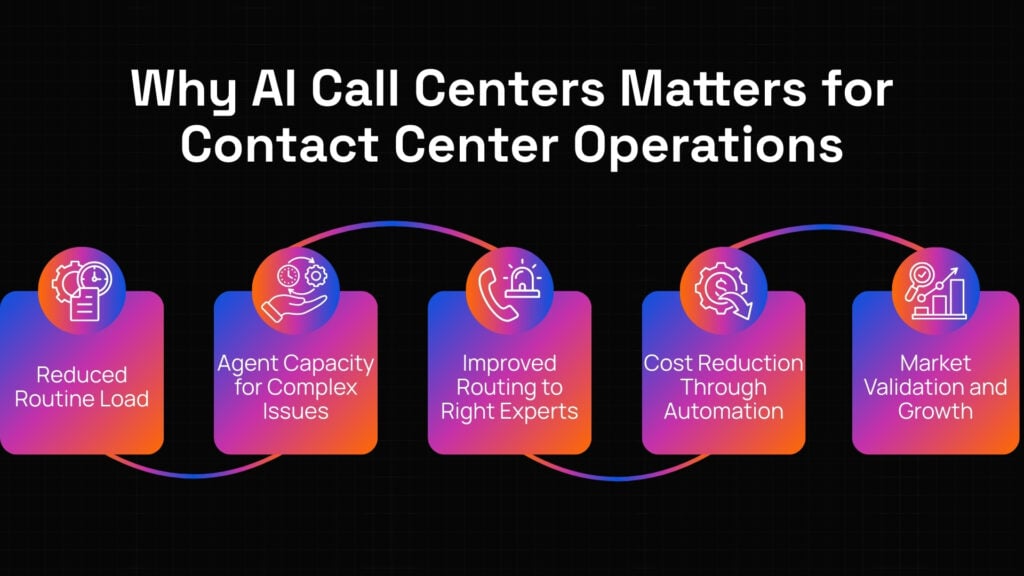
Why AI Call Centers Matters for Contact Center Operations
AI automation goes beyond simple IVR routing; it transforms how organizations manage call volume, maintain service quality, and ensure agent capacity focuses on situations requiring human judgment. Manual contact center workflows that once created bottlenecks through routine inquiry overload, delayed expert routing, and impossible 24/7 coverage can now be executed with intelligence and precision through AI voice agents orchestration. From reducing average handle time by 15 percent for billing calls to improving first-call resolution through accurate routing, AI voice assistant software delivers measurable outcomes that strengthen both operational efficiency and customer experience.
For contact center leaders evaluating AI call center strategies, the benefits manifest in five critical ways:
- Reduced Routine Load with SLA Protection: AI automation handles repetitive inquiries reducing time to contact and maintaining SLA promises during volume spikes, with Reuters showing telcos predict approximately 80 percent of call reasons enabling intelligent routing that prevents queue overflow and service level breaches during peak periods.
- Agent Capacity for Complex Issues: AI voice agents free representatives from repeatable work so they focus on complex or high-value calls requiring empathy, creativity, and problem-solving, with Verloop.io indicating 20 to 30 percent operational cost reductions when automation handles routine interactions redirecting saved capacity to strategic customer relationships.
- Improved Routing to Right Experts: Intelligent call classification ensures customers reach appropriate specialists faster, with Reuters demonstrating telcos reduce downstream churn through accurate routing addressing caller needs immediately rather than multiple transfers creating frustration and abandonment threatening retention.
- Cost Reduction Through Automation: AI call center implementations deliver measurable financial returns, with Verloop.io showing companies achieve 20 to 30 percent operational cost reductions though results vary by use case and data quality requiring careful pilot validation before full deployment across all call types.
- Market Validation and Growth: Market data shows strong expansion with $3.85 billion in 2024 and projected growth through decade, while Contact Center Pipeline indicates adoption and ROI are higher with human oversight and clear measurement, validating disciplined approaches as Gartner shows 64 percent customer AI skepticism requiring trust-building transparency.
AI call center is not about replacing contact center agents; it is about reducing routine load, preserving SLAs, and handing off hard problems to humans with complete context while enabling representative capacity to focus on situations where human judgment, empathy, and creative problem-solving create customer loyalty and retention.
Key Considerations When Choosing AI Voice Agents Partners
Selecting the right AI automation for contact centers requires careful alignment between technology capabilities and operational requirements. The most successful AI voice assistant software implementations are built on a foundation of transparency, deep telephony integration, and measurable impact on critical metrics like average handle time, first-call resolution, and CSAT.
Below are the core factors that should guide every AI call center decision:
- Business Outcomes & KPI Alignment: Every AI voice agents initiative must connect directly to tangible contact center metrics including average handle time reduction, first-call resolution maintenance, SLA breach rate decrease, CSAT improvement, or cost per contact optimization. Vendors should measure against your specific KPIs with clear baselines and tracking rather than generic efficiency promises disconnected from actual service quality outcomes.
- Integration with Contact Center Stack: Effective AI automation depends on seamless connectivity with telephony and IVR platforms, CRM systems, workforce management tools, ticketing platforms, and analytics systems. Confirm native connectors or robust APIs supporting read-write operations and event webhooks enabling real-time orchestration across complex contact center technology ecosystems without manual intervention.
- Security and Governance: AI call center handles sensitive customer data including call recordings, transcripts, personal information, and payment details requiring strict controls. Confirm data residency options, encryption standards, PII handling procedures, and compliance with local telecom and privacy laws ensuring responsible data management as Gartner shows 64 percent prefer companies not use AI requiring trust-building security transparency.
- Human-in-the-Loop (HITL) Design: Successful AI voice assistant software always includes agent escalation mechanisms with confidence thresholds, agent notifications, and context handoffs defined clearly. Ensure transfer of full transcript, AI summary, detected intent, and prior 2 to 3 interactions to agents, plus undo or override actions for AI decisions enabling quality control and continuous improvement through human feedback.
- Observability and Analytics: Transparency is essential when scaling AI voice agents across call volume. A capable vendor provides comprehensive call-level traces enabling troubleshooting, transcript search supporting quality review, SLA alerts triggering proactive intervention, and quick disable path allowing rollback when automation degrades customer experience or creates service quality issues.
- Pricing Transparency and Flexibility: Clarify pricing model including per-minute, per-call, license plus usage, or outcomes-based structures. Treat pricing as ROI input not sole decider, require pricing assumptions sheet documenting sensitivity to escalation rates and call volumes, and include one-time integration costs plus ongoing monitoring, training, and governance overhead in total cost calculations.
Choosing AI call center partners who understand these requirements ensures your investment delivers sustainable improvements rather than creating technical debt, vendor lock-in, or governance gaps that limit future flexibility when contact center strategies or technology stacks evolve.
Understanding AI Call Center KPIs: What to Measure
Before launching any AI automation initiative, organizations must thoroughly define success metrics enabling objective pilot evaluation and ongoing performance monitoring. Key performance indicators provide the measurement framework distinguishing valuable implementations from expensive failures. When contact center operations teams establish KPIs in advance, they align stakeholders around clear targets, enable data-driven optimization, and build business cases justifying continued investment through demonstrated value.
- Average Handle Time (AHT): Target reduction in call duration and understand how AI affects wrap-up work, as shorter handle times free capacity but must maintain resolution quality to avoid negative downstream impacts from incomplete problem-solving requiring callback volume increases.
- First-Call Resolution (FCR): Ensure automation doesn’t reduce FCR through premature escalation or poor routing, as maintaining or improving single-touch resolution protects customer satisfaction even when AI handles initial interaction requiring seamless handoff when human expertise becomes necessary.
- Escalation Rate: Track percent of calls passed to humans with detailed reasons for escalation, analyzing patterns to identify automation gaps, confidence threshold tuning opportunities, and training needs ensuring appropriate balance between containment and quality.
- SLA Breach Count and Remediation: Deploy automated alerts for service level threshold approaches and establish rollback thresholds triggering automatic reversion to human handling when AI performance degrades, protecting customer commitments through proactive monitoring as Reuters shows 80 percent call prediction enabling better capacity planning.
- CSAT and NPS: Measure customer happiness before and after rollout comparing AI-handled calls to human baseline, addressing Gartner finding that 64 percent prefer companies not use AI by demonstrating quality maintenance or improvement through disciplined measurement and transparent communication.
- Cost Per Contact: Estimate agent time saved versus vendor costs including integration, monitoring, training, and governance overhead, with Verloop.io showing 20 to 30 percent operational cost reductions requiring sensitivity modeling as small changes in escalation rates or volumes have outsized financial impact.
Pro Tip: Start with assistive automation including agent assist providing recommendations and information retrieval before launching fully autonomous voice flows, as Botpress shows HITL setups improve accuracy and reduce risk by letting humans correct or annotate model outputs building confidence before complete automation deployment.
Common Pitfalls in AI Call Center Implementation
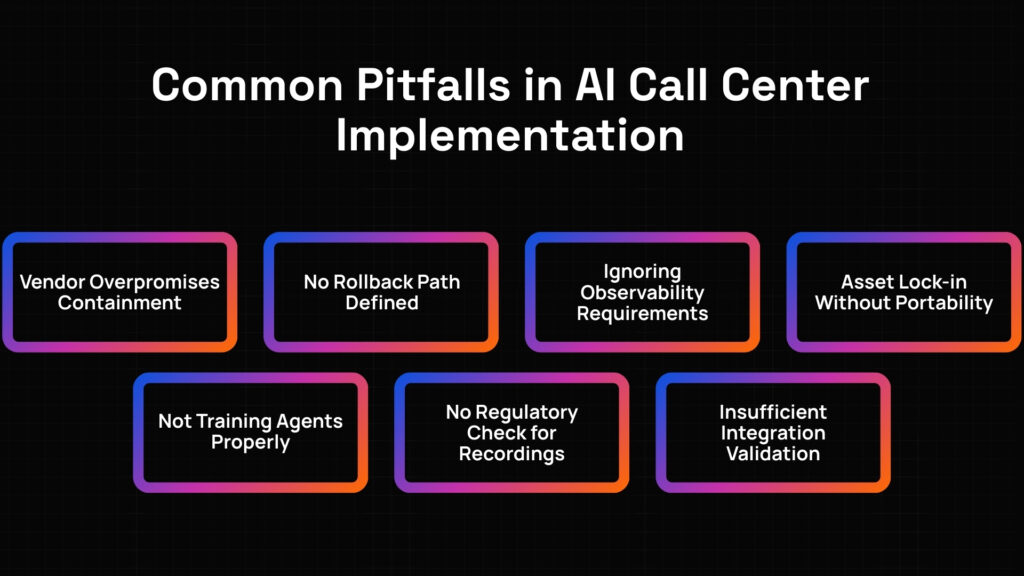
AI voice assistant software promises cost reduction and improved response times, but poor planning and inadequate guardrails can create customer frustration instead of satisfaction improvements. Many contact center organizations make avoidable mistakes during deployment that delay value realization and erode both customer and agent trust. To discover proven methodologies tailored for your contact center workflows and service requirements, explore our AI Workflow Automation Services page for detailed AI call center frameworks and real-world implementation guidance.
- Vendor Overpromises Containment: Some AI voice agents proposals claim unrealistic autonomous handling rates without validation. Pilot with realistic call mixes measuring actual escalation rates rather than accepting theoretical containment percentages, as call complexity and customer expectations vary significantly across use cases requiring honest assessment.
- No Rollback Path Defined: Launching without reversion capability creates risk when automation degrades service quality. Require contractual kill switch and automatic reversion in statement of work enabling quick response when AI call center implementations create customer frustration or SLA breaches, with Contact Center Pipeline showing adoption and ROI higher with clear measurement and control.
- Ignoring Observability Requirements: Deploying AI automation without comprehensive monitoring faces invisible quality degradation. Make trace logs and dashboards contractual deliverables providing call-level visibility, transcript search, and performance trends enabling proactive optimization before customer satisfaction erodes.
- Asset Lock-in Without Portability: Contracts lacking export provisions create operational dependency preventing competitive negotiations and future flexibility. Add exportability clauses for prompts, evaluation sets, policy documents, and flow diagrams ensuring you can switch vendors, bring automation in-house, or iterate independently without losing operational capability.
- Not Training Agents Properly: Technical implementations without representative preparation face adoption resistance and poor escalation handling. Schedule role-based training and shadowing before go-live ensuring agents understand AI capabilities and limitations, how to interpret handoff context, and when to override automation decisions.
- No Regulatory Check for Recordings: Organizations overlooking compliance requirements face legal violations and penalties. Validate local call recording and consent rules during discovery ensuring AI call center implementations align with telecom regulations and privacy laws across all operating jurisdictions before deployment.
- Insufficient Integration Validation: Teams assuming telephony and CRM integration works seamlessly discover technical debt during deployment. Get access matrix and list of required API scopes during discovery before signing when negotiating leverage is highest, validating connectivity with actual systems rather than claimed compatibility.
Evaluating AI Automation ROI and Cost Considerations
Quantifying the benefits of AI call center helps secure executive buy-in and refine future investments in contact center technology. Measuring ROI goes beyond simple call deflection; it captures gains in handle time, resolution rates, cost efficiency, and agent satisfaction. Without clear financial modeling during evaluation, AI voice agents projects risk becoming unclear implementations that fail to justify ongoing operational expenses and licensing costs.
Key considerations for financial analysis include:
- Pricing Model Understanding: Vendors price differently using per-minute, per-call, license plus usage, or outcomes-based structures. Treat pricing as ROI input not sole decider, as cheapest option may lack necessary features or integration depth creating hidden costs during implementation and ongoing operations.
- Sensitivity Modeling: Small changes in escalation rates or call volumes have outsized cost impact requiring detailed assumptions analysis. Model best case, expected case, and worst case scenarios understanding how performance variations affect total cost of ownership and return on investment over multi-year periods.
- Operational Cost Reduction: Verloop.io shows companies can see 20 to 30 percent operational cost reductions when AI automation handles routine interactions, though results vary by use case and data quality requiring conservative assumptions during business case development until pilot validates actual performance with your specific call patterns.
- Total Cost of Ownership: Include one-time integration expenses and ongoing monitoring costs, plus training and governance overhead often overlooked during initial budgeting. Factor in vendor management, compliance audits, continuous retraining, and technical support requirements providing realistic financial projections beyond just licensing fees.
- Agent Capacity Release Value: Calculate freed representative time redirected to complex issues and strategic relationships, with Reuters showing telcos reduce churn through accurate routing demonstrating value beyond pure cost reduction extending to retention and lifetime value improvements.
- Market Growth Validation: Market data indicates $3.85 billion in 2024 with projected expansion through decade validating investment case maturity, while Contact Center Pipeline shows adoption and ROI higher with human oversight and clear measurement requiring disciplined approaches proving value before aggressive scaling.
Reuters shows 80 percent call prediction enabling accurate routing and churn reduction. Gartner indicates 64 percent prefer companies not use AI requiring transparency. Verloop.io demonstrates 20 to 30 percent operational cost reductions. Market data shows $3.85 billion in 2024 with strong growth projected. Botpress notes HITL improves reliability and reduces risk. Contact Center Pipeline indicates higher adoption and ROI with human oversight and clear measurement. When every AI call center interaction logs call transcript, intent classification, confidence scores, escalation triggers, and outcomes, every flow change maintains version history with rollback capabilities, and every escalation provides agents with complete caller context including transcript, AI summary, and detected intent, organizations build trusted contact center operations that scale.
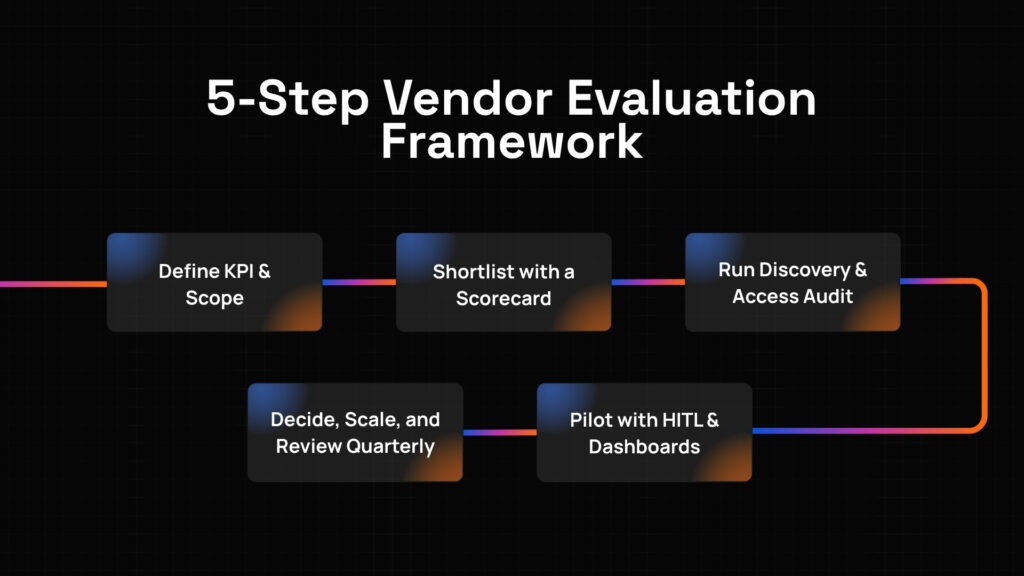
5-Step Vendor Framework for AI Call Center
Selecting an AI voice agents vendor should follow a disciplined, structured process that aligns with your organization’s contact center goals while accounting for both technological depth and long-term partnership potential. Instead of focusing solely on impressive demonstrations or cost claims, evaluation should weigh how well the AI automation solution supports measurable outcomes, integrates with existing systems, and adapts to evolving customer expectations.
1. Define KPI & Scope
Start by identifying specific measurable outcomes with narrow scope enabling quick value proof. Defining concrete targets helps align all stakeholders including contact center leadership, workforce management, quality assurance, and IT operations. Your goal might be reducing AHT by 15 percent for billing calls and maintaining FCR at or above baseline, improving CSAT, or decreasing cost per contact, but it must be quantifiable with clear measurement methodology.
Example: A telecommunications company defined its KPI as “reducing average handle time by 15 percent for billing calls and maintaining first-call resolution at or above 85 percent baseline within 90 days while keeping CSAT above 4.0 out of 5.0.” This metric guided every AI call center discussion, shaped pilot design, and became the benchmark for success measurement. Narrow scope to 1 or 2 call types so pilot is measurable.
Pro Tip: Document one to three primary contact center outcomes before requesting proposals. Focus on AHT, FCR, or cost per contact tied to operational efficiency rather than vanity metrics like total calls handled, and define specific percentage improvement targets with timelines enabling objective go/no-go decisions during pilot evaluation.
2. Shortlist with a Scorecard
Once objectives are clear, move to structured vendor comparison using a weighted scorecard evaluating AI voice assistant software providers. This tool allows teams to quantify how well each vendor aligns with priorities including KPI alignment, integration depth, security and governance, HITL design, observability, delivery planning, and pricing transparency. Score integration, observability, HITL, security, and pricing transparency 0 to 5.
Example: One enterprise assigned 15 percent weight each to KPI alignment with contact center metrics, integration depth with telephony, IVR, and CRM, security and governance frameworks, HITL and escalation design, and observability including traces and dashboards, plus 10 percent each to delivery and enablement support and pricing transparency, and 5 percent to exit portability. Weight observability and HITL higher for voice automation.
Pro Tip: Turn evaluation criteria into numeric scoring so decisions remain defendable beyond subjective impressions. Weight factors reflecting your priorities with observability and HITL typically receiving highest emphasis for mission-critical contact center infrastructure given Gartner data showing 64 percent prefer companies not use AI requiring trust-building through quality monitoring. Have multiple stakeholders from operations, quality, and IT score vendors independently before group discussion to reduce bias.
3. Run Discovery & Access Audit
Before contracts are signed, a structured discovery phase maps telephony platforms, IVR flows, CRM fields, recording retention policies, and SLAs documenting every integration touchpoint. During this phase, teams validate API capabilities, surface compliance requirements, and confirm security controls with appropriate permissions. Get access matrix and list of required API scopes.
Example: A financial services contact center conducted discovery for AI automation, revealing their legacy telephony platform lacked modern API support requiring middleware, their IVR flows weren’t documented creating ambiguity about automation boundaries, their CRM contained inconsistent call disposition codes preventing accurate intent training, their recording retention policies varied by region requiring complex compliance mapping, and their SLA definitions mixed service level with quality thresholds creating measurement confusion.
Pro Tip: Map telephony platform, IVR flows, CRM fields, recording retention, and SLAs before proposals. Get access matrix and required API scopes listing exact endpoints and permissions. Validate local call recording and consent rules during discovery ensuring compliance alignment across operating jurisdictions. Use discovery to surface telephony limitations, data quality gaps, and regulatory requirements before signing when negotiating leverage is highest.
4. Pilot with HITL & Dashboards
A well-designed pilot validates both technology performance and agent adoption under real contact center conditions. Instead of full-scale deployment, run 4 to 6 week pilot with controlled volume, weekly KPIs, and kill switch maintaining human oversight for quality assurance. Incorporating human-in-the-loop review ensures AI call center outcomes align with service standards and customer experience requirements while building organizational confidence.
Example: A retail company piloted AI voice agents for order status inquiries, running 6-week evaluation with controlled volume representing 10 percent of call type, agent review for all escalations, and dashboard tracking AHT, FCR, and escalation rate, achieving 12 percent AHT reduction with 87 percent FCR above 85 percent baseline. Require weekly exported metrics and raw transcripts for internal validation as Contact Center Pipeline shows adoption and ROI higher with human oversight and clear measurement.
Pro Tip: Execute pilots with frozen scope covering specific call types, clear success criteria comparing to baseline metrics, and measurable KPIs tracked weekly. Run 4 to 6 week pilot with controlled volume establishing statistical significance. Require weekly exported metrics and raw transcripts enabling independent validation. Include contractual kill switch enabling quick rollback if service quality degrades. Use pilot period to refine prompts, train agents on escalation procedures, and validate integration stability under production call patterns.
5. Decide, Scale, and Review Quarterly
After the pilot proves value, use findings to guide the final decision about scaling after sustained KPI wins validating sustainability and stability. Scaling should be deliberate, expanding only after demonstrating approach works reliably across representative call volumes and complexity. Continuous quarterly reviews maintain alignment, ensuring automation evolves alongside product launches, policy updates, and customer language changes.
Example: A healthcare organization conducted quarterly reviews with its AI voice assistant software partner, expanding successful appointment scheduling automation to prescription refills and insurance verification over 12 months, scaling after sustained wins, identifying optimization opportunities that improved AHT by additional 8 percent while reducing escalation rate to 18 percent, and planning continuous evaluation and model retraining addressing drift. Review model drift, lexicon changes, and new call types quarterly.
Pro Tip: Treat vendor reviews as strategic sessions focused on expanding successful AI automation use cases to adjacent call types and optimizing confidence thresholds, not just maintenance calls about system uptime. Scale after sustained KPI wins proving reliability over multiple weeks. Plan continuous evaluation and retraining of models addressing drift. Use quarterly reviews to assess performance degradation, language evolution, new call type handling, and alignment with evolving products and service policies.
Next Steps in Your AI Call Center Evaluation
By now, you should have a clear understanding of what to prioritize when selecting AI voice agents partners. Bringing these insights together creates a structured evaluation flow that de-risks investment and accelerates deployment while ensuring long-term service excellence.
- Align with contact center metrics: Ensure every AI automation feature connects to specific KPIs like AHT, FCR, SLA breach rate, or cost per contact tied to operational efficiency, not just call deflection percentages disconnected from actual service quality and customer satisfaction outcomes.
- Evaluate telephony integration: Confirm that AI voice assistant software integrates with your telephony and IVR platforms, CRM, workforce management, ticketing, and analytics through native connectors or robust APIs with read-write support and event webhooks enabling real-time orchestration without manual intervention.
- Focus on HITL and guardrails: Choose vendors with clear confidence thresholds triggering handoffs, full context transfer including transcript, AI summary, and detected intent, and agent override capabilities ensuring quality control addressing the 64 percent Gartner shows prefer companies not use AI through transparent human oversight.
- Review observability capabilities: Favor partners with call-level traces enabling troubleshooting, transcript search supporting quality review, SLA alerts triggering proactive intervention, and quick disable path allowing rollback when automation creates service quality issues or customer frustration.
- Test with controlled pilots: Always run 4 to 6 week pilots with controlled volume, human oversight, weekly KPI tracking, and contractual kill switch before full deployment to validate AHT improvements, FCR maintenance, and operational readiness under real-world contact center conditions with actual call complexity.
With these criteria in place, you are better equipped to identify AI call center vendors who not only automate routine calls but also reduce handle time, maintain resolution quality, protect SLAs, and amplify your team’s capacity to focus on complex issues requiring human empathy and creative problem-solving that drive customer loyalty.
Vendor Questions to Ask
To make the most informed decision during your AI call center evaluation, be sure to ask these essential questions:
- What KPIs do you recommend for our call types including AHT, FCR, escalation rate, and CSAT, and how will you measure them with baselines and tracking?
- Which telephony and IVR platforms and CRM systems have you integrated with at scale demonstrating proven connectivity?
- What exact data fields, APIs, and permissions do you require, and can you provide access matrix documenting integration requirements?
- How do you detect low-confidence calls or situations requiring human judgment, and what is the agent handoff format including context transfer?
- What dashboards, trace logs, and raw transcript exports do you provide for quality monitoring, and how long are logs retained for compliance?
- What is your pricing model including per-minute, per-call, or license structures, and what assumptions drive it regarding volume, hold times, and escalations?
- Who owns prompts, evaluation sets, and training artifacts on contract termination ensuring operational portability?
- Can you provide comparable customer case anonymized and pilot metrics demonstrating measured AHT, FCR, and cost improvements?
- What is the rollback mechanism including kill switch and automatic reversion thresholds when automation degrades service quality?
- How do you handle regulatory requirements for call recording consent and data retention across different jurisdictions?
- Can I speak to two customer references with similar call volumes and complexity who can discuss implementation challenges and ongoing partnership quality?
Transform Contact Centers with AI Call Center
AI call center is not just a technological investment; it is a strategic operational capability that requires careful planning, vendor selection, and continuous optimization. The right implementation brings reduced routine load, protected SLAs, and improved routing across call workflows, while poor execution creates customer frustration and agent resistance that undermine confidence and waste investment.
Ready to transform your contact center with AI call center? Book a Free Strategy Call with us to explore the next steps and discover how we can help you scope pilots, evaluate vendors, and scale the right AI voice assistant software solution for your unique telephony environment, call mix, and measurable business outcomes.