
The Power of AI in Healthcare: Why Automation Matters
AI in healthcare has evolved from experimental pilot projects into strategic clinical and operational infrastructure that defines care quality in modern health systems. Healthcare teams implementing professional healthcare automation are fundamentally transforming how clinician time gets allocated, how administrative tasks get completed, and how patient outcomes improve through reduced burden and faster throughput. Advanced AI process automation now manages workflows from clinical documentation and prior authorization to billing triage and patient routing, enabling clinicians to focus on direct patient care while machines handle repetitive execution that once consumed hours daily without requiring medical expertise.
The data supporting this transformation continues to strengthen across healthcare functions. According to American Medical Association research, two in three physicians report using health AI with adoption up sharply year over year, demonstrating mainstream acceptance beyond experimental pilots as intelligent systems become core healthcare infrastructure. Business Insider reports large deployments of AI and document understanding in revenue cycle work have saved tens of thousands of employee hours and materially cut turnaround times in real programs, validating substantial operational returns from disciplined implementations. PMC narrative and systematic reviews show AI can improve diagnostic support, documentation efficiency, and workflow optimization when clinically validated, proving that appropriate oversight enables quality enhancement rather than degradation.
Why Healthcare Automation Matters for Clinical Operations
AI process automation goes beyond simple task automation; it transforms how healthcare organizations manage clinician capacity, maintain compliance, and ensure patient safety across all operational workflows. Manual healthcare processes that once created bottlenecks through administrative burden, delayed authorizations, and impossible documentation requirements can now be executed with intelligence and precision through AI automation benefits that compound over time. From reducing documentation time by 30 percent for inpatient notes to cutting prior authorization turnaround from days to hours, AI in healthcare delivers measurable outcomes that strengthen both operational efficiency and clinical capacity.
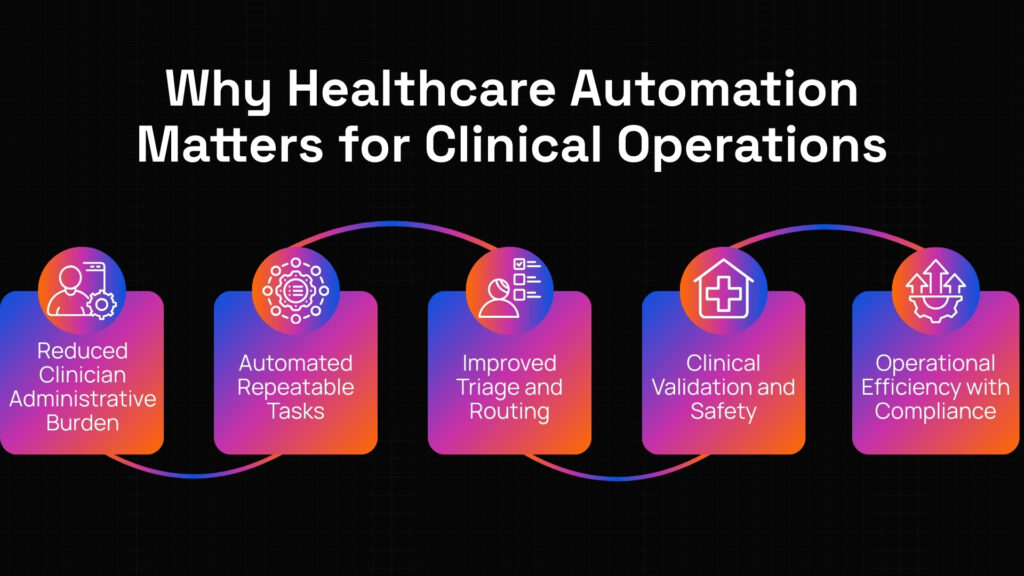
For healthcare leaders evaluating healthcare automation strategies, the AI automation benefits manifest in five critical ways:
- Reduced Clinician Administrative Burden: AI handles documentation drafting, coding suggestions, and prior authorization preparation reducing hours per clinician per week, with American Medical Association showing two in three physicians using health AI as adoption grows addressing burnout from administrative overload consuming time better spent on direct patient care and clinical decision-making.
- Automated Repeatable Tasks: AI process automation handles documentation, prior authorization workflows, and billing triage speeding throughput, with Business Insider reporting large deployments save tens of thousands of employee hours monthly and materially cut turnaround times demonstrating substantial operational returns when implementations extend beyond pilots to production scale.
- Improved Triage and Routing: Intelligent systems prioritize high-risk patients faster through automated acuity assessment and care team notification, with PMC reviews showing AI improves workflow optimization when clinically validated ensuring appropriate resources reach critical situations without manual review delays that risk patient outcomes.
- Clinical Validation and Safety: Well-designed AI in healthcare requires physician oversight for diagnostic or treatment-adjacent features, with JAMA Network showing patients prefer explainable, physician-led AI proving that human-in-the-loop design builds trust while FDA guidance for AI/ML-based SaMD establishes regulatory framework for device-classified implementations requiring appropriate controls.
- Operational Efficiency with Compliance: AI automation benefits extend to revenue cycle management when paired with HIPAA-compliant handling, with HHS guidance on PHI requiring Business Associate Agreements, data retention policies, and consent flows ensuring automation accelerates operations while maintaining regulatory compliance preventing violations that damage reputation and create financial penalties.
AI in healthcare is not about replacing clinicians; it is about cutting administrative time, protecting patient data, and improving outcomes through workflow redesign enabling healthcare professionals to focus capacity on complex clinical decisions, empathetic patient relationships, and care coordination that machines cannot replicate effectively.
Key Considerations When Choosing Healthcare Automation Partners
Selecting the right AI in healthcare requires careful alignment between technology capabilities and clinical requirements. The most successful AI process automation implementations are built on a foundation of clinical validation, deep EHR integration, and measurable impact on critical metrics like clinician time saved, prior authorization turnaround, and patient throughput.
Below are the core factors that should guide every healthcare automation decision:
- Business Outcomes & KPI Alignment: Every AI process automation initiative must connect directly to tangible healthcare metrics including time saved per clinician hour, prior authorization turnaround reduction, claim denial rate improvement, or patient throughput increase. Vendors should tie work to measurable KPIs with clear baselines and tracking rather than generic efficiency promises disconnected from actual clinical and operational outcomes.
- Integration with Healthcare Systems: Effective AI in healthcare depends on seamless connectivity with EHR platforms requiring native connectors, HL7/FHIR support, document ingestion capabilities, telephony and appointment systems integration, plus read-write access and event hooks enabling real-time orchestration across complex healthcare technology ecosystems without manual intervention.
- Security and Governance: Healthcare automation handles protected health information requiring HIPAA-compliant data handling with Business Associate Agreements, data residency controls, encryption standards, and comprehensive audit logs. HHS guidance establishes baseline requirements with retention policies and consent flows as American Medical Association shows two in three physicians adopt AI requiring trust-building security transparency.
- Human-in-the-Loop (HITL) Clinical Design: Successful AI in healthcare always includes clinician oversight with confidence thresholds triggering physician review flows and documentation handoff defined clearly. Use AI to draft clinician notes not finalize them requiring sign-off, flag low-confidence items for immediate review with clear context, and provide concise AI summaries with quick accept/modify actions as JAMA Network shows patients prefer physician-led AI.
- Observability and Analytics: Transparency is essential when scaling AI automation benefits across patient volume. A capable vendor provides searchable transcripts and notes enabling quality review, error rate tracking comparing to human baseline, model drift alerts triggering retraining, and fast disable path allowing rollback when automation degrades clinical quality or creates safety concerns.
- Pricing Transparency and Flexibility: Clarify pricing model including per-API-call charges, per-minute transcription costs, or per-claim processing with transparent assumptions sheet documenting volumes, expected error rates, escalation percentages, and per-unit costs. Include one-time integration expenses, clinician validation time, training investments, and ongoing governance overhead in total cost calculations as Business Insider shows substantial employee hour savings requiring comprehensive ROI analysis.
Choosing AI in healthcare partners who understand these requirements ensures your investment delivers sustainable improvements rather than creating technical debt, vendor lock-in, or governance gaps that limit future flexibility when clinical workflows or regulatory requirements evolve.
Understanding AI in Healthcare KPIs: What to Measure
Before launching any AI process automation initiative, organizations must thoroughly define success metrics enabling objective pilot evaluation and ongoing performance monitoring. Key performance indicators provide the measurement framework distinguishing valuable implementations from expensive failures creating clinical skepticism. When healthcare operations teams establish KPIs in advance, they align stakeholders around clear targets, enable data-driven optimization, and build business cases justifying continued investment through demonstrated value.
- Clinician Time Saved: Track hours per clinician per week freed from automation handling notes, prior authorization, and documentation, measuring capacity release enabling more patient interaction as American Medical Association shows two in three physicians adopt AI addressing administrative burden that contributes to burnout and reduced care time.
- Turnaround Time Improvement: Measure reduction in prior authorization or discharge summary completion time when AI process automation accelerates workflows, targeting specific improvements like authorization turnaround from days to hours enabling faster treatment initiation and reduced patient frustration from delayed care access.
- Error and Recall Rates: Evaluate transcription or data extraction accuracy versus human baseline ensuring automation maintains or improves quality, as clinical errors create safety risks and liability exposure requiring rigorous validation before physician sign-off as JAMA Network shows patients prefer physician oversight.
- Escalation to Clinician Rate: Track percent of items flagged for human review analyzing patterns to identify automation gaps and confidence threshold tuning opportunities, ensuring appropriate balance between autonomy and safety as FDA guidance for AI/ML-based SaMD establishes regulatory framework for device-classified implementations.
- Patient Experience Metrics: Monitor follow-up times and customer satisfaction where appropriate, assessing whether AI automation benefits extend to patient perception as PMC reviews show AI improves workflow optimization when clinically validated ensuring speed doesn’t sacrifice quality or create negative experiences.
- Cost Per Transaction Analysis: Compare automation costs including API usage, transcription minutes, and infrastructure against labor cost saved through employee hour reductions, with Business Insider reporting tens of thousands of hours saved monthly at scale demonstrating substantial financial returns when implementations achieve operational efficiency targets.
Pro Tip: Start with assistive workflows including note drafting and coding suggestions before automating clinical decisioning, as human-in-the-loop setups build confidence and enable validation. Keep audit trail documenting who accepted what and why to support clinical governance and quality assurance as HHS HIPAA guidance requires comprehensive compliance documentation.
Clinical and Regulatory Guardrails: Essential Compliance
AI in healthcare faces unique regulatory requirements beyond general business automation demanding strict adherence to healthcare-specific frameworks. Organizations must navigate HIPAA obligations, FDA device classification, and clinical validation standards preventing implementations that create compliance violations or patient safety risks. When healthcare teams incorporate regulatory guardrails in advance, they prevent expensive remediation, maintain patient trust, and ensure sustainable deployments meeting evolving standards.
- HIPAA Obligations and BAAs: Validate HIPAA obligations requiring Business Associate Agreements, data retention policies aligned with HHS guidance, encryption standards for PHI, and audit logging documenting all access. HHS HIPAA and Security Rule guidance remain baseline with recent NPRMs providing security updates requiring ongoing monitoring.
- FDA Device Classification: Check whether an AI component is regulated as Software as a Medical Device (SaMD) consulting FDA resources for AI/ML devices, as regulatory classification affects development requirements, validation standards, and post-market surveillance obligations beyond standard software implementations.
- Clinical Validation Requirements: Require explainability and physician oversight for diagnostic or treatment-adjacent features, as JAMA Network research shows patients prefer explainable, physician-led AI proving transparency and human control build trust while PMC reviews demonstrate AI improves outcomes when clinically validated through rigorous testing.
- Consent and Opt-Out Flows: Keep strong consent and opt-out mechanisms for using patient data in model training and inference, with HHS guidance on online tracking and patient data establishing requirements ensuring patients control how their information gets used beyond direct care delivery preventing trust erosion.
- Data Residency and Export: Ensure data storage locations comply with state and federal requirements, with clear retention policies documenting how long transcripts and training data persist, and export capabilities enabling patient access and vendor portability as HHS guidance requires patient data access rights.
Pro Tip: Run parallel validation with clinicians for initial weeks ensuring AI outputs meet clinical standards before relying on automation. Require mock regulatory checklist and evidence of clinical oversight during pilots validating vendor compliance maturity before production deployment as FDA maintains AI-enabled device list providing transparency into regulated implementations.
The Impact of Integration Readiness
Before launching any AI in healthcare initiative, organizations must thoroughly assess their EHR architecture, data quality, and workflow documentation completeness. Integration readiness evaluates how well existing clinical systems, information assets, and operational procedures can support intelligent automation without creating chaos or poor patient outcomes. When healthcare operations teams conduct integration audits in advance, they uncover data gaps and system limitations early, align clinical and IT stakeholders around connectivity requirements, and minimize wasted time during vendor discovery and pilot phases.
Example: A hospital system preparing for healthcare automation mapped their clinical documentation workflows, discovering their EHR used custom fields beyond standard FHIR resources requiring mapping, their dictation system lacked API support for real-time transcription, their physician templates varied by department preventing standardized automation, and their compliance team required retention policies aligned with state regulations not addressed in vendor proposals. Addressing these integration readiness issues before vendor engagement reduced the overall project timeline by nine weeks.
Pro Tip: Map EHR data model including FHIR and HL7 resources, storage systems, transcription workflows, and consent flows before engaging vendors. Ask for access matrix showing exact API requirements and permissions. Download EHR and PHI Integration Readiness Checklist to map data flows, FHIR resources, and export policies before pilot ensuring comprehensive preparation.
Common Pitfalls in AI in Healthcare Implementation
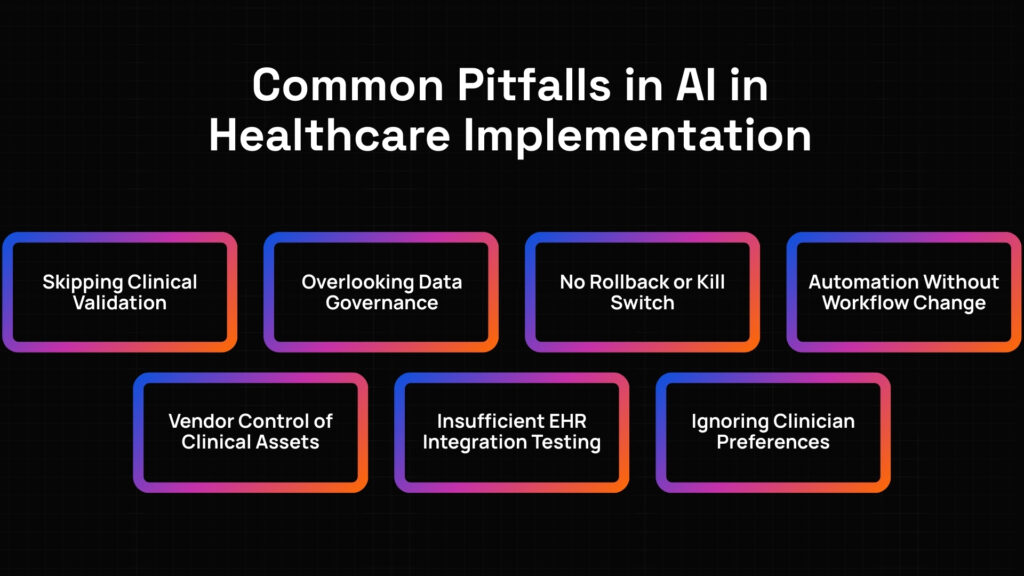
AI process automation promises efficiency and capacity release, but poor planning and inadequate clinical validation can create safety issues instead of operational improvements. Many healthcare organizations make avoidable mistakes during deployment that delay value realization and erode both clinician and patient trust. To discover proven methodologies tailored for your healthcare workflows and clinical requirements, explore our AI Workflow Automation Services page for detailed AI in healthcare frameworks and real-world implementation guidance.
- Skipping Clinical Validation: Some organizations deploy AI automation benefits without rigorous testing against clinician performance. Run parallel validation with clinicians for defined weeks comparing AI outputs to human baseline ensuring accuracy, safety, and appropriateness before relying on automation for clinical workflows requiring medical judgment.
- Overlooking Data Governance: Organizations assuming basic security suffices discover compliance gaps. Map complete data flows requiring Business Associate Agreements and retention policies aligned with HHS HIPAA guidance, with encryption, audit logging, and access controls as American Medical Association shows two in three physicians adopt AI requiring trust-building governance transparency.
- No Rollback or Kill Switch: Launching without reversion capability creates risk when automation degrades clinical quality or creates safety concerns. Make contractual kill switch and revert path requirements enabling immediate response when AI in healthcare implementations produce incorrect outputs, miss critical findings, or create patient safety issues.
- Automation Without Workflow Change: Technical implementations without role redesign and training face adoption resistance. Pair AI process automation with clinician role changes, documentation training, and workflow optimization as Business Insider shows tens of thousands of hours saved requiring operational discipline beyond pure technology deployment for achieving reported efficiency gains.
- Vendor Control of Clinical Assets: Contracts without export provisions create operational dependency preventing competitive negotiations and future flexibility. Require ownership and exportability for prompts, evaluation sets, and transcripts ensuring you can switch vendors, bring automation in-house, or iterate independently without losing clinical validation work or operational capability.
- Insufficient EHR Integration Testing: Teams assuming FHIR or HL7 support works seamlessly discover technical debt during deployment. Map EHR data model, storage systems, transcription workflows, and consent flows before signing, validating connectivity with actual systems and data rather than claimed compatibility creating implementation delays.
- Ignoring Clinician Preferences: Deploying without physician input faces adoption resistance undermining success. Provide clinicians with concise AI summaries and quick accept/modify actions respecting their workflow preferences, as JAMA Network shows patients prefer physician-led AI requiring implementations that augment rather than replace clinical judgment.
Evaluating AI Automation Benefits Through Healthcare ROI
Quantifying the benefits of AI in healthcare helps secure executive buy-in and refine future investments in clinical technology. Measuring ROI goes beyond simple time savings; it captures gains in clinician capacity, patient throughput, compliance maintenance, and care quality. Without clear metrics during evaluation, AI process automation projects risk becoming unclear implementations that fail to justify ongoing operational expenses and licensing costs.
Key considerations for financial analysis include:
- Employee Hour Savings: Business Insider reports large deployments save tens of thousands of employee hours monthly with materially cut turnaround times, providing substantial operational returns when implementations scale beyond pilots to production workflows across multiple departments or specialties requiring comprehensive time-tracking validation.
- Clinician Capacity Release: Calculate freed physician and nurse time redirected to direct patient care, complex clinical decisions, and care coordination, with American Medical Association showing two in three physicians adopt AI addressing administrative burden enabling more patient interaction and reduced burnout from documentation overload.
- Workflow Optimization Value: PMC reviews demonstrate AI improves documentation efficiency and workflow optimization when clinically validated, measuring value from faster turnaround, reduced delays, and improved throughput beyond pure labor cost savings extending to patient satisfaction and clinical outcomes.
- Compliance Cost Avoidance: Include value from maintained HIPAA compliance, reduced claim denials, and avoided audit penalties when AI process automation maintains documentation quality and regulatory adherence, with HHS guidance establishing strict requirements where violations create substantial financial and reputational damage.
- Total Cost of Ownership: Treat RPA and document automation as mix of license, integration, and maintenance costs, while treating LLM and voice AI as variable usage expenses for tokens and minutes plus monitoring and retraining. Include one-time integration, clinician validation, training, and ongoing governance investments in comprehensive TCO analysis.
- Realistic ROI Windows: PMC peer-reviewed reviews and industry reporting find substantive operational gains when AI reduces documentation and administrative work, with many real implementations reporting multi-week to multi-month ROI windows when combined with workflow redesign, requiring conservative assumptions until pilots validate actual performance with your specific clinical workflows.
American Medical Association shows two in three physicians use health AI with sharp adoption growth. Business Insider reports tens of thousands of employee hours saved monthly at scale with materially cut turnaround. PMC reviews demonstrate AI improves diagnostic support, documentation efficiency, and workflow optimization when validated. When every AI in healthcare interaction logs clinical decisions, confidence scores, escalation triggers, and outcomes, every workflow change maintains version history with rollback capabilities, and every implementation includes physician oversight with audit trails documenting who accepted what and why, organizations build trusted healthcare operations that scale without sacrificing clinical quality, patient safety, or regulatory compliance.
5-Step Vendor Framework for AI in Healthcare
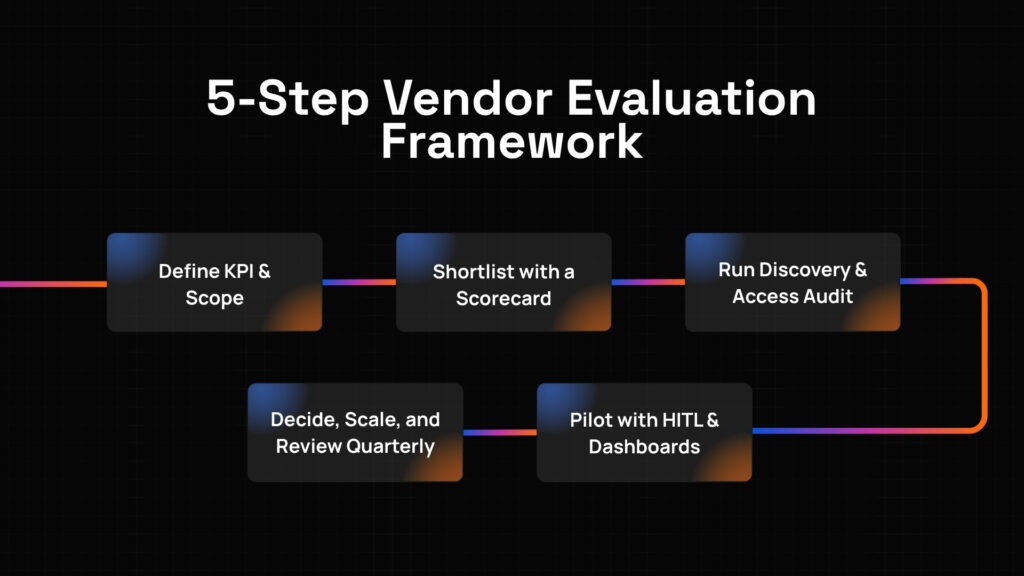
Selecting an AI process automation vendor should follow a disciplined, structured process that aligns with your organization’s clinical goals while accounting for both technological depth and regulatory compliance. Instead of focusing solely on impressive demonstrations or cost claims, evaluation should weigh how well the AI in healthcare solution supports measurable outcomes, integrates with existing systems, and maintains patient safety through appropriate clinical validation.
1. Define KPI & Scope
Start by identifying specific measurable outcomes with narrow scope enabling quick clinical validation. Defining concrete targets helps align all stakeholders including clinical leadership, health information management, compliance officers, and IT operations. Your goal might be cutting documentation time by 30 percent for inpatient notes in cardiology, reducing prior authorization turnaround, or improving coding accuracy, but it must be quantifiable with clear clinical impact.
Example: A health system defined its KPI as “cutting documentation time by 30 percent for inpatient notes in cardiology within 90 days while maintaining clinical accuracy above 98 percent and physician satisfaction above 4.0 out of 5.0.” This metric guided every AI in healthcare discussion, shaped pilot design with clear clinical benchmarks, and became the success measurement. Start with one specialty and one workflow proving approach.
Pro Tip: Document one primary clinical outcome before requesting proposals. Focus on clinician time saved, turnaround time reduction, or error rate improvement tied to operational efficiency and care quality rather than vanity metrics like total notes generated, and define specific percentage improvement targets with timelines enabling objective go/no-go decisions during pilot evaluation.
2. Shortlist with a Scorecard
Once objectives are clear, move to structured vendor comparison using a weighted scorecard evaluating AI process automation providers. This tool allows teams to quantify how well each vendor aligns with priorities including clinical validation and safety, EHR integration depth, governance and PHI handling, observability and traceability, delivery and enablement, pricing transparency, and exit portability.
Example: One health system assigned 25 percent weight to clinical validation and safety demonstrating appropriate physician oversight, 20 percent to integration with EHR and FHIR resources, 15 percent to governance and PHI handling meeting HIPAA requirements, 15 percent to observability and traceability enabling quality review, 10 percent each to delivery and enablement support and pricing transparency, and 5 percent to exit portability. Weight clinical validation and governance higher for healthcare.
Pro Tip: Turn evaluation criteria into numeric scoring so decisions remain defendable beyond subjective clinical impressions. Score integration, clinical validation, governance, observability, and portability 0 to 5. Weight clinical validation and governance appropriately given JAMA Network showing patients prefer physician-led AI and HHS requiring strict HIPAA compliance. Have multiple stakeholders from clinical, compliance, and IT score vendors independently before group discussion to reduce bias.
3. Run Discovery & Access Audit
Before contracts are signed, a structured discovery phase maps EHR data model including FHIR and HL7 resources, storage systems, transcription workflows, and consent flows documenting every integration touchpoint and compliance requirement. During this phase, teams validate API capabilities, surface PHI handling gaps, and confirm security controls with appropriate permissions. Ask for access matrix.
Example: A hospital system conducted discovery for AI in healthcare, revealing their EHR used custom extensions beyond standard FHIR resources requiring custom mapping, their transcription vendor lacked direct integration requiring middleware, their consent workflows weren’t documented preventing clear opt-out implementation, their data retention policies varied by department creating compliance complexity, and their BAA templates required modification for AI-specific language not in standard vendor agreements.
Pro Tip: Map EHR data model including FHIR and HL7 resources, storage locations, transcription systems, and consent flows before proposals. Ask for access matrix documenting required API scopes and data access. Validate HIPAA obligations requiring Business Associate Agreements and retention policies during discovery. Use discovery to surface integration limitations, compliance gaps, and clinical validation requirements before signing when negotiating leverage is highest.
4. Pilot with HITL & Dashboards
A well-designed pilot validates both technology performance and clinical safety under real healthcare conditions. Instead of full-scale deployment, run 4 to 8 week pilot with parallel human validation, weekly KPI snapshots, and kill switch maintaining clinical oversight. Incorporating human-in-the-loop review ensures AI automation benefits align with clinical standards and patient safety requirements while building clinician confidence.
Example: A medical group piloted AI process automation for progress note documentation, running 8-week evaluation with parallel clinician validation comparing AI drafts to traditional documentation, physician review for all notes before signing, and dashboard tracking time saved, accuracy, and satisfaction, achieving 28 percent documentation time reduction with 98.5 percent accuracy above 98 percent target. Require raw outputs for audit as PMC shows AI requires clinical validation.
Pro Tip: Execute pilots with frozen scope covering specific specialty and workflow, clear success criteria including clinical accuracy benchmarks, and measurable KPIs tracked weekly. Run 4 to 8 week pilot with parallel human validation establishing AI meets clinical standards. Require weekly KPI snapshots and raw outputs for independent audit. Require mock regulatory checklist and evidence of clinical oversight validating vendor compliance maturity. Include contractual kill switch enabling immediate rollback if clinical quality degrades.
5. Decide, Scale, and Review Quarterly
After the pilot proves both clinical safety and operational value, use findings to guide the final decision about scaling after consistent clinical and operational wins validating sustainability. Scaling should be deliberate, expanding only after demonstrating approach maintains quality across representative patient populations and clinical scenarios. Continuous quarterly reviews maintain clinical discipline, ensuring automation adapts as guidelines, protocols, and regulatory requirements evolve.
Example: A healthcare organization conducted quarterly reviews with its AI in healthcare partner, expanding successful cardiology documentation to internal medicine and surgery over 12 months, scaling after consistent wins validating quality maintenance, identifying optimization opportunities reducing documentation time by additional 8 percent, and reviewing for model drift and regulatory changes as FDA publishes updated guidance. Review model drift and regulatory changes quarterly.
Pro Tip: Treat vendor reviews as clinical governance sessions focused on quality maintenance and regulatory compliance, not just operational performance calls. Scale after consistent clinical and operational wins proving reliability across patient populations. Review model drift, clinical guideline updates, and regulatory changes quarterly. Use quarterly reviews to assess accuracy trends, escalation patterns, clinician satisfaction, and alignment with evolving standards as FDA and HHS update guidance.
Next Steps in Your AI in Healthcare Evaluation
By now, you should have a clear understanding of what to prioritize when selecting AI process automation partners for healthcare. Bringing these insights together creates a structured evaluation flow that de-risks investment and accelerates deployment while ensuring patient safety and regulatory compliance.
- Align with clinical metrics: Ensure every AI automation benefits feature connects to specific KPIs like clinician time saved, prior authorization turnaround, or error rates tied to operational efficiency and care quality, not just automation coverage percentages disconnected from actual clinical impact and patient outcomes.
- Evaluate EHR integration: Confirm that AI in healthcare works smoothly with your EHR requiring native connectors, HL7/FHIR support, document ingestion, and read-write access plus event hooks enabling real-time orchestration without manual intervention or disconnected systems creating data gaps.
- Focus on clinical validation: Choose vendors with rigorous physician oversight for diagnostic or treatment features, explainability meeting JAMA Network patient preferences, and parallel validation proving accuracy as PMC shows AI requires clinical validation, with FDA guidance for device-classified implementations requiring appropriate regulatory compliance.
- Review HIPAA governance: Favor partners with comprehensive Business Associate Agreements, data retention policies, encryption standards, and audit logging meeting HHS HIPAA and Security Rule guidance, as American Medical Association shows two in three physicians adopt AI requiring trust-building security transparency.
- Test with controlled pilots: Always run 4 to 8 week pilots with parallel human validation, clinical accuracy tracking, weekly reviews, and contractual kill switch before full deployment to validate time savings, quality maintenance, and operational readiness under real-world healthcare conditions with actual clinical complexity.
With these criteria in place, you are better equipped to identify AI in healthcare vendors who not only automate workflows but also reduce clinician burden, maintain compliance, protect patient data, and amplify your team’s capacity to focus on direct patient care requiring empathy, judgment, and expertise that machines cannot replicate.
Vendor Questions to Ask
To make the most informed decision during your AI in healthcare evaluation, be sure to ask these essential questions:
- Which EHRs and FHIR resources do you integrate with natively, and can you provide access matrix documenting required API scopes and data fields?
- What clinical validation have you done for our specialty including accuracy rates, physician satisfaction, and safety outcomes, and can you share anonymized results?
- How are PHI, transcripts, and training data stored and for how long meeting HIPAA requirements, and can you provide retention and export policies plus Business Associate Agreement?
- How do you detect low-confidence outputs requiring physician review, and what is the clinician handoff format including context and accept/modify actions?
- What dashboards, trace logs, and raw transcript exports do you provide for clinical quality monitoring and audit trail documentation?
- What is your pricing model including unit assumptions for inference, transcription, and hosting, and what one-time integration and validation costs should we expect?
- Who owns prompts, evaluation sets, and exported artifacts on termination ensuring clinical validation work remains with our organization?
- Is your solution classified as Software as a Medical Device requiring FDA oversight, and what regulatory compliance documentation can you provide?
- Can I speak to two customer references in similar specialties who can discuss clinical validation results, implementation challenges, and ongoing quality maintenance?
- What is the rollback mechanism including kill switch enabling immediate disable if clinical quality degrades or safety concerns emerge?
Transform Healthcare Operations with AI in Healthcare
AI in healthcare is not just a technological investment; it is a strategic clinical and operational capability that requires careful planning, clinical validation, and continuous quality monitoring. The right implementation brings reduced clinician burden, maintained compliance, and improved patient outcomes, while poor execution creates safety issues and regulatory violations that undermine confidence and damage reputation.
Ready to transform your healthcare operations with AI in healthcare? Book a Free Strategy Call with us to explore the next steps and discover how we can help you scope pilots, evaluate vendors, and scale the right AI process automation solution for your unique clinical workflows, EHR environment, compliance requirements, and measurable patient care outcomes.