

The Power of AI Automation in Finance: Why Selection Matters
AI automation in finance has evolved from basic RPA scripts into intelligent process orchestration that defines operational excellence in modern finance organizations. Finance teams implementing professional AI process automation are fundamentally transforming how manual work gets eliminated, how controls remain protected, and how measurable KPIs drive vendor accountability. Advanced AI automation benefits now extend from invoice processing and reconciliations to expense classification and collections outreach, enabling accountants to focus on judgment-heavy decisions while machines handle repetitive execution that once consumed hours daily during month-end close cycles.
The data supporting strategic finance automation continues to strengthen across operational functions. According to Deloitte research, organizations that scale intelligent automation report average cost reductions in the low 30s percent range, demonstrating substantial operational returns when implementations extend beyond pilots to production workflows. Gartner indicates conversational and voice AI can cut contact-center and operations labor costs significantly as agentic systems mature, validating efficiency gains from intelligent automation addressing high-volume repetitive work. McKinsey reports adoption is growing with many organizations now having at least one AI use case and experimenting with agentic systems, proving mainstream acceptance beyond experimental pilots as intelligent systems become core operational infrastructure.
Why AI Process Automation Matters for Finance Operations
AI automation benefits extend beyond simple task automation; they transform how finance organizations manage close cycles, maintain audit trails, and ensure compliance across all accounting workflows. Manual finance processes that once created bottlenecks through repetitive data entry, delayed reconciliations, and impossible scaling during period-end crunch can now be executed with intelligence and precision through AI process automation that compounds efficiency over time. From reducing manual invoice processing time by 50 percent to accelerating month-end close by days, AI automation in finance delivers measurable outcomes that strengthen both operational efficiency and control quality.
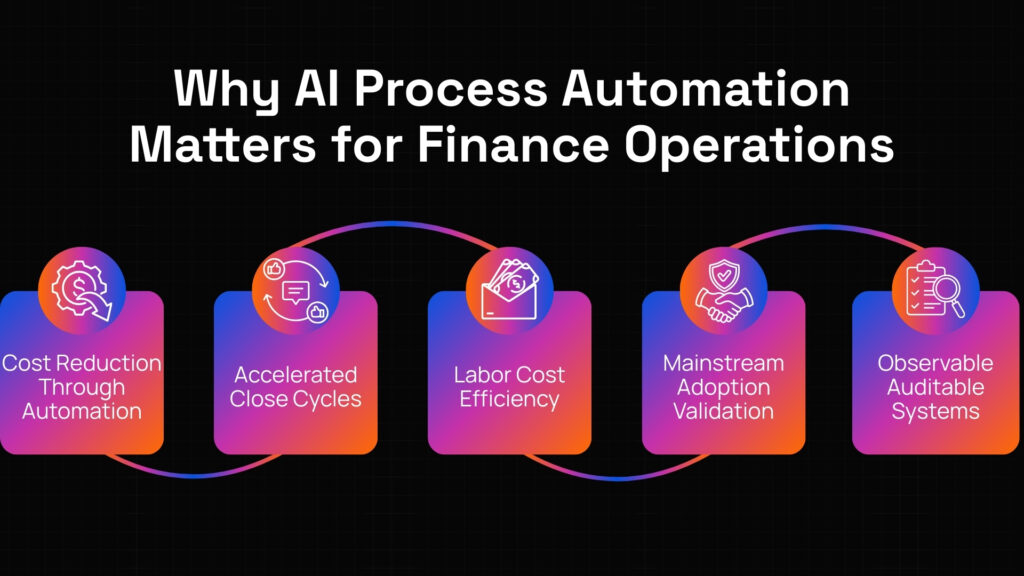
For finance leaders evaluating AI process automation strategies, the AI automation benefits manifest in five critical ways:
- Cost Reduction Through Automation: Deloitte shows organizations scaling intelligent automation report approximately 30 percent cost reductions demonstrating substantial operational returns when implementations eliminate repetitive manual work, freeing finance capacity for analysis, judgment, and strategic support requiring human expertise that machines cannot replicate effectively.
- Accelerated Close Cycles: AI automation in finance handles routine GL postings, invoice processing, and reconciliations speeding month-end tasks, reducing close-cycle time enabling faster financial reporting and executive decision-making as finance teams under pressure to close faster benefit from workflow acceleration addressing manual exception handling delays.
- Labor Cost Efficiency: Gartner indicates conversational and voice AI can cut operations labor costs significantly as agentic systems mature, validating efficiency when AI process automation handles collections outreach, vendor communications, and routine inquiries freeing finance representatives for complex negotiations and relationship management.
- Mainstream Adoption Validation: McKinsey reports many organizations have at least one AI use case and experiment with agentic systems proving widespread acceptance, as AI automation examples demonstrate production deployments beyond pilots validating business cases for finance workflow automation across invoice processing, expense classification, and payment processing.
- Observable Auditable Systems: McKinsey notes buyers worry about accuracy, governance, and model drift requiring observable auditable systems as table stakes, emphasizing AI automation in finance must provide transaction-level traces, approval logs, and rollback capabilities addressing control and compliance requirements that distinguish finance from less regulated functions.
AI automation in finance is not about replacing accountants; it is about cutting manual work, protecting controls, and tying automation to measurable finance KPIs through workflow redesign enabling finance professionals to focus capacity on complex accounting estimates, legal interpretation, and strategic analysis that require judgment and expertise.
Key Considerations When Choosing AI Process Automation Partners
Selecting the right AI automation in finance requires careful alignment between technology capabilities and finance requirements. The most successful AI process automation implementations are built on a foundation of governance, deep ERP integration, and measurable impact on critical metrics like close-cycle time, days sales outstanding, and error rates.
Below are the core factors that should guide every AI automation in finance decision:
- Business Outcomes & KPI Alignment: Every AI process automation initiative must connect directly to tangible finance metrics including close-cycle time reduction, DSO improvement, error rate decrease, or cost per transaction optimization. Vendors should commit to measurable KPIs with clear baselines and tracking rather than generic efficiency promises disconnected from actual financial operations outcomes.
- Integration with Finance Systems: Effective AI automation in finance depends on seamless connectivity with ERP and general ledger platforms, treasury management and payment systems, banking feeds, and downstream reporting tools. Confirm native connectors or robust APIs supporting file formats, FHIR/HL7 for healthcare finance, and SFTP protocols enabling real-time data flow without manual intervention.
- Security and Governance: AI process automation handles sensitive financial data including transactions, account balances, and payment information requiring encryption in transit and at rest, data residency options, role-based access controls, and SOC/ISO compliance reports. Address audit requirements as McKinsey notes buyers worry about governance making controls table stakes.
- Human-in-the-Loop (HITL) Approvals: Successful AI automation in finance always includes accountant oversight with clear thresholds for human review, audit trails for overrides, and fast rollback capabilities. Require explicit approval gates for accounting entries and changes to GL mappings, as Deloitte shows 30 percent cost reductions requiring appropriate controls not unguarded automation.
- Observability and Analytics: Transparency is essential when scaling AI automation benefits across transaction volume. A capable vendor provides transaction-level traces enabling audit, error classification supporting root cause analysis, model performance metrics measuring drift, and kill switch allowing immediate disable when automation degrades quality or creates control issues.
- Pricing Transparency and Flexibility: Clarify pricing structure including per-transaction charges, API usage fees, or license-based models with transparent assumptions sheet documenting volumes, expected containment, human review minutes, and unit costs. Include vendor fees, cloud inference expenses, and human review time in comprehensive TCO analysis as costs differ from traditional RPA licensing.
Choosing AI automation in finance partners who understand these requirements ensures your investment delivers sustainable improvements rather than creating control gaps, vendor lock-in, or governance vulnerabilities that limit future flexibility when accounting standards, regulations, or finance workflows evolve.
Understanding Finance Automation Fit: Where It Wins and Where It Doesn’t
Before launching any AI process automation initiative, organizations must thoroughly assess which workflows benefit from automation versus requiring continued human judgment. Process selection determines success more than technology sophistication, making fit assessment the most critical planning investment. When finance teams identify appropriate automation candidates, they accelerate value realization, maintain control quality, and avoid expensive failures from automating judgment-heavy work inappropriately.
Good Fit for AI Automation in Finance: Invoice processing handles high-volume repetitive data extraction and validation. Reconciliations automate matching transactions across systems with exception handling. Expense classification applies consistent coding rules to spending data. Routine GL postings execute rule-following journal entries. Collections outreach automates payment reminders and follow-up communications as Deloitte shows 30 percent cost reductions achievable for these repeatable workflows.
Caution Required: Judgment-heavy tasks including complex accounting estimates, legal interpretation, unusual transaction analysis, and material misstatement risk assessment need human sign-off and tight HITL flows. These situations require expertise, context, and professional judgment that AI process automation cannot replicate effectively as McKinsey notes governance concerns making human oversight essential for sensitive decisions.
Pro Tip: Prioritize high-volume rule-following processes with clear success metrics enabling objective evaluation. Start with one legal entity or business unit proving value on narrow scope as Gartner indicates agentic systems mature requiring focused implementation over broad deployment attempting too much simultaneously creating poor results undermining confidence.
Understanding AI Automation in Finance KPIs: What to Measure
Before launching any AI process automation initiative, organizations must thoroughly define success metrics enabling objective pilot evaluation and ongoing performance monitoring. Key performance indicators provide the measurement framework distinguishing valuable implementations from expensive failures creating finance team skepticism. When finance operations teams establish KPIs in advance, they align stakeholders around clear targets, enable data-driven optimization, and build business cases justifying continued investment through demonstrated value.
- Close Time Reduction: Measure days to complete month-end close pre- and post-automation targeting specific improvements like 3-day reduction enabling faster financial reporting and executive decision-making as finance teams under pressure benefit from workflow acceleration addressing manual exception handling delays.
- DSO and Collections Velocity: Track incremental lift from automated outreach measuring days sales outstanding improvement when AI automation in finance handles payment reminders and follow-up communications freeing collections representatives for complex negotiations and disputed items requiring relationship skills.
- Cost Per Transaction: Calculate comprehensive expenses including vendor fees, cloud inference costs, and human review time divided by transaction volume measuring total efficiency as Deloitte shows 30 percent cost reductions requiring accurate baseline and post-implementation comparison validating financial returns.
- Exception and Rework Rate: Monitor false positives creating extra manual work when AI process automation misclassifies transactions or flags incorrect exceptions, as small increases in exception rates can remove expected savings according to sensitivity analysis requiring careful accuracy tracking.
- Audit Completeness: Evaluate percent of transactions with full trace and approval metadata ensuring regulatory compliance and internal control effectiveness, as McKinsey notes buyers worry about governance requiring comprehensive audit trails not just operational efficiency measurements.
Pro Tip: Build sensitivity analyses around escalation and exception rates understanding how performance variations affect total cost of ownership. Small increases in exceptions can negate expected savings requiring break-even threshold calculation establishing performance floor triggering immediate intervention preventing situations where declining accuracy undermines financial business case.
The Impact of Integration Readiness
Before launching any AI automation in finance initiative, organizations must thoroughly assess their ERP architecture, data quality, and chart of accounts structure completeness. Integration readiness evaluates how well existing finance systems, master data, and accounting procedures can support intelligent automation without creating technical debt or control gaps. When finance operations teams conduct integration audits in advance, they uncover system limitations and data quality issues early, align stakeholders around connectivity requirements, and minimize wasted time during vendor discovery and pilot phases.
Example: A manufacturing company preparing for AI process automation mapped their ERP and banking integration, discovering their general ledger used custom account structures beyond standard CoA requiring mapping, their vendor master contained duplicate records preventing accurate invoice matching, their banking feeds lacked real-time APIs requiring batch file processing, and their approval workflows weren’t documented in system configuration creating ambiguity about automation boundaries. Addressing these integration readiness issues before vendor engagement reduced the overall project timeline by nine weeks.
Pro Tip: Map ERP schemas, API scopes, SFTP feeds, chart of accounts mapping, and retention rules before engaging vendors. Request access matrix documenting required permissions and data fields. Use ERP and Integration Readiness Checklist preparing comprehensive pilot validation ensuring data quality, system connectivity, and control framework readiness.
Common Pitfalls in AI Automation in Finance Implementation
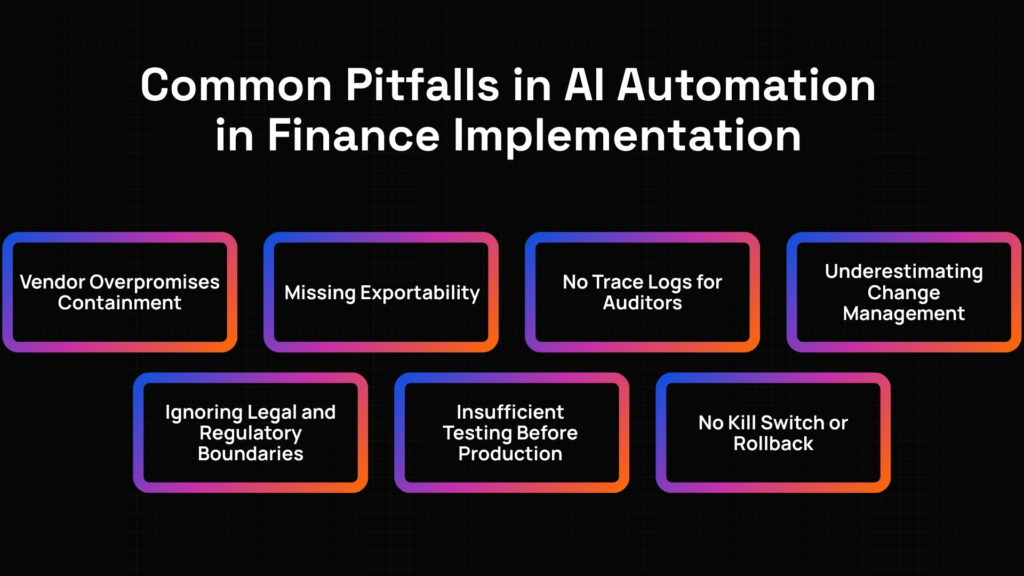
AI process automation promises efficiency and cost reduction, but poor planning and inadequate governance can create control failures instead of operational improvements. Many finance organizations make avoidable mistakes during deployment that delay value realization and erode both team and auditor trust. To discover proven methodologies tailored for your finance workflows and control requirements, explore our AI Workflow Automation Services page for detailed AI automation in finance frameworks and real-world implementation guidance.
- Vendor Overpromises Containment: Some AI automation examples claim unrealistic exception rates without validation. Pilot on real data measuring actual exceptions rather than accepting theoretical accuracy percentages, as Deloitte shows 30 percent cost reductions requiring honest assessment not inflated promises creating unrealistic expectations undermining credibility when performance disappoints.
- Missing Exportability: Contracts without asset ownership clarity create operational dependency preventing competitive negotiations and future flexibility. Add export clauses for prompts, mappings, and evaluation sets ensuring you can switch vendors, bring automation in-house, or iterate independently without losing operational capability or starting from scratch after substantial investment.
- No Trace Logs for Auditors: Launching AI automation in finance without comprehensive audit trails creates compliance violations. Require transaction-level traces and approved change logs documenting every automated entry, user, timestamp, rule or model version, and reasoning as McKinsey notes governance concerns making auditability table stakes not optional enhancement.
- Underestimating Change Management: Technical implementations without training and process redesign face adoption resistance. Budget training time for accountants and process redesign efforts, as Deloitte shows 30 percent cost reductions come from intelligent automation plus workflow transformation requiring holistic approach beyond pure technology deployment.
- Ignoring Legal and Regulatory Boundaries: Organizations overlooking compliance requirements for payments, KYC, or financial reporting face violations. Map compliance checkpoints into workflow ensuring AI process automation respects regulatory boundaries through appropriate human review gates and audit documentation as McKinsey emphasizes observable systems addressing governance concerns.
- Insufficient Testing Before Production: Organizations rushing deployment without parallel validation discover quality issues after financial impact. Run 4 to 8 week pilot with parallel human validation comparing AI outputs to accountant decisions measuring accuracy, exception rates, and control effectiveness before production deployment as McKinsey shows pilots plus human oversight improve outcomes.
- No Kill Switch or Rollback: Launching without emergency disable capability creates risk when automation produces incorrect entries or violates controls. Keep rollback and emergency-disable as contractual requirement enabling immediate response when AI automation in finance degrades quality, creates material errors, or threatens financial reporting integrity.
Evaluating AI Automation Benefits Through Finance ROI
Quantifying the benefits of AI process automation helps secure executive buy-in and refine future investments in finance technology. Measuring ROI goes beyond simple time savings; it captures gains in close velocity, DSO improvement, cost efficiency, and audit quality. Without clear financial modeling during evaluation, AI automation in finance projects risk becoming unclear implementations that fail to justify ongoing operational expenses and licensing costs.
Key considerations for financial analysis include:
- Cost Reduction Achievement: Deloitte shows organizations scaling intelligent automation report approximately 30 percent cost reductions providing optimistic scenario for modeling when implementations eliminate repetitive manual work through invoice processing automation, reconciliation acceleration, and routine posting execution freeing finance capacity for strategic work.
- Labor Cost Efficiency: Gartner indicates conversational and voice AI can cut operations labor costs significantly as agentic systems mature, measuring savings from automated collections outreach, vendor communications, and routine inquiries calculating freed staff time redirected to complex analysis and judgment work requiring human expertise.
- Close Cycle Acceleration: Track days saved in month-end close when AI automation in finance handles routine postings, reconciliations, and exception resolution, measuring value from faster financial reporting enabling timely executive decision-making as finance teams under pressure to close faster quantify acceleration benefits.
- DSO and Working Capital: Calculate working capital improvements when automated collections outreach accelerates payment velocity, measuring days sales outstanding reduction and associated cash flow benefits as AI process automation handles reminder communications and payment tracking freeing representatives for disputed items.
- Exception and Rework Cost: Monitor cost increases from false positives requiring manual correction when AI automation in finance misclassifies transactions, as small increases in exception rates can negate expected savings requiring sensitivity modeling understanding how accuracy variations affect total financial returns validating break-even thresholds.
- Total Cost of Ownership: Include vendor fees, cloud inference expenses, and human review time in comprehensive analysis. Understand that AI and LLM workloads are more variable with per-call, per-token, and per-transcription-minute charges unlike traditional RPA license plus infrastructure models requiring different financial forecasting approaches as costs scale with usage.
Deloitte shows approximately 30 percent cost reductions from scaled intelligent automation. Gartner indicates significant labor cost cuts from conversational and voice AI. McKinsey reports growing adoption with buyers worried about governance requiring observable systems. Industry forecasts show enterprise agentic AI use with pilots plus human oversight improving outcomes. When every AI automation in finance interaction logs transaction details, approval decisions, model versions, and exception reasoning, every accounting entry maintains comprehensive audit trail with user, timestamp, and rule documentation, and every quarterly review assesses model drift and exception taxonomy evolution, organizations build trusted finance operations that scale without sacrificing control quality, audit compliance, or financial reporting integrity.
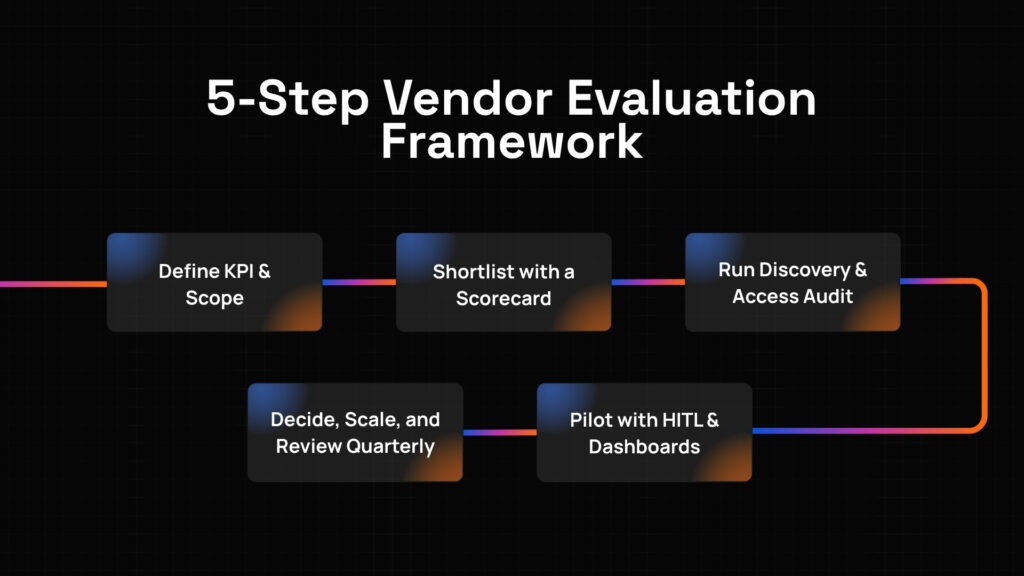
5-Step Vendor Framework for AI Automation in Finance
Selecting an AI process automation vendor should follow a disciplined, structured process that aligns with your organization’s finance goals while accounting for both technological depth and regulatory compliance. Instead of focusing solely on impressive demonstrations or cost claims, evaluation should weigh how well the AI automation in finance solution supports measurable outcomes, integrates with existing systems, and maintains control quality through appropriate governance.
1. Define KPI & Scope
Start by identifying specific measurable outcomes with narrow scope enabling quick value proof. Defining concrete targets helps align all stakeholders including finance leadership, accounting operations, IT teams, and internal audit. Your goal might be reducing manual invoice processing time by 50 percent for vendor invoices under $10,000, accelerating close cycle, or improving DSO, but it must be quantifiable with clear financial impact.
Example: A distribution company defined its KPI as “reducing manual invoice processing time by 50 percent for vendor invoices under $10,000 within 90 days while maintaining error rate below 2 percent and audit completeness above 98 percent.” This metric guided every AI automation in finance discussion, shaped pilot design with clear operational benchmarks, and became the success measurement. Start with one legal entity or business unit proving approach.
Pro Tip: Document one primary finance outcome before requesting proposals. Focus on close-cycle time, DSO reduction, or cost per transaction tied to operational efficiency rather than vanity metrics like total transactions processed, and define specific percentage improvement targets with timelines enabling objective go/no-go decisions during pilot evaluation.
2. Shortlist with a Scorecard
Once objectives are clear, move to structured vendor comparison using a weighted scorecard evaluating AI process automation providers. This tool allows teams to quantify how well each vendor aligns with priorities including governance and auditability, integration depth, HITL and approvals, observability and exports, pricing transparency, and delivery and enablement.
Example: One enterprise assigned 25 percent weight to governance and auditability meeting finance control requirements, 20 percent to integration depth with ERP and banking systems, 15 percent each to HITL and approval design, observability and export capabilities, and pricing transparency, and 10 percent to delivery and enablement support. Weight governance and observability higher for finance.
Pro Tip: Turn evaluation criteria into numeric scoring so decisions remain defendable beyond subjective demonstration impressions. Score integration, governance, HITL, observability, and pricing (0 to 5). Weight governance and observability appropriately as McKinsey notes buyers worry about accuracy and model drift requiring audit trails and controls. Have multiple stakeholders from finance, IT, and audit score vendors independently before group discussion to reduce bias.
3. Run Discovery & Access Audit
Before contracts are signed, a structured discovery phase maps ERP schemas, API scopes, SFTP feeds, chart of accounts mapping, and retention rules documenting every integration touchpoint and compliance requirement. During this phase, teams validate API capabilities, surface data quality gaps, and confirm security controls with appropriate permissions. Request access matrix.
Example: A healthcare organization conducted discovery for AI automation in finance, revealing their ERP used custom GL segment structures requiring mapping, their vendor master lacked standardized naming creating duplicate records, their banking feeds didn’t support real-time API access requiring batch processing, their approval workflows varied by entity preventing standardized automation, and their audit documentation requirements weren’t codified in procedures.
Pro Tip: Map ERP schemas, API scopes, SFTP feeds, chart of accounts mapping, and retention rules before proposals. Request access matrix documenting exact read-write actions in ERP and which fields will be modified. Use discovery to surface integration limitations, data quality gaps, and compliance requirements before signing when negotiating leverage is highest.
4. Pilot with HITL & Dashboards
A well-designed pilot validates both technology performance and control effectiveness under real finance conditions. Instead of full-scale deployment, run 4 to 8 week pilot with parallel human validation, weekly KPI exports, and kill switch maintaining accountant oversight for quality assurance. Incorporating human-in-the-loop review ensures AI automation benefits align with finance standards and control requirements while building organizational confidence.
Example: A manufacturing company piloted AI process automation for invoice processing, running 8-week evaluation with parallel accountant validation comparing AI classification to manual coding, approval review for all GL postings before system entry, and dashboard tracking processing time, error rate, and exception volume, achieving 48 percent time reduction with 1.8 percent error rate below 2 percent target. Require raw exports for audit as McKinsey shows pilots plus human oversight improve outcomes.
Pro Tip: Execute pilots with frozen scope covering specific workflow, clear success criteria including control effectiveness benchmarks, and measurable KPIs tracked weekly. Run 4 to 8 week pilot with parallel human validation establishing AI meets finance standards. Require weekly KPI exports and raw data for independent audit validation. Include contractual kill switch enabling immediate disable if control quality degrades or material errors occur.
5. Decide, Scale, and Review Quarterly
After the pilot proves both operational value and control maintenance, use findings to guide the final decision about scaling after meeting KPIs for consecutive periods validating sustainability and stability. Scaling should be deliberate, expanding only after demonstrating approach maintains quality across representative transaction volumes and complexity. Continuous quarterly reviews maintain financial discipline, ensuring automation adapts as accounting standards, regulations, and business workflows evolve.
Example: A financial services company conducted quarterly reviews with its AI automation in finance partner, expanding successful invoice automation to expense processing and reconciliations over 12 months, scaling after meeting targets for consecutive periods, identifying optimization opportunities reducing close time by additional 1.5 days, and reviewing drift, exception taxonomy, and regulatory changes as Deloitte shows 30 percent cost reductions requiring ongoing governance.
Pro Tip: Treat vendor reviews as governance sessions focused on control maintenance and audit compliance, not just operational performance. Scale after meeting KPIs for consecutive periods proving reliability. Review drift, exception taxonomy evolution, and regulatory changes quarterly. Use quarterly reviews to assess accuracy trends, control effectiveness, audit trail completeness, and alignment with evolving accounting standards and regulations.
Next Steps in Your AI Automation in Finance Evaluation
By now, you should have a clear understanding of what to prioritize when selecting AI process automation partners for finance. Bringing these insights together creates a structured evaluation flow that de-risks investment and accelerates deployment while ensuring control quality and regulatory compliance.
- Align with finance metrics: Ensure every AI automation benefits feature connects to specific KPIs like close-cycle time, DSO, error rate, or cost per transaction tied to operational efficiency, not just automation coverage percentages disconnected from actual financial operations impact and measurable outcomes.
- Evaluate ERP integration: Confirm that AI automation in finance works smoothly with your ERP and GL, treasury management and payment systems, banking feeds, and reporting tools through native connectors or robust APIs enabling real-time data flow without manual intervention or disconnected systems creating data gaps.
- Focus on governance: Choose vendors with transaction-level traces enabling audit, approval workflows supporting human review gates, and rollback capabilities allowing emergency disable, as McKinsey notes buyers worry about accuracy and model drift requiring observable auditable systems addressing control and compliance requirements.
- Review observability capabilities: Favor partners with error classification supporting root cause analysis, model performance metrics measuring drift, audit logs documenting all changes, and kill switch allowing immediate response when automation degrades quality or creates control issues threatening financial reporting integrity.
- Test with controlled pilots: Always run 4 to 8 week pilots with parallel human validation, weekly KPI tracking, audit documentation review, and contractual kill switch before full deployment to validate time savings, error rate maintenance, and operational readiness under real-world finance conditions with actual transaction complexity.
With these criteria in place, you are better equipped to identify AI automation in finance vendors who not only automate workflows but also reduce close time, maintain controls, enable audit compliance, and amplify your team’s capacity to focus on judgment-heavy decisions requiring expertise that machines cannot replicate.
Vendor Questions to Ask
To make the most informed decision during your AI automation in finance evaluation, be sure to ask these essential questions:
- Which ERP, TMS, and banking platforms do you integrate with natively, and can you provide connector list documenting supported systems?
- What exact read-write actions do you require in our ERP, and which fields will be modified including GL accounts, approval status, and transaction details?
- How do you log approvals and automated accounting entries for auditors, and can you provide sample trace logs showing documentation standards?
- What are your confidence thresholds requiring human review, and how do escalations work including what handoff payload contains for accountant context?
- How do you store and export prompts, mappings, and evaluation data on termination ensuring operational work remains with our organization?
- What pricing assumptions drive your quote including transactions, exceptions, API calls, and storage costs, and how do costs scale with volume?
- Can you provide anonymized finance case studies demonstrating close-cycle improvements, DSO gains, or cost reductions with actual pilot metrics?
- What is the kill switch mechanism enabling emergency disable and rollback to prior state when automation produces errors or violates controls?
- Can I speak to two customer references in similar industries who can discuss implementation challenges, control effectiveness, and ongoing partnership quality?
- How do you handle model drift and exception taxonomy evolution requiring quarterly reviews maintaining accuracy and control quality over time?
Transform Finance Operations with AI Automation in Finance
AI automation in finance is not just a technological investment; it is a strategic operational capability that requires careful planning, appropriate controls, and continuous performance monitoring. The right implementation brings reduced manual work, accelerated close cycles, and maintained audit compliance, while poor execution creates control gaps and material errors that undermine confidence and threaten financial reporting integrity.
Ready to transform your finance operations with AI automation in finance? Book a Free Strategy Call with us to explore the next steps and discover how we can help you scope pilots, evaluate vendors, and deploy the right AI process automation solution for your unique ERP environment, finance workflows, control requirements, and measurable business outcomes.