
The Power of AI Automation in Manufacturing: Why Selection Matters
AI automation in manufacturing has evolved from basic monitoring systems into intelligent predictive infrastructure that defines operational excellence in modern factories. Operations teams implementing professional AI process automation are fundamentally transforming how downtime gets prevented, how throughput accelerates, and how quality controls remain protected through sensor analytics and predictive maintenance. Advanced AI automation benefits now extend from anomaly detection and quality inspection to process optimization and spare parts planning, enabling technicians to focus on complex troubleshooting while machines handle predictive analytics that once required specialized data science expertise unavailable to most manufacturers.
The data supporting strategic manufacturing automation continues to strengthen across operational functions. According to Deloitte research, predictive maintenance reduces downtime and maintenance costs substantially for many firms, demonstrating measurable operational returns when implementations combine sensor data with operational action. Deloitte indicates manufacturers are committing serious budgets to smart factory investments with most executives planning material spend on digital and AI initiatives next year, validating widespread investment cases beyond experimental pilots as intelligent systems become core manufacturing infrastructure. McKinsey and industry analyses estimate large productivity gains from wider AI adoption through accelerated R&D and process optimization, proving that AI automation in manufacturing enables competitive advantages beyond pure cost reduction.
Why AI Process Automation Matters for Manufacturing Operations
AI automation benefits extend beyond simple monitoring; they transform how manufacturing organizations manage equipment reliability, maintain throughput velocity, and ensure product quality across all production workflows. Manual manufacturing processes that once created bottlenecks through reactive maintenance, inconsistent quality sampling, and impossible real-time optimization can now be executed with intelligence and precision through AI process automation that compounds efficiency over time. From reducing unplanned downtime by 30 percent to improving yield through vision-based defect detection, AI automation in manufacturing delivers measurable outcomes that strengthen both operational efficiency and production quality.
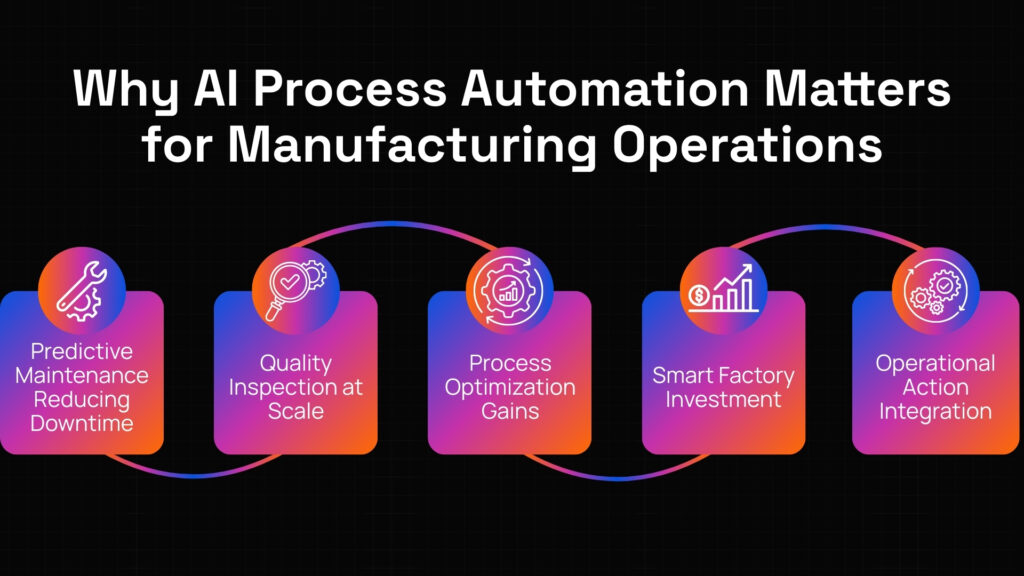
For manufacturing leaders evaluating AI process automation strategies, the AI automation benefits manifest in five critical ways:
- Predictive Maintenance Reducing Downtime: Deloitte shows predictive maintenance can reduce maintenance costs and unplanned breakdowns materially when sensor analytics flag bearing wear and component degradation, with World Economic Forum demonstrating over 50 percent downtime reductions proving substantial performance improvements from combining analytics with operational response playbooks preventing costly line stoppages.
- Quality Inspection at Scale: Vision AI detects defects faster than manual sampling improving yield and reducing scrap, enabling 100 percent inspection without slowing throughput as AI automation examples demonstrate automated quality control identifying issues that statistical sampling misses preventing defective products from reaching customers.
- Process Optimization Gains: McKinsey shows AI-enabled R&D and process tuning accelerate productivity gains when systems recommend parameter tweaks for energy efficiency and throughput improvements, demonstrating that AI process automation optimizes complex manufacturing processes requiring simultaneous variable management beyond human cognitive capacity.
- Smart Factory Investment: Deloitte indicates most executives plan material spend on digital and AI initiatives validating mainstream business cases, as manufacturers commit serious budgets to smart factory investments proving widespread acceptance beyond isolated pilots with AI automation in manufacturing becoming competitive requirement rather than experimental advantage.
- Operational Action Integration: World Economic Forum emphasizes downtime reductions require combining predictive analytics with operational response, proving that AI automation benefits depend on workflow integration not just technology deployment as alerts without clear technician procedures and spare parts planning fail to capture predicted value from sensor intelligence.
AI automation in manufacturing is not about replacing technicians; it is about reducing unplanned downtime, speeding throughput, and preserving quality controls through predictive intelligence enabling operations professionals to focus capacity on complex troubleshooting, process improvement, and strategic optimization that require expertise and judgment.
Key Considerations When Choosing AI Process Automation Partners
Selecting the right AI automation in manufacturing requires careful alignment between technology capabilities and operational requirements. The most successful AI process automation implementations are built on a foundation of deep OT integration, operator workflow design, and measurable impact on critical metrics like downtime, yield, and throughput.
Below are the core factors that should guide every AI automation in manufacturing decision:
- Business Outcomes & KPI Alignment: Every AI process automation initiative must connect directly to tangible manufacturing metrics including throughput increase, yield improvement, unplanned downtime reduction, scrap rate decrease, or cost per unit optimization. Vendors should map automation outcomes to your specific KPIs with measurement frameworks rather than generic efficiency promises disconnected from actual production outcomes.
- Integration with Manufacturing Systems: Effective AI automation in manufacturing depends on seamless connectivity with PLCs and SCADA systems, MES and ERP platforms, and historian databases. Confirm native connectors and documented APIs supporting OPC-UA, MQTT, and FHIR/HL7 for healthcare-adjacent manufacturing enabling real-time data flow from edge devices without manual intervention.
- Security and OT Governance: AI process automation handles sensitive operational data including sensor readings, production parameters, and equipment configurations requiring edge and cloud encryption, role-based access controls, data residency options, and SOC/ISO attestations. Include OT security and network segmentation in statement of work as Deloitte shows serious budget commitments requiring appropriate controls.
- Human-in-the-Loop (HITL) Operator Design: Successful AI automation in manufacturing always includes technician oversight with confidence thresholds triggering operator alerts and clear runbooks for manual override. Deliver action-oriented alerts including root cause, affected assets, recommended next steps, and required spare parts enabling informed response as World Economic Forum shows 50 percent downtime reductions requiring operational action integration.
- Observability and Analytics: Transparency is essential when scaling AI automation benefits across equipment fleet. A capable vendor provides per-event traces enabling troubleshooting, model performance metrics measuring drift, audit trails documenting automated actions and operator overrides, and operational kill switch allowing immediate disable without vendor intervention.
- Pricing Transparency and Flexibility: Clarify pricing structure including sensor ingest rates, per-inference costs, storage expenses, and integration labor with line-item assumptions sheet. Build sensitivity scenarios around false-alert and exception rates as higher-than-expected exception handling can erode ROI quickly requiring accurate forecasting as McKinsey shows productivity gains requiring realistic cost modeling.
Choosing AI automation in manufacturing partners who understand these requirements ensures your investment delivers sustainable improvements rather than creating technical debt, vendor lock-in, or operational gaps that limit future flexibility when equipment, processes, or production requirements evolve.
Understanding Manufacturing Use Cases: Where AI Wins
Before launching any AI process automation initiative, organizations must thoroughly assess which workflows benefit from automation versus requiring continued human expertise. Use case selection determines success more than technology sophistication, making fit assessment the most critical planning investment. When manufacturing teams identify appropriate automation candidates, they accelerate value realization, maintain operational quality, and avoid expensive failures from automating judgment-heavy work inappropriately.
- Predictive Maintenance: Sensor analytics flag bearing wear, vibration anomalies, and temperature deviations saving maintenance costs and preventing line stoppages. Deloitte and industry reviews report predictive maintenance can reduce maintenance costs and unplanned breakdowns materially when implementations integrate operational response playbooks with World Economic Forum showing over 50 percent downtime reductions from combined analytics and action.
- Quality Inspection: Vision AI detects defects faster than manual sampling improving yield and reducing scrap through 100 percent inspection. AI automation examples demonstrate automated defect detection identifying surface flaws, dimensional variations, and assembly errors that statistical sampling misses preventing costly recalls and warranty claims.
- Process Optimization: AI recommends parameter tweaks for energy efficiency and throughput gains through real-time analysis. McKinsey shows AI-enabled R&D and process tuning accelerate productivity gains when systems optimize complex multi-variable processes requiring simultaneous adjustment beyond human cognitive capacity enabling continuous improvement.
- Supply and Spare Parts Planning: Forecasting models reduce stockouts and overstock improving uptime through predictive ordering. AI process automation analyzes failure patterns, lead times, and usage rates recommending optimal inventory levels preventing both emergency expedited shipments and excess working capital tied up in unnecessary stock.
- Worker Augmentation: AI gives technicians concise diagnostics and repair guidance shortening mean time to repair. Systems provide root cause analysis, recommended troubleshooting steps, and relevant historical cases enabling faster resolution as Deloitte shows material productivity gains when automation augments rather than replaces human expertise.
Pro Tip: Limit scope to one production line and one failure mode for pilot proving value on narrow focused implementation. Start with predictive maintenance on equipment with clear failure patterns and available sensor data as World Economic Forum demonstrates 50 percent downtime reductions achievable through focused deployment before expanding to comprehensive coverage.
Understanding AI Automation in Manufacturing KPIs: What to Measure
Before launching any AI process automation initiative, organizations must thoroughly define success metrics enabling objective pilot evaluation and ongoing performance monitoring. Key performance indicators provide the measurement framework distinguishing valuable implementations from expensive failures creating operations team skepticism. When manufacturing operations teams establish KPIs in advance, they align stakeholders around clear targets, enable data-driven optimization, and build business cases justifying continued investment through demonstrated value.
- Unplanned Downtime Reduction: Track hours per week and percentage reduction when AI automation in manufacturing predicts failures enabling preventive action, targeting specific improvements like 30 percent reduction on Line A within 90 days as World Economic Forum shows over 50 percent downtime reductions achievable with combined analytics and operational response.
- Mean Time to Repair (MTTR): Measure how quickly teams can act on AI alerts when systems provide root cause analysis and repair guidance, tracking resolution duration improvements as AI process automation shortens troubleshooting cycles through concise diagnostics enabling faster corrective action.
- Yield and Scrap Rate: Monitor percent of good units out of total production when vision AI detects defects enabling real-time quality control, measuring improvement in first-pass yield and reduction in scrap costs as AI automation benefits extend to quality enhancement beyond pure efficiency.
- Throughput and Cycle Time: Track units per hour or line-balanced output when AI process optimization recommends parameter adjustments, measuring production velocity improvements as McKinsey shows productivity gains from AI-enabled process tuning accelerating throughput without capital investment in additional equipment.
- Operator Overrides and False Alerts: Monitor volume and root causes when technicians override AI recommendations or systems generate incorrect alerts, as excessive false positives erode trust and consume capacity requiring accuracy tracking ensuring alerts provide value not noise undermining adoption.
- Cost Avoided: Calculate maintenance expenses, expedited parts, and overtime saved when predictive maintenance prevents failures, measuring financial returns as Deloitte shows material cost reductions requiring comprehensive TCO analysis validating ROI justifying continued investment in smart factory initiatives.
Pro Tip: Build sensitivity scenarios around false-alert and exception rates understanding how performance variations affect total cost of ownership. Higher-than-expected exception handling can erode ROI quickly requiring break-even threshold calculation establishing performance floor triggering immediate intervention preventing situations where declining accuracy undermines financial business case.
The Impact of Integration Readiness
Before launching any AI automation in manufacturing initiative, organizations must thoroughly assess their OT architecture, sensor infrastructure, and data historian maturity. Integration readiness evaluates how well existing manufacturing systems, equipment connectivity, and operational procedures can support intelligent automation without creating technical debt or operational gaps. When manufacturing operations teams conduct integration audits in advance, they uncover system limitations and data quality issues early, align stakeholders around connectivity requirements, and minimize wasted time during vendor discovery and pilot phases.
Example: A food processing company preparing for AI process automation mapped their PLC and historian integration, discovering their legacy equipment lacked OPC-UA support requiring protocol conversion, their historian database contained inconsistent timestamp formats preventing accurate trend analysis, their MES didn’t capture equipment state changes needed for context, their network segmentation prevented direct sensor access requiring edge compute architecture, and their maintenance procedures weren’t documented in digital formats creating ambiguity about alert escalation. Addressing these integration readiness issues before vendor engagement reduced the overall project timeline by ten weeks.
Pro Tip: Map PLCs, historians, MES, ERP feeds, and edge compute requirements before engaging vendors. Get access matrix listing required data fields and read-write permissions. Use Integration and OT Readiness Checklist covering PLC/OPC-UA fields, historian exports, and edge specifications preparing comprehensive pilot validation.
Common Pitfalls in AI Automation in Manufacturing Implementation
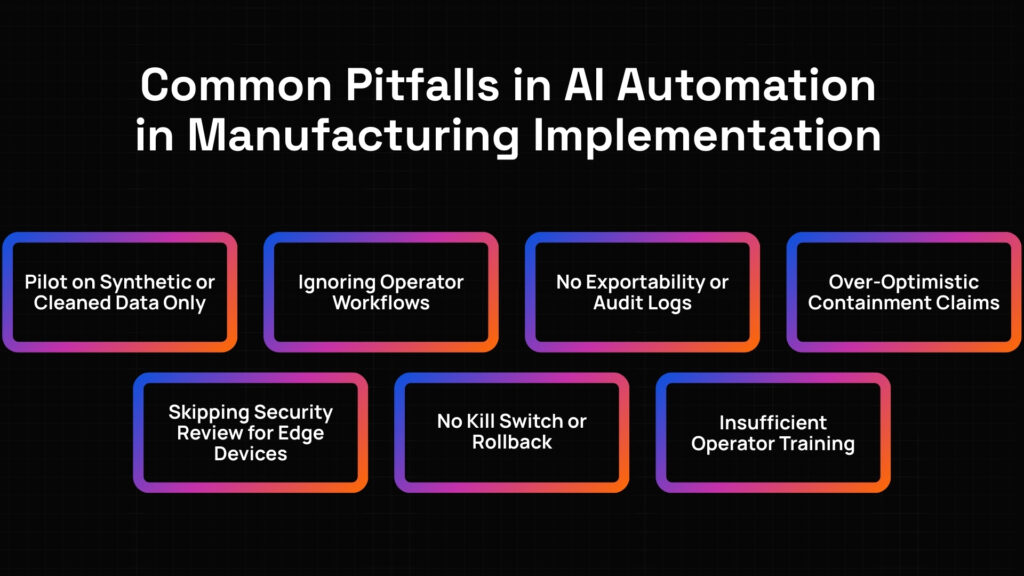
AI process automation promises efficiency and downtime reduction, but poor planning and inadequate operator integration can create false alerts instead of operational improvements. Many manufacturing organizations make avoidable mistakes during deployment that delay value realization and erode both technician and leadership trust. To discover proven methodologies tailored for your manufacturing workflows and operational requirements, explore our AI Workflow Automation Services page for detailed AI automation in manufacturing frameworks and real-world implementation guidance.
- Pilot on Synthetic or Cleaned Data Only: Organizations testing with idealized data discover production surprises. Run pilots on live representative data streams including normal variations, transient conditions, and edge cases ensuring AI automation in manufacturing handles actual operational complexity not just sanitized laboratory conditions as Deloitte shows material gains requiring real-world validation.
- Ignoring Operator Workflows: Deploying AI process automation without technician input faces adoption resistance. Co-design alerts with technicians and include human feedback loop ensuring recommendations fit maintenance procedures, available tools, and spare parts inventory as World Economic Forum shows 50 percent downtime reductions requiring operational action integration not just analytics alone.
- No Exportability or Audit Logs: Contracts without asset ownership clarity create operational dependency preventing competitive negotiations and future flexibility. Contract for raw trace and model export on termination ensuring you can switch vendors, bring automation in-house, or validate independently without losing operational capability or starting from scratch.
- Over-Optimistic Containment Claims: Vendors promising unrealistic accuracy without validation create disappointment. Require controlled pilot and measurable SLAs proving actual performance under production conditions before enterprise commitments, as McKinsey shows productivity gains requiring honest assessment not inflated promises creating unrealistic expectations.
- Skipping Security Review for Edge Devices: Organizations overlooking OT security face operational technology vulnerabilities. Include OT security and network segmentation in statement of work validating edge device protection, encrypted communications, and isolated networks preventing situations where AI automation in manufacturing creates cyber attack vectors threatening production continuity.
- No Kill Switch or Rollback: Launching without operational disable capability creates risk when automation produces false alerts or incorrect predictions. Require kill switch and rollback process that operations team can execute without vendor intervention enabling immediate response when AI automation in manufacturing degrades quality or creates operational confusion.
- Insufficient Operator Training: Technical implementations without technician enablement face poor adoption. Deliver training for technicians on alert interpretation, recommended actions, and system limitations ensuring workforce understands how AI augments rather than replaces expertise as Deloitte shows productivity gains requiring human-AI collaboration not technology alone.
Evaluating AI Automation Benefits Through Manufacturing ROI
Quantifying the benefits of AI process automation helps secure executive buy-in and refine future investments in manufacturing technology. Measuring ROI goes beyond simple downtime reduction; it captures gains in throughput velocity, quality improvement, maintenance efficiency, and production cost. Without clear financial modeling during evaluation, AI automation in manufacturing projects risk becoming unclear implementations that fail to justify ongoing operational expenses and licensing costs.
Key considerations for financial analysis include:
- Downtime Reduction Value: World Economic Forum shows over 50 percent downtime reductions when predictive analytics combine with operational action, calculating avoided production losses, prevented revenue impact, and maintained customer commitments providing substantial financial returns as unplanned stoppages represent highest operational costs in continuous manufacturing.
- Maintenance Cost Savings: Deloitte demonstrates predictive maintenance reduces maintenance costs and unplanned breakdowns materially through condition-based servicing replacing time-based schedules, measuring savings from prevented failures, optimized parts inventory, and eliminated emergency overtime as AI automation in manufacturing enables proactive intervention before catastrophic equipment damage.
- Productivity and Throughput Gains: McKinsey shows AI-enabled process tuning accelerates productivity gains through parameter optimization, measuring output improvements from cycle time reduction and yield enhancement as AI process automation identifies optimal settings that human operators cannot discover through trial and error given multi-variable complexity.
- Quality Cost Avoidance: Calculate prevented scrap, reduced rework, and avoided recalls when vision AI detects defects enabling real-time quality control, measuring value from first-pass yield improvement and warranty claim reduction as AI automation benefits extend beyond efficiency to revenue protection through quality assurance.
- Total Cost of Ownership: Treat classical RPA as license plus infrastructure plus services while treating AI/ML as usage plus model operations plus monitoring. Combine both when solution uses model inference plus orchestration, asking vendors for line-item assumptions sheet covering sensor ingest rates, per-inference cost, storage, integration labor, and expected human-review minutes.
- Investment Validation: Deloitte indicates most executives plan material spend on digital and AI initiatives with manufacturers committing serious budgets to smart factory investments, requiring ROI validation through controlled pilots proving actual performance before enterprise-scale commitments as industry reports show material gains when automation pairs with process redesign and governance.
Deloitte shows predictive maintenance reduces maintenance costs and unplanned breakdowns materially with most executives planning material AI spend. McKinsey demonstrates large productivity gains from AI-enabled R&D and process optimization. World Economic Forum reports over 50 percent downtime reductions from combined analytics and operational action. Industry reports find material cost reductions when automation pairs with process redesign. When every AI automation in manufacturing interaction logs sensor data, prediction confidence, alert generation, and operator response, every model maintains version history with rollback capabilities enabling emergency reversion, and every quarterly review assesses drift in sensor behavior and exception taxonomy evolution, organizations build trusted manufacturing operations that scale without sacrificing equipment reliability, product quality, or operational safety.
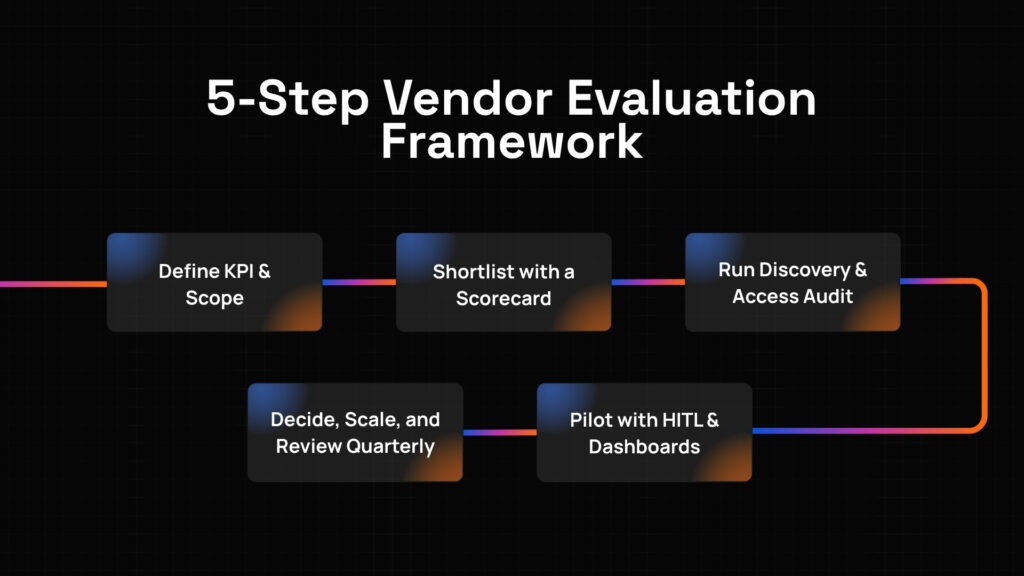
5-Step Vendor Framework for AI Automation in Manufacturing
Selecting an AI process automation vendor should follow a disciplined, structured process that aligns with your organization’s manufacturing goals while accounting for both technological depth and operational sustainability. Instead of focusing solely on impressive demonstrations or downtime claims, evaluation should weigh how well the AI automation in manufacturing solution supports measurable outcomes, integrates with existing systems, and maintains operational quality through appropriate operator workflows.
1. Define KPI & Scope
Start by identifying specific measurable outcomes with narrow scope enabling quick value proof. Defining concrete targets helps align all stakeholders including operations leadership, maintenance teams, quality departments, and IT infrastructure. Your goal might be reducing unplanned downtime by 30 percent on Line A within 90 days, improving yield, or accelerating throughput, but it must be quantifiable with clear operational impact.
Example: A packaging manufacturer defined its KPI as “reducing unplanned downtime by 30 percent on Line A within 90 days while maintaining mean time to repair below 2 hours and keeping false alert rate under 5 percent.” This metric guided every AI automation in manufacturing discussion, shaped pilot design with clear operational benchmarks, and became the success measurement. Limit to one line and one failure mode proving approach.
Pro Tip: Document one primary manufacturing outcome before requesting proposals. Focus on unplanned downtime reduction, yield improvement, or throughput increase tied to production efficiency rather than vanity metrics like total alerts generated, and define specific percentage improvement targets with timelines enabling objective go/no-go decisions during pilot evaluation.
2. Shortlist with a Scorecard
Once objectives are clear, move to structured vendor comparison using a weighted scorecard evaluating AI process automation providers. This tool allows teams to quantify how well each vendor aligns with priorities including integration depth, observability and exports, HITL and operator workflows, security and OT controls, pricing transparency, and delivery and enablement.
Example: One enterprise assigned 25 percent weight to integration depth with PLCs, historians, and MES, 20 percent to observability and export capabilities, 15 percent each to HITL operator workflow design and security and OT controls, 15 percent to pricing transparency, and 10 percent to delivery and enablement support. Weight integration and observability highest.
Pro Tip: Turn evaluation criteria into numeric scoring so decisions remain defendable beyond subjective demonstration impressions. Score integration, HITL, observability, security, and pricing clarity 0 to 5. Weight integration and observability appropriately as World Economic Forum shows 50 percent downtime reductions requiring operational integration and Deloitte emphasizes serious budgets demanding proven value. Have multiple stakeholders from operations, maintenance, and IT score vendors independently before group discussion to reduce bias.
3. Run Discovery & Access Audit
Before contracts are signed, a structured discovery phase maps PLCs, historians, MES, ERP feeds, and edge compute requirements documenting every integration touchpoint and security requirement. During this phase, teams validate protocol support, surface data quality gaps, and confirm network architecture with appropriate segmentation. Get access matrix.
Example: An automotive parts manufacturer conducted discovery for AI automation in manufacturing, revealing their PLCs used proprietary protocols requiring conversion gateways, their historian had inconsistent tag naming preventing automated mapping, their MES lacked real-time equipment state APIs requiring polling workarounds, their OT network prohibited direct internet connectivity requiring edge compute architecture, and their maintenance procedures weren’t digitized preventing automated work order generation.
Pro Tip: Map PLCs, historians, MES, ERP feeds, and edge compute requirements before proposals. Get access matrix listing required data schema and read-write permissions. What is required data schema and what fields need read-write access should be documented. Use discovery to surface protocol limitations, data quality gaps, and security requirements before signing when negotiating leverage is highest.
4. Pilot with HITL & Dashboards
A well-designed pilot validates both technology performance and operator adoption under real manufacturing conditions. Instead of full-scale deployment, run 6 to 12 week pilot with shadow mode, weekly KPI snapshots, and kill switch maintaining technician oversight for quality assurance. Incorporating human-in-the-loop review ensures AI automation benefits align with operational standards and production requirements while building organizational confidence.
Example: A pharmaceutical manufacturer piloted AI process automation for tablet press predictive maintenance, running 12-week evaluation with shadow mode where AI flagged potential issues while technicians followed existing schedules, controlled deployment on one production line, and dashboard tracking downtime, MTTR, false alerts, and operator feedback, achieving 28 percent downtime reduction with 3 percent false alert rate below 5 percent target. Require raw traces as World Economic Forum shows large downtime reductions with operational response playbooks.
Pro Tip: Execute pilots with frozen scope covering specific equipment and failure mode, clear success criteria including operational effectiveness benchmarks, and measurable KPIs tracked weekly. Run 6 to 12 week pilot with shadow mode, weekly snapshots, and kill switch. Require raw traces for independent validation. Use pilot to train technicians on alert interpretation and recommended actions. Include contractual kill switch enabling immediate disable if operational quality degrades.
5. Decide, Scale, and Review Quarterly
After the pilot proves both operational value and equipment reliability improvement, use findings to guide the final decision about scaling after consistent KPI wins validating sustainability and stability. Scaling should be deliberate, expanding only after demonstrating approach maintains quality across representative equipment fleet and production scenarios. Continuous quarterly reviews maintain operational discipline, ensuring automation adapts as equipment ages, processes change, and production requirements evolve.
Example: A food processing company conducted quarterly reviews with its AI automation in manufacturing partner, expanding successful conveyor predictive maintenance to mixing equipment and packaging lines over 12 months, scaling after consistent wins, identifying optimization opportunities reducing unplanned downtime by additional 12 percent, and reviewing model drift, exceptions taxonomy, and spare parts cadence as McKinsey shows productivity gains requiring ongoing governance.
Pro Tip: Treat vendor reviews as operational governance sessions focused on equipment reliability and operator satisfaction, not just performance metrics. Scale after consistent KPI wins proving reliability across multiple production cycles. Review model drift, exception taxonomy evolution, and spare parts forecasting accuracy quarterly. Use quarterly reviews to assess prediction accuracy, alert quality, technician satisfaction, and alignment with evolving equipment and process conditions.
Next Steps in Your AI Automation in Manufacturing Evaluation
By now, you should have a clear understanding of what to prioritize when selecting AI process automation partners for manufacturing. Bringing these insights together creates a structured evaluation flow that de-risks investment and accelerates deployment while ensuring operational excellence and equipment reliability.
- Align with manufacturing metrics: Ensure every AI automation benefits feature connects to specific KPIs like unplanned downtime, yield, throughput, or MTTR tied to production efficiency, not just prediction accuracy percentages disconnected from actual operational impact and measurable manufacturing outcomes.
- Evaluate OT integration: Confirm that AI automation in manufacturing works smoothly with your PLCs, SCADA, historians, and MES through native connectors or documented APIs supporting OPC-UA and MQTT enabling real-time sensor data flow without manual intervention or disconnected systems creating data gaps.
- Focus on operator workflows: Choose vendors with action-oriented alerts including root cause and recommended steps, clear escalation procedures, and technician training programs, as World Economic Forum shows 50 percent downtime reductions requiring operational action integration not just analytics alone.
- Review observability capabilities: Favor partners with per-event traces enabling troubleshooting, model performance metrics measuring drift, audit trails documenting automated actions and operator overrides, and operational kill switch allowing immediate disable without vendor dependency.
- Test with controlled pilots: Always run 6 to 12 week pilots with shadow mode, weekly KPI tracking, live data streams, and contractual kill switch before full deployment to validate downtime improvements, alert quality, and operational readiness under real-world manufacturing conditions with actual equipment complexity.
With these criteria in place, you are better equipped to identify AI automation in manufacturing vendors who not only predict failures but also reduce downtime, improve yield, accelerate throughput, and amplify your team’s capacity to focus on complex troubleshooting requiring expertise that machines cannot replicate.
Vendor Questions to Ask
To make the most informed decision during your AI automation in manufacturing evaluation, be sure to ask these essential questions:
- What PLC, historian, and MES platforms do you integrate with natively, and can you provide connector list documenting supported systems?
- What is the required data schema and what fields do you need read-write access to including sensor tags, equipment states, and maintenance records?
- How do you detect low-confidence predictions requiring operator review, and what does the technician handoff payload include for actionable response?
- What dashboards, traces, and raw export formats do you provide for troubleshooting, and for how long do you retain logs supporting audit and improvement?
- How do you secure edge devices and what OT network segmentation do you require preventing operational technology vulnerabilities?
- What are your pricing assumptions for sensor ingestion, inference computation, storage, and professional services including how costs scale with equipment fleet?
- Who owns trained models, sensor annotations, and evaluation sets on termination ensuring operational work remains with our organization?
- Can you provide anonymized manufacturing case studies demonstrating downtime reductions, yield improvements, or throughput gains with actual pilot metrics?
- What is the kill switch mechanism enabling operations team to disable without vendor intervention when automation produces false alerts?
- Can I speak to two customer references in similar industries who can discuss implementation challenges, operator adoption, and ongoing partnership quality?
Transform Manufacturing Operations with AI Automation in Manufacturing
AI automation in manufacturing is not just a technological investment; it is a strategic operational capability that requires careful planning, appropriate operator integration, and continuous performance monitoring. The right implementation brings reduced unplanned downtime, improved yield, and accelerated throughput, while poor execution creates false alerts and operator frustration that undermine confidence and waste investment.
Ready to transform your manufacturing operations with AI automation in manufacturing? Book a Free Strategy Call with us to explore the next steps and discover how we can help you scope pilots, evaluate vendors, and deploy the right AI process automation solution for your unique equipment fleet, operational workflows, OT infrastructure, and measurable business outcomes.