

The Power of AI Automation in Healthcare: Why Workflow Selection Matters
AI automation in healthcare has evolved from basic appointment reminders into intelligent clinical workflow orchestration that defines operational excellence in modern health systems. Healthcare teams implementing professional AI automation examples are fundamentally transforming how patients move from intake to safe follow-up, how clinicians manage administrative burden, and how care quality improves without creating compliance or safety problems. Advanced systems now manage workflows from pre-visit questionnaires and symptom triage to post-visit follow-up and readmission prevention, enabling clinicians to focus on complex medical decisions while machines handle predictive analytics and documentation that once consumed hours daily.
The data supporting strategic healthcare automation continues to strengthen across clinical and operational functions. According to McKinsey research, more than 70 percent of healthcare organizations report they are pursuing or have implemented generative AI capabilities, demonstrating mainstream acceptance beyond experimental pilots as intelligent systems become core healthcare infrastructure. The Guardian indicates nearly 30 percent of UK GPs say they use AI tools in consultations for notes, administrative tasks, or clinical help, validating practical adoption at point of care. PMC systematic reviews and clinical studies show virtual triage can reduce avoidable ED visits and improve referral speed, proving AI automation examples deliver measurable patient outcomes beyond pure operational efficiency.
Why AI Automation Matter for Healthcare Operations
AI automation in healthcare extends beyond simple task automation; it transforms how health systems manage patient flow, maintain clinical quality, and ensure safety across all care touchpoints. Manual healthcare processes that once created bottlenecks through delayed triage, missed follow-ups, and impossible 24/7 coverage can now be executed with intelligence and precision through AI automation examples that compound efficiency over time. From reducing time-to-first-clinical-triage from 8 hours to 2 hours to preventing avoidable ED visits through proactive outreach, AI automation in healthcare delivers measurable outcomes that strengthen both operational efficiency and patient safety.
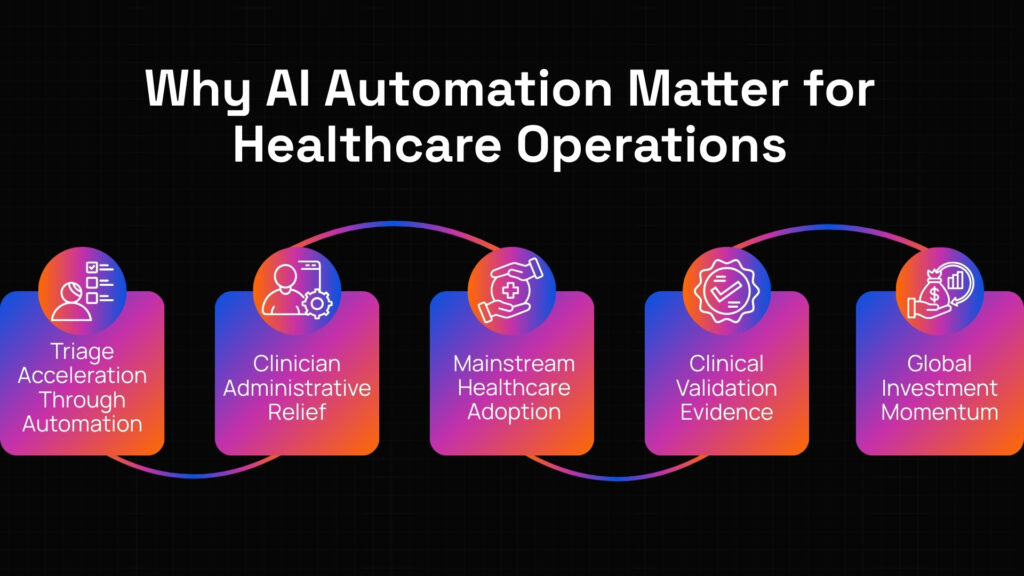
For healthcare leaders evaluating AI automation examples strategies, the benefits manifest in five critical ways:
- Triage Acceleration Through Automation: Virtual triage and symptom assistants cut time-to-clinical-review by 75 percent from 8 hours to 2 hours for urgent referrals, with PMC showing virtual triage reduces avoidable ED visits and improves referral speed demonstrating AI automation in healthcare enables faster access to appropriate care preventing condition deterioration during wait periods.
- Clinician Administrative Relief: The Guardian shows nearly 30 percent of UK GPs use AI tools for notes, admin, or clinical help addressing documentation burden, as AI automation examples demonstrate visit summarization, coding suggestions, and HPI drafting for clinician review freeing capacity from paperwork for direct patient interaction and complex decision-making.
- Mainstream Healthcare Adoption: McKinsey reports over 70 percent pursuing or implementing generative AI proving widespread acceptance, as AI automation in healthcare expands from isolated pilots to production workflows across intake automation, scheduling optimization, documentation assistance, and follow-up coordination becoming competitive requirement rather than experimental advantage.
- Clinical Validation Evidence: Cureus systematic review demonstrates AI-based triage systems improve accuracy and operational outcomes in ED settings when implementations include human oversight, proving AI automation examples deliver measurable clinical value beyond efficiency requiring appropriate validation before deployment addressing safety concerns that distinguish healthcare from less regulated industries.
- Global Investment Momentum: Statista shows large share of digital health funding targeted AI products in 2024 with Reuters indicating regional adoption from 54 percent globally to 83 percent in leading markets, validating sustained business cases as AI automation in healthcare captures investor confidence and demonstrates production-ready maturity beyond proof-of-concept demonstrations.
AI automation in healthcare is not about replacing clinicians; it is about moving patients from intake to safe follow-up fast through workflow optimization enabling healthcare professionals to focus capacity on complex medical decisions, empathetic patient relationships, and clinical judgment that machines cannot replicate effectively.
Key Considerations When Choosing AI Automation in Healthcare Partners
Selecting the right AI automation examples requires careful alignment between technology capabilities and clinical requirements. The most successful AI automation in healthcare implementations are built on a foundation of clinical validation, deep EHR integration, and measurable impact on critical metrics like triage time, avoidable ED visits, and readmission rates.
Below are the core factors that should guide every AI automation in healthcare decision:
- Business Outcomes & KPI Alignment: Every AI automation examples initiative must connect directly to tangible healthcare metrics including lower time-to-triage, reduced no-shows, fewer avoidable ED visits, or lower readmission rates. Vendors should map outputs to your specific goals with measurement frameworks rather than generic efficiency promises disconnected from actual patient outcomes and clinical effectiveness.
- Integration with Healthcare Systems: Effective AI automation in healthcare depends on seamless connectivity with EHR and EMR platforms, scheduling systems, secure messaging, laboratory systems, and single sign-on providers. Confirm native connectors with clear read-write scopes and field update documentation enabling real-time data flow across complex healthcare technology ecosystems without manual intervention.
- Security and Compliance: AI automation examples handle protected health information requiring HIPAA and GDPR controls, data residency options, encryption at rest and in transit, and independent attestations including SOC 2 and ISO 27001. Address PHI security as McKinsey shows 70 percent implementing requiring strict controls preventing breaches that damage patient trust and create regulatory penalties.
- Human-in-the-Loop (HITL) Design: Successful AI automation in healthcare always includes clinician oversight with explicit approval gates for clinical recommendations, configurable confidence thresholds triggering review, and clear escalation flows. Enforce HITL approvals for red-flag categories as PMC shows virtual triage improves outcomes when combined with clinical validation not autonomous execution replacing medical judgment.
- Observability and Auditability: Transparency is essential when scaling AI automation examples across patient populations. A capable vendor provides per-interaction traces enabling quality review, versioned models supporting rollback, evaluation sets measuring accuracy, and audit trails documenting clinical decisions for regulatory compliance and continuous improvement.
- Pricing Transparency and Flexibility: Clarify cost drivers including inference volumes, storage expenses, and professional services with detailed assumptions. Document ownership and portability of prompts, annotations, and evaluation data developed during implementation preventing vendor lock-in as The Guardian shows 30 percent of GPs adopting requiring sustainable partnerships enabling ongoing refinement.
Choosing AI automation in healthcare partners who understand these requirements ensures your investment delivers sustainable improvements rather than creating compliance gaps, vendor lock-in, or safety vulnerabilities that limit future flexibility when clinical workflows, regulations, or care models evolve.
Understanding AI Automation Examples: Production-Ready Workflows
Before launching any AI automation in healthcare initiative, organizations must thoroughly understand specific workflows demonstrating production readiness. Use case clarity prevents inappropriate implementations creating safety issues or poor patient experiences. When healthcare teams identify proven automation candidates, they accelerate value realization, maintain clinical quality, and avoid expensive failures from automating judgment-heavy work inappropriately.
- Intake Automation: Pre-visit questionnaires normalize symptoms, populate EHR fields, and flag urgent cases to triage reducing administrative burden while capturing structured data. AI automation examples demonstrate patient-facing forms collecting chief complaint, symptom duration, and medical history enabling faster clinical review as McKinsey shows 70 percent implementing proving widespread acceptance.
- Symptom Triage Assistant: Patient-facing chat or voice suggests next steps and books appropriate slots escalating high-acuity cases to clinicians. PMC demonstrates virtual triage reduces avoidable ED visits and improves referral speed proving AI automation in healthcare directs patients to appropriate care level preventing both unnecessary emergency visits and delayed specialist access.
- Scheduling and Reminder Flows: Two-way scheduling handles cancellations, reschedules, and pre-visit forms reducing no-shows through automated reminders. AI automation examples demonstrate coordination eliminating phone tag and missed appointments as The Guardian shows GPs using AI tools addressing administrative tasks freeing staff capacity for patient care coordination.
- Post-Visit Follow-Up: Automated care instructions, medication checks, and symptom monitoring via chatbots with human fallback for red flags ensure adherence and early complication detection. AI automation in healthcare maintains continuity after appointments through proactive outreach as Cureus shows triage systems improve outcomes when implementations include appropriate escalation.
- Readmission Prevention: Predictive rules surface patients needing early outreach identifying high-risk cases before discharge enabling proactive intervention. AI automation examples demonstrate risk scoring based on diagnosis, social determinants, and prior utilization patterns targeting limited care management capacity on patients most likely to benefit from intensive support.
- Documentation Helpers: Visit summarization, coding suggestions, and HPI drafting for clinician review reduce documentation burden. The Guardian validates nearly 30 percent of UK GPs use AI tools for notes proving practical adoption, as AI automation in healthcare handles structured data entry while clinicians focus on medical decision-making and patient interaction requiring human judgment.
Pro Tip: Start with one specialty or intake channel proving value on narrow focused implementation. Example includes reducing time-to-first-clinical-triage from 8 hours to 2 hours for urgent referrals as PMC shows virtual triage improves speed requiring focused excellence demonstrating value before comprehensive deployment across all care pathways simultaneously.
Understanding AI Automation in Healthcare KPIs: What to Measure
Before launching any AI automation examples initiative, organizations must thoroughly define success metrics enabling objective pilot evaluation and ongoing performance monitoring. Key performance indicators provide the measurement framework distinguishing valuable implementations from expensive failures creating clinical team skepticism. When healthcare operations teams establish KPIs in advance, they align stakeholders around clear targets, enable data-driven optimization, and build business cases justifying continued investment through demonstrated value.
- Time-to-Triage: Track median time from intake to clinically reviewed triage decision measuring access improvements when AI automation in healthcare accelerates screening, targeting reductions like 8 hours to 2 hours for urgent referrals proving 75 percent improvement as PMC shows virtual triage reduces delays enabling faster appropriate care preventing condition deterioration.
- Appropriateness Rate: Evaluate percent of AI triage recommendations matching clinician decision on holdout sample measuring accuracy, requiring 90 percent or higher concordance as Cureus demonstrates AI-based triage systems improve accuracy when validated proving clinical effectiveness before production deployment across patient populations.
- No-Show Reduction: Monitor percent drop in missed appointments after automated reminders calculating operational efficiency and access improvements, as AI automation examples demonstrate two-way scheduling and proactive communication reducing wasted clinical capacity from patient non-attendance improving utilization and revenue capture.
- Administrative Hours Saved: Measure time reduction through before-after time studies when AI automation in healthcare handles documentation, scheduling, and routine inquiries, quantifying operational efficiency as The Guardian shows 30 percent of GPs use AI tools addressing administrative burden freeing clinician capacity for direct patient care.
- Avoidable ED Visits: Calculate percent reduction for pilot cohort versus matched control when virtual triage directs patients appropriately, with PMC demonstrating systematic reviews show reduced avoidable presentations measuring both patient convenience and system cost avoidance from emergency department diversion to appropriate care settings.
- Readmission Risk Alert Precision: Track percent of alerts correctly predicting readmission within 30 days measuring predictive accuracy, requiring sufficient positive predictive value preventing alert fatigue as AI automation examples demonstrate risk stratification enabling targeted interventions on truly high-risk patients not false positives overwhelming care coordination capacity.
Pro Tip: Test on anonymized real streams or shadow mode before writes validating performance under actual conditions. Run 6 to 8 week pilot in assist or shadow mode collecting traces, clinician overrides, and outcome metrics as Cureus systematic reviews recommend clinical validation before production writes ensuring safety and effectiveness under real-world clinical complexity.
The Impact of Integration Readiness
Before launching any AI automation in healthcare initiative, organizations must thoroughly assess their EHR architecture, API capabilities, and consent workflow completeness. Integration readiness evaluates how well existing clinical systems, patient data assets, and compliance procedures can support intelligent automation without creating technical debt or safety gaps. When healthcare operations teams conduct integration audits in advance, they uncover system limitations and data quality issues early, align stakeholders around connectivity requirements, and minimize wasted time during vendor discovery and pilot phases.
Example: A regional health system preparing for AI automation examples mapped their EHR and scheduling integration, discovering their EMR used custom fields beyond standard FHIR resources requiring mapping, their scheduling system lacked real-time API access requiring batch synchronization creating delay, their secure messaging platform didn’t support automated patient communication requiring separate integration, their consent workflows weren’t documented digitally preventing automated opt-out handling, and their data retention policies varied by department creating compliance complexity. Addressing these integration readiness issues before vendor engagement reduced the overall project timeline by eight weeks.
Pro Tip: Map EHR fields, API rate limits, identity scopes, logging paths, and legal constraints before engaging vendors. Get access matrix listing exact read-write actions required. Use Integration Readiness Checklist covering EHR fields, consent flows, and logging needs preparing comprehensive pilot validation ensuring data quality, system connectivity, and compliance framework readiness.
Common Pitfalls in AI Automation in Healthcare Implementation
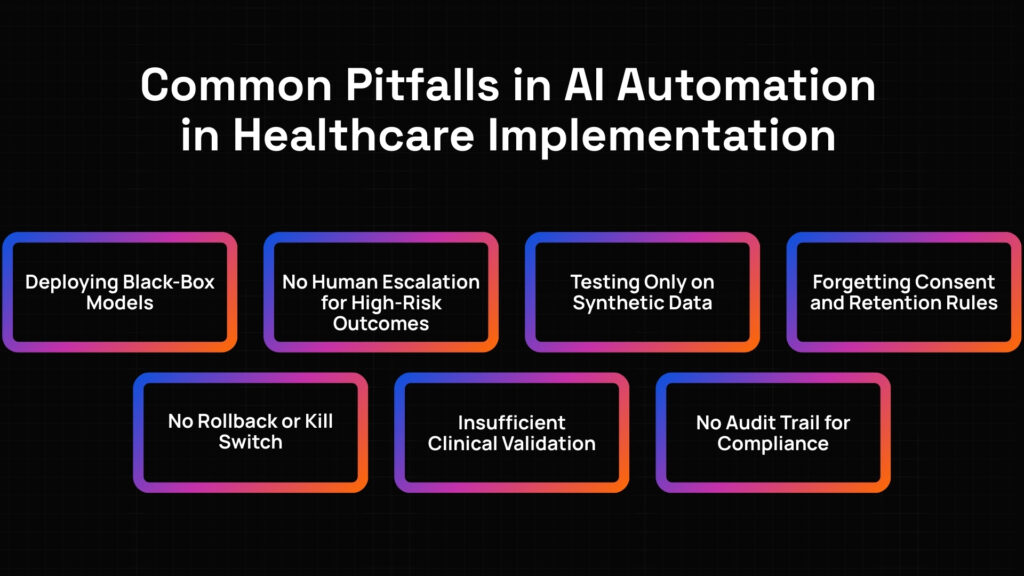
AI automation examples promise efficiency and faster triage, but poor planning and inadequate clinical validation can create safety issues instead of patient improvements. Many healthcare organizations make avoidable mistakes during deployment that delay value realization and erode both clinician and patient trust. To discover proven methodologies tailored for your clinical workflows and safety requirements, explore our AI Workflow Automation Services page for detailed AI automation in healthcare frameworks and real-world implementation guidance.
- Deploying Black-Box Models: Organizations using opaque clinical decision-making cannot validate safety or troubleshoot errors. Require explainability for each triage decision and exportable traces showing why specific recommendations were made, enabling clinical review and quality assurance as McKinsey shows 70 percent implementing requiring transparency addressing safety concerns distinguishing healthcare from less regulated domains.
- No Human Escalation for High-Risk Outcomes: Launching autonomous clinical recommendations without oversight creates safety violations. Enforce HITL approvals for red-flag categories including chest pain, shortness of breath, mental health crises, and pediatric acute illness as PMC shows virtual triage improves outcomes when combined with clinician validation not replacing medical judgment.
- Testing Only on Synthetic Data: Validating with sanitized data misses real-world complexity and safety edge cases. Test on anonymized real streams or shadow mode before writes ensuring AI automation in healthcare handles actual patient diversity, incomplete information, and atypical presentations as Cureus recommends clinical validation before production deployment.
- Forgetting Consent and Retention Rules: Organizations overlooking data privacy face HIPAA violations and patient trust erosion. Map consent flows and retention in discovery requiring configurable retention periods, explicit patient consent for automated communication, and PHI anonymization procedures as The Guardian shows 30 percent of GPs adopting requiring transparent data handling.
- No Rollback or Kill Switch: Deploying without reversion capability creates risk when automation produces incorrect clinical guidance. Require contractual kill switch plus tested rollback scripts enabling immediate disable when AI automation examples generate unsafe recommendations, technical failures, or accuracy degradation threatening patient safety.
- Insufficient Clinical Validation: Launching without evidence-based testing creates unproven interventions. Require peer-reviewed studies or controlled pilots demonstrating clinical effectiveness as Cureus systematic review validates AI-based triage systems improving outcomes, with anonymized examples from similar settings proving approach before deploying across patient populations.
- No Audit Trail for Compliance: Deploying AI automation examples without comprehensive logging creates regulatory violations. Ensure per-interaction traces document clinical decisions, confidence scores, escalation triggers, and outcomes supporting quality reviews, malpractice defense, and regulatory audits as McKinsey shows 70 percent implementing requiring strict compliance controls.
Evaluating AI Automation Challenges Through Healthcare ROI
Quantifying the benefits of AI automation in healthcare helps secure executive buy-in and refine future investments in clinical technology while addressing AI automation challenges including implementation complexity and change management. Measuring ROI goes beyond simple time savings; it captures gains in triage speed, avoidable visit reduction, readmission prevention, and clinician capacity. Without clear financial modeling during evaluation, AI automation examples projects risk becoming unclear implementations that fail to justify ongoing operational expenses and licensing costs.
Key considerations for financial analysis include:
- Triage Time Reduction Value: Calculate access improvements when AI automation in healthcare cuts time from 8 hours to 2 hours achieving 75 percent reduction, measuring patient satisfaction from faster care plus clinical outcomes from earlier intervention as PMC shows virtual triage reduces avoidable ED visits preventing condition progression during delays.
- Avoidable ED Visit Cost Savings: Track prevented emergency department presentations when virtual triage directs patients appropriately, calculating system cost avoidance from unnecessary visits plus patient convenience improvements as PMC demonstrates systematic reviews show reduced avoidable late presentations measuring both financial returns and patient experience enhancements.
- Administrative Efficiency Gains: Measure hours saved when AI automation examples handle documentation, scheduling coordination, and routine inquiries, quantifying operational returns as The Guardian shows nearly 30 percent of UK GPs use AI tools freeing clinician capacity from administrative burden for direct patient care and complex medical decision-making.
- Readmission Prevention Value: Calculate cost avoidance when predictive alerts enable proactive intervention preventing 30-day readmissions, measuring penalties avoided plus care quality improvements as AI automation in healthcare identifies high-risk patients enabling targeted case management on populations most likely to benefit from intensive support.
- No-Show Reduction Impact: Track revenue capture from reduced missed appointments when automated reminders improve attendance, calculating clinical capacity utilization improvements plus access gains from eliminated wasted slots as AI automation examples demonstrate proactive communication reducing non-attendance improving both financial performance and patient access.
- Total Cost of Ownership: Include inference and usage costs, EHR integration expenses, clinical validation studies, plus ongoing model monitoring, bias testing, and compliance audit costs in comprehensive analysis. Understand pricing scales with patient volume, interaction frequency, or care episodes requiring sensitivity modeling as Cureus emphasizes validation requiring investment beyond pure technology deployment.
McKinsey shows over 70 percent pursuing or implementing generative AI proving mainstream acceptance. The Guardian indicates nearly 30 percent of UK GPs use AI tools in consultations. PMC demonstrates virtual triage reduces avoidable ED visits and improves referral speed. Cureus validates AI-based triage systems improve accuracy and operational outcomes with appropriate oversight. When every AI automation in healthcare interaction logs clinical decision logic, confidence scores, escalation triggers, and patient outcomes, every triage recommendation validates against clinician assessment before autonomous execution, and every quarterly review assesses model drift and clinical guideline alignment, organizations build trusted healthcare operations that scale without sacrificing patient safety.
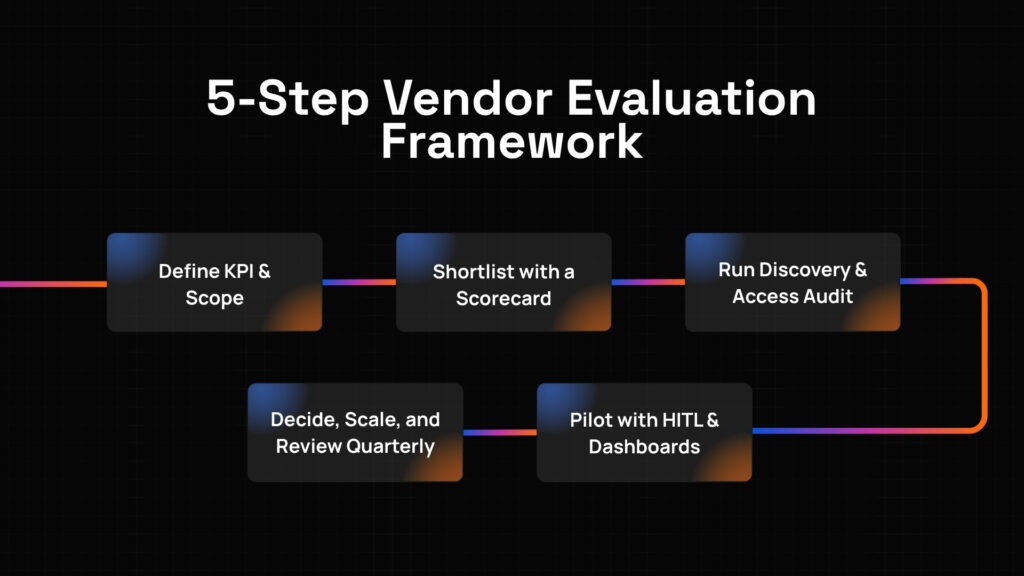
5-Step Vendor Framework for AI Automation in Healthcare
Selecting an AI automation examples vendor should follow a disciplined, structured process that aligns with your organization’s clinical goals while accounting for both technological depth and patient safety requirements. Instead of focusing solely on impressive demonstrations or efficiency claims, evaluation should weigh how well the AI automation in healthcare solution supports measurable outcomes, integrates with existing systems, and maintains safety through appropriate clinical validation.
1. Define KPI & Scope
Start by identifying specific measurable outcomes with narrow scope enabling quick clinical validation. Defining concrete targets helps align all stakeholders including clinical leadership, quality departments, IT infrastructure, and patient experience teams. Your goal might be reducing time-to-first-clinical-triage from 8 hours to 2 hours for urgent referrals, decreasing no-shows, or preventing avoidable ED visits, but it must be quantifiable with clear patient impact.
Example: A community hospital defined its KPI as “reducing time-to-first-clinical-triage from 8 hours to 2 hours for urgent specialty referrals within 90 days while maintaining appropriateness rate above 90 percent and avoidable ED visit reduction of 15 percent.” This metric guided every AI automation in healthcare discussion, shaped pilot design with clear clinical benchmarks, and became the success measurement. Start with one specialty or intake channel proving approach.
Pro Tip: Document one primary healthcare outcome before requesting proposals. Focus on triage time reduction, avoidable visit prevention, or readmission rate decrease tied to patient safety rather than vanity metrics like total interactions processed, and define specific percentage improvement targets with timelines enabling objective go/no-go decisions during pilot evaluation.
2. Shortlist with a Scorecard
Once objectives are clear, move to structured vendor comparison using a weighted scorecard evaluating AI automation examples providers. This tool allows teams to quantify how well each vendor aligns with priorities including integration depth, governance and compliance, clinical validation, observability and exports, HITL design, and pricing transparency.
Example: One health system assigned 20 percent weight each to integration depth with EHR and scheduling systems, governance and compliance meeting HIPAA requirements, and clinical validation demonstrating evidence-based effectiveness, 15 percent each to observability and export capabilities and HITL design ensuring clinician oversight, and 10 percent to pricing transparency. Score integration, governance, HITL, observability, clinical validation, and portability 0 to 5.
Pro Tip: Turn evaluation criteria into numeric scoring so decisions remain defendable beyond subjective demonstration impressions. Weight clinical validation and governance appropriately as McKinsey shows 70 percent implementing and Cureus emphasizes validation before production writes. Have multiple stakeholders from clinical, quality, compliance, and IT score vendors independently before group discussion to reduce bias.
3. Run Discovery & Access Audit
Before contracts are signed, a structured discovery phase maps EHR fields, API rate limits, identity scopes, logging paths, and legal constraints documenting every integration touchpoint and compliance requirement. During this phase, teams validate connector capabilities, surface data quality gaps, and confirm security controls with appropriate permissions. Get access matrix.
Example: An ambulatory care network conducted discovery for AI automation in healthcare, revealing their EHR used non-standard terminology requiring mapping, their scheduling system had API rate limits preventing real-time synchronization, their secure messaging lacked patient communication APIs requiring workarounds, their consent workflows weren’t digitized preventing automated opt-out management, and their PHI retention policies varied by state creating compliance complexity requiring careful configuration.
Pro Tip: Map EHR fields, API rate limits, identity scopes, logging paths, and legal constraints before proposals. Get access matrix listing exact read-write actions and required permissions. Use discovery to surface integration limitations, compliance gaps, and clinical validation requirements before signing when negotiating leverage is highest.
4. Pilot with HITL & Dashboards
A well-designed pilot validates both technology performance and patient safety under real clinical conditions. Instead of full-scale deployment, run 6 to 8 week pilot in assist or shadow mode maintaining clinician oversight for quality assurance. Incorporating human-in-the-loop review ensures AI automation examples outcomes align with clinical standards and patient safety requirements while building organizational confidence.
Example: A primary care group piloted AI automation in healthcare for symptom triage, running 8-week evaluation in shadow mode where AI suggested urgency levels while nurses made actual triage decisions, controlled deployment on urgent care referrals, and dashboard tracking triage time, appropriateness rate, and clinician override patterns, achieving 72 percent triage time reduction with 94 percent appropriateness rate above 90 percent target. Collect traces, clinician overrides, and outcome metrics as Cureus systematic reviews recommend clinical validation before production writes.
Pro Tip: Execute pilots with frozen scope covering specific care pathway, clear success criteria including safety benchmarks, and measurable KPIs tracked weekly. Run 6 to 8 week pilot in assist or shadow mode establishing AI meets clinical standards. Collect comprehensive traces, clinician override reasons, and patient outcome data. Use pilot to train staff on system capabilities, escalation procedures, and quality monitoring processes.
5. Decide, Scale, and Review Quarterly
After the pilot proves both operational value and patient safety maintenance, use findings to guide the final decision about scaling only after stable KPI improvement validating sustainability and reliability. Scaling should be deliberate, expanding only after demonstrating approach maintains quality across representative patient populations and clinical scenarios. Continuous quarterly reviews maintain clinical discipline, ensuring automation adapts as disease patterns, treatment protocols, and care models evolve.
Example: A hospital system conducted quarterly reviews with its AI automation in healthcare partner, expanding successful intake triage to post-visit follow-up and readmission prevention over 12 months, scaling only after stable improvement, identifying optimization opportunities reducing triage time by additional 45 minutes, and reviewing quarterly for bias, drift audits, and clinical guideline alignment as PMC shows virtual triage requires ongoing validation. Only scale after stable KPI improvement and quarterly bias/drift audits.
Pro Tip: Treat vendor reviews as clinical governance sessions focused on patient safety and quality, not just performance metrics. Only scale after stable KPI improvement proving reliability across multiple clinical cycles and patient populations. Schedule quarterly bias and drift audits detecting model degradation and guideline changes. Use quarterly reviews to assess appropriateness trends, escalation patterns, clinician satisfaction, and alignment with evolving clinical evidence and care standards.
Next Steps in Your AI Automation in Healthcare Evaluation
By now, you should have a clear understanding of what to prioritize when selecting AI automation examples partners for healthcare. Bringing these insights together creates a structured evaluation flow that de-risks investment and accelerates deployment while ensuring patient safety and regulatory compliance.
- Align with clinical metrics: Ensure every AI automation in healthcare feature connects to specific KPIs like triage time, avoidable ED visits, or readmission rate tied to patient outcomes, not just automation coverage percentages disconnected from actual clinical effectiveness and safety measures.
- Evaluate EHR integration: Confirm that AI automation examples work smoothly with your EHR, EMR, scheduling, and secure messaging through native connectors with clear read-write scopes enabling real-time data flow without manual intervention or disconnected systems creating patient safety gaps.
- Focus on clinical validation: Choose vendors with peer-reviewed studies or controlled pilot evidence demonstrating effectiveness, explainability showing decision logic, and HITL approval gates for high-risk recommendations as Cureus emphasizes validation before production writes and PMC shows virtual triage improves outcomes with appropriate oversight.
- Review compliance capabilities: Favor partners with HIPAA and GDPR controls, SOC 2 and ISO attestations, comprehensive audit trails, and PHI encryption meeting regulatory requirements as McKinsey shows 70 percent implementing requiring strict security preventing breaches that damage patient trust and create penalties.
- Test with controlled pilots: Always run 6 to 8 week pilots in assist or shadow mode, weekly metric tracking, clinician override collection, and contractual kill switch before full deployment to validate triage improvements, safety maintenance, and operational readiness under real-world clinical conditions with actual patient complexity.
With these criteria in place, you are better equipped to identify AI automation in healthcare vendors who not only automate workflows but also reduce triage time, prevent avoidable visits, maintain clinical quality, and amplify your team’s capacity to focus on complex medical decisions requiring clinical judgment and patient relationships that machines cannot replicate.
Vendor Questions to Ask
To make the most informed decision during your AI automation in healthcare evaluation, be sure to ask these essential questions:
- Which EHR, EMR, and scheduling systems do you integrate with natively, and can you provide connector documentation listing supported platforms?
- What exact read-write actions do you need in our EHR, and can you provide access matrix documenting required field modifications?
- How do you secure PHI and what compliance attestations do you hold including SOC 2, ISO 27001, and HIPAA validation?
- For triage: what confidence threshold triggers clinician review, and what data payload is sent including patient context and recommendation rationale?
- How do you detect and handle model drift, and what rollback mechanisms exist enabling quick reversion when accuracy degrades?
- What clinical validation or peer-reviewed studies support your approach, and can you share anonymized examples from similar healthcare settings?
- How do you export prompts, annotated evaluation sets, and audit logs on contract end ensuring operational work remains with our organization?
- Can I speak to two customer references in similar care settings who can discuss triage improvements, clinical validation results, and ongoing partnership quality?
- What is the kill switch mechanism enabling immediate disable when automation produces unsafe recommendations or technical failures?
- How do you handle patient consent for automated communication and what opt-out mechanisms exist respecting patient preferences?
Transform Healthcare Operations with AI Automation in Healthcare
AI automation in healthcare is not just a technological investment; it is a strategic clinical capability that requires careful planning, appropriate validation, and continuous safety monitoring. The right implementation brings faster triage, reduced avoidable visits, and improved patient experience, while poor execution creates safety issues and compliance violations that undermine confidence and damage reputation.
Ready to transform your healthcare operations with AI automation in healthcare? Book a Free Strategy Call with us to explore the next steps and discover how we can help you scope pilots, validate clinical effectiveness, and deploy the right AI automation examples solution for your unique EHR environment, clinical workflows, compliance requirements, and measurable patient outcomes.