

The Power of AI Automation in Retail: Why Integration Selection Matters
AI automation in retail has evolved from isolated chatbot deployments into mission-critical commerce orchestration that defines competitive advantage in modern retail operations. Retail teams implementing professional AI integration services are fundamentally transforming how POS systems connect, how order management synchronizes, and how customer service operates efficiently without creating tech debt or customer experience failures. Advanced AI automation platform capabilities now manage workflows from transaction processing and order routing to customer inquiry resolution and inventory coordination, enabling retail professionals to focus on merchandising strategy while machines handle data integration that once consumed hours daily during operational execution.
The data supporting strategic retail automation continues to strengthen across operational functions. According to McKinsey research, retailers using AI across integrated commerce workflows see revenue lifts of 5 to 10 percent through better availability and personalization, demonstrating that connectivity quality determines automation value not just algorithm sophistication. Bain finds focused AI pilots outperform broad retail rollouts early on, proving that structured evaluation with narrow scope accelerates deployment over comprehensive implementations attempting too much simultaneously. Forrester notes AI-assisted CX teams resolve issues faster when human oversight is built in, validating that operational monitoring distinguishes successful deployments from problematic implementations creating service quality gaps.
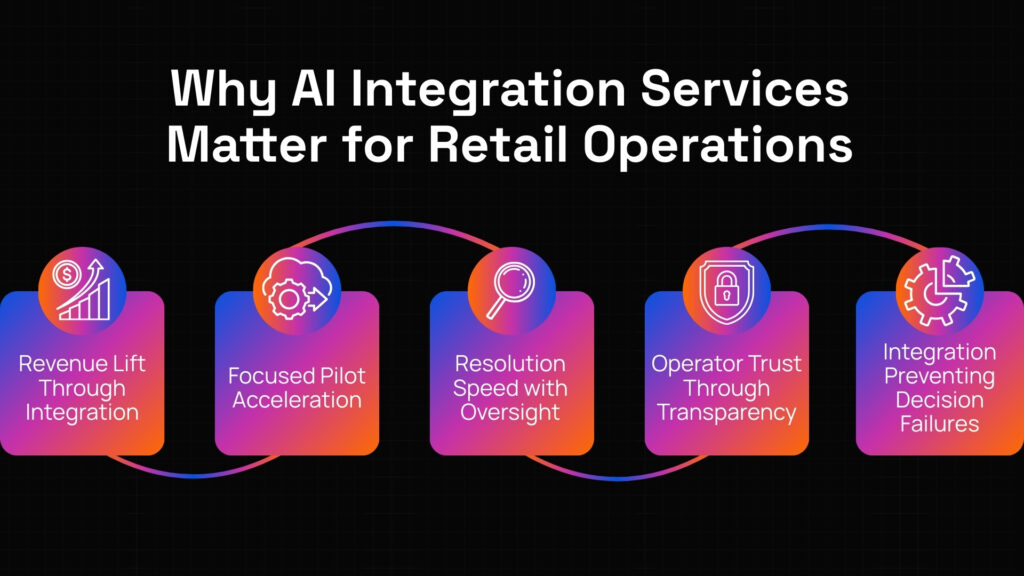
Why AI Integration Services Matter for Retail Operations
AI automation software extends beyond simple task automation; it transforms how retail organizations manage commerce velocity, maintain inventory accuracy, and ensure customer satisfaction across all sales channels. Manual retail processes that once created bottlenecks through delayed order updates, disconnected inventory visibility, and impossible 24/7 customer support can now be executed with intelligence and precision through AI integration services that compound efficiency over time. From reducing refund handling time by 30 percent for online orders to achieving 5 to 10 percent revenue lifts through integrated workflows, AI automation in retail delivers measurable outcomes that strengthen both operational efficiency and customer experience.
For retail leaders evaluating AI automation platform strategies, the benefits manifest in five critical ways:
- Revenue Lift Through Integration: McKinsey shows retailers using AI across integrated commerce workflows see revenue lifts of 5 to 10 percent through better availability and personalization, proving connectivity from POS through OMS to help desk creates foundation for intelligent optimization not achievable with isolated point solutions creating fragmented customer experience.
- Focused Pilot Acceleration: Bain finds focused AI pilots outperform broad retail rollouts early on demonstrating structured approach, as AI integration services deployments with narrow scope on one channel like ecommerce or stores prove value faster than omnichannel implementations attempting simultaneous coverage overwhelming resources and diluting focus.
- Resolution Speed with Oversight: Forrester notes AI-assisted CX teams resolve issues faster when human oversight built in validating monitoring value, as AI automation in retail must provide appropriate escalation enabling agents to handle complex situations requiring empathy while automation handles routine inquiries at scale.
- Operator Trust Through Transparency: Nielsen Norman Group shows clear system feedback improves operator trust proving visibility importance, as AI automation platform must explain recommendations showing order context and inventory status enabling retail staff to validate decisions not blindly accepting opaque suggestions undermining confidence.
- Integration Preventing Decision Failures: Industry guidance emphasizes AI decisions fail when inventory, order status, and tickets out of sync, as AI automation software depends on real-time data from POS, OMS, and help desk requiring event-driven synchronization not nightly batch updates creating staleness degrading decision quality and customer experience.
AI automation in retail is not about replacing store associates or customer service representatives; it is about wiring systems together cleanly through workflow optimization enabling retail professionals to focus capacity on merchandising strategy, complex problem resolution, and relationship building that machines cannot replicate effectively.
Key Considerations When Choosing AI Integration Services Partners
Selecting the right AI automation platform requires careful alignment between technology capabilities and retail requirements. The most successful AI automation in retail implementations are built on a foundation of deep POS connectivity, real-time OMS integration, and measurable impact on critical metrics like refund rate, order cycle time, CSAT, and cost per contact.
Below are the core factors that should guide every AI integration services decision:
- Business Outcomes & KPI Alignment: Every AI automation software initiative must connect directly to tangible retail metrics including refund rate reduction, order cycle time acceleration, CSAT improvement, or cost per contact decrease. Ask for baseline metrics and expected deltas not marketing percentages, requiring specific measurement with clear operational impact rather than generic efficiency promises.
- Integration Depth and Timeliness: Effective AI automation in retail depends on seamless connectivity with POS providing transactions, returns, and store-level inventory, OMS supplying order status and routing, help desk/CX platform capturing tickets and interactions, inventory/WMS showing available-to-promise, and CRM providing customer context. Require read-write access not just read-only, real-time events versus delayed syncs, and support for common retail platforms.
- Security and Commerce Governance: AI integration services handle sensitive customer data including payment information, purchase history, and personal identifiers requiring PCI awareness, PII handling procedures, and comprehensive audit logs. Address security requirements as McKinsey shows 5 to 10 percent revenue lifts requiring appropriate controls protecting customer data.
- Human-in-the-Loop (HITL) Design: Successful AI automation platform always includes agent oversight with clear handoff procedures when AI escalates and approval paths for refunds or exceptions. When does AI transfer to human ensuring appropriate review as Forrester shows oversight built in improving resolution speed through effective collaboration.
- Observability and Analytics: Transparency is essential when scaling AI automation in retail across customer touchpoints. A capable vendor provides traces from customer request to system action, dashboards for error tracking and confidence scoring, and rollback capabilities as Nielsen Norman Group shows clear feedback improving operator trust.
- Pricing Transparency and Asset Ownership: Clarify ownership of workflows, prompts, and trained logic developed during implementation preventing vendor lock-in. Document pricing drivers with detailed breakdown as Bain shows focused pilots requiring sustainable partnerships enabling continuous improvement.
Choosing AI integration services partners who understand these requirements ensures your investment delivers sustainable improvements rather than creating tech debt, vendor lock-in, or customer experience vulnerabilities that limit future flexibility when merchandising strategies, commerce platforms, or customer preferences evolve.
Understanding AI Integration Services: What to Connect First
Before launching any AI automation in retail initiative, organizations must thoroughly understand integration priorities and connectivity sequence. Start with systems that control money, promises, and conversations as integration choices determine automation value. When retail teams identify essential connections in proper order, they accelerate value realization, maintain customer experience quality, and avoid expensive failures from inappropriate integration creating operational chaos.
- POS – Point of Sale (Priority 1): Transactions, returns, and store-level inventory provide commerce foundation. Critical for fraud detection, demand signals, and real-time stock accuracy as POS integration enables inventory visibility supporting accurate available-to-promise preventing overselling and customer disappointment.
- OMS – Order Management System (Priority 2): Order status, routing, and fulfillment exceptions provide order lifecycle visibility. The backbone for AI-driven order decisions as AI automation in retail must understand current state enabling intelligent routing, exception handling, and proactive customer communication preventing “where is my order” inquiries.
- Help Desk and CX Platform (Priority 3): Tickets, chat, email, and voice interactions provide customer service context. Where AI chatbots and agents deliver immediate value as AI integration services handle routine inquiries freeing human agents for complex issues requiring empathy and creative problem-solving.
- Inventory and WMS (Priority 4): Available-to-promise, backorders, and replenishment signals enable fulfillment optimization. Provides real-time visibility for allocation decisions as AI automation platform balances customer demand against inventory constraints optimizing fulfillment costs while maintaining service levels.
- CRM and Loyalty Systems (Priority 5): Customer context enables smarter service and retention. Provides purchase history, lifetime value, and preferences as AI automation software personalizes recommendations and prioritizes high-value customers maximizing relationship value.
Pro Tip: POS plus OMS plus help desk usually account for most AI automation benefits in retail capturing approximately 80 percent of value with everything else layering on. Focus on these three systems first proving operational returns as McKinsey shows 5 to 10 percent revenue requiring integrated workflows starting with core commerce systems.
Understanding AI Automation in Retail KPIs: What to Measure
Before launching any AI integration services initiative, organizations must thoroughly define success metrics enabling objective pilot evaluation and ongoing performance monitoring. Key performance indicators provide the measurement framework distinguishing valuable implementations from expensive failures creating operations team skepticism. When retail operations teams establish KPIs in advance, they align stakeholders around clear targets, enable data-driven optimization, and build business cases justifying continued investment through demonstrated value.
- Refund Rate: Track percent of transactions requiring returns measuring process efficiency when AI automation in retail streamlines handling, targeting reductions as excessive refunds consume margin and create operational burden requiring investigation identifying root causes whether quality issues or policy abuse.
- Refund Handling Time: Monitor duration from request to resolution measuring operational efficiency when automation accelerates processing, targeting reductions like 30 percent for online orders as Bain shows focused pilots proving value through measurable cycle time improvements freeing agent capacity.
- Order Cycle Time: Evaluate days from order placement to delivery measuring fulfillment velocity when AI integration services optimize routing and exception handling, calculating customer satisfaction impact as faster delivery drives repeat purchase in competitive retail environments.
- Customer Satisfaction (CSAT): Track post-interaction satisfaction measuring service quality when AI automation platform handles inquiries, ensuring automation maintains experience standards as Forrester shows resolution speed improvements when oversight built in requiring quality validation not just efficiency metrics.
- Cost Per Contact: Calculate total support expenses divided by interaction volume measuring financial efficiency when automation handles routine inquiries, quantifying operational returns as AI automation software deflects contacts to self-service reducing per-interaction costs substantially below human-assisted channels.
- First Contact Resolution (FCR): Monitor percent of issues resolved in initial interaction measuring effectiveness when AI chatbots provide accurate responses, ensuring quality as low FCR creates customer frustration from repeated contacts undermining satisfaction despite faster initial response.
- Revenue Per Available Unit: Assess sales optimization when inventory visibility and personalization improve conversion, measuring revenue lift as McKinsey shows 5 to 10 percent gains through better availability and personalization enabled by integrated AI across commerce workflows.
- Integration Sync Latency: Track delay between system updates measuring data freshness, maintaining low latency as industry guidance shows AI decisions fail when inventory, order status, and tickets out of sync requiring near real-time events not nightly batch updates.
Pro Tip: Set confidence thresholds for AI actions during 4 to 6 week pilot handling order status and returns. Pick one channel first like ecommerce or stores not both proving approach as Bain finds focused pilots outperform broad rollouts enabling concentrated effort demonstrating clear value before expansion.
The Impact of Integration Readiness
Before launching any AI automation in retail initiative, organizations must thoroughly assess their POS architecture, OMS connectivity, and help desk integration maturity. Integration readiness evaluates how well existing retail systems, customer data assets, and operational procedures can support intelligent automation without creating technical debt or customer experience gaps. When retail operations teams conduct integration audits in advance, they uncover system limitations and data quality issues early, align stakeholders around connectivity requirements, and minimize wasted time during vendor discovery and pilot phases.
Example: A specialty apparel retailer preparing for AI integration services mapped their POS and OMS connectivity, discovering their POS data synced nightly creating stale inventory requiring near real-time events, their OMS provided read-only access preventing automated status updates, their help desk wasn’t connected to order management creating context gaps, their customer data was fragmented across systems requiring identity resolution, and their security policies hadn’t addressed PCI requirements for automated refund processing. Addressing these integration readiness issues before vendor engagement reduced the overall project timeline by six weeks.
Pro Tip: Ask for real order replay before signing anything validating actual workflow complexity and data quality. Vendor should map POS events, OMS states, and ticket flows during discovery. Connect OMS before chatbot goes live preventing frustrating “I can’t see your order” responses undermining customer experience.
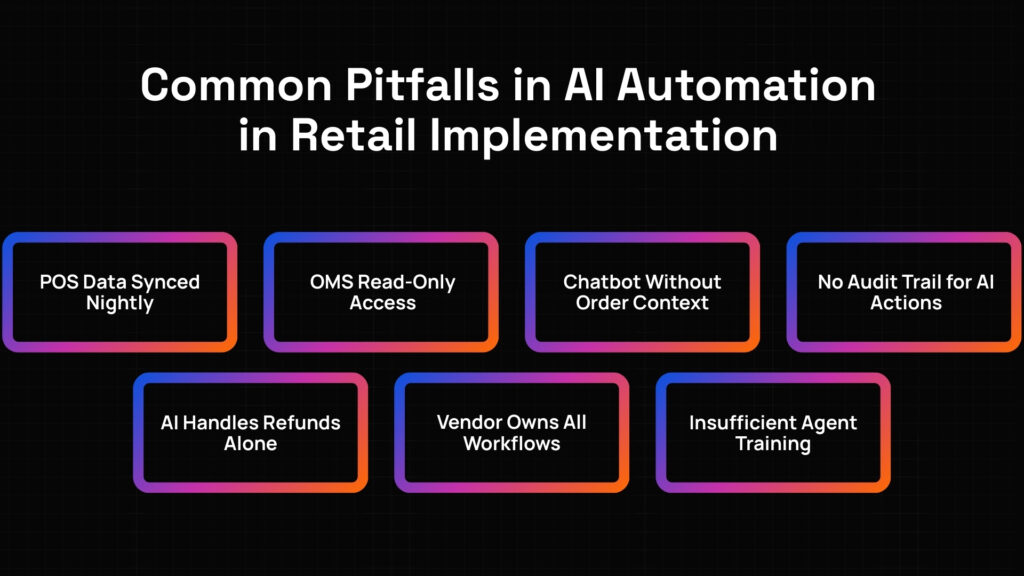
Common Pitfalls in AI Automation in Retail Implementation
AI automation platform promises efficiency and revenue growth, but poor planning and inadequate integration can create customer frustration instead of experience improvements. Many retail organizations make avoidable mistakes during deployment that delay value realization and erode both team and customer trust. To discover proven methodologies tailored for your retail workflows and commerce requirements, explore our AI Workflow Automation Services page for detailed AI automation in retail frameworks and real-world implementation guidance.
- POS Data Synced Nightly: Relying on batch updates creates stale inventory affecting availability decisions. Require near real-time events enabling accurate available-to-promise as AI integration services must react to current inventory not yesterday’s snapshot creating overselling and customer disappointment.
- OMS Read-Only Access: Accepting view-only connectivity prevents automated actions. Enable controlled write-backs for status updates and exception handling as AI automation in retail must close loop from inquiry through resolution not just providing information requiring manual execution negating automation efficiency.
- Chatbot Without Order Context: Launching customer service automation without OMS integration creates frustrating experiences. Connect OMS before going live ensuring AI can access order status as industry guidance shows decisions fail when systems out of sync preventing effective customer support.
- No Audit Trail for AI Actions: Deploying without comprehensive logging creates compliance and troubleshooting issues. Demand full logs and rollback capabilities documenting every automated decision as McKinsey shows 5 to 10 percent revenue requiring governance supporting regulatory compliance and continuous improvement.
- AI Handles Refunds Alone: Allowing autonomous refund processing without oversight creates fraud and policy violation risk. Add human approval thresholds for high-value or unusual refunds as Forrester shows oversight improving outcomes through appropriate human judgment on edge cases.
- Vendor Owns All Workflows: Accepting proprietary automation creates dependency preventing future flexibility. Contract for portability ensuring you can export workflows, prompts, and trained logic as Bain shows pilots requiring sustainable partnerships not vendor lock-in.
- Insufficient Agent Training: Technical implementations without workforce enablement face adoption resistance. Include playbooks for CX teams and operations leaders as Nielsen Norman Group shows clear feedback improving trust requiring comprehensive change management not just technology installation.
Evaluating AI Integration Services ROI
Quantifying the benefits of AI automation platform helps secure executive buy-in and refine future investments in retail technology. Measuring ROI goes beyond simple cost savings; it captures improvements in revenue, customer satisfaction, operational efficiency, and agent capacity. Without clear financial modeling during evaluation, AI automation in retail projects risk becoming unclear implementations that fail to justify ongoing operational expenses and licensing costs.
Key considerations for financial analysis include:
- Revenue Lift Realization: McKinsey shows retailers using AI across integrated commerce workflows see revenue lifts of 5 to 10 percent through better availability and personalization, calculating incremental sales from improved inventory visibility preventing stockouts and targeted recommendations driving conversion as integration enables intelligent orchestration.
- Refund Processing Efficiency: Track time saved when AI automation in retail reduces handling duration by 30 percent for online orders, measuring operational capacity release enabling agents to focus on complex issues as Bain shows focused pilots proving value through measurable cycle time improvements.
- Customer Support Cost Reduction: Calculate cost per contact decrease when AI integration services handle routine inquiries, quantifying financial returns as automated self-service deflects contacts from expensive human-assisted channels reducing per-interaction costs substantially while maintaining satisfaction through appropriate escalation.
- Order Cycle Time Value: Monitor fulfillment acceleration when intelligent routing optimizes delivery, measuring customer satisfaction impact as faster delivery drives repeat purchase and reduces “where is my order” inquiries consuming support capacity as AI automation platform enables proactive communication.
- Agent Capacity Gains: Assess volume handling improvements when automation eliminates routine work, calculating operational returns as Forrester shows resolution speed improvements enabling agents to manage higher loads without proportional hiring improving cost efficiency through workflow optimization.
- Total Cost of Ownership: Include licensing fees, integration development, security infrastructure, plus ongoing monitoring, model retraining, and support in comprehensive analysis. Understand pricing scales with transaction volume, order count, or interaction frequency as retail automation requiring realistic cost modeling.
McKinsey shows 5 to 10 percent revenue lifts from integrated AI workflows. Bain finds focused AI pilots outperform broad retail rollouts. Forrester notes AI-assisted CX teams resolve faster with oversight. Nielsen Norman Group shows clear feedback improves operator trust. Industry guidance emphasizes decisions fail when systems out of sync. When every AI automation in retail interaction logs customer request, system actions taken, confidence scores, and escalation triggers, every integration maintains real-time synchronization preventing stale data degrading decisions, and every quarterly review assesses workflow effectiveness and volume changes, organizations build trusted commerce operations that scale without sacrificing customer experience, inventory accuracy, or operational efficiency.
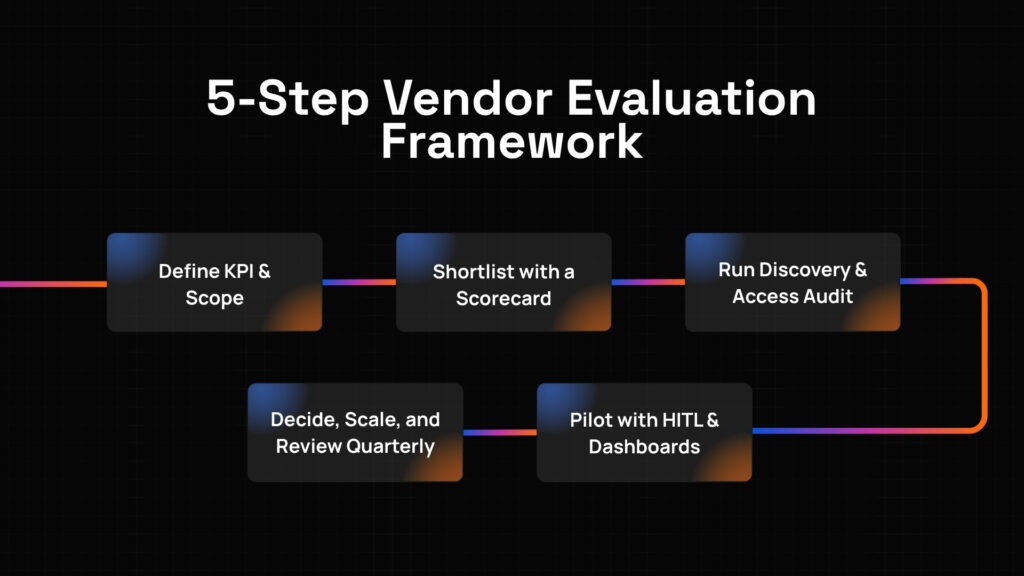
5-Step Vendor Framework for AI Automation in Retail
Selecting an AI integration services vendor should follow a disciplined, structured process that aligns with your organization’s retail goals while accounting for both technological depth and customer experience requirements. Instead of focusing solely on impressive demonstrations or revenue claims, evaluation should weigh how well the AI automation platform solution supports measurable outcomes, integrates with existing systems, and maintains quality through appropriate governance.
1. Define KPI & Scope
Start by identifying specific measurable outcomes with narrow scope enabling quick operational validation. Defining concrete targets helps align all stakeholders including operations leadership, customer service, merchandising, and IT infrastructure. Your goal might be reducing refund handling time by 30 percent for online orders, improving CSAT, or decreasing cost per contact, but it must be quantifiable with clear retail impact.
Example: An electronics retailer defined its KPI as “reducing refund handling time by 30 percent for online orders within 90 days while maintaining CSAT above 4.2 out of 5.0 and first contact resolution above 85 percent.” This metric guided every AI automation in retail discussion, shaped pilot design with clear operational benchmarks, and became the success measurement. Pick one channel first like ecommerce or stores not both.
Pro Tip: Document one to two primary retail outcomes before requesting proposals. Focus on refund handling time, order cycle time, or cost per contact tied to operational efficiency rather than vanity metrics like total interactions processed, and define specific percentage improvement targets with timelines enabling objective go/no-go decisions during pilot evaluation as Bain finds focused pilots outperform broad rollouts.
2. Shortlist with a Scorecard
Once objectives are clear, move to structured vendor comparison using a weighted scorecard evaluating AI integration services providers. This tool allows teams to quantify how well each vendor aligns with priorities including integration depth, CX workflows and HITL, security and governance, observability and rollback, and portability and IP ownership.
Example: One enterprise assigned 30 percent weight to integration depth assessing POS, OMS, and help desk connectivity, 20 percent to CX workflows and HITL design, 15 percent each to security and governance and observability and rollback capabilities, and 20 percent to portability and IP ownership ensuring asset control. Integration realism beats flashy demos.
Pro Tip: Turn evaluation criteria into numeric scoring so decisions remain defendable beyond subjective demonstration impressions. Score vendors on OMS access, CX depth, and observability. Weight appropriately as McKinsey shows 5 to 10 percent revenue requiring integration and Forrester emphasizes oversight importance. Have multiple stakeholders from operations, customer service, and IT score vendors independently before group discussion to reduce bias.
3. Run Discovery & Access Audit
Before contracts are signed, a structured discovery phase where vendor maps POS events, OMS states, and ticket flows documenting every integration touchpoint and security requirement. During this phase, teams validate connector support, surface data synchronization gaps, and confirm PCI and PII handling with appropriate controls. Ask for real order replay.
Example: A home goods retailer conducted discovery for AI automation in retail, revealing their POS used proprietary format requiring custom parsing, their OMS lacked webhook support for real-time events, their help desk didn’t capture order context requiring manual lookup, their inventory system had different SKU formats across channels requiring normalization, and their security policies hadn’t addressed automated refund approval workflows.
Pro Tip: Vendor should map POS events, OMS states, and ticket flows before proposals detailing exact connectivity requirements. Ask for real order replay before signing anything validating actual complexity including returns, exchanges, and exceptions. Connect OMS before chatbot goes live. Use discovery to surface synchronization delays, data quality gaps, and PCI requirements before signing when negotiating leverage is highest.
4. Pilot with HITL & Dashboards
A well-designed pilot validates both technology performance and customer experience maintenance under real retail conditions. Instead of full-scale deployment, run 4 to 6 week pilot handling order status and returns maintaining agent oversight for quality assurance. Incorporating human-in-the-loop review ensures AI automation in retail outcomes align with service standards and customer satisfaction requirements while building organizational confidence.
Example: A beauty retailer piloted AI integration services for online order support, running 6-week evaluation with controlled deployment on order status inquiries and returns, agent review of all refunds above $100 before processing, and dashboard tracking handling time, CSAT, cost per contact, and escalation quality, achieving 28 percent time reduction with 4.4 CSAT above 4.2 target. Set confidence thresholds for AI actions as Forrester shows oversight matters.
Pro Tip: Execute pilots with frozen scope covering specific inquiry type, clear success criteria including customer experience benchmarks, and measurable KPIs tracked weekly. Run 4 to 6 week pilot handling order status and returns establishing AI meets standards. Measure refund handling time targeting 30 percent reduction and CSAT targeting above 4.2. Track first contact resolution ensuring quality. Use pilot to train agents on escalation procedures and override capabilities.
5. Decide, Scale, and Review Quarterly
After the pilot proves both operational value and customer experience maintenance, use findings to guide the final decision about expanding from returns to inventory inquiries validating sustainability and stability. Scaling should be deliberate, expanding only after demonstrating approach maintains quality across representative inquiry types and customer segments. Continuous quarterly reviews maintain operational discipline, ensuring automation adapts as volumes change with seasonal patterns, promotional calendars, and inventory mix.
Example: A fashion retailer conducted quarterly reviews with its AI automation in retail partner, expanding successful returns handling to inventory availability and product recommendations over 12 months, scaling after validation, identifying optimization opportunities reducing cost per contact by additional 18 percent, and re-evaluating workflows quarterly as volumes changed. Expand from returns to inventory inquiries as Bain shows focused approach.
Pro Tip: Treat vendor reviews as customer experience governance sessions focused on satisfaction and efficiency, not just performance metrics. Expand from returns to inventory inquiries proving reliability before comprehensive deployment. Re-evaluate workflows quarterly as volumes change with seasons, promotions, and inventory. Use quarterly reviews to assess resolution quality, escalation patterns, agent satisfaction, and alignment with evolving customer expectations and commerce requirements.
Next Steps in Your AI Automation in Retail Evaluation
By now, you should have a clear understanding of what to prioritize when selecting AI integration services partners for retail. Bringing these insights together creates a structured evaluation flow that de-risks investment and accelerates deployment while ensuring customer experience and operational efficiency.
- Align with retail metrics: Ensure every AI automation platform feature connects to specific KPIs like refund handling time, order cycle time, CSAT, or cost per contact tied to operational efficiency, not just automation coverage percentages disconnected from actual customer outcomes and measurable business results.
- Evaluate commerce integration: Confirm that AI automation software works smoothly with your POS through real-time events, OMS through read-write access, and help desk through contextual ticket enrichment as McKinsey shows 5 to 10 percent revenue requiring integrated workflows from transaction through fulfillment to service.
- Focus on customer oversight: Choose vendors with clear escalation when AI hands off to agents, approval paths for refunds or exceptions, and transparent confidence scoring as Forrester shows resolution speed improvements when oversight built in enabling effective human-AI collaboration.
- Review observability capabilities: Favor partners with traces from customer request to system action, dashboards for errors and confidence tracking, and rollback capabilities as Nielsen Norman Group shows clear feedback improving operator trust preventing situations where opaque automation erodes confidence.
- Test with controlled pilots: Always run 4 to 6 week pilots on one channel, agent review maintaining oversight, real order replay validating actual complexity, and confidence thresholds before production deployment to validate handling time improvements, CSAT maintenance, and operational readiness under real-world retail conditions with actual customer diversity.
With these criteria in place, you are better equipped to identify AI automation in retail vendors who not only automate workflows but also increase revenue, reduce costs, maintain satisfaction, and amplify your team’s capacity to focus on complex customer issues requiring empathy and creative problem-solving that machines cannot replicate.
Vendor Questions to Ask
To make the most informed decision during your AI automation in retail evaluation, be sure to ask these essential questions:
- Which POS and OMS platforms do you integrate with directly, and what read-write capabilities do you provide for transactions and order updates?
- Do you support real-time order and inventory events or only delayed batch synchronization, and what latency do you guarantee?
- Can AI write back to OMS or issue refunds with approval, and what confidence thresholds trigger human review for high-value or unusual transactions?
- How is PCI and PII handled including encryption standards, data residency options, and compliance attestations for payment and customer data?
- What observability tools are included providing traces from customer request to system action with error tracking and confidence scoring?
- Who owns workflows and prompts after delivery ensuring operational portability at contract end including export rights for trained logic?
- Can we export integrations if we switch vendors enabling portability without starting over or losing operational capability?
- Can you provide two customer references in similar retail verticals who can discuss revenue improvements, customer satisfaction, and ongoing partnership?
- What are recurring costs beyond license including integration maintenance, model retraining, and support fees, and how do expenses scale?
- What rollback procedures exist for erroneous automated actions enabling quick restoration when automation produces incorrect responses or refund processing?
Transform Retail Operations with AI Automation in Retail
AI automation in retail is not just a technological investment; it is a strategic commerce capability that requires careful planning, appropriate integration, and continuous performance monitoring. The right implementation brings 5 to 10 percent revenue lift, reduced refund handling time, and improved customer satisfaction, while poor execution creates tech debt and customer frustration that undermine confidence and damage brand reputation.
Ready to transform your retail operations with AI automation in retail? Book a Free Strategy Call with us to explore the next steps and discover how we can help you identify the first integrations delivering value without breaking operations, validate commerce readiness, and deploy the right AI integration services solution for your unique POS environment, order management system, help desk platform, and measurable business outcomes.