

The Power of AI Automation in Finance: Why AP and AR Workflow Selection Matters
AI automation in finance has evolved from isolated data entry tools into mission-critical accounting orchestration that defines operational excellence in modern finance organizations. Finance teams implementing professional AI process automation are fundamentally transforming how invoice coding operates, how matching executes, and how follow-ups get coordinated without creating control gaps or audit issues. Advanced AI automation examples now manage workflows from invoice ingestion and GL coding to three-way matching and automated payment reminders, enabling controllers to focus on variance analysis while machines handle repetitive processing that once consumed hours daily during accounts payable and receivable operations.
The data supporting strategic finance automation continues to strengthen across operational functions. According to McKinsey research, automation can reduce finance processing costs by 30 to 50 percent when workflows are redesigned end-to-end, demonstrating that process optimization combined with technology determines automation value not just algorithm deployment. Gartner reports focused finance automation pilots outperform broad programs, proving that structured evaluation with narrow scope accelerates deployment over comprehensive implementations attempting too much simultaneously. Industry guidance emphasizes manual invoice handling slows closes and ties up cash, with exceptions piling up when data lives in silos while follow-ups fall through when AR relies on inboxes.
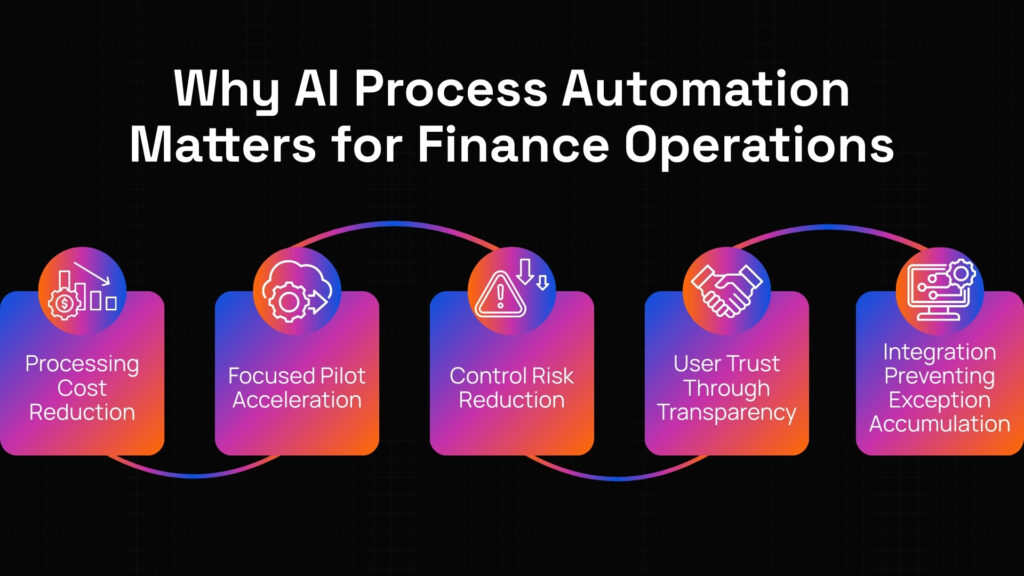
Why AI Process Automation Matters for Finance Operations
AI automation examples extend beyond simple task automation; they transform how finance organizations manage processing velocity, maintain control quality, and ensure cash optimization across all accounting workflows. Manual finance processes that once created bottlenecks through invoice backlogs, matching delays, and inconsistent follow-up execution can now be executed with intelligence and precision through AI automation in finance that compounds efficiency over time. From reducing AP invoice cycle time by 40 percent to achieving 30 to 50 percent processing cost reductions through redesigned workflows, AI process automation delivers measurable outcomes that strengthen both operational efficiency and working capital management.
For finance leaders evaluating AI automation in finance strategies, AI automation benefits manifest in five critical ways:
- Processing Cost Reduction: McKinsey shows automation can reduce finance processing costs by 30 to 50 percent when workflows redesigned end-to-end, proving that process optimization combined with intelligent systems eliminates manual work not achievable with technology alone without addressing underlying inefficiencies creating waste.
- Focused Pilot Acceleration: Gartner reports focused finance automation pilots outperform broad programs demonstrating structured approach, as AI automation examples with narrow scope on one process like AP or AR prove value faster than comprehensive implementations attempting both simultaneously overwhelming resources and diluting focus.
- Control Risk Reduction: Deloitte notes HITL models reduce financial control risk validating monitoring value, as AI process automation must provide appropriate approval gates for GL posting and payment processing preventing autonomous execution creating audit findings or fraud exposure.
- User Trust Through Transparency: Nielsen Norman Group shows clear system feedback improves trust proving visibility importance, as AI automation in finance must explain coding recommendations showing matching logic enabling finance staff to validate decisions not blindly accepting opaque suggestions undermining confidence.
- Integration Preventing Exception Accumulation: Industry guidance emphasizes exceptions pile up when data lives in silos, as AI automation examples depend on connected ERP, bank feeds, and document storage requiring seamless integration not isolated systems creating manual reconciliation negating automation efficiency.
AI automation in finance is not about replacing AP and AR teams; it is about connecting accounting systems cleanly through workflow optimization enabling finance professionals to focus capacity on exception resolution, vendor relationships, and cash forecasting that machines cannot replicate effectively.
Key Considerations When Choosing AI Automation in Finance Partners
Selecting the right AI process automation requires careful alignment between technology capabilities and finance requirements. The most successful AI automation in finance implementations are built on a foundation of deep ERP connectivity, real-time bank feed integration, and measurable impact on critical metrics like cycle time, cost per invoice, DSO, and exception rate.
Below are the core factors that should guide every AI automation in finance decision:
- Business Outcomes & KPI Alignment: Every AI automation examples initiative must connect directly to tangible finance metrics including cycle time reduction, cost per invoice decrease, DSO acceleration, or exception rate improvement. Ask for baseline metrics and expected deltas not marketing percentages, requiring specific measurement with clear financial impact rather than generic efficiency promises.
- Integration Depth and Access: Effective AI automation in finance depends on seamless connectivity with ERP systems providing read-write access for posting, bank feeds supplying real-time transaction data, and document storage enabling invoice retrieval. Require comprehensive access not read-only views preventing automation from closing workflow loops.
- Security and Control Governance: AI process automation handles sensitive financial data including invoices, payments, and vendor information requiring role-based access, comprehensive audit logs, and segregation of duties. Address control requirements as McKinsey shows 30 to 50 percent cost reduction requiring appropriate governance supporting regulatory compliance and internal controls.
- Human-in-the-Loop (HITL) Design: Successful AI automation in finance always includes finance team oversight with clear approval paths for exceptions and posting authorizations. When does AI escalate ensuring appropriate review as Deloitte shows HITL models reducing risk through effective collaboration preventing autonomous GL changes creating control violations.
- Observability and Analytics: Transparency is essential when scaling AI automation examples across accounting workflows. A capable vendor provides traces from invoice receipt to posting, comprehensive dashboards tracking accuracy and exceptions, and rollback and reprocessing controls as Nielsen Norman Group shows clear feedback improving trust.
- Pricing Transparency and Asset Ownership: Clarify ownership of workflows, prompts, and logic developed during implementation preventing vendor lock-in. Document pricing drivers with detailed breakdown as Gartner shows focused pilots requiring sustainable partnerships enabling continuous improvement.
Choosing AI automation in finance partners who understand these requirements ensures your investment delivers sustainable improvements rather than creating control gaps, vendor lock-in, or audit vulnerabilities that limit future flexibility when accounting standards, regulations, or business workflows evolve.
Understanding AI Automation in Finance: 6 High-Volume Workflows
Before launching any AI process automation initiative, organizations must thoroughly understand workflow priorities and automation sequence. Start with volume and rule-based work as workflow choices determine operational value. When finance teams identify essential automation candidates in proper order, they accelerate value realization, maintain control quality, and avoid expensive failures from inappropriate automation creating compliance issues.
- Invoice Ingestion and Coding (AP Workflow 1): OCR plus rules for GL accounts, cost centers, and vendors enable automated classification. Handles high-volume repetitive coding as AI automation in finance extracts invoice data and applies accounting logic reducing manual entry consuming AP capacity.
- Three-Way Matching (AP Workflow 2): Purchase order, invoice, and receipt matching validates completeness. Automates verification workflow as AI process automation compares documents flagging discrepancies enabling exception-based processing where staff resolve mismatches not performing routine checks.
- Exception Routing (AP Workflow 3): Auto-flag mismatches and assign owners based on dollar thresholds or vendor type. Intelligent workflow distribution as AI automation examples route issues to appropriate approvers preventing queue bottlenecks and ensuring timely resolution supporting vendor relationships.
- Invoice Generation and Delivery (AR Workflow 4): Triggered from ERP events like shipment or service completion. Automated billing as AI automation in finance creates and sends customer invoices eliminating manual preparation delays accelerating cash collection cycles.
- Payment Matching (AR Workflow 5): Bank feed reconciliation matches incoming payments to open invoices. Cash application automation as AI process automation handles straightforward matches enabling cash forecasting accuracy while routing complex cases requiring investigation.
- Automated Follow-Ups (AR Workflow 6): Email or portal nudges based on aging rules. Collections workflow as AI automation examples send systematic reminders improving DSO through consistent communication without manual tracking in spreadsheets or inboxes.
Pro Tip: AP automation usually delivers faster ROI than AR because rules are clearer upfront with defined coding schemes and matching logic. Focus on AP first proving returns as McKinsey shows 30 to 50 percent cost reduction achievable through workflow redesign starting with high-volume repetitive processes.
Understanding AI Automation in Finance KPIs: What to Measure
Before launching any AI process automation initiative, organizations must thoroughly define success metrics enabling objective pilot evaluation and ongoing performance monitoring. Key performance indicators provide the measurement framework distinguishing valuable implementations from expensive failures creating finance team skepticism. When accounting operations teams establish KPIs in advance, they align stakeholders around clear targets, enable data-driven optimization, and build business cases justifying continued investment through demonstrated value.
- AP Invoice Cycle Time: Track duration from invoice receipt to payment processing measuring processing velocity when AI automation in finance handles coding and matching, targeting reductions like 40 percent as faster processing captures early payment discounts and strengthens vendor relationships.
- Cost Per Invoice: Calculate total processing expenses divided by invoice volume measuring efficiency when automation reduces manual work, quantifying operational returns as McKinsey shows 30 to 50 percent cost reduction achievable through workflow redesign eliminating repetitive tasks.
- Days Sales Outstanding (DSO): Monitor average collection period when automated follow-ups and payment matching accelerate cash collection, measuring working capital optimization as AI automation examples improve cash conversion cycles affecting liquidity and investment capacity.
- Exception Rate: Evaluate percent of transactions requiring human intervention measuring automation effectiveness, targeting low exception rates as high escalation volumes indicate poor matching logic or data quality requiring refinement preventing capacity savings.
- GL Posting Accuracy: Track incorrect account coding requiring correction measuring quality when automated classification reduces errors, maintaining high accuracy as posting mistakes create financial statement risk and audit findings requiring investigation and restatement.
- Vendor Payment Timeliness: Monitor percent of invoices paid within terms when streamlined processing prevents delays, calculating relationship value as late payments damage vendor partnerships while early payment captures discounts improving margin.
- AR Follow-Up Consistency: Evaluate percent of overdue invoices receiving systematic reminders measuring collections discipline when automation eliminates manual oversight gaps, ensuring comprehensive coverage as inconsistent follow-up allows receivables aging unnecessarily.
- Audit Trail Completeness: Track percent of transactions with full decision documentation measuring compliance support, maintaining comprehensive logs as Deloitte shows HITL models reducing risk requiring auditability supporting internal controls and regulatory examinations.
Pro Tip: Track false positives and exceptions during 4 to 6 week AP invoice pilot with approvals. Pick one process like AP or AR not both proving approach as Gartner reports focused finance automation pilots outperform broad programs enabling concentrated effort demonstrating clear operational improvements.
The Impact of Integration Readiness
Before launching any AI automation in finance initiative, organizations must thoroughly assess their ERP architecture, bank feed reliability, and document management maturity. Integration readiness evaluates how well existing accounting systems, financial data assets, and approval procedures can support intelligent automation without creating technical debt or control gaps. When finance operations teams conduct integration audits in advance, they uncover system limitations and data quality issues early, align stakeholders around connectivity requirements, and minimize wasted time during vendor discovery and pilot phases.
Example: A distribution company preparing for AI process automation mapped their ERP and bank connectivity, discovering their invoice OCR lacked validation requiring confidence thresholds, their bank feeds updated daily creating matching delays requiring real-time integration, their ERP prevented direct GL posting requiring approval gates, their vendor master contained duplicates creating coding ambiguity, and their approval workflows weren’t documented creating routing confusion. Addressing these integration readiness issues before vendor engagement reduced the overall project timeline by five weeks.
Pro Tip: Involve finance and IT together during discovery ensuring both accounting requirements and technical feasibility addressed. Vendor should map invoice sources, approval rules, and posting logic before proposals. Standardize invoice formats first preventing automating chaos as inconsistent data degrades OCR accuracy.
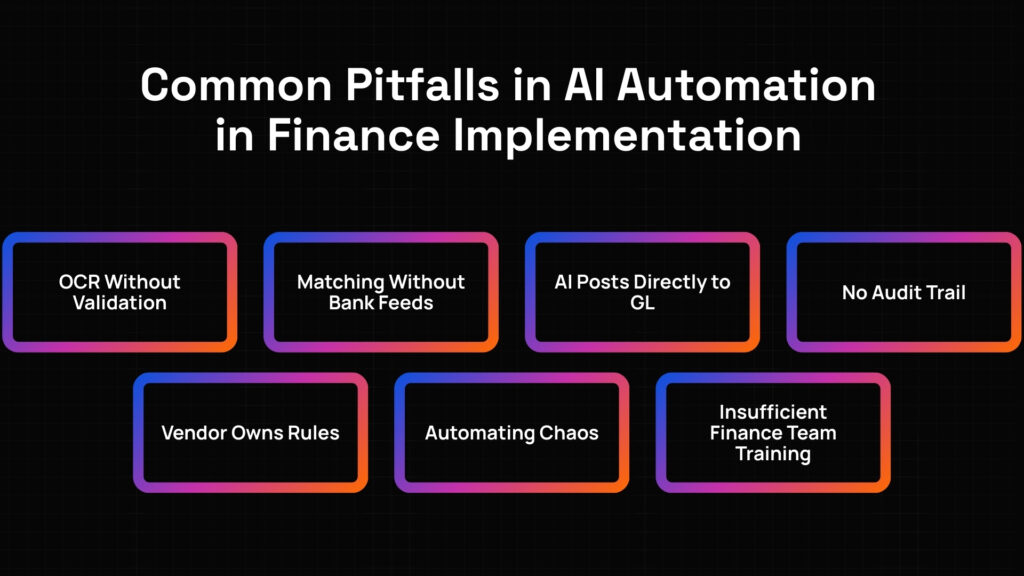
Common Pitfalls in AI Automation in Finance Implementation
AI process automation promises efficiency and cost reduction, but poor planning and inadequate controls can create audit issues instead of operational improvements. Many finance organizations make avoidable mistakes during deployment that delay value realization and erode both team and auditor trust. To discover proven methodologies tailored for your finance workflows and control requirements, explore our AI Workflow Automation Services page for detailed AI automation in finance frameworks and real-world implementation guidance.
- OCR Without Validation: Accepting extracted data without verification creates posting errors. Add confidence thresholds and approvals for low-certainty extractions as AI automation in finance must flag uncertain data preventing incorrect GL coding creating financial statement errors.
- Matching Without Bank Feeds: Performing reconciliation without real-time transaction data creates delays. Integrate live bank data enabling immediate payment matching as AI automation examples depend on current information not stale batch files degrading cash application accuracy.
- AI Posts Directly to GL: Allowing autonomous general ledger updates creates control violations. Require approval gates for all posting as AI process automation must never modify financial statements without human authorization as Deloitte shows HITL models reducing risk.
- No Audit Trail: Launching without comprehensive logging creates compliance issues. Log every decision and change including user, timestamp, and rationale as McKinsey shows 30 to 50 percent cost reduction requiring governance supporting audit validation.
- Vendor Owns Rules: Accepting proprietary coding logic creates dependency preventing future flexibility. Contract for portability ensuring you can export mappings and rules as Gartner shows focused pilots requiring sustainable partnerships not vendor lock-in threatening operational continuity.
- Automating Chaos: Deploying automation on inconsistent processes amplifies problems. Standardize invoice formats first ensuring clean data as AI automation in finance performs best with structured inputs not variable uncontrolled documents degrading extraction accuracy.
- Insufficient Finance Team Training: Technical implementations without user enablement face adoption resistance. Include AP and AR playbooks and staff training as Nielsen Norman Group shows clear feedback improving trust requiring comprehensive change management not just technology installation.
Evaluating AI Automation in Finance ROI
Quantifying AI automation benefits helps secure executive buy-in and refine future investments in finance technology. Measuring ROI goes beyond simple time savings; it captures improvements in processing costs, cycle time, working capital, and control quality. Without clear financial modeling during evaluation, AI automation in finance projects risk becoming unclear implementations that fail to justify ongoing operational expenses and licensing costs.
Key considerations for financial analysis include:
Processing Cost Reduction Value: McKinsey shows automation can reduce finance processing costs by 30 to 50 percent when workflows redesigned end-to-end, calculating operational savings when AI process automation eliminates manual invoice handling, matching verification, and follow-up tracking freeing finance capacity for analysis.
Cycle Time Acceleration Impact: Track AP invoice cycle time reduction when automation targets 40 percent improvement, measuring value from captured early payment discounts and strengthened vendor relationships as faster processing demonstrates operational excellence supporting supply chain partnerships.
Working Capital Optimization: Calculate DSO improvement value when automated AR follow-ups and payment matching accelerate collections, measuring cash flow impact as reduced receivables aging releases working capital enabling investment or debt reduction improving financial flexibility.
Exception Resolution Efficiency: Monitor capacity gains when intelligent routing accelerates issue handling, quantifying productivity as Gartner shows focused pilots enabling staff focus on complex cases requiring judgment beyond routine processing automated by AI automation examples.
Control Quality Enhancement: Assess audit finding reduction when systematic processing and comprehensive logging improve compliance, calculating risk mitigation value as Deloitte shows HITL models reducing financial control risk preventing regulatory violations and internal control weaknesses.
Total Cost of Ownership: Include licensing fees, ERP integration development, OCR infrastructure, plus ongoing model tuning, control testing, and support in comprehensive analysis. Understand pricing scales with invoice volume, transaction frequency, or vendor count as finance automation requiring realistic cost modeling.
McKinsey shows 30 to 50 percent processing cost reduction from finance automation. Gartner reports focused finance automation pilots outperform broad programs. Deloitte notes HITL models reduce financial control risk. Nielsen Norman Group shows clear feedback improves trust. Industry guidance emphasizes manual handling slows closes and ties up cash. When every AI automation in finance interaction logs invoice extraction confidence, matching decisions, approval workflows, and GL posting rationale, every integration maintains real-time bank feed synchronization preventing reconciliation delays, and every quarterly review assesses control effectiveness and exception patterns, organizations build trusted accounting operations that scale without sacrificing audit quality, financial statement accuracy, or regulatory compliance.
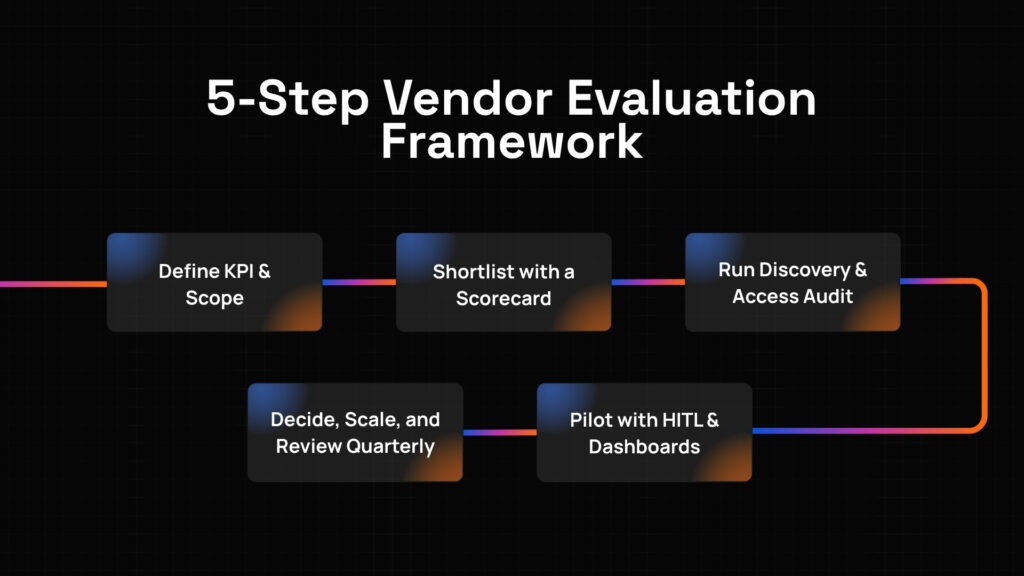
5-Step Vendor Framework for AI Automation in Finance
Selecting an AI process automation vendor should follow a disciplined, structured process that aligns with your organization’s finance goals while accounting for both technological depth and control requirements. Instead of focusing solely on impressive demonstrations or cost claims, evaluation should weigh how well the AI automation in finance solution supports measurable outcomes, integrates with existing systems, and maintains controls through appropriate governance.
1. Define KPI & Scope
Start by identifying specific measurable outcomes with narrow scope enabling quick operational validation. Defining concrete targets helps align all stakeholders including finance leadership, AP and AR teams, IT infrastructure, and internal audit. Your goal might be reducing AP invoice cycle time by 40 percent, decreasing cost per invoice, or improving DSO, but it must be quantifiable with clear financial impact.
Example: A manufacturing company defined its KPI as “reducing AP invoice cycle time by 40 percent within 90 days while maintaining GL posting accuracy above 99 percent and audit trail completeness at 100 percent.” This metric guided every AI automation in finance discussion, shaped pilot design with clear accounting benchmarks, and became the success measurement. Pick one process like AP or AR not both.
Pro Tip: Document one to two primary finance outcomes before requesting proposals. Focus on cycle time reduction, cost per invoice decrease, or DSO improvement tied to operational efficiency rather than vanity metrics like total invoices processed, and define specific percentage improvement targets with timelines enabling objective go/no-go decisions during pilot evaluation as Gartner reports focused pilots outperform broad programs.
2. Shortlist with a Scorecard
Once objectives are clear, move to structured vendor comparison using a weighted scorecard evaluating AI process automation providers. This tool allows teams to quantify how well each vendor aligns with priorities including ERP and bank integrations, controls and auditability, HITL design, observability, and portability and IP ownership.
Example: One enterprise assigned 30 percent weight to ERP and bank integrations assessing connectivity depth, 25 percent to controls and auditability meeting regulatory requirements, 20 percent to HITL design ensuring appropriate approvals, 15 percent to observability capabilities, and 10 percent to portability and IP ownership. Ask for live demos with your invoice samples.
Pro Tip: Turn evaluation criteria into numeric scoring so decisions remain defendable beyond subjective demonstration impressions. Score vendors on ERP and bank feed depth. Weight appropriately as McKinsey shows 30 to 50 percent cost reduction and Deloitte emphasizes control importance. Have multiple stakeholders from AP, AR, IT, and audit score vendors independently before group discussion to reduce bias.
3. Run Discovery & Access Audit
Before contracts are signed, a structured discovery phase maps invoice sources, approval rules, and posting logic documenting every integration touchpoint and control requirement. During this phase, teams validate ERP access, surface data quality gaps, and confirm approval workflows with appropriate segregation of duties. Involve finance and IT together.
Example: A services company conducted discovery for AI automation in finance, revealing their ERP required custom API authentication not in standard vendor documentation, their bank provided files in non-standard format requiring parser customization, their invoice formats varied widely across vendors requiring OCR tuning, their approval matrix wasn’t digitized creating routing complexity, and their chart of accounts had inactive segments preventing clean mapping.
Pro Tip: Vendor should map invoice sources, approval rules, and posting logic before proposals detailing exact connectivity requirements. Involve finance and IT together ensuring both accounting needs and technical feasibility addressed. Standardize invoice formats first preventing chaos automation. Use discovery to surface ERP limitations, bank feed delays, and control gaps before signing when negotiating leverage is highest.
4. Pilot with HITL & Dashboards
A well-designed pilot validates both technology performance and control effectiveness under real finance conditions. Instead of full-scale deployment, run 4 to 6 week AP invoice pilot with approvals maintaining finance team oversight for quality assurance. Incorporating human-in-the-loop review ensures AI automation examples align with accounting standards and audit requirements while building organizational confidence.
Example: A healthcare organization piloted AI process automation for AP invoice processing, running 6-week evaluation with controlled deployment on indirect spend categories, finance review of all low-confidence OCR extractions and exceptions before posting, and dashboard tracking cycle time, cost per invoice, exception rate, and posting accuracy, achieving 38 percent cycle time reduction with 99.2 percent accuracy above 99 percent target. Track false positives and exceptions as Deloitte shows HITL matters.
Pro Tip: Execute pilots with frozen scope covering specific vendor category or spend type, clear success criteria including control benchmarks, and measurable KPIs tracked weekly. Run 4 to 6 week AP invoice pilot with approvals establishing AI meets standards. Measure cycle time targeting 40 percent reduction and posting accuracy targeting above 99 percent. Track exception rates understanding automation coverage. Use pilot to train finance staff on approval procedures and override capabilities.
5. Decide, Scale, and Review Quarterly
After the pilot proves both operational value and control maintenance, use findings to guide the final decision about expanding from AP coding to matching and AR follow-ups validating sustainability and stability. Scaling should be deliberate, expanding only after demonstrating approach maintains quality across representative transaction types and vendor complexity. Continuous quarterly reviews maintain financial discipline, ensuring automation adapts as vendors, transaction patterns, and accounting requirements evolve.
Example: A technology company conducted quarterly reviews with its AI automation in finance partner, expanding successful AP invoice coding to three-way matching and AR payment application over 12 months, scaling after validation, identifying optimization opportunities reducing processing costs by additional 12 percent, and reviewing controls quarterly. Expand from AP coding to matching and AR follow-ups as Gartner shows focused approach.
Pro Tip: Treat vendor reviews as control governance sessions focused on audit quality and accuracy, not just performance metrics. Expand from AP coding to matching and AR follow-ups proving reliability before comprehensive deployment. Review controls quarterly detecting segregation of duties issues and exception trends. Use quarterly reviews to assess accuracy patterns, approval bottlenecks, finance team satisfaction, and alignment with evolving accounting standards and business requirements.
Next Steps in Your AI Automation in Finance Evaluation
By now, you should have a clear understanding of what to prioritize when selecting AI process automation partners for finance. Bringing these insights together creates a structured evaluation flow that de-risks investment and accelerates deployment while ensuring control quality and audit compliance.
- Align with finance metrics: Ensure every AI automation in finance feature connects to specific KPIs like cycle time, cost per invoice, DSO, or exception rate tied to operational efficiency, not just automation coverage percentages disconnected from actual accounting performance and measurable financial outcomes.
- Evaluate accounting system integration: Confirm that AI automation examples work smoothly with your ERP through read-write access, bank feeds through real-time synchronization, and document storage through seamless retrieval as McKinsey shows 30 to 50 percent cost reduction requiring integrated workflows from invoice receipt through GL posting.
- Focus on control oversight: Choose vendors with clear approval paths for exceptions and posting, comprehensive audit logs documenting decisions, and segregation of duties enforcement as Deloitte shows HITL models reduce financial control risk significantly preventing autonomous GL changes creating audit findings.
- Review observability capabilities: Favor partners with traces from invoice receipt to posting, dashboards tracking accuracy and exceptions, and rollback and reprocessing controls as Nielsen Norman Group shows clear feedback improving trust enabling effective validation.
- Test with controlled pilots: Always run 4 to 6 week pilots on one process, finance review maintaining oversight, frozen scope on specific categories, and approval gates before production deployment to validate cycle time improvements, accuracy maintenance, and operational readiness under real-world finance conditions with actual invoice complexity.
With these criteria in place, you are better equipped to identify AI automation in finance vendors who not only automate workflows but also reduce processing costs, accelerate cycles, maintain controls, and amplify your team’s capacity to focus on variance analysis and cash forecasting requiring professional judgment that machines cannot replicate.
Vendor Questions to Ask
To make the most informed decision during your AI automation in finance evaluation, be sure to ask these essential questions:
- Which ERPs and bank feeds do you integrate with, and what read-write capabilities do you provide for invoice processing and GL posting?
- How do you handle invoice exceptions including routing logic, approval workflows, and escalation procedures for mismatches or errors?
- What approvals are enforced before posting including dollar thresholds, account types, and authorization levels preventing unauthorized GL changes?
- How is auditability maintained including comprehensive activity logs, decision rationale documentation, and compliance reporting supporting internal and external audits?
- Who owns workflows and rules after delivery ensuring operational portability at contract end including export rights for coding logic and matching algorithms?
- Can we export mappings and logic enabling portability without starting over or losing automation capability if we switch vendors?
- What observability tools are included providing dashboards, alerts, and analytics tracking accuracy, exceptions, and control effectiveness?
- Can you provide two customer references in similar industries who can discuss cycle time improvements, cost reductions, and ongoing partnership quality?
- What are recurring costs beyond license including OCR processing, integration maintenance, and support fees, and how do expenses scale with volume?
- What rollback and reprocessing controls exist for erroneous postings enabling quick restoration when automation produces incorrect GL entries or matching errors?
Transform Finance Operations with AI Automation in Finance
AI automation in finance is not just a technological investment; it is a strategic operational capability that requires careful planning, appropriate controls, and continuous performance monitoring. The right implementation brings 30 to 50 percent processing cost reduction, 40 percent faster cycles, and improved working capital, while poor execution creates control gaps and audit issues that undermine confidence and threaten financial statement accuracy.
Ready to transform your finance operations with AI automation in finance? Book a Free Strategy Call with us to explore the next steps and discover how we can help you identify the highest-impact workflows to automate safely, validate accounting system readiness, and deploy the right AI process automation solution for your unique ERP environment, invoice workflows, control requirements, and measurable financial outcomes.