
The Power of AI Automation in Retail: Why Post-Purchase Integration Matters
AI automation in retail has evolved from isolated order tracking bots into mission-critical customer experience orchestration that defines competitive advantage in modern commerce operations. Retail teams implementing professional AI chatbot and AI voice agents are fundamentally transforming how tracking operates, how notifications get delivered, and how exchanges execute without creating customer frustration or support bottlenecks. Advanced AI automation examples now manage workflows from order status ingestion and proactive notifications to self-serve exchanges and return authorization, enabling customer service teams to focus on complex cases while machines handle repetitive inquiries that once consumed hours daily during post-purchase support operations.
The data supporting strategic retail automation continues to strengthen across operational functions. According to Forrester research, post-purchase issues drive up to 60 percent of retail support contacts, demonstrating that tracking, notifications, and exchanges represent massive operational burden not just minor convenience features. Gartner notes focused CX pilots outperform broad automation programs, proving that structured evaluation with narrow scope accelerates deployment over comprehensive implementations attempting too much simultaneously. Deloitte finds HITL improves trust in AI-driven CX, validating that operational monitoring distinguishes successful deployments from problematic implementations creating customer dissatisfaction. Industry guidance emphasizes WISMO tickets flood support after peak sales with delayed updates killing trust more than delays themselves, while returns and exchanges cost more when handled manually.
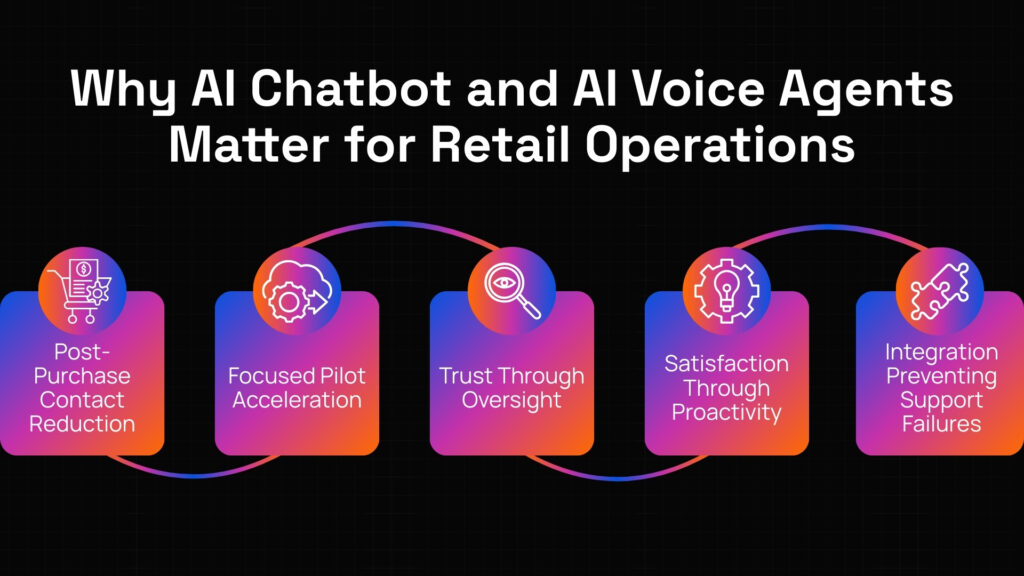
Why AI Chatbot and AI Voice Agents Matter for Retail Operations
AI automation examples extend beyond simple task automation; they transform how retail organizations manage post-purchase experience, maintain customer satisfaction, and ensure operational efficiency across all fulfillment touchpoints. Manual retail processes that once created bottlenecks through phone queue delays, email response lag, and inconsistent return handling can now be executed with intelligence and precision through AI automation in retail that compounds efficiency over time. From reducing WISMO tickets by 30 percent to addressing the 60 percent of support contacts driven by post-purchase issues, AI chatbot and AI voice agents deliver measurable outcomes that strengthen both operational efficiency and customer loyalty.
For retail leaders evaluating AI automation in retail strategies, the benefits manifest in five critical ways:
- Post-Purchase Contact Reduction: Forrester shows post-purchase issues drive up to 60 percent of retail support contacts, proving that tracking, notifications, and exchanges represent primary operational burden as “where is my order” inquiries consume capacity better directed at revenue-generating activities requiring automated self-service eliminating repetitive inquiries.
- Focused Pilot Acceleration: Gartner notes focused CX pilots outperform broad automation programs demonstrating structured approach, as AI automation examples with narrow scope starting with tracking before returns prove value faster than comprehensive implementations attempting exchanges, refunds, and voice simultaneously overwhelming resources.
- Trust Through Oversight: Deloitte finds HITL improves trust in AI-driven CX validating monitoring value, as AI chatbot and AI voice agents must provide confidence thresholds and agent takeover enabling human intervention when situations require empathy or complex problem-solving beyond algorithmic capabilities.
- Satisfaction Through Proactivity: Nielsen Norman Group shows proactive system feedback boosts satisfaction proving transparency importance, as AI automation in retail through push notifications informing customers of shipping, delays, and delivery reduces anxiety eliminating need for customers to initiate inquiries creating better experiences.
- Integration Preventing Support Failures: Industry guidance emphasizes delayed updates kill trust more than delays themselves, as AI automation examples depend on connected OMS, WMS, and carrier APIs requiring real-time data integration not batch updates creating staleness where customer sees old information contradicting reality degrading trust.
AI automation in retail is not about replacing customer service representatives; it is about connecting post-purchase systems cleanly through workflow optimization enabling retail professionals to focus capacity on complex returns, service recovery, and relationship building that machines cannot replicate effectively.
Key Considerations When Choosing AI Automation in Retail Partners
Selecting the right AI chatbot and AI voice agents requires careful alignment between technology capabilities and retail requirements. The most successful AI automation in retail implementations are built on a foundation of deep OMS connectivity, real-time carrier integration, and measurable impact on critical metrics like contact rate, CSAT, AHT, and return cycle time.
Below are the core factors that should guide every AI automation in retail decision:
- Business Outcomes & KPI Alignment: Every AI automation examples initiative must connect directly to tangible retail metrics including contact rate reduction, CSAT improvement, AHT decrease, or return cycle time acceleration. Ask for baseline metrics and expected deltas not marketing percentages, requiring specific measurement with clear operational impact rather than generic efficiency promises.
- Integration Depth and Actions: Effective AI automation in retail depends on seamless connectivity with OMS providing order events, WMS supplying fulfillment status, carrier APIs delivering tracking updates, and help desk enabling escalation. Require read-write actions for exchanges and refunds not just read-only access preventing automation from closing workflow loops.
- Security and Privacy Governance: AI chatbot and AI voice agents handle sensitive customer data including order details, addresses, and payment information requiring PII handling procedures, consent management, and comprehensive audit logs. Address privacy requirements as Forrester shows 60 percent of contacts being post-purchase requiring appropriate safeguards protecting customer data.
- Human-in-the-Loop (HITL) Design: Successful AI automation in retail always includes agent oversight with confidence thresholds triggering escalation and clear takeover procedures. When does AI hand off ensuring appropriate review as Deloitte shows HITL improving trust through effective collaboration enabling human judgment when edge cases require flexible problem-solving.
- Observability and Analytics: Transparency is essential when scaling AI automation examples across customer touchpoints. A capable vendor provides traces from order event to customer message, comprehensive dashboards tracking accuracy and escalations, and rollback and replay for errors as Nielsen Norman Group shows proactive feedback boosting satisfaction.
- Pricing Transparency and Asset Ownership: Clarify ownership of flows, prompts, and logic developed during implementation preventing vendor lock-in. Document pricing drivers with detailed breakdown as Gartner shows focused pilots requiring sustainable partnerships enabling continuous improvement.
Choosing AI automation in retail partners who understand these requirements ensures your investment delivers sustainable improvements rather than creating customer frustration, vendor lock-in, or support quality vulnerabilities that limit future flexibility when commerce platforms, carrier relationships, or return policies evolve.
Understanding AI Automation in Retail: 6 Post-Purchase Workflows
Before launching any AI automation examples initiative, organizations must thoroughly understand workflow priorities and automation sequence. Start with high-volume predictable interactions as workflow choices determine operational value. When retail teams identify essential automation candidates in proper order, they accelerate value realization, maintain customer satisfaction, and avoid expensive failures from inappropriate automation creating negative experiences.
- Order Status Ingestion (Tracking Workflow 1): Pull events from OMS, carrier APIs, and WMS provide visibility foundation. Real-time tracking as AI automation in retail must consume shipping updates, delivery confirmations, and exception events enabling accurate customer communication not working from stale snapshots.
- Proactive Notifications (Tracking Workflow 2): Shipping, delays, out-for-delivery, and delivered alerts reduce inquiry volume. Push communication as AI chatbot and AI voice agents eliminate need for customers to ask “where is my order” through systematic updates addressing primary contact driver proactively.
- Exception Alerts (Tracking Workflow 3): Lost, delayed, or split shipments trigger intervention. Proactive problem notification as AI automation examples identify issues enabling service recovery before customer frustration escalates preventing negative reviews and loyalty damage.
- Self-Serve Exchanges (Exchange Workflow 4): Size or color swaps tied to inventory enable automated handling. Order modification as AI automation in retail checks availability and creates exchange orders without agent involvement handling straightforward product substitutions.
- Return Authorization (Return Workflow 5): Rule-based approvals and labels streamline processing. Return initiation as AI chatbot applies policy logic generating prepaid shipping labels for eligible returns accelerating cycle time and reducing manual authorization work.
- Refund Status Updates (Return Workflow 6): Triggered by receipt or inspection events provide transparency. Payment communication as AI automation examples notify customers of refund processing eliminating “where is my refund” inquiries through systematic status updates.
Pro Tip: Proactive notifications reduce inbound volume more than any chatbot alone addressing root cause. Start with tracking before returns proving value as Forrester shows 60 percent of contacts being post-purchase with majority asking order status questions automated through push notifications.
Understanding AI Automation in Retail KPIs: What to Measure
Before launching any AI automation examples initiative, organizations must thoroughly define success metrics enabling objective pilot evaluation and ongoing performance monitoring. Key performance indicators provide the measurement framework distinguishing valuable implementations from expensive failures creating operations team skepticism. When retail operations teams establish KPIs in advance, they align stakeholders around clear targets, enable data-driven optimization, and build business cases justifying continued investment through demonstrated value.
- Contact Rate: Track support interactions per order measuring deflection when AI automation in retail handles inquiries, targeting reductions as Forrester shows 60 percent of contacts being post-purchase representing massive automation opportunity reducing phone, email, and chat volume.
- WISMO Ticket Reduction: Monitor “where is my order” inquiry count measuring tracking automation effectiveness when proactive notifications eliminate inquiries, targeting reductions like 30 percent as status questions represent highest-volume post-purchase contact type.
- Customer Satisfaction (CSAT): Evaluate post-interaction ratings when AI chatbot and AI voice agents handle support, ensuring automation maintains experience standards as Nielsen Norman Group shows proactive feedback boosting satisfaction through transparency not reactive support creating frustration.
- Average Handle Time (AHT): Track agent duration when complex cases escalate measuring efficiency, maintaining reasonable times as AI automation examples should deflect simple inquiries enabling agents to focus undistracted on resolution not switching between routine and complex work.
- Return Cycle Time: Monitor duration from return initiation to refund completion measuring processing velocity when automation accelerates authorization and status updates, calculating customer satisfaction impact as faster refunds reduce anxiety and future cart abandonment.
- First Contact Resolution (FCR): Evaluate percent of issues resolved in initial interaction when AI automation in retail provides accurate responses, ensuring quality as low FCR creates frustration from repeated contacts undermining satisfaction despite faster initial response.
- Escalation Rate: Calculate percent of AI interactions requiring human takeover measuring confidence calibration, targeting appropriate rates as excessive escalation indicates poor training while insufficient escalation suggests over-confident automation creating errors.
- Proactive Notification Open Rate: Track customer engagement with shipping and delivery alerts measuring communication effectiveness, ensuring messages provide value as ignored notifications waste sending costs and suggest irrelevant content requiring optimization.
Pro Tip: Monitor fallback and escalation rates during 4-week chatbot pilot for tracking queries. Start with tracking before returns proving approach as Gartner notes focused CX pilots outperform broad programs enabling concentrated effort demonstrating clear contact reduction.
Common Pitfalls in AI Automation in Retail Implementation
AI automation examples promise efficiency and better customer experience, but poor planning and inadequate integration can create satisfaction issues instead of operational improvements. Many retail organizations make avoidable mistakes during deployment that delay value realization and erode both team and customer trust. To discover proven methodologies tailored for your retail workflows and CX requirements, explore our AI Workflow Automation Services page for detailed AI automation in retail frameworks and real-world implementation guidance.
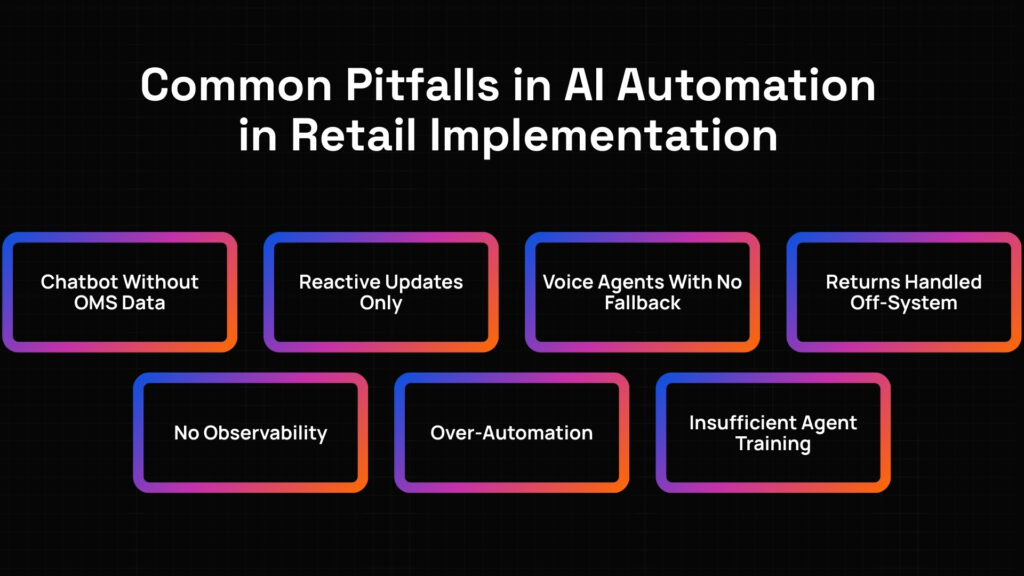
- Chatbot Without OMS Data: Launching conversation automation without order access creates frustration. Integrate live order events enabling AI chatbot to reference current status as industry guidance emphasizes customers expect instant answers requiring real-time visibility not “let me check” delays.
- Reactive Updates Only: Relying on customer-initiated inquiries misses deflection opportunity. Push proactive notifications for shipping, delays, and delivery as Nielsen Norman Group shows proactive feedback boosting satisfaction eliminating anxiety-driven “where is my order” contacts.
- Voice Agents With No Fallback: Deploying phone automation without escalation creates trapped customers. Clear human escalation enabling transfer when AI voice agents encounter complexity as Deloitte shows HITL improving trust through appropriate handoffs not forcing customers through frustrating loops.
- Returns Handled Off-System: Processing exchanges and refunds manually negates automation benefits. Connect inventory and refunds enabling AI automation in retail to complete transactions as disconnected workflows create delays and manual work undermining efficiency gains.
- No Observability: Launching without performance visibility prevents quality assurance. Trace every message and action documenting conversations, decisions, and outcomes as Forrester shows 60 percent of contacts being post-purchase requiring comprehensive monitoring supporting continuous improvement.
- Over-Automation: Attempting autonomous handling of all situations creates service failures. Keep humans for edge cases requiring judgment as AI automation examples should handle volume freeing agents for complex situations not eliminating human judgment entirely.
- Set-and-Forget Mentality: Treating AI chatbot and AI voice agents as one-time deployment creates performance degradation through policy changes and product evolution. Review flows quarterly as return policies, carrier partnerships, and product catalogs change requiring ongoing calibration.
- Insufficient Agent Training: Technical implementations without staff enablement face adoption resistance. Include CX playbooks and agent training as effective escalation requires agents understanding what AI attempted preventing duplicated effort and ensuring seamless handoffs.
The Impact of Integration Readiness
Before launching any AI automation in retail initiative, organizations must thoroughly assess their OMS architecture, carrier connectivity, and help desk integration maturity. Integration readiness evaluates how well existing commerce systems, order data assets, and support procedures can support intelligent automation without creating technical debt or customer experience gaps. When retail operations teams conduct integration audits in advance, they uncover system limitations and data quality issues early, align stakeholders around connectivity requirements, and minimize wasted time during vendor discovery and pilot phases.
Example: A fashion retailer preparing for AI automation examples mapped their OMS and carrier connectivity, discovering their chatbot lacked OMS data requiring live order integration, their notifications were reactive only requiring proactive push capability, their carrier APIs updated hourly creating staleness requiring real-time webhooks, their exchange workflows were manual requiring inventory and refund system connection, and their escalation procedures weren’t documented creating handoff confusion. Addressing these integration readiness issues before vendor engagement reduced the overall project timeline by five weeks.
Pro Tip: Validate real-time versus batch updates during discovery ensuring customers see current information not stale status. Vendor should map order events, messages, and actions before proposals. Integrate live order events for chatbot preventing frustrating “I can’t see your order” responses as industry guidance emphasizes delayed updates killing trust.
Evaluating AI Automation in Retail ROI
Quantifying the benefits of AI automation examples helps secure executive buy-in and refine future investments in retail technology. Measuring ROI goes beyond simple cost savings; it captures improvements in contact reduction, customer satisfaction, operational efficiency, and agent capacity. Without clear financial modeling during evaluation, AI automation in retail projects risk becoming unclear implementations that fail to justify ongoing operational expenses and licensing costs.
Key considerations for financial analysis include:
- Support Cost Reduction: Forrester shows post-purchase issues drive up to 60 percent of retail support contacts, calculating capacity release when AI chatbot and AI voice agents handle inquiries eliminating phone, email, and chat work freeing agents for revenue-generating activities like sales support and complex problem-solving.
- WISMO Deflection Value: Track ticket reduction when proactive notifications target 30 percent decrease in “where is my order” inquiries, measuring operational savings as status questions represent highest-volume contact type consuming capacity through repetitive interactions providing no business value.
- Customer Lifetime Value Protection: Calculate churn prevention when better post-purchase experience maintains satisfaction, measuring revenue impact as positive fulfillment experiences drive repeat purchase while negative experiences create defection to competitors offering superior service.
- Return Processing Efficiency: Monitor cycle time acceleration when automated authorization and status updates reduce manual work, quantifying operational returns as Gartner shows focused pilots enabling agents to handle higher volumes without proportional hiring improving cost efficiency.
- Agent Capacity Reallocation: Assess freed hours redirected to complex cases and service recovery, calculating productivity as AI automation in retail handles routine inquiries enabling agents to focus on situations requiring empathy and creative problem-solving beyond algorithmic capabilities.
- Total Cost of Ownership: Include licensing fees, OMS and carrier integration development, chatbot and voice agent training, plus ongoing model tuning, flow optimization, and support in comprehensive analysis. Understand pricing scales with interaction volume, order count, or customer base as retail automation requiring realistic cost modeling.
Forrester shows post-purchase issues drive up to 60 percent of retail support contacts. Gartner notes focused CX pilots outperform broad automation programs. Deloitte finds HITL improves trust in AI-driven CX. Nielsen Norman Group shows proactive system feedback boosts satisfaction. Industry guidance emphasizes delayed updates kill trust more than delays. When every AI automation in retail interaction logs customer inquiries, AI responses, confidence scores, and escalation triggers, every integration maintains real-time order event synchronization preventing stale status information, and every quarterly review assesses flow effectiveness and policy alignment, organizations build trusted post-purchase operations that scale without sacrificing customer experience, agent capacity, or brand reputation.
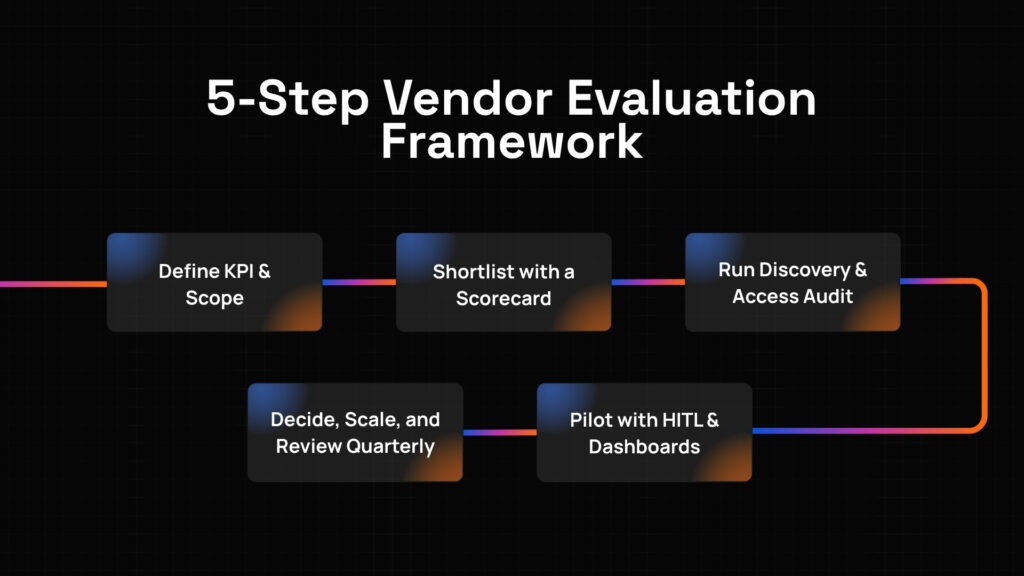
5-Step Vendor Framework for AI Automation in Retail
Selecting an AI automation examples vendor should follow a disciplined, structured process that aligns with your organization’s retail goals while accounting for both technological depth and customer experience requirements. Instead of focusing solely on impressive demonstrations or deflection claims, evaluation should weigh how well the AI chatbot and AI voice agents solution supports measurable outcomes, integrates with existing systems, and maintains quality through appropriate governance.
1. Define KPI & Scope
Start by identifying specific measurable outcomes with narrow scope enabling quick operational validation. Defining concrete targets helps align all stakeholders including customer service leadership, operations teams, IT infrastructure, and marketing. Your goal might be reducing WISMO tickets by 30 percent, improving CSAT, or decreasing contact rate, but it must be quantifiable with clear retail impact.
Example: An electronics retailer defined its KPI as “reducing WISMO tickets by 30 percent within 90 days while maintaining CSAT above 4.0 out of 5.0 and first contact resolution above 85 percent.” This metric guided every AI automation in retail discussion, shaped pilot design with clear CX benchmarks, and became the success measurement. Start with tracking before returns.
Pro Tip: Document one to two primary retail outcomes before requesting proposals. Focus on WISMO reduction, contact rate decrease, or return cycle time improvement tied to operational efficiency rather than vanity metrics like total conversations handled, and define specific percentage improvement targets with timelines enabling objective go/no-go decisions during pilot evaluation as Gartner notes focused pilots outperform broad programs.
2. Shortlist with a Scorecard
Once objectives are clear, move to structured vendor comparison using a weighted scorecard evaluating AI automation in retail providers. This tool allows teams to quantify how well each vendor aligns with priorities including OMS and carrier integrations, proactive notifications, chatbot and voice design, observability, and portability and IP ownership.
Example: One enterprise assigned 30 percent weight to OMS and carrier integrations assessing connectivity depth, 25 percent to proactive notifications evaluating push capability, 20 percent to chatbot and voice design ensuring quality interactions, 15 percent to observability capabilities, and 10 percent to portability and IP ownership. Score OMS and carrier integrations highest.
Pro Tip: Turn evaluation criteria into numeric scoring so decisions remain defendable beyond subjective demonstration impressions. Ask for live demos with your order data validating actual integration complexity. Weight appropriately as Forrester shows 60 percent of contacts being post-purchase and Deloitte emphasizes trust importance. Have multiple stakeholders from customer service, operations, and IT score vendors independently before group discussion to reduce bias.
3. Run Discovery & Access Audit
Before contracts are signed, a structured discovery phase maps order events, messages, and actions documenting every integration touchpoint and CX requirement. During this phase, teams validate OMS and carrier access, surface notification gaps, and confirm escalation workflows with appropriate confidence thresholds. Validate real-time versus batch updates.
Example: A home goods retailer conducted discovery for AI automation examples, revealing their OMS required custom API authentication not in standard vendor documentation, their carrier webhooks weren’t configured requiring real-time setup, their help desk lacked chatbot integration requiring escalation pathway development, their exchange workflows weren’t digitized creating automation complexity, and their return policies varied by product requiring rule engine configuration.
Pro Tip: Vendor should map order events, messages, and actions before proposals detailing exact connectivity requirements. Validate real-time versus batch updates ensuring customers see current information not stale status. Push proactive notifications not just reactive responses. Use discovery to surface OMS limitations, carrier API delays, and help desk gaps before signing when negotiating leverage is highest.
4. Pilot with HITL & Dashboards
A well-designed pilot validates both technology performance and customer experience maintenance under real retail conditions. Instead of full-scale deployment, run 4-week chatbot pilot for tracking queries maintaining agent oversight for quality assurance. Incorporating human-in-the-loop review ensures AI automation in retail outcomes align with service standards and customer satisfaction requirements while building organizational confidence.
Example: A beauty retailer piloted AI chatbot for post-purchase support, running 4-week evaluation with controlled deployment on order status inquiries, agent review of all low-confidence interactions before escalation, and dashboard tracking WISMO reduction, CSAT, escalation rate, and first contact resolution, achieving 28 percent WISMO decrease with 4.3 CSAT above 4.0 target. Monitor fallback and escalation rates as Deloitte shows HITL matters.
Pro Tip: Execute pilots with frozen scope covering specific inquiry type, clear success criteria including CX benchmarks, and measurable KPIs tracked weekly. Run 4-week chatbot pilot for tracking queries establishing AI meets standards. Measure WISMO reduction targeting 30 percent and CSAT targeting above 4.0. Track escalation rates understanding confidence calibration. Use pilot to train agents on takeover procedures and seamless handoff techniques.
5. Decide, Scale, and Review Quarterly
After the pilot proves both operational value and customer experience maintenance, use findings to guide the final decision about expanding from tracking to exchanges and voice validating sustainability and stability. Scaling should be deliberate, expanding only after demonstrating approach maintains quality across representative inquiry types and customer segments. Continuous quarterly reviews maintain CX discipline, ensuring automation adapts as return policies, carrier partnerships, and product catalogs evolve.
Example: A sporting goods retailer conducted quarterly reviews with its AI automation in retail partner, expanding successful tracking automation to exchanges, returns, and voice channels over 12 months, scaling after validation, identifying optimization opportunities reducing contact rate by additional 15 percent, and reviewing flows quarterly as policies changed. Expand from tracking to exchanges and voice as Gartner shows focused approach.
Pro Tip: Treat vendor reviews as CX governance sessions focused on customer satisfaction and agent effectiveness, not just performance metrics. Expand from tracking to exchanges and voice proving reliability before comprehensive deployment. Review flows quarterly detecting policy changes and seasonal patterns. Use quarterly reviews to assess conversation quality, escalation appropriateness, customer feedback, and alignment with evolving return policies and carrier capabilities.
Next Steps in Your AI Automation in Retail Evaluation
By now, you should have a clear understanding of what to prioritize when selecting AI automation examples partners for retail. Bringing these insights together creates a structured evaluation flow that de-risks investment and accelerates deployment while ensuring customer experience and operational efficiency.
- Align with retail metrics: Ensure every AI chatbot and AI voice agents feature connects to specific KPIs like contact rate, WISMO tickets, CSAT, or return cycle time tied to operational efficiency, not just automation coverage percentages disconnected from actual customer outcomes and measurable business results.
- Evaluate commerce integration: Confirm that AI automation in retail works smoothly with your OMS through real-time events, carrier APIs through webhook delivery, and help desk through seamless escalation as Forrester shows 60 percent of contacts being post-purchase requiring integrated workflows from order through delivery communication.
- Focus on customer oversight: Choose vendors with confidence thresholds triggering escalation, agent takeover procedures enabling seamless handoffs, and proactive notifications reducing inquiry volume as Deloitte shows HITL improving trust through appropriate human intervention when situations require flexibility.
- Review observability capabilities: Favor partners with traces from order event to customer message, dashboards tracking accuracy and escalations, and rollback and replay for errors as Nielsen Norman Group shows proactive feedback boosting satisfaction enabling quality assurance.
- Test with controlled pilots: Always run 4-week pilots on tracking queries, agent review maintaining oversight, frozen scope on specific workflows, and escalation monitoring before production deployment to validate WISMO reduction, CSAT maintenance, and operational readiness under real-world retail conditions with actual customer diversity.
With these criteria in place, you are better equipped to identify AI automation in retail vendors who not only automate workflows but also reduce contacts, maintain satisfaction, enable agents, and amplify your team’s capacity to focus on complex service recovery and relationship building requiring empathy that machines cannot replicate.
Vendor Questions to Ask
To make the most informed decision during your AI automation in retail evaluation, be sure to ask these essential questions:
- Which OMS, WMS, and carriers do you integrate with, and what real-time capabilities do you provide for order events and tracking updates?
- How do chatbots and voice agents access live order data including API protocols, latency characteristics, and data refresh frequency?
- What triggers proactive notifications including event types, timing logic, and customer preference management for shipping and delivery alerts?
- How do you handle low-confidence responses including escalation thresholds, agent notification procedures, and conversation handoff protocols?
- Who owns conversation flows and prompts ensuring operational portability at contract end including export rights for automation logic?
- Can we export workflows and logs enabling portability without starting over or losing conversation history if we switch vendors?
- What observability is included providing dashboards, analytics, and conversation traces tracking accuracy, escalations, and customer satisfaction?
- Can you provide two customer references in similar retail verticals who can discuss WISMO reduction, CSAT improvement, and ongoing partnership?
- What are recurring costs beyond license including integration maintenance, conversation training, and support fees, and how do expenses scale?
- What rollback and replay capabilities exist for errors enabling quick restoration when automation produces incorrect responses or system failures?
Transform Post-Purchase Experience with AI Automation in Retail
AI automation in retail is not just a technological investment; it is a strategic customer experience capability that requires careful integration, appropriate oversight, and continuous optimization. The right implementation brings 30 percent WISMO reduction, improved customer satisfaction, and freed agent capacity, while poor execution creates customer frustration and support quality issues that undermine confidence and damage brand reputation.
Ready to transform your post-purchase experience with AI automation in retail? Book a Free Strategy Call with us to explore the next steps and discover how we can help you prioritize what to automate first, validate commerce system readiness, and deploy the right AI chatbot and AI voice agents solution for your unique OMS environment, carrier relationships, support workflows, and measurable customer experience outcomes.