

The Power of AI Sales Automation Tools: Why Measurement Integration Matters
AI sales automation tools have evolved from isolated task bots into mission-critical revenue orchestration that defines competitive advantage in modern sales operations. Sales teams implementing professional sales automation are fundamentally transforming how routing operates, how follow-ups execute, and how performance gets measured without creating noise or revenue confusion. Advanced AI automation examples now manage workflows from lead assignment and outreach cadences to escalation triggers and outcome tracking, enabling sales leaders to focus on coaching strategy while machines handle coordination that once consumed hours daily during pipeline management operations.
The data supporting strategic sales automation continues to strengthen across operational functions. According to Forrester research, 60 percent of sales automation initiatives fail to show ROI due to poor measurement, demonstrating that deployment without accountability creates expensive ambiguity not demonstrable value requiring clear metrics proving impact. Harvard Business Review reports leads contacted within an hour are 7 times more likely to convert, proving that speed-to-lead optimization delivers measurable conversion improvement as velocity creates competitive advantage in saturated markets. Nielsen Norman Group research indicates clear dashboards improve decision quality, emphasizing that transparency requirements enable confident optimization not opaque systems creating confusion.
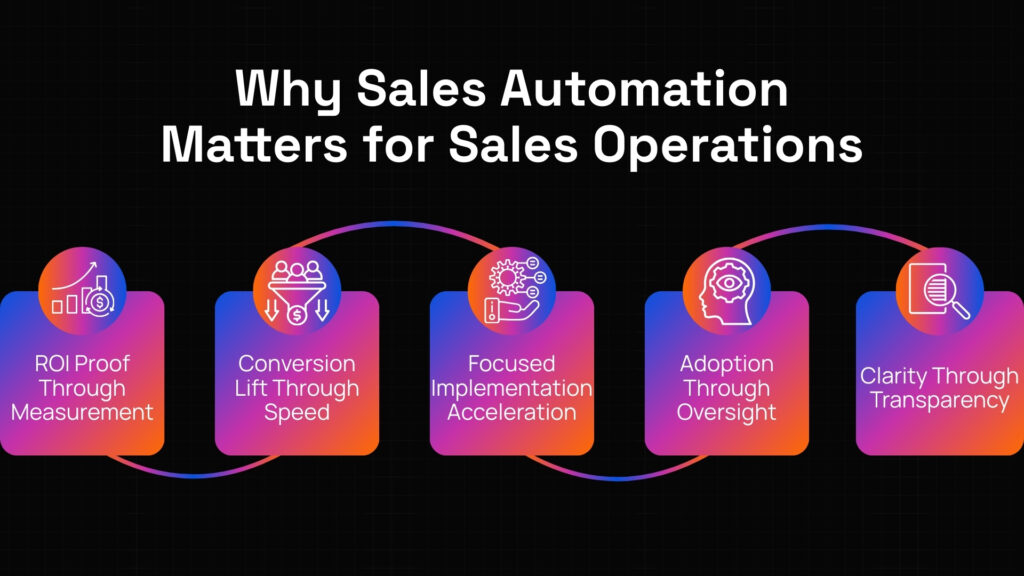
Why Sales Automation Matters for Sales Operations
AI automation examples extend beyond simple task automation; they transform how sales organizations manage pipeline velocity, maintain contact discipline, and ensure revenue predictability across all funnel stages. Manual sales processes that once created bottlenecks through routing delays, inconsistent follow-up, and invisible performance gaps can now be executed with intelligence and precision through AI sales automation tools that compound efficiency over time. From reducing speed-to-lead from 15 minutes to under 2 to achieving 7 times better conversion through faster contact, sales automation delivers measurable outcomes that strengthen both operational efficiency and revenue generation.
For sales leaders evaluating AI sales automation tools strategies, AI automation benefits manifest in five critical ways:
- ROI Proof Through Measurement: Forrester shows 60 percent of sales automation initiatives fail to show ROI due to poor measurement, proving that deployment without scorecards creates expensive ambiguity as teams argue whether automation worked requiring clear metrics demonstrating impact not activity enabling investment justification.
- Conversion Lift Through Speed: Harvard Business Review reports leads contacted within an hour are 7 times more likely to convert demonstrating velocity value, as AI sales automation tools enable instant routing and immediate follow-up capturing prospects before competitor engagement or interest cooling as speed creates measurable advantage.
- Focused Implementation Acceleration: McKinsey shows focused KPI programs outperform broad ones validating structured approach, as AI automation examples with narrow scope measuring one funnel stage prove value faster than comprehensive dashboards tracking recruiting, onboarding, pipeline, and retention simultaneously overwhelming analysis capacity.
- Adoption Through Oversight: Deloitte finds HITL improves trust and adoption validating monitoring importance, as sales automation must provide overrides for routing and messaging enabling rep judgment when business context requires deviation from algorithmic recommendations preventing forced compliance eroding morale.
- Clarity Through Transparency: Nielsen Norman Group shows clear dashboards improve decision quality proving visibility importance, as AI sales automation tools through explainable actions and real-time scorecards enable sales leaders to understand performance not accepting black-box metrics undermining confidence.
AI sales automation tools are not about replacing sales reps; they are about connecting revenue systems cleanly through workflow optimization enabling sales professionals to focus capacity on complex deals, relationship building, and strategic accounts that machines cannot replicate effectively.
Key Considerations When Choosing AI Sales Automation Tools Partners
Selecting the right sales automation requires careful alignment between technology capabilities and sales requirements. The most successful AI sales automation tools implementations are built on a foundation of deep CRM connectivity, appropriate measurement frameworks, and measurable impact on critical metrics like pipeline velocity, win rate, and revenue per rep.
Below are the core factors that should guide every AI sales automation tools decision:
- Business Outcomes & KPI Alignment: Every AI automation examples initiative must connect directly to tangible sales metrics including pipeline velocity acceleration, win rate improvement, or revenue per rep increase. Ask for baseline metrics and expected deltas not marketing percentages, requiring specific measurement with clear revenue impact rather than generic efficiency promises.
- Integration Depth and Access: Effective AI sales automation tools depend on seamless connectivity with CRM providing lead and opportunity data, dialers enabling call automation, email platforms capturing outreach, and calendars coordinating meetings. Require read and write access for tasks and fields not just read-only preventing automation from completing workflow loops.
- Security and Governance: Sales automation handles sensitive business data including pipeline forecasts, deal values, and competitive information requiring role-based permissions and comprehensive audit logs. Address security requirements as Forrester shows 60 percent failing to prove ROI requiring governance supporting measurement validation.
- Human-in-the-Loop (HITL) Design: Successful AI sales automation tools always include rep oversight with overrides for routing and messaging preventing forced compliance. When does automation suggest versus execute ensuring appropriate review as Deloitte shows HITL improving adoption through effective collaboration enabling judgment when deals require custom approaches.
- Observability and Analytics: Transparency is essential when scaling AI automation examples across sales workflows. A capable vendor provides traces from automation action to outcome, comprehensive dashboards showing metric calculation, and explainable logic as Nielsen Norman Group shows clear displays improving decision quality.
- Pricing Transparency and Asset Ownership: Clarify ownership of workflows and reports developed during implementation preventing vendor lock-in. Document pricing drivers with detailed breakdown as McKinsey shows focused programs requiring sustainable partnerships enabling continuous improvement.
Choosing AI sales automation tools partners who understand these requirements ensures your investment delivers sustainable improvements rather than creating measurement confusion, vendor lock-in, or rep resistance that limit future flexibility when sales strategies, market conditions, or business priorities evolve.
Understanding AI Sales Automation Tools: Core Scorecard Metrics
Before launching any sales automation initiative, organizations must thoroughly understand measurement priorities and metric selection. Focus on outcomes that change behavior as metric choices determine operational accountability. When sales teams identify essential scorecard candidates, they accelerate value proof, maintain rep trust, and avoid expensive failures from inappropriate measurement creating vanity metric obsession.
- Speed-to-Lead (Metric 1): Time from inbound inquiry to first touch measures responsiveness. Contact velocity as AI sales automation tools enable instant routing and immediate outreach reducing delays from minutes to seconds as Harvard Business Review shows 7 times better conversion with hour contact proving speed value.
- Contact Rate (Metric 2): Percent of leads actually reached measures execution quality. Connection effectiveness as AI automation examples track attempts versus successful conversations showing discipline not just activity as dial volume without conversations wastes capacity.
- Qualified Meeting Rate (Metric 3): Meetings that pass discovery measure quality. Opportunity conversion as sales automation separates informational calls from genuine prospects showing front-end qualification effectiveness preventing pipeline pollution with unqualified opportunities consuming sales capacity.
- Cycle Time (Metric 4): Days from lead to close measure velocity. Deal duration as AI sales automation tools track progression identifying bottlenecks enabling intervention as extended cycles tie up capacity and risk competitor interference requiring acceleration.
- Revenue Per Rep (Metric 5): Output not activity measures productivity. Individual effectiveness as sales automation calculates closed revenue divided by rep count showing actual contribution as activity metrics like calls made don’t prove value without revenue connection.
Pro Tip: Track before-and-after deltas for each metric capturing baseline before automation deployment. Measure activity versus outcomes as Forrester shows 60 percent failing to prove ROI requiring revenue-tied metrics not vanity measures demonstrating busy-ness without business impact.
Understanding AI Sales Automation Tools: Essential SLAs
Before launching any sales automation initiative, organizations must thoroughly define service level agreements enforcing discipline. SLAs that keep automation honest as accountability requirements determine operational compliance. When sales teams establish clear SLAs, they create performance standards, enable objective measurement, and build cultures prioritizing speed and follow-through beyond algorithmic execution.
- Routing SLA: Assign inbound leads in under 60 seconds prevents delay. Instant allocation as AI sales automation tools automatically distribute inquiries based on territory, product, or capacity ensuring immediate assignment as Harvard Business Review shows 7 times conversion lift with fast follow-up requiring speed optimization.
- Follow-Up SLA: First outreach within 5 minutes captures interest. Contact velocity as AI automation examples trigger immediate response sequences preventing cooling as prospects engage competitors during delays requiring strike-while-hot discipline.
- Escalation SLA: Route stalled deals to managers after 7 days enables intervention. Deal monitoring as sales automation flags inactive opportunities triggering review conversations preventing silent slippage as extended inactivity correlates with lost business requiring proactive management.
Pro Tip: Segment SLAs by lead source not applying one-size-fits-all standards. Inbound inquiries require faster response than outbound prospecting as interest level differs warranting different velocity targets as McKinsey shows focused programs outperforming broad approaches requiring segmented accountability.
Understanding AI Sales Automation Tools KPIs: What to Measure
Before launching any sales automation initiative, organizations must thoroughly define success metrics enabling objective pilot evaluation and ongoing performance monitoring. Key performance indicators provide the measurement framework distinguishing valuable implementations from expensive failures creating operations team skepticism. When sales operations teams establish KPIs in advance, they align stakeholders around clear targets, enable data-driven optimization, and build business cases justifying continued investment through demonstrated value.
- Pipeline Velocity: Calculate time from stage to stage measuring flow when AI sales automation tools accelerate progression, targeting reductions as faster movement through funnel increases revenue per period enabling quota attainment without proportional headcount growth.
- Win Rate: Track closed-won divided by total opportunities measuring effectiveness when better qualification improves conversion, quantifying returns as AI automation examples identify highest-probability prospects preventing capacity waste on unlikely deals.
- Speed-to-Lead: Monitor minutes from inquiry to first touch measuring responsiveness when instant routing enables immediate contact, targeting reductions like 15 minutes to under 2 as Harvard Business Review shows 7 times conversion lift proving velocity value.
- Contact Rate: Evaluate percent of leads reached measuring execution when automation ensures consistent outreach, tracking connection as AI sales automation tools maintain discipline preventing leads from falling through cracks due to rep workload or oversight.
- Qualified Meeting Rate: Calculate discovery calls resulting in opportunities measuring quality when automation improves targeting, ensuring efficiency as high meeting volume with low qualification wastes capacity on informational conversations not progressing to proposals.
- Cycle Time: Track days from lead to close measuring duration when escalation triggers accelerate stalled deals, reducing extended sales cycles as AI automation examples flag inactivity enabling intervention preventing competitor interference.
- Revenue Per Rep: Calculate closed revenue divided by seller count measuring productivity when automation eliminates administrative work, quantifying capacity gains as Forrester shows 60 percent failing to prove ROI requiring clear output metrics demonstrating value.
- Rep Adoption Rate: Monitor automation usage and override frequency measuring acceptance, ensuring utilization as unused automation wastes investment indicating poor targeting or insufficient trust requiring refinement as Deloitte shows HITL improving adoption.
Pro Tip: Compare automated versus manual cohorts during 30-day inbound routing pilot. Capture 30-day pre-automation data establishing baseline as McKinsey shows focused KPI programs requiring measurement proving impact not assumptions enabling expansion justification.
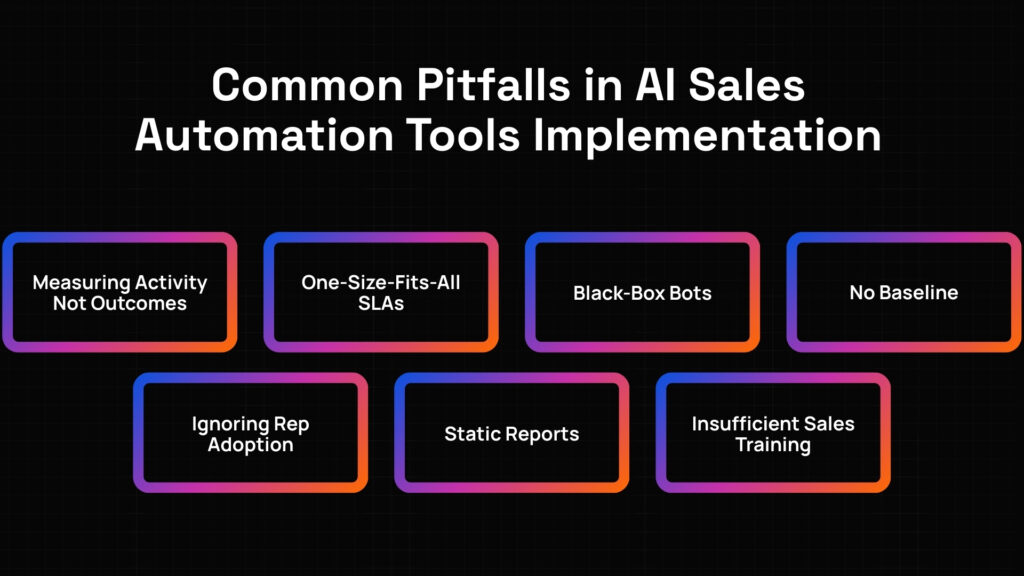
Common Pitfalls in AI Sales Automation Tools Implementation
Sales automation promises efficiency and better conversion, but poor planning and inadequate measurement can create noise instead of revenue improvements. Many sales organizations make avoidable mistakes during deployment that delay value realization and erode both leadership and rep trust. To discover proven methodologies tailored for your sales workflows and measurement requirements, explore our AI Workflow Automation Services page for detailed AI sales automation tools frameworks and real-world implementation guidance.
- Measuring Activity Not Outcomes: Tracking calls made or emails sent without revenue connection wastes effort. Tie metrics to revenue showing business impact as Forrester shows 60 percent failing to prove ROI requiring outcome focus preventing vanity measures demonstrating busy-ness without demonstrable value.
- One-Size-Fits-All SLAs: Applying uniform standards ignoring lead quality differences creates misalignment. Segment by lead source as inbound inquiries require faster response than cold outbound warranting different velocity targets as McKinsey shows focused programs requiring segmented accountability not broad blanket standards.
- Black-Box Bots: Accepting opaque automation without explanation creates distrust. Require explainable actions showing logic as Nielsen Norman Group demonstrates clarity improving decisions enabling validation not mysterious algorithms producing assignments without rationale undermining adoption.
- No Baseline: Launching without pre-automation measurement prevents impact proof. Capture 30-day pre-automation data establishing starting point proving improvement as Harvard Business Review shows 7 times conversion requiring before-after comparison demonstrating value not assumptions.
- Ignoring Rep Adoption: Deploying without tracking usage misses resistance. Track usage and overrides measuring acceptance as Deloitte shows HITL improving adoption requiring monitoring detecting avoidance indicating poor targeting or insufficient trust requiring refinement.
- Static Reports: Relying on scheduled dashboards creates staleness. Real-time scorecards enabling current visibility as operators need fast feedback not quarterly postmortems allowing agile optimization responding to performance shifts immediately.
- Insufficient Sales Training: Technical implementations without user enablement face adoption resistance. Include scorecard templates and training as effective usage requires understanding metric calculation enabling confident interpretation not confused acceptance.
The Impact of Integration Readiness
Before launching any AI sales automation tools initiative, organizations must thoroughly assess their CRM architecture, historical data quality, and routing rule complexity. Integration readiness evaluates how well existing sales systems, pipeline data assets, and assignment procedures can support intelligent automation without creating technical debt or measurement gaps. When sales operations teams conduct integration audits in advance, they uncover system limitations and data quality issues early, align stakeholders around connectivity requirements, and minimize wasted time during vendor discovery and pilot phases.
Example: A software company preparing for AI automation examples mapped their CRM and dialer connectivity, discovering they measured activity not outcomes requiring revenue-tied metrics, their routing SLAs were uniform requiring lead source segmentation, their bot actions were opaque requiring explainable logic, they lacked baseline data requiring 30-day pre-capture, their rep adoption wasn’t tracked requiring usage monitoring, and their reports were static requiring real-time scorecards. Addressing these integration readiness issues before vendor engagement reduced the overall project timeline by four weeks.
Pro Tip: Validate historical data depth during discovery ensuring sufficient baseline for comparison. Vendor should map lead sources and routing rules before proposals. Tie metrics to revenue not activity as Forrester shows 60 percent failing requiring outcome focus preventing vanity metric obsession with calls made or emails sent disconnected from business results.
Evaluating AI Sales Automation Tools ROI
Quantifying AI automation benefits helps secure executive buy-in and refine future investments in sales technology. Measuring ROI goes beyond simple efficiency gains; it captures improvements in conversion rate, pipeline velocity, rep productivity, and revenue generation. Without clear financial modeling during evaluation, AI sales automation tools projects risk becoming unclear implementations that fail to justify ongoing operational expenses and licensing costs.
Key considerations for financial analysis include:
- ROI Proof Through Scorecards: Forrester shows 60 percent of sales automation initiatives fail to show ROI due to poor measurement, calculating value when comprehensive scorecards demonstrate impact enabling continued investment as clear metrics prove business case supporting expansion beyond pilot to comprehensive deployment.
- Conversion Improvement Value: Harvard Business Review reports leads contacted within an hour are 7 times more likely to convert, calculating revenue impact when speed-to-lead optimization captures prospects as velocity creates measurable advantage improving close rates generating incremental revenue from existing lead flow.
- Pipeline Velocity Acceleration: Track cycle time reduction when escalation triggers and routing optimization accelerate progression, measuring revenue impact as faster movement through funnel increases revenue per period enabling quota attainment without proportional headcount growth.
- Rep Productivity Gains: Calculate revenue per rep increase when AI automation examples eliminate administrative work, quantifying capacity gains as McKinsey shows focused programs enabling sellers to handle higher volumes through systematic coordination freeing selling time.
- Win Rate Improvement Impact: Assess conversion enhancement when better qualification directs capacity to highest-probability opportunities, measuring efficiency as sales automation prevents wasted effort on unlikely deals improving close rates through focused allocation.
- Total Cost of Ownership: Include licensing fees, CRM integration development, scorecard configuration, plus ongoing SLA monitoring, metric refinement, and support in comprehensive analysis. Understand pricing scales with user count, lead volume, or automation complexity as sales technology requiring realistic cost modeling.
Forrester shows 60 percent fail to show ROI due to poor measurement. Harvard Business Review reports 7 times conversion lift with fast follow-up. McKinsey demonstrates focused KPI programs outperform broad ones. Deloitte finds HITL improves trust and adoption. Nielsen Norman Group shows clear dashboards improve decision quality. When every AI sales automation tools interaction logs routing decisions, outreach timing, escalation triggers, and outcome connections, every integration maintains real-time synchronization preventing stale performance data, and every quarterly review assesses SLA relevance and metric accuracy, organizations build trusted sales operations that scale without sacrificing revenue accountability, rep autonomy, or strategic effectiveness.
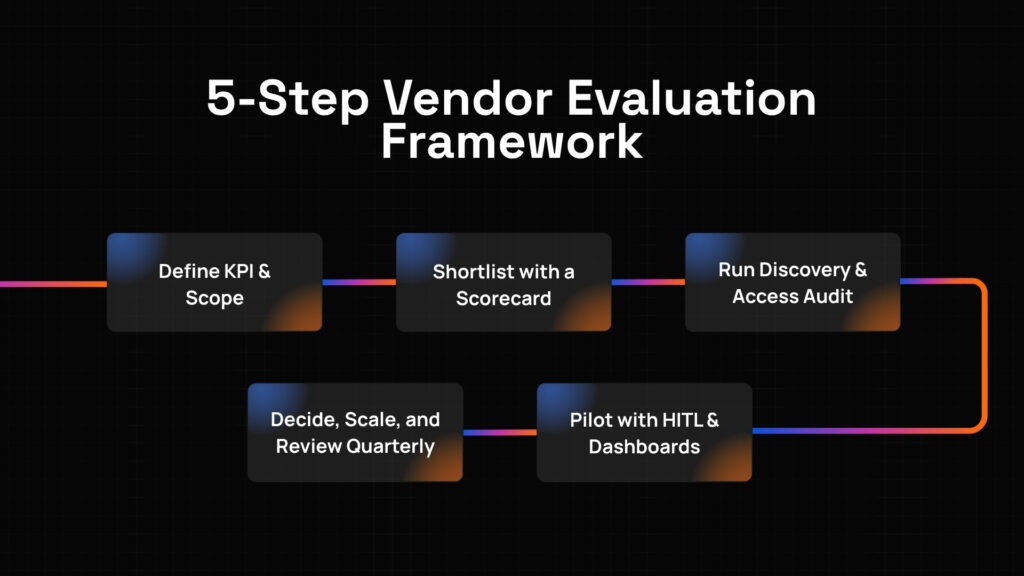
5-Step Vendor Framework for AI Sales Automation Tools
Selecting a sales automation vendor should follow a disciplined, structured process that aligns with your organization’s sales goals while accounting for both technological depth and measurement requirements. Instead of focusing solely on impressive demonstrations or automation claims, evaluation should weigh how well the AI sales automation tools solution supports measurable outcomes, integrates with existing systems, and maintains trust through appropriate transparency.
1. Define KPI & Scope
Start by identifying specific measurable outcomes with narrow scope enabling quick value proof. Defining concrete targets helps align all stakeholders including sales leadership, operations teams, frontline reps, and revenue operations. Your goal might be reducing speed-to-lead from 15 minutes to under 2, improving contact rate, or increasing revenue per rep, but it must be quantifiable with clear sales impact.
Example: A B2B company defined its KPI as “reducing speed-to-lead from 15 minutes to under 2 within 90 days while maintaining contact rate above 70 percent and qualified meeting rate above 40 percent.” This metric guided every AI sales automation tools discussion, shaped pilot design with clear sales benchmarks, and became the success measurement. Pick one funnel stage.
Pro Tip: Document one to two primary sales outcomes before requesting proposals. Focus on speed-to-lead reduction, contact rate improvement, or revenue per rep increase tied to business impact rather than vanity metrics like total activities logged, and define specific percentage improvement targets with timelines enabling objective go/no-go decisions during pilot evaluation as McKinsey shows focused KPI programs outperforming broad approaches.
2. Shortlist with a Scorecard
Once objectives are clear, move to structured vendor comparison using a weighted scorecard evaluating AI automation examples providers. This tool allows teams to quantify how well each vendor aligns with priorities including CRM write access, metric calculation transparency, SLA configurability, observability, and portability and IP ownership.
Example: One enterprise assigned 30 percent weight to CRM write access assessing automation capability, 25 percent to metric calculation transparency evaluating scorecard reliability, 20 percent to SLA configurability ensuring flexibility, 15 percent to observability capabilities, and 10 percent to portability and IP ownership. Rank vendors by CRM write access.
Pro Tip: Turn evaluation criteria into numeric scoring so decisions remain defendable beyond subjective demonstration impressions. Ask how metrics are calculated validating methodology. Weight appropriately as Forrester shows 60 percent failing and Deloitte emphasizes adoption importance. Have multiple stakeholders from sales operations, frontline management, and RevOps score vendors independently before group discussion to reduce bias.
3. Run Discovery & Access Audit
Before contracts are signed, a structured discovery phase maps lead sources and routing rules documenting every integration touchpoint and measurement requirement. During this phase, teams validate CRM access, surface data quality gaps, and confirm automation logic with appropriate explainability. Validate historical data depth.
Example: A technology company conducted discovery for sales automation, revealing their CRM lacked field write access requiring permission enhancement, their lead sources weren’t documented requiring mapping, their routing rules were inconsistent requiring standardization, their historical data was only three months requiring longer retention, and their baseline metrics weren’t captured requiring pre-automation measurement period.
Pro Tip: Vendor should map lead sources and routing rules before proposals detailing exact connectivity requirements. Validate historical data depth ensuring sufficient baseline for comparison. Ask how metrics are calculated understanding methodology. Use discovery to surface CRM limitations, data quality issues, and routing complexity before signing when negotiating leverage is highest.
4. Pilot with HITL & Dashboards
A well-designed pilot validates both technology performance and rep acceptance under real sales conditions. Instead of full-scale deployment, run 30-day inbound routing pilot maintaining rep oversight for quality assurance. Incorporating human-in-the-loop review ensures AI sales automation tools outcomes align with sales standards and conversion requirements while building organizational confidence.
Example: A financial services company piloted AI automation examples for inbound lead routing, running 30-day evaluation with controlled deployment on web inquiries, rep override capability for special handling, and dashboard tracking speed-to-lead, contact rate, qualified meeting rate, and adoption patterns, achieving 1.8-minute speed-to-lead with 73 percent contact rate above 70 percent target. Compare automated versus manual cohorts as Deloitte shows HITL matters.
Pro Tip: Execute pilots with frozen scope covering specific lead source, clear success criteria including conversion benchmarks, and measurable KPIs tracked weekly. Run 30-day inbound routing pilot establishing AI meets standards. Measure speed-to-lead targeting under 2 minutes and contact rate targeting above 70 percent. Track rep adoption understanding override patterns. Use pilot to train sales team on automation interpretation and appropriate override situations.
5. Decide, Scale, and Review Quarterly
After the pilot proves both operational value and rep trust maintenance, use findings to guide the final decision about expanding to renewals and upsell validating sustainability and stability. Scaling should be deliberate, expanding only after demonstrating approach maintains quality across representative deal types and customer segments. Continuous quarterly reviews maintain measurement discipline, ensuring automation adapts as lead quality, market conditions, and sales strategies evolve.
Example: A SaaS company conducted quarterly reviews with its AI sales automation tools partner, expanding successful inbound routing to renewal management and upsell workflows over 12 months, scaling after validation, identifying optimization opportunities improving win rate by additional 8 percent, and revisiting SLAs quarterly. Expand to renewals and upsell as McKinsey shows focused approach.
Pro Tip: Treat vendor reviews as measurement governance sessions focused on metric accuracy and revenue impact, not just performance dashboards. Expand to renewals and upsell proving reliability before comprehensive deployment. Revisit SLAs quarterly detecting lead quality changes and capacity shifts. Use quarterly reviews to assess metric relevance, rep adoption, conversion trends, and alignment with evolving sales strategies and market dynamics.
Next Steps in Your AI Sales Automation Tools Evaluation
By now, you should have a clear understanding of what to prioritize when selecting sales automation partners for sales. Bringing these insights together creates a structured evaluation flow that de-risks investment and accelerates deployment while ensuring measurement accountability and rep trust.
- Align with sales metrics: Ensure every AI sales automation tools feature connects to specific KPIs like pipeline velocity, win rate, or revenue per rep tied to business impact, not just automation coverage percentages disconnected from actual sales outcomes and measurable revenue results.
- Evaluate CRM integration: Confirm that AI automation examples work smoothly with your CRM through read-write access, dialers through call automation, and calendars through meeting coordination as Forrester shows 60 percent failing requiring integrated workflows from lead through close.
- Focus on measurement oversight: Choose vendors with explainable actions showing logic, comprehensive scorecards tracking outcomes not activity, and configurable SLAs enabling segmentation as Harvard Business Review shows 7 times conversion requiring speed discipline enforced through accountability.
- Review observability capabilities: Favor partners with traces from automation action to outcome, dashboards showing metric calculation, and real-time scorecards enabling fast feedback as Nielsen Norman Group shows clear displays improving decision quality.
- Test with controlled pilots: Always run 30-day pilots on one funnel stage, rep review maintaining oversight, frozen scope on specific lead source, and cohort comparison before production deployment to validate speed improvements, conversion maintenance, and operational readiness under real-world sales conditions with actual pipeline complexity.
With these criteria in place, you are better equipped to identify AI sales automation tools vendors who not only automate workflows but also prove ROI, improve conversion, maintain trust, and amplify your team’s capacity to focus on complex deals and strategic accounts requiring relationship skills that machines cannot replicate.
Vendor Questions to Ask
To make the most informed decision during your AI sales automation tools evaluation, be sure to ask these essential questions:
- Which sales systems do you integrate with including CRM platforms, dialers, email tools, and calendars, and what read-write capabilities do you provide?
- How do you calculate each scorecard metric including speed-to-lead, contact rate, qualified meeting rate, cycle time, and revenue per rep?
- Can we change SLAs without engineering including routing thresholds, follow-up timing, and escalation rules enabling business user configuration?
- How are actions logged and audited including routing decisions, outreach timing, and override rationale documenting automation behavior?
- Who owns the workflows and reports ensuring operational portability at contract end including export rights for rules and dashboards?
- Can we export everything if we leave enabling portability without starting over or losing automation logic and historical metrics?
- Can you provide two customer references in similar industries who can discuss ROI proof, conversion improvement, and ongoing partnership?
- What are recurring costs beyond license including integration maintenance, scorecard updates, and support fees, and how do expenses scale?
- What rollback capabilities exist for errors enabling quick restoration when automation produces incorrect routing or system failures?
- How do you handle rep adoption tracking including usage monitoring and override pattern analysis supporting continuous improvement?
Transform Sales Operations with AI Sales Automation Tools
AI sales automation tools are not just a technological investment; they are a strategic revenue capability that requires careful measurement, appropriate oversight, and continuous optimization. The right implementation brings speed-to-lead reduction from 15 minutes to under 2, 7 times better conversion through fast contact, and proven ROI through comprehensive scorecards, while poor execution creates measurement confusion and rep resistance that undermine confidence and waste investment.
Ready to transform your sales operations with AI sales automation tools? Book a Free Strategy Call with us to explore the next steps and discover how we can help you define scorecards, validate CRM readiness, and deploy the right sales automation solution for your unique sales process, funnel stages, measurement requirements, and measurable revenue outcomes.