

The Power of AI Automation in Finance: Why Control Integration Matters
AI automation in finance has evolved from isolated task bots into mission-critical control orchestration that defines operational excellence in modern finance organizations. Finance teams implementing professional AI process automation are fundamentally transforming how risk flags operate, how controls execute, and how oversight maintains without creating compliance gaps or audit issues. Advanced AI automation use cases now manage workflows from anomaly detection and policy violation alerts to pre-approval rules and escalation paths, enabling controllers to focus on complex judgments while machines handle systematic monitoring that once consumed hours daily during control operations.
The data supporting strategic finance automation continues to strengthen across operational functions. According to Deloitte research, weak internal controls are a leading contributor to financial misstatements and audit issues, demonstrating that control quality determines financial statement integrity not just operational efficiency requiring systematic governance preventing compliance failures. PwC reports that audit preparation consumes hundreds of hours per year for mid-sized finance teams, proving that documentation burden represents substantial capacity drain as manual evidence gathering wastes professional time better directed at strategic analysis. Accenture reports that HITL improves trust in AI-driven finance systems, demonstrating that operational monitoring distinguishes successful deployments from problematic implementations creating user resistance.
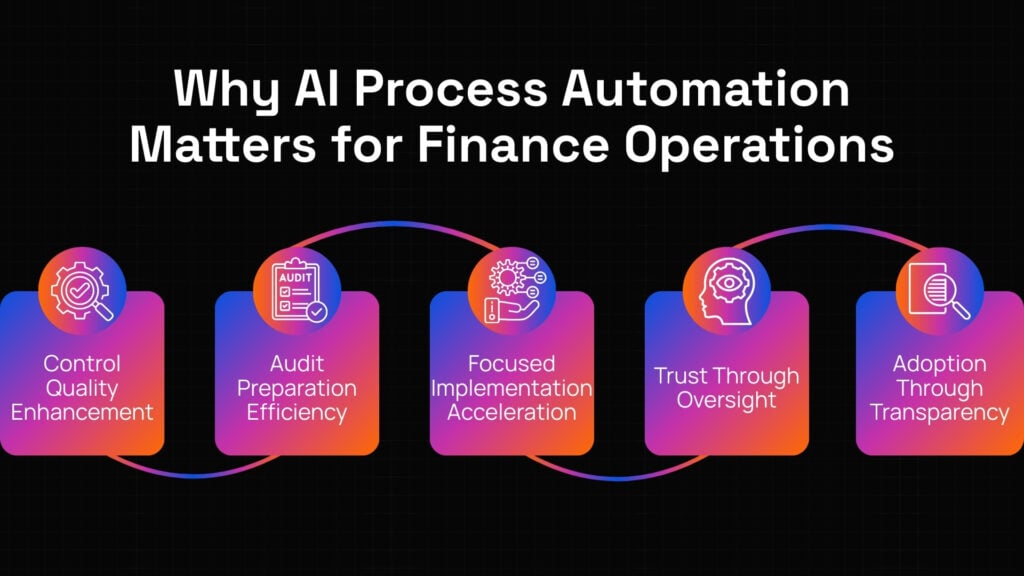
Why AI Process Automation Matters for Finance Operations
AI automation use cases extend beyond simple task automation; they transform how finance organizations manage control quality, maintain audit readiness, and ensure compliance velocity across all financial workflows. Manual finance processes that once created bottlenecks through delayed exception detection, inconsistent policy enforcement, and impossible real-time monitoring can now be executed with intelligence and precision through AI automation in finance that compounds efficiency over time. From reducing payment errors by 30 percent to saving hundreds of audit preparation hours through systematic documentation, AI process automation delivers measurable outcomes that strengthen both operational efficiency and governance quality.
For finance leaders evaluating AI automation in finance strategies, the benefits manifest in five critical ways:
- Control Quality Enhancement: Deloitte shows weak internal controls are leading contributor to financial misstatements and audit issues, proving that systematic monitoring prevents compliance failures as AI automation in finance enables consistent policy enforcement catching violations not achievable through manual spot checks creating coverage gaps.
- Audit Preparation Efficiency: PwC reports audit preparation consumes hundreds of hours per year for mid-sized finance teams, calculating capacity release when automated documentation replaces manual evidence gathering as AI process automation maintains decision logs and time-stamped approvals enabling one-click audit packets.
- Focused Implementation Acceleration: McKinsey shows targeted automation delivers higher ROI than broad programs validating structured approach, as AI automation use cases with narrow scope starting with high-risk transactions prove value faster than comprehensive implementations attempting AP, AR, and expense simultaneously overwhelming resources.
- Trust Through Oversight: Accenture reports HITL improves trust in AI-driven finance systems validating monitoring importance, as AI automation in finance must provide mandatory approvals for flagged items enabling professional judgment when exceptions require contextual interpretation preventing autonomous decisions creating control failures.
- Adoption Through Transparency: Nielsen Norman Group shows explainable systems improve adoption proving visibility importance, as AI process automation through audit trails explaining why transactions flagged enables finance teams to validate logic not blindly accepting black-box alerts undermining confidence.
AI automation in finance is not about eliminating controls; it is about embedding controls systematically through workflow optimization enabling finance professionals to focus capacity on complex judgments, strategic planning, and value-added analysis that machines cannot replicate effectively.
Key Considerations When Choosing AI Automation in Finance Partners
Selecting the right AI process automation requires careful alignment between technology capabilities and finance requirements. The most successful AI automation in finance implementations are built on a foundation of deep ERP connectivity, appropriate control frameworks, and measurable impact on critical metrics like reduced errors, faster close, and audit findings.
Below are the core factors that should guide every AI automation in finance decision:
- Business Outcomes & KPI Alignment: Every AI automation use cases initiative must connect directly to tangible finance metrics including error reduction, close cycle time acceleration, or audit findings decrease. Ask for baseline metrics and expected deltas not marketing percentages, requiring specific measurement with clear governance impact rather than generic efficiency promises.
- Integration Depth and Access: Effective AI automation in finance depends on seamless connectivity with ERP providing transaction data, accounting systems supplying general ledger detail, and banking systems enabling payment coordination. Require read and write permissions with event triggers not just read-only preventing automation from enforcing workflow stops.
- Security and Governance: AI process automation handles sensitive financial data including payment details, vendor relationships, and control exceptions requiring role-based access and comprehensive audit logs. Address security requirements as Deloitte shows weak controls causing misstatements requiring appropriate safeguards supporting compliant operations.
- Human-in-the-Loop (HITL) Design: Successful AI automation in finance always includes finance oversight with mandatory approvals for flagged items preventing autonomous execution. When does automation pause versus proceed ensuring appropriate review as Accenture shows HITL improving trust through effective collaboration enabling judgment when exceptions require contextual analysis.
- Observability and Analytics: Transparency is essential when scaling AI automation use cases across finance workflows. A capable vendor provides traces from input to decision to action, comprehensive dashboards showing control logic, and explainable flagging as Nielsen Norman Group shows transparency improving adoption enabling validation.
- Pricing Transparency and Asset Ownership: Clarify ownership of rules and logic developed during implementation preventing vendor lock-in. Document pricing drivers with detailed breakdown as McKinsey shows targeted automation requiring sustainable partnerships enabling continuous improvement.
Choosing AI automation in finance partners who understand these requirements ensures your investment delivers sustainable improvements rather than creating compliance gaps, vendor lock-in, or user resistance that limit future flexibility when regulations, control requirements, or business priorities evolve.
Understanding AI Automation in Finance: 3 Essential Guardrails
Before launching any AI process automation initiative, organizations must thoroughly understand control priorities and guardrail design. The goal is not full autonomy but fast detection and smart escalation as automation choices determine governance quality. When finance teams identify essential guardrail candidates, they accelerate value realization, maintain audit confidence, and avoid expensive failures from inappropriate automation creating control weaknesses.
- Risk Flagging (Guardrail 1): Anomaly detection identifies unusual invoice amounts or timing preventing fraud. Policy violations flag spend outside approval thresholds enforcing limits as AI automation in finance monitors transactions systematically catching exceptions not achievable through manual sampling. Duplicate detection identifies repeated vendors or payments preventing double-payment as automated matching eliminates costly errors. Flag invoices exceeding historical averages by 2 times triggering review as statistical thresholds enable objective criteria preventing arbitrary judgments.
- Automated Controls (Guardrail 2): Pre-approval rules block payments missing documentation enforcing completeness. Segregation of duties ensures no single actor completes end-to-end actions preventing fraud as AI process automation maintains independence requiring multiple authorizations. Escalation paths route high-risk cases to finance leads enabling senior review as automated tiering directs exceptions appropriately based on dollar thresholds or vendor risk. Controls should pause workflows not silently fail as visible stops enable intervention preventing unauthorized processing.
- Audit Readiness (Guardrail 3): Decision logs document why transactions were flagged providing evidence trail. Time-stamped approvals capture who approved and when establishing accountability as AI automation in finance maintains comprehensive records addressing PwC showing hundreds of hours spent on audit preparation. Exportable evidence enables one-click audit packets streamlining reviews as systematic documentation replaces manual gathering. Audit trails explain reasoning enabling external validation as Nielsen Norman Group shows transparency supporting compliance.
Pro Tip: Controls should pause workflows not silently fail creating visible intervention points. Tie KPIs to audit outcomes as McKinsey shows targeted automation requiring governance measurement not just efficiency metrics proving control effectiveness enabling audit finding reduction.
Understanding AI Automation in Finance KPIs: What to Measure
Before launching any AI automation use cases initiative, organizations must thoroughly define success metrics enabling objective pilot evaluation and ongoing performance monitoring. Key performance indicators provide the measurement framework distinguishing valuable implementations from expensive failures creating operations team skepticism. When finance operations teams establish KPIs in advance, they align stakeholders around clear targets, enable data-driven optimization, and build business cases justifying continued investment through demonstrated value.
- Payment Error Rate: Track incorrect payments or duplicate processing measuring accuracy when AI automation in finance catches mistakes, targeting reductions like 30 percent as errors consume capacity through corrections and damage vendor relationships creating reconciliation burden.
- Control Exception Volume: Monitor flagged transactions requiring manual review measuring detection effectiveness when anomaly identification surfaces issues, balancing sensitivity as excessive flags create alert fatigue while insufficient detection misses violations requiring calibration.
- Close Cycle Time: Calculate days from period end to financial statement finalization measuring velocity when automated reconciliation accelerates completion, targeting reductions as faster close enables timely reporting supporting business decisions requiring current information.
- Audit Finding Count: Track control weaknesses identified during reviews measuring governance quality when systematic monitoring prevents issues, reducing findings as Deloitte shows weak controls causing misstatements requiring proactive prevention not reactive correction.
- Audit Preparation Hours: Monitor time spent gathering evidence when automated documentation streamlines reviews, targeting reductions as PwC shows hundreds of hours consumed representing capacity opportunity redirecting professional time to strategic analysis.
- Override Rate: Calculate percent of AI flags rejected by finance measuring calibration, understanding patterns as excessive overrides indicate poor tuning while insufficient review suggests blind acceptance requiring balance as Accenture shows oversight importance.
- Policy Violation Detection Rate: Evaluate percent of non-compliant transactions identified measuring control coverage, ensuring comprehensive monitoring as undetected violations create risk when exceptions bypass governance enabling unauthorized activity.
- Segregation of Duties Compliance: Track percent of transactions with proper authorization separation measuring independence, maintaining complete compliance as AI process automation enforces dual approval preventing single-actor completion creating fraud exposure.
Pro Tip: Compare flagged versus approved outcomes during 60-day AP risk flag pilot. Update thresholds quarterly as transaction patterns and vendor relationships change requiring ongoing calibration maintaining detection effectiveness while minimizing false positives creating unnecessary manual review.
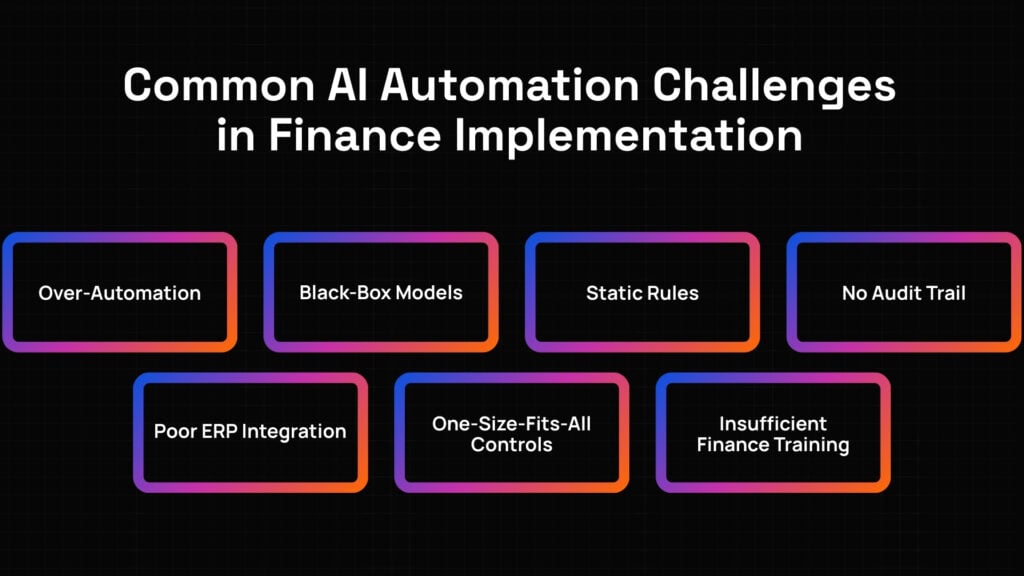
Common AI Automation Challenges in Finance Implementation
AI process automation promises efficiency and better controls, but poor planning and inadequate governance can create compliance issues instead of operational improvements. Many finance organizations make avoidable mistakes during deployment that delay value realization and erode both leadership and user trust. To discover proven methodologies tailored for your finance workflows and control requirements, explore our AI Workflow Automation Services page for detailed AI automation in finance frameworks and real-world implementation guidance.
- Over-Automation: Attempting autonomous processing without approval gates creates control failures. Enforce approval thresholds maintaining oversight as Accenture shows HITL improving trust enabling professional judgment when exceptions require contextual interpretation preventing inappropriate automated execution creating audit findings.
- Black-Box Models: Accepting opaque flagging without explanation creates distrust. Require explainability showing logic as Nielsen Norman Group demonstrates transparency improving adoption enabling finance teams to validate reasoning understanding why transactions flagged not blindly accepting mysterious alerts.
- Static Rules: Deploying fixed thresholds ignoring business evolution creates misalignment. Review quarterly as transaction patterns, vendor relationships, and business priorities change requiring ongoing calibration as McKinsey shows targeted automation requiring continuous refinement maintaining relevance.
- No Audit Trail: Launching without comprehensive logging creates compliance vulnerability. Log every decision documenting flagging rationale, approval timing, and override reasons as Deloitte shows weak controls causing misstatements requiring systematic evidence supporting governance.
- Poor ERP Integration: Accepting read-only access prevents enforcement. Validate write access enabling workflow pauses as AI automation in finance must stop processing not just alert when controls trigger requiring capability to block unauthorized activity.
- One-Size-Fits-All Controls: Applying uniform thresholds ignoring risk differences creates inefficiency. Segment by risk as high-dollar vendor payments warrant different monitoring than routine supplies requiring tailored controls not blanket rules creating excessive false positives or insufficient coverage.
- Insufficient Finance Training: Technical implementations without user enablement face adoption resistance. Include clear handover to internal teams as effective usage requires understanding flag interpretation and override procedures enabling confident professional judgment.
The Impact of Integration Readiness
Before launching any AI automation in finance initiative, organizations must thoroughly assess their ERP architecture, control documentation, and approval workflow maturity. Integration readiness evaluates how well existing finance systems, transaction data assets, and governance procedures can support intelligent automation without creating technical debt or compliance gaps. When finance operations teams conduct integration audits in advance, they uncover system limitations and control weaknesses early, align stakeholders around connectivity requirements, and minimize wasted time during vendor discovery and pilot phases.
Example: A manufacturing company preparing for AI automation use cases mapped their ERP and banking connectivity, discovering their automation lacked approval thresholds requiring enforcement gates, their risk models were opaque requiring explainability, their control rules were static requiring quarterly review, their audit documentation was manual requiring systematic logging, their ERP integration was read-only requiring write access, and their controls were uniform requiring risk segmentation. Addressing these integration readiness issues before vendor engagement reduced the overall project timeline by six weeks.
Pro Tip: Identify high-risk transactions first during discovery prioritizing control coverage. Vendor should map approvals and handoffs before proposals. Validate write access enabling automation to pause workflows as controls requiring enforcement capability not just detection creating visible stops preventing unauthorized processing.
Evaluating AI Automation in Finance ROI
Quantifying the benefits of AI process automation helps secure executive buy-in and refine future investments in finance technology. Measuring ROI goes beyond simple time savings; it captures improvements in error reduction, close velocity, audit quality, and control effectiveness. Without clear financial modeling during evaluation, AI automation in finance projects risk becoming unclear implementations that fail to justify ongoing operational expenses and licensing costs.
Key considerations for financial analysis include:
- Error Reduction Value: Track payment error decrease when targeting 30 percent improvement, calculating cost avoidance from prevented mistakes as errors consume capacity through corrections and damage vendor relationships requiring reconciliation as AI automation in finance catches issues before processing preventing costly rework.
- Close Acceleration Impact: Monitor cycle time reduction when automated reconciliation streamlines period-end, measuring reporting timeliness as faster close enables current business decisions as McKinsey shows targeted automation delivering ROI through systematic workflow optimization eliminating manual bottlenecks.
- Audit Preparation Efficiency: Calculate hours saved when automated documentation replaces manual gathering, quantifying capacity release as PwC shows hundreds of hours consumed representing opportunity redirecting professional time to strategic analysis as AI process automation maintains systematic evidence.
- Control Quality Enhancement: Assess audit finding reduction when systematic monitoring prevents issues, measuring governance improvement as Deloitte shows weak controls causing misstatements requiring proactive prevention as automated flagging identifies violations before auditor discovery preventing corrective action plans.
- Compliance Cost Avoidance: Track prevented fines and reputational damage when controls catch violations, calculating risk mitigation value as control failures create regulatory exposure as AI automation use cases enforce policies systematically preventing non-compliance slipping through coverage gaps.
- Total Cost of Ownership: Include licensing fees, ERP integration development, control rule configuration, plus ongoing threshold tuning, audit support, and staff training in comprehensive analysis. Understand pricing scales with transaction volume, user count, or control complexity as finance automation requiring realistic cost modeling.
Deloitte shows weak controls are leading contributor to misstatements. PwC reports audit preparation consumes hundreds of hours annually. McKinsey demonstrates targeted automation delivers higher ROI than broad programs. Accenture reports HITL improves trust in AI-driven finance systems. Nielsen Norman Group shows explainable systems improve adoption. When every AI automation in finance interaction logs flagging decisions, approval workflows, override rationale, and control outcomes, every integration maintains event-driven synchronization enabling real-time enforcement, and every quarterly review assesses threshold effectiveness and false positive rates, organizations build trusted finance operations that scale without sacrificing control quality, audit readiness, or governance integrity.
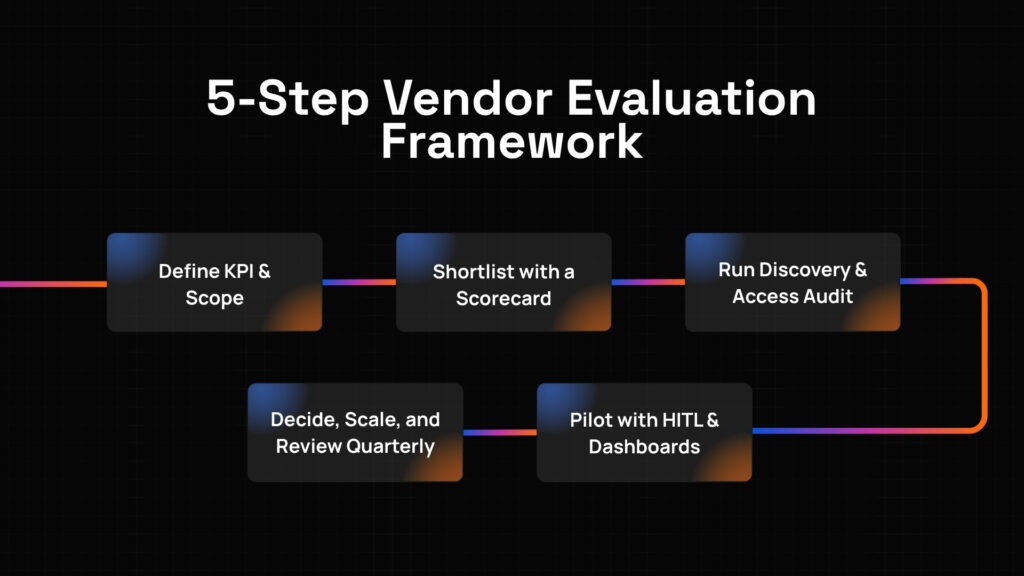
5-Step Vendor Framework for AI Automation in Finance
Selecting an AI automation use cases vendor should follow a disciplined, structured process that aligns with your organization’s finance goals while accounting for both technological depth and control requirements. Instead of focusing solely on impressive demonstrations or error reduction claims, evaluation should weigh how well the AI automation in finance solution supports measurable outcomes, integrates with existing systems, and maintains controls through appropriate governance.
1. Define KPI & Scope
Start by identifying specific measurable outcomes with narrow scope enabling quick value proof. Defining concrete targets helps align all stakeholders including finance leadership, accounting teams, internal audit, and IT infrastructure. Your goal might be reducing payment errors by 30 percent, improving close cycle time, or decreasing audit findings, but it must be quantifiable with clear governance impact.
Example: A distribution company defined its KPI as “reducing payment errors by 30 percent within 90 days while maintaining override rate below 15 percent and audit preparation hours under 50 per period.” This metric guided every AI automation in finance discussion, shaped pilot design with clear control benchmarks, and became the success measurement. Tie KPIs to audit outcomes.
Pro Tip: Document one to two primary finance outcomes before requesting proposals. Focus on payment error reduction, close cycle time decrease, or audit finding elimination tied to governance impact rather than vanity metrics like total transactions processed, and define specific percentage improvement targets with timelines enabling objective go/no-go decisions during pilot evaluation as McKinsey shows targeted automation delivering higher ROI.
2. Shortlist with a Scorecard
Once objectives are clear, move to structured vendor comparison using a weighted scorecard evaluating AI process automation providers. This tool allows teams to quantify how well each vendor aligns with priorities including ERP integration and audit logs, control configurability, HITL design, observability, and portability and IP ownership.
Example: One enterprise assigned 30 percent weight to ERP integration and audit logs assessing connectivity and documentation, 25 percent to control configurability evaluating rule flexibility, 20 percent to HITL design ensuring approval gates, 15 percent to observability capabilities, and 10 percent to portability and IP ownership. Rank vendors on ERP integration and audit logs.
Pro Tip: Turn evaluation criteria into numeric scoring so decisions remain defendable beyond subjective demonstration impressions. Ask how controls are tested validating governance effectiveness. Weight appropriately as Deloitte shows weak controls causing issues and Accenture emphasizes trust importance. Have multiple stakeholders from accounting, internal audit, IT, and treasury score vendors independently before group discussion to reduce bias.
3. Run Discovery & Access Audit
Before contracts are signed, a structured discovery phase maps approvals and handoffs documenting every integration touchpoint and control requirement. During this phase, teams validate ERP and banking access, surface control gaps, and confirm audit trail capabilities with appropriate segregation of duties. Identify high-risk transactions first.
Example: A services company conducted discovery for AI automation in finance, revealing their ERP required custom API authentication not in standard vendor documentation, their approval workflows weren’t digitized creating automation complexity, their high-risk transactions weren’t categorized requiring risk segmentation, their control rules were inconsistently documented requiring standardization, and their audit evidence was stored in multiple locations requiring consolidation.
Pro Tip: Vendor should map approvals and handoffs before proposals detailing exact connectivity requirements. Identify high-risk transactions first prioritizing control coverage on material items. Ask how controls are tested understanding validation methodology. Use discovery to surface ERP limitations, approval workflow gaps, and audit documentation needs before signing when negotiating leverage is highest.
4. Pilot with HITL & Dashboards
A well-designed pilot validates both technology performance and control effectiveness under real finance conditions. Instead of full-scale deployment, run 60-day AP risk flag pilot maintaining finance oversight for quality assurance. Incorporating human-in-the-loop review ensures AI automation use cases align with governance standards and audit requirements while building organizational confidence.
Example: A technology company piloted AI process automation for accounts payable risk flagging, running 60-day evaluation with controlled deployment on vendor payments, finance review of all flagged exceptions before approval, and dashboard tracking payment errors, flagging accuracy, override patterns, and close cycle time, achieving 28 percent error reduction with 12 percent override rate below 15 percent target. Compare flagged versus approved outcomes as Accenture shows HITL matters.
Pro Tip: Execute pilots with frozen scope covering specific workflow, clear success criteria including control benchmarks, and measurable KPIs tracked weekly. Run 60-day AP risk flag pilot establishing AI meets standards. Measure payment errors targeting 30 percent reduction and override rate targeting below 15 percent. Track false positive rates understanding calibration. Use pilot to train finance staff on flag interpretation and appropriate override situations.
5. Decide, Scale, and Review Quarterly
After the pilot proves both operational value and control maintenance, use findings to guide the final decision about expanding controls to AR and expense audits validating sustainability and stability. Scaling should be deliberate, expanding only after demonstrating approach maintains quality across representative transaction types and risk levels. Continuous quarterly reviews maintain governance discipline, ensuring automation adapts as business priorities, fraud patterns, and regulatory requirements evolve.
Example: A healthcare organization conducted quarterly reviews with its AI automation in finance partner, expanding successful AP risk flagging to accounts receivable and expense audits over 12 months, scaling after validation, identifying optimization opportunities reducing audit findings by additional 40 percent, and updating thresholds quarterly. Expand controls to AR and expense audits as McKinsey shows targeted approach.
Pro Tip: Treat vendor reviews as governance sessions focused on control effectiveness and audit quality, not just performance metrics. Expand controls to AR and expense audits proving reliability before comprehensive deployment. Update thresholds quarterly detecting transaction pattern changes and business evolution. Use quarterly reviews to assess false positive trends, override appropriateness, user satisfaction, and alignment with evolving risk profiles and regulatory requirements.
Next Steps in Your AI Automation in Finance Evaluation
By now, you should have a clear understanding of what to prioritize when selecting AI automation use cases partners for finance. Bringing these insights together creates a structured evaluation flow that de-risks investment and accelerates deployment while ensuring control quality and audit readiness.
- Align with finance metrics: Ensure every AI automation in finance feature connects to specific KPIs like error reduction, close cycle time, or audit findings tied to governance impact, not just automation coverage percentages disconnected from actual control outcomes and measurable compliance results.
- Evaluate ERP integration: Confirm that AI process automation works smoothly with your ERP through read-write permissions, banking systems through payment coordination, and accounting platforms through GL integration as Deloitte shows weak controls requiring comprehensive connectivity enforcing governance.
- Focus on control oversight: Choose vendors with mandatory approvals for flagged items, segregation of duties enforcement, and comprehensive audit trails documenting decisions as PwC shows hundreds of audit hours requiring systematic evidence supporting compliance reviews.
- Review observability capabilities: Favor partners with traces from input to decision to action, dashboards showing control logic, and explainable flagging as Nielsen Norman Group shows transparency improving adoption enabling finance validation.
- Test with controlled pilots: Always run 60-day pilots on high-risk transactions, finance review maintaining oversight, frozen scope on specific workflows, and outcome comparison before production deployment to validate error reduction, control effectiveness, and operational readiness under real-world finance conditions with actual transaction complexity.
With these criteria in place, you are better equipped to identify AI automation in finance vendors who not only automate workflows but also reduce errors, maintain controls, support audits, and amplify your team’s capacity to focus on strategic analysis and value-added work requiring professional judgment that machines cannot replicate.
Vendor Questions to Ask
To make the most informed decision during your AI automation in finance evaluation, be sure to ask these essential questions:
- How are risk thresholds defined and updated including statistical methods, business rules, and calibration procedures enabling ongoing optimization?
- Can finance override automated decisions including flag dismissal, approval bypass, and threshold adjustment supporting professional judgment?
- What audit logs are generated by default including decision rationale, approval timestamps, and override documentation supporting compliance reviews?
- How do you handle exceptions including escalation procedures, approval routing, and segregation of duties enforcement preventing single-actor completion?
- Who owns the automation logic ensuring operational portability at contract end including export rights for control rules and threshold configurations?
- Can we export controls and evidence enabling portability without starting over or losing audit documentation and historical compliance records?
- Can you provide two customer references in similar industries who can discuss error reduction, audit outcomes, and ongoing partnership quality?
- What are recurring costs beyond license including integration maintenance, threshold updates, and support fees, and how do expenses scale with volume?
- What rollback capabilities exist for errors enabling quick restoration when automation produces incorrect flags or control failures?
- How do you handle segregation of duties including independence validation, dual approval enforcement, and authorization tracking preventing fraud exposure?
Transform Finance Operations with AI Automation in Finance
AI automation in finance is not just a technological investment; it is a strategic control capability that requires careful integration, appropriate oversight, and continuous calibration. The right implementation brings 30 percent payment error reduction, faster close cycles, and comprehensive audit readiness, while poor execution creates control gaps and compliance issues that undermine confidence and damage governance quality.
Ready to transform your finance operations with AI automation in finance? Book a Free Strategy Call with us to explore the next steps and discover how we can help you design guardrails, validate ERP readiness, and deploy the right AI process automation solution for your unique control requirements, risk profile, compliance obligations, and measurable governance outcomes.