
AI automation services are reshaping how businesses run daily operations. But picking the right AI automation company is tricky. You want a partner who understands your goals, integrates smoothly with your systems, and supports you through the journey. This guide breaks down what to expect and how to avoid common mistakes.
Why AI Automation Services Matter Now
- Automation cuts repetitive tasks, freeing your team for higher-impact work.
- Smart automation improves accuracy, reducing costly human errors.
- Companies with automation solutions see an average 20-30% boost in operational efficiency (McKinsey, 2023 ).
- It’s not just about technology; it’s about aligning automation to your key performance indicators (KPIs).
- Choosing the right AI automation company can make or break your success.
Pro tip: Focus on how automation impacts your core KPIs, not just shiny features.
What AI Automation Services Typically Include
AI automation companies often provide a broad range of services, but these key components form the foundation:
- Business Process Analysis: Understanding your workflows and where automation will add the most value.
- Custom AI Integration: Connecting AI tools with your existing systems CRM, help desk, phone systems, TMS, ERP and ensuring they talk to each other bi-directionally.
- Consulting on Automation Strategy: Helping you define goals, scope, and realistic outcomes.
- Human-in-the-Loop (HITL) Design: Building escalation paths where AI flags exceptions for human review.
- Governance & Compliance Support: Ensuring security, privacy, and audit trails meet your standards.
- Observability & Reporting: Dashboards, evaluation metrics, and rollback mechanisms to monitor AI performance.
- Training & Enablement: Playbooks, hands-on sessions, and documentation for your team.
- Support & Maintenance: Ongoing tuning, updates, and troubleshooting.
Example: One AI automation company helped a customer service team reduce ticket resolution time by integrating AI with their CRM and help desk, plus HITL escalation for tricky cases.
Common Pitfalls When Selecting an AI Automation Company
- Trap → Fix: Overlooking integration depth → Prioritize companies that demonstrate deep API and event-level access to your systems.
- Trap → Fix: Ignoring governance → Ask for clear policies on data privacy, security, and audit trails.
- Trap → Fix: Skipping HITL design → Make sure there’s a solid plan for human oversight and escalation.
- Trap → Fix: Missing observability → Demand dashboards and rollback options to track AI behavior.
- Trap → Fix: Unclear delivery plan → Confirm there are playbooks, training, and a phased rollout strategy.
- Trap → Fix: Vendor lock-in risks → Seek clarity on IP ownership, portability of models, and exit plans.
- Trap → Fix: Pricing transparency gaps → Request clear pricing ranges and assumptions early on.
- Trap → Fix: Relying on vague case studies → Verify references and ask for specific, measurable outcomes.
Pro tip: Use a vendor scorecard to rate companies on these criteria during evaluation.
Quick Checklist: What to Look for in an AI Automation Company
- Alignment with your business outcomes and KPIs.
- Integration capabilities with your core platforms.
- Governance and security compliance.
- HITL design and escalation paths.
- Monitoring, dashboards, and rollback features.
- Training, documentation, and enablement support.
- Transparent pricing and clear ownership of assets.
- Exit strategy and portability of AI assets.
- Strong case studies and client references.
Why Choosing the Right AI Automation Company Matters
Selecting the right AI automation services partner is more than a vendor choice, it’s a strategic decision that impacts your entire business. Poor choices can lead to wasted budgets, stalled projects, and missed opportunities. Here’s why it’s crucial to get it right:
- Scalability: A good AI automation company designs solutions that grow with your business, avoiding costly rewrites or tool swaps down the line.
- Security and Compliance: With regulations tightening around data privacy and AI ethics, choosing a partner that prioritizes governance protects you from legal risks.
- Operational Efficiency: The right automation streamlines workflows, improves accuracy, and frees up staff to focus on high-value tasks.
- User Adoption: Smooth integration and clear training increase your team’s comfort and trust in AI tools, boosting ROI.
- Flexibility: Vendors who understand your unique environment and adapt accordingly prevent “one-size-fits-all” failures.
- Risk Mitigation: Human-in-the-loop designs and rollback capabilities guard against errors and help maintain control.
Example: A mid-sized tech firm avoided a costly failed rollout by insisting on HITL controls and thorough training; saving them thousands in customer support costs.
According to Forrester (2023), companies investing strategically in AI automation report a 35% faster time-to-market and 25% reduction in operational costs (forrester.com ).
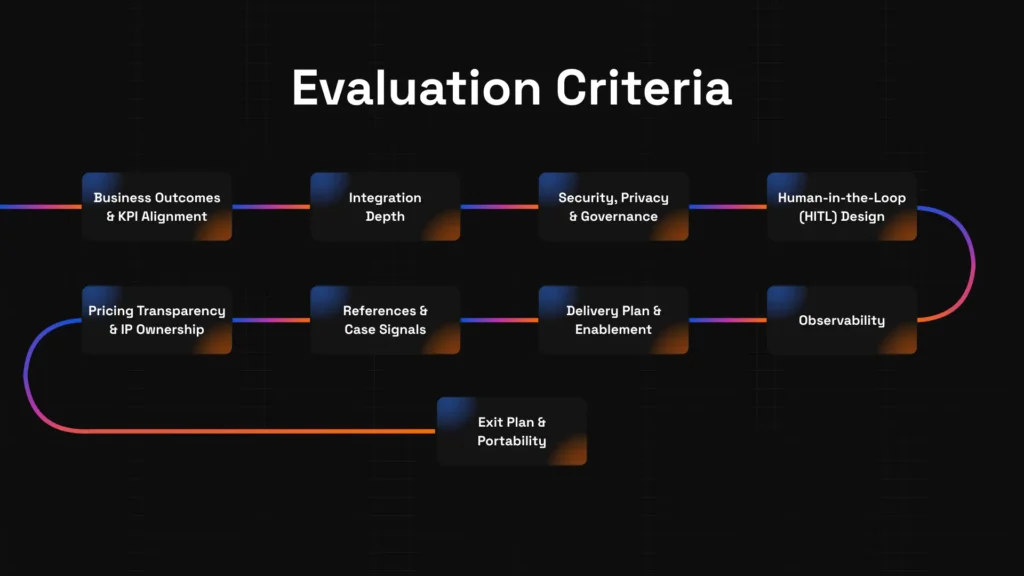
Evaluation Criteria: What to Compare in AI Automation Services
Choosing an AI automation company isn’t just about tech specs or price tags. Use this vendor-neutral checklist to evaluate offerings objectively:
1. Business Outcomes & KPI Alignment
- Does the vendor understand your specific KPIs?
- Can they show how automation impacts these metrics?
- Are outcomes measurable and realistic?
Pro tip: Prioritize vendors who start with your business goals, not their tools.
2. Integration Depth
- Check for deep integration with your CRM, help desk, phone system, TMS, and ERP.
- Ensure APIs support both read and write functions, and event-level triggers.
- Ask about out-of-the-box connectors versus custom development.
Example: A logistics company saved 15% in shipping delays after integrating AI automation with their TMS and ERP systems.
3. Security, Privacy & Governance
- Request clear policies on data handling, encryption, and access controls.
- Confirm compliance with relevant regulations (e.g., GDPR, HIPAA).
- Verify audit trail capabilities and reporting.
4. Human-in-the-Loop (HITL) Design
- Is there a plan for AI to escalate uncertain or risky cases to humans?
- Are escalation thresholds configurable?
- How easy is it for staff to intervene or override AI decisions?
5. Observability
- Look for dashboards showing AI performance, error rates, and usage.
- Confirm rollback capabilities if AI behavior causes issues.
- Ask if evaluative feedback loops exist for ongoing AI tuning.
6. Delivery Plan & Enablement
- Does the vendor provide detailed playbooks and training?
- Are there phased rollouts with milestones?
- How is knowledge transferred to your team for ongoing management?
7. References & Case Signals
- Request references with relevant industry experience.
- Ask for methodologies used to measure success.
- Look for case studies that include specific metrics, not vague claims.
8. Pricing Transparency & IP Ownership
- Is pricing clear, with ranges and assumptions explained?
- Who owns the IP created (models, prompts, code)?
- What happens to assets if you part ways?
9. Exit Plan & Portability
- Can AI assets be exported or transferred easily?
- Are there documented policies for handover?
- Is there support for migration to new vendors if needed?
Common Pitfalls When Evaluating AI Automation Companies
- Trap → Fix: Focusing solely on price → Consider total cost of ownership including training and support.
- Trap → Fix: Accepting vague case studies → Demand detailed, measurable outcomes.
- Trap → Fix: Overlooking integration complexity → Audit APIs and workflows early.
- Trap → Fix: Ignoring governance → Confirm compliance and auditability upfront.
- Trap → Fix: Skipping human-in-the-loop design → Make HITL mandatory for critical workflows.
- Trap → Fix: Neglecting enablement → Prioritize vendors with strong training and documentation.
- Trap → Fix: Missing exit strategy → Get clarity on asset portability before signing contracts.
- Trap → Fix: Underestimating observability → Insist on dashboards and rollback tools.
Pro tip: Use a weighted scorecard combining these criteria to make balanced vendor comparisons.
Common Pitfalls in AI Automation Services and How to Avoid Them
Even with a solid evaluation framework, many organizations stumble on common traps when engaging AI automation companies. Here’s a straightforward list of pitfalls and actionable fixes to keep your project on track.
- Trap → Fix: Overpromising on AI capabilities → Set realistic expectations with vendors; validate claims through demos and references.
- Trap → Fix: Ignoring human-in-the-loop (HITL) requirements → Make HITL a non-negotiable for sensitive or complex workflows to maintain quality and control.
- Trap → Fix: Skipping integration testing → Conduct thorough tests in your environment early to catch unexpected issues with CRM, ERP, or phone systems.
- Trap → Fix: Neglecting observability tools → Demand dashboards and metrics to monitor AI behavior and intervene quickly if needed.
- Trap → Fix: Weak training and enablement → Insist on comprehensive playbooks, workshops, and knowledge transfer to empower your team.
- Trap → Fix: Lack of clear exit strategies → Ensure contracts include asset portability and handover plans to avoid vendor lock-in.
- Trap → Fix: Overcomplicating pilots → Start with focused, achievable pilots with clear KPIs before scaling up.
- Trap → Fix: Poor pricing transparency → Request detailed pricing models upfront, including assumptions on usage, support, and future costs.
A 5-Step Vendor Evaluation Framework
Navigating AI automation vendor selection doesn’t have to be overwhelming. Here’s a practical 5-step framework to keep your process structured and efficient.
1. Define KPI & Scope
Start by clearly outlining the key performance indicators and the scope of automation.
- Example: Reducing average ticket resolution time by 20% within six months.
- Pro tip: Engage cross-functional stakeholders early to align goals.
- Studies show organizations with clear KPI definitions are 40% more likely to achieve successful AI outcomes (gartner.com).
2. Shortlist with a Scorecard
Use your evaluation criteria to score vendors objectively.
- Example: Create a matrix rating integration depth, security, HITL design, and references.
- Pro tip: Weight criteria based on your unique priorities, e.g., heavy weight on security for healthcare.
3. Run Discovery & Access Audit
Dig deep into vendor capabilities and assess your internal readiness.
- Example: Conduct technical workshops to map integration points and security reviews.
- Pro tip: Include IT and security teams in audits to identify gaps early.
4. Pilot with HITL & Dashboards
Run a pilot focusing on critical workflows with human oversight and monitoring.
- Example: Pilot AI-powered customer support triage with agents reviewing flagged cases.
- Pro tip: Set clear metrics and schedule regular check-ins for feedback and adjustments.
5. Decide, Scale, and Review Quarterly
Based on pilot results, decide on scaling, and set up quarterly reviews for continuous improvement.
- Example: Scale from support triage to invoicing automation after positive pilot metrics.
- Pro tip: Keep governance and observability active as you expand to manage risks.
Vendor Questions to Ask During Evaluation
To get clear answers, here are essential questions you can ask vendors without sounding salesy or directive:
- How do you align your AI automation services with our specific KPIs?
- What integrations do you support out of the box, and how customizable are they?
- Can you describe your data security, privacy policies, and compliance certifications?
- How is human-in-the-loop implemented in your solutions?
- What observability tools are included for monitoring AI performance?
- What training and enablement resources do you provide during and after implementation?
- Can you share case studies with measurable outcomes relevant to our industry?
- How transparent is your pricing, and what factors influence cost changes?
- What ownership rights do we retain over AI assets and IP?
- What’s your exit strategy if we choose to transition to another vendor?
Quick Templates for Your Vendor Outreach
RFP Email Template
Hi [Vendor Name],
We’re exploring AI automation services to improve [specific process]. Could you provide details on your integration capabilities, HITL design, and governance approach? We’re also interested in pricing transparency and case studies demonstrating measurable outcomes.
Looking forward to your response.
Best,
[Your Name]
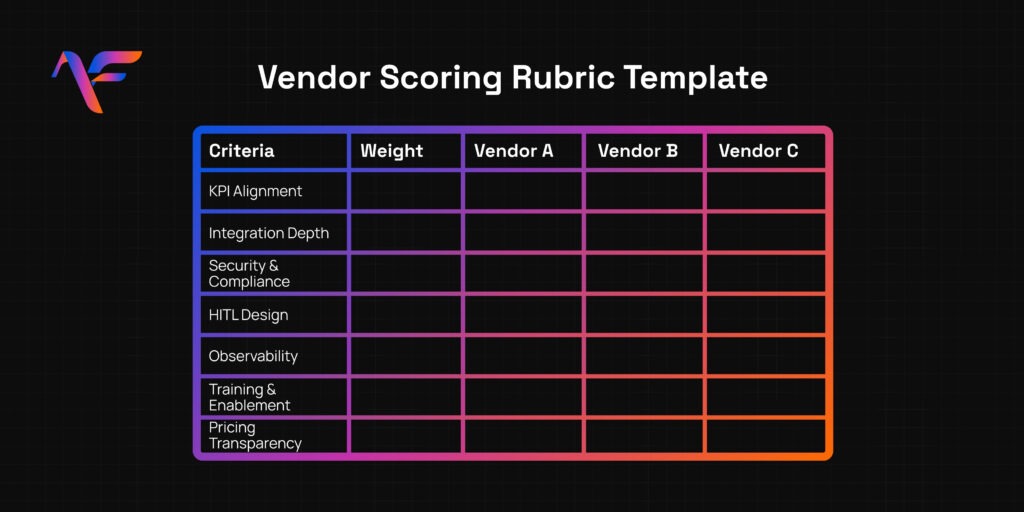
Vendor Scoring Rubric Template
| Criteria | Weight | Vendor A | Vendor B | Vendor C |
| KPI Alignment | 20% | 4 | 3 | 5 |
| Integration Depth | 20% | 3 | 5 | 4 |
| Security & Compliance | 15% | 5 | 4 | 4 |
| HITL Design | 15% | 4 | 4 | 3 |
| Observability | 10% | 3 | 5 | 4 |
| Training & Enablement | 10% | 5 | 3 | 4 |
| Pricing Transparency | 10% | 4 | 3 | 5 |
Scores: 1=Poor, 5=Excellent
Final Thoughts
Choosing the right AI automation company can transform your operations, but only if you’re clear on what to look for and how to avoid common pitfalls.
Take time to define your KPIs, evaluate vendors rigorously, and run pilots with human oversight. Governance and observability are your safety nets, so don’t overlook them.
When you’re ready, book a free strategy call to explore your AI automation options with practical, vendor-neutral advice tailored to your needs.