
The Power of Offer Automation: A Key to Business Efficiency
In today’s fast-paced business environment, streamlining HR processes is more than a nice-to-have it’s a necessity. One area where automation can make a big impact is in offer letter automation, a tool that can save your team time, reduce errors, and enhance the candidate experience. However, with so many solutions on the market, how do you evaluate which AI-powered platform is best for automating your offer letters, approvals, and signatures?
In this guide, we’ll walk through the key criteria to consider when selecting an AI automation company for your offer letter process. Whether you’re looking to template your offers, automate approval chains, or integrate e-sign capabilities like DocuSign, this post will help you make an informed decision.
Why Offer Letter Automation Matters
It’s easy to overlook offer letter workflows, but these are often where delays, errors, and friction can occur. Streamlining and automating this process can deliver tangible benefits:
- Faster Hiring Process: Automation accelerates the creation and approval of offer letters, helping you move from candidate selection to offer acceptance faster.
- Improved Accuracy: Automated templates and approval rules reduce human errors, ensuring the right information is included every time.
- Consistent Candidate Experience: When candidates receive timely, professional offers, they’re more likely to have a positive view of your company, even before they sign the contract.
- Cost Savings: Cutting down on manual administrative work frees up HR teams to focus on more strategic initiatives, improving overall operational efficiency.
Studies show that businesses that implement AI-powered automation in HR processes can see up to a 30% reduction in hiring cycle time and 20% improvement in offer acceptance rates (source: Forrester Report).
Key Considerations When Choosing an AI Automation Solution
Selecting the right vendor for offer letter automation involves more than just picking a tool that can fill out templates. It’s about finding a solution that integrates seamlessly with your existing workflows, offers strong security and governance, and scales with your company’s needs.
To help guide your decision, here are some critical criteria to evaluate:
- Business Outcomes & KPI Alignment: Ensure the solution aligns with your business goals. For instance, if reducing time-to-hire is a key KPI, look for automation tools that promise faster offer approval workflows.
- Integration with Existing Systems: Your offer letter automation tool should integrate with other systems in your tech stack, like your HRIS (Human Resource Information System), CRM, or DocuSign for e-signatures. A solution that works with your existing systems will save you time and reduce friction when implementing.
- Security and Privacy Compliance: With sensitive candidate data involved, ensuring the tool meets compliance requirements (e.g., GDPR, CCPA) is crucial. The automation vendor should have clear privacy policies and strong encryption practices.
- Human-in-the-Loop (HITL) Design: While AI can automate many tasks, it’s important to have options for manual intervention in certain scenarios. Whether it’s flagging high-value offers or dealing with complex legal requirements, HITL capabilities ensure human oversight where needed.
- Observability and Analytics: You’ll want to track the performance of the automation tool to ensure it’s meeting your business needs. Look for features like dashboards, traceability, and real-time evaluation of the automation process.
- Pricing Transparency and Flexibility: Understand what’s included in the pricing model are there hidden fees for integration, support, or additional features? A good vendor will be transparent about their costs and provide clear guidance on how pricing aligns with your usage.
The Impact of Integration Readiness
A key aspect to consider when selecting a solution is its integration readiness. Many AI automation tools offer out-of-the-box integration with popular platforms like HRIS, CRM systems, and e-signature tools (e.g., DocuSign). The better these tools integrate, the less manual work your team will have to do, and the faster the automation will pay off.
Example:
If your company uses Workday for HR management, choose a vendor whose automation tool integrates directly with Workday. This way, when you create an offer letter, the system can automatically pull in candidate data from Workday, eliminating manual data entry.
Pro tip:
Always check whether the solution has API-based integration, as this can make future system updates and additions much easier.
Common Pitfalls in Offer Letter Automation
While automation offers many advantages, it’s important to keep an eye out for potential pitfalls. Here are a few mistakes organizations make when choosing automation solutions:
- Overlooking Workflow Flexibility → Some automation solutions can be too rigid, forcing your team into a standard workflow that doesn’t account for unique approval processes or offer variations. Always verify that the tool offers flexible approval chains and customizable templates.
- Not Considering Compliance Risks → Offer letter data often involves personal and legal information. Not all automation platforms adhere to the strict compliance guidelines that your organization may need. Ensure the platform is GDPR, CCPA, or other region-specific compliant.
- Choosing a Tool Without Scalability → Your company may only be hiring 10 new employees per year now, but what happens when you scale to 100 hires annually? Pick an automation tool that can scale alongside your business needs.
- Ignoring Human-in-the-Loop (HITL) Options → AI is powerful, but human oversight is still critical in some processes. Make sure the tool allows for manual intervention when needed, particularly in complex or high-risk offer scenarios.
Evaluating the ROI of Offer Letter Automation
As you narrow down your vendor list, calculating the return on investment (ROI) should be part of your decision-making process. Here are some metrics to track when evaluating the effectiveness of your chosen solution:
- Time Saved: Quantify how much time your HR team saves by automating the offer letter process.
- Error Reduction: Compare error rates before and after implementing automation.
- Candidate Experience: Monitor candidate feedback and offer acceptance rates.
Many businesses see a 15-25% improvement in overall HR efficiency when automating offer letter workflows, making this an area with substantial potential for ROI (source: McKinsey).
How to Evaluate an Offer Letter Automation Vendor
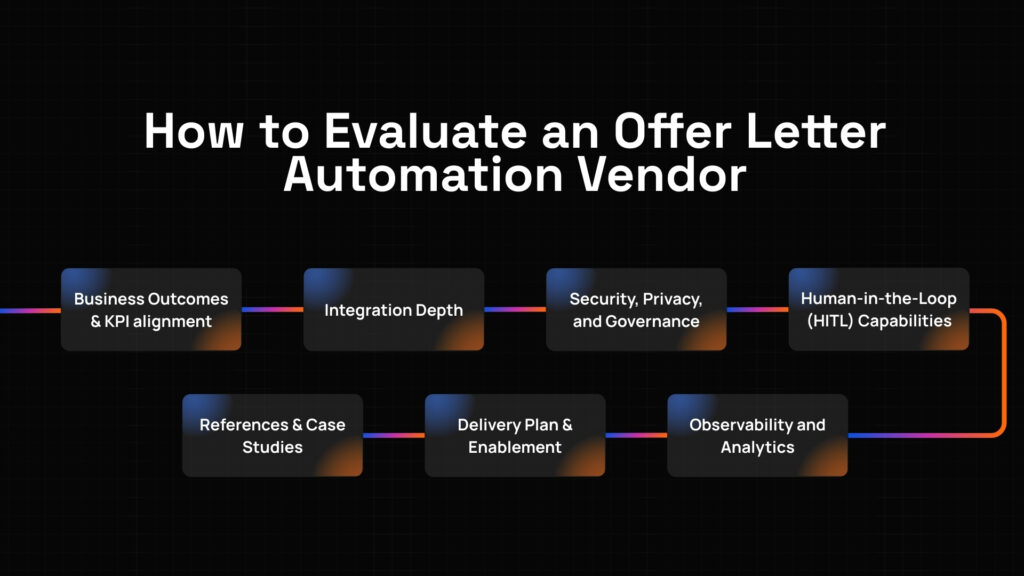
Now that you understand why offer letter automation is so valuable, it’s time to dive deeper into how to evaluate the right AI automation vendor. Making the right choice can significantly affect the efficiency and accuracy of your offer letter process, as well as your team’s long-term success with the automation tool. Here’s a breakdown of the key evaluation criteria to guide your decision.
1. Business Outcomes & KPI Alignment
Example:
If you want to reduce your time-to-hire, look for an automation tool that emphasizes speed in offer creation and approval processes.
Before you begin comparing vendors, ensure that the automation tool aligns with your business’s goals and KPIs. The best AI solutions will support your hiring objectives, whether that’s speeding up the hiring process, improving candidate experience, or increasing offer acceptance rates.
Pro tip:
Map out the KPIs you want to improve and see if the vendor’s offering specifically addresses those areas. For instance, if reducing errors in offer details is your goal, prioritize solutions that emphasize customizable templates and error-checking features.
2. Integration Depth
Automating your offer letter process isn’t just about creating templates and sending offers it’s about seamlessly integrating with your existing tech stack. For example, your CRM or HRIS system may house candidate data that needs to be pulled into your offers automatically. Or, you might need to integrate with a platform like DocuSign for electronic signatures.
Ensure the vendor’s solution integrates well with your current systems. This reduces manual data entry, minimizes errors, and ensures a smoother workflow.
Example:
If your company uses Salesforce for customer relationship management (CRM), choosing a tool that integrates with Salesforce ensures that candidate information is transferred accurately and automatically into the offer letters.
Pro tip:
Ask vendors for demo integrations with your most-used systems. Check if their API documentation and integration options are clear and well-supported.
3. Security, Privacy, and Governance
When dealing with personal and sensitive candidate information, security and privacy should be a top priority. Look for a vendor that adheres to relevant security frameworks, including GDPR, CCPA, or industry-specific regulations (e.g., HIPAA for healthcare).
Key areas to check include:
- Data Encryption: Ensure the platform offers data encryption both in transit and at rest.
- Access Controls: The tool should have granular user permissions to control who can access, edit, or approve offer letters.
- Audit Trails: Check that the system creates an audit trail for every action taken whether it’s editing an offer letter or signing it digitally.
Example:
A vendor that complies with ISO 27001 standards guarantees that your data security and privacy needs are met, reducing the risk of data breaches.
Pro tip:
Ask for the vendor’s security audit report or certifications. A transparent vendor will readily provide this information.
4. Human-in-the-Loop (HITL) Capabilities
Although AI automation is incredibly efficient, there are situations that require human judgment. Offering a Human-in-the-Loop (HITL) option allows your team to intervene at critical stages of the offer process.
For instance, a senior HR manager may need to review an offer for a high-level executive position before it is sent out. HITL capabilities ensure that automation does not replace human oversight, but instead enhances it.
Example:
Imagine an instance where a candidate is offered an unusually high salary or benefits package. Your team may want to verify the details before sending the offer. With HITL, you can set rules for automatic pauses and manual review at key stages.
Pro tip:
Check if the solution allows manual approval steps and offers flexibility in how and when human involvement is triggered.
5. Observability and Analytics
In order to monitor the effectiveness of your offer letter automation, choose a solution that offers robust observability features. With access to dashboards, real-time evaluations, and traces of each action taken during the automation process, you’ll be able to track efficiency and identify areas for improvement.
Key Features to Look For:
- Dashboards that display real-time metrics on offer letter completion rates, approval times, and errors.
- Trace Logs to follow the process from template creation to offer acceptance.
- Real-time Alerts that notify you of issues or bottlenecks in the workflow.
Example:
If you notice that your approval process takes longer than expected, your tool should allow you to see where the bottleneck occurs whether it’s a specific approver or a document step.
Pro tip:
Ask the vendor for a demo of their analytics dashboard to make sure it provides actionable insights and helps you meet your hiring KPIs.
6. Delivery Plan & Enablement
When implementing any new tool, the way it is delivered and supported is just as important as its features. The best vendors offer a clear and structured delivery plan, ensuring that the implementation process is smooth and that your team has access to resources for onboarding and training.
Key Considerations:
- Playbooks and Training: Does the vendor provide comprehensive training materials or in-person support? The more prepared your team is, the quicker they’ll adapt.
- Post-Implementation Support: Check if the vendor offers ongoing support, including troubleshooting, updates, and feature expansions.
- Handover Process: Ensure the vendor has a clear handover process once the automation is in place, allowing your team to independently manage the solution.
Example:
A good vendor will provide you with a “go-live” checklist, timeline, and an account manager for the first 30 days after implementation.
Pro tip:
Consider working with a vendor that offers a managed services option, so you have a dedicated partner during the early stages of the transition.
7. References & Case Studies
Vendor references and case studies are valuable for understanding how a solution has worked for companies similar to yours. Ask for case studies that demonstrate measurable outcomes, such as reduced hiring time or improved offer acceptance rates. This will give you a better sense of the vendor’s effectiveness.
Example:
If a vendor claims to reduce offer letter approval times by 50%, ask them for a case study from a client who has seen this benefit.
Pro tip:
Request to speak with a few of the vendor’s existing customers. This will give you a clearer picture of how they handle customer relationships and post-implementation support.
Next Steps in Your Evaluation Process
By now, you should have a solid understanding of what to look for in an AI-powered offer letter automation solution. Next, it’s time to put everything together. Here’s a quick recap:
- Align with business goals: Ensure the solution meets your specific needs and KPIs.
- Evaluate integrations: Make sure the tool works seamlessly with your current tech stack.
- Focus on security: Prioritize vendors that offer robust security features and compliance.
- Review support: Check if the vendor offers strong onboarding and ongoing support.
With these criteria in mind, you’ll be well-equipped to select the best solution for your business.
Common Pitfalls to Avoid When Choosing an Offer Letter Automation Vendor
The process of selecting the right AI-powered offer letter automation solution can be tricky. Even if you follow all the best practices and evaluation criteria, there are still a few common traps that could lead you astray. Let’s look at some of the biggest pitfalls and how to avoid them.
1. Overlooking Integration Complexity → Test Integrations Early
You might be tempted to prioritize vendors based on their features or price, but a common mistake is ignoring how well the solution integrates with your existing systems. If the vendor’s platform doesn’t seamlessly integrate with your HRIS, CRM, or DocuSign, it will cause unnecessary friction.
Pro tip:
Before committing to any vendor, ensure they provide hands-on integration testing during the trial phase. If possible, ask for a sandbox environment to test the integration yourself.
2. Focusing Too Much on Templates → Prioritize Flexibility & Customization
It’s easy to get caught up in the idea of automating offer letter templates. However, focusing too much on pre-built templates can be limiting. While templates are essential, the real value lies in the system’s ability to customize those templates to suit your needs and incorporate evolving business rules.
Example:
A one-size-fits-all template may not suit various hiring scenarios (e.g., full-time vs. contract workers). Look for automation solutions that allow you to tailor templates based on candidate types or different job offers.
Pro tip:
Ask the vendor about their customization capabilities can you easily add or edit fields? How flexible is the workflow? Does the system allow for dynamic rules based on different types of employees?
3. Neglecting Post-Implementation Support → Check for Long-Term Support
While an AI tool might look great on paper, post-implementation support is often an afterthought for many vendors. Some vendors may offer great onboarding but fail to provide ongoing assistance as your needs evolve.
Example:
What happens if your business processes change or you need to add new workflows? If the vendor doesn’t offer continuous training, bug fixes, or feature updates, you might find yourself stuck after the initial deployment.
Pro tip:
Ensure that ongoing support is part of the deal. Ask about the vendor’s customer service and response times. Are they available for troubleshooting, updates, or even onboarding additional features?
4. Ignoring Security and Compliance Risks → Prioritize Data Protection
Your offer letters contain sensitive candidate information, and it’s critical to ensure that the vendor has robust security measures in place. Don’t make the mistake of assuming that all AI automation platforms are equally secure.
Example:
A vendor with weak data encryption or lax privacy protocols could expose your company to risks such as data breaches or non-compliance with regulations like GDPR or CCPA.
Pro tip:
Request documentation on the vendor’s data security protocols, and check if they are compliant with major security standards like ISO 27001 or SOC 2. Be sure to also check if their platform allows for end-to-end encryption and regular security audits.
5. Underestimating the Need for Human Oversight → Ensure HITL Flexibility
While AI automation is highly efficient, it still needs human oversight, especially when it comes to critical tasks like offer letter approval. Ignoring this aspect can lead to errors that no AI solution can catch, such as inconsistencies in salary offers or missing compliance clauses.
Example:
Imagine sending out an offer letter with incorrect compensation figures that weren’t caught by the AI system. Without an option for human intervention, you might only realize the mistake after the offer is sent out, leading to embarrassment or, worse, compliance issues.
Pro tip:
Make sure the solution offers Human-in-the-Loop (HITL) features, so your HR team can intervene when necessary. A well-designed tool should allow you to pause, review, and approve offers at key stages.
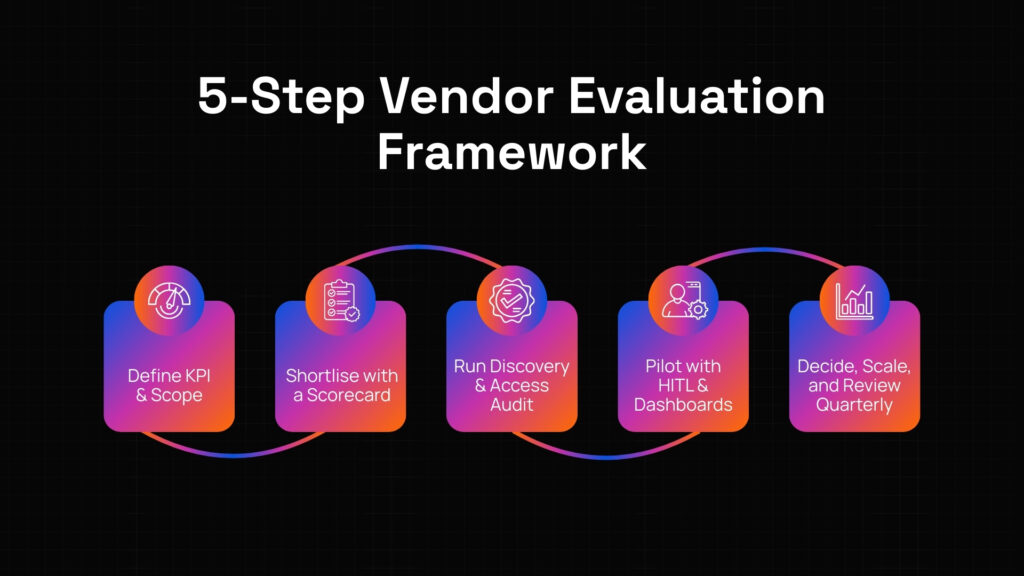
5-Step Vendor Evaluation Framework
Now that you’re familiar with the potential pitfalls, it’s time to walk through a practical evaluation framework to help you make the best decision. This framework is designed to guide you step-by-step through the process of evaluating offer letter automation solutions and ensure you’re choosing the right tool for your company’s needs.
Step 1: Define KPI & Scope
Start by clearly defining your business goals and KPIs. Are you trying to improve speed, accuracy, or compliance in your offer process? Knowing exactly what you want to achieve will help you identify which vendor features align with your objectives.
Example:
If your primary KPI is reducing time-to-hire, look for automation tools that streamline offer approval and offer letter creation, with integrations into your applicant tracking system (ATS).
Pro tip:
Create a list of your must-have features and prioritize them based on their impact on your KPIs. Use this list as a scorecard when comparing vendors.
Step 2: Shortlist with a Scorecard
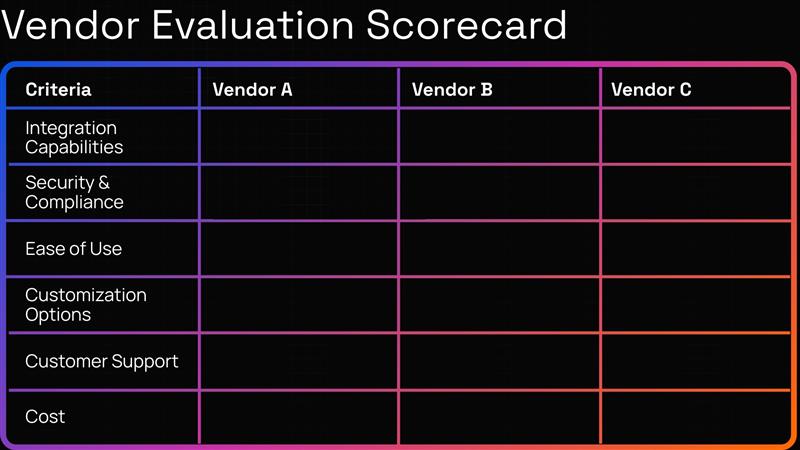
Create a scorecard to compare your top vendor options. For each vendor, rank them on key criteria such as integration capabilities, ease of use, customer support, and security features. This will help you make an objective decision based on the factors that matter most to your team.
Pro tip:
Use a simple rating system, such as 1-5 stars, to evaluate each vendor across different criteria. This gives you a visual and quantitative way to compare options.
Step 3: Run Discovery & Access Audit
During the discovery phase, dive deeper into how each solution functions. Request access to product demos, sandbox environments, and user documentation. Ensure the vendor is transparent about their implementation process, system capabilities, and any limitations.
Example:
Request a demo where the vendor sets up a full workflow, from offer letter creation to e-signature. This will help you assess if the tool will truly meet your needs.
Pro tip:
Ask the vendor for specific use cases relevant to your business to ensure they understand your unique challenges.
Step 4: Pilot with HITL & Dashboards
After narrowing down your choices, run a pilot program with the tool. During this phase, ensure that the system provides Human-in-the-Loop (HITL) capabilities and dashboards for real-time monitoring. This will give you a sense of how the tool functions in a live environment and how well it supports decision-making.
Example:
Pilot the automation with a small set of hires and see if the approval process is smooth, if the templates are accurate, and if the dashboards give you actionable insights.
Pro tip:
Use this phase to evaluate the user interface and overall user experience. Does it help your team perform tasks more efficiently? Are there any roadblocks?
Step 5: Decide, Scale, and Review Quarterly
Once you’ve completed your evaluation and pilot phase, it’s time to make a decision. After the tool has been fully implemented, schedule quarterly reviews to assess the solution’s performance, including ROI, adoption rates, and any additional features that could improve the process.
Pro tip:
Set up quarterly check-ins with the vendor to ensure that the solution is evolving with your needs and to address any emerging issues.
Vendor Questions to Ask
To make the most informed decision, be sure to ask these essential questions during the evaluation phase:
- What integrations do you offer with common HR and CRM tools (e.g., Salesforce, Workday)?
- How customizable are your templates, and can we create dynamic templates based on role or department?
- Can you provide customer references or case studies from similar-sized companies?
- How do you handle data encryption, privacy, and compliance?
- What is the average implementation timeline, and what kind of post-implementation support do you offer?
- How flexible are your workflows? Can we pause, review, and approve offer letters manually at any stage?
Quick Templates for Evaluating Vendors
Here are a couple of quick templates to help streamline your vendor selection process.
RFP Email Template
Subject: Request for Proposal – Offer Letter Automation Solution
Dear [Vendor Name],
We are considering automation for our offer letter process and would like to understand how your solution fits our needs. Please send us an overview of your product’s capabilities, including integrations with HRIS/CRM, data security features, and implementation timeline. We are particularly interested in customization options for offer letter templates.
Thank you for your time,
[Your Name]
[Your Job Title]
[Your Company Name]
Final Thoughts
Choosing the right offer letter automation solution can seem overwhelming, but by following a structured evaluation process, you can confidently select a tool that streamlines your hiring operations.
Pro tip:
Start with a clear understanding of your goals, use a scorecard to compare vendors, and pilot your final choice before full implementation.
Ready to optimize your offer letter automation? Book a Free Strategy Call with us to explore the next steps in your automation journey.