
The Power of AI Automation for HR: Why Template-Based Approach Matters
AI automation for HR has evolved from isolated FAQ chatbots into mission-critical employee service orchestration that defines operational excellence in modern human capital operations. HR teams implementing professional AI automation examples are fundamentally transforming how policy questions get answered, how PTO requests get processed, and how service requests execute without creating delays or inconsistency. Advanced AI process automation now manages workflows from policy lookup and context-aware answers to balance checks and automated approvals, enabling HR professionals to focus on strategic initiatives while machines handle repetitive inquiries that once consumed hours daily during transactional support operations.
The data supporting strategic HR automation continues to strengthen across operational functions. According to Gartner research, HR teams spend over 40 percent of their time on transactional requests, demonstrating that policy, PTO, and routine service inquiries represent massive operational burden not just minor administrative tasks. McKinsey shows targeted automation delivers faster ROI than broad programs, proving that structured evaluation with narrow scope accelerates deployment over comprehensive implementations attempting too much simultaneously. Industry guidance emphasizes HR teams lose hours every week answering the same questions with manual handling creating delays and inconsistency, while policy answers vary by location, role, or tenure requiring context-aware automation.
Why AI Automation Examples Matter for HR Operations
AI process automation extends beyond simple task automation; it transforms how HR organizations manage employee service, maintain policy consistency, and ensure operational efficiency across all workforce touchpoints. Manual HR processes that once created bottlenecks through email delays, portal navigation complexity, and inconsistent policy interpretation can now be executed with intelligence and precision through AI automation for HR that compounds efficiency over time. From deflecting 30 percent of policy and PTO tickets to reclaiming the 40 percent of time spent on transactional requests, AI automation examples deliver measurable outcomes that strengthen both operational efficiency and employee experience.
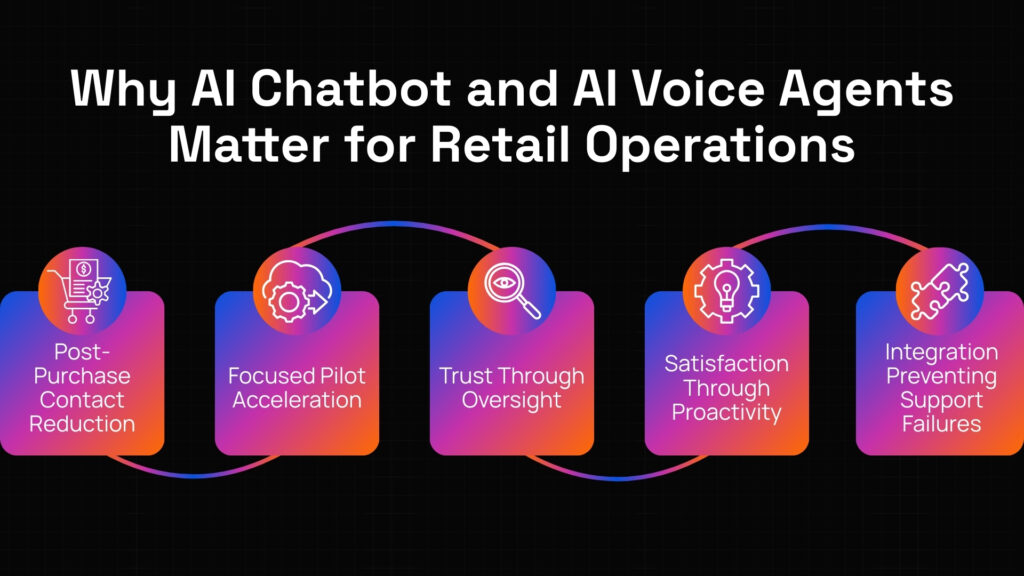
For HR leaders evaluating AI automation for HR strategies, AI automation benefits manifest in five critical ways:
- Transactional Work Reduction: Gartner shows HR teams spend over 40 percent of their time on transactional requests, proving that policy questions, PTO inquiries, and routine service requests consume capacity better directed at strategic workforce planning, talent development, and employee relations requiring professional judgment.
- Focused Implementation Acceleration: McKinsey shows targeted automation delivers faster ROI than broad programs demonstrating structured approach, as AI automation examples with narrow scope starting with policy, PTO, and requests prove value faster than comprehensive implementations attempting performance management, recruiting, and compensation simultaneously overwhelming resources.
- Trust Through Oversight: Deloitte finds HITL improves trust in HR automation validating monitoring value, as AI process automation must provide clear escalation for sensitive requests enabling human intervention when situations require empathy, flexibility, or exception handling beyond rule-based processing.
- Satisfaction Through Transparency: Nielsen Norman Group shows clear feedback improves employee satisfaction proving visibility importance, as AI automation for HR through source citations and status updates enables employees to understand answers and track progress eliminating frustrating opacity.
- Consistency Through Integration: Industry guidance emphasizes policy answers vary by location, role, or tenure, as AI automation examples depend on connected HRIS, ATS, and payroll requiring real-time data integration providing context-aware responses not generic answers creating confusion when policies differ across employee populations.
AI automation for HR is not about replacing HR professionals; it is about connecting employee service systems cleanly through workflow optimization enabling human capital teams to focus capacity on complex cases, organizational development, and strategic initiatives that machines cannot replicate effectively.
Key Considerations When Choosing AI Automation for HR Partners
Selecting the right AI automation examples requires careful alignment between technology capabilities and HR requirements. The most successful AI automation for HR implementations are built on a foundation of deep HRIS connectivity, appropriate policy source integration, and measurable impact on critical metrics like ticket volume, response time, and HR satisfaction.
Below are the core factors that should guide every AI automation for HR decision:
- Business Outcomes & KPI Alignment: Every AI process automation initiative must connect directly to tangible HR metrics including ticket volume reduction, response time acceleration, or HR satisfaction improvement. Ask for baseline metrics and expected deltas not marketing percentages, requiring specific measurement with clear operational impact rather than generic efficiency promises.
- Integration Depth and Access: Effective AI automation for HR depends on seamless connectivity with HRIS providing employee context, ATS supplying candidate information, payroll capturing compensation data, and calendars enabling PTO synchronization. Require read and write access for PTO actions not just read-only preventing automation from completing workflow loops.
- Security and Governance: AI automation examples handle sensitive employee data including compensation details, performance records, and personal situations requiring role-based access and comprehensive audit logs. Address privacy requirements as Gartner shows 40 percent of time being transactional requiring appropriate safeguards protecting confidential information.
- Human-in-the-Loop (HITL) Design: Successful AI automation for HR always includes HR oversight with clear escalation for sensitive requests including terminations, investigations, or complex exceptions. When does AI hand off ensuring appropriate review as Deloitte shows HITL improving trust through effective collaboration enabling judgment when edge cases require discretion.
- Observability and Analytics: Transparency is essential when scaling AI process automation across employee touchpoints. A capable vendor provides request type tracking, confidence scoring, and outcome monitoring enabling quality assurance as Nielsen Norman Group shows clear feedback improving satisfaction through visibility.
- Pricing Transparency and Asset Ownership: Clarify ownership of templates and flows developed during implementation preventing vendor lock-in. Document pricing drivers with detailed breakdown as McKinsey shows targeted automation requiring sustainable partnerships enabling continuous improvement.
Choosing AI automation for HR partners who understand these requirements ensures your investment delivers sustainable improvements rather than creating employee frustration, vendor lock-in, or compliance vulnerabilities that limit future flexibility when policies, regulations, or workforce needs evolve.
Understanding AI Automation for HR: 3 Reusable Templates
Before launching any AI automation examples initiative, organizations must thoroughly understand workflow priorities and template design. Start with low-risk high-volume workflows as automation choices determine operational value. When HR teams identify reusable template candidates, they accelerate value realization, maintain employee satisfaction, and avoid expensive failures from inappropriate automation creating compliance issues or negative experiences.
Policy Questions (Template 1): Policy lookup for benefits, leave, expenses, and remote work provides answer foundation. Context-aware answers considering location, role, and employment type enable personalized responses as AI automation for HR must differentiate policies applying to different employee populations not providing generic answers creating confusion. Source citations link answers back to official policy documents building trust through transparency showing where information originates. If answer lives in document or system today it’s strong automation candidate as existing documentation enables reliable responses.
PTO and Leave Requests (Template 2): Balance checks show real-time PTO availability preventing employees from requesting unavailable time. Request routing applies manager approval or auto-approval rules based on duration and notice period as AI process automation handles straightforward requests while escalating edge cases. Calendar updates sync approved leave automatically eliminating manual calendar entry as AI automation examples close workflow loop from request through system-of-record update.
HR Service Requests (Template 3): Standard forms handle letters, employment verification, and profile changes providing self-service. Exception handling routes edge cases to HR when requests fall outside normal parameters requiring judgment as AI automation for HR should automate routine not attempt autonomous handling of sensitive situations. Status updates show employees progress without follow-ups reducing inquiry volume as transparency eliminates anxiety-driven “where is my request” contacts.
Pro Tip: If answer lives in document or system today it’s strong automation candidate proving data availability. Exclude sensitive cases in phase one building confidence through safe workflows as McKinsey shows targeted automation delivering faster ROI focusing on high-volume low-risk requests before expanding to complex cases.
Understanding AI Automation for HR KPIs: What to Measure
Before launching any AI automation examples initiative, organizations must thoroughly define success metrics enabling objective pilot evaluation and ongoing performance monitoring. Key performance indicators provide the measurement framework distinguishing valuable implementations from expensive failures creating operations team skepticism. When HR operations teams establish KPIs in advance, they align stakeholders around clear targets, enable data-driven optimization, and build business cases justifying continued investment through demonstrated value.
- Ticket Deflection Rate: Track percent of inquiries resolved without HR intervention measuring automation effectiveness when AI automation for HR handles questions, targeting rates like 30 percent as Gartner shows 40 percent of time being transactional representing substantial deflection opportunity reducing manual work.
- Response Time: Monitor duration from employee inquiry to answer delivery measuring service velocity when instant automated responses replace email delays, calculating satisfaction impact as immediate answers improve experience compared to hours or days waiting for HR response.
- HR Staff Satisfaction: Evaluate HR team sentiment when freed from repetitive inquiries measuring adoption success, ensuring automation enables focus on strategic work as AI process automation should liberate capacity for talent development and organizational initiatives not create additional administrative burden managing systems.
- First Contact Resolution: Calculate percent of issues resolved in initial interaction when AI automation examples provide accurate complete answers, ensuring quality as low resolution creates frustration from repeated contacts undermining satisfaction despite faster initial response.
- Escalation Rate: Monitor percent of AI interactions requiring human review measuring confidence calibration, targeting appropriate rates as excessive escalation indicates poor training while insufficient escalation suggests over-confident automation creating errors or compliance issues.
- Policy Update Lag: Track time between policy change and AI answer accuracy measuring content management effectiveness, maintaining currency as AI automation for HR must reflect current policies not outdated information creating employee confusion and potential compliance violations.
- Employee Satisfaction: Evaluate post-interaction ratings when AI automation examples handle service measuring experience quality, ensuring automation maintains standards as Nielsen Norman Group shows clear feedback improving satisfaction through transparency and completeness.
- Audit Trail Completeness: Calculate percent of transactions with full documentation measuring compliance support, maintaining comprehensive logs as Deloitte shows HITL improving trust requiring auditability supporting regulatory reviews and internal investigations.
Pro Tip: Monitor confidence and escalation rates during 3-week pilot for PTO and policy Q&A. Track deflection and resolution time measuring success as McKinsey shows targeted automation delivering faster ROI through focused measurement proving value enabling expansion decisions.
Common Pitfalls in AI Automation for HR Implementation
AI process automation promises efficiency and better employee experience, but poor planning and inadequate governance can create compliance issues instead of service improvements. Many HR organizations make avoidable mistakes during deployment that delay value realization and erode both HR and employee trust. To discover proven methodologies tailored for your HR workflows and compliance requirements, explore our AI Workflow Automation Services page for detailed AI automation for HR frameworks and real-world implementation guidance.
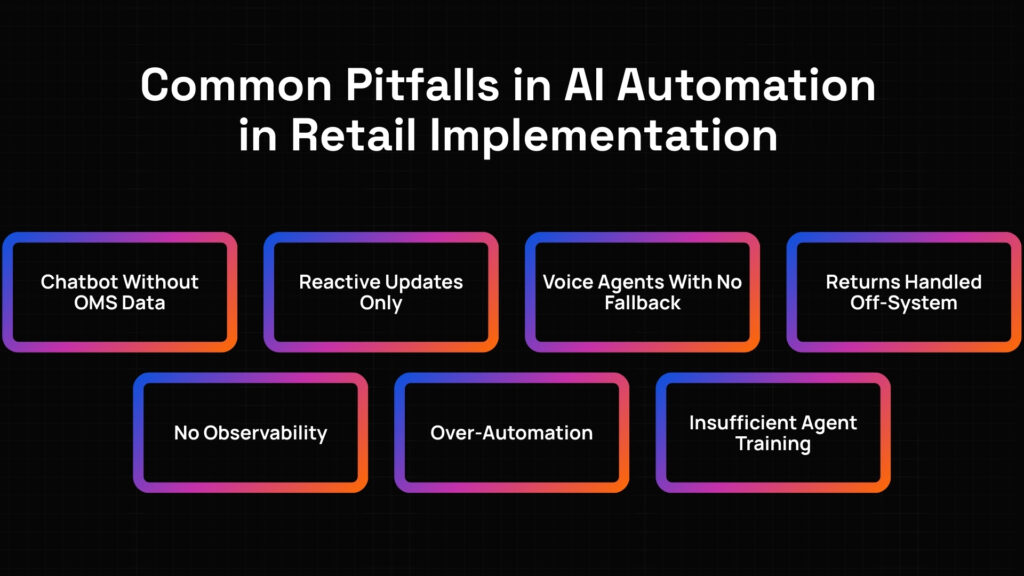
- AI Answers Outdated Policies: Responding with obsolete information creates confusion and potential compliance violations. Connect live document sources ensuring AI automation for HR reflects current policies as regulations and company procedures change requiring continuous synchronization not static knowledge bases.
- No Role-Based Access: Providing uniform answers regardless of employee context creates errors. Enforce HRIS permissions ensuring AI automation examples respect data security as compensation, performance, and personal information require appropriate access controls preventing unauthorized disclosure.
- Over-Automation of Sensitive Cases: Attempting autonomous handling of terminations or investigations creates risk. Escalate to humans for situations requiring discretion as AI process automation should handle routine transactions not replace judgment on matters affecting careers and livelihoods as Deloitte shows HITL improving trust.
- No Audit Trail: Launching without comprehensive logging creates compliance vulnerability. Log every decision and answer documenting who asked what when enabling investigation when questions arise about information provided or decisions made as Gartner shows 40 percent transactional requiring auditability.
- One-Size-Fits-All Replies: Providing generic answers ignoring employee context creates confusion. Personalize by role and location as AI automation for HR must differentiate policies applying differently across populations providing relevant information not requiring employees to determine applicability themselves.
- No Success Metrics: Deploying without measurement prevents optimization. Track deflection and resolution time quantifying value as McKinsey shows targeted automation requiring clear ROI demonstration justifying continued investment and expansion to additional workflows.
- Insufficient HR Training: Technical implementations without staff enablement face adoption resistance. Include HR playbooks and admin training as effective escalation requires HR understanding what AI attempted preventing duplicated effort and ensuring seamless handoffs.
The Impact of Integration Readiness
Before launching any AI automation for HR initiative, organizations must thoroughly assess their HRIS architecture, policy document accessibility, and approval workflow maturity. Integration readiness evaluates how well existing HR systems, policy content, and service procedures can support intelligent automation without creating technical debt or compliance gaps. When HR operations teams conduct integration audits in advance, they uncover system limitations and content issues early, align stakeholders around connectivity requirements, and minimize wasted time during vendor discovery and pilot phases.
Example: A technology company preparing for AI automation examples mapped their HRIS and policy document connectivity, discovering their AI answered outdated policies requiring live document source connections, their HRIS lacked role-based API access requiring permission enforcement, their sensitive case handling wasn’t defined requiring escalation rules, their audit logging was manual requiring systematic tracking, and their policy answers were generic requiring role and location personalization. Addressing these integration readiness issues before vendor engagement reduced the overall project timeline by four weeks.
Pro Tip: Confirm read versus write permissions early during discovery validating what automation can execute autonomously versus requiring approval. Vendor should map policies, approvals, and exceptions before proposals. Connect live document sources preventing outdated policy answers as industry guidance emphasizes consistency requiring current information.
Evaluating AI Automation for HR ROI
Quantifying AI automation benefits helps secure executive buy-in and refine future investments in HR technology. Measuring ROI goes beyond simple time savings; it captures improvements in deflection rate, response velocity, employee satisfaction, and HR capacity. Without clear financial modeling during evaluation, AI automation for HR projects risk becoming unclear implementations that fail to justify ongoing operational expenses and licensing costs.
Key considerations for financial analysis include:
- Transactional Work Liberation: Gartner shows HR teams spend over 40 percent of their time on transactional requests, calculating capacity release when AI automation for HR handles policy questions, PTO inquiries, and service requests freeing HR professionals for strategic workforce planning and organizational development.
- Ticket Deflection Value: Track volume reduction when targeting 30 percent deflection of policy and PTO tickets, measuring operational savings as eliminated tickets free capacity enabling HR to focus on talent acquisition, employee relations, and culture initiatives beyond answering repetitive questions.
- Response Time Acceleration Impact: Calculate satisfaction improvement when instant automated responses replace email delays measuring minutes or hours, quantifying experience gains as immediate answers improve employee perception compared to waiting for HR availability creating frustration.
- HR Capacity Reallocation: Assess freed hours redirected to strategic initiatives like succession planning and engagement programs, calculating productivity as McKinsey shows targeted automation enabling HR focus on high-value activities requiring judgment beyond transactional processing.
- Employee Self-Service Adoption: Monitor utilization rates when automation enables independent problem-solving, measuring empowerment as self-service reduces dependency on HR improving employee autonomy and reducing perceived bureaucracy.
- Total Cost of Ownership: Include licensing fees, HRIS integration development, policy document preparation, plus ongoing content updates, template refinement, and support in comprehensive analysis. Understand pricing scales with employee count, request volume, or template complexity as HR automation requiring realistic cost modeling.
Gartner shows HR teams spend over 40 percent of time on transactional requests. McKinsey demonstrates targeted automation delivers faster ROI than broad programs. Deloitte finds HITL improves trust in HR automation. Nielsen Norman Group shows clear feedback improves employee satisfaction. Industry guidance emphasizes manual handling creates delays and inconsistency. When every AI automation for HR interaction logs employee inquiries, AI responses, confidence scores, and escalation triggers, every integration maintains role-based access preventing unauthorized information disclosure, and every quarterly review assesses policy accuracy and template effectiveness, organizations build trusted employee service operations that scale without sacrificing compliance quality, HR capacity, or workforce satisfaction.
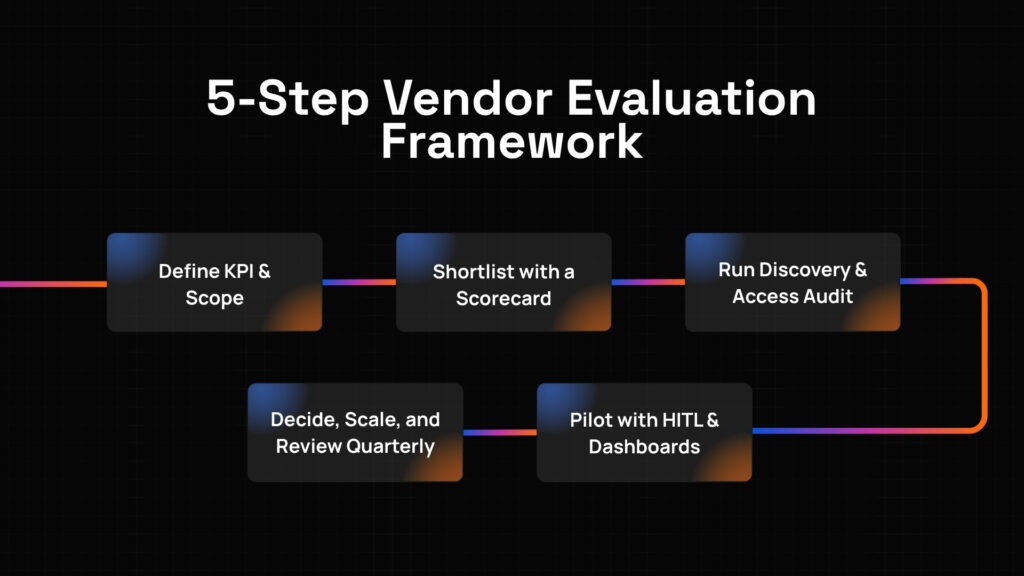
5-Step Vendor Framework for AI Automation for HR
Selecting an AI automation examples vendor should follow a disciplined, structured process that aligns with your organization’s HR goals while accounting for both technological depth and compliance requirements. Instead of focusing solely on impressive demonstrations or deflection claims, evaluation should weigh how well the AI automation for HR solution supports measurable outcomes, integrates with existing systems, and maintains quality through appropriate governance.
1. Define KPI & Scope
Start by identifying specific measurable outcomes with narrow scope enabling quick operational validation. Defining concrete targets helps align all stakeholders including HR leadership, operations teams, IT infrastructure, and legal. Your goal might be deflecting 30 percent of policy and PTO tickets, improving response time, or increasing HR satisfaction, but it must be quantifiable with clear HR impact.
Example: A financial services company defined its KPI as “deflecting 30 percent of policy and PTO tickets within 90 days while maintaining employee satisfaction above 4.0 out of 5.0 and first contact resolution above 85 percent.” This metric guided every AI automation for HR discussion, shaped pilot design with clear service benchmarks, and became the success measurement. Exclude sensitive cases in phase one.
Pro Tip: Document one to two primary HR outcomes before requesting proposals. Focus on ticket deflection, response time reduction, or HR satisfaction improvement tied to operational efficiency rather than vanity metrics like total conversations handled, and define specific percentage improvement targets with timelines enabling objective go/no-go decisions during pilot evaluation as McKinsey shows targeted automation delivering faster ROI.
2. Shortlist with a Scorecard
Once objectives are clear, move to structured vendor comparison using a weighted scorecard evaluating AI process automation providers. This tool allows teams to quantify how well each vendor aligns with priorities including HRIS and payroll integrations, policy content management, HITL design, observability, and portability and IP ownership.
Example: One enterprise assigned 30 percent weight to HRIS and payroll integrations assessing connectivity depth, 25 percent to policy content management evaluating answer accuracy, 20 percent to HITL design ensuring appropriate escalation, 15 percent to observability capabilities, and 10 percent to portability and IP ownership. Score HRIS and payroll integrations highest.
Pro Tip: Turn evaluation criteria into numeric scoring so decisions remain defendable beyond subjective demonstration impressions. Ask for live demos using your policies validating actual content complexity. Weight appropriately as Gartner shows 40 percent of time being transactional and Deloitte emphasizes trust importance. Have multiple stakeholders from HR operations, IT, and legal score vendors independently before group discussion to reduce bias.
3. Run Discovery & Access Audit
Before contracts are signed, a structured discovery phase maps policies, approvals, and exceptions documenting every integration touchpoint and compliance requirement. During this phase, teams validate HRIS and payroll access, surface policy gaps, and confirm escalation workflows with appropriate sensitivity handling. Confirm read versus write permissions.
Example: A healthcare organization conducted discovery for AI automation for HR, revealing their HRIS required custom API authentication not in standard vendor documentation, their policy documents lacked consistent formatting requiring standardization, their approval workflows weren’t digitized creating automation complexity, their sensitive case definitions weren’t documented requiring escalation rule development, and their audit requirements mandated specific retention periods.
Pro Tip: Vendor should map policies, approvals, and exceptions before proposals detailing exact connectivity requirements. Confirm read versus write permissions early understanding what automation can execute autonomously. Enforce HRIS permissions ensuring role-based access. Use discovery to surface policy gaps, permission issues, and escalation needs before signing when negotiating leverage is highest.
4. Pilot with HITL & Dashboards
A well-designed pilot validates both technology performance and employee experience maintenance under real HR conditions. Instead of full-scale deployment, run 3-week pilot for PTO and policy Q&A maintaining HR oversight for quality assurance. Incorporating human-in-the-loop review ensures AI automation examples align with compliance standards and satisfaction requirements while building organizational confidence.
Example: A retail company piloted AI process automation for employee service, running 3-week evaluation with controlled deployment on policy questions and PTO requests, HR review of all sensitive escalations, and dashboard tracking deflection rate, response time, employee satisfaction, and escalation patterns, achieving 28 percent deflection with 4.2 satisfaction above 4.0 target. Monitor confidence and escalation rates as Deloitte shows HITL matters.
Pro Tip: Execute pilots with frozen scope covering specific request types, clear success criteria including compliance benchmarks, and measurable KPIs tracked weekly. Run 3-week pilot for PTO and policy Q&A establishing AI meets standards. Measure deflection rate targeting 30 percent and employee satisfaction targeting above 4.0. Track escalation rates understanding confidence calibration. Use pilot to train HR staff on exception handling and seamless handoff techniques.
5. Decide, Scale, and Review Quarterly
After the pilot proves both operational value and compliance maintenance, use findings to guide the final decision about expanding to benefits and manager requests validating sustainability and stability. Scaling should be deliberate, expanding only after demonstrating approach maintains quality across representative employee populations and request types. Continuous quarterly reviews maintain governance discipline, ensuring automation adapts as policies, regulations, and organizational structures evolve.
Example: A manufacturing company conducted quarterly reviews with its AI automation for HR partner, expanding successful policy and PTO automation to benefits inquiries and manager service requests over 12 months, scaling after validation, identifying optimization opportunities reducing ticket volume by additional 12 percent, and reviewing policies quarterly for drift. Expand to benefits and manager requests as McKinsey shows targeted approach.
Pro Tip: Treat vendor reviews as compliance governance sessions focused on policy accuracy and employee trust, not just performance metrics. Expand to benefits and manager requests proving reliability before comprehensive deployment. Review policies quarterly for drift detecting changes requiring content updates. Use quarterly reviews to assess answer accuracy, escalation appropriateness, employee feedback, and alignment with evolving policies and regulatory requirements.
Next Steps in Your AI Automation for HR Evaluation
By now, you should have a clear understanding of what to prioritize when selecting AI automation examples partners for HR. Bringing these insights together creates a structured evaluation flow that de-risks investment and accelerates deployment while ensuring compliance and employee experience.
- Align with HR metrics: Ensure every AI automation for HR feature connects to specific KPIs like ticket deflection, response time, or HR satisfaction tied to operational efficiency, not just automation coverage percentages disconnected from actual service outcomes and measurable workforce results.
- Evaluate HRIS integration: Confirm that AI process automation works smoothly with your HRIS through role-based access, payroll through compensation context, and calendars through PTO synchronization as Gartner shows 40 percent of time being transactional requiring integrated workflows from inquiry through resolution.
- Focus on compliance oversight: Choose vendors with clear escalation for sensitive requests, comprehensive audit logs documenting decisions, and role-based permissions enforcing access controls as Deloitte shows HITL improving trust preventing inappropriate information disclosure or autonomous handling of sensitive situations.
- Review observability capabilities: Favor partners with request type tracking, confidence scoring, and outcome monitoring enabling quality assurance as Nielsen Norman Group shows clear feedback improving satisfaction through transparency supporting continuous improvement.
- Test with controlled pilots: Always run 3-week pilots on policy and PTO workflows, HR review maintaining oversight, frozen scope on specific request types, and escalation monitoring before production deployment to validate deflection improvements, satisfaction maintenance, and operational readiness under real-world HR conditions with actual employee diversity.
With these criteria in place, you are better equipped to identify AI automation for HR vendors who not only automate workflows but also deflect tickets, free capacity, maintain compliance, and amplify your team’s capacity to focus on strategic workforce planning and organizational development requiring judgment that machines cannot replicate.
Vendor Questions to Ask
To make the most informed decision during your AI automation for HR evaluation, be sure to ask these essential questions:
- Which HRIS and payroll systems do you integrate with, and what read-write capabilities do you provide for PTO actions and employee data access?
- How do you keep policy answers current including document source connections, content refresh procedures, and version control for policy changes?
- How are sensitive requests escalated including confidence thresholds, HR notification procedures, and handoff protocols for complex situations?
- What audit logs are available providing comprehensive documentation of inquiries, responses, and decisions supporting compliance reviews?
- Who owns the automation templates ensuring operational portability at contract end including export rights for flows and content?
- Can workflows be exported enabling portability without starting over or losing automation logic if we switch vendors?
- How do you measure success including deflection metrics, satisfaction tracking, and response time monitoring proving operational value?
- Can you provide two customer references in similar industries who can discuss deflection improvements, HR satisfaction, and ongoing partnership?
- What are recurring costs beyond license including integration maintenance, content updates, and support fees, and how do expenses scale?
- What rollback capabilities exist for errors enabling quick restoration when automation produces incorrect answers or system failures?
Transform HR Operations with AI Automation for HR
AI automation for HR is not just a technological investment; it is a strategic employee service capability that requires careful integration, appropriate oversight, and continuous content management. The right implementation brings 30 percent ticket deflection, improved response time, and freed HR capacity, while poor execution creates employee frustration and compliance issues that undermine confidence and damage workforce trust.
Ready to transform your HR operations with AI automation for HR? Book a Free Strategy Call with us to explore the next steps and discover how we can help you decide what to automate first, validate HRIS readiness, and deploy the right AI automation examples solution for your unique policy environment, employee workflows, compliance obligations, and measurable service outcomes.