
The Power of AI Automation for HR: Why Selection Matters
AI automation for HR has evolved from basic resume parsers into intelligent talent orchestration that defines competitive advantage in modern human capital management. HR teams implementing professional AI process automation are fundamentally transforming how administrative load gets reduced, how hiring accelerates, and how employee experience improves without creating audit or bias problems. Advanced AI automation benefits now extend from screening and shortlisting to scheduling coordination and retention signal detection, enabling HR professionals to focus on strategic talent decisions while machines handle repetitive execution that once consumed hours daily during recruitment cycles.
The data supporting strategic HR automation continues to strengthen across talent functions. According to Gartner research, 38 percent of HR leaders are piloting, planning, or have implemented generative AI, demonstrating mainstream acceptance beyond experimental pilots as intelligent systems become core HR infrastructure. McKinsey reports nearly all companies invest in AI while only about 1 percent consider themselves at maturity, suggesting treating pilots as learning loops not finished systems requiring iterative refinement and organizational learning. LinkedIn Learning indicates teams that treat career development as a priority are significantly more likely to deploy AI training programs, proving that upskilling matters for successful adoption as workforce capabilities must evolve alongside technology.
Why AI Process Automation Matters for HR Operations
AI automation benefits extend beyond simple task automation; they transform how HR organizations manage recruiting velocity, maintain compliance, and ensure employee satisfaction across all talent touchpoints. Manual HR processes that once created bottlenecks through resume review delays, scheduling coordination chaos, and impossible 24/7 employee support can now be executed with intelligence and precision through AI process automation that compounds efficiency over time. From reducing time-to-first-screen from 3 days to 24 hours to automating benefits lookups and onboarding flows, AI automation for HR delivers measurable outcomes that strengthen both operational efficiency and talent quality.
For HR leaders evaluating AI process automation strategies, the AI automation benefits manifest in five critical ways:
- Screening and Shortlisting Acceleration: AI automation examples demonstrate parsing resumes, scoring candidate fit, and suggesting top applicants for recruiter review enabling 3X faster screening, with Gartner showing 38 percent of HR leaders piloting generative AI addressing recruiting bottlenecks that delay time-to-hire damaging candidate experience and losing top talent to faster competitors.
- Scheduling and Coordination Efficiency: Automated interview booking integrates calendars and reminders eliminating coordination overhead, as Deloitte shows HR automation improves speed-to-hire when paired with governance freeing recruiter capacity from administrative tasks for strategic candidate assessment and relationship building requiring human judgment.
- Employee Experience Enhancement: Chatbots handle policy questions, benefits lookups, and onboarding flows providing instant 24/7 support, with IBM noting conversational AI widely used to automate HR queries and improve engagement demonstrating AI automation for HR extends beyond recruiting to comprehensive employee lifecycle management.
- Predictive Retention Signals: AI process automation surfaces disengagement or attrition flags using engagement and performance signals enabling proactive intervention, as McKinsey shows nearly all companies invest in AI with successful implementations treating pilots as learning loops refining predictive models through iterative improvement.
- Process Automation Gains: Auto-populating HRIS changes, PTO approvals, and routine payroll checks reduces administrative load, with LinkedIn Learning indicating career development champions more likely to deploy AI training programs demonstrating that AI automation benefits compound when workforce upskilling accompanies technology deployment enabling effective human-AI collaboration.
AI automation for HR is not about replacing recruiters or HR professionals; it is about reducing administrative load, speeding hiring, and improving employee experience through workflow redesign enabling talent teams to focus capacity on strategic decisions, relationship building, and complex judgment that require human expertise and empathy.

Key Considerations When Choosing AI Automation for HR Partners
Selecting the right AI process automation requires careful alignment between technology capabilities and HR requirements. The most successful AI automation for HR implementations are built on a foundation of governance, deep HRIS integration, and measurable impact on critical metrics like time-to-fill, offer acceptance rate, and employee satisfaction.
Below are the core factors that should guide every AI automation for HR decision:
- Business Outcomes & KPI Alignment: Every AI process automation initiative must connect directly to tangible HR metrics including time-to-fill reduction, offer acceptance rate improvement, HR cycle time decrease, or retention rate increase. Vendors should map outputs to your specific KPIs with measurement frameworks rather than generic efficiency promises disconnected from actual talent outcomes.
- Integration with HR Systems: Effective AI automation for HR depends on seamless connectivity with applicant tracking systems, HRIS platforms, payroll systems, calendar applications, single sign-on providers, and reporting tools. Confirm native or documented connectors supporting read-write clarity enabling real-time data flow across complex HR technology ecosystems.
- Security and Governance: AI process automation handles sensitive employee data including resumes, performance records, compensation information, and personal identifiers requiring data residency options, encryption standards, least-privilege access controls, and vendor SOC/ISO attestations. Address PII handling as Gartner shows 38 percent piloting requiring strict controls preventing compliance violations.
- Human-in-the-Loop (HITL) Design: Successful AI automation for HR always includes recruiter and HR oversight with confidence thresholds triggering review, explicit human-approval gates for high-risk actions, and audit trails for overrides. Ensure humans approve candidate decisions, compensation changes, and termination processes as Deloitte shows automation improves outcomes when paired with human review not autonomous execution.
- Observability and Analytics: Transparency is essential when scaling AI automation benefits across talent workflows. A capable vendor provides per-transaction traces enabling audit, explainability for recommendations showing decision logic, comprehensive dashboards tracking performance, and model-version rollbacks allowing reversion when automation degrades quality or creates bias issues.
- Pricing Transparency and Flexibility: Clarify pricing structure including volume assumptions, inference costs, storage expenses, and professional services with detailed breakdown. Document who owns prompts, evaluation sets, and annotated data developed during implementation preventing vendor lock-in as McKinsey shows 1 percent at maturity requiring sustainable partnerships enabling iterative improvement.
Choosing AI automation for HR partners who understand these requirements ensures your investment delivers sustainable improvements rather than creating compliance gaps, vendor lock-in, or bias vulnerabilities that limit future flexibility when talent strategies, regulations, or workforce needs evolve.
Understanding What AI Automation for HR Actually Does
Before launching any AI process automation initiative, organizations must thoroughly understand specific capabilities and limitations. Clear definitional understanding prevents inappropriate use cases creating compliance issues or poor employee experiences. When HR teams grasp what automation handles effectively versus requiring human judgment, they design implementations maximizing value while protecting quality and fairness.
- Screening and Shortlisting: Parse resumes extracting skills, experience, and education. Score candidate fit against role requirements. Suggest top applicants for recruiter review enabling 3X faster screening as Gartner shows 38 percent piloting generative AI addressing recruiting bottlenecks, though requiring human approval preventing automated rejection creating legal exposure or missing qualified candidates through narrow algorithmic assessment.
- Scheduling and Coordination: Automated interview booking integrates calendars and sends reminders eliminating coordination overhead. Handle timezone conversions, availability conflicts, and confirmation communications as Deloitte shows automation improves speed-to-hire freeing recruiter capacity from administrative tasks for strategic candidate assessment and relationship building.
- Employee Experience Support: Chatbots answer policy questions, perform benefits lookups, and guide onboarding flows providing instant 24/7 support. Handle routine inquiries about PTO balances, 401k contributions, health insurance options, and company policies as IBM notes conversational AI widely used to automate HR queries improving engagement through immediate response.
- Sentiment and Retention Signals: Predictive flags for disengagement or attrition using engagement surveys, performance trends, and behavioral signals. Surface at-risk employees enabling proactive intervention through manager coaching, development opportunities, or retention conversations as AI automation examples demonstrate early warning systems requiring careful handling preventing invasive monitoring eroding trust.
- Process Automation: Auto-populate HRIS changes from offer letters and promotion approvals. Route PTO requests through approval workflows. Execute routine payroll checks validating hours, deductions, and compliance thresholds as AI process automation handles rule-following administrative work reducing manual data entry and approval coordination overhead.
Pro Tip: Limit scope to one role family and one channel for pilot proving value on narrow focused implementation. Example includes reducing time-to-first-screen from 3 days to 24 hours for inbound applicants as LinkedIn Learning shows career development champions more likely to deploy AI training requiring focused excellence demonstrating value before comprehensive deployment.
Understanding AI Automation for HR KPIs: What to Measure
Before launching any AI process automation initiative, organizations must thoroughly define success metrics enabling objective pilot evaluation and ongoing performance monitoring. Key performance indicators provide the measurement framework distinguishing valuable implementations from expensive failures creating HR team skepticism. When talent operations teams establish KPIs in advance, they align stakeholders around clear targets, enable data-driven optimization, and build business cases justifying continued investment through demonstrated value.
- Time-to-Fill: Track duration from requisition open to offer accepted measuring hiring velocity improvements when AI automation for HR accelerates screening, targeting reductions like 3 days to 24 hours for first screen enabling faster candidate engagement as Gartner shows 38 percent piloting addressing speed-to-hire bottlenecks.
- Offer Acceptance Rate: Monitor percent of offers accepted when candidate experience improves through faster communication and seamless coordination, measuring quality of hire and employer brand strength as AI process automation eliminates delays and scheduling friction that damage candidate perception during recruitment process.
- Recruiter Cycle Time: Evaluate screens per position per week when automation handles resume parsing and initial triage, calculating capacity release enabling recruiters to focus on relationship building and strategic assessment as Deloitte shows automation improves outcomes freeing professional judgment for complex evaluation.
- HR Admin Hours Saved: Measure administrative time reduction through before-after time studies when AI automation for HR handles data entry, approval routing, and routine inquiries, quantifying operational efficiency gains as LinkedIn Learning indicates upskilling enables effective human-AI collaboration maximizing automation value.
- Employee NPS or Onboarding CSAT: Track post-enrollment satisfaction when chatbots provide instant policy answers and seamless onboarding guidance, ensuring automation maintains or improves employee experience as IBM shows conversational AI improves engagement through 24/7 support availability.
- False-Positive/Negative Screening Rate: Calculate accuracy of candidate triage measuring incorrect rejections and missed qualifications, monitoring bias and fairness as McKinsey emphasizes treating pilots as learning loops requiring iterative refinement when accuracy or fairness issues emerge preventing discrimination and legal exposure.
Pro Tip: Run AI suggestions in assist mode during pilot requiring human approval for actions. Track every decision comparing AI recommendations to human choices validating accuracy and identifying bias patterns before autonomous execution, as Gartner finds many HR leaders piloting generative AI in this phased way building confidence through controlled validation.
The Impact of Integration Readiness
Before launching any AI automation for HR initiative, organizations must thoroughly assess their ATS architecture, HRIS data quality, and SSO configuration completeness. Integration readiness evaluates how well existing HR systems, employee data assets, and security procedures can support intelligent automation without creating technical debt or compliance gaps. When HR operations teams conduct integration audits in advance, they uncover system limitations and data quality issues early, align stakeholders around connectivity requirements, and minimize wasted time during vendor discovery and pilot phases.
Example: A technology company preparing for AI process automation mapped their ATS and HRIS integration, discovering their applicant tracking system used custom fields beyond standard data models requiring mapping, their HRIS contained inconsistent job title nomenclature preventing accurate candidate matching, their calendar system lacked API support for automated scheduling requiring manual workarounds, their SSO configuration didn’t support service account access needed for automation, and their data retention policies weren’t documented creating ambiguity about candidate record handling. Addressing these integration readiness issues before vendor engagement reduced the overall project timeline by six weeks.
Pro Tip: Map ATS fields, HRIS write operations, SSO scopes, retention rules, and legal constraints before engaging vendors. Get access matrix documenting required permissions and data fields. Use ATS and HRIS Integration Readiness Checklist preparing comprehensive pilot validation ensuring data quality, system connectivity, and compliance framework readiness.
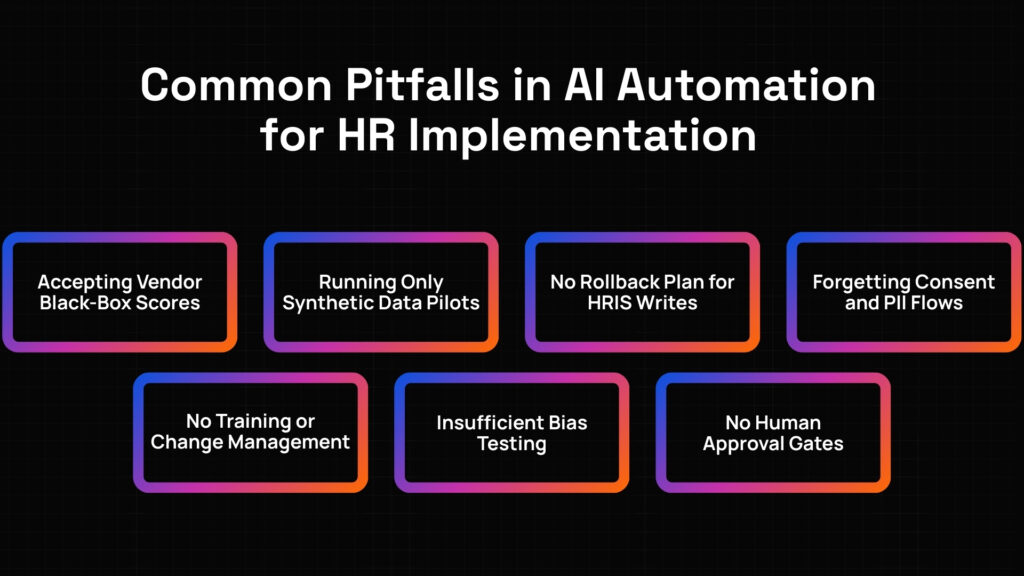
Common Pitfalls in AI Automation for HR Implementation
AI process automation promises efficiency and faster hiring, but poor planning and inadequate governance can create bias issues instead of talent improvements. Many HR organizations make avoidable mistakes during deployment that delay value realization and erode both recruiter and candidate trust. To discover proven methodologies tailored for your HR workflows and compliance requirements, explore our AI Workflow Automation Services page for detailed AI automation for HR frameworks and real-world implementation guidance.
- Accepting Vendor Black-Box Scores: Organizations using opaque candidate ranking cannot validate fairness or troubleshoot errors. Require sample-level explainability and trace exports showing why specific candidates were scored higher or flagged for rejection, enabling bias detection and quality assurance as Gartner shows 38 percent piloting requiring transparency addressing discrimination concerns.
- Running Only Synthetic Data Pilots: Testing with sanitized data misses real-world complexity and bias patterns. Use live anonymized streams where possible validating performance under actual conditions including diverse candidate backgrounds, unconventional career paths, and incomplete resume formats as Deloitte shows automation paired with governance requiring realistic validation.
- No Rollback Plan for HRIS Writes: Deploying without reversion capability creates risk when automation produces incorrect data changes. Require contractual kill switch and rollback scripts enabling quick restoration when AI automation for HR writes incorrect compensation, job titles, or organizational assignments threatening payroll accuracy and compliance.
- Forgetting Consent and PII Flows: Organizations overlooking data privacy face regulatory violations. Map consent and retention in discovery requiring configurable retention periods, explicit candidate consent for data usage, and PII anonymization procedures as McKinsey shows only 1 percent at maturity requiring careful privacy handling during iterative learning.
- No Training or Change Management: Technical implementations without recruiter enablement face adoption resistance. Budget training for HR operations owners and embed them in pilot ensuring workforce understands how AI augments rather than replaces judgment as LinkedIn Learning shows career development champions more likely to deploy AI training successfully.
- Insufficient Bias Testing: Launching without fairness validation creates discrimination risk. Analyze screening outcomes across protected classes including gender, ethnicity, and age ensuring AI automation for HR maintains demographic parity, with audit trails documenting fairness testing supporting legal defensibility if hiring decisions are challenged.
- No Human Approval Gates: Deploying autonomous decision-making for high-stakes actions creates legal exposure. Require explicit human approval for candidate rejections, compensation changes, and performance ratings as Deloitte emphasizes human review pairing ensuring quality control and accountability when automated recommendations affect employee livelihoods.
Evaluating AI Automation Benefits Through HR ROI
Quantifying the benefits of AI process automation helps secure executive buy-in and refine future investments in HR technology. Measuring ROI goes beyond simple time savings; it captures gains in hiring velocity, recruiter capacity, employee satisfaction, and retention improvement. Without clear financial modeling during evaluation, AI automation for HR projects risk becoming unclear implementations that fail to justify ongoing operational expenses and licensing costs.
Key considerations for financial analysis include:
- Time-to-Fill Reduction: Calculate days saved when AI automation for HR accelerates screening from 3 days to 24 hours enabling faster offers, measuring revenue impact from filled positions contributing to business objectives plus cost avoidance from reduced contractor usage during vacancy periods as Gartner shows 38 percent piloting addressing hiring speed.
- Recruiter Capacity Release: Track screens per recruiter per week improvements when automation handles resume parsing and initial triage, calculating freed capacity redirected to relationship building and strategic assessment as Deloitte shows automation improves speed-to-hire and engagement enabling 3X faster screening without proportional headcount increases.
- Administrative Efficiency Gains: Measure hours saved when AI process automation handles HRIS data entry, PTO routing, and benefits inquiries, quantifying operational cost reductions as IBM shows conversational AI automates routine queries freeing HR capacity for strategic initiatives like talent development and organizational design.
- Improved Offer Acceptance: Calculate revenue from higher acceptance rates when candidate experience improves through faster communication and coordination, measuring quality of hire and employer brand strengthening as AI automation for HR eliminates scheduling friction and communication delays damaging candidate perception.
- Retention Impact: Assess attrition cost avoidance when predictive signals enable proactive intervention, calculating replacement costs including recruiting expenses, training investments, and productivity ramps as retention improvements from early disengagement detection provide substantial financial returns beyond pure hiring efficiency.
- Total Cost of Ownership: Include inference and usage costs, connector fees, professional services, plus ongoing model operations, bias testing, and audit expenses in comprehensive analysis. Understand pricing scales with employee count, requisition volume, or transaction frequency requiring sensitivity modeling as McKinsey shows only 1 percent at maturity requiring iterative investment.
Gartner shows 38 percent of HR leaders piloting, planning, or implementing generative AI. McKinsey reports nearly all invest in AI while only 1 percent at maturity requiring learning loops. LinkedIn Learning indicates career development champions significantly more likely to deploy AI training. Deloitte demonstrates automation improves speed-to-hire and engagement with governance. IBM notes conversational AI widely used to automate queries and improve engagement. When every AI automation for HR interaction logs candidate scores, decision rationale, human overrides, and demographic outcomes, every screening change validates through bias testing before deployment, and every quarterly review assesses model drift and fairness metrics, organizations build trusted talent operations that scale without sacrificing compliance quality, candidate experience, or workforce diversity.
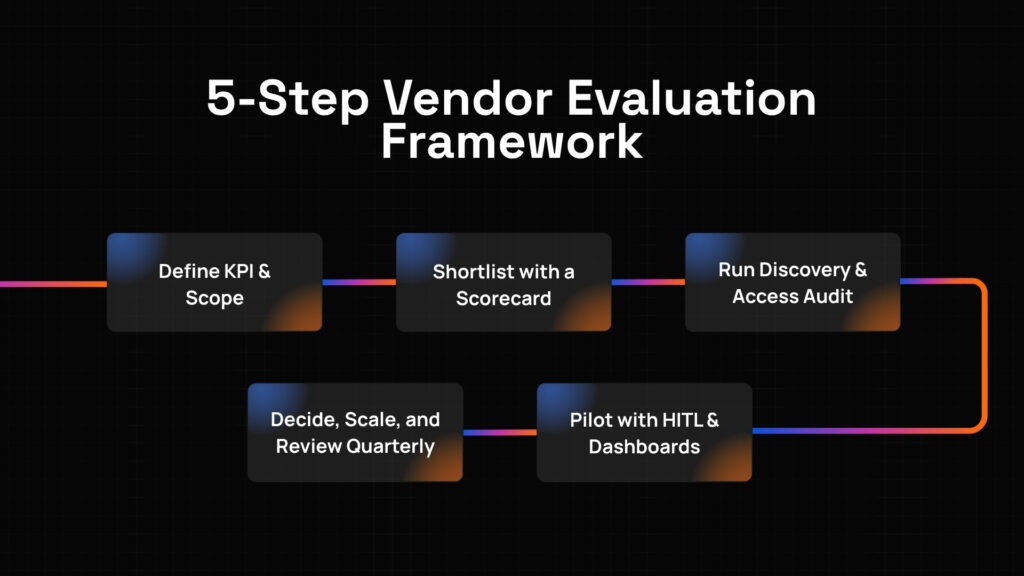
5-Step Vendor Framework for AI Automation for HR
Selecting an AI process automation vendor should follow a disciplined, structured process that aligns with your organization’s talent goals while accounting for both technological depth and regulatory compliance. Instead of focusing solely on impressive demonstrations or speed claims, evaluation should weigh how well the AI automation for HR solution supports measurable outcomes, integrates with existing systems, and maintains fairness through appropriate governance.
1. Define KPI & Scope
Start by identifying specific measurable outcomes with narrow scope enabling quick value proof. Defining concrete targets helps align all stakeholders including talent acquisition leadership, HR operations, recruiting coordinators, and IT infrastructure. Your goal might be reducing time-to-first-screen from 3 days to 24 hours for inbound applicants, improving offer acceptance rate, or decreasing admin hours, but it must be quantifiable with clear talent impact.
Example: A financial services company defined its KPI as “reducing time-to-first-screen from 3 days to 24 hours for inbound applicants in engineering roles within 8 weeks while maintaining offer acceptance rate above 80 percent and false-positive screening rate below 5 percent.” This metric guided every AI automation for HR discussion, shaped pilot design with clear talent benchmarks, and became the success measurement. Limit to one role family and one channel proving approach.
Pro Tip: Document one primary HR outcome before requesting proposals. Focus on time-to-fill reduction, recruiter cycle time improvement, or admin hours saved tied to operational efficiency rather than vanity metrics like total resumes processed, and define specific percentage improvement targets with timelines enabling objective go/no-go decisions during pilot evaluation.
2. Shortlist with a Scorecard
Once objectives are clear, move to structured vendor comparison using a weighted scorecard evaluating AI process automation providers. This tool allows teams to quantify how well each vendor aligns with priorities including governance and privacy, integration depth, HITL and approvals, observability and exports, pricing transparency, and delivery and enablement.
Example: One enterprise assigned 25 percent weight to governance and privacy meeting compliance requirements, 20 percent to integration depth with ATS and HRIS, 15 percent each to HITL and approval design and observability and export capabilities, 15 percent to pricing transparency, and 10 percent to delivery and enablement support. Weight governance higher for HR.
Pro Tip: Turn evaluation criteria into numeric scoring so decisions remain defendable beyond subjective demonstration impressions. Score integration, HITL, observability, privacy, pricing, and enablement 0 to 5. Weight governance and privacy appropriately as Gartner shows 38 percent piloting requiring strict controls and Deloitte emphasizes human review pairing. Have multiple stakeholders from TA, HR ops, and legal score vendors independently before group discussion to reduce bias.
3. Run Discovery & Access Audit
Before contracts are signed, a structured discovery phase maps ATS fields, HRIS write operations, SSO scopes, retention rules, and legal constraints documenting every integration touchpoint and compliance requirement. During this phase, teams validate API capabilities, surface data quality gaps, and confirm security controls with appropriate permissions. Get access matrix.
Example: A healthcare organization conducted discovery for AI automation for HR, revealing their ATS used non-standard field names requiring custom mapping, their HRIS lacked API documentation for automated writes requiring vendor consultation, their SSO configuration prohibited service accounts requiring architecture changes, their retention policies varied by jurisdiction creating compliance complexity, and their legal team required bias testing protocols not addressed in initial vendor proposals.
Pro Tip: Map ATS fields, HRIS writes, SSO scopes, retention rules, and legal constraints before proposals. Get access matrix listing exact read-write actions and required permissions. Use discovery to surface integration limitations, compliance gaps, and bias testing requirements before signing when negotiating leverage is highest.
4. Pilot with HITL & A/B Validation
A well-designed pilot validates both technology performance and fairness under real recruiting conditions. Instead of full-scale deployment, run 6-week pilot with AI suggestions in assist mode, human approval for actions, decision tracking, and holdout group measuring incremental impact. Incorporating human-in-the-loop review ensures AI automation benefits align with talent standards and compliance requirements while building organizational confidence.
Example: A technology company piloted AI process automation for software engineer screening, running 6-week evaluation with assist mode where AI scored candidates while recruiters made final decisions, controlled deployment on 50 percent of applicants creating holdout for comparison, and dashboard tracking time-to-screen, false-positive rate, and demographic outcomes, achieving 2.8X faster screening with 3.2 percent false-positive rate below 5 percent target. Run AI suggestions in assist mode as Gartner finds HR leaders piloting generative AI in this phased way.
Pro Tip: Execute pilots with frozen scope covering specific role family, clear success criteria including fairness benchmarks, and measurable KPIs tracked weekly. Run 6-week pilot with assist mode, human approval, and holdout group establishing AI meets standards. Track every decision comparing AI recommendations to human choices. Include bias testing across protected classes documenting demographic parity. Use pilot to train recruiters on score interpretation and override procedures.
5. Decide, Scale, and Review Quarterly
After the pilot proves both operational value and fairness maintenance, use findings to guide the final decision about scaling when KPIs show consistent wins validating sustainability and stability. Scaling should be deliberate, expanding only after demonstrating approach maintains quality across representative role families and candidate demographics. Continuous quarterly reviews maintain compliance discipline, ensuring automation adapts as job requirements, labor markets, and regulations evolve.
Example: A retail company conducted quarterly reviews with its AI automation for HR partner, expanding successful engineering screening to sales and operations roles over 12 months, scaling when KPIs showed consistent wins, identifying optimization opportunities reducing time-to-fill by additional 4 days, and scheduling quarterly audits for drift, bias checks, and retention of exportable logs as McKinsey shows only 1 percent at maturity requiring ongoing governance.
Pro Tip: Treat vendor reviews as compliance governance sessions focused on fairness and quality, not just performance metrics. Scale when KPIs show consistent wins proving reliability across hiring cycles and candidate pools. Schedule quarterly audits detecting drift, bias testing validating demographic parity, and log retention ensuring audit trail completeness. Use quarterly reviews to assess accuracy trends, fairness metrics, recruiter satisfaction, and alignment with evolving compliance requirements.
Next Steps in Your AI Automation for HR Evaluation
By now, you should have a clear understanding of what to prioritize when selecting AI process automation partners for HR. Bringing these insights together creates a structured evaluation flow that de-risks investment and accelerates deployment while ensuring compliance and candidate experience quality.
- Align with HR metrics: Ensure every AI automation benefits feature connects to specific KPIs like time-to-fill, offer acceptance rate, or admin hours saved tied to operational efficiency, not just automation coverage percentages disconnected from actual talent outcomes and measurable business results.
- Evaluate HR system integration: Confirm that AI automation for HR works smoothly with your ATS, HRIS, payroll, calendar, and SSO through native or documented connectors with read-write clarity enabling real-time data flow without manual intervention or disconnected systems creating data gaps.
- Focus on governance: Choose vendors with explainability showing decision logic, human approval gates for high-risk actions, and comprehensive audit trails addressing the compliance requirements as Gartner shows 38 percent piloting and Deloitte emphasizes human review pairing for quality assurance and legal defensibility.
- Review observability capabilities: Favor partners with per-transaction traces enabling audit, bias testing protocols measuring fairness, model version tracking supporting rollback, and raw log exports ensuring compliance documentation completeness when hiring decisions are challenged legally or organizationally.
- Test with controlled pilots: Always run 6-week pilots with assist mode, human approval tracking, holdout groups, and bias testing before full deployment to validate time-to-fill improvements, fairness maintenance, and operational readiness under real-world recruiting conditions with actual candidate diversity.
With these criteria in place, you are better equipped to identify AI automation for HR vendors who not only automate workflows but also reduce hiring time, improve recruiter efficiency, maintain compliance, and amplify your team’s capacity to focus on strategic talent decisions requiring relationship skills and complex judgment that machines cannot replicate.
Vendor Questions to Ask
To make the most informed decision during your AI automation for HR evaluation, be sure to ask these essential questions:
- Which ATS, HRIS, payroll, calendar, and SSO providers do you integrate with natively, and can you provide connector list documenting capabilities?
- What exact read-write actions do you need in our HRIS and ATS, and can you provide access matrix listing required permissions?
- How do you handle PII, consent, and data residency for employee records, and can you provide compliance attestations including SOC reports?
- What confidence thresholds trigger human review for candidate decisions, and what does the handoff payload contain for recruiter context?
- What observability do you provide including event traces, model version tracking, and audit logs enabling compliance documentation?
- What are your pricing assumptions for volumes, inference computation, storage, and professional services, and how do costs scale?
- How do you export prompts, annotated evaluation sets, and logs on termination ensuring operational work remains with our organization?
- What bias testing protocols do you support, and can you provide demographic parity analysis across protected classes?
- Can I speak to two customer references in similar industries who can discuss time-to-fill improvements, fairness validation, and ongoing partnership quality?
- What is the rollback mechanism enabling quick reversion to prior model versions when accuracy or fairness issues emerge?
Transform Talent Operations with AI Automation for HR
AI automation for HR is not just a technological investment; it is a strategic talent capability that requires careful planning, appropriate governance, and continuous fairness monitoring. The right implementation brings faster hiring, reduced administrative load, and improved employee experience, while poor execution creates bias issues and compliance violations that undermine confidence and damage employer brand.
Ready to transform your talent operations with AI automation for HR? Book a Free Strategy Call with us to explore the next steps and discover how we can help you scope pilots, validate fairness, and deploy the right AI process automation solution for your unique ATS environment, recruiting workflows, compliance requirements, and measurable talent outcomes.