

The Power of AI Automation in Healthcare: Why Integration Selection Matters
AI automation in healthcare has evolved from isolated pilot projects into mission-critical clinical workflow orchestration that defines operational excellence in modern health systems. Healthcare teams implementing professional AI integration services are fundamentally transforming how EHR systems connect, how clinical workflows operate efficiently, and how governance remains protected without creating patient-safety risks or compliance nightmares. Advanced AI process automation now manages workflows from intake triage and prior authorization to discharge planning and clinical documentation, enabling clinicians to focus on patient care while machines handle repetitive coordination that once consumed hours daily during clinical operations.
The data supporting strategic healthcare automation continues to strengthen across operational functions. According to Office of the National Coordinator for Health IT research, over 90 percent of U.S. hospitals use certified EHR systems making EHR integration the default first step for clinical AI, demonstrating that connectivity is foundational not optional for healthcare automation success. Deloitte healthcare survey indicates clinical staff spend significant time on documentation with freeing clinician time being common ROI driver, proving that administrative burden reduction delivers measurable operational returns addressing capacity constraints. Industry reports from Accenture show automation of repetitive clinical administrative tasks can materially free clinician time representing key ROI lever for health systems, validating substantial efficiency gains from disciplined implementations.
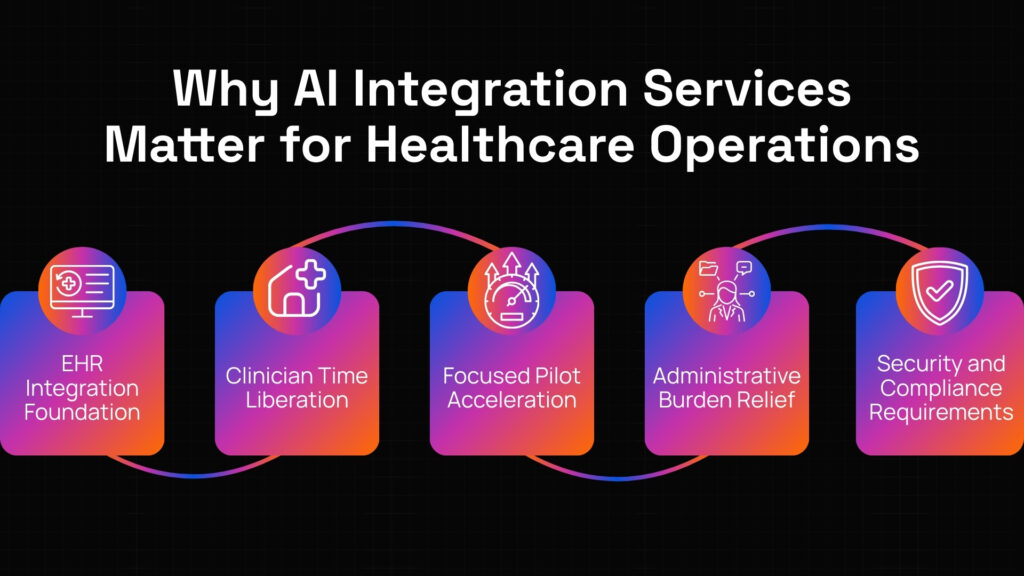
Why AI Integration Services Matter for Healthcare Operations
AI process automation extends beyond simple task automation; it transforms how healthcare organizations manage clinical workflows, maintain patient safety, and ensure regulatory compliance across all care touchpoints. Manual healthcare processes that once created bottlenecks through documentation burden, prior authorization delays, and impossible 24/7 coordination can now be executed with intelligence and precision through AI automation in healthcare that compounds efficiency over time. From reducing intake triage administrative time by 40 percent to preventing compliance violations through systematic governance, AI integration services deliver measurable outcomes that strengthen both operational efficiency and care quality.
For healthcare leaders evaluating AI automation in healthcare strategies, the benefits manifest in five critical ways:
- EHR Integration Foundation: Office of the National Coordinator shows over 90 percent of U.S. hospitals use certified EHR systems making integration default first step, as AI automation in healthcare requires read-write access, event hooks for admit and discharge events, CCD and FHIR support enabling seamless data flow not isolated point solutions creating workflow fragmentation.
- Clinician Time Liberation: Deloitte and Accenture demonstrate clinical staff spend significant time on documentation with automation materially freeing clinician capacity, as AI integration services handle repetitive administrative tasks enabling 40 percent time reduction redirecting focus to direct patient care and complex medical decision-making requiring professional judgment.
- Focused Pilot Acceleration: McKinsey shows short focused pilots reach production faster than long POCs when KPI and HITL rules defined proving structured approach, as AI process automation deployments with clear success criteria and governance frameworks accelerate value realization over open-ended experimentation consuming months without measurable progress.
- Administrative Burden Relief: Deloitte reports large share of health systems pilot AI for administrative burden reduction and clinical decision support validating strategic priorities, as AI automation in healthcare addresses documentation overhead, prior authorization complexity, and care coordination inefficiency consuming capacity that clinical shortage makes increasingly precious.
- Security and Compliance Requirements: HIMSS guidance shows healthcare vendors increasingly require SOC 2 and HIPAA-attested controls from partners proving governance non-negotiable, as AI integration services must provide BAAs, data separation through tenant-level encryption, and comprehensive audit trails addressing regulatory requirements distinguishing healthcare from less regulated industries.
AI automation in healthcare is not about replacing clinicians or care coordinators; it is about cutting administrative work and improving outcomes through workflow optimization enabling healthcare professionals to focus capacity on patient relationships, clinical judgment, and complex care coordination that machines cannot replicate effectively.
Key Considerations When Choosing AI Automation in Healthcare Partners
Selecting the right AI integration services requires careful alignment between technology capabilities and healthcare requirements. The most successful AI automation in healthcare implementations are built on a foundation of deep EHR connectivity, clinical validation, and measurable impact on critical metrics like charting time, callback rates, and readmission prevention.
Below are the core factors that should guide every AI automation in healthcare decision:
- Business Outcomes & KPI Alignment: Every AI process automation initiative must connect directly to tangible healthcare metrics including reduced charting time, fewer callbacks, or fewer readmissions. Ask for baseline metric and expected delta not marketing percentages, requiring specific improvement targets with measurement frameworks rather than generic efficiency promises disconnected from actual clinical performance.
- Integration with Healthcare Systems: Effective AI automation in healthcare depends on seamless connectivity with EHR platforms providing read-write access, event hooks for admit and discharge triggers, CCD and FHIR support, plus queuing for offline sync. Nice-to-have includes connections to scheduling, labs, imaging, and telehealth platforms as Office of the National Coordinator shows 90 percent use certified EHR systems requiring deep integration.
- Security and Compliance: AI integration services handle protected health information requiring HIPAA controls, business associate agreements, data separation through tenant-level encryption, and comprehensive data retention policies. Ask for penetration test summaries and SOC 2 or equivalent as HIMSS shows healthcare vendors increasingly require attested controls addressing regulatory requirements.
- Human-in-the-Loop (HITL) Design: Successful AI automation in healthcare always includes clinical oversight with clear handoff procedures to staff and explicit edge case routing. Look for audit trails and escalation flows as Deloitte shows administrative burden reduction requiring appropriate clinical validation when automation affects patient care decisions with safety implications.
- Observability and Analytics: Transparency is essential when scaling AI process automation across clinical workflows. A capable vendor provides request traces to model, evaluation logs tracking accuracy, error rates enabling troubleshooting, and rollback controls allowing reversion. Does vendor provide dashboards and downloadable evaluation sets supporting continuous improvement.
- Pricing Transparency and Flexibility: Clarify cost drivers including tokens, inference computation, and integration work with detailed breakdown. Who owns prompts, evaluation sets, and any custom models developed during implementation preventing vendor lock-in as McKinsey shows focused pilots requiring sustainable partnerships enabling iterative refinement.
Choosing AI automation in healthcare partners who understand these requirements ensures your investment delivers sustainable improvements rather than creating patient-safety gaps, vendor lock-in, or compliance vulnerabilities that limit future flexibility when clinical workflows, regulations, or care models evolve.
Understanding AI Integration Services: What to Connect First
Before launching any AI automation in healthcare initiative, organizations must thoroughly understand integration priorities and connectivity requirements. Poor integrations multiply risk and cost as small mistakes in data flow or governance become patient-safety issues fast. When healthcare teams identify essential connections, they accelerate value realization, maintain clinical quality, and avoid expensive failures from inappropriate integration creating workflow fragmentation.
- Essential EHR Integration: Read-write access to EHR enables automated data capture and clinical documentation. Event hooks for admit and discharge triggers enable real-time workflow automation. CCD and FHIR support provides standardized data exchange. Queuing for offline sync ensures reliability when network interruptions occur as Office of the National Coordinator shows 90 percent use certified EHR systems making EHR integration default first step not optional enhancement.
- Nice-to-Have System Connections: Scheduling systems enable automated appointment coordination. Lab interfaces provide real-time results integration. Imaging platforms support diagnostic workflow automation. Telehealth systems enable virtual care coordination as AI integration services expand beyond core EHR to comprehensive clinical ecosystem when foundational connectivity established.
- Security and Governance Infrastructure: HIPAA controls protect patient data through encryption and access restrictions. Business associate agreements establish legal framework for data handling. Data separation through tenant-level encryption isolates patient information. Audit trails document all access and modifications as HIMSS shows healthcare vendors require SOC 2 and HIPAA-attested controls addressing compliance requirements.
- Observability and Control Systems: Request traces to model enable troubleshooting when issues occur. Evaluation logs track accuracy supporting continuous improvement. Error rates identify problems requiring intervention. Rollback controls allow quick reversion when automation degrades as McKinsey shows focused pilots requiring clear success measurement.
Pro Tip: Don’t let user experience alone drive decision focusing on integration readiness first. Pick one lead KPI like reducing intake triage admin time by 40 percent within 90 days plus one safety KPI like error rate as Deloitte shows freeing clinician time being common ROI driver requiring measurable baseline and target.
Understanding AI Automation in Healthcare KPIs: What to Measure
Before launching any AI integration services initiative, organizations must thoroughly define success metrics enabling objective pilot evaluation and ongoing performance monitoring. Key performance indicators provide the measurement framework distinguishing valuable implementations from expensive failures creating clinical team skepticism. When healthcare operations teams establish KPIs in advance, they align stakeholders around clear targets, enable data-driven optimization, and build business cases justifying continued investment through demonstrated value.
- Charting Time Reduction: Track minutes saved per encounter when AI automation in healthcare handles documentation, targeting reductions like 40 percent as Deloitte and Accenture show clinical staff spend significant time on documentation representing key ROI lever freeing clinician capacity for direct patient care.
- Callback Rate Decrease: Monitor percent of post-visit callbacks when automated follow-up and clear instructions improve patient understanding, measuring care quality as AI process automation provides consistent communication preventing confusion requiring additional clinical contact consuming capacity.
- Readmission Rate Reduction: Evaluate 30-day readmissions when predictive alerts and discharge planning automation improve transitions, calculating quality improvements as AI integration services identify high-risk patients enabling proactive intervention preventing costly readmissions affecting reimbursement and outcomes.
- Prior Authorization Cycle Time: Track days from request to approval when automated documentation and submission accelerate processing, measuring operational efficiency as AI automation in healthcare handles repetitive paperwork freeing staff for exception cases requiring clinical judgment and payer negotiation.
- Clinical Documentation Completeness: Monitor percent of required fields completed when automated capture improves data quality, ensuring regulatory compliance as AI integration services provide consistent documentation preventing audit findings and supporting accurate coding affecting revenue capture.
- Error Rate: Calculate automation mistakes requiring correction measuring accuracy and safety, targeting below threshold as Office of the National Coordinator shows 90 percent use EHR systems requiring reliable integration preventing data corruption or clinical errors threatening patient safety.
- Escalation Quality: Evaluate percent of HITL handoffs with complete context accepted smoothly by clinicians measuring workflow effectiveness, ensuring AI automation in healthcare provides sufficient information enabling informed clinical decisions without frustrating repetition or missing critical details.
- Staff Satisfaction: Track clinician and administrator satisfaction with automation measuring adoption and usability, as McKinsey shows focused pilots reaching production faster when KPI and HITL rules defined requiring user acceptance not just technical functionality.
Pro Tip: Require downloadable evaluation set and root-cause logs for errors during 4-week pilot on simulated records with clinician review. Define escalation thresholds upfront specifying when automation hands off to staff as Deloitte shows large share pilot administrative burden reduction requiring clear governance preventing inappropriate autonomous decisions.
The Impact of Integration Readiness
Before launching any AI automation in healthcare initiative, organizations must thoroughly assess their EHR architecture, API capability completeness, and security framework maturity. Integration readiness evaluates how well existing clinical systems, patient data assets, and compliance procedures can support intelligent automation without creating technical debt or patient-safety gaps. When healthcare operations teams conduct integration audits in advance, they uncover system limitations and security issues early, align stakeholders around connectivity requirements, and minimize wasted time during vendor discovery and pilot phases.
Example: A regional hospital system preparing for AI integration services mapped their EHR and ancillary system connectivity, discovering their Epic environment used custom workflows beyond standard configurations requiring mapping, their lab interface lacked real-time event hooks requiring polling workarounds, their scheduling system didn’t support automated appointment creation requiring manual confirmation, their security policies required multi-factor authentication not addressed in initial vendor proposals, and their BAA templates weren’t standardized across departments creating approval delays. Addressing these integration readiness issues before vendor engagement reduced the overall project timeline by eight weeks.
Pro Tip: Start with integration readiness not letting UX alone drive decision. Confirm EHR sandbox access, list required API scopes, and confirm BAA during discovery. Capture simple data flow diagram documenting read-write operations and event hooks. Insist on short pilot using your EHR sandbox not canned demonstration as Office of the National Coordinator shows 90 percent use certified systems requiring actual connectivity validation.
Common Pitfalls in AI Automation in Healthcare Implementation
AI integration services promise efficiency and better outcomes, but poor planning and inadequate governance can create patient-safety issues instead of improvements. Many healthcare organizations make avoidable mistakes during deployment that delay value realization and erode both clinical and administrative trust. To discover proven methodologies tailored for your clinical workflows and compliance requirements, explore our AI Workflow Automation Services page for detailed AI automation in healthcare frameworks and real-world implementation guidance.
- Vendor Only Demonstrates Canned Chat Demo: Organizations accepting generic demonstrations without actual EHR testing discover integration surprises. Insist on short pilot using your EHR sandbox proving performance under actual conditions including data quality issues and workflow complexity as Office of the National Coordinator shows 90 percent use certified systems requiring real connectivity validation.
- “We Can Fix Accuracy Later” Promises: Launching without baseline accuracy measurement creates unproven interventions. Require initial evaluation sets and target metrics establishing performance standards as Deloitte shows administrative burden reduction requiring validation when automation affects clinical workflows with patient-safety implications.
- No Clear HITL Rules: Deploying without escalation thresholds creates inappropriate autonomous decisions. Define escalation thresholds upfront specifying when system hands off to staff and how edge cases route as HIMSS shows security expectations requiring explicit clinical oversight protecting patients.
- Dependence on Single Cloud Account: Accepting vendor lock-in through proprietary infrastructure creates portability risk. Ask for multi-tenant separation and portability ensuring you can migrate or switch vendors as AI automation in healthcare requires exit planning not permanent dependency threatening operational continuity.
- Missing Observability: Launching without performance visibility prevents troubleshooting and quality assurance. Add trace and dashboard requirements to statement of work ensuring request logs, evaluation metrics, and error analysis as McKinsey shows focused pilots requiring measurable success not black-box implementations.
- Vague Data Governance: Proceeding without clear security framework creates compliance violations. Demand data flow diagram and BAA before any sandbox access documenting exact data handling as HIMSS shows healthcare vendors require HIPAA-attested controls addressing regulatory requirements preventing violations.
- Vendor “Custom Model” Promises Without Evidence: Accepting optimization claims without validation creates unproven systems. Avoid custom model promises without measurable evidence and governance as AI integration services must demonstrate clinical validation not just technical capability.

Evaluating AI Automation in Healthcare ROI
Quantifying the benefits of AI integration services helps secure executive buy-in and refine future investments in clinical technology. Measuring ROI goes beyond simple time savings; it captures gains in clinician capacity, documentation quality, care coordination, and patient outcomes. Without clear financial modeling during evaluation, AI automation in healthcare projects risk becoming unclear implementations that fail to justify ongoing operational expenses and licensing costs.
Key considerations for financial analysis include:
- Clinician Time Value: Deloitte and Accenture show clinical staff spend significant time on documentation calculating capacity release when AI automation in healthcare reduces charting burden by 40 percent, measuring freed clinician hours redirected to direct patient care as clinical shortage makes every saved minute valuable enabling volume growth without proportional hiring.
- Administrative Efficiency Gains: Track staff time saved when AI process automation handles prior authorization documentation, care coordination tasks, and patient communications, quantifying operational returns as Deloitte reports large share pilot administrative burden reduction freeing capacity for complex cases requiring human judgment.
- Readmission Cost Avoidance: Calculate prevented 30-day readmissions when predictive alerts enable proactive intervention, measuring penalty avoidance plus quality improvement as AI integration services identify high-risk patients enabling targeted case management preventing costly readmissions affecting both outcomes and reimbursement.
- Documentation Quality Revenue Impact: Monitor coding accuracy and completeness improvements when automated capture enhances data quality, calculating revenue capture from accurate billing as AI automation in healthcare provides consistent documentation supporting appropriate reimbursement not leaving money on table through incomplete records.
- Pilot Speed Value: McKinsey shows short focused pilots reach production faster than long POCs calculating time-to-value improvements, as structured evaluation with clear KPI and HITL rules accelerates deployment enabling earlier benefit realization over extended experimentation delaying returns.
- Total Cost of Ownership: Include licensing fees, integration expenses, security infrastructure, clinical validation studies, plus ongoing model monitoring, compliance audits, and support in comprehensive analysis. Understand pricing scales with patient volume, encounter frequency, or user count as healthcare automation requiring realistic cost modeling.
Deloitte and Accenture demonstrate clinical staff spend significant time on documentation with automation materially freeing capacity. McKinsey shows short focused pilots reach production faster with defined KPI and HITL rules. Deloitte reports large share of health systems pilot AI for administrative burden reduction. HIMSS indicates healthcare vendors increasingly require SOC 2 and HIPAA-attested controls. When every AI automation in healthcare interaction logs clinical decision logic, escalation triggers, and patient data access, every automation change validates through clinical review before production deployment, and every quarterly audit assesses model drift and safety metrics, organizations build trusted clinical operations that scale without sacrificing patient safety, or regulatory compliance.
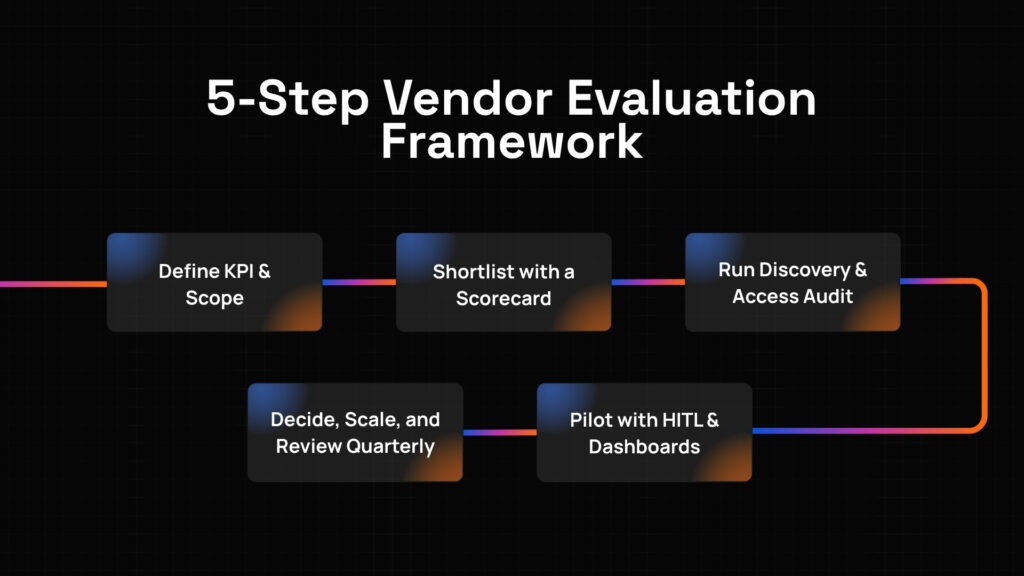
5-Step Vendor Framework for AI Automation in Healthcare
Selecting an AI integration services vendor should follow a disciplined, structured process that aligns with your organization’s clinical goals while accounting for both technological depth and patient safety requirements. Instead of focusing solely on impressive demonstrations or efficiency claims, evaluation should weigh how well the AI automation in healthcare solution supports measurable outcomes, integrates with existing systems, and maintains safety through appropriate governance.
1. Define KPI & Scope
Start by identifying specific measurable outcomes with narrow scope enabling quick clinical validation. Defining concrete targets helps align all stakeholders including clinical leadership, quality departments, IT infrastructure, and compliance teams. Your goal might be reducing intake triage administrative time by 40 percent within 90 days, decreasing callback rate, or preventing readmissions, but it must be quantifiable with clear patient impact.
Example: A community hospital defined its KPI as “reducing intake triage administrative time by 40 percent within 90 days while maintaining error rate below 2 percent and escalation quality above 95 percent complete context handoffs.” This metric guided every AI automation in healthcare discussion, shaped pilot design with clear clinical benchmarks, and became the success measurement. Pick one lead KPI plus one safety KPI.
Pro Tip: Document one to two primary healthcare outcomes before requesting proposals. Focus on charting time reduction, callback rate decrease, or readmission prevention tied to clinical efficiency rather than vanity metrics like total interactions processed, and define specific percentage improvement targets with timelines enabling objective go/no-go decisions during pilot evaluation as Deloitte shows freeing clinician time being common ROI driver.
2. Shortlist with a Scorecard
Once objectives are clear, move to structured vendor comparison using a weighted scorecard evaluating AI integration services providers. This tool allows teams to quantify how well each vendor aligns with priorities including integration depth, security and compliance, HITL design, observability, references, and pricing transparency.
Example: One health system assigned 25 percent weight to integration depth with EHR and ancillary systems, 25 percent to security and compliance meeting HIPAA requirements, 15 percent each to HITL design and observability capabilities, 10 percent to references and clinical validation, and 10 percent to pricing transparency. Weight integration and security higher for healthcare.
Pro Tip: Turn evaluation criteria into numeric scoring so decisions remain defendable beyond subjective demonstration impressions. Score each vendor 1 to 5 on integration, security, HITL, and observability. Weight appropriately as Office of the National Coordinator shows 90 percent use EHR systems and HIMSS emphasizes security attestations. Have multiple stakeholders from clinical, quality, IT, and compliance score vendors independently before group discussion to reduce bias.
3. Run Discovery & Access Audit
Before contracts are signed, a structured discovery phase confirms EHR sandbox access, lists required API scopes, and confirms BAA documenting every integration touchpoint and compliance requirement. During this phase, teams validate connector capabilities, surface security gaps, and confirm clinical workflow alignment with appropriate permissions. Capture simple data flow diagram.
Example: A specialty practice conducted discovery for AI automation in healthcare, revealing their Cerner environment required custom API authentication not in standard vendor documentation, their scheduling system lacked webhook support for automated coordination, their security policies required PHI isolation in development and test environments, their BAA template needed legal review adding weeks, and their clinical workflows varied by department creating scope complexity requiring careful configuration.
Pro Tip: Confirm EHR sandbox access, list required API scopes, and confirm BAA before proposals documenting exact connectivity and compliance requirements. Capture simple data flow diagram during discovery showing read-write operations and event hooks. How do you connect to common EHRs like Epic, Cerner/Oracle, and Allscripts providing sample integration documentation. Demand data flow diagram and BAA before any sandbox access as HIMSS shows security expectations non-negotiable.
4. Pilot with HITL & Dashboards
A well-designed pilot validates both technology performance and patient safety under real clinical conditions. Instead of full-scale deployment, run 4-week pilot on 200 simulated records with clinician review maintaining clinical oversight for quality assurance. Incorporating human-in-the-loop review ensures AI automation in healthcare outcomes align with care standards and patient safety requirements while building organizational confidence.
Example: A primary care network piloted AI integration services for intake triage, running 4-week evaluation on simulated patient records, clinician review of all triage recommendations before implementation, and dashboard tracking administrative time, error rate, and escalation quality, achieving 38 percent time reduction with 1.8 percent error rate below 2 percent target. Require downloadable eval set and root-cause logs for errors as McKinsey shows focused pilots reach production faster.
Pro Tip: Execute pilots with frozen scope covering specific clinical workflow, clear success criteria including safety benchmarks, and measurable KPIs tracked weekly. Run 4-week pilot on 200 simulated records with clinician review establishing AI meets clinical standards. Measure administrative time targeting 40 percent reduction and error rate targeting below 2 percent. Track escalation quality ensuring complete context handoffs. Define escalation thresholds upfront. Use pilot to train staff on override procedures and quality monitoring processes.
5. Decide, Scale, and Review Quarterly
After the pilot proves both operational value and patient safety maintenance, use findings to guide the final decision about moving to limited production by clinic validating sustainability and reliability. Scaling should be deliberate, expanding only after demonstrating approach maintains quality across representative patient populations and clinical scenarios. Continuous quarterly reviews maintain clinical discipline, ensuring automation adapts as clinical protocols, treatment guidelines, and patient populations evolve.
Example: A hospital system conducted quarterly reviews with its AI automation in healthcare partner, expanding successful intake triage to discharge planning and prior authorization over 12 months, moving to limited production by clinic after validation, identifying optimization opportunities reducing administrative time by additional 8 percent, and reviewing KPIs monthly plus conducting safety audit quarterly as Deloitte reports large share pilot administrative burden. Review KPIs monthly and conduct safety audit quarterly.
Pro Tip: Treat vendor reviews as clinical governance sessions focused on patient safety and care quality, not just performance metrics. Move to limited production by clinic proving reliability before comprehensive deployment. Review KPIs monthly detecting performance trends and conduct safety audit quarterly assessing adverse events and near misses. Keep exit-and-portability checklist ready before scaling. Use quarterly reviews to assess accuracy trends, escalation patterns, clinician satisfaction, and alignment with evolving clinical guidelines and regulatory requirements.
Next Steps in Your AI Automation in Healthcare Evaluation
By now, you should have a clear understanding of what to prioritize when selecting AI integration services partners for healthcare. Bringing these insights together creates a structured evaluation flow that de-risks investment and accelerates deployment while ensuring patient safety and regulatory compliance.
- Align with clinical metrics: Ensure every AI automation in healthcare feature connects to specific KPIs like charting time, callback rate, or readmission rate tied to clinical efficiency, not just automation coverage percentages disconnected from actual patient outcomes and measurable care quality.
- Evaluate EHR integration: Confirm that AI process automation works smoothly with your EHR through read-write access, event hooks, and FHIR support as Office of the National Coordinator shows 90 percent use certified systems requiring deep connectivity enabling real-time workflow automation not batch processing creating delays.
- Focus on clinical validation: Choose vendors with initial evaluation sets and target metrics, clinical references for similar workflows, and HITL escalation logic as Deloitte shows administrative burden reduction requiring validation when automation affects clinical decisions with patient-safety implications.
- Review security capabilities: Favor partners with HIPAA controls and BAAs, SOC 2 or equivalent evidence, tenant-level encryption isolating patient data, and comprehensive audit trails as HIMSS shows healthcare vendors increasingly require attested controls addressing regulatory requirements.
- Test with controlled pilots: Always run 4-week pilots on simulated records, clinician review maintaining oversight, downloadable eval sets enabling independent validation, and defined escalation thresholds before production deployment to validate time savings, accuracy maintenance, and operational readiness under real-world clinical conditions with actual workflow complexity.
With these criteria in place, you are better equipped to identify AI automation in healthcare vendors who not only automate workflows but also reduce charting time, maintain patient safety, ensure compliance, and amplify your team’s capacity to focus on direct patient care requiring clinical judgment and empathy that machines cannot replicate.
Vendor Questions to Ask
To make the most informed decision during your AI automation in healthcare evaluation, be sure to ask these essential questions:
- How do you connect to common EHRs including Epic, Cerner/Oracle, and Allscripts, and can you provide sample data flow diagram for read-write and event hooks?
- Do you sign BAA and provide SOC 2 or equivalent evidence including penetration test summaries and security attestations?
- How do you handle model updates and have you run clinical validation studies demonstrating accuracy in healthcare settings?
- What observability and rollback controls are available including request traces, evaluation logs, error rates, and emergency reversion capabilities?
- Who owns prompts, evaluation sets, and any fine-tuned models created for us ensuring operational portability at contract end?
- Can you provide two healthcare references for similar workflows who can discuss implementation experience and ongoing partnership quality?
- Describe your HITL routing and escalation logic including how system hands off to staff and how edge cases route?
- How is PII isolated in development and test environments ensuring protected health information security during implementation?
- What cost drivers affect pricing including tokens, inference computation, and integration work, and how do expenses scale?
- What exit plan do you provide including exportable prompts, policies, evaluation sets, and deployment diagrams enabling portability?
Transform Clinical Operations with AI Automation in Healthcare
AI automation in healthcare is not just a technological investment; it is a strategic clinical capability that requires careful planning, appropriate validation, and continuous safety monitoring. The right implementation brings 40 percent administrative time reduction, improved care coordination, and better patient outcomes, while poor execution creates patient-safety gaps and compliance violations that undermine confidence and damage reputation.
Ready to transform your clinical operations with AI automation in healthcare? Book a Free Strategy Call with us to explore the next steps and discover how we can help you scope pilots, validate EHR integration readiness, and deploy the right AI integration services solution for your unique clinical environment, workflow requirements, compliance obligations, and measurable patient outcomes.