
Why AI Automation in Healthcare Matters
Healthcare has reached a turning point where manual processes can no longer keep up with patient expectations or regulatory complexity. From intake forms to triage decisions, the system depends on fast, accurate, and compliant data handling. Yet, even with advanced digital tools, many hospitals and clinics still rely on outdated workflows that require repetitive human input. This is where AI automation in healthcare begins to redefine operations.
AI automation in healthcare enables hospitals, clinics, and private practices to streamline administrative and clinical workflows while maintaining precision and compliance. It transforms tasks such as scheduling, insurance verification, and follow-up communication into intelligent, self-learning processes. Instead of automating just one step, AI connects multiple systems, like electronic health records (EHR), patient management tools, and billing software, so that data flows seamlessly across the entire care cycle.
The results are measurable. A McKinsey study found that healthcare organizations that adopted intelligent automation achieved up to 30 percent faster patient throughput and a 25 percent reduction in administrative rework. These numbers are not about replacing staff but about giving them the tools to focus on patients rather than paperwork. As AI automation becomes more integrated into care delivery, it’s transforming healthcare operations from reactive to proactive, helping organizations anticipate needs before bottlenecks occur.
Why AI Automation in Healthcare Matters for Businesses
Healthcare providers are under constant pressure to do more with less, less time, fewer staff, and shrinking budgets. The industry is also burdened by compliance requirements, data privacy obligations, and rising patient expectations for convenience and transparency. AI automation in healthcare offers a path forward by addressing each of these pain points directly. For operations teams, automation simplifies scheduling, check-in, and eligibility verification, freeing staff from repetitive data entry. For clinical teams, it ensures accurate triage routing and faster handoffs between departments. And for patients, it delivers shorter wait times, clearer communication, and better follow-up. Every stakeholder benefits from the consistency that automation introduces.
What sets AI automation apart from traditional digitization is adaptability. Where older systems required manual updates for every change, AI learns from patterns in your workflow. It predicts appointment no-shows, recommends optimal resource allocation, and flags anomalies before they impact service. In an environment where a few minutes can change outcomes, this intelligence is transformative. Healthcare leaders who invest in automation now are not just improving efficiency, they’re building organizational resilience. As patient volumes grow and compliance demands tighten, automation ensures that processes scale without collapsing under operational load.
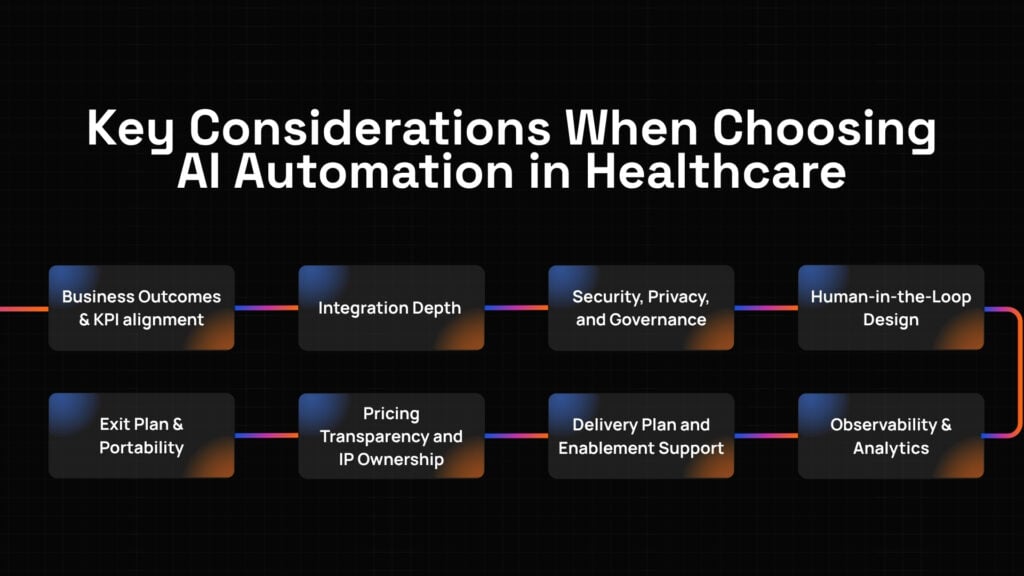
Key Considerations When Choosing AI Automation in Healthcare
Selecting the right partner for AI automation in healthcare requires more than a demo of features. You need alignment between the vendor’s technology and your organization’s operational and compliance goals. Every vendor promises transformation, but only a few deliver measurable results across intake, triage, and follow-up.
When evaluating vendors, focus on these key areas:
1. Business Outcomes and KPI Alignment: The best AI healthcare solutions tie directly to measurable outcomes such as reduced intake time, improved triage accuracy, and lower administrative costs. Ask vendors how their tools map to specific metrics like no-show reduction, patient wait time, or claim turnaround speed.
2. Integration Depth: Your automation tool must connect with multiple systems, EHRs, scheduling software, billing platforms, and patient communication tools. Check for read/write integration, API support, and compatibility with HIPAA-compliant infrastructure.
3. Security, Privacy, and Governance: AI in healthcare handles sensitive data, so compliance isn’t optional. Verify that the vendor’s system meets HIPAA and GDPR standards and includes clear audit trails, access controls, and encryption for all stored and transmitted data.
4. Human-in-the-Loop (HITL) Design: Automation should never eliminate human oversight. The right system escalates low-confidence triage results or critical alerts to a qualified professional, preserving accountability while maintaining efficiency.
5. Observability and Analytics: Effective automation isn’t a black box. Vendors should provide dashboards, trace logs, and monitoring tools that allow you to observe how the AI makes decisions and where it may need intervention.
6. Delivery and Enablement: A strong vendor goes beyond deployment, they train your staff, document workflows, and provide playbooks for ongoing management. This ensures long-term success instead of a one-off rollout.
7. Pricing Transparency and IP Ownership: Healthcare organizations should always know what they own. Confirm that you retain rights to your prompts, workflows, and models created during customization.
8. Exit Strategy and Portability: Automation investments should remain flexible. Ask whether your assets, data sets, prompts, and process maps, can be exported easily if you switch vendors in the future.
By focusing on these dimensions, healthcare providers can move beyond pilot programs and implement sustainable, scalable AI automation frameworks that deliver measurable ROI.
The Impact of AI Automation in Healthcare
AI automation in healthcare is redefining what operational excellence looks like. The impact extends far beyond time savings—it reaches into patient satisfaction, clinical accuracy, and organizational resilience. Let’s look at some of the most transformative effects:
- Streamlined Patient Intake: Automated intake forms and chatbot-assisted data capture reduce administrative burden while improving accuracy. Patients can complete registration remotely, and systems automatically verify insurance or eligibility in real-time.
- Faster and Smarter Triage: AI triage systems analyze patient data and symptoms to direct cases to the appropriate departments or specialists. This ensures patients receive care sooner, while clinicians focus on higher-priority cases.
- Enhanced Follow-Up Management: Automated reminder systems improve follow-up compliance and reduce missed appointments. These systems can personalize outreach based on patient history, ensuring that communication remains human-centered.
- Improved Resource Allocation: AI automation helps hospitals predict patient flow and allocate resources efficiently. Bed management, staffing, and scheduling become data-driven rather than reactive.
- Stronger Compliance and Reporting: Automation ensures audit trails are complete and accessible. Compliance documentation that once took days can now be generated in minutes.
Together, these benefits create a foundation for more agile, efficient, and patient-centered healthcare delivery.
Common Pitfalls in AI Automation in Healthcare
AI automation in healthcare offers immense potential, but poorly planned deployments can create inefficiencies rather than solve them. Many healthcare networks fall into preventable traps when implementing new systems. To learn how automation can be adapted to your operations, explore our AI Workflow Automation Services page for detailed strategies and implementation examples.
Overlooking Workflow Flexibility:
Some AI healthcare automation tools are too rigid, forcing clinical and administrative teams into predefined workflows. Always ensure the platform allows customization to match department-specific protocols and escalation paths.
Underestimating Change Management:
Even the best solutions fail if staff aren’t properly trained. Introduce educational sessions and communication plans early so nurses, physicians, and support staff understand how automation improves, not replaces, their roles.
Neglecting Compliance Readiness:
Healthcare data demands airtight protection. Choose vendors who offer HIPAA compliance verification, encryption-in-transit, and data access logs for all user actions.
Choosing Tools Without Scalability:
A system that handles one department today should be able to scale across the entire hospital network tomorrow. Confirm that your vendor’s architecture supports future modules and data growth.
Ignoring Human Oversight:
Full autonomy sounds appealing, but healthcare decisions always require human verification. Opt for AI automation solutions that integrate human-in-the-loop checkpoints for safety-critical workflows.
Evaluating the ROI of AI Automation in Healthcare
Measuring ROI from AI automation in healthcare goes beyond cost savings. The most meaningful metrics capture improvements in accuracy, agility, and patient experience.
- Time Savings: Automation reduces manual tasks like data entry, freeing staff for higher-value work.
- Error Reduction: Intelligent workflows minimize data mismatches and compliance errors, improving accuracy across departments.
- Scalability: Once deployed, automations can expand across new departments without exponential increases in workload.
- Employee Redeployment: Staff can shift from administrative duties to patient engagement, improving satisfaction and morale.
- Long-Term Value: Unlike one-off software upgrades, automation compounds value over time as systems learn and adapt.
When evaluated correctly, automation delivers not just short-term efficiency, but long-term resilience that supports both staff and patients.
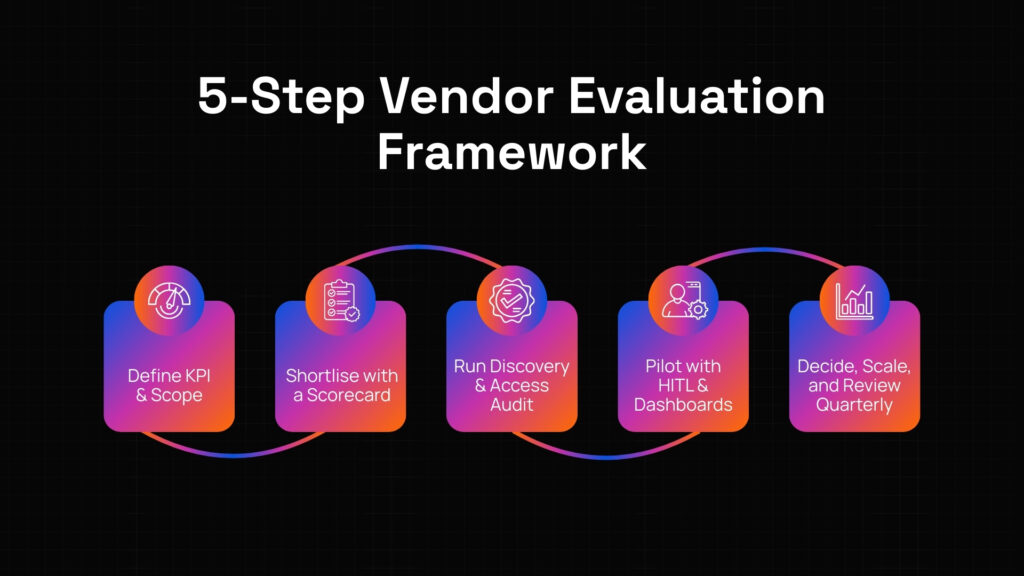
5-Step Framework for Vendor Evaluation
Selecting a vendor for AI automation in healthcare should follow a disciplined, structured process that balances innovation with compliance, scalability, and trust. The right partner will not only automate your workflows but also align with your long-term patient care goals and data governance standards. Avoid focusing solely on features or upfront pricing, your evaluation should emphasize measurable outcomes, security posture, and the vendor’s ability to evolve with your healthcare operations.
1. Business Outcomes and KPI Alignment
Start by defining what success looks like and how it will be measured. Whether it’s faster patient intake, improved triage accuracy, or reduced administrative workload, each KPI should tie directly to measurable operational outcomes. Establishing these goals early ensures stakeholders, from IT to clinical leadership, stay aligned on what value looks like in practice. Without clear metrics, evaluations tend to drift toward technical novelty instead of patient impact.
Example: A regional hospital defined its KPI as “reducing average patient intake time by 60 percent within the first quarter of deployment.” This benchmark shaped every subsequent vendor discussion and demo evaluation.
Pro tip: Document 3–5 specific outcomes before scheduling vendor presentations. Measurable goals create accountability and streamline decision-making across departments.
2. Shortlist with a Scorecard
Once objectives are clear, transition to a data-driven comparison of vendors using a weighted scorecard. Evaluate categories like system interoperability, HIPAA compliance, scalability, and usability. Assigning point values to each criterion ensures objectivity and helps highlight trade-offs between vendors. A structured scorecard also simplifies cross-functional decision-making and reduces bias during executive reviews.
Example: A healthcare network created a 100-point scorecard with 25 points dedicated to data security, 20 to integration depth, and 15 to clinical usability. This quantitative approach helped leadership quickly identify best-fit vendors.
Pro tip: Keep the scorecard fully quantitative. Use a standardized 1–5 or 1–10 scale to make comparisons objective and easy to communicate.
3. Run Discovery and Access Audit
Before committing to a vendor, conduct a structured discovery phase to identify integration barriers and confirm data governance readiness. This process should expose dependencies across your EHR, scheduling tools, and data sources. A simultaneous access audit ensures that data handling aligns with HIPAA and GDPR regulations while validating system connectivity. This proactive step minimizes surprises during implementation and fosters transparency between vendor and client teams.
Example: A telehealth provider discovered API rate limits during discovery that would have delayed deployment. Addressing them early saved two months of post-contract rework.
Pro tip: Ask each vendor for a “readiness report” summarizing their technical findings and timeline assumptions. It builds clarity and sets realistic expectations for go-live.
4. Pilot with Human-in-the-Loop (HITL) and Dashboards
A controlled pilot validates performance, usability, and accuracy under live conditions. Focus on one workflow, like patient triage or discharge follow-up—to observe measurable results. Integrating human-in-the-loop (HITL) checkpoints ensures automation outcomes remain clinically sound while dashboards give leadership visibility into metrics like response time, accuracy, and escalation rate. This phase builds team confidence and provides hard data for executive buy-in.
Example: A private clinic piloted AI-powered triage automation and reduced patient handoff time by 40 percent while maintaining 100 percent compliance with review protocols.
Pro tip: Use pilot results to identify both performance improvements and workflow friction. The combination of quantitative data and user feedback forms the foundation for scaling.
5. Decide, Scale, and Review Quarterly
After a successful pilot, finalize your vendor selection and create a phased rollout plan. Expansion should be deliberate, only scale once workflows are stable and adoption is strong. Conduct quarterly reviews with the vendor to track ROI, system accuracy, and compliance updates. These sessions should serve as collaborative checkpoints, ensuring the automation continues to evolve with your healthcare operations.
Example: A hospital group that held structured quarterly reviews with its vendor achieved a 25 percent improvement in patient follow-up compliance after the first year.
Pro tip: Treat quarterly reviews as strategic meetings, not status updates. Use them to benchmark performance, identify new automation opportunities, and sustain long-term ROI.
Next Steps in Your Evaluation Process
You now understand how to evaluate vendors and design automation workflows that fit your operations. Here’s a quick recap before you take the next step:
- Align with business goals: Tie automation success to measurable KPIs.
- Evaluate integrations: Confirm compatibility with your existing tools.
- Focus on compliance: Ensure adherence to HIPAA and local regulations.
- Review support plans: Choose vendors with strong training and ongoing service.
With these criteria in hand, you’re equipped to select automation solutions that genuinely improve care delivery and operational efficiency.
Vendor Questions to Ask
To make the most informed decision, ask these during vendor evaluations:
- How does your system align automation results with measurable healthcare KPIs?
- Which EHR and scheduling platforms do you integrate with natively?
- What compliance certifications (HIPAA, GDPR) do you hold?
- How are exceptions or low-confidence triage cases escalated?
- What transparency do we have into your model updates and decision logs?
- How long is your average implementation timeline?
- What ongoing training and support do you provide post-deployment?
- Are all automation assets and workflows exportable if we transition vendors?
Ready to Automate with Confidence?
AI automation in healthcare is no longer a futuristic promise, it’s the backbone of efficient, patient-centered care. When implemented with the right framework, it transforms intake, triage, and follow-up into streamlined, data-driven processes that empower both clinicians and patients.
Pro tip: Start with one high-impact process—like automating patient intake or follow-up reminders, and measure results before scaling. This focused approach ensures faster ROI and stronger organizational buy-in.
Ready to optimize your healthcare workflows? Book a Free Strategy Call with our experts to design a roadmap for AI automation tailored to your operations.