
The Power of AI Automation in Retail: Why It Matters
AI automation in retail has evolved from experimental pilots into operational infrastructure that defines excellence in modern commerce. Retail teams implementing intelligent automation are fundamentally reimagining how operations handle returns processing, inventory reconciliation, and customer service workflows. Automated systems now manage tasks that once consumed entire support departments, enabling managers and associates to focus on customer experience, loss prevention, and strategic initiatives that drive conversion and reduce shrink.
The data supporting this transformation continues to strengthen across retail environments. According to Gartner research, generative AI users report saving 3.6 hours per week on average, demonstrating measurable productivity gains from automation adoption. McKinsey reports that regular generative AI use in at least one business function jumped from 33 percent in 2023 to 71 percent in 2024, showing rapid mainstream adoption. Harvard Business Review research confirms that inventory record accuracy strongly correlates with sales and margin improvement, while Accenture findings show AI-enhanced fraud screening reduces false positives and review time in high-volume retail environments, enabling loss prevention teams to focus on genuine threats.
Why AI Automation in Retail Matters for Operations Teams
AI automation in retail goes beyond simple task processing; it transforms how organizations manage returns lifecycles, inventory accuracy, and omnichannel customer support. Manual processes that once created bottlenecks in return disposition, stock reconciliation, and order inquiries can now be executed with intelligence and precision through retail automation. From returns triage and fraud detection to inventory sync and vendor performance analysis, AI process automation delivers measurable outcomes that strengthen both customer satisfaction and operational efficiency across all retail functions.
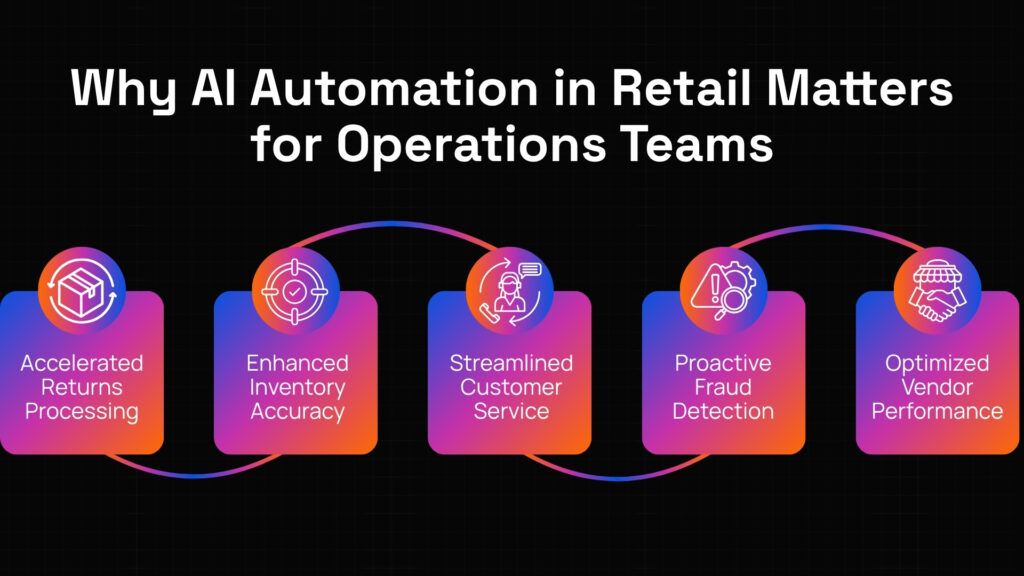
For retail leaders evaluating automation strategies, the benefits manifest in five critical ways:
- Accelerated Returns Processing: AI automation in retail matches order details, item conditions from photos, and policy rules to generate return merchandise authorizations, shipping labels, and restock tasks automatically, reducing processing time by 20 to 40 percent while enabling associates to focus on complex cases requiring judgment.
- Enhanced Inventory Accuracy: Intelligent systems reconcile warehouse management, point-of-sale, and ecommerce counts in real time, flagging phantom stock from system discrepancies and automatically creating cycle count tasks, improving inventory record accuracy that directly correlates with sales performance and margin protection.
- Streamlined Customer Service: Retail automation answers order status inquiries, exchange requests, and refund policy questions with grounded data from order management systems, escalating only edge cases to human agents and reducing average handle time while improving first-contact resolution rates.
- Proactive Fraud Detection: AI process automation scores high-risk orders and returns using purchase history, device fingerprints, and behavior patterns like repeat bracketing, routing suspicious transactions to loss prevention teams with evidence summaries that enable faster investigation without delaying legitimate customers.
- Optimized Vendor Performance: Automated analysis of advanced shipping notices versus actual receipts and defect rates generates performance summaries with chargeback recommendations or supplier coaching opportunities, strengthening supply chain quality and reducing inbound inventory issues that create customer disappointment.
AI automation in retail is not about replacing store teams; it is about amplifying their effectiveness, ensuring policy consistency, and enabling associates and managers to focus on customer relationships and loss prevention activities that require human judgment and empathy.
Key Considerations When Choosing AI Automation Services
Selecting the right partner for AI automation in retail requires careful alignment between technology capabilities and retail operations requirements. The most successful retail automation projects are built on a foundation of transparency, deep order management and inventory system integration, and measurable impact on critical metrics like return rate, customer satisfaction, and inventory accuracy.
Below are the core factors that should guide every AI automation in retail decision:
- Business Outcomes & KPI Alignment: Every AI automation in retail initiative must connect directly to tangible operational metrics, whether that is reducing return processing time, improving average order value, increasing conversion rates, enhancing customer satisfaction and net promoter scores, or lowering days sales outstanding and inventory shrinkage. Vendors should demonstrate a clear methodology for linking their retail automation solutions to your specific KPIs with baseline measurements and regular review cadences, not vague transformation promises.
- Integration with Existing Systems: Effective AI process automation depends on seamless connectivity with your order management system, warehouse management platform, ERP, point-of-sale systems, ecommerce platform, CRM and help desk, payment processors, carrier APIs, and master data or product information management systems. The ideal partner ensures smooth bidirectional data flow with read and write capabilities, event-driven webhooks, bulk synchronization with idempotency and retry logic, and service level agreements so automated workflows have complete order context.
- Security and Compliance: AI automation in retail handles highly sensitive customer data including payment information, personal identifiers, order history, and device fingerprints. Confirm that vendors maintain strict adherence to security frameworks with single sign-on, role-based access controls, VPC and private networking options, encryption in transit and at rest, PII redaction capabilities, PCI compliance implications, token vaulting for payment data, and comprehensive audit trails.
- Human-in-the-Loop (HITL) Flexibility: Successful retail automation always includes associate and manager oversight mechanisms for decisions affecting customer refunds, fraud accusations, or inventory adjustments. Ensure that workflows incorporate clear thresholds distinguishing automatic execution, suggest-only recommendations, and require-approval gates with complete audit trails, one-click rollback capabilities, and named on-call process owners for escalation.
- Observability and Analytics: Transparency is essential when scaling AI automation in retail across stores and channels. A capable vendor provides dashboards that surface automation accuracy with complete decision traces, evaluation datasets for testing, accuracy metrics and error taxonomies, cost and latency monitoring, drift detection alerts, and rollback-to-version capabilities that allow teams to restore previous configurations when issues emerge.
- Pricing Transparency and Flexibility: Insist on clear, predictable pricing models with transparent assumptions around transaction volumes, SKU complexity, and channel coverage. The right AI process automation solution grows with your organization without unexpected fees for additional brands, regions, or system connectors, with explicit clarity on who owns prompts, workflows, policies, evaluation datasets, and architecture diagrams.
Choosing retail automation partners with these capabilities ensures your investment delivers sustainable operational improvements and strengthens customer experience rather than creating vendor lock-in or technical debt that limits future flexibility and platform portability.
The Impact of Integration Readiness
Before launching any AI automation in retail initiative, organizations must thoroughly assess their order management and inventory system data quality, integration landscape, and policy documentation completeness. Integration readiness evaluates how well existing retail systems, return procedures, and data structures can support automation without creating visibility gaps or customer experience risks. When retail teams conduct integration audits in advance, they uncover data quality issues early, align IT and operations stakeholders around connectivity requirements, and minimize wasted time during vendor discovery.
Example: A multi-brand apparel retailer preparing for AI automation in retail discovered inconsistent product identifiers across three ecommerce platforms, missing webhook support for real-time inventory updates from the warehouse management system, and incomplete return policy documentation for international orders across five markets. Addressing these integration issues before vendor engagement reduced the overall project timeline by eight weeks and improved return disposition accuracy by 46 percent during the pilot phase, while ensuring all prompts and workflows remained portable.
Pro Tip: Create an internal integration readiness checklist that evaluates order management and warehouse system API completeness with event-driven capabilities for order updates and inventory movements, assesses return policy documentation with explicit decision criteria and approval thresholds, confirms product master and customer data quality across key fields, and documents escalation workflow requirements for customer service and loss prevention teams. Stress-test integration patterns with 50 messy return cases including damaged items and no-receipt scenarios.
Common Pitfalls in AI Automation in Retail
AI automation in retail promises consistency and efficiency, but poor planning and inadequate policy clarity can create customer experience risk instead of operational improvements. Many retail organizations make avoidable mistakes during implementation that delay value realization and erode team trust. To discover proven methodologies tailored for your retail workflows and customer experience requirements, explore our AI Workflow Automation Services page for detailed retail automation frameworks and real-world AI automation examples.
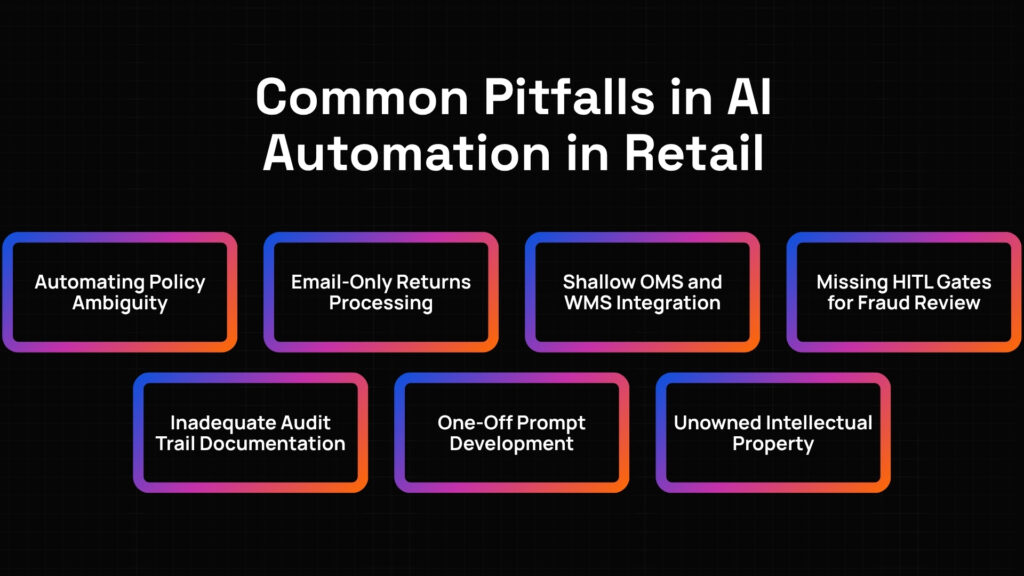
- Automating Policy Ambiguity: Some organizations attempt AI automation in retail before clearly codifying return policies, exchange rules, and fraud thresholds into machine-readable logic. Always document policies explicitly with versioning like code, pairing every rule with concrete examples and test cases before attempting automation that applies those policies at scale.
- Email-Only Returns Processing: A technically sound retail automation rollout can still fail to deliver time savings if it lacks access to photos, barcodes, and receipt data needed for disposition decisions. Ingest visual evidence of item conditions, scan return labels for product identification, and capture proof of purchase to enable fully automated disposition routing.
- Shallow OMS and WMS Integration: Many teams accept polling-based connections when event-driven synchronization with retry logic exists. Demand read-write access with webhook triggers for order updates and inventory movements to avoid swivel-chair automation that simply moves manual lookups between systems without eliminating the underlying work.
- Missing HITL Gates for Fraud Review: Successful AI process automation requires loss prevention oversight for high-risk decisions affecting customer relationships and shrink metrics. Start fraud detection in suggest-only mode with mandatory subject matter expert review above confidence thresholds, gradually increasing autonomy only after false positive rates prove acceptable.
- Inadequate Audit Trail Documentation: Full automation without comprehensive logging creates compliance nightmares and makes root cause analysis impossible. Log prompts, input data, decision rationale, confidence scores, and approver identities for every action to support dispute resolution, policy refinement, and continuous improvement initiatives.
- One-Off Prompt Development: Organizations implementing retail automation without systematic prompt management create maintenance debt and inconsistent outcomes. Build a prompt library with automated tests, change history tracking, and version control so policy updates propagate consistently and regression testing prevents unintended behavior changes.
- Unowned Intellectual Property: Retail automation projects without contractual IP ownership create long-term vendor dependency and migration barriers. Contract explicitly for ownership of all prompts, policies, evaluation datasets, workflow diagrams, and integration logic so you can switch platforms or bring capabilities in-house without rebuilding from scratch.
Evaluating the ROI of AI Automation in Retail
Quantifying the benefits of AI automation in retail helps secure executive buy-in and refine future investments in operations technology. Measuring ROI goes beyond simple time savings; it captures gains in customer satisfaction, inventory turns, fraud prevention, and associate productivity. Without clear metrics during evaluation, retail automation risks becoming a feature-heavy project with unclear business outcomes that fail to justify ongoing operational expenses.
Key metrics to monitor include:
- Returns Processing Time Reduction: Track the decrease in hours or minutes required to complete return disposition following implementation of AI process automation that matches items to policies and generates RMA documentation, with leading implementations achieving 20 to 40 percent reductions in manual touches within 6 to 8 weeks.
- Inventory Record Accuracy Improvement: Measure the increase in cycle count accuracy and reduction in phantom stock occurrences when AI automation in retail reconciles warehouse, point-of-sale, and ecommerce counts in real time, as research confirms inventory accuracy directly correlates with sales and margin performance.
- Customer Satisfaction and NPS Scores: Evaluate improvements in post-interaction surveys and net promoter scores following deployment of retail automation for order status inquiries, exchange processing, and policy questions that provide instant, accurate responses grounded in actual order data.
- First-Contact Resolution Rate: Compare the percentage of customer inquiries resolved without escalation before and after AI automation in retail implementation, as intelligent systems answer routine questions autonomously while routing complex cases with complete context to human agents.
- Fraud Detection Precision: Assess reductions in false positive rates and manual review time when AI process automation scores orders and returns using behavioral patterns, device fingerprints, and purchase history, enabling loss prevention teams to focus on genuine threats while minimizing friction for legitimate customers.
- Vendor Performance and Inbound Quality: Review improvements in supplier on-time delivery, receipt accuracy, and defect rates following automated analysis of advanced shipping notices versus actual receipts, as systematic performance summaries enable proactive supplier coaching and chargeback enforcement.
According to Gartner research, generative AI users save 3.6 hours per week on average, demonstrating measurable productivity gains. McKinsey reports that AI adoption in at least one function jumped from 33 percent to 71 percent year-over-year, showing mainstream momentum. Deloitte findings indicate automation cuts manual touches in returns processing by 20 to 40 percent. Harvard Business Review confirms inventory accuracy strongly correlates with financial performance, while Accenture research shows AI-enhanced fraud screening reduces false positives and review time substantially. When every return decision logs condition assessment and policy application, every inventory discrepancy documents reconciliation logic, and every workflow change maintains version history, organizations build audit-ready retail operations that scale without increasing customer friction or operational risk.
5-Step Framework for Vendor Evaluation
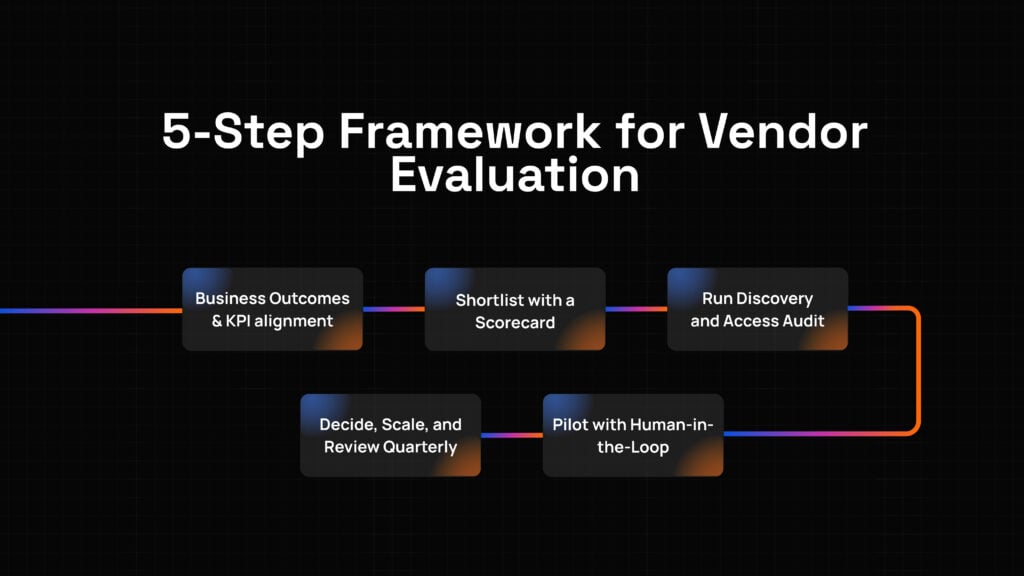
Selecting an AI automation in retail vendor should follow a disciplined, structured process that aligns with your organization’s customer experience goals while accounting for both technological depth and long-term partnership potential. Instead of focusing solely on price or impressive demonstrations, evaluation should weigh how well the vendor’s retail automation solution supports policy enforcement, integrates with commerce platforms, and adapts to evolving product assortments.
1. Business Outcomes & KPI Alignment
Start by clearly outlining what success looks like and how it will be measured in retail operations terms. Defining specific KPIs and project scope early helps align all stakeholders including operations leadership, customer service teams, loss prevention, and IT departments. Your goals might include reducing returns processing time by 20 percent in 6 weeks for apparel, improving inventory accuracy, or increasing first-contact resolution rates, but they must be tied to measurable outcomes. This clarity becomes the foundation for every subsequent decision about AI automation in retail, shaping both vendor conversations and internal buy-in.
Example: A footwear and accessories retailer defined its KPI as “reducing returns processing time by 25 percent within 6 weeks for footwear category orders.” This metric guided every vendor discussion, shaped pilot design, and became the benchmark for success measurement, with explicit agreement on ground truth sources including the order management system for order data, warehouse system for receipts, and carrier APIs for delivery exceptions.
Pro Tip: Document 3 to 5 measurable retail outcomes before requesting proposals. Pick one workflow and one metric so evaluation stays grounded in operational impact rather than technology feature lists, and helps vendors tailor demonstrations to your actual returns processing challenges, SKU complexity, and channel mix rather than generic retail scenarios.
2. Shortlist with a Scorecard
Once objectives are clear, move to structured vendor comparison using a weighted scorecard for evaluating AI automation in retail providers. This tool allows teams to quantify how well each vendor aligns with their priorities from order management and inventory system integration to governance frameworks and asset portability. By assigning weights to each factor, decision-makers can balance technical capability with customer experience risk and compliance requirements. A disciplined scorecard approach removes subjectivity and ensures that even non-technical retail operations stakeholders understand trade-offs.
Example: One omnichannel beauty retailer assigned 35 percent weight to system integration capabilities with event-driven synchronization and retry logic, 25 percent to governance controls including PII redaction and PCI compliance, and 20 percent to human-in-the-loop patterns with configurable approval thresholds for fraud and high-value returns, which helped eliminate vendors with shallow API connections early.
Pro Tip: Keep the scorecard fully quantitative to ensure fairness in vendor evaluation. Rate each criterion on a defined scale such as 1 to 5 so decisions are driven by operational requirements and customer experience relevance rather than sales presentation quality. Give heavier weight to integrations and governance than impressive demo polish. Ask vendors to pre-fill your scorecard with links to supporting evidence.
3. Run Discovery and Access Audit
Before contracts are signed, a structured discovery phase ensures that all technical, operational, and compliance details are surfaced early when implementing AI process automation. During this phase, vendors should gain thorough understanding of your order management architecture, warehouse systems, point-of-sale platforms, return policy documentation, and existing escalation workflows. Running an access audit alongside discovery verifies API scopes, permission structures, least-privilege access controls, and data flow patterns, preventing security gaps and costly change orders later.
Example: A home goods retailer invited shortlisted AI automation in retail vendors for a two-week technical discovery with anonymized order samples, exposing read-only constraints on the warehouse system that prevented automated restock task creation, missing event webhooks for inventory updates, and gaps in international return policy documentation before signing contracts or allocating team resources.
Pro Tip: Ask vendors to deliver a brief “readiness summary” document at the end of discovery that identifies technical blockers like missing API capabilities, data quality issues in product masters or customer records, PCI compliance requirements, and realistic timeline estimates. Map standard operating procedures to systems and define least-privilege access boundaries before any pilot work begins.
4. Pilot with Human-in-the-Loop (HITL) and Dashboards
A well-designed pilot validates both performance and customer experience under real-world retail conditions when exploring AI automation in retail. Instead of full-scale deployment, focus on a limited, high-impact workflow such as returns triage for one product category or customer service automation for one ecommerce channel to test accuracy, policy adherence, and team adoption. Incorporating human-in-the-loop review queues ensures that retail automation outcomes align with brand standards and customer expectations, while dashboards provide quantifiable visibility into accuracy, rework rates, and satisfaction metrics.
Example: An athletic apparel retailer piloted automated return disposition where supervisors approved RMA creation and routing decisions for two weeks, processing 800 returns and achieving 89 percent policy accuracy, 8 percent false positive rate requiring manual override, and 4.3 out of 5 associate satisfaction scores. Put evaluation sets in continuous integration pipelines so regressions trigger automatic rollback to previous versions.
Pro Tip: Use pilots to gather associate and customer feedback through surveys and daily review sessions. Release automation to one store cluster or a single ecommerce lane to contain risk. Early adoption feedback often surfaces policy interpretation gaps, user interface friction, or escalation threshold needs that accuracy metrics alone miss completely.
5. Decide, Scale, and Review Quarterly
After the pilot proves value, use its findings to guide the final decision and create a phased rollout plan for AI automation in retail. Scaling should be deliberate, expanding only after decision logic is refined, team training is complete, and performance metrics remain stable for two to three consecutive weeks. Continuous quarterly reviews between your operations team and the vendor maintain alignment, ensuring the technology evolves alongside policy changes, product assortment shifts, and channel expansions. These sessions assess ROI against initial KPI targets and plan expansions.
Example: A consumer electronics retailer conducted quarterly model and process reviews with its retail automation vendor, expanding successful returns automation from small electronics to appliances then furniture categories, identifying workflow optimization opportunities and adding fraud detection capabilities after disposition accuracy exceeded 95 percent that reduced shrink by 18 percent over the first year.
Pro Tip: Treat vendor reviews as strategic sessions focused on expanding AI automation in retail use cases to adjacent workflows like inventory optimization and vendor performance management, not just maintenance calls about system uptime. Scale winners and pause or re-scope underperforming automations. Keep a quarterly cadence for KPI resets and policy updates as business conditions change.
Next Steps in Your Evaluation Process
By now, you should have a clear understanding of what to prioritize when selecting an AI automation in retail partner. Bringing these insights together creates a structured evaluation flow that de-risks investment and accelerates deployment while ensuring long-term customer experience quality and operational excellence.
- Align with retail goals: Ensure every feature and function supports specific operational KPIs like return rate, inventory accuracy, customer satisfaction, and first-contact resolution, not just generic automation capabilities or impressive technology demonstrations that lack retail relevance.
- Evaluate commerce system integrations: Confirm that retail automation solutions work smoothly with your order management, warehouse, point-of-sale, ecommerce, and CRM platforms through event-driven webhooks and bidirectional updates without requiring extensive custom development or ongoing maintenance overhead.
- Focus on customer experience and security: Choose vendors with documented decision traces, comprehensive audit trails, PII and PCI compliance controls, and robust HITL workflow capabilities that enforce associate oversight for decisions affecting customer refunds, fraud accusations, or loyalty standing.
- Review enablement and change management: Favor partners who provide continuous training for associates and managers, standard operating procedure mapping templates, change management playbooks, operational runbooks, and handover criteria documentation, not one-time technical onboarding sessions.
- Test with a controlled pilot: Always run a controlled pilot with real order data and actual return workflows before full deployment to validate policy accuracy, customer experience quality, team adoption, and business impact under real-world retail conditions with representative product categories and return reasons.
With these criteria in place, you are better equipped to identify AI process automation vendors who not only automate repetitive tasks but also improve customer satisfaction, reduce operational costs, strengthen loss prevention effectiveness, and amplify your team’s capacity to focus on strategic initiatives that drive conversion and loyalty.
Vendor Questions to Ask
To make the most informed decision during your AI automation in retail evaluation, be sure to ask these essential questions:
- What KPI like return processing time or inventory accuracy will you target first, and how will we establish baseline measurements and ongoing tracking?
- Which systems including order management, warehouse, point-of-sale, and ecommerce do you integrate with out of the box, and what is the coverage for read, write, and event-driven synchronization?
- Show your human-in-the-loop pattern with specific examples for returns, fraud detection, and customer service escalations, including how we adjust confidence thresholds?
- How do you log and observe prompts, decision traces, costs, and latency to support continuous improvement and troubleshooting?
- What data governance guarantees apply to personally identifiable information, payment card data, and data residency requirements for international operations?
- Which assets do we own at contract end including prompts, policies, evaluation datasets, workflow diagrams, and integration code?
- What is your rollback path and incident escalation procedure when automation accuracy degrades or customer complaints spike?
- Provide two customer references with similar SKU complexity, channel mix, and return volumes who can discuss measured outcomes?
Transform Retail Operations with AI Automation in Retail
AI automation in retail is not just a technological investment; it is a strategic operations capability that requires careful planning, vendor selection, and continuous customer experience optimization. The right implementation brings consistency, policy compliance, and scalability across your retail workflows, while poor execution creates customer friction and associate resistance that undermines adoption and brand perception.
Ready to transform your retail operations with AI automation in retail? Book a Free Strategy Call with us to explore the next steps and discover how we can help you select, pilot, and scale the right retail automation solution for your unique workflows, system environment, and customer experience requirements.