

The Power of Choosing the Right AI Automation Platform: Why It Matters
Selecting the right AI automation platform has become a defining decision for organizations seeking to scale intelligent workflows beyond initial pilots without creating technical debt or vendor dependency. Companies that choose platforms strategically are not simply adopting new technology; they are fundamentally transforming how automation gets built, governed, and scaled across departments. The right platform enables rapid workflow deployment, maintains security and compliance, and provides clear exit paths, while poor platform choices create integration nightmares that drain resources and delay value realization for months or years.
The evidence supporting strategic platform selection continues to strengthen across industries. According to Forrester’s Total Economic Impact study on Microsoft Power Automate, composite organizations achieved 248 percent ROI over three years when workflow automation gets properly instrumented and scaled. These findings demonstrate more than tactical efficiency gains; they represent measurable business outcomes that result from selecting AI automation software with the right architectural foundations, integration capabilities, and governance features.
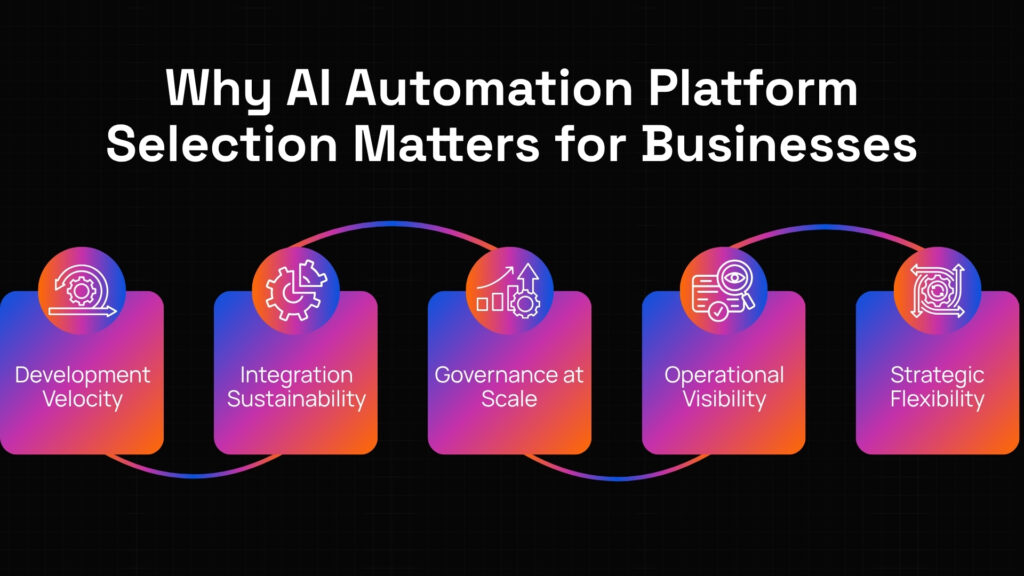
Why AI Automation Platform Selection Matters for Businesses
Choosing the right AI automation platform goes beyond evaluating features; it transforms how organizations build, govern, and scale intelligent workflows across departments and use cases. Platform decisions determine integration complexity, development velocity, and long-term flexibility. From orchestration capabilities and security frameworks to observability tools and portability options, the best AI automation tools deliver architectural foundations that enable systematic scaling while maintaining control, visibility, and the ability to change direction when business requirements evolve.
For technology and business leaders evaluating platforms, the decision impacts operations in five critical ways:
- Development Velocity: The right AI automation platform enables teams to ship workflows in days or weeks rather than months, with pre-built connectors, templates, and development frameworks that accelerate time to value.
- Integration Sustainability: Platform choices determine whether integration work compounds or simplifies over time, with event-driven architectures and idempotent patterns reducing technical debt as workflows scale across systems.
- Governance at Scale: Strategic AI automation software provides policy enforcement, approval workflows, and audit trails that maintain compliance and security as automation expands across sensitive processes and regulated data.
- Operational Visibility: The best AI tools deliver observability dashboards, decision traces, and performance metrics that enable teams to optimize systematically rather than troubleshooting blind or relying on vendor support for basic diagnostics.
- Strategic Flexibility: Platform portability features including exportable workflows, prompts, and policies ensure organizations can evolve their automation strategy without starting over or accepting vendor lock-in when requirements change.
Understanding which AI automation platform capabilities matter most is not about comparing feature lists; it’s about selecting architectural foundations that enable sustainable scaling, maintain control, and preserve strategic flexibility as automation programs mature.
Key Considerations When Choosing AI Automation Services
Selecting the right partner for platform-based automation requires careful alignment between vendor capabilities and your organization’s architectural requirements. The most successful platform deployments are built on a foundation of deep system integration, comprehensive observability, and clear ownership of automation assets that enable long-term flexibility and control.
Below are the core factors that should guide every AI automation platform decision:
- Business Outcomes & KPI Alignment: Every platform evaluation must connect directly to tangible operational metrics including cycle time, first-pass accuracy, exception rates, SLA adherence, and unit cost per workflow. Vendors should demonstrate how their AI automation software instruments these metrics from system-generated events, not manual reporting, and provide baseline comparison frameworks.
- Integration with Existing Systems: Effective automation platforms depend on robust connectivity with CRM, help desk, phone systems, ERP, and data platforms using event-driven patterns. The ideal AI automation platform ensures idempotency, retries, backoff strategies, and dead-letter queues for reliable execution, not just basic API connections that fail under production loads.
- Security and Compliance: Platform choices affect organizational security posture and regulatory compliance. Confirm that AI automation software maintains strict adherence to frameworks like ISO 27001, SOC 2, and GDPR with SSO, RBAC, field-level controls, regional data residency, encryption, redaction capabilities, and comprehensive audit logs including DPIA templates for regulated industries.
- Human-in-the-Loop (HITL) Flexibility: Successful automation platforms integrate human oversight systematically through confidence thresholds, approval queues, policy-based escalation, and approver analytics. Ensure that the best AI automation tools track when and why automation defers to humans, measuring queue SLAs and resolution patterns.
- Observability and Analytics: Transparency is essential for maintaining quality and troubleshooting issues as automation scales. A capable AI automation platform provides decision traces, versioned prompts and policies, regression test frameworks, and one-click rollback capabilities with timestamped release notes that support rapid issue resolution.
- Pricing Transparency and Flexibility: Insist on clear consumption models that enable accurate cost-per-workflow calculations. The right platform scales predictably with usage, instrumenting compute costs and alerting when thresholds trip, not creating budget surprises that erode ROI calculations and stakeholder confidence.
Choosing platforms with these capabilities ensures your automation investment delivers sustainable value and maintains strategic flexibility rather than creating technical debt or vendor dependency that limits future options.
The Impact of Integration Readiness
Before selecting any AI process automation platform, organizations must thoroughly assess their system architecture, data accessibility, and event instrumentation capabilities. Integration readiness is the process of evaluating how well existing systems expose APIs, capture events, and support reliable data flows needed for production automation. Skipping this assessment leads to underestimating integration complexity, overestimating platform capabilities, and discovering critical gaps months into implementation when switching costs become prohibitive. When teams conduct architecture reviews in advance, they uncover API limitations early, align IT and business stakeholders around realistic timelines, and make platform decisions based on actual technical constraints rather than vendor promises.
Example: A financial services technology team preparing to select an AI automation platform discovered that their legacy mainframe systems lacked REST APIs and their ticketing platform only supported polling, not webhooks. Understanding these constraints before vendor selection helped them evaluate platforms based on actual integration patterns rather than theoretical capabilities, avoiding a costly false start.
Pro Tip: Create an internal integration inventory that catalogs which systems provide REST APIs, which support webhooks, which require polling, and which need custom middleware. Share this assessment with platform vendors during initial conversations to ensure proposals address your actual architectural reality, not idealized integration scenarios.
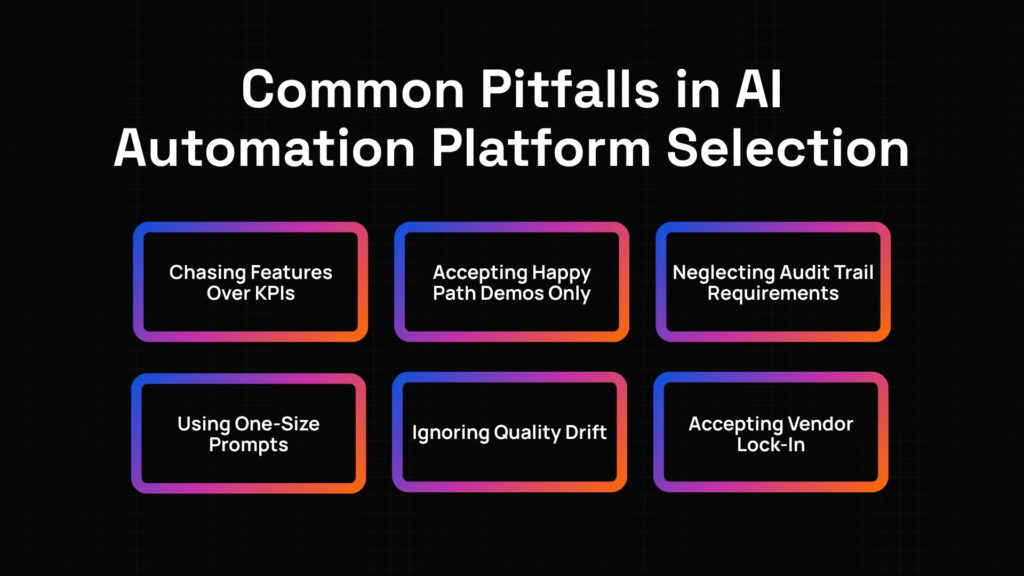
Common Pitfalls in AI Automation Platform Selection
Choosing an AI automation platform promises scalability and velocity, but poor evaluation processes and unrealistic expectations can create technical debt instead of strategic capabilities. Many organizations make avoidable mistakes during platform selection that lock them into inflexible architectures or force expensive migrations. To discover proven methodologies for evaluating platforms and avoiding common traps, explore our AI Workflow Automation Services page for detailed evaluation frameworks and architectural guidance.
- Chasing Features Over KPIs: Some organizations evaluate AI automation software based on feature completeness rather than proven ability to deliver specific business outcomes. Always tie platform scope to measurable KPIs and publish baselines before evaluation to ensure selection criteria reflect actual value delivery.
- Accepting Happy Path Demos Only: Vendors demonstrating the best AI automation tools showcase ideal scenarios with clean data and straightforward workflows. Demand to see how platforms handle malformed inputs, stale data, permission errors, rate limits, and integration failures that occur in production environments.
- Neglecting Audit Trail Requirements: Production automation requires comprehensive logging for troubleshooting, compliance, and optimization. Ensure that AI automation platforms log inputs, outputs, policy versions, and approver actions with timestamps, not just success/failure status that provides insufficient context.
- Using One-Size Prompts: Successful platforms support versioning by channel, risk class, and region rather than forcing global prompt templates. Look for AI tools that enable context-specific customization while maintaining governance and version control across variations.
- Ignoring Quality Drift: Automation quality degrades over time as data patterns shift and business rules evolve. Choose platforms that support living evaluation sets with pre-merge regression testing, not manual quality checks that cannot scale or maintain consistency.
- Accepting Vendor Lock-In: Platform decisions often become multi-year commitments due to workflow migration complexity. Contract explicit rights to export flows, prompts, policies, and test suites before kickoff, not discovering portability limitations when switching becomes necessary.
Evaluating the ROI of AI Automation Platform Selection
Quantifying the business value of platform choices requires tracking metrics that connect technology decisions to financial outcomes and operational efficiency. Measuring platform ROI goes beyond simple feature comparisons; it captures gains in development velocity, integration sustainability, governance effectiveness, and strategic flexibility. Without clear platform-specific metrics during evaluation, organizations risk selecting AI automation software based on subjective assessments that fail to predict actual business impact.
Key metrics to monitor when evaluating platforms include:
- Time to First Automation: Track how many days or weeks from platform access to first production workflow, measuring development velocity and learning curve steepness.
- Admin Time Per Change: Evaluate hours required per policy tweak or prompt modification to assess operational overhead as automation scales and business rules evolve.
- Change Failure Rate: Measure percentage of releases requiring rollback or hotfix to evaluate platform stability, testing frameworks, and deployment safety mechanisms.
- Cost Per Workflow: Calculate fully loaded cost including compute, vendor fees, and rework time to enable accurate ROI projections and budget planning.
- Adoption Rate: Track percentage of eligible teams actually using automations weekly to measure whether platforms deliver usability and value that drive organic adoption beyond pilot teams.
- Integration Sustainability: Assess whether adding new workflows or systems requires proportional integration effort or whether platform patterns enable reuse and acceleration over time.
According to Forrester TEI research, workflow automation platforms deliver 248 percent ROI over three years when properly implemented and measured. Related low-code platforms show 206 percent or higher ROI in composite studies. Deloitte finds that ROI leaders pair quick wins with disciplined governance and training rather than rushing to scale prematurely. Beyond financial metrics, the right AI automation platform also delivers operational transparency and strategic flexibility, two pillars of sustainable automation programs. When teams can see exactly how workflows perform, troubleshoot issues independently, and export assets when requirements change, they build automation capabilities that compound value over time rather than creating technical debt.
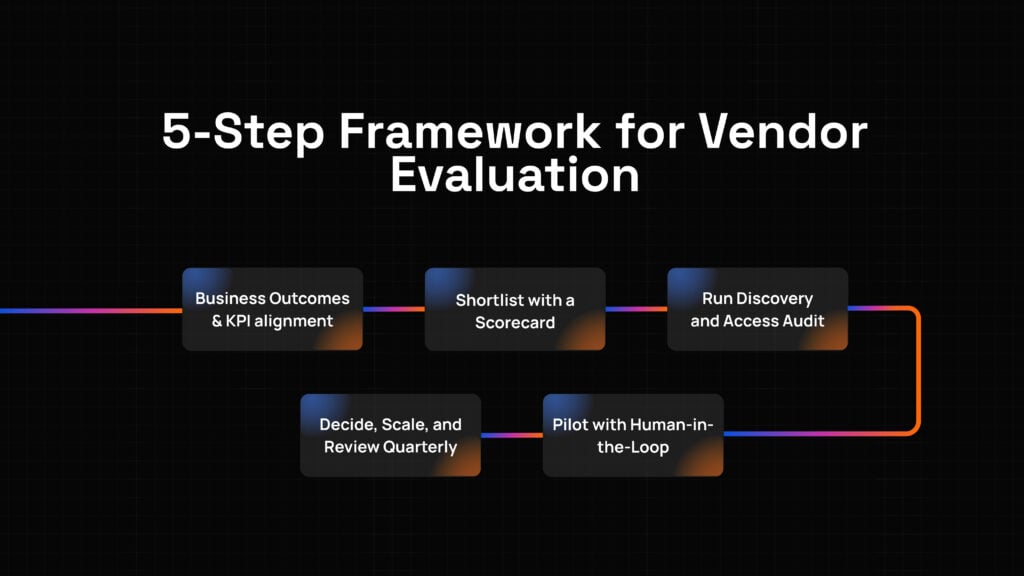
5-Step Framework for Vendor Evaluation
Selecting an AI automation platform should follow a disciplined process that prioritizes proven capability over promised features, actual integration patterns over theoretical connectivity, and demonstrated governance over architectural diagrams. Instead of focusing solely on breadth of capabilities, evaluation should weigh how well platforms enable systematic scaling while maintaining control, visibility, and strategic flexibility.
1. Business Outcomes & KPI Alignment
Start by clearly outlining which operational improvements will justify platform investment and how they will be measured from system-generated data. Defining specific KPIs and quality floors early helps align all stakeholders including technology leadership, operations teams, and finance, ensuring that platform selection focuses on outcomes rather than features. Your goals might include reducing ticket resolution time by specific percentages, maintaining CSAT above thresholds, or keeping policy violations below acceptable limits, but they must be tied to measurable baselines. This clarity becomes the foundation for evaluating whether AI automation software delivers business value or merely technical capability. Without defined success criteria, teams often select platforms based on impressive demonstrations that fail to translate into operational improvements.
Example: An IT operations team defined its primary KPI as “reducing ticket resolution time by 30 percent for top 3 request types within 60 days while maintaining CSAT and under 2 percent policy violations.” This single outcome guided platform evaluation, pilot design, and scaling decisions.
Pro Tip: Document one workflow and one number before requesting platform proposals. Add a quality floor to prevent optimizing for speed at the expense of accuracy or satisfaction. It keeps evaluation grounded in business impact rather than technical sophistication.
2. Shortlist with a Scorecard
Once measurement objectives are clear, move to structured platform comparison using a weighted scorecard that prioritizes integration reliability and rollback capabilities over UI polish. This tool allows teams to quantify how well each AI automation platform supports operational requirements through proven connectivity patterns, comprehensive observability, and asset portability. By assigning higher weights to integration depth and operational safety than feature completeness, decision-makers ensure selections support long-term sustainability. A disciplined scorecard approach removes subjectivity and ensures that even non-technical stakeholders understand which platforms enable reliable scaling versus those offering impressive demonstrations without production-grade foundations.
Example: One enterprise assigned 40 percent weight to integration reliability including event patterns, retries, and dead-letter queues, and 30 percent to observability and rollback capabilities, which helped eliminate platforms lacking production-grade operational features early.
Pro Tip: Request a 48-hour gap report from each vendor listing APIs, scopes, events, retries, and sample decision traces. Weight platforms based on actual integration patterns they demonstrate, not connectivity claims in marketing materials.
3. Run Discovery and Access Audit
Before contracts are signed, a structured discovery phase ensures that all architectural and operational details are surfaced early. During this phase, vendors should gain thorough understanding of your system schemas, event catalogs, approval matrices, and security requirements. It’s the stage where platform claims get tested against actual technical constraints and integration complexity becomes visible. Running an access audit alongside discovery verifies API scopes in sandbox environments, confirms least-privilege patterns, and identifies gaps requiring custom development. Request week-by-week implementation plans with risks, owners, and unblockers to understand true deployment complexity.
Example: A healthcare technology organization invited shortlisted platforms for one-week technical assessments, exposing missing webhook support and incomplete permission models before signing contracts, which prevented months of post-implementation workarounds.
Pro Tip: Confirm audit log locations and retention policies before granting production data access. Ask vendors to deliver technical readiness summaries that identify integration gaps, security requirements, and realistic timelines based on discovery findings.
4. Pilot with Human-in-the-Loop (HITL) and Dashboards
A well-designed pilot validates both platform capability and operational fit under real-world conditions. Instead of toy demonstrations, focus on limited production workflows to test whether the AI automation platform delivers on integration promises, maintains quality under load, and provides troubleshooting visibility teams need. Run 3 to 4 weeks on real data with human checkpoints, tracking cycle time, exception rate, rework frequency, and hours saved by team. Incorporating human oversight ensures measurement captures both automated and escalated work accurately. This phase is critical for proving that best AI automation tools maintain performance, reliability, and observability when conditions deviate from happy paths demonstrated during sales cycles.
Example: A customer service operations team piloted ticket triage using 100 real cases, publishing a single executive dashboard showing SLA adherence, escalation patterns, and hours saved by team, which secured expansion approval within 45 days based on clear proof points.
Pro Tip: Review dashboards daily during pilots with both operators and executives present. Early visibility builds confidence in platform capabilities and surfaces operational gaps before they undermine business cases or delay scaling decisions.
5. Decide, Scale, and Review Quarterly
After the pilot proves both platform capability and business value, use findings to guide final selection and create phased expansion plans. Scale to adjacent workflows only after KPI gains hold steady for 6 to 8 weeks and risk metrics stay inside acceptable guardrails, proving that performance is sustainable rather than pilot-specific. Continuous quarterly reviews between your team and vendor maintain operational discipline, ensuring the AI automation platform evolves alongside business priorities, system migrations, and regulatory changes. These sessions should assess whether integrations remain stable, identify optimization opportunities, and refine policies based on production learnings. Treat automation like products with versioned changes, regression tests, release notes, and deprecation policies.
Example: A financial services organization conducted quarterly platform reviews, expanding from support triage to billing exceptions only after hitting targets consistently, which maintained quality standards and stakeholder confidence throughout scaling.
Pro Tip: Maintain operational discipline by treating platform changes as product releases. Version prompts and policies, run regression tests before changes ship, and publish release notes that communicate improvements and breaking changes to stakeholders.
Next Steps in Your Evaluation Process
By now, you should have a clear understanding of which AI automation platform capabilities to prioritize and how to evaluate vendors based on proven capability rather than promised features. Bringing these insights together creates a structured selection process that de-risks platform investments and enables systematic scaling with maintained control and flexibility.
- Align on business metrics: Ensure platforms instrument cycle time, accuracy, exception rates, and cost per workflow from system-generated events, not manual reporting that cannot scale.
- Evaluate integration patterns: Confirm that AI automation software demonstrates event-driven architectures with idempotency, retries, and dead-letter queues, not just basic API connectivity.
- Focus on operational visibility: Choose platforms that provide decision traces, version control, regression testing, and rollback capabilities, not black-box systems requiring vendor support for troubleshooting.
- Review asset ownership: Favor platforms that enable exporting workflows, prompts, policies, and evaluation sets, preserving strategic flexibility when requirements evolve.
- Test with production scenarios: Always pilot with real data including edge cases and failure modes before committing to enterprise-wide deployment and multi-year contracts.
With these criteria in place, you are better equipped to identify AI tools that enable sustainable automation programs, deliver measurable business value, and preserve strategic flexibility as requirements and technologies evolve.
Vendor Questions to Ask
To make the most informed decision during AI automation platform evaluation, be sure to ask these essential questions:
- Which KPIs will you instrument on day one and where do those event signals originate in our system architecture?
- How do you implement idempotent patterns, retry logic, and dead-letter queues for reliable execution under production conditions?
- What sample decision logs can you provide showing inputs, outputs, confidence scores, policy versions, and approver actions with timestamps?
- How do you calculate cost per workflow and provide instrumentation that enables ongoing financial tracking and optimization?
- What regression tests run before prompt or policy changes ship to production environments?
- Can we export workflows, prompts, policies, evaluation sets, and architecture diagrams on demand without vendor assistance?
- What is your rollback plan if error rates or SLA metrics degrade after platform updates or configuration changes?
Build Sustainable Automation with the Right AI Automation Platform
Selecting an AI automation platform is not just a technology decision; it’s a strategic investment that determines development velocity, operational sustainability, and long-term flexibility for years. The right platform brings systematic scaling capabilities, comprehensive governance, and strategic flexibility across automated workflows, while poor platform choices create technical debt that compounds over time and limits future options.
Ready to select the right AI automation platform for your unique requirements? Book a Free Strategy Call with us to explore the next steps and discover how we can help you evaluate platforms, design pilots, and build automation programs that deliver sustainable business value with maintained control and flexibility.