
The Power of AI Automation vs RPA: Why It Matters
AI automation vs RPA represents a fundamental shift in how organizations handle process automation, moving from brittle rule-based scripts to intelligent systems that adapt to changing business conditions. Operations teams implementing modern AI automation platform solutions are fundamentally reimagining how work flows through their organizations, how exceptions get handled, and how automation evolves alongside business requirements. Advanced AI automation and RPA hybrid approaches now manage workflows that once required constant script maintenance or complete rebuilds, enabling teams to focus on process optimization, strategic initiatives, and innovation that drive competitive advantage and operational efficiency.
The data supporting this transformation continues to strengthen across industries and functions. According to McKinsey research, generative and predictive AI can boost productivity at scale with annual potential value estimated at up to $4.4 trillion across functions, representing unprecedented economic impact when automation combines intelligence with execution. Salesforce research shows service volumes and customer expectations keep rising, with leaders leaning into AI to cut resolution time and costs as traditional approaches struggle to scale efficiently. However, only 42 percent of customers trust businesses to use AI ethically according to Salesforce data, underscoring the critical importance of responsible AI policies, transparent data practices, and governance frameworks that build rather than erode customer confidence.
Why AI Automation vs RPA Matters for Operations Teams
AI automation platform solutions go beyond fixed rule execution; they transform how organizations manage process variability, handle exceptions intelligently, and maintain automation effectiveness as business conditions evolve. Legacy RPA workflows that once created bottlenecks through brittle scripts breaking when inputs change, maintenance overhead consuming IT capacity, and inability to handle nuanced decisions can now be upgraded with AI automation and RPA hybrids that learn from data, adapt to exceptions, and escalate gracefully. From resolving customer inquiries autonomously to processing transactions with confidence thresholds, AI automation consulting helps organizations identify which processes benefit from intelligent upgrade versus remaining as stable rule-based scripts.
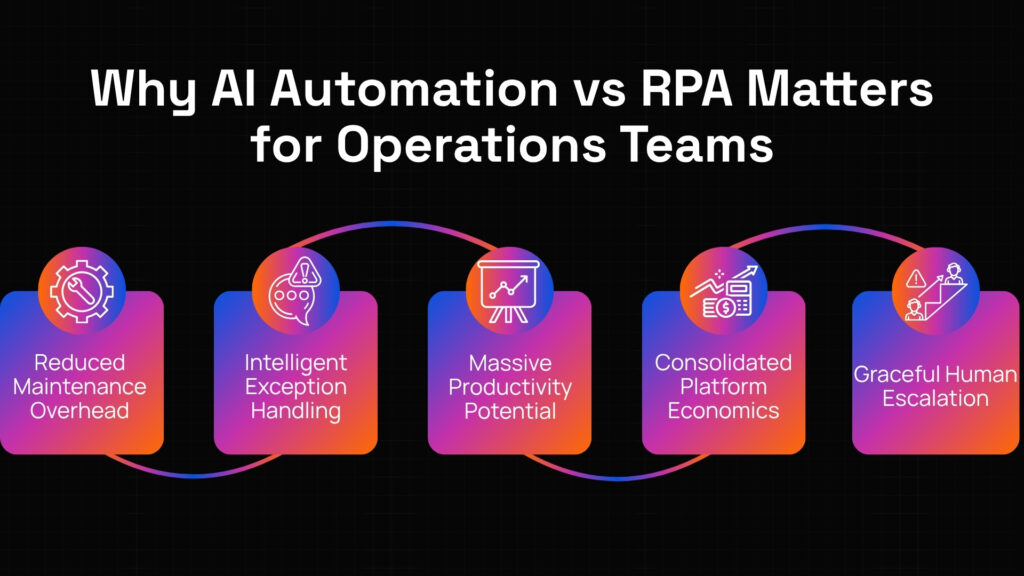
For operations leaders evaluating AI automation vs RPA strategies, the benefits manifest in five critical ways:
- Reduced Maintenance Overhead: AI automation platform solutions handle process variations and exceptions through learned patterns rather than hard-coded rules, dramatically reducing the script maintenance burden that consumes IT capacity when business processes evolve, data formats change, or new edge cases emerge requiring developer intervention to update brittle RPA logic.
- Intelligent Exception Handling: Advanced systems apply confidence thresholds and learned decision patterns to process exceptions autonomously when possible or escalate to human reviewers with complete context when uncertainty is high, unlike traditional RPA that breaks on unexpected inputs or routes all exceptions uniformly without intelligence about complexity or risk.
- Massive Productivity Potential: McKinsey estimates up to $4.4 trillion in annual value across functions from generative and predictive AI at scale, representing exponentially greater impact than traditional RPA limited to repetitive tasks with fixed rules, as intelligence enables automation of judgment-based work previously requiring human analysis.
- Consolidated Platform Economics: Forrester research demonstrates substantial ROI when organizations consolidate automation onto modern platforms and retire duplicate legacy tooling that creates licensing sprawl, integration complexity, and operational fragmentation, with AI automation and RPA hybrid approaches enabling rationalization while preserving existing investments where appropriate.
- Graceful Human Escalation: Best AI automation platform maintains complete process context including data gathered, decisions made, and confidence scores, enabling smooth handoffs to human agents with sufficient information to continue workflows without restarting, unlike traditional RPA that often fails silently or errors without context about what succeeded before breakage.
AI automation vs RPA is not about completely replacing existing automation; it is about strategic upgrade of processes suffering from change, exceptions, and data variety while keeping stable RPA where rules remain static and maintenance remains low, creating hybrid architectures that optimize total cost of ownership.
Key Considerations When Choosing AI Automation Consulting Partners
Selecting the right AI automation platform requires careful alignment between technology capabilities and operational requirements. The most successful AI automation and RPA implementations are built on a foundation of transparency, deep system integration, and measurable impact on critical metrics like time to resolution, cost per transaction, and error rates.
Below are the core factors that should guide every AI automation vs RPA decision:
- Business Outcomes & KPI Alignment: Every AI automation consulting engagement must connect directly to tangible operational metrics, whether that is reducing time to resolution by specific percentages, decreasing cost per transaction, lowering error rates, or improving throughput. Tie scope to 2 to 3 measurable targets that vendors can instrument and prove through baselines, not vague efficiency promises disconnected from measurable impact.
- Integration with Existing Systems: Effective AI automation platform depends on seamless connectivity with your CRM, help desk platforms, phone systems, treasury management systems, ERP, and data warehouses. Confirm read-write capabilities and event hooks with vendors, and ask for reference architectures demonstrating how integration works in production environments similar to yours with comparable system complexity.
- Security and Governance: AI automation and RPA handles sensitive business data and customer information requiring strict controls. Require comprehensive audit trails logging all automated actions, role-based access controls, encryption in transit and at rest, PII handling procedures, responsible AI policies addressing ethical use, and model usage logs supporting compliance and trust, as only 42 percent of customers trust businesses to use AI ethically according to Salesforce.
- Human-in-the-Loop (HITL) Flexibility: Successful AI automation consulting always includes agent oversight mechanisms for decisions requiring human judgment or situations where confidence drops below thresholds. Mandate graceful handoff to agents with full process context, conversation history, data gathered, and confidence indicators so representatives can continue workflows without forcing customers to repeat information or restart processes.
- Observability and Analytics: Transparency is essential when scaling AI automation platform across process volume. A capable vendor provides complete traces showing decision logic and system interactions, live dashboards tracking success rates and error patterns, evaluation sets measuring accuracy against known scenarios, prompt and policy versioning with change history, and easy rollback capabilities when updates degrade performance.
- Pricing Transparency and Flexibility: Document usage drivers including transaction volumes, model inference costs, integration counts, and who owns prompts, automation flows, evaluation sets, and voice or chat assets developed during implementation. Understanding AI automation vs RPA economically helps forecast costs accurately as volumes scale and ensures intellectual property remains with your organization.
Choosing AI automation consulting partners who understand these requirements ensures your investment delivers sustainable improvements rather than creating technical debt, vendor lock-in, or governance gaps that limit future flexibility when business processes or technology stacks evolve.
The Impact of Integration Readiness
Before launching any AI automation platform initiative, organizations must thoroughly assess their process documentation quality, system integration landscape, and data governance completeness. Integration readiness evaluates how well existing business processes, data sources, and operational procedures can support intelligent automation without creating chaos or poor outcomes. When operations teams conduct integration audits in advance, they uncover data quality gaps and process instability early, align IT and business stakeholders around connectivity requirements, and minimize wasted time during vendor discovery and pilot phases.
Example: A support team preparing for AI automation vs RPA migration discovered that their top 10 automation candidates had inconsistent input validation creating data quality issues, their CRM lacked webhook support for real-time status updates, and their escalation procedures mixed simple routing rules with judgment-based decisions requiring human assessment. Addressing these integration readiness issues before vendor engagement reduced the overall project timeline by eight weeks and enabled their pilot to achieve target 20 percent reduction in average handle time on order-status calls.
Pro Tip: Stabilize process inputs first with validations and guardrails before automating chaos. Map your top 10 automations by volume, cost, and breakage frequency to identify which processes suffer most from brittleness. Share five anonymized transcripts or process logs with vendors for evaluation design so they understand actual complexity rather than idealized scenarios. Run the Integration Readiness Checklist to spot blockers in data quality, access controls, and governance before shortlisting vendors.
Common Pitfalls in AI Automation and RPA Migrations
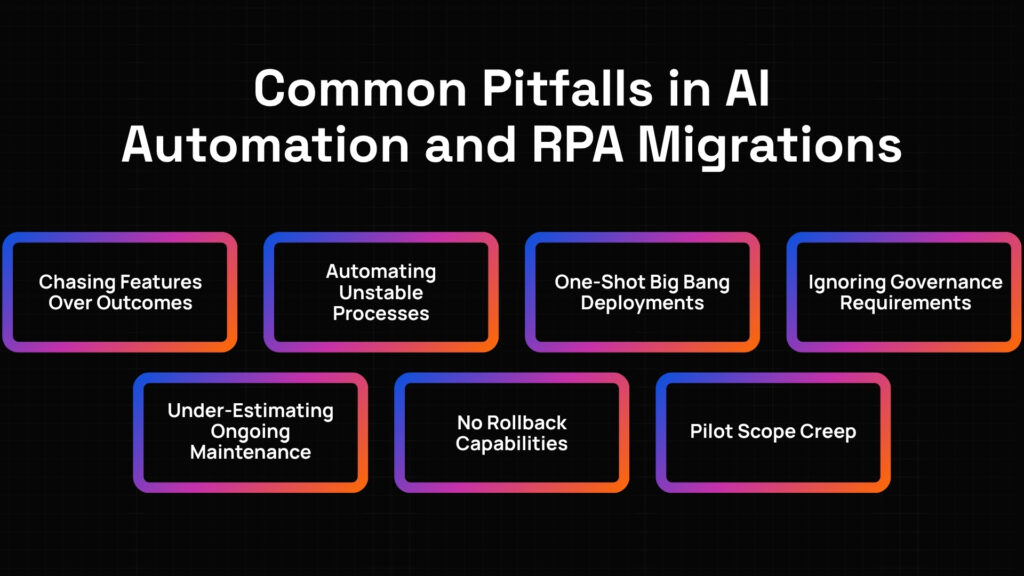
AI automation consulting promises resilience and intelligence, but poor planning and inadequate governance can create implementation failures instead of operational improvements. Many organizations make avoidable mistakes during migration that delay value realization and erode both team and leadership trust. To discover proven methodologies tailored for your process workflows and operational requirements, explore our AI Workflow Automation Services page for detailed AI automation platform frameworks and real-world implementation guidance.
- Chasing Features Over Outcomes: Some organizations select AI automation and RPA solutions based on impressive capability demonstrations rather than measurable business impact. Anchor evaluation to 2 to 3 KPIs for go/no-go decisions including time to resolution, cost per transaction, or error rate reduction rather than feature checklists disconnected from operational value.
- Automating Unstable Processes: A technically advanced AI automation platform can still fail if underlying processes are chaotic. Stabilize process inputs with data validations and business rule guardrails before migration, as automating broken processes just creates automated chaos that undermines confidence in intelligent automation approaches.
- One-Shot Big Bang Deployments: Organizations attempting to migrate all RPA processes simultaneously create impossible complexity and risk concentration. Pilot focused scenarios first, then phase rollout by queue, business line, or geography to isolate impact, validate assumptions, and build organizational confidence before scaling investment.
- Ignoring Governance Requirements: Deploying AI automation consulting without controls creates compliance and trust violations. Bake in audit logging, consent management, PII retention policies from day one as only 42 percent of customers trust businesses to use AI ethically according to Salesforce, making transparent governance essential for maintaining customer relationships.
- Under-Estimating Ongoing Maintenance: Organizations treating AI automation vs RPA as one-time projects face performance degradation over time. Budget capacity for prompt updates addressing new scenarios, evaluation runs detecting accuracy drift, and periodic checks ensuring automation adapts as business rules, data formats, and customer expectations evolve.
- No Rollback Capabilities: Deploying AI automation platform without version control creates recovery nightmares when updates degrade performance. Keep versioned flows, prompt libraries, and policy configurations with documented procedures to revert to previous versions in minutes when issues emerge, preventing extended outages during troubleshooting.
- Pilot Scope Creep: Expanding pilot definitions during evaluation makes measuring success impossible. Freeze scope for 2-week periods to stabilize automation performance and document operational runbooks before expanding to adjacent processes or additional business units, ensuring lessons learned inform subsequent phases.
Evaluating the ROI of AI Automation Platform
Quantifying the benefits of AI automation vs RPA helps secure executive buy-in and refine future investments in process automation. Measuring ROI goes beyond simple task completion; it captures gains in maintenance reduction, exception handling, throughput improvement, and cost efficiency. Without clear metrics during evaluation, AI automation consulting projects risk becoming feature-heavy implementations with unclear business outcomes that fail to justify ongoing operational expenses and licensing costs.
Key metrics to monitor include:
- Maintenance Cost Reduction: Track the decrease in developer hours required to maintain automation as business processes evolve when AI automation platform handles variations through learned patterns rather than hard-coded rules, with leading migrations reducing maintenance overhead by 40 percent or more within 90 days by eliminating brittle script updates.
- Exception Handling Improvement: Measure the increase in process completion rates when AI automation and RPA intelligently handles exceptions using confidence thresholds and escalation logic, calculating the percentage of previously-failed transactions now completing autonomously compared to legacy RPA that broke on unexpected inputs.
- Cost Per Transaction Optimization: Evaluate total operational costs including platform licensing, model inference, maintenance labor, and escalation handling divided by successful transactions to calculate unit economics, with successful migrations achieving 18 percent or greater cost per contact reduction within 90 days through consolidated platforms and retired legacy tooling.
- Time to Resolution Improvement: Compare average processing duration before and after AI automation platform implementation, targeting 20 percent or greater reduction in resolution time on targeted processes like order-status calls through intelligent automation that eliminates manual lookups, system navigation delays, and exception handling bottlenecks.
- Productivity Value Realization: Assess progress toward McKinsey’s estimated $4.4 trillion annual value potential from generative and predictive AI at scale, calculating incremental gains as intelligent automation expands from narrow use cases to broader process coverage while maintaining quality and governance standards.
- Platform Consolidation Savings: Review licensing and operational cost reductions when migrating from fragmented RPA tools to unified AI automation platform, as Forrester research demonstrates substantial ROI from retiring duplicate legacy tooling that creates integration complexity, skill fragmentation, and vendor management overhead.
According to McKinsey research, AI productivity potential reaches $4.4 trillion annually across functions at scale. Salesforce shows leaders using AI to cut resolution time as volumes rise, but only 42 percent of customers trust ethical AI use. Salesforce State of Service highlights rising case resolution expectations. Forrester demonstrates ROI from platform consolidation. Gartner reports accelerating automation penetration. When every AI automation vs RPA interaction logs decision logic, confidence scores, escalation triggers, and outcomes, every prompt change maintains version history with rollback capabilities, and every process includes appropriate human oversight for judgment-based decisions, organizations build trusted automation operations that scale without sacrificing quality or creating governance vulnerabilities that erode customer confidence.
A Practical 90-Day Plan for AI Automation vs RPA Migration
Organizations need structured migration approaches that prove value quickly while managing risk. This 90-day framework enables controlled transition from legacy RPA to modern AI automation platform with measurable milestones and clear decision gates.
0–30 Days: Define KPI and Inventory the Estate
Start by mapping your top 10 automations by volume, cost, and breakage frequency to identify which processes suffer most from brittleness. Choose 2 processes with high rework rates and stable data availability to pilot, avoiding overly complex scenarios that delay learning. Define measurable outcomes targeting specific improvements.
Example: A support team analyzing their automation portfolio identified order-status calls as highest volume with 18 percent failure rate due to data format variations. They set target of 20 percent reduction in average handle time within 90 days with satisfaction scores maintained above 4.0 out of 5.0. Limit scope to one channel and one integration first to isolate variables and prove approach before expanding complexity.
Pro Tip: Cap KPIs at three so teams stay focused on proving core value rather than optimizing multiple dimensions simultaneously. Use Salesforce benchmarks showing AI expected to handle 30 percent of cases in 2025 rising to 50 percent by 2027 as directional guidance, not promises, validating your specific context through controlled pilots.
31–60 Days: Pilot with HITL and Dashboards
Stand up an AI automation consulting sandbox environment, connect to your CRM and help desk systems, and import bot logs for training and evaluation set development. Configure confidence thresholds determining when automation proceeds versus escalates, and implement human escalation with complete context transfer.
Example: The support team piloted FAQ resolution autonomously while escalating policy exceptions to agents with conversation history and confidence scores. They resolved 32 percent of inquiries without escalation while maintaining 4.1 out of 5 satisfaction scores, identifying 7 knowledge gaps requiring content updates. Treat pilot reviews as training data to update prompts and policies based on actual patterns.
Pro Tip: Configure confidence below 0.75 to route to agents with bot context attached. Review misfires every Friday analyzing root causes, then ship prompt fixes Monday addressing identified gaps. Weekly evaluation cycles enable rapid iteration while maintaining quality control, with McKinsey emphasizing that sustained AI adoption links to disciplined data and change practices, not tooling alone.
61–90 Days: Scale, Then Harden
Expand to one adjacent process or geographic region after meeting success criteria consistently for 2 to 3 weeks. Lock observability including success rates, abandonment patterns, cost per outcome, and conduct rollback tests validating reversion procedures.
Example: After 6 weeks meeting targets, the team expanded from order-status to returns eligibility using the same governance framework and achieving 28 percent autonomous resolution. They froze scope for 2 weeks to stabilize performance and document operational runbooks before planning next expansion phase. Scale by surface area based on proven results, not hype or vendor promises.
Pro Tip: Expand to billing inquiries only after meeting SLA targets 3 consecutive weeks, validating stability before introducing new complexity. Quarterly refreshes keep prompts and policies aligned with new business rules, product launches, and customer behavior patterns as AI’s macro productivity lift requires ongoing change management and upskilling according to McKinsey research.
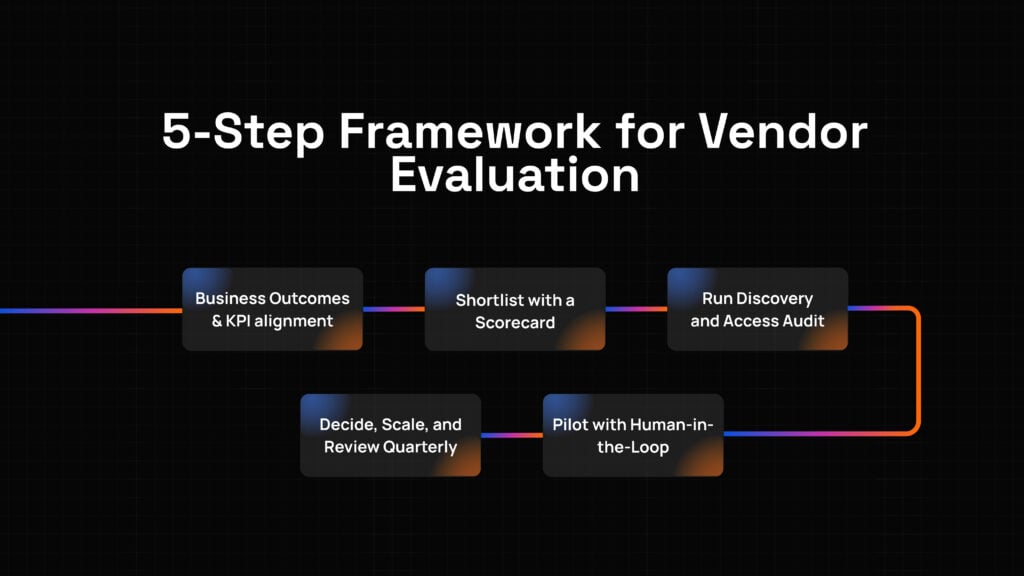
5-Step Vendor Framework for AI Automation vs RPA
Selecting an AI automation platform vendor should follow a disciplined, structured process that aligns with your organization’s operational goals while accounting for both technological depth and long-term partnership potential. Instead of focusing solely on impressive demonstrations or lowest price, evaluation should weigh how well the vendor’s AI automation consulting approach supports measurable outcomes, integrates with existing systems, and adapts to evolving business requirements.
1. Define KPI and Scope
Start by targeting measurable outcomes and documenting success criteria with no more than three KPIs so teams stay focused. Defining specific targets helps align all stakeholders including operations leadership, IT departments, process owners, and agent teams. Your goal might be reducing cost per contact by 18 percent within 90 days, improving time to resolution, or lowering error rates, but it must be quantifiable. This clarity becomes the foundation for every subsequent decision about AI automation and RPA, shaping both vendor conversations and internal buy-in.
Example: A financial services company defined its KPI as “reducing cost per contact by 18 percent within 90 days while maintaining first-contact resolution above 85 percent.” This metric guided every vendor discussion, shaped pilot design, and became the benchmark for success measurement. Salesforce reports AI expected to handle 30 percent of cases in 2025 rising to 50 percent by 2027, providing directional benchmarks to validate through your specific pilots.
Pro Tip: Document one to three measurable operational outcomes before requesting proposals. Focus on time to resolution, cost per transaction, or error rate tied to efficiency rather than vanity metrics like total transactions processed, and cap pilot scope to specific process types so impact attribution remains clear during evaluation.
2. Shortlist with a Scorecard
Once objectives are clear, move to structured vendor comparison using a weighted scorecard for evaluating AI automation platform providers. This tool allows teams to quantify how well each vendor aligns with priorities including proven outcomes in similar contexts, integration depth, governance frameworks, and data portability. By assigning weights to each factor, decision-makers can balance technical capability with operational impact and long-term flexibility. A disciplined scorecard approach removes bias and keeps evaluation objective.
Example: One enterprise assigned 40 percent weight to outcomes fit validated through reference customers, 25 percent to integration depth with existing systems, 20 percent to governance and observability capabilities, and 15 percent to portability and IP ownership, helping eliminate vendors lacking production-ready connectors early. Keep ratings numeric to reduce bias in scoring.
Pro Tip: Weight outcomes fit at 40 percent, integration at 25 percent, governance at 20 percent, and portability at 15 percent to emphasize business results over feature counts. Rate each vendor numerically on criteria to enable objective comparison. Gartner reports automation penetration accelerating across enterprises, signaling organizational readiness for scaled programs when vendor selection is disciplined.
3. Run Discovery and Access Audit
Before contracts are signed, a structured discovery phase provides vendors with sample data, role access definitions, and process sequence diagrams so they can validate assumptions with actual complexity. During this phase, teams test integration capabilities with real system versions, surface data quality gaps requiring remediation, and confirm security controls. Running an access audit with representative scenarios rather than idealized demos uncovers limitations early.
Example: A week-long sandbox evaluation with real process logs exposed legacy data-mapping gaps before go-live, revealing that vendor B’s claimed integration required 40 hours of custom development not included in base pricing. Share five anonymized transcripts or logs for evaluation design. McKinsey finds sustained AI adoption links to disciplined data and change practices, not tooling alone.
Pro Tip: Provide vendors with controlled sandbox access to representative sample data including edge cases and exception scenarios, not just happy-path examples. Validate that claimed integrations work with your specific CRM version, help desk configuration, and data formats. Transparency early about customization requirements prevents scope creep during implementation when budgets are committed.
4. Pilot with HITL and Dashboards
A well-designed pilot validates both technology performance and operational readiness under real conditions. Instead of full-scale deployment, launch in one queue or process area with weekly evaluation cycles, human escalation procedures, and rollback capabilities. Incorporating human-in-the-loop oversight ensures AI automation vs RPA outcomes align with quality standards and business requirements.
Example: A logistics company piloted returns processing with confidence below 0.75 routing to agents with complete process context, running 8-week evaluation with weekly misfire reviews and achieving 26 percent autonomous completion with 4.0 out of 5 agent satisfaction scores. Review misfires every Friday and ship prompt fixes Monday. Forrester TEI studies show large ROI when consolidating automation on single platforms and retiring legacy tooling, which pilots should validate with your unit economics.
Pro Tip: Launch pilots with frozen scope, clear success criteria, weekly evaluation cycles analyzing failure patterns, and documented rollback procedures. Include human escalation monitoring, live dashboards tracking success rates and costs, and agent feedback sessions. Use pilot period to refine prompts based on actual scenarios, train teams on new workflows, and validate integration stability before scaling investment.
5. Decide, Scale, and Review Quarterly
After the pilot proves value, use findings to guide the final decision and create a phased expansion plan for AI automation platform deployment. Scaling should be deliberate, expanding by surface area based on proven results rather than hype, with training, handover documentation, and clear ownership transferred to internal teams. Continuous quarterly reviews maintain alignment, ensuring the technology evolves alongside business rule changes, process updates, and operational requirement shifts.
Example: A healthcare payer conducted quarterly reviews with its AI automation consulting partner, expanding successful eligibility verification automation to claims status and prior authorization over 12 months, identifying prompt optimization opportunities that improved autonomous completion by 11 percentage points while reducing cost per transaction by 19 percent. Quarterly refreshes keep prompts and policies aligned with new rules as AI’s productivity lift requires change management according to McKinsey.
Pro Tip: Treat vendor reviews as strategic sessions focused on expanding successful AI automation and RPA use cases to adjacent processes and optimizing governance, not just maintenance calls about system uptime. Lock training and handover so your team can operate day 2 without consultants. Scale only after meeting SLA targets consistently, and use quarterly reviews to refresh prompts, update policies, and assess performance against evolving benchmarks.
Costs to Expect During Migration
Understanding financial requirements helps budget accurately and set realistic expectations for AI automation vs RPA migration:
- Discovery and Data Access: Time investment to map existing systems, sanitize process logs for vendor evaluation, and align single sign-on plus role-based access controls ensuring security while enabling integration testing and validation.
- Pilot Build: Development costs for automation flows, prompt engineering, evaluation set creation, human escalation logic, and integration configuration connecting AI automation platform to CRM, help desk, and data sources with appropriate read-write permissions.
- Change and Enablement: Training programs for agents and analysts covering new playbooks, dashboard interpretation, escalation procedures, and quality monitoring ensuring teams understand their evolving roles and can operate automation confidently without consultant dependency.
- Run and Tune: Ongoing operational costs including weekly evaluation cycles, prompt and policy updates addressing new scenarios, model or tool licensing, and infrastructure expenses, with Forrester research pointing to material savings when consolidating onto modern platforms and retiring duplicate legacy tools but requiring quantification using your specific volumes and SLA targets.
Risk Controls That Keep You Safe
Implementing governance safeguards protects operations during AI automation and RPA migration:
- Version Everything: Maintain version control for prompts, policies, automation flows, and system connectors enabling rollback to previous configurations when updates degrade performance or introduce errors, with documented change history supporting audit and troubleshooting.
- Golden Datasets: Lock evaluation sets so accuracy scores remain comparable over time, preventing false confidence from changing test scenarios and enabling objective assessment of whether prompt updates actually improve versus degrade performance on representative cases.
- Guardrails: Implement confidence thresholds determining automation versus escalation decisions, PII filters preventing exposure of sensitive data, and safe response templates for ambiguous situations ensuring customer interactions remain appropriate even when uncertainty is high.
- Traceability: Store conversation or process run traces with complete decision logs supporting compliance audits, quality reviews, and continuous improvement analysis, as responsible AI and clear data practices are table stakes with customer trust at historic lows and scrutiny rising according to Salesforce.
- Rollback Drills: Practice reverting to previous automation versions in minutes through documented procedures and tested recovery paths, ensuring teams can respond quickly when issues emerge rather than scrambling during outages with untested reversion approaches.
Next Steps in Your Evaluation Process
By now, you should have a clear understanding of what to prioritize when selecting an AI automation consulting partner. Bringing these insights together creates a structured evaluation flow that de-risks investment and accelerates migration while ensuring long-term operational excellence.
- Align with operational metrics: Ensure every capability connects to specific KPIs like time to resolution, cost per transaction, or error rate tied to efficiency, not just automation coverage percentages disconnected from business outcomes and customer experience quality.
- Evaluate integration architecture: Confirm that AI automation platform works smoothly with your CRM, help desk, ERP, and data warehouse through read-write capabilities and event hooks, with reference architectures demonstrating production deployments in similar contexts with comparable system complexity.
- Focus on governance and trust: Choose vendors with comprehensive audit trails, role-based access, responsible AI policies, and transparent data practices, as only 42 percent of customers trust businesses to use AI ethically according to Salesforce, making governance essential for maintaining customer relationships.
- Review enablement and ownership: Favor partners who provide playbooks, training programs, handover documentation, and operational runbooks ensuring your team can run day 2 without consultants, building internal capability rather than creating perpetual dependency on external resources.
- Test with controlled pilots: Always run 90-day pilots with clear KPIs, weekly evaluation cycles, human escalation monitoring, and rollback capabilities before full migration to validate maintenance reduction, exception handling, and cost improvements under real-world operational conditions with actual process complexity.
With these criteria in place, you are better equipped to identify AI automation vs RPA partners who not only upgrade processes but also reduce maintenance overhead, improve exception handling, unlock productivity value, and build organizational confidence in intelligent automation approaches.
Vendor Questions to Ask
To make the most informed decision during your AI automation platform evaluation, be sure to ask these essential questions:
- How do you design migration from brittle RPA to resilient AI tasks while preserving existing controls, audit trails, and compliance frameworks?
- Which connectors support read-write events for our CRM, help desk, phone system, treasury management system, and ERP, and can we see working reference architectures from similar deployments?
- What observability do we get out of the box including traces, evaluation suites, drift alerts, and single-click rollback capabilities?
- How is human-in-the-loop configured and measured, and what is your escalation SLA ensuring smooth handoffs when automation confidence drops below thresholds?
- Can we export prompts, policies, datasets, and process diagrams at any time without professional services fees or vendor lock-in restrictions?
- What is your data retention policy and how do you handle PII masking, consent management, and compliance with regional privacy regulations?
- What training and handover are included so our team can operate day 2 without ongoing consultant dependency, and what does your enablement program cover?
- What assumptions drive variable costs including transaction volumes and model usage, and how do you model cost per resolved outcome for our specific processes?
- Can I speak to two customer references with similar migration scope and system complexity who can discuss measured maintenance reduction and implementation challenges?
Transform Operations with AI Automation Platform
AI automation vs RPA is not just a technological upgrade; it is a strategic operational capability that requires careful planning, vendor selection, and disciplined execution. The right implementation brings resilience, intelligence, and adaptability across your process workflows, while poor migration creates implementation failures, integration chaos, and wasted investment that undermines organizational confidence.
Ready to transform your operations with AI automation vs RPA? Book a Free Strategy Call with us to explore the next steps and discover how we can help you scope, pilot, and scale the right AI automation platform solution for your unique process workflows, system environment, and measurable business outcomes.