

The Power of AI Automation vs RPA: Why the Difference Matters
In 2025, the landscape of AI automation vs RPA has evolved from simple rule-based scripts to intelligent, adaptive systems that learn, predict, and improve.. Yet one question continues to surface across boardrooms: AI automation vs RPA, what’s the difference and which delivers more value today? At first glance, both promise faster processes and lower costs. However, the real distinction lies in intelligence. RPA, or Robotic Process Automation, follows fixed rules and scripts, performing repetitive actions with precision but without understanding. AI automation, on the other hand, goes beyond execution, it recognizes context, learns patterns, and adapts autonomously.
A Deloitte study on Intelligent Automation found that organizations combining AI automation with RPA achieve 2.5 times more sustainable efficiency gains than those relying solely on RPA. This shows that while RPA forms the foundation of digital transformation, AI automation is what gives it adaptability, decision-making power, and long-term scalability. Businesses that understand the dynamics of AI automation vs RPA are redefining efficiency, moving from workflows that merely follow instructions to systems that think strategically.
Why AI Automation vs RPA Matters for Businesses
For many years, RPA was the go-to solution for companies seeking immediate wins in process automation. It worked perfectly for structured, repetitive tasks, like invoice processing, data transfers, or compliance checks, where rules never change. However, 2025 brings new realities. Businesses now deal with unstructured data, rapid customer interactions, and market fluctuations that RPA alone cannot interpret. AI automation bridges this gap by adding intelligence, enabling systems to adapt to changing conditions rather than breaking under them.
Organizations that continue to rely solely on RPA often hit scalability walls. Every process variation requires new coding or bot adjustments. AI automation overcomes this by learning from historical data and self-adjusting, reducing maintenance costs and unlocking predictive capability. For leaders, this shift means automation is no longer about labor replacement; it’s about decision acceleration. With AI automation, workflows evolve dynamically, allowing human talent to focus on creativity, problem-solving, and innovation rather than repetitive supervision.
What is the difference between AI automation and RPA?
Let’s break down the distinction clearly:
- RPA (Robotic Process Automation) is rule-based. It mimics human actions in structured environments, clicking buttons, entering data, and transferring information between systems.
- AI automation is cognitive. It interprets unstructured input such as text, voice, or images, and makes decisions based on learned logic.
Think of RPA as a digital worker that performs instructions precisely, and AI automation as the brain that interprets when and how those instructions should evolve.
Example:
An HR department might use RPA to automatically generate offer letters. But when paired with AI automation, the system could analyze candidate sentiment, check policy compliance, and predict likelihood of acceptance, all without human input.
Challenges with Traditional RPA Systems
While RPA offers efficiency, understanding its limitations is critical when comparing AI automation vs RPA at scale.
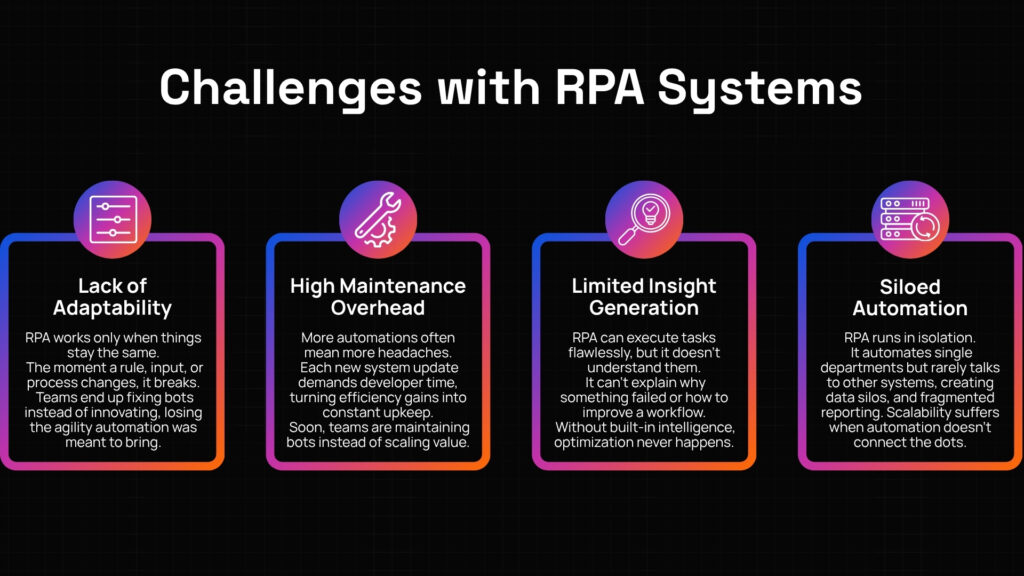
1. Lack of Adaptability
RPA thrives on predictability. The moment an input format changes, a new rule is introduced, or an exception occurs, most bots simply stop functioning. This rigidity means even small updates, like an altered data field or new approval step, require developer intervention. Over time, this slows teams down and undermines the agility that automation was meant to provide.
2. High Maintenance Overhead
As organizations expand their automation footprint, maintenance quickly becomes a hidden cost. Each new workflow or platform change demands updates to existing scripts. Instead of reducing workload, teams often find themselves managing dozens of interdependent automations that need constant oversight. The effort spent maintaining RPA logic can offset much of its initial efficiency gain.
3. Limited Insight Generation
RPA executes instructions with precision but lacks contextual understanding. It can tell you what it did, but not why outcomes differ from expectations. Because it doesn’t analyze the data it handles, RPA provides no deeper insight into process inefficiencies or potential optimizations. As a result, companies often rely on separate analytics systems to make sense of what their automations are producing.
4. Siloed Automation
Traditional RPA typically operates in isolation, automating one process or department at a time. It rarely communicates with other systems or workflows, which limits its scalability and strategic value. This fragmentation can lead to duplicated data, inconsistent records, and disconnected reporting — all of which reduce overall transparency and control.
As industries digitize further, static automation can no longer sustain operational agility. This is where AI automation vs RPA comparisons become meaningful, as AI automation turns rigid workflows into intelligent, learning ecosystems.
How AI Automation Enhances RPA
The relationship between AI automation vs RPA forms what experts call intelligent automation, a synergy where each component amplifies the other.
1. Adaptive Decision-Making
While RPA is designed to execute predefined tasks, it cannot adjust when unexpected data or exceptions arise. AI automation closes this gap by interpreting context and modifying the workflow automatically. When new information enters the system, AI determines whether to reroute, reprocess, or escalate the task without requiring manual intervention. This adaptability prevents workflow disruptions and allows organizations to maintain operational continuity even as processes change.
2. Predictive Capabilities
AI automation introduces predictive intelligence to what was once a purely reactive system. By learning from historical data, it can forecast potential outcomes, identify process bottlenecks, and anticipate system failures before they occur. This proactive approach allows businesses to address issues early rather than react to them after the fact. The result is a more reliable automation environment that continuously improves efficiency and performance over time.
3. Natural Language Understanding
Traditional RPA can only interact with structured data, such as spreadsheets or form fields. AI automation, however, expands that capacity through natural language processing. It enables bots to understand and respond to unstructured inputs like emails, chat logs, or even voice commands. This opens the door to automating customer service inquiries, employee onboarding, and knowledge management tasks that were previously beyond RPA’s reach. In doing so, it helps businesses create smoother, more human-like digital experiences.
4. Self-Healing Processes
In conventional setups, an RPA bot can fail if an interface, file path, or API changes. AI automation prevents these breakdowns through self-healing logic. When the system detects an anomaly, it diagnoses the issue, identifies an alternative route, and corrects itself automatically. This not only minimizes downtime but also reduces the maintenance burden on IT teams, ensuring automation remains resilient in the face of software updates or data shifts.
5. Scalable Optimization
AI automation takes process improvement a step further by analyzing patterns across workflows and continuously enhancing performance. Rather than simply executing tasks faster, it identifies areas where processes can be redesigned for better outcomes. These learned optimizations are shared across similar automations, creating a compounding effect on efficiency and accuracy. This scalability ensures that every new automation added to the system benefits from the intelligence accumulated by previous ones.
Evaluating the ROI of AI Automation vs RPA
The ROI of AI automation vs RPA should reflect more than speed or cost savings. The true return lies in agility, decision accuracy, and user satisfaction.
- Time Savings: RPA shortens task duration, while AI automation continuously optimizes those durations by learning from execution data.
- Error Reduction: RPA eliminates manual data entry errors, while AI automation reduces cognitive errors, improving judgment consistency across teams.
- Scalability: RPA scales horizontally across similar processes, while AI automation scales vertically across different workflows through learning.
- Employee Redeployment: Both technologies free up teams for higher-value work, transforming rather than replacing human contribution.
- Long-Term Value: RPA delivers immediate results, while AI automation compounds value over time as models learn and adapt.
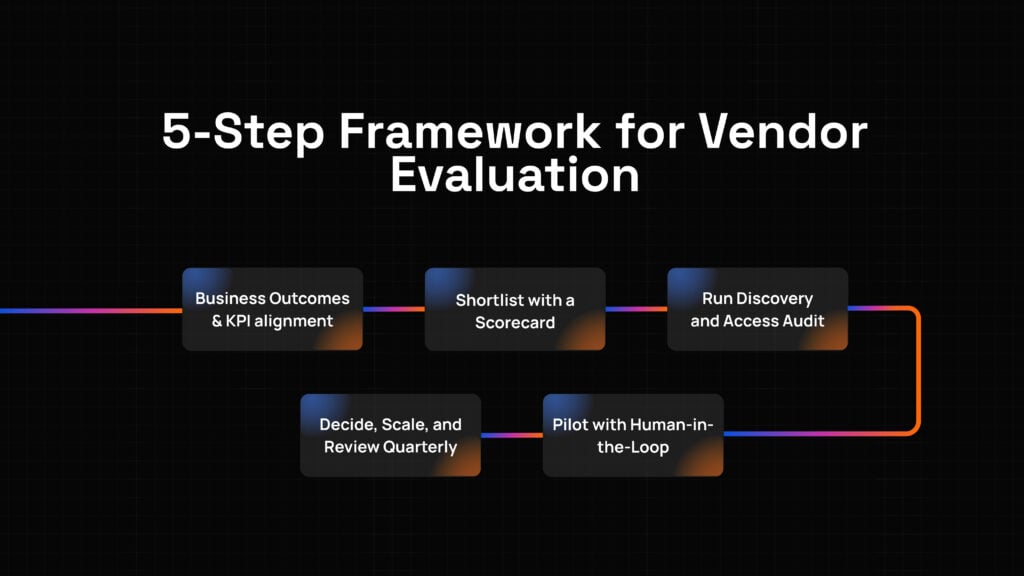
5-Step Framework for Evaluating and Integrating Automation Vendors
When selecting vendors for AI automation vs RPA, the process should follow a structured, disciplined approach that aligns with your organization’s goals while ensuring long-term scalability. Beyond technical specs or pricing, the focus should be on how each vendor supports measurable business outcomes, integrates seamlessly with your stack, and adapts as your automation strategy matures.
1. Define KPI and Scope
Start by identifying what success looks like and how it will be tracked. Establish clear KPIs that link directly to operational goals such as reduced processing time, fewer manual interventions, or improved reporting accuracy. This step ensures alignment among stakeholders and sets a shared vision of impact. Without defined KPIs, evaluations risk drifting into feature comparisons instead of value assessments.
Example: A telecom firm targeted a 50 percent reduction in service ticket resolution time within six months. This clear objective guided every vendor conversation.
Pro tip: Document three to five measurable outcomes before requesting proposals. It keeps discussions focused on business results rather than technical checklists.
2. Shortlist Using a Scorecard
Once objectives are defined, create a weighted scorecard to evaluate vendors systematically. Include metrics such as integration capability, security posture, ease of use, and governance maturity. Assigning weights to each factor provides a balanced perspective between functionality and long-term partnership potential.
Example: A logistics company used a 100-point scorecard, allocating 30 points to integration quality and 25 to security compliance. This clarified trade-offs during executive review.
Pro tip: Use a shared evaluation sheet to capture stakeholder feedback in one place. This avoids bias and ensures transparency during final vendor selection.
3. Run Discovery and Access Audit
Before committing, conduct a discovery and access audit with shortlisted vendors. This phase exposes data silos, integration barriers, and hidden dependencies early. It also helps gauge the vendor’s understanding of your technical environment.
Example: During discovery, a SaaS provider uncovered redundant authentication layers in its systems. The vendor adjusted the architecture pre-launch, avoiding potential security issues.
Pro tip: Ask vendors to document all findings from discovery sessions. These insights become valuable input for future process optimization and change management.
4. Pilot with HITL and Dashboards
A pilot program validates not just functionality but user experience. Incorporate human-in-the-loop (HITL) checkpoints and real-time dashboards to measure impact accurately. This approach balances automation with oversight, helping teams build confidence before scaling.
Example: A healthcare network piloted AI-driven claims processing with HITL reviews at key approval stages. The system achieved a 33 percent improvement in accuracy within the first month.
Pro tip: Gather both quantitative data and user feedback during pilots. The combination ensures the chosen solution performs well technically and aligns with real-world workflows.
5. Decide, Scale, and Review Quarterly
Once the pilot delivers measurable success, move to full deployment, but keep governance ongoing. Establish quarterly reviews to track adoption, ROI, and evolving feature needs. Continuous evaluation prevents stagnation and identifies new automation opportunities.
Example: A financial firm expanded its pilot across five departments after quarterly reviews revealed consistent time savings and zero compliance issues.
Pro tip: Set a quarterly agenda that includes retraining, data audits, and improvement tracking. This ensures the solution continues evolving alongside business priorities.
Common Pitfalls to Avoid When Choosing an AI Automation Vendor
Even with strong preparation, teams often stumble during final selection, especially when evaluating AI automation vs RPA solutions. Below are recurring mistakes and how to prevent them.
1. Overlooking Integration Complexity: Feature checklists can be deceptive. The real value lies in seamless connection to your current systems. Failing to validate this can create post-launch friction.
2. Focusing Too Much on Templates: Pre-built automations save time, but rigid templates limit adaptability. Choose vendors whose workflows allow edits to logic, data mapping, and escalation conditions.
3. Neglecting Post-Implementation Support: Implementation is only the beginning. The real test lies in updates, bug fixes, and evolving integrations.
4. Ignoring Security and Compliance Risks: Automation systems handle critical business information. Weak encryption or unclear ownership can lead to compliance issues.
5. Underestimating Human Oversight: AI excels at recognizing patterns, but human judgment remains vital. Omitting human-in-the-loop checkpoints risks undetected anomalies.
Next Steps in Your Evaluation Process
By now, you should have a clear understanding of how AI automation vs RPA differ and when to deploy each. The next step is putting this insight into motion.
- Align with business goals: Match automation goals with measurable KPIs.
- Evaluate integrations: Choose systems that plug seamlessly into your existing infrastructure.
- Focus on compliance: Prioritize vendors that offer strong data security frameworks.
- Review support plans: Opt for vendors that guarantee long-term partnership and feature growth.
To see how AI and RPA can work together in practice, explore our AI Workflow Automation Services page. It outlines real-world strategies enterprises use to unify structured and intelligent automation for measurable gains.
Vendor Questions to Ask
To make the most informed decision, be sure to ask these essential questions during the evaluation phase:
- How does your solution link automation outcomes to measurable KPIs?
- Which native integrations are supported out of the box?
- What security certifications and audit results can you provide?
- How do you handle workflow exceptions or overrides?
- What is your average implementation timeline?
- How do you structure post-implementation support?
- Are all automation assets and data fully exportable if we move providers?
Ready to Automate with Confidence?
AI automation vs RPA is not a debate, it’s a collaboration. The future of business automation lies in pairing precision with perception. When done right, intelligent automation becomes a foundation for resilience, not just efficiency.
Pro tip: Start by identifying one high-impact process to automate intelligently, something repetitive but variable enough for AI learning. This approach ensures measurable ROI and faster adoption across teams. Book a Free Strategy Call with our experts to design a roadmap that fits your business needs and unlocks operational intelligence.