
The Power of AI Chatbot for Customer Service: Why It Matters
AI chatbot for customer service has evolved from basic FAQ responders into intelligent deflection systems that define operational excellence in modern support organizations. Customer service teams implementing professional AI customer service automation tools are fundamentally reimagining how inquiries get resolved, how agents spend their time, and how customers experience support across every channel. Advanced AI chatbot services now manage conversations that once consumed entire support departments, enabling human agents to focus on complex escalations, emotional situations, and relationship building that drive customer loyalty and satisfaction scores.
The data supporting this transformation continues to strengthen across support functions. According to Salesforce research, 71 percent of consumers now expect real-time support across all channels, creating unprecedented pressure on support teams to deliver instant, accurate responses. Research shows agent satisfaction and retention improve by 15 percent when automation removes repetitive ticket burdens, allowing representatives to focus on challenging cases requiring human expertise. Customer satisfaction scores climb measurably when resolution time falls below two minutes, as speed combined with accuracy creates the friction-free experiences that modern customers demand from best AI chatbot for customer service implementations.
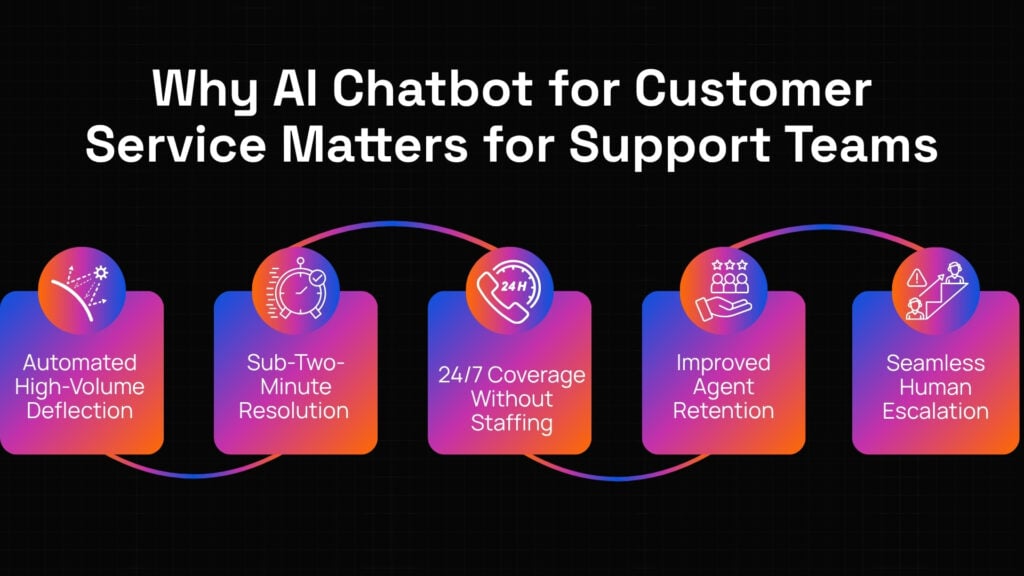
Why AI Chatbot for Customer Service Matters for Support Teams
AI customer service automation tools go beyond simple automated responses; they transform how organizations manage ticket volume, maintain service consistency, and ensure customer satisfaction across all support touchpoints. Manual support workflows that once created bottlenecks in triage, routine inquiries, and after-hours coverage can now be executed with intelligence and precision through AI chatbot services. From resolving common questions instantly to seamlessly escalating complex issues with complete context, best AI chatbot for customer service deployments deliver measurable outcomes that strengthen both operational efficiency and customer experience across all support functions.
For customer service leaders evaluating AI chatbot for customer service strategies, the benefits manifest in five critical ways:
- Automated High-Volume Deflection: AI customer service automation tools resolve 25 to 40 percent of support inquiries autonomously according to Gartner estimates, handling routine questions about account status, policy clarification, and troubleshooting steps without agent involvement, enabling teams to absorb volume growth without proportional headcount increases.
- Sub-Two-Minute Resolution Speed: Intelligent chatbots provide instant answers from knowledge bases and integrated systems without wait times or transfers, achieving the sub-two-minute resolution threshold where customer satisfaction scores climb measurably because speed combined with accuracy creates friction-free experiences.
- 24/7 Coverage Without Staffing: AI chatbot services provide round-the-clock support across all time zones without requiring night shift staffing, holiday coverage, or weekend agents, ensuring 71 percent of consumers who expect real-time support according to Salesforce receive immediate assistance regardless of when they contact your organization.
- Improved Agent Retention: Support teams experience 15 percent higher agent retention when automation removes repetitive ticket burdens that cause burnout, as representatives can focus on complex cases requiring problem-solving skills, empathy, and judgment that provide job satisfaction and professional development.
- Seamless Human Escalation: Best AI chatbot for customer service maintains complete conversation context including questions asked, answers provided, and customer frustration signals, enabling smooth handoffs to human agents who can continue conversations without forcing customers to repeat information or restart troubleshooting processes.
AI chatbot for customer service is not about replacing support agents; it is about amplifying their effectiveness, ensuring service availability, and enabling representatives to focus on emotionally charged situations, complex technical issues, and relationship building that require human judgment and empathy that machines cannot replicate.
Key Considerations When Choosing AI Customer Service Automation Tools
Selecting the right AI chatbot services requires careful alignment between technology capabilities and customer support requirements. The most successful best AI chatbot for customer service implementations are built on a foundation of transparency, deep system integration, and measurable impact on critical metrics like deflection rates, average handle time, and customer satisfaction scores.
Below are the core factors that should guide every AI chatbot for customer service decision:
- Business Outcomes & KPI Alignment: Every AI customer service automation tools initiative must connect directly to tangible support metrics, whether that is reducing average handle time by specific minutes, increasing net promoter scores, achieving 30 percent deflection rates, improving first-contact resolution percentages, or decreasing cost per ticket. Vendors should demonstrate clear methodology for starting with measurable goals and proving impact through baselines, not vague efficiency promises.
- Integration with Existing Systems: Effective AI chatbot services depend on seamless connectivity with your CRM, help desk platforms, telephony systems, and ERP. The ideal partner confirms compatibility including read-write synchronization and event-driven triggers so automated workflows can look up account information, create tickets with conversation context, and update customer records without manual data entry.
- Security and Governance: Best AI chatbot for customer service handles sensitive customer data including personal identifiers, account details, support history, and payment information that require strict controls. Require evidence of data encryption in transit and at rest, comprehensive audit trails logging all interactions, and ISO 27001/27017 compliance certifications validating security management practices.
- Human-in-the-Loop (HITL) Flexibility: Successful AI customer service automation tools always include agent oversight mechanisms for conversations requiring human judgment, empathy, or specialized expertise. Ensure seamless handoff from bot to agent with full conversation context, chat transcript, customer information, and sentiment indicators so representatives can continue without forcing customers to repeat themselves.
- Observability and Analytics: Transparency is essential when scaling AI chatbot for customer service across ticket volume. A capable vendor provides real-time dashboards tracking deflection rates and satisfaction scores, complete conversation traces for quality assessment, evaluation frameworks measuring accuracy, and rollback capability for faulty responses when prompt or model updates degrade performance.
- Pricing Transparency and Flexibility: Insist on clear pricing assumptions around conversation volumes, integration counts, and model inference usage. Understanding AI chatbot services economically helps forecast costs accurately as ticket volumes scale, and clarify ownership of prompt libraries and fine-tuned models so intellectual property remains with your organization.
Choosing AI customer service automation tools partners who understand these requirements ensures your investment delivers sustainable improvements rather than creating technical debt, vendor lock-in, or governance gaps that limit future flexibility when support strategies or technology stacks evolve.
The Impact of Integration Readiness
Before launching any best AI chatbot for customer service initiative, organizations must thoroughly assess their systems architecture, knowledge base quality, and support process documentation completeness. Integration readiness evaluates how well existing help desk platforms, CRM systems, and information repositories can support intelligent automation without creating customer frustration or data quality issues. When support teams conduct integration audits in advance, they uncover knowledge gaps and API limitations early, align IT and operations stakeholders around connectivity requirements, and minimize wasted time during vendor discovery and pilot phases.
Example: A logistics company preparing for AI chatbot for customer service discovered that their help desk system lacked webhook support for real-time ticket updates, their knowledge base contained inconsistent article formatting that confused retrieval, and their escalation procedures mixed simple routing rules with judgment-based decisions requiring human assessment. Addressing these integration readiness issues before vendor engagement reduced the overall project timeline by five weeks and achieved their target 30 percent drop in chat queue time during the pilot phase.
Pro Tip: Create an internal integration readiness checklist that validates help desk and CRM compatibility with read-write capabilities, benchmarks current response times before implementation for accurate before-after comparison, tests multilingual edge cases if serving global customers, and allows vendors sandbox access to sample data for evaluation without risking production quality. Transparency early prevents scope creep later when assumptions prove incorrect.
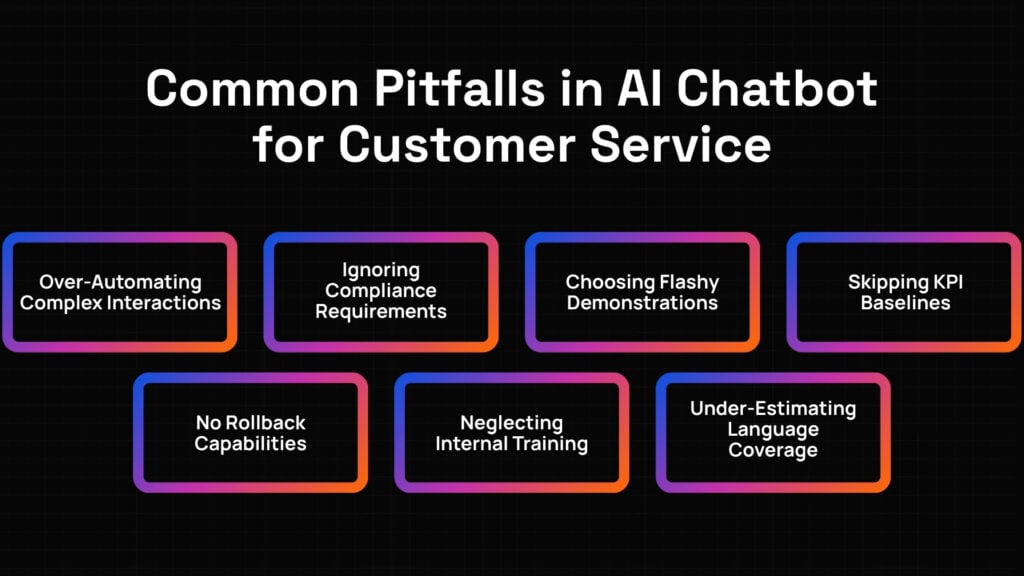
Common Pitfalls in AI Chatbot for Customer Service
AI customer service automation tools promise efficiency and availability, but poor planning and inadequate design can create customer frustration instead of satisfaction improvements. Many support organizations make avoidable mistakes during implementation that delay value realization and erode both customer and agent trust. To discover proven methodologies tailored for your support workflows and customer experience requirements, explore our AI Workflow Automation Services page for detailed best AI chatbot for customer service frameworks and real-world implementation guidance.
- Over-Automating Complex Interactions: Some organizations attempt to automate emotionally charged or technically complex conversations. Keep human agents in the loop for sensitive topics like billing disputes, account cancellations, or situations where customers express frustration, as empathy and creative problem-solving require human judgment.
- Ignoring Compliance Requirements: A technically impressive AI chatbot services deployment can still create regulatory violations without proper governance. Align chatbot logging practices and consent flows with privacy regulations from day one, ensuring conversation retention, data access, and customer notification meet jurisdictional requirements.
- Choosing Flashy Demonstrations: Organizations selecting AI customer service automation tools based on impressive demo conversations often face disappointment in production. Validate production-level metrics including actual deflection rates, resolution accuracy, and customer satisfaction from reference customers, not just polished sample chats.
- Skipping KPI Baselines: Measuring improvement without benchmarks makes proving ROI impossible. Document current response times, deflection rates, customer satisfaction scores, and cost per ticket before implementation so impact attribution remains clear during vendor evaluations and executive reviews.
- No Rollback Capabilities: Deploying best AI chatbot for customer service without version control creates recovery nightmares when prompt or model updates degrade response quality. Maintain version control for all model configurations and prompt updates with documented rollback procedures and testing protocols before production deployment.
- Neglecting Internal Training: Support agents resistant to AI chatbot for customer service can undermine technically sound implementations. Create short internal how-to videos demonstrating escalation workflows, override procedures, and quality monitoring so agents understand their evolving role and feel confident with new tools.
- Under-Estimating Language Coverage: Organizations serving global customers without testing multilingual edge cases create poor experiences for non-English speakers. Validate that AI chatbot services handle regional dialects, idiomatic expressions, and cultural nuances accurately before launching in new markets.
Evaluating the ROI of AI Chatbot for Customer Service
Quantifying the benefits of AI customer service automation tools helps secure executive buy-in and refine future investments in support technology. Measuring ROI goes beyond simple ticket deflection; it captures gains in resolution speed, agent capacity, customer satisfaction, and retention. Without clear metrics during evaluation, best AI chatbot for customer service projects risk becoming feature-heavy implementations with unclear business outcomes that fail to justify ongoing operational expenses and licensing costs.
Key metrics to monitor include:
- Support Cost Reduction: Track the decrease in total support spend when AI chatbot for customer service automates 25 to 40 percent of inquiries according to Gartner estimates, calculating cost per ticket before and after implementation to quantify savings from reduced agent headcount needs or absorbed volume growth without hiring.
- Deflection Rate Achievement: Measure the percentage of customer inquiries resolved autonomously without agent escalation following AI chatbot services deployment, with leading implementations achieving 30 percent or higher deflection on targeted inquiry types while maintaining satisfaction scores above baseline performance.
- Resolution Time Improvement: Evaluate the reduction in average time to resolution when best AI chatbot for customer service provides instant answers, targeting the sub-two-minute threshold where customer satisfaction scores climb measurably because speed combined with accuracy creates friction-free experiences.
- Customer Satisfaction Maintenance: Compare post-conversation survey scores before and after AI customer service automation tools implementation to ensure automation maintains or improves experience quality, as speed gains without accuracy create frustration that damages brand perception and loyalty.
- Agent Retention Enhancement: Assess improvements in agent turnover rates when automation removes repetitive ticket burdens, as research shows 15 percent higher retention when representatives can focus on complex cases requiring problem-solving skills, empathy, and judgment that provide job satisfaction.
- Queue Time Reduction: Review decreases in customer wait times when AI chatbot for customer service handles volume spikes instantly, as one logistics firm achieved 30 percent drop in chat queue time during pilot phase, preventing the abandoned contacts that occur when customers tire of waiting.
According to Salesforce research, 71 percent of consumers expect real-time support across channels creating pressure for instant responses. Gartner estimates 25 to 40 percent of support spend can be automated with AI-assisted workflows. Research shows 15 percent higher agent retention when automation removes repetitive burdens. Customer satisfaction climbs when resolution time falls below two minutes. When every AI chatbot for customer service interaction logs conversation context, escalation triggers, and resolution outcomes, every prompt change maintains version history with rollback capabilities, and every customer has clear human escalation options when automation struggles, organizations build trusted support operations that scale without sacrificing experience quality or creating agent burnout from overwhelming ticket volumes.
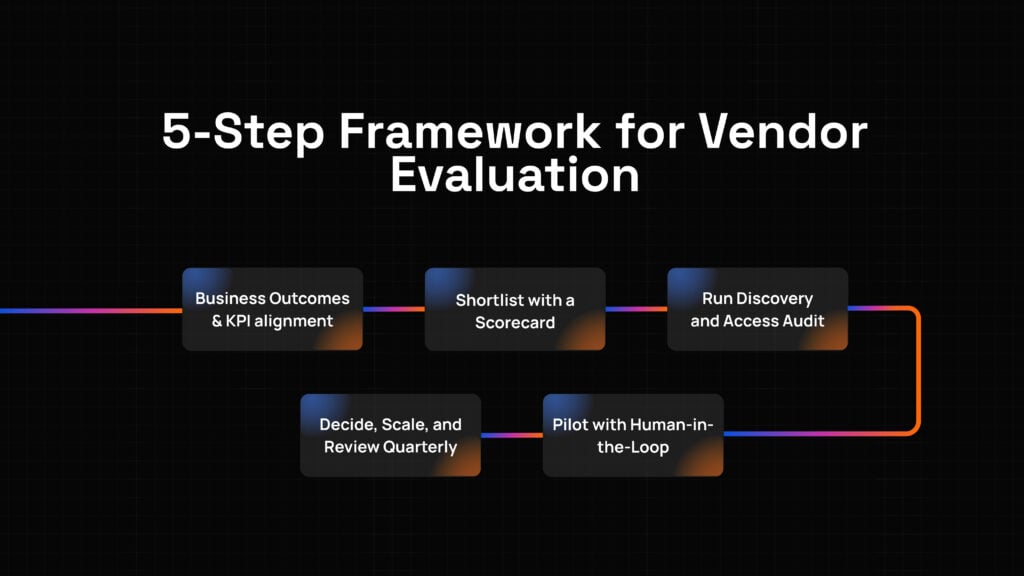
5-Step Framework for Vendor Evaluation
Selecting an AI customer service automation tools vendor should follow a disciplined, structured process that aligns with your organization’s support goals while accounting for both technological depth and long-term partnership potential. Instead of focusing solely on impressive demonstration conversations or lowest price, evaluation should weigh how well the vendor’s AI chatbot services solution supports customer experience standards, integrates with support systems, and adapts to evolving customer expectations.
1. Define KPI & Scope
Start by clearly outlining what success means with no more than three metrics to keep evaluations objective. Defining specific targets helps align all stakeholders including customer service leadership, agent teams, IT departments, and experience officers. Your goal might be achieving 30 percent drop in chat queue time, improving first-contact resolution rates, or reducing average handle time while maintaining satisfaction scores, but it must be quantifiable. This clarity becomes the foundation for every subsequent decision about best AI chatbot for customer service, shaping both vendor conversations and internal buy-in.
Example: A logistics firm defined its KPI as “achieving 30 percent drop in chat queue time within 90 days while maintaining customer satisfaction scores at 4.0 out of 5.0 or higher.” This metric guided every vendor discussion, shaped pilot design, and became the benchmark for success measurement. Quantify time saved per ticket or CSAT lift as primary metrics with guardrails for quality.
Pro Tip: Document one to three measurable support outcomes before requesting proposals. Focus on deflection rates, queue time reduction, resolution speed, or satisfaction maintenance tied to operational efficiency rather than vanity metrics like total conversations handled, and clarify exactly which inquiry types are in scope for automation versus requiring human agents.
2. Shortlist with a Scorecard
Once objectives are clear, move to structured vendor comparison using a weighted scorecard for evaluating AI chatbot for customer service providers. This tool allows teams to quantify how well each vendor aligns with priorities including security compliance, usability for agents and customers, and integration quality with existing systems. By assigning weights to each factor, decision-makers can balance technical capability with customer experience quality and long-term flexibility. A disciplined scorecard approach removes subjectivity and ensures that even non-technical support stakeholders understand tradeoffs.
Example: One retail brand assigned 35 percent weight to integration depth prioritizing smooth CRM and help desk synchronization, 25 percent to security and compliance certifications, 20 percent to human-in-the-loop escalation design, 15 percent to observability dashboards, and 5 percent to pricing transparency, helping eliminate vendors lacking production-ready integrations early.
Pro Tip: Keep the scorecard numeric to reduce bias. Rate each criterion on a defined scale such as 1 to 10 so decisions are driven by support requirements rather than sales presentation quality. Weight your highest priorities like integration or security at 30 to 35 percent of total score to ensure critical capabilities receive appropriate emphasis.
3. Run Discovery & Access Audit
Before contracts are signed, a structured discovery phase allows vendors sandbox access to sample data for evaluation without risking production quality. During this phase, teams validate integration capabilities including data mapping between systems, test multilingual handling if serving global customers, and confirm security controls including encryption and audit logging. Running an access audit uncovers gaps early that prevent scope creep later when assumptions about capabilities prove incorrect.
Example: A healthcare company uncovered data-mapping gaps during a one-week sandbox test where the vendor’s chatbot couldn’t access custom fields in their help desk system, requiring integration customization that would have delayed launch by six weeks if discovered after contract signing when negotiating leverage was lost.
Pro Tip: Allow vendors controlled sandbox access with representative sample data including typical inquiry patterns and edge cases. Validate that claimed integrations actually work with your specific system versions and configurations. Transparency early about limitations and customization requirements prevents surprises during implementation when timelines and budgets are committed.
4. Pilot with Human-in-the-Loop & Dashboards
A well-designed pilot validates both technology performance and customer experience quality under real support conditions. Instead of full-scale deployment, focus on small-scale pilot with escalation logic and live metrics tracking deflection, resolution time, and satisfaction. Incorporating human-in-the-loop oversight ensures AI chatbot services outcomes align with brand standards and experience expectations, while dashboards provide quantifiable visibility into performance versus baseline metrics and success criteria.
Example: A fintech tested sentiment tracking on 500 customer queries before scaling, running 4-week pilot with human escalation for frustrated customers and achieving 28 percent deflection rate with 4.1 out of 5 satisfaction scores while identifying 7 knowledge base gaps requiring content updates. Treat pilot learnings as training data for full rollout optimization.
Pro Tip: Launch pilots with clear success criteria, frozen baseline metrics, and controlled scope focusing on specific inquiry types. Track both efficiency gains like deflection and quality indicators like satisfaction and escalation appropriateness. Use pilot period to identify knowledge gaps, refine escalation triggers, and train agents on new workflows before broad deployment.
5. Decide, Scale, and Review Quarterly
After the pilot proves value, use findings to guide the final decision and create a phased expansion plan for AI customer service automation tools deployment. Scaling should be deliberate, expanding to additional inquiry types and channels only after performance metrics remain stable and agent adoption proves effective. Continuous quarterly reviews between your support operations team and the vendor maintain alignment, ensuring the technology evolves alongside knowledge base updates, policy changes, and customer expectation shifts.
Example: A B2B SaaS scaled from Level-1 chat inquiries to billing questions within three months after pilot success, conducting quarterly reviews that identified prompt optimization opportunities improving deflection by 9 percentage points and reducing average handle time by 1.3 minutes over the first year. Maintain quarterly reviews to refresh prompts and retrain models as products and policies evolve.
Pro Tip: Treat vendor reviews as strategic sessions focused on expanding successful AI chatbot for customer service use cases to adjacent inquiry types and optimizing accuracy, not just maintenance calls about system uptime. Use quarterly reviews to refresh prompts based on new product launches, update knowledge bases with policy changes, and retrain models on recent conversation patterns.
Next Steps in Your Evaluation Process
By now, you should have a clear understanding of what to prioritize when selecting an AI chatbot services partner. Bringing these insights together creates a structured evaluation flow that de-risks investment and accelerates deployment while ensuring long-term customer satisfaction and operational excellence.
- Align with support metrics: Ensure every feature connects to specific KPIs like deflection rates, queue time reduction, resolution speed, or satisfaction scores tied to operational efficiency, not just conversation volume or containment percentages disconnected from customer experience quality.
- Evaluate system integration depth: Confirm that best AI chatbot for customer service works smoothly with your CRM, help desk, telephony, and ERP through read-write synchronization and event triggers enabling data lookup, ticket creation, and record updates without manual intervention or data silos.
- Focus on experience and compliance: Choose vendors with documented conversation traces for quality assessment, seamless human handoff with complete context, data encryption and audit trails, and ISO 27001/27017 compliance certifications validating security management practices.
- Review enablement and training: Favor partners who provide support team training on escalation workflows, knowledge base optimization guidance, agent coaching on working alongside automation, and post-go-live support beyond initial implementation.
- Test with a controlled pilot: Always run controlled pilots with clear success criteria, escalation logic, and live metrics before full deployment to validate deflection accuracy, satisfaction maintenance, and agent adoption under real-world support conditions with actual customer inquiries.
With these criteria in place, you are better equipped to identify AI customer service automation tools vendors who not only automate routine inquiries but also improve customer satisfaction, reduce support costs, strengthen agent retention, and amplify your team’s capacity to focus on complex cases requiring human empathy and creative problem-solving.
Vendor Questions to Ask
To make the most informed decision during your AI chatbot for customer service evaluation, be sure to ask these essential questions:
- How does your chatbot integrate with Zendesk, Salesforce, HubSpot, or our specific help desk platform including read-write capabilities and event triggers?
- Can we export chat logs, training data, conversation transcripts, and configuration settings anytime without vendor assistance or professional services fees?
- What is your human handoff logic including escalation triggers, context transfer, and agent notification workflows?
- How are model decisions audited and explainable for quality assurance, compliance reviews, and continuous improvement?
- Do you support multilingual intents out of the box including regional dialects and cultural nuances, or does that require custom training?
- What is your data retention policy including conversation logs, customer information, and analytics data with regional compliance options?
- Can we bring our own LLM API key or are we locked into your model choices and pricing?
- What is the average time from pilot launch to production deployment for clients with similar support volumes and system complexity?
- Can I speak to two customer references with similar inquiry types and integration requirements who can discuss measured deflection rates and implementation challenges?
Transform Customer Support with AI Chatbot Services
AI chatbot for customer service is not just a technological investment; it is a strategic support capability that requires careful planning, vendor selection, and continuous optimization. The right implementation brings consistency, availability, and efficiency across your support workflows, while poor execution creates customer frustration and agent resistance that undermines adoption and experience quality.
Ready to transform your customer support with AI chatbot for customer service? Book a Free Strategy Call with us to explore the next steps and discover how we can help you scope, pilot, and scale the right AI chatbot services solution for your unique support workflows, system environment, and measurable business outcomes.