

The Power of AI Chatbot Technology: Why It Matters
AI chatbot technology has evolved from simple rule-based responders into intelligent conversational systems that define operational excellence in modern customer service. Organizations implementing professional AI chatbot platforms are fundamentally reimagining how teams handle customer inquiries, support escalations, and service workflows across email, chat, social media, and voice channels. Advanced AI chatbot for website deployments now manage conversations that once consumed entire support departments, enabling agents to focus on complex cases, relationship building, and strategic initiatives that drive customer loyalty and satisfaction scores.
The data supporting this transformation continues to strengthen across industries. According to Tidio research, 82 percent of consumers in 2024 stated they would use a chatbot instead of waiting for a customer representative to take their call, demonstrating strong customer preference for instant responses. The global AI chatbot market reached $1.34 billion in 2024 and is projected to hit $27.3 billion by 2030 showing explosive growth. Klarna’s widely-publicized AI chatbot handled 2.3 million conversations in its first month, performing the equivalent work of 700 full-time agents while reducing average resolution time from 11 minutes to under 2 minutes and maintaining customer satisfaction scores on par with human agents.
Why AI Chatbot Platforms Matter for Support Teams
AI chatbot technology goes beyond simple automated responses; it transforms how organizations manage customer lifecycles, maintain service consistency, and ensure satisfaction across all communication channels. Manual support workflows that once created bottlenecks in inquiry handling, issue resolution, and knowledge access can now be executed with intelligence and precision through AI chatbot platform implementations. From intent classification and order status lookup to refund processing and troubleshooting guidance, AI chatbot for website deployments deliver measurable outcomes that strengthen both customer experience and operational efficiency across all service functions.
For customer service leaders evaluating AI chatbot strategies, the benefits manifest in five critical ways:
- 24/7 Availability Without Staffing Limits: AI chatbot platforms provide round-the-clock support across multiple languages and time zones, handling inquiries instantly during nights, weekends, and holidays when human agents are unavailable, improving global customer accessibility while controlling labor costs and avoiding peak-period overwhelm.
- Accelerated Resolution Times: Intelligent AI chatbot for website systems resolve routine inquiries in under 2 minutes compared to 11-minute averages for human agents, as demonstrated by Klarna’s implementation, by instantly accessing knowledge bases, order systems, and policy documentation without search delays or information gaps.
- Scalable Concurrent Conversation Handling: AI chatbot technology manages thousands of simultaneous conversations without wait times or queue buildup, unlike human teams constrained by one interaction per agent, enabling organizations to handle volume spikes during launches, promotions, or seasonal peaks without proportional staffing increases.
- Consistent Policy Application: Automated systems ensure every customer receives identical information from standardized knowledge sources with current policy versions, eliminating the variability that comes from agent experience gaps, training deficiencies, or outdated manual documentation that creates inconsistent service experiences.
- Agent Capacity for Complex Cases: AI chatbot platform implementations handle 60 to 70 percent of routine inquiries automatically, freeing human agents to focus on escalations requiring empathy, creativity, or judgment that machines cannot replicate, improving job satisfaction while directing expertise where it delivers maximum customer value.
AI chatbot technology is not about replacing support teams; it is about amplifying their effectiveness, ensuring service availability, and enabling agents to focus on relationship-building activities that improve loyalty and lifetime value through human connection.

Key Considerations When Choosing AI Chatbot Services
Selecting the right AI chatbot platform requires careful alignment between technology capabilities and customer service requirements. The most successful AI chatbot for website implementations are built on a foundation of transparency, deep system integration, and measurable impact on critical metrics like containment rate, first-contact resolution, and customer satisfaction scores.
Below are the core factors that should guide every AI chatbot decision:
- Business Outcomes & KPI Alignment: Every AI chatbot platform initiative must connect directly to tangible service metrics, whether that is improving containment or deflection rates, increasing first-contact resolution, reducing average handle time, maintaining customer satisfaction scores, or lowering cost per resolution. Vendors should demonstrate clear methodology for establishing baseline performance and setting 90-day target windows with measurable impacts, not vague transformation promises.
- Integration with Existing Systems: Effective AI chatbot for website deployments depend on seamless connectivity with your CRM, help desk, telephony and IVR systems, order management platforms, ERP, billing systems, and knowledge bases. The ideal partner ensures smooth bidirectional data flow with read and write capabilities, event-driven triggers, entity resolution across identities and channels, and method-level permissions so automated workflows can fetch customer context and execute actions.
- Security and Governance: AI chatbot technology handles sensitive customer data including personal identifiers, order history, payment information, and support transcripts that require strict controls. Confirm that vendors maintain data residency and retention capabilities, PII redaction features, role-based access controls, least-privilege service accounts, comprehensive vendor subprocessor lists, and security review packages ready on request.
- Human-in-the-Loop (HITL) Flexibility: Successful AI chatbot platforms always include agent oversight mechanisms for decisions affecting customer relationships, refunds, or account modifications. Ensure that workflows incorporate clear handoff rules to human agents with complete context and conversation transcripts, agent-facing controls to edit or override AI suggestions, and customer-visible paths to human help within one click or simple prompt.
- Observability and Analytics: Transparency is essential when scaling AI chatbot for website implementations across service channels. A capable vendor provides traces for every conversation turn including model calls and tool invocations, evaluation frameworks with reference questions and golden answers plus automatic grading, dashboards covering containment, first-contact resolution, average handle time, customer satisfaction, escalations, and red flags, plus safe rollback and versioning for prompts, tools, and policies.
- Pricing Transparency and Flexibility: Insist on clear pricing models with transparent assumptions and range scenarios covering different volume levels, not single figures that hide variability. Understanding AI chatbot platform economics helps forecast costs accurately as token usage and channel mix evolve, requiring different budgeting approaches than traditional support staffing models with fixed per-agent expenses.
Choosing AI chatbot services partners who understand these requirements ensures your investment delivers sustainable improvements rather than creating technical debt, vendor lock-in, or governance gaps that limit future flexibility and increase operational risk when customer preferences or business requirements change.
The Impact of Integration Readiness
Before launching any AI chatbot platform initiative, organizations must thoroughly assess their systems architecture, knowledge base quality, and process documentation completeness. Integration readiness evaluates how well existing customer service platforms, support procedures, and information structures can support intelligent automation without creating context gaps or customer frustration. When service teams conduct integration audits in advance, they uncover data quality issues early, align IT and operations stakeholders around system connectivity requirements, and minimize wasted time during vendor discovery and pilot phases.
Example: An ecommerce retailer preparing for AI chatbot for website deployment discovered that their order management system lacked webhook support for real-time status updates, their knowledge base articles contained inconsistent formatting with outdated policy references, and their escalation workflow documentation mixed simple lookups suitable for automation with judgment-heavy decisions requiring human agents. Addressing these integration readiness issues before vendor engagement reduced the overall project timeline by eight weeks and improved intent classification accuracy by 44 percent during the pilot phase, while clarifying which interactions needed AI chatbot handling versus agent escalation with complete context.
Pro Tip: Create an internal integration readiness checklist that evaluates API completeness with event-driven capabilities for order updates and case creation, assesses knowledge base documentation with explicit policy references and freshness rules, confirms customer data quality across identity resolution and channel mapping, and documents escalation requirements for different intent types. Bring security stakeholders in early to avoid month-end surprises on data access permissions, PII handling protocols, and audit trail requirements.
Common Pitfalls in AI Chatbot Implementations
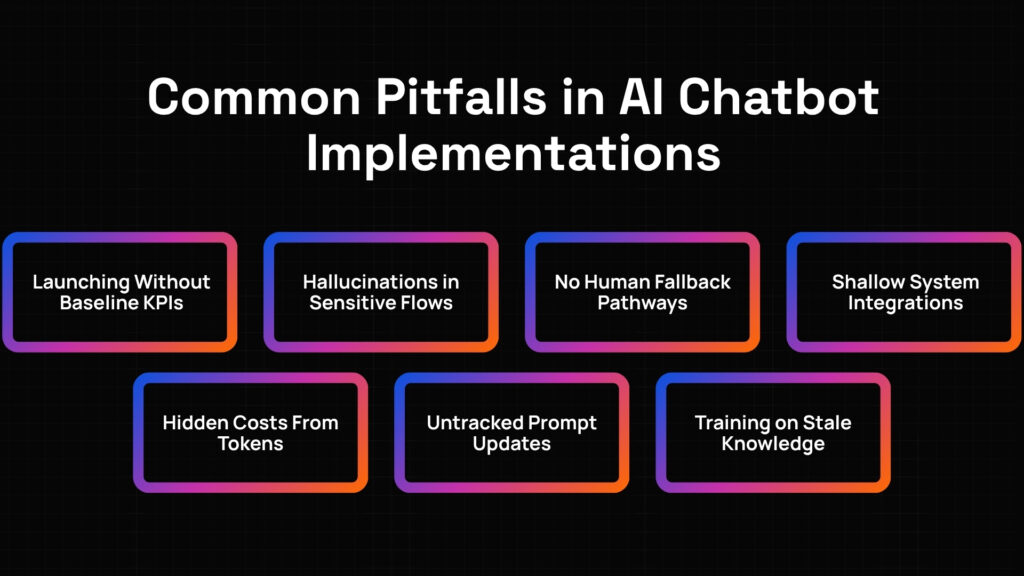
AI chatbot technology promises consistency and efficiency, but poor planning and inadequate customer experience design can create frustration instead of satisfaction improvements. Many organizations make avoidable mistakes during implementation that delay value realization and erode both customer and agent trust. To discover proven methodologies tailored for your service workflows and channel requirements, explore our AI Workflow Automation Services page for detailed AI chatbot platform frameworks and real-world implementation guidance.
- Launching Without Baseline KPIs: Some organizations deploy AI chatbot for website systems before establishing current performance metrics. Always snapshot deflection rates, average handle time, first-contact resolution, and customer satisfaction scores before any changes to enable accurate measurement of automation impact and ROI calculation.
- Hallucinations in Sensitive Flows: A technically impressive AI chatbot platform rollout can still create customer harm if models generate inaccurate information about refunds, billing, or account status. Implement guardrail prompts, tool-only modes that prevent free-form generation, and human approval gates on risky intents affecting money or account standing.
- No Human Fallback Pathways: Successful AI chatbot technology requires clear escalation mechanisms respecting that 82 percent of customers prefer chatbots over waiting but 85 percent believe problems need human support. Add prominent escalation buttons and confidence thresholds that automatically route to agents with complete conversation context when automation struggles.
- Shallow System Integrations: Many teams accept read-only connections when bidirectional write capabilities exist for case creation, order updates, and knowledge base feedback. Add comprehensive read-write APIs to CRM, help desk, and knowledge management systems, then test complete end-to-end workflows including actions, not just information retrieval.
- Hidden Costs From Tokens: Organizations implementing AI chatbot platforms without usage monitoring face budget surprises as conversation volumes scale. Budget by channel and scenario type, monitor unit economics per resolved interaction including token costs and system API calls, and optimize prompts to reduce unnecessary inference expenses.
- Untracked Prompt Updates: Full automation without version control creates troubleshooting nightmares when customer satisfaction drops. Version all prompts and policies with change logs, implement rollback-ready releases with deployment gates, and maintain evaluation sets that detect accuracy regression before customer impact.
- Training on Stale Knowledge: AI chatbot for website implementations lose effectiveness when knowledge bases contain outdated policies or discontinued products. Schedule regular synchronization from authoritative sources with freshness rules, automated alerts when articles exceed age thresholds, and validation workflows ensuring accuracy.
Evaluating the ROI of AI Chatbot Platforms
Quantifying the benefits of AI chatbot technology helps secure executive buy-in and refine future investments in service operations. Measuring ROI goes beyond simple deflection rates; it captures gains in resolution speed, agent capacity, customer satisfaction, and cost per interaction. Without clear metrics during evaluation, AI chatbot for website projects risk becoming feature-heavy implementations with unclear business outcomes that fail to justify ongoing operational expenses and licensing costs.
Key metrics to monitor include:
- Containment and Deflection Rate: Track the percentage of inquiries resolved autonomously without agent escalation following AI chatbot platform implementation, with leading deployments achieving 60 to 70 percent containment for routine intents within 90 days while maintaining satisfaction scores above human baseline performance.
- Average Handle Time Reduction: Measure the decrease in minutes required to resolve inquiries when AI chatbot for website systems instantly access order data and knowledge articles, as Klarna demonstrated with resolution time improvements from 11 minutes to under 2 minutes representing 82 percent reduction.
- First-Contact Resolution Improvement: Evaluate the increase in percentage of issues resolved in initial interaction following deployment of AI chatbot technology that provides accurate answers from current documentation rather than requiring follow-up inquiries or escalations for missing information.
- Customer Satisfaction Score Maintenance: Compare post-interaction survey scores before and after AI chatbot platform implementation to ensure automation maintains or improves experience quality, as Klarna achieved customer satisfaction on par with human agents while dramatically improving speed.
- Agent Capacity Release: Assess improvements in cases handled per agent when AI chatbot for website systems contain routine inquiries, measured through ticket volumes, occupancy rates, and time allocated to complex cases requiring human judgment, empathy, and creative problem-solving.
- Cost Per Resolution: Review total cost including infrastructure, licensing, and remaining agent touches divided by resolved interactions to calculate unit economics, as demonstrated by Klarna’s $40 million projected profit improvement from handling work equivalent to 700 full-time agents.
According to Tidio research, 82 percent of consumers prefer using chatbots over waiting for representatives, showing strong adoption readiness. The global AI chatbot market reached $1.34 billion in 2024 with projections of $27.3 billion by 2030 demonstrating massive investment momentum. However, 77 percent of adults find chatbots frustrating and 85 percent believe problems need human support, underscoring implementation quality importance. When every AI chatbot interaction logs intent classification, knowledge source citations, confidence scores, and escalation triggers, every policy change maintains version history with rollback capabilities, and every customer has clear human escalation paths, organizations build trusted service operations that scale without sacrificing experience quality or creating customer frustration from poor automation design.
5-Step Framework for Vendor Evaluation
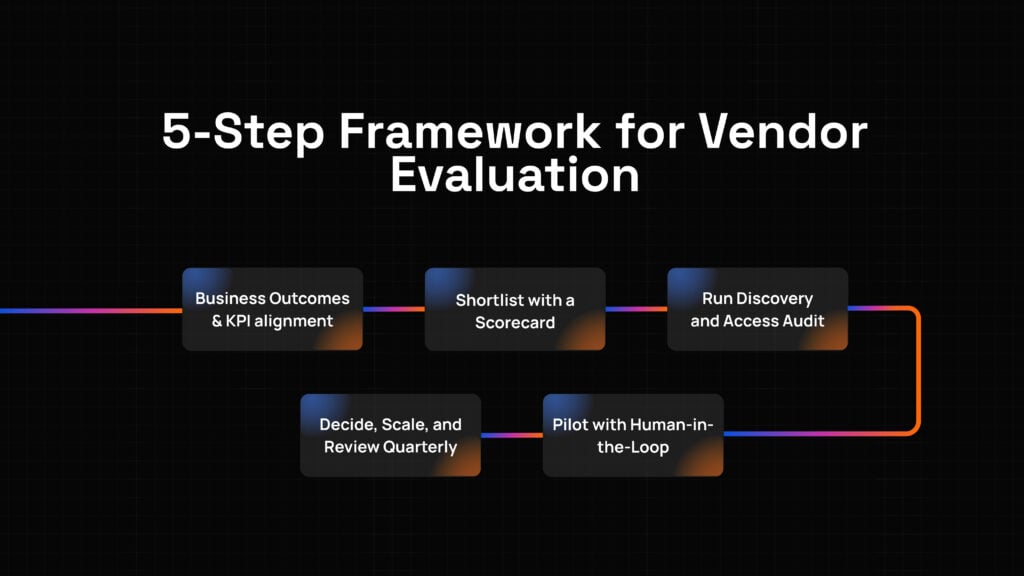
Selecting an AI chatbot platform vendor should follow a disciplined, structured process that aligns with your organization’s customer service goals while accounting for both technological depth and long-term partnership potential. Instead of focusing solely on impressive demonstrations or lowest price, evaluation should weigh how well the vendor’s AI chatbot for website solution supports service standards, integrates with support systems, and adapts to evolving customer expectations.
1. Business Outcomes & KPI Alignment
Start by clearly outlining what success looks like with 3 high-volume, low-risk intents and specific performance targets. Defining primary KPIs and quantified goals helps align all stakeholders including service operations leadership, agent teams, IT departments, and customer experience officers. Your goals might include achieving 15 to 20 percent containment improvement, reducing average handle time by 10 to 20 percent, or maintaining customer satisfaction at or above baseline levels, but they must be measurable. This clarity becomes the foundation for every subsequent decision about AI chatbot technology, shaping both vendor conversations and internal buy-in.
Example: A software company defined its KPI as “containing 30 percent of ‘Where is my order?’ chat inquiries with under 2-minute handle time and customer satisfaction greater than or equal to baseline scores within 90 days.” This metric guided every vendor discussion, shaped pilot design, and became the benchmark for success measurement. Choose intents that need 1 to 2 systems of record, not five complex integrations. Research shows generative AI can reduce contact volumes by up to 50 percent when paired with process redesign.
Pro Tip: Document 3 to 5 measurable service outcomes before requesting proposals. Pick intents with high volume and low risk to prove value quickly so evaluation stays grounded in operational impact rather than technology feature lists, and helps vendors tailor demonstrations to your actual support challenges, knowledge base structure, and system environment.
2. Shortlist with a Scorecard
Once objectives are clear, move to structured vendor comparison using a weighted scorecard for evaluating AI chatbot platform providers. This tool allows teams to quantify how well each vendor aligns with their priorities including KPI fit, integration depth with event-driven capabilities, governance and human-in-the-loop design, observability and evaluation frameworks, plus exit plan portability. By assigning weights to each factor, decision-makers can balance technical capability with service risk management and long-term flexibility. A disciplined scorecard approach removes subjectivity and ensures that even non-technical service operations stakeholders understand trade-offs.
Example: One financial services firm assigned 25 percent weight to KPI alignment methodologies and customer references, 25 percent to integration depth including read-write access with CRM and help desk event triggers, 20 percent to governance controls and human-in-the-loop escalation patterns, 15 percent to observability with trace-level decision visibility, and 15 percent to exit plan asset portability, with a rule that no vendor could exceed 3 out of 5 overall without comprehensive trace-level observability.
Pro Tip: Keep the scorecard fully quantitative to ensure fairness. Rate each criterion on a defined scale such as 1 to 5 so decisions are driven by service requirements rather than sales presentation quality. Weight KPI alignment and system integrations higher than impressive agent-like demonstrations that may not reflect actual customer inquiry patterns or knowledge base coverage.
3. Run Discovery and Access Audit
Before contracts are signed, a structured discovery phase maps complete data access requirements by intent including which database tables, which fields, and which permission levels. During this phase, teams document RAG sources with freshness rules, PII redaction requirements, and risk registers identifying what could go wrong with assigned ownership. Running an access audit verifies API capabilities, security controls, and least-privilege access boundaries, preventing governance gaps and costly change orders later in implementation when production requirements surface.
Example: A healthcare company mapped their “order status” intent requirements as read-only ERP access for order details, logistics API for shipment tracking, and knowledge base snippets with 7-day freshness service level agreements, creating a risk register documenting potential hallucination scenarios, data access failures, and escalation bottlenecks before vendor engagement or contract negotiations.
Pro Tip: Ask vendors to deliver a brief “readiness summary” document at the end of discovery that identifies technical blockers like missing webhook support or incomplete entity resolution, data quality issues in customer masters or product catalogs, security requirements for PII handling, and realistic timeline estimates. Bring security and compliance stakeholders in early to avoid delays from late-stage requirements discovery.
4. Pilot with Human-in-the-Loop and Dashboards
A well-designed pilot validates both technology performance and service quality under real customer conditions. Instead of full-scale deployment, focus on limited scope starting in shadow mode running silently alongside agents to compare outcomes, then blended mode with agent review, then full routing only for proven intents. Incorporating human-in-the-loop review ensures AI chatbot for website outcomes align with brand standards and customer expectations, while dashboards provide quantifiable visibility into containment, resolution quality, satisfaction, and unit economics per resolved conversation.
Example: A retail company piloted AI chatbot technology for web chat only, during business hours on weekdays to contain scope and support availability, processing 500 conversations over 4 weeks and achieving 65 percent containment rate with 89 percent accuracy on golden evaluation sets, 4.2 out of 5 customer satisfaction scores, and identification of 3 knowledge gaps requiring article updates. Research shows 71 percent of support leaders plan to increase AI investment, but top performers pair AI with strong agent workflows.
Pro Tip: Use pilots to gather customer and agent feedback through surveys and weekly evaluation sessions with representative conversation samples. Evaluate performance against golden test sets, ship prompt and policy updates behind feature flags for safe rollback, and track unit economics including token costs and system API expenses. Don’t add voice channel until chat KPIs remain stable for four consecutive weeks.
5. Decide, Scale, and Review Quarterly
After the pilot proves value, use findings to guide the final decision and create a phased expansion plan for AI chatbot platform deployment. Scaling should be deliberate, expanding to 3 to 5 additional intents or one additional channel only after containment and satisfaction targets are met consistently. Continuous quarterly reviews between your service operations team and the vendor maintain alignment, ensuring the technology evolves alongside knowledge base updates, policy changes, and customer expectation shifts. These sessions re-baseline KPIs, retire underperforming intents, and refresh evaluation sets.
Example: A telecommunications company conducted quarterly business reviews with its AI chatbot for website vendor, promoting “returns policy” and “billing address change” intents to full automation after achieving 72 percent containment for two consecutive months, identifying prompt optimization opportunities that improved accuracy by 9 percentage points and reduced token costs by 28 percent over the first year.
Pro Tip: Treat vendor reviews as strategic sessions focused on expanding successful AI chatbot technology use cases to adjacent intents and channels, not just maintenance calls about system uptime. Keep a 20 percent buffer in capacity planning for seasonality, product launches, and promotional periods that create volume spikes requiring headroom.
Next Steps in Your Evaluation Process
By now, you should have a clear understanding of what to prioritize when selecting an AI chatbot platform partner. Bringing these insights together creates a structured evaluation flow that de-risks investment and accelerates deployment while ensuring long-term customer satisfaction and operational excellence.
- Align with service goals: Ensure every feature connects to specific KPIs like containment rate, average handle time, first-contact resolution, and customer satisfaction, not just generic automation capabilities or impressive demonstrations disconnected from actual support inquiry patterns.
- Evaluate system integrations: Confirm that AI chatbot for website solutions work smoothly with your CRM, help desk, knowledge base, order management, and telephony platforms through event-driven webhooks and bidirectional updates without requiring extensive custom development.
- Focus on customer experience and governance: Choose vendors with documented decision traces, comprehensive escalation pathways, PII redaction controls, and robust human-in-the-loop capabilities that enforce agent oversight for sensitive decisions while respecting customer preferences for human interaction.
- Review enablement and change management: Favor partners who provide continuous training for agents and supervisors, knowledge base optimization guidance, prompt refinement support, and operational runbook documentation, not one-time technical onboarding sessions.
- Test with a controlled pilot: Always run a controlled pilot with real customer inquiries and actual service workflows before full deployment to validate containment accuracy, satisfaction maintenance, agent adoption, and unit economics under real-world conditions with representative intent distributions.
With these criteria in place, you are better equipped to identify AI chatbot technology vendors who not only automate routine inquiries but also improve customer satisfaction, reduce operational costs, strengthen agent capacity for complex cases, and amplify your team’s ability to deliver empathetic service that builds loyalty.
Vendor Questions to Ask
To make the most informed decision during your AI chatbot platform evaluation, be sure to ask these essential questions:
- What top three KPIs including containment, average handle time, and customer satisfaction will your solution move for our use case in 90 days, and how do you establish baselines and prove impact?
- Which system integrations are turnkey versus requiring custom development for our CRM, help desk, telephony, order management, and knowledge base platforms?
- How do you design human-in-the-loop escalation with confidence thresholds, and can customers request human agents at any time through simple prompts or prominent buttons?
- Show me complete decision traces for resolved conversations including prompts used, knowledge sources accessed, tool calls executed, confidence scores, and PII redactions applied?
- What evaluation set do you propose for our top intents with golden answers and automatic grading, and how often will it be refreshed to detect accuracy drift?
- What is your rollback plan including feature flags and version control if customer satisfaction or containment metrics regress after prompt or policy updates?
- Who owns our prompts, policies, system connectors, and evaluation sets at contract end, and how do we export all automation assets in standard formats?
- What risks have you observed with similar clients regarding hallucinations, escalation failures, or integration gaps, and how did you mitigate them?
- Can I speak to two customer references with similar channel mix, inquiry volumes, and compliance requirements who can discuss measured KPI improvements and implementation challenges?
Transform Customer Service with AI Chatbot Technology
AI chatbot platforms are not just technological investments; they are strategic service capabilities that require careful planning, vendor selection, and continuous optimization. The right implementation brings consistency, availability, and scalability across your customer service channels, while poor execution creates frustration and agent resistance that undermines adoption and customer trust.
Ready to transform your customer service with AI chatbot technology? Book a Free Strategy Call with us to explore the next steps and discover how we can help you scope, pilot, and scale the right AI chatbot platform solution for your unique service workflows, system environment, and customer experience requirements.