

The Power of AI Marketing: Why Attribution and Insights Matter
AI marketing has evolved from basic last-click tracking into strategic attribution infrastructure that defines campaign optimization in modern marketing organizations. Marketing teams implementing professional AI tools are fundamentally transforming how campaigns get measured, how budget decisions get made, and how conversions get understood through causal analysis rather than correlation. Advanced AI automation examples now demonstrate multi-touch attribution, marketing mix modeling integration, and incrementality testing that once required data science teams, enabling marketers to focus on strategic decisions while machines handle complex measurement that accurately attributes revenue impact.
The data supporting this transformation continues to strengthen across marketing functions. According to Salesforce research, 63 percent of marketers report using generative AI in marketing tasks making AI tools common in measurement workflows, demonstrating mainstream adoption beyond experimental pilots as intelligent systems become core marketing infrastructure. Google Business data shows 76 percent of marketers say they have or will soon have the capability to run marketing attribution, validating investment in measurement infrastructure addressing fragmented channel tracking and identity challenges. Google recommends combining AI-powered measurement with incrementality testing and first-party data for reliable ROI, providing framework for implementations balancing sophisticated models with controlled experiments proving causality.
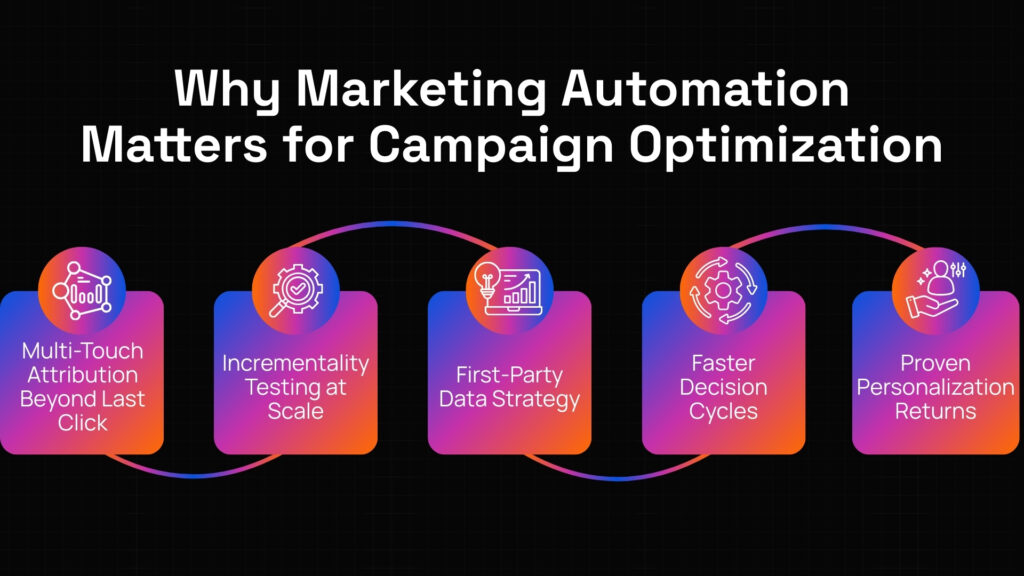
Why Marketing Automation Matters for Campaign Optimization
AI tools go beyond simple analytics dashboards; they transform how organizations understand campaign causality, maintain first-party data strategies, and ensure budget efficiency across all channels. Manual attribution workflows that once created bottlenecks through last-click bias, cookie deprecation, and impossible incrementality testing can now be executed with intelligence and precision through AI marketing that combines multiple measurement approaches. From improving paid search ROAS by 15 percent to reducing wasted spend through controlled experiments, marketing automation delivers measurable outcomes that strengthen both measurement accuracy and decision velocity.
For marketing leaders evaluating AI marketing strategies, the AI automation examples manifest in five critical ways:
- Multi-Touch Attribution Beyond Last Click: AI tools combine first-party data, CRM outcomes, and multi-touch models explaining which campaigns causally drive conversions, with Google Business showing 76 percent of marketers building attribution capability addressing fragmented channel tracking where simple rules break under cookie and identity changes.
- Incrementality Testing at Scale: Marketing automation enables controlled experiments proving causality before large budget reallocations, with Google recommending combining AI measurement with incrementality testing for reliable ROI preventing correlation-based decisions that waste spend on ineffective channels receiving credit through flawed attribution logic.
- First-Party Data Strategy: AI marketing requires CDP and CRM integration with identity stitching creating unified customer views, as cookie deprecation forces transition from third-party tracking to first-party measurement infrastructure with consent handling and cookieless approaches according to Google’s recommendations.
- Faster Decision Cycles: The CMO emphasizes speed matters with faster response and decision loops materially improving conversion likelihood, as AI tools provide automated alerts and weekly recommender reports enabling budget reallocation before campaigns lose momentum through delayed measurement preventing timely optimization.
- Proven Personalization Returns: Envive reports meaningful uplifts when AI in marketing executes at scale with strong returns from well-implemented platforms, demonstrating that accurate attribution enables personalization optimization delivering measurable business outcomes beyond pure measurement providing actionable recommendations.
AI marketing is not about replacing marketers; it is about measuring what actually moves the needle through causal analysis, turning signals into decisions through automated recommendations, and reducing wasted spend through incrementality validation enabling strategic budget allocation based on proven performance.
Key Considerations When Choosing AI Tools for Attribution
Selecting the right marketing automation requires careful alignment between technology capabilities and measurement requirements. The most successful AI marketing implementations are built on a foundation of explainability, deep data integration, and measurable impact on critical metrics like customer acquisition cost, lifetime value, and return on ad spend.
Below are the core factors that should guide every AI tools decision:
- Business Outcomes & KPI Alignment: Every AI marketing initiative must connect directly to tangible performance metrics including CAC reduction, LTV improvement, ROAS increase, or pipeline velocity acceleration. Vendors should connect attribution outputs to your specific KPIs with measurement frameworks rather than generic insight promises disconnected from actual budget optimization and revenue outcomes.
- Integration with Marketing Stack: Effective AI tools depend on seamless connectivity with first-party data sources, CRM systems, advertising platforms, analytics tools, and customer data platforms. Confirm event-level join capabilities enabling multi-touch tracking across customer journeys rather than siloed channel reporting creating incomplete attribution and flawed optimization decisions.
- Attribution Methodology Support: Marketing automation should support multi-touch models, marketing mix modeling integration, and controlled incrementality experiments not just last-touch attribution, with Google recommending combining approaches for reliable ROI as Salesforce shows 63 percent use generative AI in marketing tasks requiring sophisticated measurement beyond simple rules.
- Security and Governance: AI marketing handles sensitive customer data and campaign performance requiring first-party focus, consent handling, and readiness for cookieless measurement. Confirm data privacy frameworks and identity resolution approaches as Google emphasizes first-party foundation addressing cookie deprecation threatening third-party tracking infrastructure.
- Human-in-the-Loop (HITL) Decisioning: Successful AI tools always include marketer oversight enabling operations teams to override model suggestions and embed business rules. Ensure transparency in recommendations with confidence bands and drill-down capabilities, as The CMO emphasizes speed matters requiring fast action on insights while maintaining human judgment for strategic decisions.
- Observability and Explainability: Transparency is essential when scaling AI marketing across campaign budgets. A capable vendor provides traceable attribution decisions showing how credit gets assigned, confidence bands indicating recommendation reliability, and easy drill-downs enabling validation rather than black-box models creating distrust undermining adoption when marketers cannot verify logic.
Choosing marketing automation partners who understand these requirements ensures your investment delivers sustainable improvements rather than creating technical debt, vendor lock-in, or governance gaps that limit future flexibility when attribution strategies or data infrastructure evolve.
Understanding AI Marketing KPIs: What to Measure
Before launching any AI tools initiative, organizations must thoroughly define success metrics enabling objective pilot evaluation and ongoing performance monitoring. Key performance indicators provide the measurement framework distinguishing valuable implementations from expensive failures creating marketing skepticism. When marketing operations teams establish KPIs in advance, they align stakeholders around clear targets, enable data-driven optimization, and build business cases justifying continued investment through demonstrated value.
- Customer Acquisition Cost (CAC): Track total marketing spend divided by new customers acquired, measuring efficiency improvements when AI marketing enables better budget allocation to high-performing channels identified through causal attribution rather than correlation-based credit creating wasted spend on ineffective touchpoints.
- Return on Ad Spend (ROAS): Evaluate revenue generated per dollar spent on advertising when marketing automation optimizes channel mix, targeting specific improvements like 15 percent ROAS increase for paid search without reducing overall conversion volume proving attribution enables profitable scaling not just efficiency.
- Lifetime Value (LTV): Assess long-term customer value improvements when AI tools identify high-quality acquisition channels, as Google Business shows 76 percent building attribution capability enabling channel comparison beyond immediate conversion measuring sustained engagement and retention affecting total customer profitability.
- Pipeline Velocity: Monitor speed from lead to opportunity to close when AI marketing accelerates decision cycles, with The CMO emphasizing faster response materially improves conversion likelihood as delayed measurement prevents timely budget reallocation before campaigns lose momentum affecting overall throughput.
- Attribution Accuracy: Compare multi-touch model outputs to incrementality test results validating causal claims, as Google recommends combining approaches for reliable ROI preventing situations where sophisticated models assign credit incorrectly creating confidence in measurement enabling strategic decisions.
- Decision Cycle Time: Track duration from insight to action when marketing automation provides automated alerts and weekly recommendations, measuring organizational velocity improvements as Salesforce shows 63 percent use generative AI in tasks requiring speed translating measurement into optimization.
Pro Tip: Prioritize CDP and CRM integration with identity stitching as first-party data strategy foundation. Run controlled incrementality tests before reallocating large budgets based on attribution models, treating correlation as hypothesis requiring experimental validation before confident causation claims enable strategic investment decisions.
The Impact of Integration Readiness
Before launching any AI marketing initiative, organizations must thoroughly assess their data architecture, identity resolution maturity, and measurement infrastructure completeness. Integration readiness evaluates how well existing first-party data, CRM systems, and advertising platforms can support intelligent attribution without creating measurement gaps or flawed conclusions. When marketing operations teams conduct integration audits in advance, they uncover data quality issues and identity resolution gaps early, align stakeholders around measurement requirements, and minimize wasted time during vendor discovery and pilot phases.
Example: A B2B company preparing for AI tools implementation mapped their data flows from CRM through CDP to advertising platforms and analytics, discovering their identity resolution lacked cross-device stitching creating duplicate customer records, their CRM didn’t capture advertising touchpoints preventing multi-touch analysis, their event tracking used inconsistent naming conventions across channels, and their first-party data strategy hadn’t addressed consent management for cookieless measurement. Addressing these integration readiness issues before vendor engagement reduced the overall project timeline by seven weeks.
Pro Tip: Map complete data flows identifying every system where customer interactions get captured. Require sample data schema and exportable join key for every vendor documenting how identity resolution works across channels. Use Attribution Readiness Checklist covering data sources, identity keys, and experiment templates preparing comprehensive pilot validation.
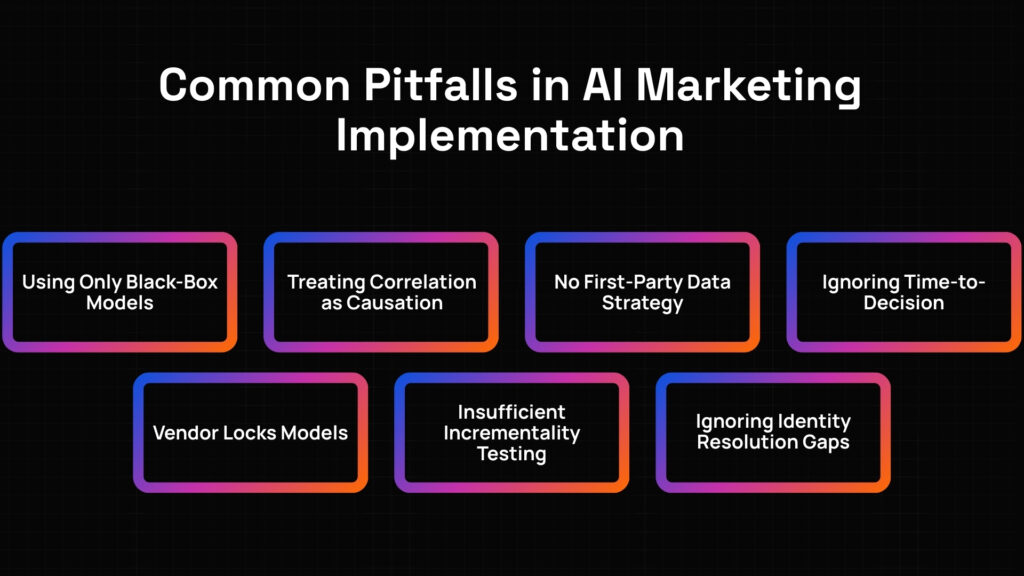
Common Pitfalls in AI Marketing Implementation
AI tools promise better campaign decisions and reduced waste, but poor planning and inadequate validation can create flawed attribution instead of accurate measurement. Many marketing organizations make avoidable mistakes during deployment that delay value realization and erode both budget efficiency and team trust. To discover proven methodologies tailored for your attribution workflows and measurement requirements, explore our AI Workflow Automation Services page for detailed AI marketing frameworks and real-world implementation guidance.
- Using Only Black-Box Models: Some organizations deploy AI marketing without understanding attribution logic creating distrust. Require explainability and sample-level traces showing how individual conversions get attributed, enabling validation that model outputs match marketing intuition and business context preventing blind faith in recommendations that may reflect correlation not causation.
- Treating Correlation as Causation: Organizations reallocating budgets based on multi-touch models without validation waste spend. Run controlled incrementality tests before large reallocations proving channels actually cause conversions rather than just correlating with them, as Google recommends combining measurement approaches for reliable ROI preventing costly mistakes from flawed attribution.
- No First-Party Data Strategy: Teams relying on third-party cookies face measurement collapse as privacy changes eliminate tracking. Prioritize CDP and CRM integration with identity stitching creating unified customer views based on first-party data with consent management, as Google emphasizes first-party foundation for cookieless measurement addressing industry transformation.
- Ignoring Time-to-Decision: Organizations with slow measurement cycles miss optimization opportunities. Automate alerts and weekly recommender reports enabling humans to act fast, as The CMO emphasizes speed matters with faster decision loops materially improving conversion likelihood when budget reallocation happens before campaign momentum decays.
- Vendor Locks Models: Contracts without export provisions create operational dependency preventing competitive negotiations and future flexibility. Contract for exported model snapshots and raw outputs ensuring you can validate independently, switch vendors, or bring measurement in-house without losing historical attribution work.
- Insufficient Incrementality Testing: Teams trusting attribution models without experimental validation face flawed optimization. Make pilot reversible and require controlled tests comparing treatment and control groups proving causality before scaling recommendations across budget, preventing situations where sophisticated models confidently assign incorrect credit.
- Ignoring Identity Resolution Gaps: Organizations assuming customer tracking works seamlessly discover attribution fragmentation. Identify identity resolution gaps during discovery including cross-device stitching, anonymous-to-known conversion, and multi-session journeys preventing situations where same customer appears as multiple individuals fragmenting attribution calculations.
Evaluating AI Automation Examples Through Marketing ROI
Quantifying the benefits of AI marketing helps secure executive buy-in and refine future investments in measurement technology. Measuring ROI goes beyond attribution accuracy; it captures gains in budget efficiency, decision velocity, wasted spend reduction, and campaign performance. Without clear metrics during evaluation, AI tools projects risk becoming unclear implementations that fail to justify ongoing operational expenses and licensing costs.
Key considerations for financial analysis include:
- ROAS Improvement: Track return on ad spend increases when marketing automation enables better channel allocation, targeting specific gains like 15 percent improvement for paid search proving attribution enables profitable optimization as Google Business shows 76 percent building capability recognizing measurement value.
- Wasted Spend Reduction: Calculate budget saved when AI marketing identifies ineffective channels through incrementality testing, measuring eliminated spend on touchpoints receiving credit through correlation but not causing conversions as Google recommends controlled experiments validating causality before reallocation.
- Decision Velocity Value: Assess opportunity capture improvements when faster measurement cycles enable timely optimization, with The CMO emphasizing speed matters as delayed decisions lose conversion momentum requiring measurement providing actionable recommendations quickly not just accurate attribution eventually.
- Personalization Returns: Measure revenue uplift from optimization enabled by accurate attribution, with Envive reporting meaningful returns when AI in marketing executes at scale demonstrating measurement value extends beyond efficiency to enable growth through better targeting and creative optimization.
- CAC and LTV Optimization: Review customer acquisition cost decreases and lifetime value increases when AI tools identify high-quality channels, calculating total impact as Salesforce shows 63 percent use generative AI in tasks enabling sophisticated analysis previously requiring data science teams unavailable to most organizations.
- Incrementality Validation: Compare model-based attribution to controlled experiment results measuring accuracy and reliability, with Google recommending combined approaches ensuring measurement drives confident decisions not flawed reallocations based on correlation masquerading as causation.
Salesforce shows 63 percent use generative AI in marketing tasks. Google Business indicates 76 percent have or will soon have attribution capability. Google recommends combining AI measurement with incrementality testing and first-party data for reliable ROI. The CMO emphasizes faster decision cycles materially improve conversion. Envive reports meaningful uplifts from well-implemented personalization at scale. When every AI marketing interaction logs attribution decision logic, confidence scores, experiment results, and model assumptions, every budget reallocation validates through incrementality testing before scaling, and every quarterly review assesses channel drift and identity resolution quality, organizations build trusted measurement operations that optimize spending without sacrificing accuracy or creating flawed optimization from incorrect attribution creating executive confidence in data-driven budget decisions.
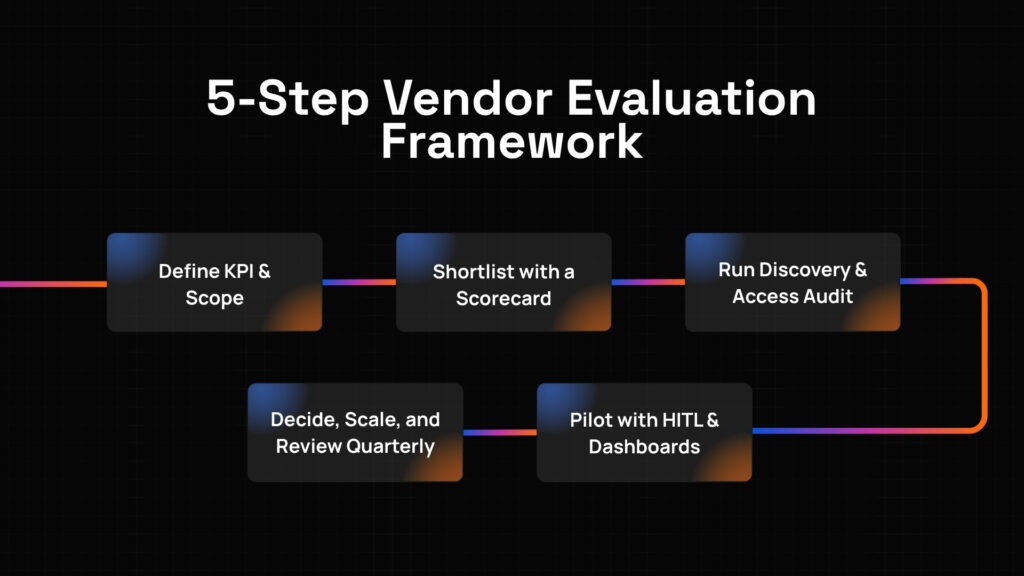
5-Step Vendor Framework for AI Marketing
Selecting an AI tools vendor should follow a disciplined, structured process that aligns with your organization’s measurement goals while accounting for both technological depth and long-term attribution maturity. Instead of focusing solely on impressive dashboards or model sophistication, evaluation should weigh how well the marketing automation solution supports measurable outcomes, integrates with existing data infrastructure, and proves causality through controlled experiments.
1. Define KPI & Scope
Start by identifying specific measurable outcomes with narrow scope enabling quick causality validation. Defining concrete targets helps align all stakeholders including marketing leadership, analytics teams, media buyers, and finance departments. Your goal might be improving paid search ROAS by 15 percent without reducing overall conversion volume, reducing CAC, or accelerating pipeline velocity, but it must be quantifiable with clear financial impact.
Example: A SaaS company defined its KPI as “improving paid search ROAS by 15 percent without reducing overall conversion volume within 90 days while maintaining CAC below $150.” This metric guided every AI marketing discussion, shaped pilot design with clear financial benchmarks, and became the success measurement. Pick one channel and one audience to prove causality quickly as The CMO emphasizes speed matters for conversion capture.
Pro Tip: Document one primary optimization outcome before requesting proposals. Focus on ROAS improvement, CAC reduction, or pipeline velocity tied to budget efficiency rather than vanity metrics like attribution coverage, and define specific percentage improvement targets with timelines enabling objective go/no-go decisions during pilot evaluation.
2. Shortlist with a Scorecard
Once objectives are clear, move to structured vendor comparison using a weighted scorecard evaluating AI tools providers. This tool allows teams to quantify how well each vendor aligns with priorities including incrementality support, integration depth, explainability and observability, pricing transparency, delivery and enablement, and exit portability.
Example: One enterprise assigned 20 percent weight each to incrementality support proving causality, integration depth with CRM and advertising platforms, and explainability showing attribution logic, plus 15 percent each to pricing transparency and delivery and enablement, and 10 percent to exit portability. Weight incrementality and explainability higher than fancy dashboards.
Pro Tip: Turn evaluation criteria into numeric scoring so decisions remain defendable beyond subjective dashboard impressions. Score integration, explainability, incrementality support, and pricing clarity 0 to 5. Weight incrementality and explainability appropriately as Google recommends controlled experiments and Salesforce shows 63 percent use AI requiring trust in measurement logic. Have multiple stakeholders from marketing, analytics, and finance score vendors independently before group discussion to reduce bias.
3. Run Discovery & Access Audit
Before contracts are signed, a structured discovery phase maps complete data flows from CRM through CDP to advertising platforms and analytics documenting every integration touchpoint and identity resolution approach. During this phase, teams validate join key availability, surface identity resolution gaps, and confirm data quality standards. Identify identity resolution gaps.
Example: A retail company conducted discovery for AI marketing, revealing their CDP lacked cross-device identity stitching creating duplicate customer profiles, their advertising platform pixels weren’t synchronized with CRM events preventing accurate attribution, their analytics used different customer IDs than CRM requiring complex reconciliation, and their first-party data strategy hadn’t addressed consent management as cookie deprecation approached. Map data flows from CRM through CDP to ad platforms to analytics.
Pro Tip: Require sample data schema and exportable join key for every vendor documenting exactly how identity resolution happens across channels and devices. Map complete data flows identifying every customer interaction capture point. Use discovery to surface identity gaps, data quality issues, and integration limitations before signing when negotiating leverage is highest rather than discovering issues after contracts are executed.
4. Pilot with Experiments & Dashboards
A well-designed pilot validates both technology performance and causal attribution accuracy under real marketing conditions. Instead of full-scale deployment, run 6-week pilot including 2 small incrementality tests plus multi-touch model comparing recommendations against experimental results. Incorporating controlled experiments ensures AI marketing outcomes reflect causality not correlation while building marketing team confidence.
Example: A financial services company piloted AI tools for paid search attribution, running 6-week evaluation with 2 geographic holdout tests comparing treatment and control markets, multi-touch model tracking customer journeys, and dashboard comparing model recommendations to experiment results, validating 12 percent ROAS improvement claim with 13 percent measured lift in treatment markets. Make pilot reversible and require weekly exported results for internal validation as Google recommends combining measurement approaches.
Pro Tip: Execute pilots with frozen scope covering specific channel and audience, clear success criteria including experimental validation, and measurable KPIs tracked weekly. Run 6-week pilot with 2 small incrementality tests and multi-touch model comparing recommendations. Make pilot reversible enabling rollback if attribution proves inaccurate. Require weekly exported results for independent validation. Use pilot to validate attribution logic through controlled experiments proving causality before trusting models for budget decisions.
5. Decide, Scale, and Institutionalize Insights
After the pilot proves both attribution accuracy and decision value, use findings to guide the final decision about scaling successful experiment learnings into automated budget rules. Scaling should be deliberate, expanding only after controlled tests validate model recommendations across multiple channels and customer segments. Continuous quarterly reviews maintain measurement discipline, ensuring attribution adapts as channel performance, identity infrastructure, and privacy regulations evolve.
Example: A technology company conducted quarterly reviews with its AI marketing partner, expanding successful paid search optimization to display advertising and social media over 12 months, scaling experiment-validated learnings into automated budget rules, identifying optimization opportunities improving overall ROAS by additional 8 percent, and keeping quarterly reviews to catch channel drift and identity changes as Google Business shows 76 percent building attribution capability requiring ongoing governance.
Pro Tip: Treat vendor reviews as measurement governance sessions focused on attribution accuracy and experiment validation, not just dashboard updates. Scale successful experiment learnings into automated budget rules after consistent validation across scenarios. Keep quarterly reviews catching channel drift, identity resolution quality changes, and privacy regulation updates. Use quarterly reviews to assess attribution accuracy through ongoing incrementality tests, model-experiment agreement, and decision velocity as markets and customers evolve.
Next Steps in Your AI Marketing Evaluation
By now, you should have a clear understanding of what to prioritize when selecting AI tools partners for attribution. Bringing these insights together creates a structured evaluation flow that de-risks investment and accelerates deployment while ensuring measurement accuracy and budget optimization.
- Align with financial metrics: Ensure every marketing automation feature connects to specific KPIs like ROAS, CAC, or pipeline velocity tied to budget efficiency, not just attribution coverage percentages disconnected from actual campaign performance and spending optimization.
- Evaluate data integration: Confirm that AI marketing works smoothly with first-party data sources, CRM, advertising platforms, and analytics through event-level joins enabling multi-touch tracking, with identity resolution approaches addressing cross-device and anonymous-to-known challenges fragmenting attribution without unified customer views.
- Focus on incrementality: Choose vendors supporting controlled experiments proving causality before budget reallocations, as Google recommends combining AI measurement with incrementality testing for reliable ROI preventing flawed optimization from correlation-based attribution assigning incorrect credit.
- Review explainability: Favor partners with traceable attribution decisions, confidence bands, and drill-down capabilities enabling validation, as black-box models undermine adoption when marketers cannot verify logic despite Salesforce showing 63 percent use AI requiring trust in measurement recommendations.
- Test with controlled pilots: Always run 6-week pilots with 2 small incrementality tests comparing model recommendations to experimental results before full deployment to validate attribution accuracy, decision value, and operational readiness under real-world marketing conditions with actual channel complexity and identity resolution challenges.
With these criteria in place, you are better equipped to identify AI marketing vendors who not only provide sophisticated models but also prove causality, reduce wasted spend, accelerate decision cycles, and enable confident budget optimization through validated attribution driving measurable ROAS improvements.
Vendor Questions to Ask
To make the most informed decision during your AI marketing evaluation, be sure to ask these essential questions:
- Which attribution methods do you support including multi-touch models, marketing mix modeling, and incrementality testing, and can you provide examples of each?
- How do you join first-party events to CRM outcomes across channels and devices, and what identity graph or resolution approach do you use?
- Can you run controlled incrementality tests with treatment and control groups, and will you show raw experiment outputs enabling independent validation?
- What explainability does the model provide for specific attribution recommendations showing how credit gets assigned with confidence bands?
- What data connectors are native versus requiring custom work including advertising platforms, CDP, CRM, and analytics tools?
- How is pricing metered including events tracked, models run, or experiments conducted, and what assumptions drive cost projections as usage scales?
- What export formats do you provide for models, raw data, and experiment logs on termination ensuring attribution work remains with our organization?
- Can I speak to two customer references with similar measurement challenges who can discuss attribution accuracy validation and ongoing partnership quality?
- How do you handle cookieless measurement and first-party data strategies as privacy regulations eliminate third-party tracking?
- What is the process for validating attribution accuracy through incrementality testing, and how often do you recommend running controlled experiments?
Transform Campaign Optimization with AI Marketing
AI marketing is not just a technological investment; it is a strategic measurement capability that requires careful planning, experimental validation, and continuous accuracy monitoring. The right implementation brings better budget allocation, faster decision cycles, and reduced wasted spend, while poor execution creates flawed attribution and misguided optimization that undermine confidence and damage performance.
Ready to transform your campaign optimization with AI marketing? Book a Free Strategy Call with us to explore the next steps and discover how we can help you scope pilots, validate attribution through incrementality testing, and scale the right AI tools solution for your unique data infrastructure, measurement requirements, and measurable business outcomes.