

The Power of AI Marketing Automation: Why Lifecycle Nurtures Matter
AI marketing automation has evolved from basic email sequencers into intelligent lifecycle orchestration that defines conversion success in modern revenue operations. Marketing teams implementing professional AI automation for marketing are fundamentally reimagining how leads progress from initial magnet to sales-qualified status, how personalization scales across channels, and how SLAs maintain compliance without overwhelming sales development representatives. Advanced marketing with AI now manages nurture flows that once required entire SDR departments, enabling teams to focus on high-intent conversations, complex objections, and relationship building that drive pipeline and revenue.
The data supporting this transformation continues to strengthen across marketing functions. According to McKinsey research, marketing and sales use cases report the largest revenue gains from AI deployments, demonstrating these functions capture disproportionate value when automation targets revenue-critical workflows. MultiFamily Strategic Marketing Summit data shows around two thirds of marketers already use AI or automation in their workflows, representing mainstream adoption beyond experimental pilots. McKinsey notes generative AI adoption expanded quickly with one in three organizations using gen-AI regularly in at least one function within a year of mainstream breakout, signaling rapid transformation as AI automation benefits become validated through production deployments.
Why AI Automation for Marketing Matters for Revenue Teams
AI marketing automation goes beyond simple email scheduling; it transforms how organizations manage lead progression, maintain response time commitments, and ensure conversion quality across all touchpoints. Manual nurture workflows that once created bottlenecks through inconsistent personalization, delayed handoffs, and impossible 24/7 coverage can now be executed with intelligence and precision through marketing with AI. From reducing lead-to-MQL time from 48 hours to 8 hours to protecting conversion SLAs through automated triage, AI automation for marketing delivers measurable outcomes that strengthen both operational efficiency and revenue generation.
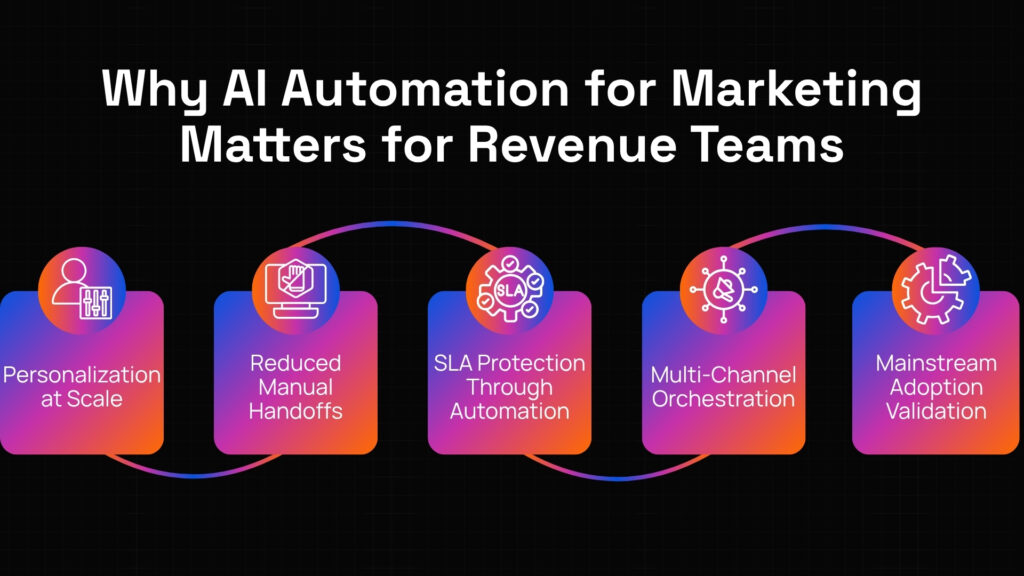
For marketing leaders evaluating AI marketing automation strategies, the AI automation benefits manifest in five critical ways:
- Personalization at Scale: AI systems customize outreach across email, SMS, chat, and web without writing every variant manually, with McKinsey showing personalization leaders generate approximately 40 percent more revenue than average performers proving intelligent customization drives conversion improvements when executed systematically across customer journeys.
- Reduced Manual Handoffs: Intelligent automation eliminates delays in time to contact after lead magnet conversion through automated triage and routing, with McKinsey indicating marketing and sales use cases report largest revenue gains from AI deployments when systems accelerate progression from awareness to sales engagement.
- SLA Protection Through Automation: AI automation for marketing maintains response time commitments by automating lead routing to appropriate teams based on intent signals, qualification criteria, and capacity availability, preventing SLA breaches that damage conversion rates and waste marketing investment when speed-to-lead degrades.
- Multi-Channel Orchestration: Marketing with AI coordinates touches across channels intelligently, with HubSpot case studies showing pilots adding automated SMS and message workflows demonstrate approximately 21 percent conversion uplift from cohesive multi-channel experiences versus single-channel approaches that miss engagement opportunities.
- Mainstream Adoption Validation: Two thirds of marketers already use AI or automation according to MultiFamily Strategic Marketing Summit data, with McKinsey noting one in three organizations adopted gen-AI in one function within a year proving AI automation benefits are validated through widespread production deployment beyond experimental pilots.
AI marketing automation is not about replacing SDRs; it is about creating predictable nurture flows that turn leads into sales-qualified opportunities without burning representatives on low-intent touches, enabling human capacity to focus on high-value conversations requiring relationship skills and complex objection handling.
Key Considerations When Choosing AI Automation for Marketing Partners
Selecting the right AI marketing automation requires careful alignment between technology capabilities and revenue operation requirements. The most successful marketing with AI implementations are built on a foundation of transparency, deep CRM and ESP integration, and measurable impact on critical metrics like lead-to-MQL time, SQL rate, and cost per SQL.
Below are the core factors that should guide every AI automation for marketing decision:
- Business Outcomes & KPI Alignment: Every AI marketing automation initiative must connect directly to tangible revenue metrics including lead-to-MQL time reduction, SQL rate improvement, demo show rate increase, or cost per SQL decrease. Vendors should map automation to your specific KPIs with measurement frameworks rather than generic efficiency promises disconnected from pipeline generation and revenue outcomes.
- Integration with Marketing Stack: Effective AI automation for marketing depends on seamless connectivity with your CRM, email service provider, marketing data warehouse, and communication channels. Confirm native connectors or APIs supporting read-write access and event hooks enabling real-time orchestration across systems rather than batch processing creating delays and synchronization issues.
- Security and Governance: Marketing with AI handles sensitive lead data including contact information, engagement history, and qualification scores requiring strict controls. Confirm data residency options, encryption standards, retention policies for leads and transcripts, and support for regional compliance frameworks ensuring responsible data handling as two thirds of marketers adopt AI according to MultiFamily Strategic Marketing Summit.
- Human-in-the-Loop (HITL) Design: Successful AI marketing automation always includes SDR escalation mechanisms when AI detects low confidence or high-risk leads. Ensure clear definition of how detection works including confidence thresholds and qualification signals, what triggers human engagement, and what context is handed off enabling seamless continuation without forcing leads to repeat information.
- Observability and Analytics: Transparency is essential when scaling AI automation for marketing across lead volume. A capable vendor provides comprehensive dashboards tracking routing decisions and message performance, trace logs showing why a lead was routed to specific team or why particular message was sent, and audit trails supporting governance reviews and optimization efforts.
- Pricing Transparency and Flexibility: Clarify pricing assumptions covering lead volume, channel usage, language support, and feature tiers so financial forecasting remains accurate as nurture programs scale. Document whether you retain prompts, templates, and datasets developed during implementation ensuring intellectual property belongs to your organization preventing vendor lock-in threatening operational continuity.
Choosing AI marketing automation partners who understand these requirements ensures your investment delivers sustainable improvements rather than creating technical debt, vendor lock-in, or governance gaps that limit future flexibility when marketing strategies or technology stacks evolve.
The Impact of Integration Readiness
Before launching any AI automation for marketing initiative, organizations must thoroughly assess their CRM data quality, ESP integration maturity, and SLA documentation completeness. Integration readiness evaluates how well existing lead flows, scoring models, and handoff procedures can support intelligent automation without creating chaos or poor conversion outcomes. When revenue operations teams conduct integration audits in advance, they uncover data gaps and process inconsistencies early, align marketing and sales stakeholders around workflow requirements, and minimize wasted time during vendor discovery and pilot phases.
Example: A SaaS company preparing for AI marketing automation mapped their lead magnet to SQL workflow, discovering their CRM lacked standardized lead source tracking preventing accurate attribution, their ESP used different contact IDs than their CRM requiring complex reconciliation, their SLA for lead-to-contact wasn’t documented creating ambiguity about response time commitments, and their qualification criteria mixed explicit scoring with judgment-based assessment. Addressing these integration readiness issues before vendor engagement reduced the overall project timeline by eight weeks.
Pro Tip: Vendor should map your CRM fields, webhook flows, and SLA rules before proposals. Ask for access matrix showing what data they need and why ensuring clarity on integration touchpoints. Use the Integration Readiness Checklist for CRM, ESP, and SLA flows to make pilot painless by surfacing data quality gaps, access control issues, and governance requirements before engaging vendors when negotiating leverage is highest.
Common Pitfalls in AI Automation for Marketing
AI marketing automation promises conversion improvements and operational efficiency, but poor planning and inadequate governance can create implementation failures instead of revenue gains. Many marketing organizations make avoidable mistakes during deployment that delay value realization and erode both lead quality and team trust. To discover proven methodologies tailored for your lifecycle workflows and conversion requirements, explore our AI Workflow Automation Services page for detailed marketing with AI frameworks and real-world implementation guidance.
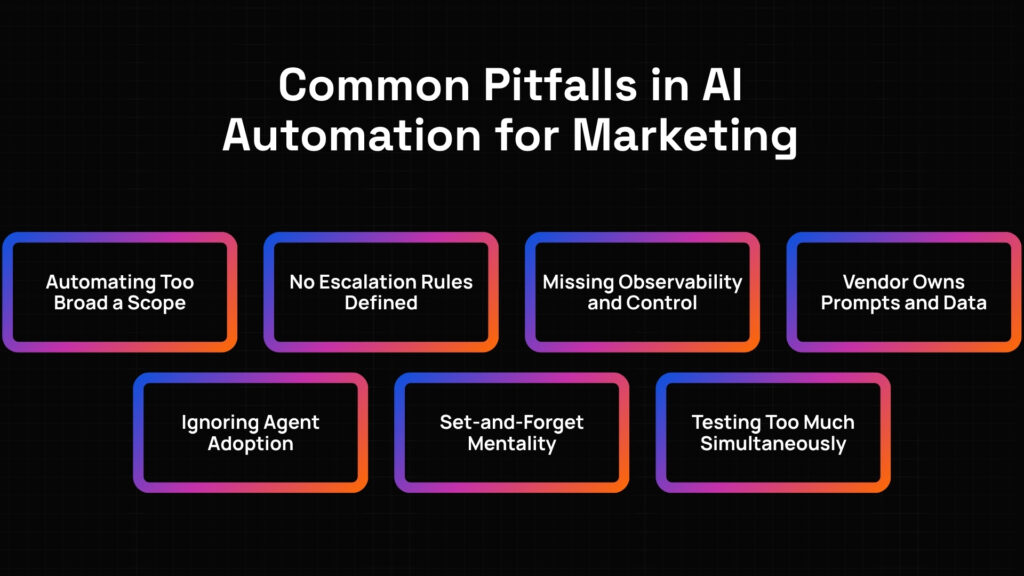
- Automating Too Broad a Scope: Some organizations attempt to automate all lead magnets and channels simultaneously without prioritization. Start with 1 lead magnet plus 1 channel proving value on narrow scope before expanding to comprehensive coverage that delays launch and creates impossible complexity during pilot evaluation.
- No Escalation Rules Defined: Deploying AI automation for marketing without clear SDR handoff procedures creates low-quality SQL flow and representative frustration. Define confidence thresholds that always trigger human engagement for high-intent signals or low-confidence qualification, specifying what context SDRs receive ensuring seamless continuation.
- Missing Observability and Control: Organizations implementing AI marketing automation without dashboards face invisible conversion degradation. Require trace logs showing routing decisions and rollback path before pilot enabling quick response when automation creates poor lead experiences or quality issues undermining conversion rates.
- Vendor Owns Prompts and Data: Contracts without asset ownership clarity create operational lock-in preventing future flexibility. Contract for asset portability from day one including prompts, templates, evaluation sets, and workflow logic ensuring you can switch vendors without losing operational capability or starting from scratch.
- Ignoring Agent Adoption: Technical implementations without SDR enablement face resistance undermining success. Build agent playbooks showing how AI-routed leads differ from manual flow, and pair AI actions with agent coaching addressing concerns about lead quality and demonstrating how automation helps them focus on high-intent conversations.
- Set-and-Forget Mentality: Treating AI automation for marketing as one-time project creates performance degradation. Schedule quarterly reviews for drift in model performance and new lead types ensuring automation adapts as products, markets, and buyer behaviors evolve rather than becoming stale and ineffective.
- Testing Too Much Simultaneously: Organizations running multiple experiments across variables create impossible attribution. A/B test one element at a time including message content, timing, or channel so learning isolates what drives conversion improvements rather than guessing which changes among many caused performance shifts.
Evaluating AI Automation Benefits Through ROI
Quantifying the benefits of AI marketing automation helps secure executive buy-in and refine future investments in revenue technology. Measuring ROI goes beyond simple lead volume; it captures gains in lead-to-MQL time, SQL quality, conversion rates, and SDR capacity. Without clear metrics during evaluation, marketing with AI projects risk becoming unclear implementations that fail to justify ongoing operational expenses and licensing costs.
Key metrics to monitor include:
- Lead-to-MQL Time Reduction: Track decreases in progression duration when AI automation for marketing accelerates qualification and routing, targeting specific improvements like reducing lead-to-MQL time from 48 hours to 8 hours for webinar signups enabling faster sales engagement while buyer intent remains high.
- SQL Rate and Quality Improvement: Measure increases in sales-qualified lead percentage when intelligent triage and personalization improve conversion, with McKinsey showing marketing and sales use cases report largest revenue gains from AI deployments when automation enhances qualification accuracy beyond pure volume metrics.
- Conversion Uplift from Multi-Channel: Evaluate performance improvements when marketing with AI coordinates touches across email, SMS, chat, and web, with HubSpot case studies showing pilots adding automated SMS and message workflows demonstrate approximately 21 percent conversion lift from cohesive orchestration.
- Cost Per SQL Reduction: Assess operational efficiency improvements when automation reduces manual work, calculating unit economics gains demonstrating financial returns as two thirds of marketers adopt AI according to MultiFamily Strategic Marketing Summit validating mainstream business cases.
- Personalization Revenue Impact: Review revenue gains from intelligent customization at scale, with McKinsey indicating personalization leaders generate approximately 40 percent more revenue from those activities than average performers proving systematic personalization drives measurable business outcomes beyond operational efficiency.
- Adoption and Scale Progress: Calculate momentum as one in three organizations adopted gen-AI in one function within a year according to McKinsey, measuring implementation maturity as AI marketing automation expands from narrow pilots to comprehensive lifecycle coverage while maintaining conversion quality and SDR satisfaction.
McKinsey shows marketing and sales report largest revenue gains with personalization leaders generating 40 percent more revenue. MultiFamily Strategic Marketing Summit indicates two thirds of marketers use AI or automation. HubSpot demonstrates 21 percent conversion lift from automated multi-channel workflows. McKinsey notes one in three organizations adopted gen-AI in one function within a year. When every AI automation for marketing interaction logs routing decisions, confidence scores, escalation triggers, and outcomes, every workflow change maintains version history with rollback capabilities, and every escalation provides SDRs with complete lead context and AI actions, organizations build trusted revenue operations that scale without sacrificing conversion quality or creating governance vulnerabilities.
5-Step Vendor Framework for AI Marketing Automation
Selecting an AI automation for marketing vendor should follow a disciplined, structured process that aligns with your organization’s revenue goals while accounting for both technological depth and long-term partnership potential. Instead of focusing solely on impressive demonstrations or feature lists, evaluation should weigh how well the marketing with AI solution supports measurable outcomes, integrates with existing systems, and adapts to evolving buyer expectations.
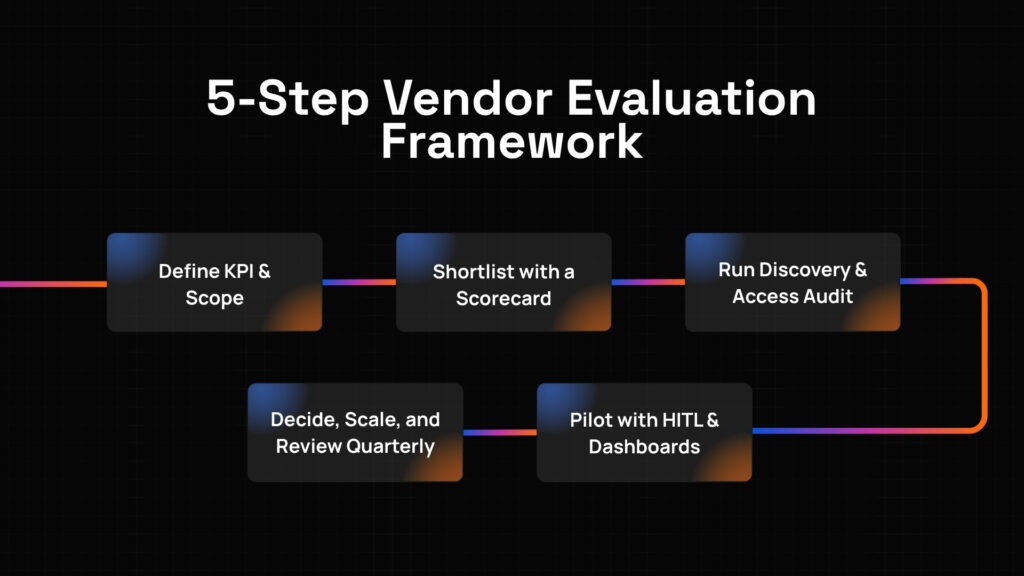
1. Define KPI & Scope
Start by identifying specific measurable outcomes with narrow scope enabling quick value proof. Defining concrete targets helps align all stakeholders including marketing leadership, revenue operations, sales development, and demand generation. Your goal might be reducing lead-to-MQL time from 48 hours to 8 hours for webinar signups, improving SQL rate, or decreasing cost per SQL, but it must be quantifiable with clear measurement methodology.
Example: A B2B software company defined its KPI as “reducing lead-to-MQL time from 48 hours to 8 hours for webinar signups while maintaining SQL rate above 15 percent and demo show rate above 40 percent within 90 days.” This metric guided every AI marketing automation discussion, shaped pilot design, and became the benchmark for success measurement. Pick one channel and one audience segment for pilot as McKinsey shows marketing and sales report largest revenue gains when implementations focus scope strategically.
Pro Tip: Document one primary conversion metric before requesting proposals. Focus on lead-to-MQL time, SQL rate, or cost per SQL tied to revenue impact rather than vanity metrics like total leads processed, and define specific percentage improvement targets with timelines enabling objective go/no-go decisions during pilot evaluation.
2. Shortlist with a Scorecard
Once objectives are clear, move to structured vendor comparison using a weighted scorecard evaluating AI automation for marketing providers. This tool allows teams to quantify how well each vendor aligns with priorities including integration depth with CRM and ESP, observability capabilities, human-in-the-loop design, KPI alignment, delivery planning, and pricing transparency. Score integration, observability, HITL design, and pricing transparency 0 to 5.
Example: One enterprise assigned 20 percent weight to integration depth with CRM, ESP, and data warehouse, 20 percent to observability and dashboards, 15 percent to HITL and escalation design, 15 percent to KPI alignment with revenue metrics, 10 percent to pricing transparency and assumptions, 10 percent to delivery and enablement support, and 10 percent to exit portability and asset ownership. Give higher weight to integrations and observability for lifecycle work.
Pro Tip: Turn evaluation criteria into numeric scoring so decisions remain defendable beyond subjective impressions from demonstrations. Weight factors reflecting your priorities with integration and observability typically receiving highest emphasis for mission-critical revenue workflows. Have multiple stakeholders from marketing, revenue operations, and sales development score vendors independently before group discussion to reduce bias.
3. Run Discovery & Access Audit
Before contracts are signed, a structured discovery phase allows vendors to map your CRM fields, webhook flows, and SLA rules documenting every integration touchpoint and data dependency. During this phase, teams validate data quality, surface system limitations, and confirm security controls with appropriate permissions. Ask for access matrix showing what data they need and why.
Example: A healthcare technology company conducted discovery with AI marketing automation vendors, revealing their CRM used custom objects without standard API support, their ESP lacked webhook capabilities for real-time event triggers, their lead scoring mixed automated and manual components creating inconsistency, their SLA documentation was outdated not reflecting current response time commitments, and their qualification criteria weren’t documented preventing clear automation logic design.
Pro Tip: Vendor should map your CRM fields, webhook flows, and SLA rules before proposals providing complete integration architecture. Ask for access matrix documenting data requirements and justification. Use discovery to surface data quality gaps, integration limitations, and SLA ambiguities before signing when negotiating leverage is highest rather than discovering issues after contracts are executed.
4. Pilot with HITL & Dashboards
A well-designed pilot validates both technology performance and SDR adoption under real revenue conditions. Instead of full-scale deployment, run 4-week pilot on one lead magnet with clear A/B testing and KPI baselines maintaining human oversight for quality assurance. Incorporating human-in-the-loop review ensures AI automation for marketing outcomes align with conversion standards and lead quality requirements while building organizational confidence.
Example: A financial services company piloted marketing with AI for investment guide downloads, running 4-week evaluation with one lead magnet, SDR review for all high-confidence SQL classifications, and dashboard tracking lead-to-MQL time and SQL rate, achieving 6.2 hour average progression time with 18 percent SQL rate above 15 percent target. Require weekly dashboard snapshots and contractual kill switch as HubSpot shows 21 percent conversion uplift from automated multi-channel workflows when properly governed.
Pro Tip: Execute pilots with frozen scope covering specific lead magnet, clear success criteria comparing to baseline metrics, and measurable KPIs tracked weekly. Run 4-week pilot with one lead magnet and clear A/B testing establishing statistical significance. Require weekly dashboard snapshots showing progression and quality metrics. Include contractual kill switch enabling quick rollback if conversion degrades. Use pilot period to refine prompts, train SDRs on AI-routed leads, and validate integration stability.
5. Decide, Scale, and Review Quarterly
After the pilot proves value, use findings to guide the final decision about scaling to other magnets after hitting targets for 4 consecutive weeks validating sustainability and stability. Scaling should be deliberate, expanding only after consistent performance demonstrates approach and quality. Continuous quarterly reviews maintain alignment, ensuring automation evolves alongside product launches, market changes, and buyer behavior shifts.
Example: A SaaS company conducted quarterly reviews with its AI marketing automation partner, expanding successful webinar nurture automation to ebook downloads and demo requests over 12 months, scaling after hitting targets for 4 consecutive weeks, and identifying optimization opportunities that improved lead-to-MQL time by additional 35 percent while increasing SQL rate to 22 percent. Schedule quarterly reviews for drift in model performance and new lead types as McKinsey shows personalization leaders generate 40 percent more revenue requiring ongoing optimization.
Pro Tip: Treat vendor reviews as strategic sessions focused on expanding successful AI automation for marketing use cases to adjacent lead magnets and optimizing qualification logic, not just maintenance calls about system uptime. Scale to other magnets after hitting targets for 4 consecutive weeks proving consistency. Use quarterly reviews to assess performance drift, model accuracy, new lead type handling, and alignment with evolving products and markets.
Next Steps in Your AI Marketing Automation Evaluation
By now, you should have a clear understanding of what to prioritize when selecting an AI automation for marketing partner. Bringing these insights together creates a structured evaluation flow that de-risks investment and accelerates deployment while ensuring long-term revenue excellence.
- Align with revenue metrics: Ensure every marketing with AI feature connects to specific KPIs like lead-to-MQL time, SQL rate, or cost per SQL tied to pipeline generation, not just lead volume percentages disconnected from actual conversion quality and revenue outcomes.
- Evaluate integration architecture: Confirm that AI marketing automation works smoothly with your CRM, ESP, marketing data warehouse, and communication channels through native connectors or APIs with read-write access and event hooks enabling real-time orchestration without manual intervention.
- Focus on HITL and escalation: Choose vendors with clear detection mechanisms for low-confidence or high-risk leads, defined escalation paths to SDRs with complete context handoff, and confidence thresholds ensuring human engagement for situations requiring relationship skills and judgment.
- Review observability capabilities: Favor partners with comprehensive dashboards tracking routing and messaging decisions, trace logs showing why specific actions were taken, and audit trails supporting governance reviews and continuous optimization as two thirds of marketers adopt AI requiring transparency.
- Test with controlled pilots: Always run 4-week pilots with one lead magnet, clear A/B testing, human oversight, and weekly metric reviews before full deployment to validate lead-to-MQL improvements, SQL quality maintenance, and operational readiness under real-world revenue conditions.
With these criteria in place, you are better equipped to identify AI automation for marketing vendors who not only automate workflows but also reduce lead-to-MQL time, improve SQL quality, protect conversion SLAs, and amplify your team’s capacity to focus on high-intent conversations that advance deals and create pipeline.
Vendor Questions to Ask
To make the most informed decision during your AI marketing automation evaluation, be sure to ask these essential questions:
- Which CRM, ESP, analytics, and data warehouse integrations do you support natively, and what read-write actions will you perform in our systems?
- How do you detect low-confidence outputs or high-risk leads, and what is the human escalation flow with what context provided to SDRs?
- What dashboards, trace logs, and audit trails do you provide for lead routing decisions and message performance enabling ongoing optimization?
- What data is retained including leads, transcripts, and engagement history, where is it stored for compliance, and can we export it on termination?
- Can you run pilot with specific percentage of traffic and provide anonymized metrics from comparable customer demonstrating proven approach?
- What assumptions drive your pricing including lead volume, channel usage, and language support, and how do costs scale as programs expand?
- Do you deliver playbooks and training for SDRs during handover addressing how AI-routed leads differ and how to handle escalations?
- Who owns the assets including prompts, templates, and datasets developed during implementation, and can we export them if we switch vendors?
- Can I speak to two customer references with similar lead volumes and complexity who can discuss measured lead-to-MQL improvements and implementation challenges?
- What is the contractual kill switch mechanism enabling quick rollback if automation degrades conversion or creates quality issues?
Transform Lifecycle Nurtures with AI Marketing Automation
AI marketing automation is not just a technological investment; it is a strategic revenue capability that requires careful planning, vendor selection, and continuous optimization. The right implementation brings predictable lead progression, protected SLAs, and conversion improvement across touchpoints, while poor execution creates low-quality SQL flow and SDR resistance that undermine confidence and waste investment.
Ready to transform your lifecycle nurtures with AI marketing automation? Book a Free Strategy Call with us to explore the next steps and discover how we can help you scope pilots, evaluate vendors, and scale the right AI automation for marketing solution for your unique CRM environment, lead mix, and measurable business outcomes.