
The Power of AI Marketing Automation: Why It Matters
AI marketing automation has evolved from experimental content generation tools into strategic infrastructure that defines operational excellence in modern marketing organizations. Marketing teams implementing intelligent AI marketing automation software are fundamentally reimagining how campaigns move from briefs to assets, approvals to publishing, and reporting to optimization decisions. Advanced AI automation for marketing now manages workflows that once consumed entire creative departments, enabling marketers to focus on strategy, positioning, and relationship building that drive pipeline growth and customer lifetime value.
The data supporting this transformation continues to strengthen across marketing functions. According to HubSpot research, 68 percent of marketers using AI in 2024 said it makes content higher quality and 62 percent reported significant time savings, demonstrating measurable productivity gains from automation adoption. PwC’s 2025 survey found that employees using AI regularly reported 4.8 times productivity improvement versus those who rarely use it, showing substantial efficiency multipliers. Accenture’s Pulse of Change research indicates that many service teams now work with AI agents in daily workflows, reflecting broader organizational readiness for assisted operations, while employees who regularly use AI report higher satisfaction and confidence in organizational change, signaling that enablement and change management matter critically for successful deployment and sustained adoption.
Why AI Marketing Automation Matters for Marketing Teams
AI marketing automation goes beyond simple task execution; it transforms how organizations manage campaign lifecycles, maintain brand consistency, and ensure customer satisfaction across all marketing touchpoints. Manual workflows that once created bottlenecks in brief creation, asset production, approval routing, and performance reporting can now be executed with intelligence and precision through marketing automation. From generating first-draft campaign briefs and copy variations to policy checking for brand compliance and orchestrating cross-channel journeys, AI automation for marketing delivers measurable outcomes that strengthen both campaign velocity and operational efficiency across all marketing functions.
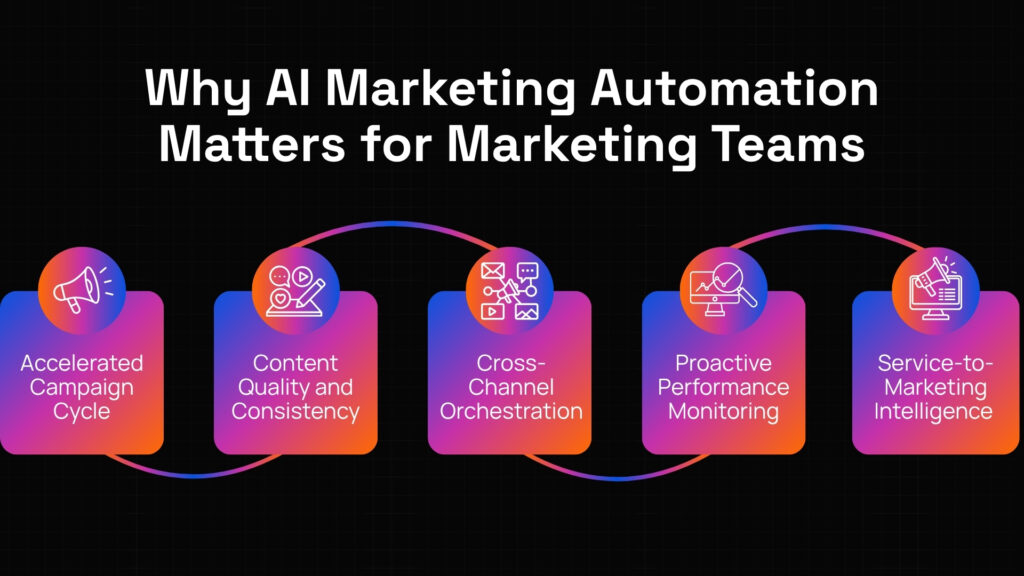
For marketing leaders evaluating AI marketing automation strategies, the benefits manifest in five critical ways:
- Accelerated Campaign Cycle Times: AI marketing automation software reduces campaign development from weeks to days by generating first-draft briefs from historical performance data and campaign goals, automatically routing assets to design and copy teams with brand guardrails, and streamlining QA processes that traditionally required multiple manual review rounds and back-and-forth coordination.
- Enhanced Content Quality and Consistency: Intelligent systems apply standardized brand rules, claim validation against legal libraries, and compliance checks automatically, eliminating the variability that comes from manual interpretation across distributed teams, rushed reviews during crunch periods, or inconsistent application of evolving brand guidelines.
- Cross-Channel Orchestration Capabilities: AI automation for marketing enables sophisticated journey triggering across email, SMS, chat, paid advertising, and website personalization based on unified customer data, behavioral signals, and predictive analytics, creating cohesive experiences that manual coordination struggles to maintain at scale.
- Proactive Performance Monitoring: Marketing automation with AI generates daily performance rollups, detects anomalies automatically, creates “explain this dip” analysis threads pushed to collaboration platforms like Slack, and surfaces optimization opportunities before quarterly reviews, enabling faster iteration and budget reallocation.
- Service-to-Marketing Intelligence Loop: AI chatbots deflect repetitive customer questions while capturing intent patterns, feeding content gap analysis back to marketing teams who can create targeted assets addressing common inquiries, improving both service efficiency and marketing relevance through closed-loop learning.
AI marketing automation is not about replacing creative teams; it is about amplifying their effectiveness, ensuring brand consistency, and enabling marketers to focus on strategic positioning, messaging innovation, and relationship building that require human creativity and emotional intelligence.
Key Considerations When Choosing AI Marketing Automation Software
Selecting the right AI automation for marketing requires careful alignment between technology capabilities and marketing operations requirements. The most successful marketing automation implementations are built on a foundation of transparency, deep integration across marketing technology stacks, and measurable impact on critical metrics like campaign cycle time, customer acquisition cost, and pipeline velocity.
Below are the core factors that should guide every AI marketing automation decision:
- Business Outcomes & KPI Alignment: Every AI marketing automation software initiative must connect directly to tangible business metrics, whether that is reducing campaign cycle time from 10 days to 4, lowering customer acquisition costs, improving lead velocity rates, increasing customer satisfaction scores, or accelerating pipeline generation. Vendors should demonstrate clear methodology for tying automations to money metrics with baseline measurements, not vague productivity promises.
- Integration with Existing Systems: Effective AI automation for marketing depends on seamless connectivity with your CRM, marketing automation platform, help desk, phone systems, content management system, and data warehouse. The ideal partner ensures smooth bidirectional data flow with read and write capabilities, event-driven triggers plus scheduled jobs, and comprehensive audit trails so automated workflows can access customer context, execute campaign actions, and maintain compliance documentation.
- Security and Governance: AI marketing automation handles sensitive customer data including contact information, behavioral tracking, campaign performance metrics, and creative assets that require strict controls. Confirm that vendors maintain single sign-on integration, role-based access controls, PII masking capabilities, comprehensive audit logging, and data retention policies aligned with privacy regulations.
- Human-in-the-Loop (HITL) Flexibility: Successful marketing automation always includes creative team and legal oversight mechanisms for decisions affecting brand positioning, compliance claims, or customer communications. Ensure that workflows incorporate inline commenting capabilities, tiered approval routing for different risk levels, evidence linking to source materials, and one-click escalation pathways when edge cases emerge.
- Observability and Analytics: Transparency is essential when scaling AI marketing automation software across campaign workflows. A capable vendor provides complete decision traces showing content generation logic and policy checks, evaluation sets for quality assessment, drift detection alerts when performance degrades, and safe revert capabilities to restore previous prompt versions when issues arise.
- Pricing Transparency and Flexibility: Insist on clear pricing models with explicit assumptions around usage volumes, system integration counts, and model inference expenses. Understanding AI automation for marketing economically helps forecast costs accurately as campaign volumes and complexity scale, requiring different budgeting approaches than fixed per-seat marketing platform licenses.
Choosing AI marketing automation partners who understand these requirements ensures your investment delivers sustainable improvements rather than creating technical debt, vendor lock-in, or governance gaps that limit future flexibility when marketing strategies or technology stacks evolve.
The Impact of Integration Readiness
Before launching any AI marketing automation software initiative, organizations must thoroughly assess their marketing technology architecture, data quality, and approval workflow documentation completeness. Integration readiness evaluates how well existing CRM, marketing automation platforms, and content management systems can support intelligent automation without creating data gaps or brand risk. When marketing teams conduct integration audits in advance, they uncover data quality issues early, align IT and operations stakeholders around connectivity requirements, and minimize wasted time during vendor discovery and pilot phases.
Example: A B2B technology company preparing for AI automation for marketing discovered that their CRM lacked webhook support for real-time lead scoring updates, their content management system contained inconsistent metadata that confused asset retrieval, and their approval workflow documentation mixed simple brand checks suitable for automation with strategic messaging decisions requiring creative director review. Addressing these integration readiness issues before vendor engagement reduced the overall project timeline by ten weeks and improved automated brief quality by 53 percent during the pilot phase, while clarifying which workflow steps needed AI assistance versus human creative judgment.
Pro Tip: Create an internal integration readiness checklist that evaluates data lineage from website forms through CRM to marketing automation platform to data warehouse, documents PII handling requirements and consent management, assesses approval workflow complexity with explicit escalation criteria, and confirms brand guideline documentation is machine-readable with validation rules. Approve least-privilege system access and log every credential request to maintain security controls from day one.
Common Pitfalls in AI Marketing Automation
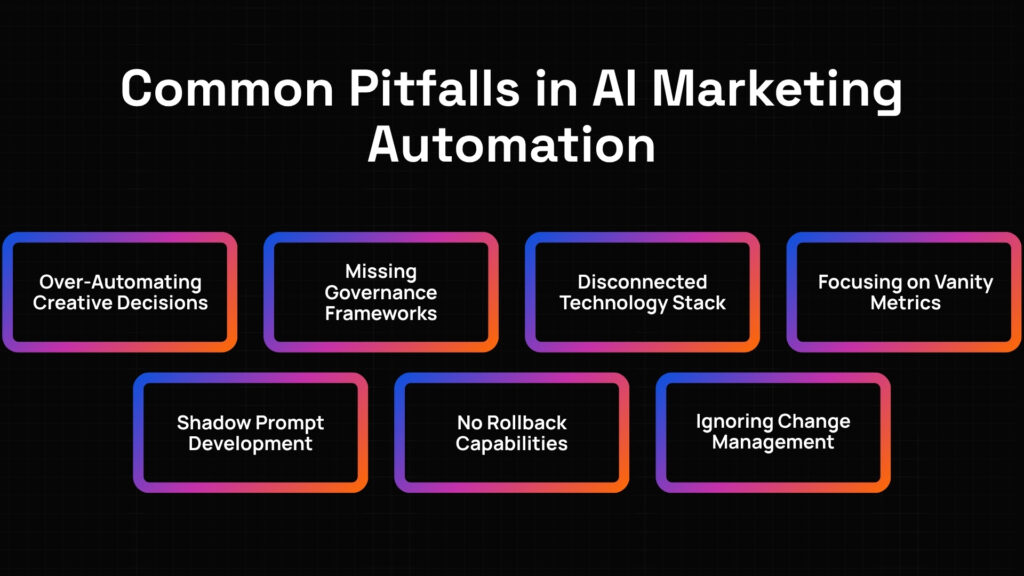
AI marketing automation promises efficiency and consistency, but poor planning and inadequate governance can create brand risk instead of operational improvements. Many marketing organizations make avoidable mistakes during implementation that delay value realization and erode both creative team and leadership trust. To discover proven methodologies tailored for your marketing workflows and brand requirements, explore our AI Workflow Automation Services page for detailed AI marketing automation software frameworks and real-world implementation guidance.
- Over-Automating Creative Decisions: Some organizations attempt to automate strategic messaging and positioning that require human creativity. Keep human marketers on core messaging strategy and positioning decisions, letting AI automation for marketing handle content variations, UTM tagging, quality assurance checks, and repetitive formatting tasks.
- Missing Governance Frameworks: A technically impressive marketing automation rollout can still create brand harm without proper controls. Add explicit brand rules in machine-readable formats, maintain claim validation libraries with legal approval, implement tiered approval lanes based on content risk levels, and document compliance requirements clearly.
- Disconnected Technology Stack: Many teams deploy AI marketing automation software that cannot access customer data or push updates to downstream systems. Choose platforms with native integrations that pull context from CRM and marketing automation platforms while pushing campaign results to data warehouses for unified reporting.
- Focusing on Vanity Metrics: Organizations implementing AI automation for marketing without tying to business outcomes waste resources on optimization that doesn’t matter. Connect automations to cycle time reductions, pipeline generation, customer acquisition cost improvements, and retention increases, not just clicks, impressions, or engagement rates disconnected from revenue.
- Shadow Prompt Development: Marketing teams creating prompts in individual tools without centralized management create inconsistency and security risk. Centralize all prompts and policy configurations in version-controlled repositories, implement change approval processes, and maintain audit trails documenting who modified what and when.
- No Rollback Capabilities: Full automation without version control creates recovery nightmares when campaign quality degrades or brand violations occur. Require one-click revert capabilities to previous prompt and policy versions, maintain sandbox environments for testing changes before production deployment, and implement canary releases for gradual rollout.
- Ignoring Change Management: Creative teams resistant to AI marketing automation can undermine technically sound implementations. Train marketing staff early with hands-on workshops, establish clear service level agreements for automation response times, share small wins weekly through internal communications, and incorporate feedback loops allowing marketers to refine automation behavior.
Evaluating the ROI of AI Marketing Automation
Quantifying the benefits of AI automation for marketing helps secure executive buy-in and refine future investments in marketing technology. Measuring ROI goes beyond simple time savings; it captures gains in campaign velocity, content quality, team capacity, and customer satisfaction. Without clear metrics during evaluation, AI marketing automation software projects risk becoming feature-heavy implementations with unclear business outcomes that fail to justify ongoing operational expenses and licensing costs.
Key metrics to monitor include:
- Campaign Cycle Time Reduction: Track the decrease in days or weeks required to move from campaign brief through asset creation, approvals, and publishing following AI marketing automation software implementation, with leading deployments achieving 40 to 60 percent reductions within 90 days by eliminating manual handoffs and approval bottlenecks.
- Content Quality Improvement: Measure the increase in first-draft approval rates and decrease in revision cycles when AI automation for marketing applies brand guidelines and generates variations automatically, as HubSpot research shows 68 percent of marketers report higher content quality with AI assistance.
- Customer Acquisition Cost Optimization: Evaluate reductions in marketing spend per acquired customer when marketing automation with AI enables faster testing iteration, better audience segmentation, and optimized channel allocation based on performance data rather than manual analysis and quarterly planning cycles.
- Lead Velocity and Pipeline Impact: Compare the improvement in qualified lead generation speed and sales pipeline growth following deployment of AI marketing automation that orchestrates personalized journeys, nurtures prospects automatically based on behavioral signals, and surfaces high-intent opportunities for sales follow-up.
- Team Productivity Multipliers: Assess improvements in campaigns launched per marketer when AI automation for marketing handles repetitive tasks, as PwC research demonstrates 4.8 times productivity improvement for employees regularly using AI versus those who rarely leverage automation capabilities.
- Service Deflection and Satisfaction: Review reductions in customer support ticket volumes and improvements in satisfaction scores when AI chatbots resolve common marketing-related inquiries automatically while feeding content gaps back to marketing teams, as Salesforce cites 30 percent case deflection rates and Intercom reports 452 percent ROI at scale.
According to HubSpot research, 68 percent of marketers using AI report higher content quality and 62 percent cite time savings, showing clear adoption benefits. When every AI marketing automation interaction logs content generation decisions, brand policy checks, approval routing, and performance attribution, every prompt change maintains version history with rollback capabilities, and every workflow includes appropriate human oversight for strategic decisions, organizations build trusted marketing operations that scale without sacrificing brand quality or creating compliance risk.
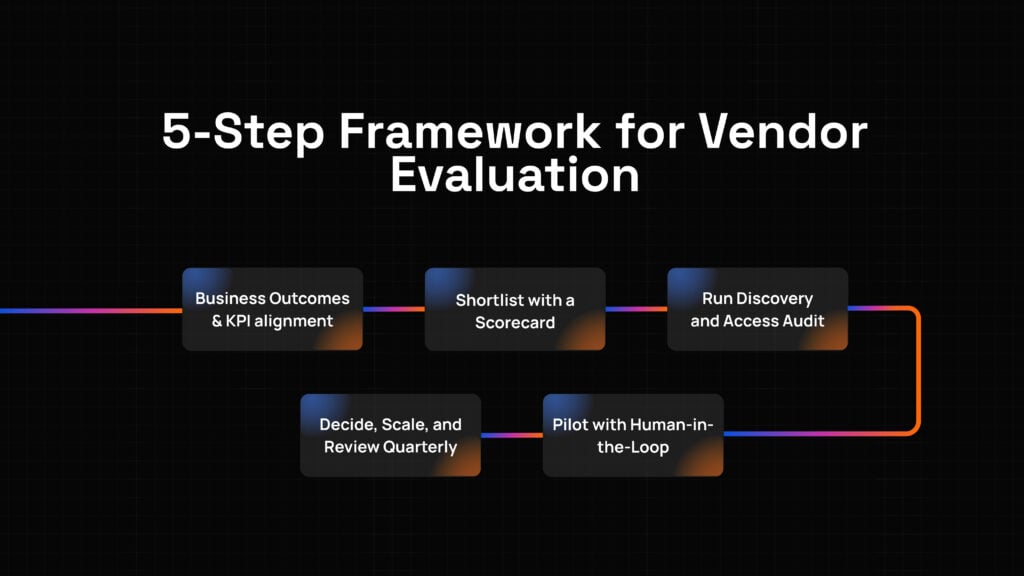
5-Step Framework for Vendor Evaluation
Selecting an AI marketing automation software vendor should follow a disciplined, structured process that aligns with your organization’s marketing goals while accounting for both technological depth and long-term partnership potential. Instead of focusing solely on impressive content generation demonstrations or lowest price, evaluation should weigh how well the vendor’s AI automation for marketing solution supports brand standards, integrates with marketing technology stacks, and adapts to evolving campaign strategies.
1. Business Outcomes & KPI Alignment
Start by clearly outlining what success looks like with 3 measurable outcomes and 3 must-have system integrations. Defining primary KPIs helps align all stakeholders including marketing leadership, creative teams, legal departments, and IT organizations. Your goals might include reducing campaign cycle time from 10 days to 4 while maintaining conversion rates, cutting customer acquisition costs by specific percentages, or improving lead velocity rates, but they must be quantifiable. This clarity becomes the foundation for every subsequent decision about AI marketing automation, shaping both vendor conversations and internal buy-in.
Example: A SaaS company defined its KPIs as “reducing campaign development cycle time from 12 days to 5 while maintaining or improving conversion rates, and cutting first-draft revision cycles from 3.2 to 1.5 within 90 days.” This metric guided every vendor discussion, shaped pilot design, and became the benchmark for success measurement. Write measurable outcomes tied to money metrics before requesting proposals. McKinsey research suggests generative AI could add trillions in annual value across functions including marketing when applied to specific jobs.
Pro Tip: Document 3 to 5 measurable marketing outcomes before requesting proposals. Focus on cycle time, pipeline impact, customer acquisition cost, or retention metrics tied to revenue rather than vanity metrics like impressions or clicks, and identify must-have integrations with CRM, marketing automation platform, and content management systems so evaluation stays grounded in operational impact.
2. Shortlist with a Scorecard
Once objectives are clear, move to structured vendor comparison using a weighted scorecard for evaluating AI marketing automation software providers. This tool allows teams to quantify how well each vendor aligns with priorities including data integration depth, governance frameworks, business outcomes delivery, usability for marketing teams, and professional services support. By assigning weights to each factor, decision-makers can balance technical capability with creative team adoption and long-term flexibility. A disciplined scorecard approach removes subjectivity and ensures that even non-technical marketing stakeholders understand tradeoffs.
Example: One enterprise retail company assigned 30 percent weight to data integration capabilities across CRM, marketing automation platform, and data warehouse, 20 percent to governance controls including brand policy enforcement and legal approval workflows, 20 percent to proven business outcomes with reference customers, 15 percent to marketer usability, and 15 percent to enablement services and training support.
Pro Tip: Keep the scorecard fully quantitative to ensure fairness. Rate each criterion on a defined scale such as 0 to 5 so decisions are driven by marketing requirements rather than sales presentation quality. Ask for sandbox access connected to your non-production technology stack to validate integration claims and test actual workflow automation with real data scenarios.
3. Run Discovery and Access Audit
Before contracts are signed, a structured discovery phase maps complete data flows from website forms through CRM to marketing automation platform to data warehouse, documenting PII handling requirements and consent management procedures. During this phase, teams identify approval workflow complexity with explicit escalation criteria and validate that brand guidelines are documented in machine-readable formats with testable validation rules. Running an access audit verifies API capabilities, permission structures, and least-privilege access boundaries, preventing security gaps and costly change orders later.
Example: A financial services company mapped their campaign workflow as: intake brief (AI drafting), generate asset variations (AI with brand guardrails), route for approvals (automated based on risk), publish across channels (orchestrated), monitor performance (AI anomaly detection), report to stakeholders (automated summaries). This mapping clarified technology boundaries and governance requirements before vendor contract negotiations.
Pro Tip: Approve least-privilege system access and log every credential request to maintain security posture. Map complete data lineage from customer touchpoints through all marketing systems to ensure AI automation for marketing has necessary context without excessive permissions, and document PII handling procedures before any production deployment.
4. Pilot with Human-in-the-Loop and Dashboards
A well-designed pilot validates both technology performance and governance effectiveness under real campaign conditions. Instead of full-scale deployment, focus on a single journey covering brief generation through asset variations to approvals to publishing to reporting. Incorporating human-in-the-loop oversight ensures AI marketing automation software outcomes align with brand standards and legal requirements, while dashboards provide quantifiable visibility into cycle time improvements, approval rework rates, content quality scores, and team adoption metrics.
Example: A B2B software company piloted AI automation for marketing on social media campaigns, running a 4-week test with pre-post metric comparison and achieving 58 percent cycle time reduction, 45 percent decrease in approval rework, 4.3 out of 5 marketer satisfaction scores, and clear kill switch procedures for immediate rollback if quality degraded. Accenture research shows many service teams now work with AI agents in daily workflows, reflecting readiness for assisted operations.
Pro Tip: Set a defined 4-week pilot window with frozen baseline metrics for accurate comparison. Track both efficiency gains like cycle time and quality indicators like approval pass rates and conversion performance. If the pilot hits 80 percent of goals, expand to 3 adjacent workflows in subsequent phases while maintaining quarterly reviews.
5. Decide, Scale, and Review Quarterly
After the pilot proves value, use findings to guide the final decision and create a phased expansion plan for AI marketing automation. Scaling should be deliberate, expanding to additional campaign types and channels only after performance metrics remain stable and team confidence builds. Continuous quarterly reviews between your marketing operations team and the vendor maintain alignment, ensuring the technology evolves alongside brand guideline updates, marketing strategy shifts, and technology stack changes. These sessions include red-team testing on prompts and policies to validate safety rails.
Example: A consumer goods company conducted quarterly business reviews with its AI marketing automation software vendor, expanding successful brief automation to include email journeys and paid advertising workflows, identifying prompt optimization opportunities that improved draft quality scores by 12 percentage points and reduced creative team revision time by 37 percent over the first year.
Pro Tip: Treat vendor reviews as strategic sessions focused on expanding successful AI automation for marketing use cases to adjacent workflows and optimizing governance controls, not just maintenance calls about system uptime. Add quarterly red-team tests on prompts, policies, and safety rails to ensure brand protection remains robust as automation scope expands.
Next Steps in Your Evaluation Process
By now, you should have a clear understanding of what to prioritize when selecting an AI marketing automation partner. Bringing these insights together creates a structured evaluation flow that de-risks investment and accelerates deployment while ensuring long-term brand quality and operational excellence.
- Align with revenue metrics: Ensure every feature connects to specific KPIs like campaign cycle time, pipeline generation, customer acquisition cost, and retention rates tied to revenue, not just vanity metrics like impressions or clicks disconnected from business outcomes.
- Evaluate technology stack integration: Confirm that AI marketing automation software works smoothly with your CRM, marketing automation platform, content management system, help desk, phone systems, and data warehouse through event-driven webhooks and bidirectional updates without requiring extensive custom development.
- Focus on brand governance and compliance: Choose vendors with documented decision traces showing brand policy checks, tiered approval workflows with risk-based routing, claim validation against legal libraries, and robust human-in-the-loop capabilities that enforce creative director oversight for strategic messaging.
- Review enablement and change management: Favor partners who provide continuous training for marketing teams, project playbooks documenting workflows, internal communications templates for adoption, and handover documentation, not one-time technical onboarding sessions that leave creative teams unprepared.
- Test with a controlled pilot: Always run a controlled pilot with one painful workflow and clear pre-post metrics before full deployment to validate cycle time improvements, content quality maintenance, team adoption, and business impact under real-world marketing conditions with actual campaign complexity.
With these criteria in place, you are better equipped to identify AI automation for marketing vendors who not only automate repetitive tasks but also improve campaign velocity, reduce customer acquisition costs, strengthen brand consistency, and amplify your team’s capacity to focus on strategic positioning and creative innovation that drive competitive advantage.
Vendor Questions to Ask
To make the most informed decision during your AI marketing automation software evaluation, be sure to ask these essential questions:
- Which 3 workflows in our technology stack will you automate first and why, based on typical impact patterns you’ve observed with similar customers?
- What read-write integrations are native versus requiring custom development for our CRM, marketing automation platform, content management system, help desk, phone systems, and data warehouse?
- How do you enforce brand guidelines, legal claim validation, and compliance requirements in prompt policies and approval review steps with documented evidence trails?
- Show me complete traces and evaluation results for one production workflow including what happened when quality degraded, and explain your rollback plan and procedures?
- Who owns prompts, evaluation test sets, and workflow notebooks if we decide to switch vendors or bring capabilities in-house?
- How do you measure and prove impact on cycle time reduction, customer acquisition cost improvement, or pipeline generation with before-after analysis?
- What is your security posture for personally identifiable information and model data retention, including which systems have access to customer data?
- How will you train our marketing team and hand over operational playbooks, and can you provide a sample training plan and runbook format?
- Can I speak to two customer references with similar marketing technology complexity and campaign volumes who can discuss measured KPI improvements and implementation challenges?
Transform Marketing Operations with AI Marketing Automation
AI marketing automation is not just a technological investment; it is a strategic marketing capability that requires careful planning, vendor selection, and continuous optimization. The right implementation brings consistency, velocity, and scalability across your campaign workflows, while poor execution creates brand risk and creative team resistance that undermines adoption and organizational trust.
Ready to transform your marketing operations with AI marketing automation? Book a Free Strategy Call with us to explore the next steps and discover how we can help you scope, pilot, and scale the right AI automation for marketing solution for your unique campaign workflows, technology stack, and measurable business outcomes.