
The Power of AI Marketing Automation: Why It Matters
AI marketing automation has evolved from experimental content tools into strategic operational infrastructure that defines content velocity in modern marketing organizations. Marketing teams implementing professional AI marketing automation are fundamentally reimagining how content flows from strategy to publication, how approvals move through stakeholders, and how reporting surfaces performance insights. Advanced AI process automation now manages content operations workflows that once consumed entire creative departments, enabling teams to focus on narrative development, strategic positioning, and campaign optimization that drive pipeline and revenue.
The data supporting this transformation continues to strengthen across marketing functions. According to HubSpot research, 66 percent of marketers already use AI in some form, demonstrating mainstream adoption beyond experimental pilots. Salesforce notes that over 50 percent of marketing professionals used generative AI to draft content in 2023, with about 63 percent of marketers now using generative AI tools in their workflows. Semrush data shows 36 percent of marketers who use AI tools spend less than one hour writing long-form blog posts, dramatically accelerating production velocity. McKinsey estimates generative AI could improve marketing productivity by 5 to 15 percent of total spend worth roughly $463 billion annually.
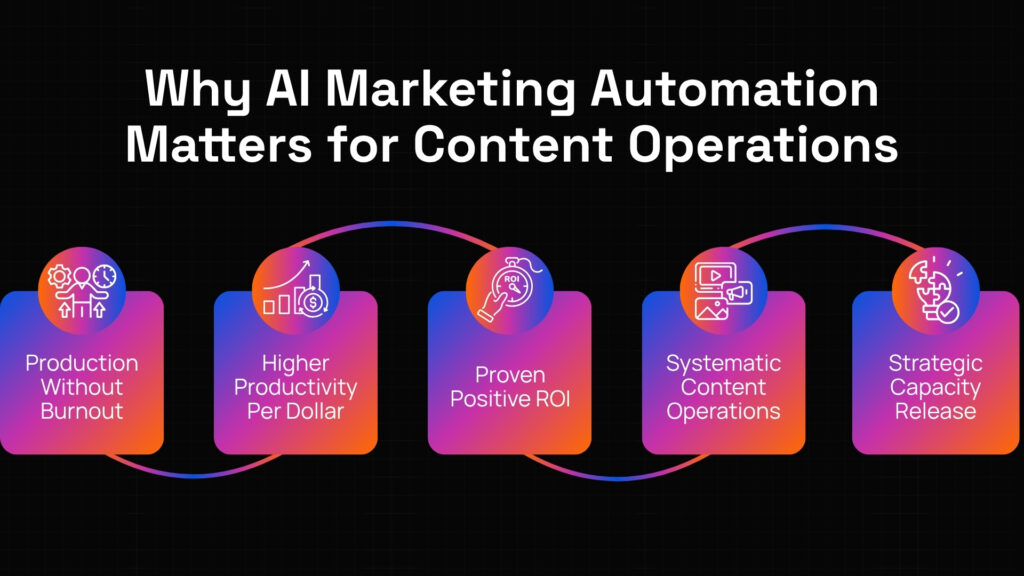
Why AI Marketing Automation Matters for Content Operations
AI process automation goes beyond simple content drafting; it transforms how organizations manage content workflows, maintain brand consistency, and ensure production velocity across all channels. Manual content operations that once created bottlenecks through scattered briefs, buried approvals, and late reporting can now be executed with intelligence and precision through AI marketing automation that connects strategy, execution, and measurement. From reducing blog production time from 15 days to 7 days to automating campaign reporting, AI tools deliver measurable outcomes that strengthen both operational efficiency and marketing impact.
For marketing leaders evaluating AI marketing automation strategies, the benefits manifest in five critical ways:
- Faster Production Without Burnout: AI tools handle repetitive drafting work enabling writers to focus on strategic narrative and editorial refinement, with Semrush showing 36 percent of marketers using AI spend less than one hour on long-form blog posts compared to multiple hours or days for manual writing from scratch.
- Higher Productivity Per Dollar: McKinsey estimates generative AI could improve marketing productivity by 5 to 15 percent of total spend worth roughly $463 billion annually, representing substantial efficiency gains when marketing with AI focuses on workflow optimization rather than just content generation.
- Proven Positive ROI: HubSpot reports 75 percent of companies see positive ROI from AI and automation investments with 34 percent calling returns very positive, demonstrating that disciplined AI marketing automation implementations deliver measurable financial returns beyond productivity improvements through pipeline influence and campaign performance.
- Systematic Content Operations: AI process automation creates predictable systems where briefs get standardized, approvals flow through defined workflows, and reporting surfaces automatically, replacing the chaos of strategy docs scattered across tools with single sources of truth and consistent processes.
- Strategic Capacity Release: Intelligent automation removes manual work from strategists who can focus on narrative development and positioning rather than formatting briefs, and from creators who can focus on ideas and editing rather than repetitive first drafts that consume creative capacity without requiring expertise.
AI marketing automation is not about replacing marketers; it is about redesigning content operations so teams spend time on strategy, creativity, and optimization rather than manual execution, approval chasing, and reporting assembly that machines can handle systematically.
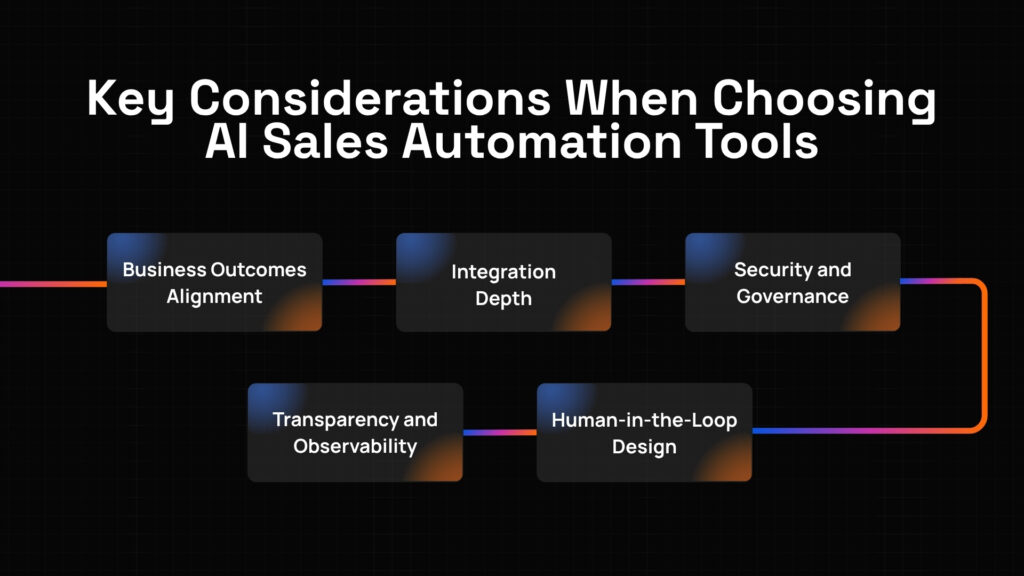
Key Considerations When Choosing AI Marketing Automation Partners
Selecting the right AI process automation for content operations requires careful alignment between technology capabilities and marketing workflow requirements. The most successful AI tools implementations are built on a foundation of transparency, deep system integration, and measurable impact on critical metrics like content velocity, campaign launch time, and cost per asset.
Below are the core factors that should guide every AI marketing automation decision:
- Business Outcomes & KPI Alignment: Every marketing with AI initiative must connect directly to tangible operational metrics including content velocity improvement, campaign launch time reduction, cost per asset decrease, or pipeline influenced. Tie work to specific metrics vendors will target in phase one and show how they will measure impact, not vague efficiency promises disconnected from marketing outcomes.
- Integration Across Marketing Stack: Effective AI marketing automation depends on seamless connectivity with your project management platforms, digital asset management or drive storage, content management systems, CRM, and analytics tools. Look for read-write capabilities plus event triggers for actions like brief approved, asset uploaded, or campaign launched enabling automated workflow orchestration.
- Security and Governance: AI process automation handles sensitive brand content, customer data, and strategic messaging requiring strict controls. Ensure single sign-on, role-based access controls, comprehensive audit logs, and content access controls, plus clarify how training data is stored and whether content or prompts ever leave your tenant or train shared models.
- Human-in-the-Loop (HITL) Flexibility: Successful AI tools always include marketer oversight mechanisms where reviewers edit and approve AI-generated drafts easily. Approvals should never bypass legal, brand, or compliance steps regardless of automation level, as AI should propose while humans finalize ensuring quality and appropriateness.
- Observability and Analytics: Transparency is essential when scaling AI marketing automation across content volume. A capable vendor provides comprehensive dashboards tracking throughput, cycle time, and revision counts, plus logs showing who changed what and when especially for AI-assisted edits, and rollback capability for prompts, workflows, and publishing rules.
- Pricing Transparency and Flexibility: Clarify what drives cost including user counts, content volume, automation executions, or workspace configurations. Ensure you own prompts, workflow logic, and any custom templates or style guides developed during implementation to avoid vendor lock-in threatening operational continuity.
Choosing AI marketing automation partners who understand these requirements ensures your investment delivers sustainable improvements rather than creating technical debt, vendor lock-in, or governance gaps that limit future flexibility when marketing strategies or technology stacks evolve.
The Impact of Integration Readiness
Before launching any AI process automation initiative for content operations, organizations must thoroughly assess their workflow documentation quality, system integration landscape, and governance frameworks. Integration readiness evaluates how well existing content processes, approval chains, and publishing tools can support intelligent automation without creating chaos or poor brand outcomes. When marketing operations teams conduct integration audits in advance, they uncover process gaps and tool limitations early, align stakeholders around workflow requirements, and minimize wasted time during vendor discovery and pilot phases.
Example: A B2B SaaS company preparing for AI marketing automation mapped their content workflow from brief requested to asset live and reported, discovering every asset touched at least four tools and two approval loops before publishing. They found that briefs lacked standardized templates creating inconsistent inputs, their digital asset management used different taxonomy than their CMS requiring manual mapping, and their approval routing combined simple stakeholder sign-offs with judgment-based legal reviews. Addressing these integration readiness issues before vendor engagement reduced the overall project timeline by eight weeks.
Pro Tip: Map your current process before bringing in any AI tools. Capture actual workflow from brief requested to asset live and reported identifying systems, owners, and approvals. Use real recent campaigns as source of truth not idealized diagrams that ignore exceptions and workarounds. Standardize brief templates then let AI speed them up, as consistent inputs enable automation while variable formats create confusion.
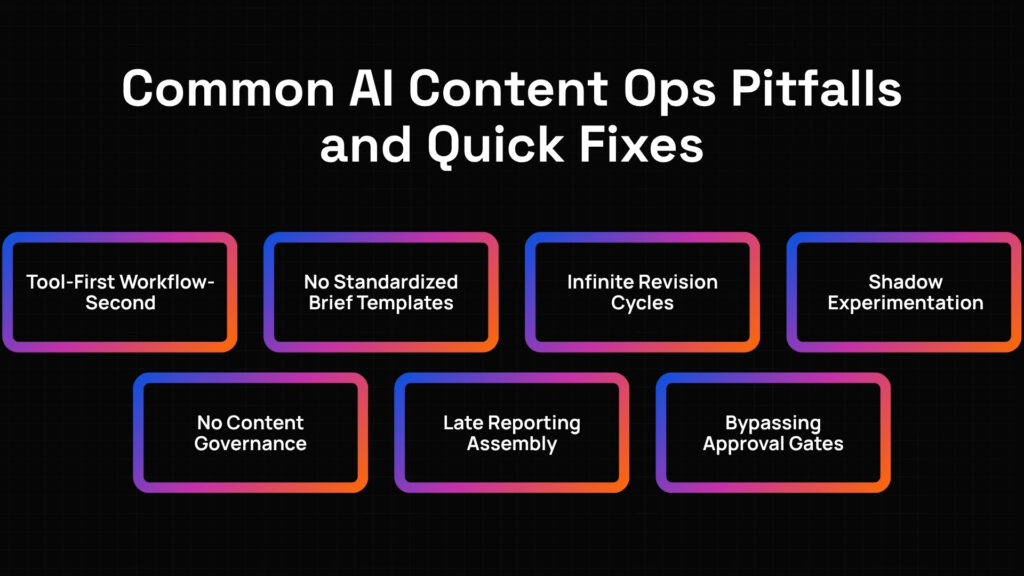
Common AI Content Ops Pitfalls and Quick Fixes
AI marketing automation promises efficiency and scale, but poor planning and inadequate governance can create brand chaos instead of operational improvements. Many marketing organizations make avoidable mistakes during implementation that delay value realization and erode both team and leadership trust. To discover proven methodologies tailored for your content workflows and brand requirements, explore our AI Workflow Automation Services page for detailed AI process automation frameworks and real-world implementation guidance.
- Tool-First Workflow-Second: Some organizations deploy AI tools without understanding current processes. Map your existing workflow before selecting technology, as automation of broken processes just creates automated chaos that undermines confidence in marketing with AI approaches.
- No Standardized Brief Templates: Organizations implementing AI marketing automation without consistent inputs create variable outputs. Standardize brief templates first establishing clear structure, then let AI speed completion and drafting rather than attempting to automate inconsistent manual processes that lack predictable patterns.
- Infinite Revision Cycles: Deploying AI process automation without clear rules creates endless iteration. Set guidelines for how many AI-assisted passes happen before human decides final version, preventing perfectionism from eliminating efficiency gains automation should provide.
- Shadow Experimentation: Individual marketers adopting AI tools without coordination creates governance gaps and duplicated learning. Centralize AI marketing automation experiments so insights are shared, prompts are refined collaboratively, and brand voice remains consistent across all AI-assisted content.
- No Content Governance: Organizations lacking clear ownership create brand inconsistency. Define who owns brand voice, prompt libraries, and training data ensuring marketing with AI maintains quality standards and legal compliance rather than creating content that damages brand perception or violates policies.
- Late Reporting Assembly: Manual reporting compiled at quarter-end prevents in-flight optimization. Automate weekly and campaign-end reports using AI tools so teams can adjust tactics based on performance rather than discovering issues after budgets are spent and opportunities are lost.
- Bypassing Approval Gates: Automation that circumvents legal, brand, or compliance reviews creates risk. Ensure AI process automation respects all approval workflows regardless of efficiency pressure, as shortcuts create violations requiring expensive remediation and relationship repair.
Evaluating the ROI of AI Marketing Automation
Quantifying the benefits of AI process automation helps secure executive buy-in and refine future investments in marketing technology. Measuring ROI goes beyond simple content volume; it captures gains in production velocity, cost efficiency, campaign performance, and strategic capacity. Without clear metrics during evaluation, AI marketing automation projects risk becoming feature-heavy implementations with unclear business outcomes that fail to justify ongoing operational expenses and licensing costs.
Key metrics to monitor include:
- Content Production Velocity: Track reduction in average time from brief to publication when AI tools handle drafting and formatting, with successful implementations reducing blog production time from 15 days to 7 days enabling teams to respond faster to market opportunities and maintain consistent publishing cadence.
- Cost Per Asset Reduction: Measure decrease in total labor and vendor costs required to produce content when AI marketing automation handles repetitive work, as Semrush shows 36 percent of marketers using AI spend less than one hour on long-form posts compared to multiple hours manually enabling higher output without proportional headcount increases.
- Marketing Productivity Improvement: Assess progress toward McKinsey’s estimate that generative AI could improve marketing productivity by 5 to 15 percent of total spend worth roughly $463 billion annually, calculating efficiency gains as marketing with AI expands from narrow use cases to broader workflow coverage.
- Positive ROI Achievement: Evaluate financial returns against HubSpot data showing 75 percent of companies see positive ROI from AI and automation investments with 34 percent calling returns very positive, tracking pipeline influenced, campaign performance, and cost savings demonstrating clear business value beyond operational efficiency.
- Strategic Time Allocation: Review improvements in hours spent on narrative development, strategic positioning, and campaign optimization when AI process automation removes manual work, as strategists focus on high-value activities rather than formatting briefs and creators focus on ideas rather than repetitive drafts.
- Revenue Function Benefits: Calculate progress toward McKinsey’s finding that marketing and sales are among functions seeing greatest reported revenue benefits from AI, measuring pipeline contribution and campaign ROI improvements attributable to faster execution, better personalization, and data-driven optimization enabled by systematic automation.
HubSpot shows 66 percent of marketers use AI with 75 percent seeing positive ROI. Salesforce notes 63 percent use generative AI with over 50 percent drafting content. Semrush shows 36 percent spend under one hour on blog posts. McKinsey estimates 5 to 15 percent productivity improvement worth $463 billion with marketing and sales seeing greatest revenue benefits. When every AI marketing automation interaction logs workflow stages, approval decisions, and content performance, every prompt change maintains version history with rollback capabilities, and every workflow respects brand governance and compliance gates, organizations build trusted content operations that scale without sacrificing quality or creating governance vulnerabilities.
5-Step Vendor Framework for AI Marketing Automation in Content Ops
Selecting an AI process automation vendor for content operations should follow a disciplined, structured process that aligns with your organization’s marketing goals while accounting for both technological depth and long-term partnership potential. Instead of focusing solely on impressive content generation demonstrations or lowest price, evaluation should weigh how well the vendor’s AI tools solution supports measurable outcomes, integrates with existing systems, and adapts to evolving brand requirements.
1. Define KPI and Scope
Start with a narrow, painful slice of content operations rather than attempting comprehensive automation simultaneously. Defining specific targets helps align all stakeholders including marketing leadership, content teams, operations managers, and legal or compliance officers. Your goal might be reducing average blog production time from 15 days to 7 days while maintaining or improving organic traffic and engagement, improving campaign launch speed, or decreasing cost per asset, but it must be quantifiable. This clarity becomes the foundation for every subsequent decision about AI marketing automation, shaping both vendor conversations and internal buy-in.
Example: A technology company defined its KPI as “reducing average blog production time from 15 days to 7 days while maintaining or improving organic traffic and engagement metrics within 90 days.” This metric guided every vendor discussion, shaped pilot design, and became the benchmark for success measurement. Avoid boiling the ocean by picking one content type and one to two channels for first automation wave.
Pro Tip: Document one narrow use case before requesting proposals. Focus on high-volume, painful workflow areas like blog production or email campaigns rather than attempting to automate all content types simultaneously, and define specific velocity, cost, or performance targets that enable objective go/no-go decisions during pilot evaluation.
2. Shortlist with a Scorecard
Once objectives are clear, move to structured vendor comparison using a weighted scorecard for evaluating AI marketing automation providers. This tool allows teams to quantify how well each vendor aligns with priorities including fit with content workflows, integration depth across tools, governance and safety controls, reporting capabilities, and data portability. Turn evaluation criteria into numbers so decisions are defendable beyond subjective preferences.
Example: One enterprise assigned 30 percent weight to outcomes fit with content workflows, 25 percent to integration depth across tools, 15 percent to governance and safety controls, 15 percent to reporting and observability, and 15 percent to portability and IP ownership. Have marketing, operations, and IT each score vendors independently then compare to reduce bias.
Pro Tip: Keep the scorecard numeric to ensure objectivity. Weight outcomes 30 percent, integration 25 percent, governance 15 percent, observability 15 percent, and portability 15 percent. Have multiple stakeholders from marketing, operations, and IT score each vendor independently before group discussion to reduce bias from impressive presentations.
3. Run Discovery and Access Audit
Before contracts are signed, a structured discovery phase captures how content is actually produced today from brief requested to asset live and reported. Get brutally honest about current workflow identifying systems touched, approval loops required, and bottlenecks created. During this phase, teams test integration capabilities with actual tools, surface governance gaps requiring policy development, and confirm brand controls.
Example: A financial services company mapped their content production discovering every asset touched project management, Google Drive, WordPress, Salesforce, and Google Analytics before going live, with two approval loops including stakeholder review and legal sign-off. Discovery revealed their brief templates varied by content type creating inconsistent inputs, their approval routing lacked clear SLAs causing delays, and their reporting required manual data assembly from three sources. Use real recent campaigns as source of truth not idealized diagrams.
Pro Tip: Map actual workflow including exception paths and workarounds using real campaign documentation, not just happy-path descriptions ignoring complexity. Capture current workflow from brief requested to asset live and reported identifying all systems, owners, and approvals. Share representative process documentation with vendors to validate assumptions about integration complexity and automation opportunities before signing when negotiating leverage is highest.
4. Pilot with HITL and Dashboards
A well-designed pilot validates both technology performance and brand quality under real content operations conditions. Instead of full-scale deployment, run 6 to 8 week pilot not multi-quarter science project, automating only parts of flow like draft briefs, first content drafts, and simple approvals while keeping humans fully in control of final edits and go-live decisions.
Example: A B2B software company piloted AI marketing automation for social posts and email copy, with AI generating first drafts from structured briefs while human editors approved before platform pushed to scheduler, running 8-week evaluation with weekly brand reviews and achieving 52 percent reduction in drafting time with 4.3 out of 5 content quality scores from editorial leads. Review sample of AI-assisted content weekly with your brand or editorial lead and tweak prompts accordingly.
Pro Tip: Execute pilots with frozen scope covering specific content types, clear success criteria comparing to baseline metrics, and measurable KPIs tracked weekly. Automate only parts of workflow initially like drafting while keeping human approval for final edits and publishing. Review random samples of AI-assisted content weekly with brand or editorial leads analyzing quality and adjusting prompts. Use pilot period to refine style guides, train teams on editing procedures, and validate integration stability.
5. Decide, Scale, and Review Quarterly
After the pilot proves value, use findings to guide the final decision about scaling patterns that work while retiring what doesn’t. Scaling should be deliberate, expanding only after successful execution on initial content type validates approach and builds organizational confidence. Continuous quarterly reviews maintain alignment, ensuring the technology evolves alongside product launches, market changes, and brand evolution.
Example: A healthcare company conducted quarterly reviews with its AI process automation partner, expanding successful blog and email automation to webinars and landing pages over 12 months using same brief structure and approval flows, identifying prompt optimization opportunities that improved content velocity by additional 18 percent while maintaining brand consistency scores. Run quarterly reviews of prompts, templates, and workflows adjusting for new products, markets, and regulations.
Pro Tip: Treat vendor reviews as strategic sessions focused on expanding successful AI tools use cases to adjacent content types and optimizing governance, not just maintenance calls about system uptime. Scale patterns that work and retire what doesn’t based on objective performance. Use quarterly reviews to refresh prompts, update templates, revise workflows, and assess performance as products, markets, and regulations evolve.
Making AI Marketing Automation Work Day to Day
When AI process automation is wired into content operations thoughtfully, the daily experience fundamentally improves for entire marketing organizations:
- Strategists Focus on Narrative: Marketing leaders spend more time on strategic narrative development and competitive positioning rather than formatting briefs, chasing approvals, or assembling status reports that marketing with AI handles systematically.
- Creators Focus on Ideas: Content producers focus on creative ideation and editorial refinement rather than repetitive first drafts, as AI tools handle initial writing enabling humans to apply expertise where judgment and creativity add value.
- Managers Get Live Visibility: Operations leaders see real-time dashboards showing what is in production, what is blocked, and what is performing, as McKinsey’s research shows marketing and sales are among functions seeing greatest reported revenue benefits from AI when implementations create systematic visibility and optimization.
Next Steps in Your Evaluation Process
By now, you should have a clear understanding of what to prioritize when selecting an AI marketing automation partner. Bringing these insights together creates a structured evaluation flow that de-risks investment and accelerates deployment while ensuring long-term content quality and operational excellence.
- Align with marketing metrics: Ensure every feature connects to specific KPIs like content velocity, campaign launch time, cost per asset, or pipeline influenced tied to marketing outcomes, not just automation coverage percentages disconnected from business impact and brand quality.
- Evaluate integration architecture: Confirm that AI process automation works smoothly with your project management, digital asset management, CMS, CRM, and analytics platforms through read-write capabilities and event triggers enabling automated workflow orchestration without manual intervention or disconnected systems.
- Focus on governance and brand control: Choose vendors with comprehensive audit logs, role-based access, clear approval workflows that never bypass legal or compliance, and controls over brand voice and style across all AI-generated outputs ensuring quality standards.
- Review enablement and ownership: Favor partners with clear implementation phases, playbooks and training for marketing teams not just IT, and handover plans enabling your team to own workflows without constant vendor help building internal capability.
- Test with controlled pilots: Always run 6 to 8 week pilots with narrow scope, clear KPIs, human oversight for final edits, and weekly brand reviews before full deployment to validate velocity improvements, cost reductions, and quality maintenance under real-world content operations conditions.
With these criteria in place, you are better equipped to identify AI marketing automation vendors who not only generate content but also improve production velocity, reduce costs, maintain brand quality, and amplify your team’s capacity to focus on strategy and creativity.
Vendor Questions to Ask
To make the most informed decision during your AI marketing automation evaluation, be sure to ask these essential questions:
- How do you design AI marketing automation around our existing editorial and approval process instead of replacing it overnight?
- Which parts of the content lifecycle can your platform automate today across briefs, drafting, approvals, and reporting?
- How do you connect into our current tools for planning, collaboration, storage, and publishing with read-write and event capabilities?
- What controls do we have over brand voice, style, and legal language across all AI outputs with prompt management and governance?
- How do we see and debug what the AI did on specific asset or campaign with complete audit trails?
- What happens if we decide to move off your platform in two years: what can we export including prompts, workflows, and templates?
- Can I speak to two customer references with similar content volumes and brand complexity who can discuss measured velocity improvements and implementation challenges?
Transform Content Operations with AI Marketing Automation
AI marketing automation is not just a technological investment; it is a strategic content operations capability that requires careful planning, vendor selection, and continuous optimization. The right implementation brings velocity, consistency, and strategic capacity across your content workflows, while poor execution creates brand chaos and team resistance that undermines confidence and wastes investment.
Ready to transform your content operations with AI marketing automation? Book a Free Strategy Call with us to explore the next steps and discover how we can help you scope, pilot, and scale the right AI process automation solution for your unique content workflows, brand requirements, and measurable business outcomes.