
The Power of AI Process Automation: Why It Matters
AI process automation has evolved from isolated scripts and bots into strategic operational infrastructure that defines efficiency in modern organizations. Operations teams implementing professional AI process automation are fundamentally reimagining how work flows through their organizations, how systems connect, and how teams focus their expertise on judgment rather than repetition. Advanced AI automation benefits now extend beyond simple task execution to intelligent workflow orchestration that connects systems, teams, and data into cohesive flows where work moves faster with fewer errors and greater visibility.
The data supporting this transformation continues to strengthen across industries and functions. According to McKinsey research, combining AI with other automation technologies could add 0.5 to 3.4 percentage points to annual productivity growth, representing substantial economic impact when organizations move beyond scattered experiments to strategic programs. Brookings Institution research shows roughly 50 percent of work activities are technically automatable with current technologies, meaning most roles will change rather than disappear as automation handles repetitive tasks while humans focus on exceptions and strategy. McKinsey highlights that AI-enabled process optimization in plants improves throughput and reduces downtime through intelligent routing and predictive maintenance.
Why AI Process Automation Matters for Operations Teams
AI process automation goes beyond simple task execution; it transforms how organizations manage workflow complexity, maintain data quality, and ensure operational excellence across all business functions. Manual processes that once created bottlenecks through repetitive data entry, inconsistent validation, and delayed routing can now be executed with intelligence and precision through AI automation benefits that compound over time. From reducing invoice processing time to predicting equipment maintenance needs, AI automation use cases deliver measurable outcomes that strengthen both operational efficiency and strategic capacity across organizations.
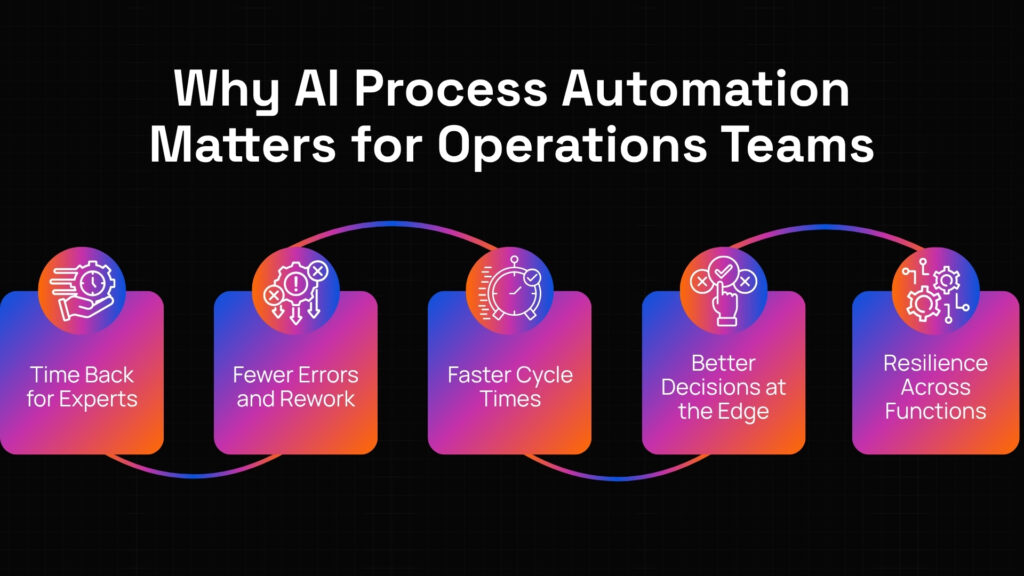
For operations leaders evaluating AI process automation strategies, the AI automation benefits manifest in five critical ways:
- Time Back for Experts: Intelligent automation removes repetitive, low-judgment tasks from subject matter experts so they focus on exceptions, strategy development, and customer relationships rather than manual data entry and validation, with Deloitte noting cost savings driven by reduced manual work freeing capacity for higher-value activities.
- Fewer Errors and Rework: Systems that check data quality, validate inputs, and reconcile automatically reduce downstream firefighting and customer complaints, as automation applies consistent rules without the human fatigue and distraction that create quality issues requiring expensive correction and relationship repair.
- Faster Cycle Times: AI can route work, predict next steps, and auto-generate responses or documents intelligently, with McKinsey highlighting that AI-enabled process optimization improves throughput and reduces downtime by eliminating the delays inherent in manual handoffs and sequential processing.
- Better Decisions at the Edge: Models embedded inside workflows can approve simple cases, flag risk patterns, or recommend next best actions in real time without escalation delays, enabling faster decision-making while routing complex situations requiring human judgment to appropriate experts with complete context.
- Resilience Across Functions: Finance uses AI to automate reconciliations and invoice processing, supply chains use AI for forecasting and inventory optimization, and customer support uses AI agents to triage and resolve issues, demonstrating that AI automation benefits extend across all operational areas when implementations connect systems rather than create silos.
AI process automation is not about replacing humans; it is about redesigning how work flows so people spend more time on judgment, creativity, and relationships while machines handle repetitive execution, data validation, and routine routing that consume capacity without requiring expertise.
Key Considerations When Choosing AI Process Automation Partners
Selecting the right AI process automation requires careful alignment between technology capabilities and operational requirements. The most successful implementations are built on a foundation of transparency, deep system integration, and measurable impact on critical metrics like cycle time, cost per transaction, and error rates.
Below are the core factors that should guide every AI process automation decision:
- Business Outcomes & KPI Alignment: Every AI automation benefits initiative must connect directly to tangible operational metrics including cycle time reduction, cost per transaction decrease, error rate improvement, or net promoter score enhancement. Ask vendors which KPIs they expect to move and how they will measure success with clarity on targets like 30 percent cycle time reduction or sub-0.5 percent error rates.
- Integration with Existing Systems: Effective AI process automation depends on seamless connectivity with your CRM, help desk platforms, phone systems, treasury management systems, ERP, finance systems, and data warehouses. Support for read and write integrations with webhooks and event triggers enables real-time workflow orchestration, not just batch jobs running overnight that create delays and synchronization issues.
- Security and Governance: AI automation use cases handle sensitive business data and customer information requiring strict controls. Require single sign-on, role-based access controls, comprehensive audit logs, and clear data residency policies, plus guardrails on which data can feed models and how PII is handled to maintain compliance and customer trust.
- Human-in-the-Loop (HITL) Flexibility: Successful AI process automation always includes oversight mechanisms for decisions requiring human judgment or where confidence drops below thresholds. Configurable confidence thresholds and routing rules enable appropriate escalation, with clear UX for humans to approve, override, or review automated decisions ensuring quality without bottlenecking workflows.
- Observability and Analytics: Transparency is essential when scaling AI automation benefits across process volume. A capable vendor provides comprehensive dashboards showing throughput, exceptions, and model behavior, plus traces and evaluation sets enabling debugging issues and comparing versions, and rollback ability for workflows and models when updates degrade performance.
- Pricing Transparency and Flexibility: Demand clarity on what drives cost, how usage is measured, and typical ranges so financial forecasting remains accurate as volumes scale. Ensure written agreement that you own prompts, workflows, and evaluation assets developed during implementation to avoid vendor lock-in threatening operational continuity.
Choosing AI process automation partners who understand these requirements ensures your investment delivers sustainable improvements rather than creating technical debt, vendor lock-in, or governance gaps that limit future flexibility when business processes or technology stacks evolve.
The Impact of Integration Readiness
Before launching any AI process automation initiative, organizations must thoroughly assess their process documentation quality, system integration landscape, and data governance completeness. Integration readiness evaluates how well existing workflows, data sources, and operational procedures can support intelligent automation without creating chaos or poor outcomes. When operations teams conduct integration audits in advance, they uncover data quality gaps and process instability early, align IT and business stakeholders around connectivity requirements, and minimize wasted time during vendor discovery and pilot phases.
Example: A financial services company preparing for accounts payable AI process automation mapped how invoice processing actually flows including CRM, ticketing, payment gateway, and ledger systems, identifying where AI could classify, validate, or approve. Discovery revealed that 35 percent of invoices lacked required data fields creating manual workarounds, their ERP used different vendor identifiers than their procurement system requiring complex reconciliation, and their approval routing combined simple dollar thresholds with judgment-based risk assessment. Addressing these integration readiness issues before vendor engagement reduced the overall project timeline by seven weeks.
Pro Tip: Stabilize and simplify processes before automating broken workflows. Map how work actually flows today and what systems it touches using real process maps and historical tickets or records, not just happy-path descriptions that ignore exceptions. Use the Integration Readiness Checklist to uncover data quality gaps, access control issues, and governance requirements before engaging vendors.
Common AI Automation Challenges and Quick Fixes
AI process automation promises efficiency and cost reduction, but poor planning and inadequate governance can create implementation failures instead of operational improvements. Many organizations make avoidable mistakes during deployment that delay value realization and erode both team and leadership trust. To discover proven methodologies tailored for your process workflows and operational requirements, explore our AI Workflow Automation Services page for detailed AI process automation frameworks and real-world implementation guidance.
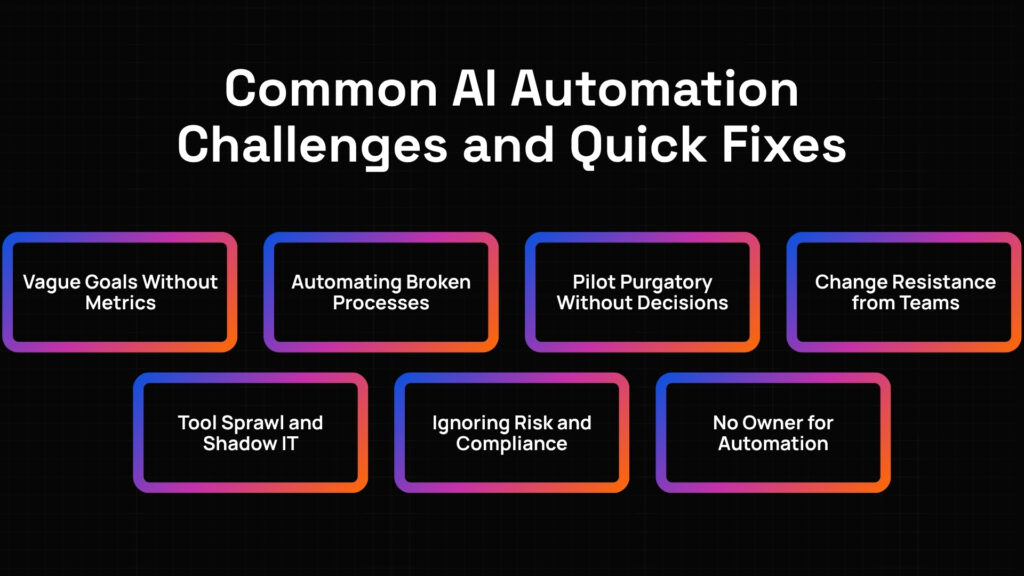
- Vague Goals Without Metrics: Some organizations pursue automation with aspirational language rather than measurable targets. Turn “be more efficient” into “cut invoice processing time by 30 percent in 6 months” with specific cycle time, cost, or error rate objectives that enable clear go/no-go decisions during pilot evaluation.
- Automating Broken Processes: A technically advanced AI automation benefits implementation still fails if underlying processes are chaotic. Stabilize and simplify workflows before automating, as implementing intelligent systems on broken processes just creates automated chaos that undermines confidence in automation approaches.
- Pilot Purgatory Without Decisions: Organizations running endless pilots without clear success criteria waste investment and create skepticism. Define up front what success looks like including specific metrics and timeline, and when you will decide to scale or stop based on objective performance rather than subjective impressions.
- Change Resistance from Teams: Frontline operators resistant to AI process automation can undermine technically sound implementations. Involve frontline workers early in design, show quick wins demonstrating automation as support not replacement, and frame changes as freeing capacity for judgment work rather than eliminating jobs that creates fear and resistance.
- Tool Sprawl and Shadow IT: Deploying multiple automation platforms without coordination creates integration nightmares and governance gaps. Consolidate on small set of platforms with good integrations and governance frameworks rather than allowing departmental tool proliferation that fragments operations and compounds licensing costs.
- Ignoring Risk and Compliance: Implementing AI automation use cases without controls creates regulatory violations and audit failures. Bring legal, risk, and security teams into design phase, not after go-live when remediating compliance gaps requires expensive rework and creates operational disruption.
- No Owner for Automation: Organizations treating automation as IT projects without business ownership face adoption failures. Assign clear process owner accountable for outcomes and automation product manager responsible for ongoing optimization, ensuring business needs drive technology rather than technology seeking business justification.
Evaluating AI Automation Benefits Through ROI
Quantifying the benefits of AI process automation helps secure executive buy-in and refine future investments in operational technology. Measuring ROI goes beyond simple task completion; it captures gains in cycle time, cost efficiency, error reduction, and strategic capacity. Without clear metrics during evaluation, AI automation use cases risk becoming feature-heavy implementations with unclear business outcomes that fail to justify ongoing operational expenses and licensing costs.
Key metrics to monitor include:
- Cost Reduction Achievement: Track total operational cost decreases when AI process automation eliminates manual work, with Deloitte surveys showing organizations expect about 31 percent cost reduction on average over three years, and organizations moving beyond pilots into scaled programs reporting reductions in the 25 to 40 percent range driven by better process discipline.
- Cycle Time Improvement: Measure reduction in end-to-end process duration when intelligent automation routes work, predicts next steps, and auto-generates outputs, with successful implementations achieving 30 percent or greater cycle time reduction by eliminating manual handoffs, delays, and sequential processing inherent in human-dependent workflows.
- Error Rate Reduction: Evaluate decreases in downstream firefighting and customer complaints when systems check data quality, validate inputs, and reconcile automatically, targeting sub-0.5 percent error rates through consistent rule application without human fatigue and distraction that create quality issues requiring expensive correction.
- Productivity Growth Contribution: Assess progress toward McKinsey’s estimate that combining AI with other automation technologies could add 0.5 to 3.4 percentage points to annual productivity growth, calculating incremental gains as AI automation benefits expand from narrow use cases to broader process coverage.
- Strategic Capacity Release: Review improvements in time spent on judgment, strategy, and customer relationships when AI process automation removes repetitive low-judgment tasks from subject matter experts, as Brookings shows 50 percent of work activities are technically automatable meaning roles change rather than disappear with humans focusing on exceptions requiring expertise.
- Cost Savings from Streamlining: Calculate progress toward McKinsey’s analysis showing well-structured automation programs deliver 20 to 30 percent cost savings by streamlining workflows and reducing manual work, measuring both direct labor savings and indirect benefits from fewer errors, faster cycles, and better decisions at the edge.
Deloitte surveys show 31 percent average cost reduction over three years with scaled programs reporting 25 to 40 percent reductions. McKinsey estimates 0.5 to 3.4 percentage points added to annual productivity growth and 20 to 30 percent cost savings from streamlining. Brookings shows 50 percent of activities are automatable. When every AI process automation interaction logs decision logic, confidence scores, exception triggers, and outcomes, every workflow change maintains version history with rollback capabilities, and every process includes appropriate human oversight for judgment-based decisions, organizations build trusted automation operations that scale without sacrificing quality or creating governance vulnerabilities.
5-Step Vendor Framework for AI Process Automation
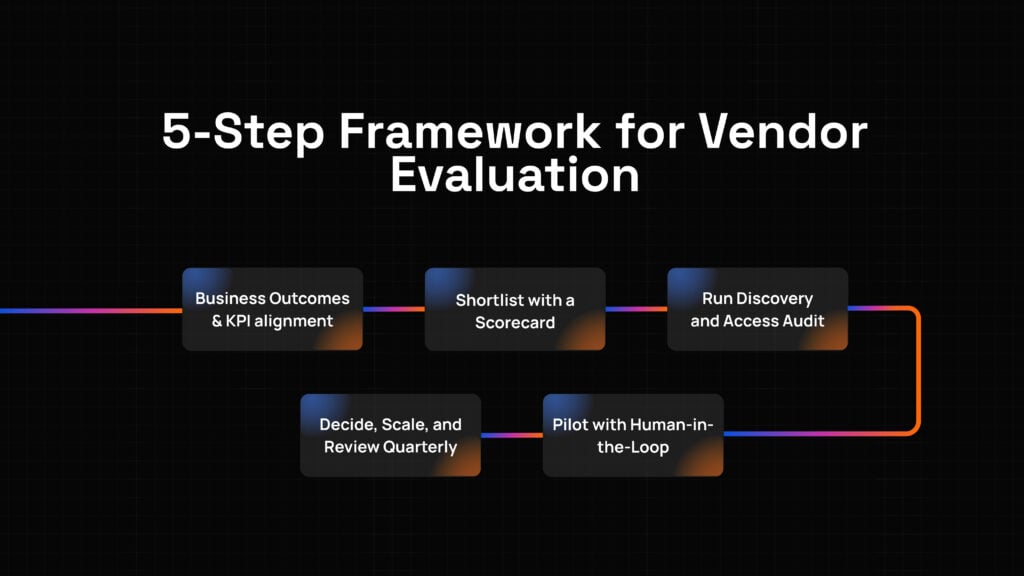
Selecting an AI process automation vendor should follow a disciplined, structured process that aligns with your organization’s operational goals while accounting for both technological depth and long-term partnership potential. Instead of focusing solely on impressive demonstrations or lowest price, evaluation should weigh how well the vendor’s approach supports measurable outcomes, integrates with existing systems, and adapts to evolving business requirements.
1. Define KPI and Scope
Start by picking a narrow, high-impact slice of work rather than attempting to automate entire departments simultaneously. Defining specific targets helps align all stakeholders including operations leadership, IT departments, process owners, and frontline teams. Your goal might be reducing manual effort in accounts payable invoice matching by 40 percent while keeping error rates below 0.5 percent, improving cycle time, or decreasing cost per transaction, but it must be quantifiable. This clarity becomes the foundation for every subsequent decision about AI automation benefits, shaping both vendor conversations and internal buy-in.
Example: A manufacturing company defined its KPI as “reducing manual effort in accounts payable invoice matching by 40 percent while keeping error rates below 0.5 percent within 6 months.” This metric guided every vendor discussion, shaped pilot design, and became the benchmark for success measurement. Avoid cross-functional mega projects at first; focus on one function, one metric, one process where impact is measurable.
Pro Tip: Document one narrow, high-impact process before requesting proposals. Focus on areas with high manual effort and clear success metrics like invoice processing or customer refunds rather than attempting comprehensive automation across multiple departments, and define specific cycle time, cost, or error rate targets that enable objective evaluation.
2. Shortlist with a Scorecard
Once objectives are clear, move to structured vendor comparison using a weighted scorecard for evaluating AI process automation providers. This tool allows teams to quantify how well each vendor aligns with priorities including proven outcomes in similar contexts, integration depth, governance frameworks, observability capabilities, and data portability. By assigning weights to each factor, decision-makers can balance technical capability with operational impact and long-term flexibility.
Example: One enterprise assigned 30 percent weight to outcomes fit validated through use case alignment, 25 percent to integration depth with existing systems, 15 percent to governance and risk controls, 15 percent to observability and tooling capabilities, and 15 percent to portability and IP ownership, helping eliminate vendors lacking production-ready connectors early.
Pro Tip: Create simple table scoring vendors on your criteria. Weight outcomes 30 percent, integration 25 percent, governance 15 percent, observability 15 percent, and portability 15 percent. Have multiple stakeholders score independently to reduce bias from impressive presentations, ensuring evaluation stays focused on requirements rather than sales quality.
3. Run Discovery and Access Audit
Before contracts are signed, a structured discovery phase maps how work actually flows today and what systems it touches, identifying where AI can classify, validate, or approve. During this phase, teams test integration capabilities with actual system versions, surface data quality gaps requiring remediation, and confirm security controls with appropriate permissions. Running an access audit with real process maps and historical records rather than happy-path descriptions uncovers limitations early.
Example: A customer support team mapped refund processing flows including CRM, ticketing, payment gateway, and ledger systems during discovery, identifying where AI process automation could classify requests, validate eligibility, and approve standard cases. Discovery revealed their payment gateway lacked webhook support for real-time status updates requiring custom development, and 30 percent of refund requests lacked complete order data requiring manual lookup.
Pro Tip: Map actual workflow including exception paths using real process documentation and historical tickets or records, not just idealized descriptions ignoring complexity. Share representative data with vendors to validate assumptions about data quality, system connectivity, and exception frequency. Use discovery to surface integration gaps, data quality issues, and customization requirements before signing when negotiating leverage is highest.
4. Pilot with HITL and Dashboards
A well-designed pilot validates both technology performance and operational readiness under real conditions. Instead of full-scale deployment, launch constrained pilot with human oversight and clear guardrails limiting scope to subset of volume or specific process variants. Incorporating human-in-the-loop oversight ensures AI automation benefits outcomes align with quality standards and business requirements.
Example: A financial services company piloted AI process automation for support ticket response drafting, with AI handling 60 percent of tickets while agents approved or edited before sending, running 8-week evaluation with weekly reviews of automated outputs and achieving 35 percent cycle time reduction with 4.2 out of 5 agent satisfaction scores. Review small sample of automated outputs weekly tracking both efficiency and quality as Deloitte shows scaled programs achieving 25 to 40 percent cost reductions with proper discipline.
Pro Tip: Execute pilots with frozen scope, clear success criteria comparing to baseline metrics, and measurable KPIs tracked weekly. Include human oversight with approval or review workflows for quality assurance. Review random samples of automated outputs weekly analyzing both efficiency gains and quality maintenance. Use pilot period to refine rules, train teams on exception handling, and validate integration stability under production load.
5. Decide, Scale, and Review Quarterly
After the pilot proves value, use findings to guide the final decision about whether to turn pilot into repeatable pattern or shut it down. Scaling should be deliberate, expanding only once pilot hits targets for three consecutive months validating stability and sustainability. Continuous quarterly reviews maintain alignment, ensuring the technology evolves alongside business rule changes, process updates, and operational requirement shifts.
Example: A manufacturing company conducted quarterly reviews with its AI process automation partner, expanding successful invoice matching automation to purchase order processing and expense management over 12 months, identifying workflow optimization opportunities that improved cycle time by additional 18 percent while reducing error rates to 0.3 percent. Run quarterly reviews where business, IT, and risk teams examine metrics, surprises, and backlog of new automation ideas as McKinsey shows 20 to 30 percent cost savings require deliberate change management and scale.
Pro Tip: Treat vendor reviews as strategic sessions focused on expanding successful AI automation use cases to adjacent processes and optimizing governance, not just maintenance calls about system uptime. Turn pilot into repeatable pattern or shut it down based on objective performance. Use quarterly reviews to assess metrics, surface surprises, prioritize new automation opportunities, and ensure business needs continue driving technology evolution.
AI Automation Use Cases Across the Business
AI process automation delivers value across all operational areas when implementations connect systems and maintain appropriate human oversight:
- Customer Support and Experience: AI agents triage tickets, answer common questions, and collect context for humans, while sentiment analysis flags at-risk customers for human follow-up ensuring emotional situations receive empathy and judgment that machines cannot provide.
- Finance and Back Office: Invoice ingestion, matching, and approval routing automate accounts payable, expense report checks enforce policy automatically, and cash application plus reconciliations eliminate manual matching and downstream corrections from data quality issues.
- Operations and Supply Chain: Demand forecasting and inventory optimization reduce stockouts and excess inventory, predictive maintenance on equipment using IoT signals prevents unplanned downtime, and exception routing for delayed shipments or stockouts accelerates resolution.
- Sales and Revenue Operations: Lead scoring and routing based on behavior and fit ensure hot prospects reach appropriate representatives quickly, quote and contract generation from templates and CRM data accelerate deal cycles, and revenue leakage checks on discounts and renewals protect margin.
Each of these AI automation use cases should be sized, prioritized, and tied to an owner before discussing tools, ensuring business needs drive technology selection rather than seeking business justification for impressive capabilities.
Next Steps in Your Evaluation Process
By now, you should have a clear understanding of what to prioritize when selecting an AI process automation partner. Bringing these insights together creates a structured evaluation flow that de-risks investment and accelerates deployment while ensuring long-term operational excellence.
- Align with operational metrics: Ensure every feature connects to specific KPIs like cycle time, cost per transaction, or error rate tied to efficiency, not just automation coverage percentages disconnected from business outcomes and customer experience quality.
- Evaluate integration architecture: Confirm that AI automation benefits work smoothly with your CRM, help desk, ERP, finance systems, and data warehouse through read-write capabilities and event triggers enabling real-time workflow orchestration without manual intervention or batch delays.
- Focus on governance and oversight: Choose vendors with comprehensive audit logs, role-based access, configurable confidence thresholds for human escalation, and clear UX for approvals ensuring quality without bottlenecking workflows that require speed.
- Review enablement and ownership: Favor partners with structured project plans, training programs, documentation supporting day-two operations, and methodology for scoping, testing, and scaling use cases ensuring your team can operate without perpetual consultant dependency.
- Test with controlled pilots: Always run constrained pilots with narrow scope, clear KPIs, human oversight, and weekly output reviews before full deployment to validate cycle time improvements, cost reductions, and operational readiness under real-world conditions with actual process complexity.
With these criteria in place, you are better equipped to identify AI process automation vendors who not only automate tasks but also reduce costs, improve cycle times, strengthen quality, and amplify your team’s capacity to focus on judgment work requiring expertise and creativity.
Vendor Questions to Ask
To make the most informed decision during your AI process automation evaluation, be sure to ask these essential questions:
- Which 2 to 3 processes do you recommend we start with and why based on impact potential and implementation complexity?
- How do you typically measure AI automation benefits for clients similar to us including cycle time, cost, and error rate improvements?
- What systems have you integrated with that are similar to our stack including CRM, ERP, and finance platforms, and can we see reference architectures?
- How do you handle human overrides, approvals, and exception queues in production with appropriate escalation logic and context transfer?
- What does your observability stack look like for workflows and models including dashboards, traces, and rollback capabilities?
- How can we export our workflows, prompts, and evaluation sets if we leave without penalties or vendor lock-in restrictions?
- What skills do we need in-house to run this a year from now, and what does your enablement and handover program cover?
- Can I speak to two customer references with similar process complexity and volumes who can discuss measured cost reductions and implementation challenges?
Transform Operations with AI Process Automation
AI process automation is not just a technological investment; it is a strategic operational capability that requires careful planning, vendor selection, and continuous optimization. The right implementation brings efficiency, quality, and strategic capacity across your workflows, while poor execution creates resistance and technical debt that undermines confidence and wastes investment.
Ready to transform your operations with AI process automation? Book a Free Strategy Call with us to explore the next steps and discover how we can help you scope, pilot, and scale the right solution for your unique process workflows, system environment, and measurable business outcomes.