

Why AI Sales Automation Tools Matter
In 2025, sales organizations are facing an inflection point. Buyer expectations have shifted toward immediacy and precision. Prospects no longer wait hours for replies or tolerate fragmented follow-ups. Every delay costs momentum, and often, deals. The solution is not simply adding more people, but deploying AI sales automation tools that handle repetitive, time-sensitive work without sacrificing personalization.
These tools are reshaping how teams qualify leads, route inquiries, and manage handoffs between AI systems and human representatives. Instead of static sequences or rigid rules, modern AI automation for sales platforms interpret intent, context, and urgency in real time. They learn from every interaction, adapt to tone and timing, and surface the right opportunities faster. The result is a sales cycle that moves fluidly, faster routing, smarter replies, and seamless transitions between automation and human touch.
According to Bain & Company’s 2025 AI in Sales Report, early adopters of AI business automation in sales achieved more than a 30 percent lift in win rates, while teams that integrated contextual AI models into their CRMs cut lead response times by half. These numbers underscore one thing: sales automation is no longer a competitive advantage; it’s a competitive necessity.
Why AI Sales Automation Matters for Businesses
For years, sales teams relied on traditional automation, CRMs with workflow rules, basic chat routing, and standard drip sequences. While these systems improved record-keeping and basic follow-up, they weren’t built to handle today’s complex, multichannel buyer journeys. Prospects interact across email, chat, phone, and social, often within minutes. Static automations simply can’t keep up.
AI sales automation tools change that dynamic by turning reactive sales processes into proactive engagement systems. They understand what stage a prospect is at, score intent in real time, and trigger relevant actions without waiting for manual input. For example, a customer who downloads a pricing sheet might automatically receive a personalized demo invitation, while a returning website visitor could be routed to a senior rep who specializes in their region.
The benefits extend beyond response speed. AI-driven routing ensures every lead reaches the right person at the right time, while automated replies free sales reps from inbox management. Intelligent handoffs guarantee that context, conversation history, data tags, sentiment, follows the lead seamlessly across touchpoints. Businesses adopting AI automation for sales are reporting not just faster conversions, but stronger customer experiences and improved team morale.
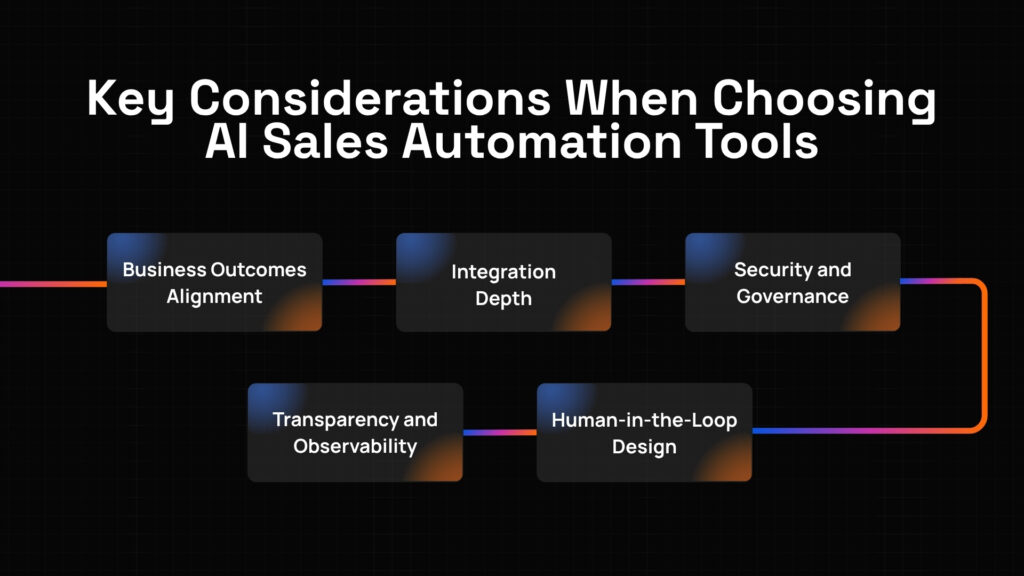
Key Considerations When Choosing AI Sales Automation Tools
Not all automation tools are created equal. Vendors vary widely in how deeply they integrate with CRMs, handle unstructured data, and manage human escalation. When evaluating AI sales automation tools, your focus should be on real workflow impact, not just the features that look impressive in a demo.
1. Business Outcome Alignment: Start with measurable goals. Whether your objective is to reduce response time by 50 percent or increase qualified lead throughput, define success before discussions begin. Every vendor claim should tie back to your KPIs.
2. Integration Depth: Evaluate how well the system connects to your existing ecosystem, CRM, help desk, ERP, and communication platforms. Real productivity gains come when automation reads and writes across these systems without manual syncing.
3. Security and Governance: Sales data often includes PII, sensitive financial details, and private conversations. Prioritize vendors with certifications like SOC 2 or ISO 27001 and those who offer encryption, data residency control, and full audit logs.
4. Human-in-the-Loop Design: Even the best automation should know when to ask for help. Confirm that the system can route uncertain cases or low-confidence responses to human agents automatically.
5. Transparency and Observability: You should be able to see what your automation is doing, in real time. Dashboards, rollback options, and version histories are essential to maintaining trust and compliance.
Example: A B2B SaaS provider replaced its legacy chat workflow with an AI sales automation tool that combined CRM sync, natural language routing, and human review checkpoints. Within two months, they reduced first-response times from 14 minutes to under 3 minutes.
Pro tip: Always ask vendors for anonymized before-and-after logs from a real client deployment. It’s the fastest way to assess how well their claims hold up under production load.
The Impact of AI Sales Automation
The shift from manual coordination to intelligent orchestration transforms sales operations at multiple levels. The impact extends across teams, metrics, and morale.
- Faster Routing: Leads are instantly evaluated and matched to the most qualified representative or next-step workflow.
- Smarter Replies: AI-generated responses reflect tone, urgency, and customer history, improving engagement without generic scripts.
- Seamless Handoffs: AI ensures every context element, from call summaries to CRM notes, travels with the prospect, reducing drop-offs.
- Predictive Insights: By analyzing historical success rates, AI suggests which actions are most likely to convert.
- Scalable Performance: Once trained, AI scales instantly across teams, regions, and time zones without the typical onboarding lag.
These efficiencies lead to measurable business outcomes, higher conversions, lower churn, and better customer satisfaction. Over time, AI business automation compounds its value by continuously learning from every interaction.
Common Pitfalls in AI Sales Automation
AI sales automation tools promise faster routing, improved accuracy, and better customer engagement, but without proper planning, they can create new bottlenecks instead of removing old ones. Many teams adopt automation reactively, chasing efficiency without mapping real workflows first. To learn how AI sales automation can be aligned with your business goals, explore our AI Workflow Automation Services page for detailed implementation examples and integration strategies.
Overlooking Workflow Flexibility: Some AI sales automation tools are too rigid, forcing teams into predefined workflows that overlook nuanced lead-handling paths or territory-specific variations. Always confirm that the platform supports customizable routing rules and adaptive escalation logic.
Underestimating Change Management: A technically strong implementation can still fail if sales reps aren’t trained or aligned. Introduce training, documentation, and feedback sessions early so teams understand how AI automation for sales supports their goals rather than replaces their role.
Neglecting Data and Compliance Controls: AI sales automation often involves handling sensitive customer information, including contact records and transaction histories. Choose vendors who maintain robust compliance frameworks like GDPR and SOC 2, and ensure you can audit access logs on demand.
Choosing Tools Without Scalability: A tool that works for one product line may collapse when expanded across multiple regions or channels. Confirm your vendor’s infrastructure can scale horizontally and vertically without significant redevelopment.
Ignoring Human Oversight: Total automation may sound efficient, but certain sales interactions always require empathy and discretion. Look for systems that integrate human-in-the-loop checkpoints to review exceptions, verify lead quality, or approve sensitive customer communications.
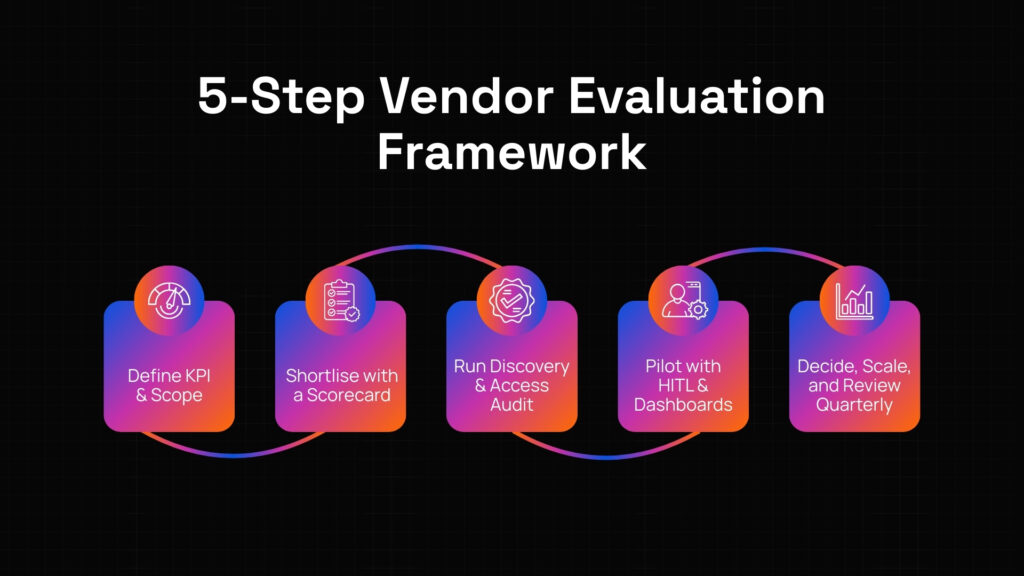
5-Step Vendor Evaluation Framework
Selecting a vendor for AI sales automation tools requires a disciplined, structured approach that aligns with your organization’s revenue goals, technological landscape, and long-term scalability plans. The best partnerships are built not just on flashy demos or pricing, but on how well the vendor’s solution integrates with your existing systems, supports measurable outcomes, and evolves alongside your business. A well-structured evaluation ensures that automation becomes an asset for sustained growth, not a short-term experiment.
1. Business Outcomes & KPI Alignment
Begin by defining what success looks like and how it will be measured. Establishing clear KPIs early ensures everyone, from operations to leadership, evaluates vendors through the same lens. Your goals might include faster lead routing, reduced response times, or improved conversion rates, but they must connect directly to measurable business results. Without these benchmarks, conversations quickly drift into feature comparisons rather than value discussions.
Example: A global SaaS company set its target KPI as “reducing average lead response time from 12 minutes to under 3 minutes within the first quarter.” This clear objective guided every vendor presentation and allowed the team to quantify results from day one.
Pro tip: List 3–5 measurable outcomes before beginning vendor outreach. It keeps evaluations grounded in impact rather than hype.
2. Shortlist with a Scorecard
Once objectives are defined, transition to a quantitative comparison. Use a weighted scorecard to rank vendors based on essential dimensions like integration quality, data security, governance, and post-launch support. Assigning numerical weights ensures objectivity and helps decision-makers visualize trade-offs. This structure prevents subjective choices and provides a defensible rationale for executive sign-off.
Example: A fintech organization built a 100-point scorecard where integration reliability accounted for 25 points, governance maturity 20, and ease of adoption 15. This approach eliminated bias and created clear alignment between technical and business stakeholders.
Pro tip: Keep the scorecard fully data-driven. Rate each vendor on a consistent scale to ensure fair comparisons across capabilities.
3. Run Discovery and Access Audit
Before signing any agreements, conduct a structured discovery phase to surface technical realities and system dependencies early. Vendors should assess your current CRM setup, communication stack, and data governance model. Running a parallel access audit ensures the vendor understands data availability, security layers, and integration constraints. This proactive step prevents misalignment, scope creep, and rework once implementation begins.
Example: A healthcare technology provider invited shortlisted vendors to perform a three-day discovery sprint, during which several API limitations were uncovered and resolved pre-contract, saving months of reconfiguration work.
Pro tip: Request a concise “readiness summary” at the end of discovery that identifies potential blockers and provides realistic deployment timelines.
4. Pilot with Human-in-the-Loop (HITL) and Dashboards
A focused pilot validates whether automation can deliver measurable improvement under live conditions. Instead of scaling immediately, start with a controlled workflow such as chat routing or lead assignment to monitor outcomes. Incorporating human-in-the-loop (HITL) feedback ensures that automation aligns with on-the-ground sales behavior, while dashboards provide visibility into accuracy, throughput, and response quality. This phase transforms theory into measurable impact and builds confidence among your sales teams.
Example: A retail enterprise piloted AI-based lead qualification for one product category and achieved a 31 percent faster sales cycle within 45 days.
Pro tip: Collect end-user feedback throughout the pilot. Human insights often reveal usability issues or contextual gaps that metrics alone cannot capture.
5. Decide, Scale, and Review Quarterly
After a successful pilot, use performance insights to finalize your vendor decision and design a phased rollout plan. Expansion should be deliberate — scale once workflows are optimized and adoption is steady. Ongoing quarterly reviews between your team and the vendor are essential for maintaining alignment, tracking ROI, and planning for future use cases. These sessions turn vendor relationships into collaborative partnerships that drive continual improvement and measurable business outcomes.
Example: A global logistics firm scheduled quarterly review meetings with its automation vendor, identifying optimizations that reduced ticket routing time by an additional 20 percent over six months.
Pro tip: Treat quarterly reviews as strategic checkpoints, not just operational updates. Regularly revisiting KPIs and performance data keeps automation aligned with evolving sales goals.
Vendor Questions to Ask
To make the most informed decision, ask these key questions during evaluation:
- How does your solution link automation outcomes to measurable KPIs?
- Which native integrations are supported out of the box?
- What security certifications and audit results can you provide?
- How do you handle workflow exceptions or overrides?
- What is your average implementation timeline?
- How do you structure post-implementation support?
- Are automation assets and data fully exportable if we move providers?
Ready to Automate with Confidence?
AI sales automation tools are not just about faster routing, they redefine how revenue operations think, act, and evolve. The right system connects intelligence with efficiency, freeing teams to focus on strategy and relationships instead of reactive tasks.
Pro tip:
Start with one process that directly affects conversion, such as lead response or chat routing. Prove ROI fast, then scale across the funnel. Ready to optimize your pipeline with AI sales automation built for growth? Book a Free Strategy Call to design your automation roadmap today.