
The Power of AI Sales Automation Tools: Why They Matter
AI sales automation tools have evolved from basic email sequencers into intelligent pipeline engines that define revenue success in modern sales organizations. Sales teams implementing professional AI automation for sales are fundamentally reimagining how leads get captured, routed, and engaged, transforming the critical first five minutes that determine whether opportunities convert or disappear. Advanced sales automation workflows now manage the lead-to-rep handoff that once leaked pipeline through delay, enabling teams to respond instantly, route accurately, and personalize at scale while maintaining complete visibility into every touchpoint.
The data supporting this transformation continues to strengthen across sales functions and demonstrates the urgent need for speed. According to HubSpot research, the average first response time of B2B companies is 42 hours, and almost a quarter never respond at all, creating massive opportunity loss from leads that move on to faster competitors. McKinsey estimates generative AI could unlock $0.8 to $1.2 trillion in productivity gains in sales and marketing alone, representing unprecedented value creation when automation combines speed with intelligence. Salesforce highlights response time and pipeline visibility as core sales metrics in modern teams, with automation serving as the primary lever improving both simultaneously.
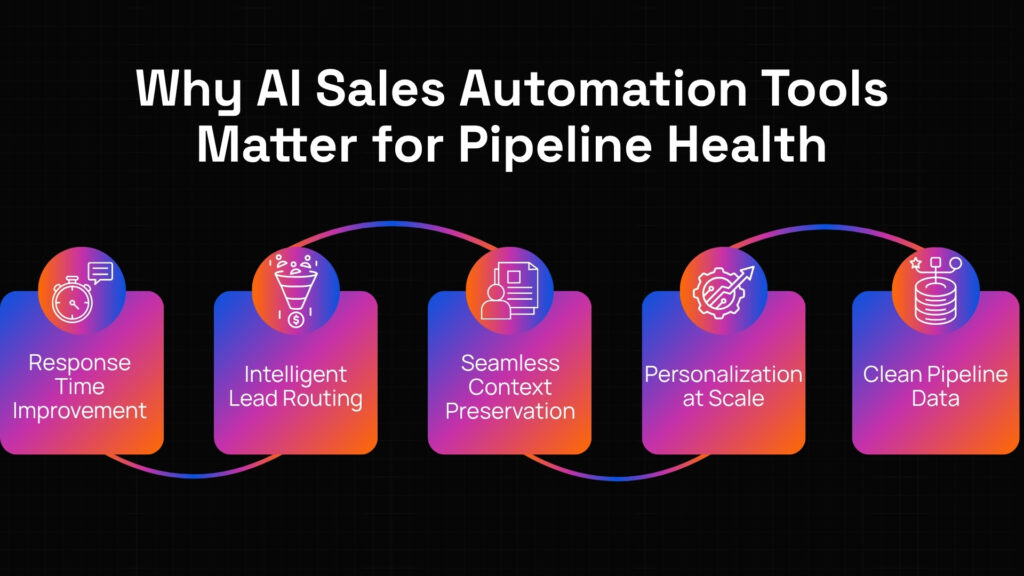
Why AI Sales Automation Tools Matter for Pipeline Health
AI automation for sales goes beyond simple task execution; it transforms how organizations capture inbound interest, qualify leads intelligently, and ensure representatives engage prospects at the optimal moment. Manual lead response workflows that once created pipeline leakage through delayed routing, inconsistent qualification, and lost context can now be executed with speed and precision through sales automation workflows. From cutting first response time from 42 hours to under 5 minutes to maintaining complete conversation context during rep handoffs, AI sales automation tools deliver measurable outcomes that strengthen both pipeline velocity and win rates across all revenue functions.
For sales leaders evaluating AI sales automation tools strategies, the benefits manifest in five critical ways:
- Dramatic Response Time Improvement: AI automation for sales eliminates the 42-hour average first response time plaguing B2B companies according to HubSpot research, enabling instant replies to inbound demo requests, chat inquiries, and form submissions before prospects move to competitors, preventing the 100-times drop in contact odds that MIT research shows occurs when response slips from 5 minutes to 30 minutes.
- Intelligent Lead Routing: Advanced systems route leads to appropriate representatives based on territory, product fit, account value, and representative availability in seconds rather than hours, using enrichment data and scoring models to match prospects with sellers who understand their industry, use case, and buying stage without manual assignment delays.
- Seamless Context Preservation: Best AI sales automation tools maintain complete lead history including pages visited, past conversations, form responses, and enrichment data, enabling smooth handoffs from automated workflows to human representatives who can continue personalized conversations without forcing prospects to repeat information or restart discovery processes.
- Personalization at Scale: Intelligent systems generate tailored responses based on prospect data including industry, company size, role, and behavioral signals, as McKinsey shows companies growing faster drive 40 percent more revenue from personalization, making relevant messaging critical for conversion while automation enables representative workloads.
- Clean Pipeline Data: Sales automation workflows force all activities into CRM with structured logging, eliminating the data gaps that undermine forecast accuracy and pipeline reviews, as Salesforce emphasizes pipeline visibility as core metric that automation directly improves through consistent capture of every touch and outcome.
AI sales automation tools are not about replacing sales representatives; they are about eliminating pipeline leakage in the critical first five minutes, ensuring no lead waits while representatives focus on qualified conversations requiring human judgment, relationship building, and deal progression that drive revenue.
Key Considerations When Choosing AI Automation for Sales
Selecting the right sales automation workflows requires careful alignment between technology capabilities and revenue operations requirements. The most successful AI sales automation tools implementations are built on a foundation of speed, deep system integration, and measurable impact on critical metrics like first response time, meeting booking rates, and pipeline value creation.
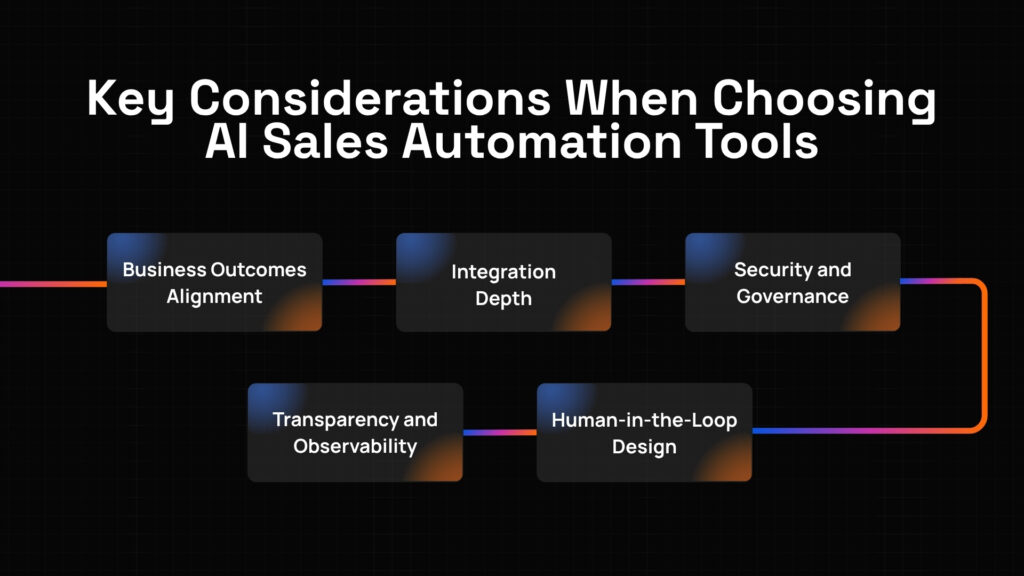
Below are the core factors that should guide every AI automation for sales decision:
- Business Outcomes & KPI Alignment: Every AI sales automation tools initiative must connect directly to tangible revenue metrics including reply time reduction, meeting rate improvement, pipeline value increase, or win rate enhancement. Start with concrete goals vendors are prepared to influence and prove through baselines and measurement frameworks, not vague productivity promises disconnected from pipeline outcomes.
- Integration with Existing Systems: Effective sales automation workflows depend on seamless connectivity with your CRM, marketing automation platform, chat systems, email infrastructure, and dialers. Confirm native or API-level integration supporting read and write operations rather than view-only access, and ensure event support for form submissions, chat starts, email replies, and advertising clicks enabling real-time trigger-based automation.
- Security and Governance: AI automation for sales handles sensitive prospect data including contact information, behavioral tracking, deal values, and conversation history requiring strict controls. Require single sign-on, role-based access controls, comprehensive audit logs, data retention configuration, and PII masking capabilities, plus clarification on how training data gets stored and whether your data trains shared models accessed by competitors.
- Human-in-the-Loop (HITL) Flexibility: Successful AI sales automation tools always include representative oversight mechanisms for conversations requiring judgment or situations where deal size, account importance, or complexity demands human attention. Tools should hand off from automation to human seamlessly keeping full context in CRM, enabling reps to see complete history including pages visited, past conversations, and enrichment data, with configurable thresholds defining when humans must step in such as large deal sizes or key accounts.
- Observability and Analytics: Transparency is essential when scaling sales automation workflows across lead volume. A capable vendor provides comprehensive dashboards tracking speed to lead, reply quality, qualification rates, and meeting creation, plus traces or logs enabling replay of complete path from lead capture to handoff, and versioning with rollback for flows, prompts, and routing rules when updates degrade performance.
- Pricing Transparency and Flexibility: Ask explicitly how vendors price including per contact, per seat, per workflow, or per message models. Clarify who owns creative assets including prompts, copy, routing logic, and scoring models developed during implementation, and ensure you can export your data, logic, and scoring models if you move platforms to avoid vendor lock-in.
Choosing AI automation for sales partners who understand these requirements ensures your investment delivers sustainable improvements rather than creating technical debt, vendor lock-in, or governance gaps that limit future flexibility when sales strategies or technology stacks evolve.
The Impact of Integration Readiness
Before launching any AI sales automation tools initiative, organizations must thoroughly assess their lead capture architecture, CRM data quality, and routing logic documentation completeness. Integration readiness evaluates how well existing marketing automation, CRM platforms, and enrichment tools can support intelligent sales automation workflows without creating prospect frustration or representative confusion. When revenue operations teams conduct integration audits in advance, they uncover form quality issues and data mapping gaps early, align marketing and sales stakeholders around handoff requirements, and minimize wasted time during vendor discovery and pilot phases.
Example: A SaaS company preparing for AI automation for sales discovered that their demo request form lacked enrichment integration creating incomplete lead records, their CRM territory assignment logic wasn’t documented making automated routing impossible without clarification, and their chat platform used different field names than their marketing automation creating data inconsistencies. Addressing these integration readiness issues before vendor engagement reduced the overall project timeline by six weeks and enabled successful pilot achieving target 25 percent increase in demo-book rate on inbound leads.
Pro Tip: Clean your forms and enrichment infrastructure first before scaling automation on junk leads. Share a schema of your CRM, small set of anonymized leads, and diagram of your inbound routing with vendors so they can map reality of your funnel. Ask vendors to highlight risks and constraints instead of over-promising universal solutions, as transparency about limitations prevents disappointment during implementation when assumptions prove incorrect.
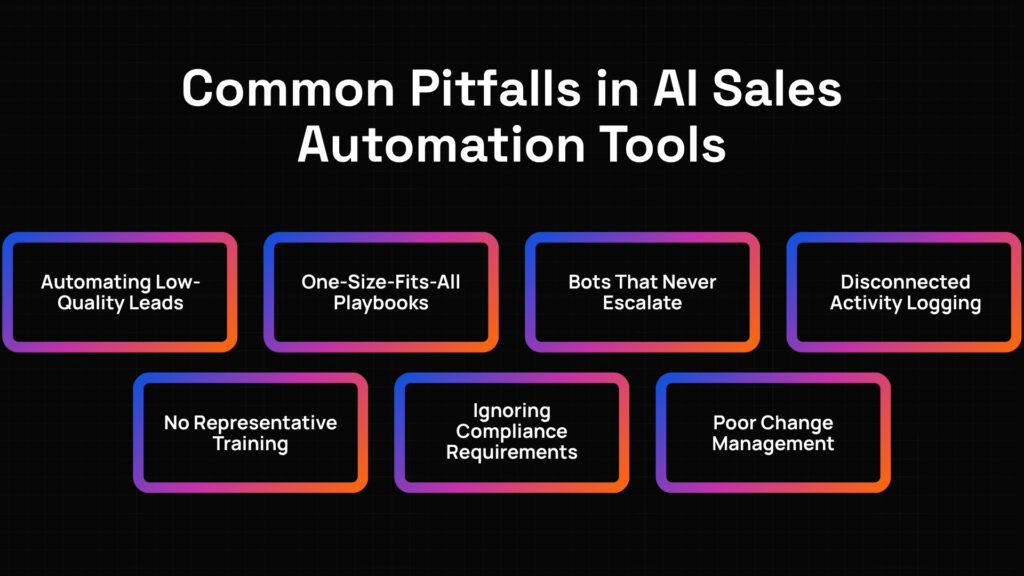
Common Pitfalls in AI Sales Automation Tools
AI automation for sales promises speed and efficiency, but poor planning and inadequate design can create representative resistance instead of pipeline improvements. Many sales organizations make avoidable mistakes during implementation that delay value realization and erode both team and leadership trust. To discover proven methodologies tailored for your sales workflows and lead management requirements, explore our AI Workflow Automation Services page for detailed sales automation workflows frameworks and real-world implementation guidance.
- Automating Low-Quality Leads: Some organizations scale AI sales automation tools on unqualified prospects without addressing root causes. Clean your form validation, enrichment processes, and lead scoring models first, then apply automation to qualified opportunities rather than amplifying noise that wastes representative capacity on junk conversations.
- One-Size-Fits-All Playbooks: Organizations implementing sales automation workflows with generic messaging create poor personalization. Segment by product line, geographic region, or annual contract value with tailored flows addressing specific buyer needs, as McKinsey shows faster-growing companies drive 40 percent more revenue from personalization than slower peers.
- Bots That Never Escalate: Full automation without human handoff thresholds creates trapped prospects and lost deals. Define clear criteria where humans must own the next touch including large deal sizes, strategic accounts, complex questions, or low confidence scores ensuring representatives engage when automation reaches its limits.
- Disconnected Activity Logging: A technically impressive AI automation for sales can still fail if activities don’t log to CRM properly. Force all automated touches into CRM with structured fields so pipeline metrics stay trustworthy and representatives see complete history when they engage prospects mid-workflow.
- No Representative Training: Support teams resistant to AI sales automation tools can undermine sound implementations. Train reps on how and when to jump into automated conversations, what context they’ll receive, and how to leverage automation-gathered intelligence for more effective discovery and qualification conversations.
- Ignoring Compliance Requirements: Deploying sales automation workflows without legal review creates regulatory violations. Align with legal teams on consent management, data retention policies, and messaging boundaries ensuring automation respects unsubscribe requests, permission levels, and regional privacy regulations before launching customer-facing workflows.
- Big-Bang Multi-Use-Case Rollouts: Attempting to automate inbound demos, outbound prospecting, renewals, and upsells simultaneously creates impossible complexity. Start where intent is highest and motion is simplest like inbound demo requests, prove value in 60 to 90 days, then expand systematically to adjacent use cases.
- Poor Change Management: Representatives uncertain about their role alongside automation resist adoption. Create clear ownership defining when automation handles touches versus when humans engage, document escalation procedures, and provide crib sheets for reps covering objection handling and how to leverage automation-gathered context.
Evaluating the ROI of AI Sales Automation Tools
Quantifying the benefits of AI automation for sales helps secure executive buy-in and refine future investments in revenue technology. Measuring ROI goes beyond simple activity volume; it captures gains in response speed, meeting booking rates, pipeline value, and representative productivity. Without clear metrics during evaluation, sales automation workflows projects risk becoming feature-heavy implementations with unclear business outcomes that fail to justify ongoing operational expenses and licensing costs.
Key metrics to monitor include:
- First Response Time Reduction: Track the decrease in hours or minutes required to engage new leads following AI sales automation tools implementation, with leading deployments reducing average first response time from 42 hours to under 5 minutes, preventing the 100-times drop in contact odds MIT research shows occurs when response slips from 5 to 30 minutes according to HubSpot.
- Meeting Booking Rate Improvement: Measure the increase in qualified meetings scheduled when AI automation for sales responds instantly with relevant messaging and intelligent routing, with successful implementations achieving 25 percent or greater improvement in demo-book rates on inbound leads through speed and personalization that McKinsey shows drives 40 percent more revenue for faster-growing companies.
- Pipeline Value Creation: Evaluate the increase in total pipeline value generated when sales automation workflows prevent leakage in the critical first five minutes, calculating incremental opportunities that would have been lost to competitors during 42-hour average response delays plaguing B2B companies according to HubSpot research.
- Representative Productivity Gains: Review improvements in qualified conversation time when AI sales automation tools handle triage and initial engagement, freeing representatives to focus on discovery, objection handling, and deal progression rather than manual lead routing and initial outreach consuming capacity without advancing opportunities.
- Data Quality Enhancement: Assess improvements in CRM completeness and forecast accuracy when sales automation workflows force consistent logging of all touches, as Salesforce emphasizes pipeline visibility as core metric that automation improves through structured capture of every interaction and outcome supporting reliable reviews.
- Productivity Value Realization: Calculate progress toward McKinsey’s estimated $0.8 to $1.2 trillion productivity potential in sales and marketing from generative AI, measuring incremental gains as AI automation for sales expands from narrow use cases to broader lead management coverage while maintaining quality and representative adoption.
According to HubSpot research, B2B companies average 42-hour first response with 25 percent never responding, while MIT shows contact odds drop 100 times when response slips from 5 to 30 minutes. McKinsey estimates $0.8 to $1.2 trillion sales and marketing productivity potential with faster-growing companies driving 40 percent more revenue from personalization. Salesforce emphasizes response time and pipeline visibility as core metrics. When every AI sales automation tools interaction logs lead source, routing logic, response content, and handoff triggers, every flow change maintains version history with rollback capabilities, and every workflow includes appropriate human oversight for strategic accounts and complex conversations, organizations build trusted sales operations that scale without sacrificing relationship quality or creating compliance risk.
5-Step Framework for Vendor Evaluation
Selecting an AI sales automation tools vendor should follow a disciplined, structured process that aligns with your organization’s revenue goals while accounting for both technological depth and long-term partnership potential. Instead of focusing solely on flashy demonstrations or lowest price, evaluation should weigh how well the vendor’s sales automation workflows solution supports measurable outcomes, integrates with existing systems, and adapts to evolving go-to-market strategies.
1. Define KPI and Scope
Start by picking one or two narrow use cases to prove value quickly rather than attempting comprehensive automation simultaneously. Defining specific targets helps align all stakeholders including sales leadership, revenue operations, marketing teams, and representative groups. Your goal might be cutting average first response time from 12 hours to under 5 minutes and increasing demo-book rate on inbound leads by 25 percent, improving meeting rates, or accelerating pipeline velocity, but it must be quantifiable. This clarity becomes the foundation for every subsequent decision about AI automation for sales, shaping both vendor conversations and internal buy-in.
Example: A B2B software company defined its KPI as “cutting average first response time from 12 hours to under 5 minutes and increasing demo-book rate on inbound leads by 25 percent within 90 days.” This metric guided every vendor discussion, shaped pilot design, and became the benchmark for success measurement. Avoid touching outbound prospecting, renewals, and upsells all at once; start where intent is highest and motion is simplest like inbound demo requests.
Pro Tip: Document one to two narrow use cases before requesting proposals. Focus on inbound demo requests, webinar leads, or pricing page chats where intent is high and conversion path is clear rather than attempting to automate entire sales motion simultaneously, and define specific response time and conversion rate targets tied to pipeline value.
2. Shortlist with a Scorecard
Once objectives are clear, move to structured vendor comparison using a weighted scorecard for evaluating AI sales automation tools providers. This tool allows teams to quantify how well each vendor aligns with priorities including proven outcomes, integration depth, observability capabilities, governance frameworks, and data portability. By assigning weights to each factor, decision-makers can balance technical capability with revenue impact and long-term flexibility. Turn your criteria into numeric scorecard so evaluation isn’t swayed by flashy demos.
Example: One enterprise technology company assigned 30 percent weight to outcomes fit validated through use case alignment, 25 percent to integration depth with CRM and marketing automation, 15 percent to observability including dashboards and rollback, 15 percent to governance and security posture, and 15 percent to portability and IP ownership, helping eliminate vendors lacking production-ready connectors early.
Pro Tip: Keep the scorecard numeric to ensure objectivity. Rate each vendor on outcomes 30 percent, integration 25 percent, observability 15 percent, governance 15 percent, and portability 15 percent. Have at least two people independently score each vendor before group discussion to reduce bias and ensure evaluation stays focused on requirements rather than presentation quality.
3. Run Discovery and Access Audit
Before contracts are signed, a structured discovery phase gives vendors just enough access to map the reality of your funnel without exposing sensitive production data. During this phase, teams share CRM schema, small set of anonymized leads, and diagram of inbound routing so vendors can validate assumptions with actual complexity. Running an access audit reveals integration limitations, data mapping gaps, and customization requirements before signing when negotiating leverage is highest.
Example: A financial services company provided vendors with their CRM field schema, 50 anonymized demo request records, and documented territory assignment logic, discovering that vendor A’s claimed routing required custom development costing $15,000 not included in base pricing while vendor B’s native integration worked immediately. Ask vendors to highlight risks and constraints instead of over-promising universal solutions.
Pro Tip: Give vendors controlled access to representative sample data including schema, anonymized leads, and routing diagrams without exposing full production environment. Validate that claimed integrations work with your specific CRM version, marketing automation configuration, and enrichment tools. Share enough complexity to surface limitations early before committing budgets and timelines.
4. Pilot with HITL and Dashboards
A well-designed pilot validates both technology performance and revenue impact under real sales conditions. Instead of full-scale deployment, run a 4 to 8 week pilot on defined segment like main demo form with clear thresholds for human review. Incorporating human-in-the-loop oversight ensures AI sales automation tools outcomes align with brand standards and relationship priorities, while dashboards provide quantifiable visibility into speed to lead, qualification rates, and meeting bookings versus control groups.
Example: A SaaS company piloted sales automation workflows for inbound demo requests, auto-routing and replying to leads with AI while representatives stepped in once meetings booked or deal size passed threshold, running 8-week evaluation and achieving 4.7-minute average first response versus 11-hour baseline, 29 percent demo-book rate improvement, and 4.2 out of 5 rep satisfaction scores. Review performance weekly pulling 20 to 30 conversations at random and scoring for quality, not just volume, as McKinsey shows B2B companies using AI effectively across sales motion grow faster with better satisfaction.
Pro Tip: Execute pilots with frozen scope covering specific lead sources, clear success criteria comparing performance to baseline metrics, and measurable KPIs tracked weekly. Include human handoff logic with defined thresholds, live dashboards showing speed and quality, and random conversation sampling for quality assessment. Use pilot period to train reps on engagement procedures, refine prompts based on actual language, and validate integration stability under production load. Your pilot proves whether your stack can join the group McKinsey identifies as growing faster through effective AI use.
5. Decide, Scale, and Review Quarterly
After the pilot proves value, use findings to guide the final decision and create a phased expansion plan for AI automation for sales deployment. Scaling should be deliberate, expanding surface area only after numbers work and processes stabilize. If metrics don’t meet targets, adjust workflows or swap vendors rather than scaling underperformance. Continuous quarterly reviews maintain alignment, ensuring the technology evolves alongside market changes, product launches, and buyer behavior shifts.
Example: A healthcare technology company conducted quarterly reviews with its AI sales automation tools vendor, expanding successful inbound demo automation to partner referrals and product-led signups over 12 months, identifying prompt optimization opportunities that improved meeting booking rates by additional 12 percentage points and reduced first response time by 3 more minutes. Treat every 90 days as reset point revisiting segments, prompts, scoring, and routing based on data.
Pro Tip: Treat vendor reviews as strategic sessions focused on expanding successful sales automation workflows to adjacent use cases and optimizing quality, not just maintenance calls about system uptime. If pilot numbers work, expand surface area to new lead sources or segments. If not, adjust or swap vendors. Use quarterly reviews to refresh prompts, update scoring models, revise routing logic, and assess performance against evolving benchmarks.
How AI Automation for Sales Changes Daily Work
Well-chosen AI sales automation tools fundamentally shift where humans spend their time rather than replacing sales teams entirely:
- Representatives Focus on Conversations: Reps spend less time triaging leads, routing inquiries, and initial outreach, instead focusing on qualified conversations with prospects ready for discovery, objection handling, and deal progression that require human relationship skills and domain expertise.
- Sales Operations Drives Experiments: RevOps teams focus on running experiments with messaging variations, testing routing logic, and enabling representatives with insights rather than manual routing fixes, alert management, and firefighting data quality issues that consume capacity without improving outcomes.
- Leadership Gets Clean Pipeline Data: Executives see accurate pipeline reviews because all touches flow through consistent sales automation workflows with structured logging, as Salesforce highlights pipeline visibility as core sales metric that automation improves through complete capture of every interaction supporting reliable forecasting.
Next Steps in Your Evaluation Process
By now, you should have a clear understanding of what to prioritize when selecting an AI sales automation tools partner. Bringing these insights together creates a structured evaluation flow that de-risks investment and accelerates deployment while ensuring long-term revenue impact and operational excellence.
- Align with pipeline metrics: Ensure every feature connects to specific KPIs like first response time, meeting booking rates, pipeline value, or win rates tied to revenue rather than vanity metrics like email opens or clicks disconnected from actual opportunity creation and advancement.
- Evaluate integration architecture: Confirm that sales automation workflows work smoothly with your CRM, marketing automation, chat, email, and dialer through read-write capabilities and event support for form submissions, chat starts, and email replies enabling real-time trigger-based automation without manual intervention.
- Focus on handoff design: Choose vendors with seamless bot-to-human handoff maintaining full context in CRM including pages visited, past conversations, and enrichment data, plus configurable thresholds defining when humans must step in based on deal size, account importance, or complexity.
- Review governance frameworks: Favor partners with comprehensive audit logs, role-based access, data retention controls, PII masking, and clarity on training data usage ensuring your prospect data doesn’t train shared models accessed by competitors and legal teams are comfortable with consent and unsubscribe handling.
- Test with controlled pilots: Always run 4 to 8 week pilots with narrow scope, clear KPIs, human oversight, and weekly performance reviews before full deployment to validate response time improvements, booking rate increases, and representative adoption under real-world sales conditions with actual lead patterns.
With these criteria in place, you are better equipped to identify AI automation for sales vendors who not only respond instantly but also route intelligently, personalize effectively, hand off seamlessly, and amplify your team’s capacity to focus on qualified conversations that drive pipeline and revenue.
Vendor Questions to Ask
To make the most informed decision during your AI sales automation tools evaluation, be sure to ask these essential questions:
- How do you measure and report speed to lead at each stage of our funnel including lead capture, enrichment, routing, and first response with time-stamped logging?
- What data fields do you need from our CRM and marketing tools to qualify and route leads including firmographics, behavioral signals, and territory assignment logic?
- How do you personalize messages without overfitting to individual prospects or breaking compliance rules around consent, unsubscribe management, and data retention?
- What safeguards exist to avoid double-contacting leads when multiple automation workflows or representatives might engage the same prospect simultaneously?
- How is handoff to human representatives logged in CRM, and where does the rep see full context including pages visited, past conversations, and enrichment data?
- Can we export workflows, prompts, and scoring models in human-readable format if we decide to switch vendors or bring capabilities in-house?
- What do your most successful customers do differently during the first 90 days in terms of pilot scope, representative training, and change management that enables adoption?
- Can I speak to two customer references with similar sales motions and lead volumes who can discuss measured response time improvements and implementation challenges?
Transform Pipeline with AI Sales Automation Tools
AI sales automation tools are not just technological investments; they are strategic revenue capabilities that require careful planning, vendor selection, and continuous optimization. The right implementation brings speed, intelligence, and consistency across your lead management workflows, while poor execution creates representative resistance and data quality issues that undermine adoption and pipeline visibility.
Ready to transform your pipeline with AI sales automation tools? Book a Free Strategy Call with us to explore the next steps and discover how we can help you scope, pilot, and scale the right AI automation for sales solution for your unique lead workflows, technology stack, and measurable business outcomes.