

The Power of AI Sales Automation Tools: Why Outbound Needs Automation
AI sales automation tools have evolved from basic email sequencers into intelligent outbound engines that define conversion success in modern sales organizations. Sales teams implementing professional AI automation for sales are fundamentally reimagining how cadences execute, how personalization scales, and how testing improves performance without overwhelming representatives with manual work. Advanced AI business automation now manages outbound workflows that once consumed entire SDR departments, enabling teams to focus on conversations, relationship building, and deal progression that drive pipeline and revenue.
The data supporting this transformation continues to strengthen across outbound functions. According to McKinsey research, 40 to 60 percent of sales tasks can now be automated with AI from lead research to follow-ups, representing substantial capacity liberation when automation handles execution while humans focus on strategy. HubSpot data shows teams using AI for personalization see 2 to 3 times higher reply rates on outbound campaigns, demonstrating that intelligent customization drives engagement far beyond generic messaging at scale. Gartner predicts 60 percent of B2B sales organizations will move to AI-driven selling by 2026, signaling industry-wide transformation as automation becomes competitive requirement rather than experimental advantage.
Why AI Automation for Sales Matters for Outbound Teams
AI sales automation tools go beyond simple email sequencing; they transform how organizations execute cadences, maintain personalization quality, and optimize messaging through systematic testing. Manual outbound workflows that once created bottlenecks through copy-paste personalization, inconsistent follow-up timing, and impossible A/B test tracking can now be executed with intelligence and precision through AI business automation. From automating multi-step cadences across channels to running experiments that identify winning sequences, AI sales tools deliver measurable outcomes that strengthen both outbound efficiency and conversion rates.
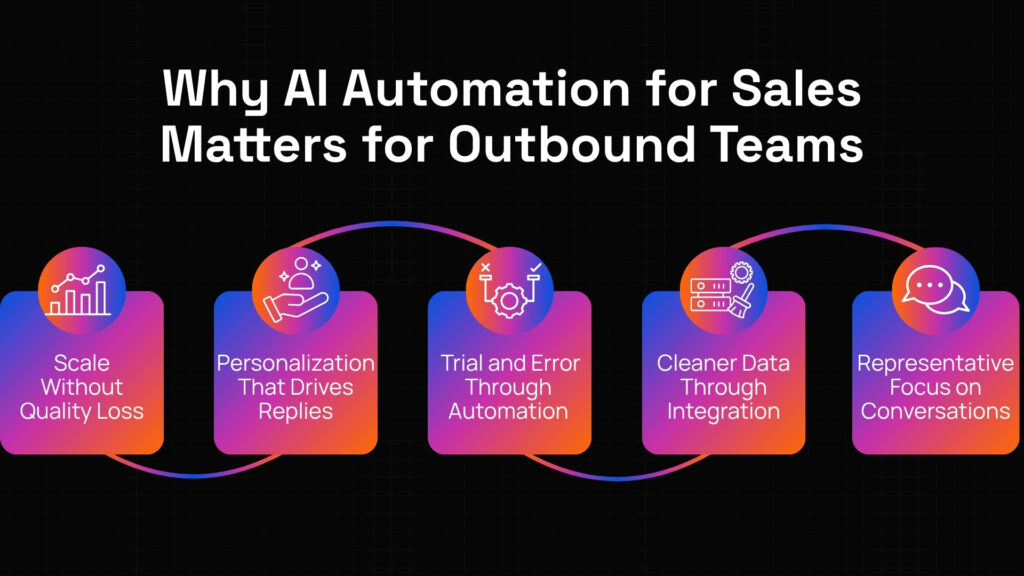
For sales leaders evaluating AI sales automation tools strategies, the benefits manifest in five critical ways:
- Speed and Scale Without Quality Loss: Automate multi-step cadences across email, LinkedIn, and phone channels while maintaining tone consistency and timing optimization, as McKinsey shows 40 to 60 percent of sales tasks are now automatable enabling teams to execute volume impossible through manual approaches without sacrificing personalization quality.
- Personalization That Drives Replies: Natural language models reference lead context from CRM, LinkedIn profiles, and prior touchpoints creating relevant messaging, with HubSpot showing teams using AI for personalization achieve 2 to 3 times higher reply rates than generic outreach at scale proving customization drives engagement.
- Smarter Trial and Error Through Automation: Run A/B tests automatically measuring reply rates and meeting conversions, then roll out winning sequences without manual tracking spreadsheets, as systematic testing compounds learning while manual approaches delay optimization through complexity and capacity constraints.
- Cleaner Data Through Integration: Bi-directional CRM integrations ensure every reply, open, and click maps to real contact or deal stage automatically, eliminating the data gaps that undermine forecast accuracy and make attribution impossible when representatives manually log activities inconsistently.
- Representative Focus on Conversations: Sales teams spend time talking to buyers rather than updating CRMs or guessing follow-up timing, as AI automation for sales handles execution freeing capacity for discovery, objection handling, and relationship building that require human judgment and emotional intelligence.
AI sales automation tools are not about replacing SDRs; they are about eliminating the manual work between strategy and conversation, ensuring every representative can execute with consistency while focusing capacity on the buyer interactions that actually advance deals and create pipeline.
Key Considerations When Choosing AI Business Automation Partners
Selecting the right AI automation for sales requires careful alignment between technology capabilities and outbound requirements. The most successful AI sales automation tools implementations are built on a foundation of transparency, deep CRM integration, and measurable impact on critical metrics like reply rates, meeting bookings, and pipeline creation.
Below are the core factors that should guide every AI sales automation tools decision:
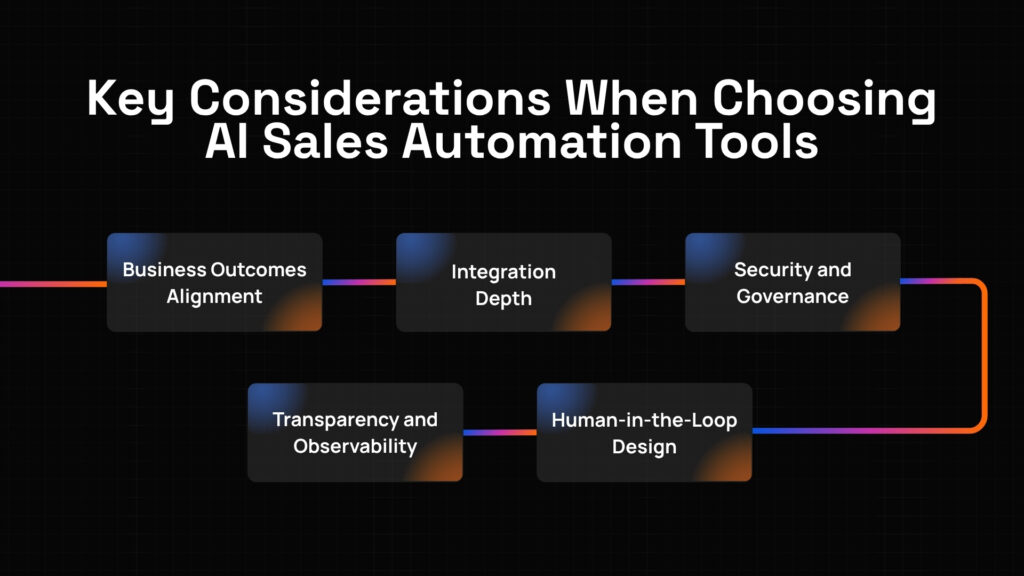
- Business Outcomes & KPI Alignment: Every AI business automation initiative must connect directly to tangible revenue metrics including pipeline added, meetings booked, or conversion rate improvement from current baseline. Define success clearly with specific targets vendors can measure and report on through ROI tracking, not vague productivity promises disconnected from pipeline outcomes.
- Integration with Sales Stack: Effective AI sales tools depend on seamless connectivity with your CRM whether HubSpot, Salesforce, or Pipedrive, plus calendar platforms and communication tools. Check compatibility with read-write APIs, event triggers, and native syncs enabling bi-directional data flow so every activity logs automatically without manual intervention.
- Security and Governance: AI automation for sales handles sensitive prospect data including contact information, engagement history, and deal details requiring strict controls. Ensure compliance with GDPR, CAN-SPAM, and data retention rules, and understand how AI-generated messages use and store personal data preventing regulatory violations and customer trust erosion.
- Human-in-the-Loop (HITL) Flexibility: Successful AI sales automation tools always include representative oversight mechanisms where SDRs review, edit, and approve AI-generated messages before sending. Create escalation paths for sensitive accounts or key deals ensuring strategic relationships receive appropriate human attention and judgment rather than automated approaches.
- Observability and Analytics: Transparency is essential when scaling AI business automation across outbound volume. A capable vendor provides comprehensive dashboards tracking open rates, click-throughs, replies, and meeting conversions in real time, plus sequence performance evaluation per representative or segment enabling data-driven optimization.
- Pricing Transparency and Flexibility: Clarify usage-based costs including message volumes, contact counts, or seat licenses so financial forecasting remains accurate as outbound scales. Confirm ownership of prompts, sequences, and templates developed during implementation to avoid vendor lock-in threatening operational continuity if partnerships change.
Choosing AI automation for sales partners who understand these requirements ensures your investment delivers sustainable improvements rather than creating technical debt, vendor lock-in, or governance gaps that limit future flexibility when outbound strategies or technology stacks evolve.
The Impact of Integration Readiness
Before launching any AI sales automation tools initiative, organizations must thoroughly assess their CRM data quality, outbound process documentation, and enrichment capabilities. Integration readiness evaluates how well existing lead databases, workflow definitions, and system connections can support intelligent automation without creating poor personalization or data chaos. When revenue operations teams conduct integration audits in advance, they uncover data quality gaps and process inconsistencies early, align sales and operations stakeholders around workflow requirements, and minimize wasted time during vendor discovery and pilot phases.
Example: A software company preparing for AI automation for sales mapped how leads moved from list to booked meeting, auditing their CRM for duplicates, incomplete fields, and stale data. Discovery revealed 42 percent of contacts lacked job titles required for personalization, their lead scoring mixed manual and automated updates creating inconsistency, and their enrichment ran weekly rather than real-time creating staleness. Addressing these integration readiness issues before vendor engagement reduced the overall project timeline by six weeks and enabled personalization quality driving reply rate improvements.
Pro Tip: Audit your CRM for duplicates, incomplete fields, and stale data before automation. Map how leads move from list to booked meeting identifying systems, handoffs, and approval gates. Garbage in, garbage out—AI sales tools are only as good as your source data quality, so automate enrichment but validate before launch ensuring personalization draws from accurate information.
Common Outbound Automation Pitfalls and Quick Fixes
AI sales automation tools promise efficiency and conversion improvements, but poor planning and inadequate oversight can create spam perceptions instead of pipeline growth. Many sales organizations make avoidable mistakes during implementation that delay value realization and erode both prospect and team trust. To discover proven methodologies tailored for your outbound workflows and conversion requirements, explore our AI Workflow Automation Services page for detailed AI business automation frameworks and real-world implementation guidance.
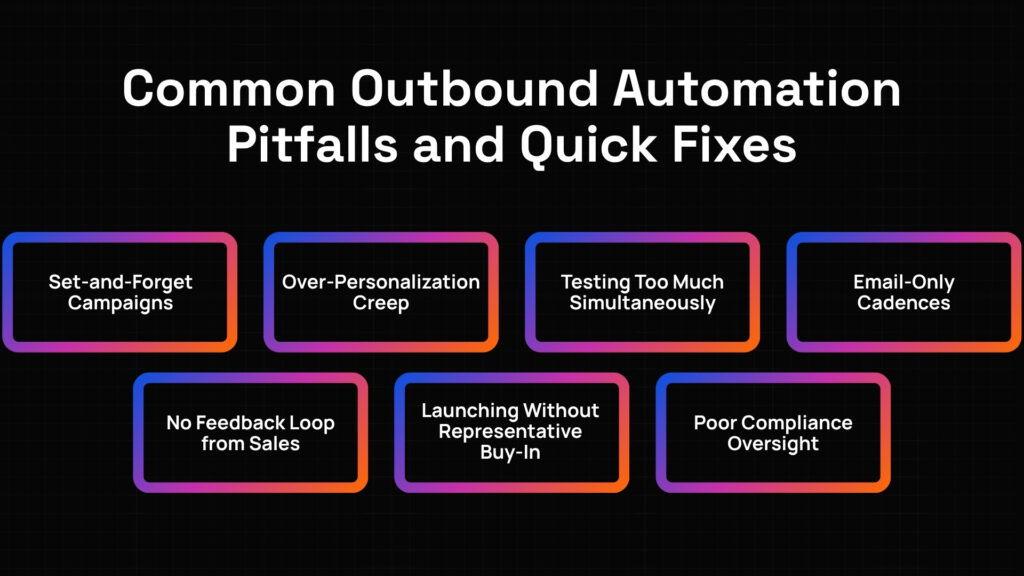
- Set-and-Forget Campaigns: Some organizations deploy AI automation for sales then never review performance. Review sequences weekly not quarterly, adjusting messaging based on reply patterns and meeting conversion data so optimization happens continuously rather than after entire campaigns complete unsuccessfully.
- Over-Personalization Creep: Organizations implementing AI sales automation tools with excessive customization create unnatural messaging. Keep tone relevant but short avoiding fake flattery that prospects recognize as automated, as authentic brevity drives engagement better than elaborate personalization that feels disingenuous.
- Testing Too Much Simultaneously: Organizations running multiple A/B tests across variables create impossible attribution. Test one variable at a time including subject line, call-to-action, or timing so learning isolates what actually drives improvement rather than guessing which changes among many caused performance shifts.
- Email-Only Cadences: Deploying AI sales automation tools exclusively for email creates limited touchpoint diversity. Combine LinkedIn interactions, phone calls, and smart follow-ups across channels as multi-channel sequences drive higher engagement than single-channel approaches regardless of message quality.
- No Feedback Loop from Sales: Automation without representative input creates drift from market reality. Tag outcomes in CRM including not interested, bad timing, and booked meeting, then retrain models monthly incorporating field feedback so AI automation for sales evolves alongside buyer objections and market conditions.
- Launching Without Representative Buy-In: SDRs resistant to AI sales tools can undermine technically sound implementations. Involve revenue operations and sales teams in vendor scoring early to avoid post-launch resistance, demonstrating automation as support not replacement that frees capacity for conversations rather than eliminating roles.
- Poor Compliance Oversight: Implementing AI business automation without controls creates regulatory violations. Ensure message tone compliance, personalization depth appropriateness, and opt-out handling preventing CAN-SPAM and GDPR violations that damage brand reputation and create legal liability.
Evaluating the ROI of AI Sales Automation Tools
Quantifying the benefits of AI automation for sales helps secure executive buy-in and refine future investments in outbound technology. Measuring ROI goes beyond simple email volume; it captures gains in reply rates, meeting bookings, pipeline creation, and representative productivity. Without clear metrics during evaluation, AI business automation projects risk becoming feature-heavy implementations with unclear business outcomes that fail to justify ongoing operational expenses and licensing costs.
Key metrics to monitor include:
- Reply Rate Improvement: Track increases in prospect responses when AI sales automation tools enable personalization at scale, with HubSpot showing teams using AI achieve 2 to 3 times higher reply rates on outbound campaigns proving intelligent customization drives engagement far beyond generic messaging approaches.
- Meeting Conversion Enhancement: Measure improvements in booked meetings per outreach attempt when AI automation for sales optimizes cadence timing, message sequencing, and channel orchestration, calculating lift from baseline performance to demonstrate clear pipeline impact attributable to automation quality.
- Pipeline Creation Acceleration: Evaluate increases in qualified opportunities generated when AI business automation handles lead research, personalization, and follow-up timing systematically, as McKinsey shows 40 to 60 percent of sales tasks are now automatable freeing representatives to focus on conversations that advance deals.
- Representative Productivity Gains: Review improvements in quota attainment and revenue per SDR when AI sales tools eliminate manual work including CRM updates, personalization research, and sequence timing decisions, redirecting capacity to buyer conversations requiring human judgment and relationship skills.
- Test-Driven Optimization: Assess the compounding value from systematic A/B testing that identifies winning sequences and rolls them out automatically, as continuous improvement through experimentation drives performance gains impossible through manual approaches where testing complexity delays learning and optimization.
- Adoption and Scale Progress: Calculate momentum toward Gartner’s prediction that 60 percent of B2B sales organizations will move to AI-driven selling by 2026, measuring implementation maturity as AI automation for sales expands from narrow use cases to comprehensive outbound coverage while maintaining quality and representative adoption.
McKinsey shows 40 to 60 percent of sales tasks are automatable. HubSpot demonstrates 2 to 3 times higher reply rates from AI personalization. Gartner predicts 60 percent of B2B orgs will use AI-driven selling by 2026. When every AI sales automation tools interaction logs engagement signals, reply sentiment, and conversion outcomes, every sequence change maintains version history with performance comparison, and every workflow includes appropriate representative review for strategic accounts, organizations build trusted outbound operations that scale without sacrificing relationship quality or creating compliance risk.
5-Step Outbound Automation Framework
Selecting an AI sales automation tools vendor should follow a disciplined, structured process that aligns with your organization’s outbound goals while accounting for both technological depth and long-term partnership potential. Instead of focusing solely on impressive personalization demonstrations or lowest price, evaluation should weigh how well the vendor’s AI automation for sales solution supports measurable outcomes, integrates with existing systems, and adapts to evolving buyer expectations.
1. Define KPI and Scope
Start by picking one metric to improve first rather than attempting comprehensive optimization simultaneously. Defining specific targets helps align all stakeholders including sales leadership, revenue operations, SDR teams, and marketing. Your goal might be increasing meeting conversion rate from 6 percent to 10 percent in 90 days, improving reply rates, or accelerating pipeline creation, but it must be quantifiable. This clarity becomes the foundation for every subsequent decision about AI business automation, shaping both vendor conversations and internal buy-in.
Example: A technology company defined its KPI as “increasing meeting conversion rate from 6 percent to 10 percent in 90 days while maintaining positive reply sentiment scores above 4.0 out of 5.0.” This metric guided every vendor discussion, shaped pilot design, and became the benchmark for success measurement. Tie goals to revenue impact not just output volume like emails sent.
Pro Tip: Document one primary conversion metric before requesting proposals. Focus on pipeline-impacting outcomes like meeting rates or qualified opportunity creation rather than vanity metrics including open rates or click-throughs disconnected from actual revenue generation, and define specific percentage improvement targets that enable objective evaluation.
2. Shortlist with a Scorecard
Once objectives are clear, move to structured vendor comparison using a weighted scorecard for evaluating AI sales automation tools providers. This tool allows teams to quantify how well each vendor aligns with priorities including proven outcomes in similar contexts, integration depth with sales stack, governance and compliance controls, observability capabilities, and data portability.
Example: One enterprise assigned 30 percent weight to outcomes impact validated through reference customers, 25 percent to integration depth with CRM and communication tools, 20 percent to governance and compliance controls, 15 percent to observability and reporting capabilities, and 10 percent to portability and IP ownership. Involve revenue operations and sales in scoring early to avoid post-launch resistance.
Pro Tip: Score vendors based on outcomes, integrations, and usability using numeric scale. Weight outcomes 30 percent, integration 25 percent, governance 20 percent, portability 15 percent, and analytics 10 percent. Have multiple stakeholders from sales, revenue operations, and marketing score vendors independently before group discussion to reduce bias from impressive demonstrations.
3. Run Discovery and Data Audit
Before contracts are signed, a structured discovery phase maps how leads actually move from list to booked meeting identifying systems, data quality issues, and process gaps. During this phase, teams audit CRM for duplicates, incomplete fields, and stale data that undermine personalization, test integration capabilities with actual tools, and confirm compliance controls with appropriate safeguards.
Example: A financial services company mapped their outbound workflow during discovery, auditing 10,000 contacts and finding 42 percent lacked job titles, 28 percent had outdated company information, and 15 percent were duplicates. Discovery revealed their enrichment ran weekly creating staleness, their CRM lacked standard fields for personalization variables, and their compliance process wasn’t documented. Garbage in, garbage out—AI sales tools are only as good as your source data.
Pro Tip: Map how leads move from list to booked meeting identifying all systems, handoffs, and data transformations. Audit CRM for duplicates, incomplete fields, and stale data quantifying quality issues. Share representative data samples with vendors to validate assumptions about personalization capability and enrichment requirements before signing when negotiating leverage is highest.
4. Pilot with Human-in-the-Loop
A well-designed pilot validates both technology performance and representative adoption under real outbound conditions. Instead of full-scale deployment, run small-scale test with SDRs editing AI-generated drafts ensuring quality and appropriateness. Incorporating human-in-the-loop oversight ensures AI automation for sales outcomes align with brand standards and relationship priorities.
Example: A SaaS company piloted AI sales automation tools for outbound cadences, with AI drafting 100 emails per week while humans reviewed and approved 25 percent including all strategic accounts and new market entries, running 12-week evaluation and achieving 2.4 times baseline reply rate with 4.1 out of 5 representative satisfaction scores. Track lift in replies and meetings to measure real impact.
Pro Tip: Execute pilots with frozen scope covering specific segments, clear success criteria comparing to baseline metrics, and measurable KPIs tracked weekly. Run with SDRs editing AI-generated drafts initially building confidence. Track lift in replies and meetings versus control groups to measure real impact. Use pilot period to refine prompts, train teams on editing workflows, and validate integration stability under production volume.
5. Decide, Scale, and Review Quarterly
After the pilot proves value, use findings to guide the final decision about scaling what works while retiring what doesn’t. Scaling should be deliberate, expanding only after 3-month pilot demonstrates consistent performance validating approach and building organizational confidence. Continuous quarterly reviews maintain alignment, ensuring the technology evolves alongside product launches, competitive dynamics, and buyer behavior shifts.
Example: A manufacturing company conducted quarterly reviews with its AI business automation partner, expanding successful North American cadences to EMEA and APAC over 12 months using top 2 performing sequences across regions, identifying prompt optimization opportunities that improved reply rates by additional 18 percent while reducing spam complaint rates to under 0.1 percent. Refresh prompts, templates, and segment logic quarterly based on campaign insights.
Pro Tip: Treat vendor reviews as strategic sessions focused on expanding successful AI sales automation tools use cases to adjacent segments and optimizing performance, not just maintenance calls about system uptime. Scale what works and retire what doesn’t based on objective performance data. Use quarterly reviews to refresh prompts, update templates, revise segment logic, and assess performance as buyer objections and market conditions evolve.
Next Steps in Your Evaluation Process
By now, you should have a clear understanding of what to prioritize when selecting an AI sales automation tools partner. Bringing these insights together creates a structured evaluation flow that de-risks investment and accelerates deployment while ensuring long-term conversion performance and operational excellence.
- Align with pipeline metrics: Ensure every feature connects to specific KPIs like meeting conversion rates, reply rates, or pipeline creation tied to revenue, not just activity volume including emails sent or sequences launched disconnected from actual deal progression.
- Evaluate integration architecture: Confirm that AI automation for sales works smoothly with your CRM, calendar, and communication tools through read-write APIs, event triggers, and native syncs enabling bi-directional data flow without manual logging or disconnected systems.
- Focus on compliance and oversight: Choose vendors with clear guardrails for message tone, compliance with GDPR and CAN-SPAM, personalization depth controls, and human review workflows ensuring strategic accounts receive appropriate attention and all messaging maintains regulatory compliance.
- Review testing capabilities: Favor partners with systematic A/B testing tracking reply rates and conversions, automatic rollout of winning sequences, and clear attribution showing which message variations drive performance rather than manual spreadsheet tracking delaying optimization.
- Test with controlled pilots: Always run small-scale tests with SDRs editing AI drafts, clear success criteria, and weekly performance reviews before full deployment to validate reply rate improvements, meeting conversion increases, and representative adoption under real-world outbound conditions with actual prospect responses.
With these criteria in place, you are better equipped to identify AI business automation vendors who not only automate cadences but also improve reply rates, boost meeting conversions, strengthen personalization quality, and amplify your team’s capacity to focus on conversations that advance deals and create pipeline.
Vendor Questions to Ask
To make the most informed decision during your AI sales automation tools evaluation, be sure to ask these essential questions:
- What core KPIs including reply rates, meeting bookings, or pipeline creation do your AI sales automation tools improve for similar clients, and how do you measure and report on ROI?
- How do you manage data sync between your platform and our CRM including bi-directional updates, event triggers, and activity logging?
- What guardrails exist for message tone, compliance with regulations, and personalization depth to ensure brand consistency and legal compliance?
- Can representatives override or retrain AI outputs easily when messages need adjustment for strategic accounts or market conditions?
- How do you track and attribute results from A/B tests and multichannel sequences showing which variations drive performance?
- If we leave, what happens to our prompts, sequences, and data including ownership and export capabilities?
- Can I speak to two customer references with similar outbound volumes and complexity who can discuss measured reply rate improvements and implementation challenges?
Transform Outbound with AI Sales Automation Tools
AI sales automation tools are not just technological investments; they are strategic outbound capabilities that require careful planning, vendor selection, and continuous optimization. The right implementation brings consistency, personalization, and conversion improvement across your cadences, while poor execution creates spam perceptions and representative resistance that undermine confidence and waste investment.
Ready to transform your outbound with AI sales automation tools? Book a Free Strategy Call with us to explore the next steps and discover how we can help you scope, pilot, and scale the right AI automation for sales solution for your unique outbound workflows, data quality, and measurable business outcomes.