

The Power of AI Sales: Why Automation Tool Selection Matters
AI sales has evolved from basic CRM enhancements into strategic automation infrastructure that defines conversion success in modern revenue operations. Sales teams implementing professional AI automation platform solutions are fundamentally choosing between extending their CRM with native AI features or adding standalone AI automation software for multi-system orchestration. Advanced sales automation now manages workflows that once required extensive manual work, enabling teams to focus on conversations, relationship building, and deal progression that drive pipeline and revenue while reducing lead response time and preserving SLA commitments.
The data supporting this transformation continues to strengthen across sales functions. According to McKinsey research, 62 percent of organizations are experimenting with AI agents, demonstrating rapid adoption beyond isolated pilots as intelligent systems become core revenue infrastructure. Salesforce data shows 83 percent of sales teams using AI reported revenue growth compared with 66 percent that were not, proving measurable business impact from strategic automation implementations. HubSpot Blog reports sales professionals achieving productivity gains when CRMs add AI features, validating native approaches for CRM-centric workflows. Outreach indicates 45 percent of teams are using hybrid AI-SDR models reporting large reductions in personalization time, demonstrating how AI automation software accelerates execution without sacrificing quality.
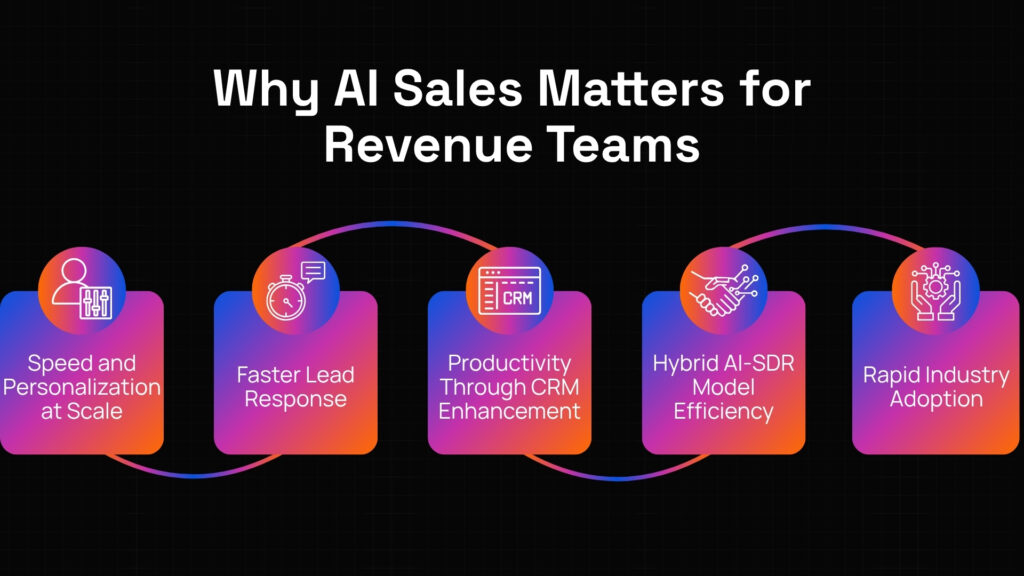
Why AI Sales Matters for Revenue Teams
AI sales goes beyond simple email automation; it transforms how organizations manage lead response, maintain personalization quality at scale, and ensure conversion velocity across all touchpoints. Manual sales workflows that once created bottlenecks through delayed contact, generic messaging, and impossible multi-channel coordination can now be executed with intelligence and precision through AI automation platform orchestration. From reducing lead-to-contact time from 24 hours to 1 hour to improving demo show rates through personalized outreach, sales automation delivers measurable outcomes that strengthen both operational efficiency and revenue generation.
For sales leaders evaluating AI sales strategies, the benefits manifest in five critical ways:
- Speed and Personalization at Scale: AI makes personalized outreach across email, dialers, and chat practical at volume, with Salesforce showing 83 percent of teams using AI reported revenue growth versus 66 percent without AI proving intelligent customization drives conversion improvements when automated systematically.
- Faster Lead Response: Intelligent sales automation reduces time-to-contact through automated triage and routing, with McKinsey showing 62 percent of organizations experimenting with AI agents as speed-to-lead becomes competitive differentiator where delays damage conversion rates and waste marketing investment.
- Productivity Through CRM Enhancement: HubSpot Blog reports sales professionals achieve productivity gains when CRMs add AI features, validating native AI sales approaches for organizations with CRM-centric workflows seeking faster time to first value for simple use cases without additional vendor complexity.
- Hybrid AI-SDR Model Efficiency: Outreach indicates 45 percent of teams using hybrid models report large reductions in personalization time, demonstrating how AI automation software handles research and drafting while human SDRs focus on conversations requiring relationship skills and objection handling that machines cannot replicate.
- Rapid Industry Adoption: HubSpot notes generative AI and marketing automation adoption grew rapidly with most teams using AI in some capacity, validating mainstream business cases as sales automation expands from narrow pilots to comprehensive coverage across lead sources and customer segments.
AI sales is not about replacing representatives; it is about reducing manual work, speeding lead response, and preserving data portability while enabling human capacity to focus on high-value conversations, complex objections, and relationship building that advance deals through nuanced judgment.
Key Considerations When Choosing Between CRM-Native and Standalone
Selecting the right approach for AI sales requires careful alignment between technology capabilities and workflow requirements. The most successful AI automation platform implementations are built on a foundation of transparency, appropriate integration depth, and measurable impact on critical metrics like time-to-contact, SQL rate, and demo show rates.
Below are the core factors that should guide every AI sales decision between CRM-native and standalone approaches:
- Business Outcomes & KPI Alignment: Every sales automation initiative must connect directly to tangible revenue metrics including time-to-contact reduction, SQL rate improvement, demo show rate increase, or pipeline velocity acceleration. Vendors should solve for your specific KPIs with measurement frameworks rather than generic efficiency promises disconnected from actual conversion and revenue outcomes.
- Integration with Sales Stack: Effective AI automation software depends on connectivity with CRM objects, ESP platforms, dialer systems, and analytics tools. For CRM-native approaches, validate tight access to CRM objects and native writebacks enabling seamless data flow. For standalone AI automation platform solutions, confirm read-write actions, webhooks, and event streams supporting multi-system orchestration across complex workflows.
- Security and Governance: Both CRM-native and standalone AI sales handle sensitive customer data including contact information, engagement history, and deal details requiring strict controls. Confirm data residency options, encryption standards, retention policies, and access controls ensuring compliance needs are met regardless of deployment approach as 62 percent of organizations experiment with AI agents according to McKinsey.
- Human-in-the-Loop (HITL) Design: Successful sales automation always includes SDR escalation mechanisms when AI detects low-confidence predictions or high-risk situations. Ensure clear definition of how routing works, what triggers human engagement, and what context is handed off to representatives enabling seamless continuation without forcing leads to repeat information already shared.
- Observability and Analytics: Transparency is essential when scaling AI sales across lead volume. A capable solution provides comprehensive traces, logs, and dashboards showing why outbound messaging or routing decisions were made, enabling troubleshooting, optimization, and governance reviews regardless of whether native CRM features or standalone AI automation software powers workflows.
- Pricing Transparency and Flexibility: Clarify pricing assumptions and document who owns prompts, templates, and evaluation sets developed during implementation. For CRM-native approaches, understand feature tier requirements and per-user costs. For standalone AI automation platform solutions, confirm integration expenses and usage-based charges ensuring financial forecasting remains accurate as programs scale.
Choosing AI sales partners who understand these requirements ensures your investment delivers sustainable improvements rather than creating technical debt, vendor lock-in, or governance gaps that limit future flexibility when sales strategies or technology stacks evolve.
CRM-Native vs Standalone: Understanding the Trade-offs
Before launching any AI sales initiative, organizations must thoroughly understand the architectural implications of CRM-native features versus standalone AI automation platform approaches. The decision impacts integration complexity, flexibility for future requirements, and operational control as workflows evolve. When revenue operations teams evaluate trade-offs in advance, they align stakeholders around appropriate approaches, prevent costly rework, and maximize value realization from automation investments.
CRM-Native Advantages: Single UI for representatives and operations teams reducing training complexity and change management challenges. Tight access to CRM objects and native writebacks eliminating integration middleware and synchronization delays. Faster time to first value for simple use cases like email sequencing or lead scoring when workflows remain contained within CRM boundaries.
CRM-Native Limitations: Limited flexibility if you need cross-system orchestration involving ESP platforms, dialers, analytics tools, or custom applications beyond CRM scope. Feature roadmap tied to CRM vendor priorities rather than your specific requirements potentially creating gaps between needs and capabilities as business evolves.
Standalone AI Automation Platform Advantages: Best for multi-system orchestration and complex workflows requiring coordination across CRM, ESP, dialer, analytics, and custom systems. Often stronger observability and vendor neutrality providing comprehensive traces, logs, and dashboards beyond native CRM capabilities plus portability preventing lock-in.
Standalone Platform Limitations: Extra integration work and another vendor to manage increasing operational complexity and coordination overhead. Potential duplication of data and extra cost to integrate creating architectural challenges and budget impact requiring justification through enhanced capability and flexibility.
Pro Tip: If your workflows are CRM-centric and you need faster time to value without multi-system orchestration, CRM-native AI features can be the right move. If you need coordination across multiple systems, stronger observability for governance, or portability for future flexibility, a standalone AI automation platform is usually better choice providing architectural control.
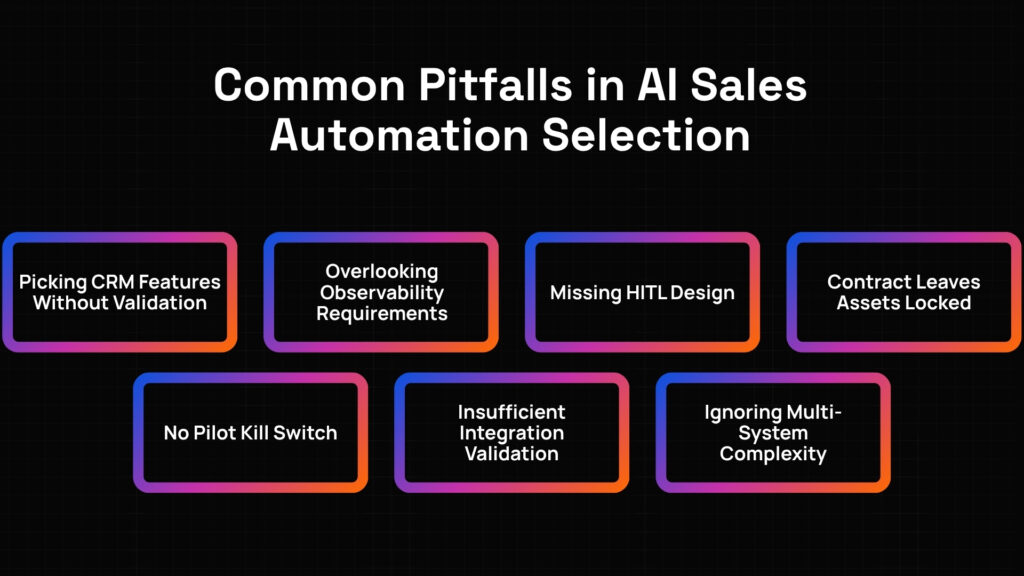
Common Pitfalls in AI Sales Automation Selection
AI automation software promises conversion improvements and operational efficiency, but poor architectural decisions and inadequate planning can create implementation failures instead of revenue gains. Many sales organizations make avoidable mistakes during vendor selection that delay value realization and erode both lead quality and team trust. To discover proven methodologies tailored for your sales workflows and conversion requirements, explore our AI Workflow Automation Services page for detailed sales automation frameworks and real-world implementation guidance.
- Picking CRM Features Without Validation: Organizations assuming native AI sales capabilities match requirements discover gaps during implementation. Validate exact field and workflow access in discovery including read-write capabilities, event triggers, and custom object support before committing to native approaches that may lack necessary flexibility.
- Overlooking Observability Requirements: Deploying sales automation without comprehensive monitoring faces invisible failures. Require trace logs and dashboards in statement of work regardless of native or standalone approach, ensuring visibility into messaging decisions, routing logic, and performance trends enabling proactive optimization.
- Missing HITL Design: Implementing AI automation platform solutions without clear escalation procedures creates poor lead experiences and SDR frustration. Define confidence thresholds and clear escalation playbook from day one specifying what context representatives receive and when human judgment supersedes automation.
- Contract Leaves Assets Locked: Agreements without portability clarity create operational lock-in preventing competitive negotiations and future flexibility. Add portability and export clauses for flows, prompts, logs, and model evaluation sets ensuring you can switch vendors or bring automation in-house without losing operational capability.
- No Pilot Kill Switch: Launching without rollback capability creates risk when automation degrades conversion quality. Require contractual disable path before go-live enabling quick response when AI sales implementations create quality issues, with Salesforce showing 83 percent of teams using AI report revenue growth requiring appropriate controls protecting success.
- Insufficient Integration Validation: Organizations assuming CRM-native features or standalone AI automation software integrate seamlessly discover technical debt during deployment. Get access matrix listing exact API calls and data fields required during discovery before signing when negotiating leverage is highest.
- Ignoring Multi-System Complexity: Teams selecting CRM-native approaches for workflows requiring coordination across ESP platforms, dialers, and analytics face architectural limitations. Evaluate whether workflows truly remain CRM-centric or require multi-system orchestration better suited to standalone AI automation platform capabilities.
Evaluating the ROI of AI Sales Automation
Quantifying the benefits of AI sales helps secure executive buy-in and refine future investments in revenue technology. Measuring ROI goes beyond simple activity volume; it captures gains in lead response time, conversion rates, demo show rates, and SDR productivity. Without clear metrics during evaluation, AI automation software projects risk becoming unclear implementations that fail to justify ongoing operational expenses and licensing costs.
Key metrics to monitor include:
- Lead Response Time Reduction: Track decreases in time-to-contact when sales automation accelerates triage and routing, targeting specific improvements like reducing lead-to-contact time from 24 hours to 1 hour for demo requests enabling engagement while buyer intent remains high and competitive differentiation through speed.
- Revenue Growth Achievement: Measure business impact improvements, with Salesforce showing 83 percent of sales teams using AI reported revenue growth compared with 66 percent that were not proving measurable financial returns from strategic automation implementations beyond pure operational efficiency metrics.
- Productivity Gains from CRM Enhancement: Evaluate efficiency improvements when native features reduce manual work, with HubSpot Blog reporting sales professionals achieve productivity gains when CRMs add AI features validating faster time to first value for CRM-centric workflows without additional vendor complexity.
- Personalization Efficiency: Assess time savings in research and drafting activities, with Outreach indicating 45 percent of teams using hybrid AI-SDR models report large reductions in personalization time demonstrating how AI automation platform solutions handle repetitive work while humans focus on conversations.
- SQL and Demo Show Rate Improvement: Review conversion metric enhancements when intelligent personalization and faster response improve qualification and meeting attendance, calculating pipeline impact from improved top-of-funnel performance as sales automation optimizes execution quality.
- Adoption and Scale Progress: Calculate momentum as McKinsey shows 62 percent of organizations experiment with AI agents and HubSpot notes most marketing teams use AI in some capacity, measuring implementation maturity as AI sales expands from narrow pilots to comprehensive coverage across lead sources and customer segments.
McKinsey shows 62 percent of organizations experiment with AI agents. Salesforce demonstrates 83 percent using AI report revenue growth versus 66 percent without AI. HubSpot reports productivity gains from CRM AI features. Outreach indicates 45 percent use hybrid AI-SDR models with large personalization time reductions. HubSpot notes rapid generative AI and marketing automation adoption. When every AI sales interaction logs decision logic, confidence scores, escalation triggers, and outcomes, every workflow change maintains version history with rollback capabilities, and every escalation provides SDRs with complete lead context and AI actions, organizations build trusted revenue operations that scale without sacrificing conversion quality or creating governance vulnerabilities.
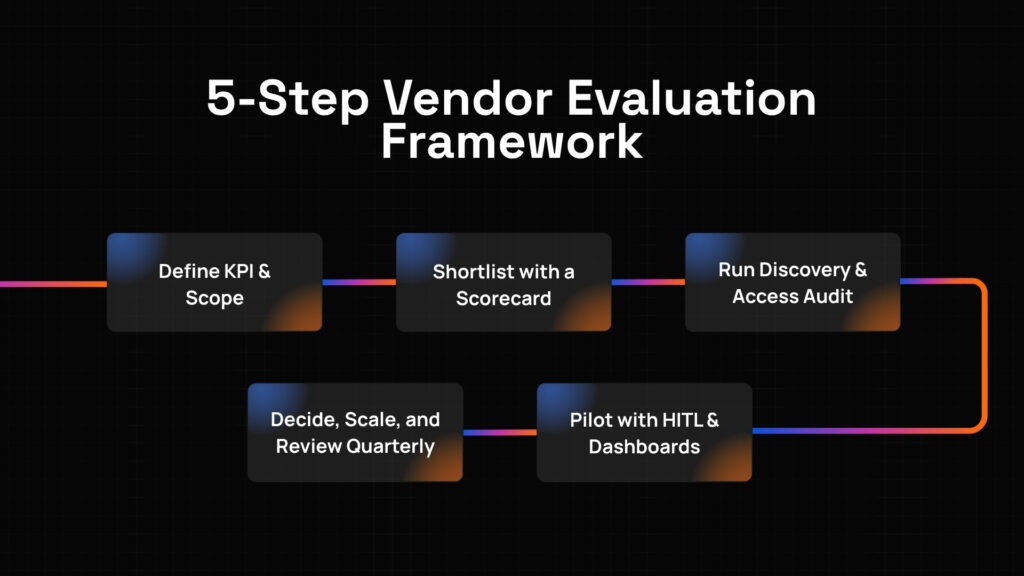
5-Step Vendor Framework for AI Sales
Selecting an AI automation platform or CRM-native approach should follow a disciplined, structured process that aligns with your organization’s revenue goals while accounting for both technological depth and long-term partnership potential. Instead of focusing solely on impressive demonstrations or feature lists, evaluation should weigh how well the sales automation solution supports measurable outcomes, integrates with existing systems, and adapts to evolving buyer expectations.
1. Define KPI & Scope
Start by identifying specific measurable outcomes with narrow scope enabling quick value proof. Defining concrete targets helps align all stakeholders including sales leadership, revenue operations, SDR management, and demand generation. Your goal might be reducing lead-to-contact time from 24 hours to 1 hour for demo requests, improving SQL rate, or increasing demo show rates, but it must be quantifiable with clear measurement methodology.
Example: A B2B software company defined its KPI as “reducing lead-to-contact time from 24 hours to 1 hour for demo requests while maintaining SQL rate above 20 percent and demo show rate above 45 percent within 90 days.” This metric guided every AI sales discussion, shaped pilot design, and became the benchmark for success measurement. Limit scope to one lead source and one ICP segment for pilot proving approach before expanding.
Pro Tip: Document one primary conversion metric before requesting proposals. Focus on time-to-contact, SQL rate, or demo show rate tied to pipeline generation rather than vanity metrics like total activities logged, and define specific percentage improvement targets with timelines enabling objective go/no-go decisions during pilot evaluation.
2. Shortlist with a Scorecard
Once objectives are clear, move to structured comparison using a weighted scorecard evaluating AI automation software providers. This tool allows teams to quantify how well each approach aligns with priorities including integration depth, HITL design, observability capabilities, KPI alignment, delivery planning, and exit portability. Score integration, HITL, observability, and portability 0 to 5.
Example: One enterprise assigned 20 percent weight to integration depth with CRM, ESP, dialer, and analytics, 20 percent to observability including traces, logs, and dashboards, 15 percent to HITL and escalation design, 15 percent to KPI alignment with revenue metrics, 10 percent to pricing transparency and assumptions, 10 percent to delivery and enablement support, and 10 percent to exit portability and asset ownership. Weight integration and observability higher for lifecycle automations.
Pro Tip: Turn evaluation criteria into numeric scoring so decisions remain defendable beyond subjective impressions. Weight factors reflecting your priorities with integration and observability typically receiving highest emphasis for mission-critical revenue workflows. Have multiple stakeholders from sales, revenue operations, and IT score approaches independently before group discussion to reduce bias.
3. Run Discovery & Access Audit
Before contracts are signed, a structured discovery phase allows vendors to map your CRM objects, webhooks, dialer access, and SLA rules documenting every integration touchpoint. During this phase, teams validate API capabilities, surface data quality gaps, and confirm security controls with appropriate permissions. Get access matrix listing exact API calls and data fields required.
Example: A financial services company conducted discovery for AI sales, revealing their CRM used custom objects without standard API documentation, their dialer lacked webhook support for real-time activity logging, their ESP required middleware for event synchronization, their SLA definitions varied by lead source creating routing complexity, and their compliance team required call recording retention policies. Vendor should map CRM objects, webhooks, dialer access, and SLA rules.
Pro Tip: For CRM-native approaches, validate exact field and workflow access including read-write capabilities, event triggers, and custom object support. For standalone AI automation platform solutions, get complete access matrix listing API endpoints, data fields, webhook requirements, and event streams. Use discovery to surface integration limitations, architectural constraints, and compliance requirements before signing when negotiating leverage is highest.
4. Pilot with HITL & Dashboards
A well-designed pilot validates both technology performance and SDR adoption under real revenue conditions. Instead of full-scale deployment, run 4-week pilot on one channel with weekly KPIs and kill switch maintaining human oversight for quality assurance. Incorporating human-in-the-loop review ensures AI sales outcomes align with conversion standards and lead quality requirements while building organizational confidence.
Example: A SaaS company piloted sales automation for product demo requests, running 4-week evaluation with one lead source, SDR review for all high-confidence SQL classifications, and dashboard tracking time-to-contact and demo show rate, achieving 1.2 hour average response time with 48 percent demo show rate above 45 percent target. Require anonymized case metrics for comparable customer as Outreach shows 45 percent use hybrid AI-SDR models with large time savings.
Pro Tip: Execute pilots with frozen scope covering specific lead source and ICP segment, clear success criteria comparing to baseline metrics, and measurable KPIs tracked weekly. Run 4-week pilot on one channel with weekly reviews establishing statistical significance. Require anonymized case metrics from comparable customer validating proven approach. Include contractual kill switch enabling quick rollback if conversion degrades. Use pilot period to refine prompts, train SDRs on AI-routed leads, and validate integration stability.
5. Decide, Scale, and Review Quarterly
After the pilot proves value, use findings to guide the final decision about scaling after consistent KPI wins for 4 weeks validating sustainability and stability. Scaling should be deliberate, expanding only after demonstrating approach works reliably. Continuous quarterly reviews maintain alignment, ensuring automation evolves alongside product launches, market changes, and buyer behavior shifts.
Example: A technology company conducted quarterly reviews with its AI automation platform partner, expanding successful demo request automation to trial signups and consultation requests over 12 months, scaling after consistent wins for 4 weeks, and identifying optimization opportunities that improved time-to-contact by additional 40 percent while increasing SQL rate to 26 percent. Review model drift quarterly and keep documented exit path as Salesforce shows 83 percent using AI report revenue growth requiring ongoing optimization.
Pro Tip: Treat vendor reviews as strategic sessions focused on expanding successful AI sales use cases to adjacent lead sources and optimizing qualification logic, not just maintenance calls about system uptime. Scale after consistent KPI wins for 4 weeks proving reliability. Keep documented exit path and asset export checklist ensuring portability. Use quarterly reviews to assess performance drift, model accuracy, new lead type handling, and alignment with evolving products and markets.
Next Steps in Your AI Sales Evaluation
By now, you should have a clear understanding of what to prioritize when selecting AI automation software or CRM-native features. Bringing these insights together creates a structured evaluation flow that de-risks investment and accelerates deployment while ensuring long-term revenue excellence.
- Align with revenue metrics: Ensure every sales automation feature connects to specific KPIs like time-to-contact, SQL rate, or demo show rate tied to pipeline generation, not just activity volume percentages disconnected from actual conversion quality and revenue outcomes.
- Evaluate integration architecture: For CRM-native, validate tight access to CRM objects and native writebacks. For standalone AI automation platform, confirm read-write actions, webhooks, and event streams enabling multi-system orchestration. Assess whether workflows truly remain CRM-centric or require coordination across multiple systems.
- Focus on HITL and observability: Choose approaches with clear escalation mechanisms for low-confidence predictions, complete context handoff to SDRs, and comprehensive traces, logs, and dashboards showing decision logic regardless of native or standalone deployment as 62 percent of organizations experiment with AI agents requiring transparency.
- Review portability and control: Favor solutions with asset export capabilities including flows, prompts, logs, and evaluation sets. For CRM-native, understand vendor roadmap dependency. For standalone AI automation software, confirm vendor neutrality and multi-system flexibility preventing architectural lock-in.
- Test with controlled pilots: Always run 4-week pilots with one channel, human oversight, weekly KPI reviews, and contractual kill switch before full deployment to validate time-to-contact improvements, SQL quality maintenance, and operational readiness under real-world revenue conditions.
With these criteria in place, you are better equipped to identify AI sales solutions whether CRM-native or standalone AI automation platform that not only automate workflows but also reduce lead response time, improve conversion rates, maintain data portability, and amplify your team’s capacity to focus on high-value conversations that advance deals and create pipeline.
Vendor Questions to Ask
To make the most informed decision during your AI sales evaluation, be sure to ask these essential questions:
- Which CRM objects and fields will you read and write, and can you provide list of API endpoints for validation?
- How do you detect low-confidence predictions or high-risk situations, and what is the agent handoff flow with what context provided?
- What dashboards, trace logs, and audit trails come standard, and can we access raw logs for custom analysis and troubleshooting?
- Where is data stored for compliance, and what export formats including flows, prompts, and transcripts do you deliver on termination?
- What access and scopes do you require for third-party dialers, ESPs, and analytics tools enabling integration validation?
- Can you pilot with specific percentage of traffic and provide anonymized metrics from comparable customer demonstrating proven approach?
- For CRM-native: What feature roadmap controls do we have, and how are enhancement priorities determined?
- For standalone: What middleware is required, and what are integration maintenance costs over time?
- Who owns the assets including prompts, templates, and evaluation sets developed during implementation?
- What is the contractual kill switch mechanism enabling quick rollback if automation degrades conversion or creates quality issues?
- Can I speak to two customer references with similar sales volumes and complexity who can discuss measured time-to-contact improvements and implementation challenges?
Transform Revenue Operations with AI Sales
AI sales is not just a technological investment; it is a strategic revenue capability that requires careful architectural decisions, vendor selection, and continuous optimization. The right approach whether CRM-native or standalone AI automation platform brings faster lead response, improved personalization, and conversion enhancement across touchpoints, while poor selection creates integration challenges and SDR resistance that undermine confidence and waste investment.
Ready to transform your revenue operations with AI sales? Book a Free Strategy Call with us to explore the next steps and discover how we can help you evaluate CRM-native versus standalone options, scope pilots, and scale the right sales automation solution for your unique workflow requirements and measurable business outcomes.