

The Power of AI Voice Agent: Why Understanding Matters
AI voice agent has evolved from simple IVR menus into intelligent conversation systems that define customer service excellence in modern contact centers. Operations teams implementing professional AI voice assistant solutions are fundamentally choosing between different automation approaches including menu-based routing, NLU intent classification, or LLM-backed dialogue with dynamic context. Advanced voice assistant software now manages call workflows that once required extensive human staffing, enabling teams to focus on complex issues while machines handle repeatable tasks through speech recognition, natural language understanding, and text-to-speech orchestration that accurately triages, routes, and sometimes resolves customer needs.
The data supporting strategic voice automation continues to strengthen across contact center functions. According to Zendesk research, 51 percent of consumers prefer bots when they want immediate service, demonstrating customer acceptance of intelligent automation for instant triage and routing reducing time-to-contact and freeing agents for complex work. However, Gartner data shows 64 percent of customers said they would prefer companies not use AI for customer service in one survey, signaling the critical importance of transparency and easy human handoffs when AI agent handles sensitive situations requiring empathy or complex problem-solving. Gartner projects up to 30 percent cost reduction by automating common issues as agentic AI could autonomously resolve large share of routine problems, validating substantial operational returns from disciplined implementations.
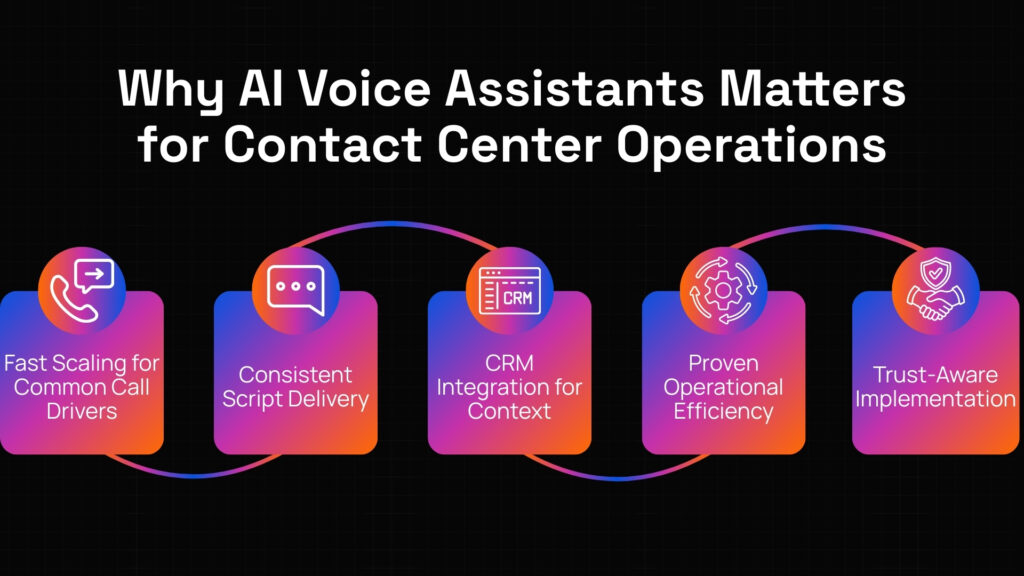
Why AI Voice Assistants Matters for Contact Center Operations
Voice assistant software goes beyond simple call routing; it transforms how organizations manage call volume, maintain service quality, and ensure agent capacity focuses on situations requiring human judgment. Manual contact center workflows that once created bottlenecks through limited operating hours, inconsistent script delivery, and impossible scaling during volume spikes can now be executed with intelligence and precision through AI voice agent orchestration. From reducing average handle time by 15 percent for billing calls to achieving 24/7 coverage without staff multiplication, AI agent delivers measurable outcomes that strengthen both operational efficiency and customer experience.
For contact center leaders evaluating AI voice assistant strategies, the benefits manifest in five critical ways:
- Fast Scaling for Common Call Drivers: AI voice agent handles repeatable tasks like balance checks, appointment scheduling, and basic troubleshooting through automated workflows, with Zendesk showing 51 percent of consumers prefer bots for immediate service proving instant response meets customer expectations when implementations provide helpful accurate information rather than frustrating incorrect handling.
- Consistent Script Delivery: Voice assistant software provides uniform conversation quality through standardized responses and 24/7 coverage eliminating human variability, with Gartner projecting 30 percent cost reduction from automating common issues demonstrating substantial operational returns when AI agent maintains quality standards across all interactions without fatigue or inconsistency.
- CRM Integration for Context: AI voice assistant integrates with CRM systems to create or update records during calls, reading customer history and writing interaction details enabling seamless data flow as Deloitte reports 20 to 30 percent workforce-equivalent gains showing efficiency improvements when automation handles data entry freeing agent capacity for conversation.
- Proven Operational Efficiency: Industry studies validate measurable gains with McKinsey reporting quality improvements when teams use gen-AI voice pilots with human oversight, demonstrating that appropriate guardrails enable excellence as voice assistant software handles appropriate scope defined through clear KPIs like containment rate and average handle time.
- Trust-Aware Implementation: Success requires addressing customer preferences, with Gartner showing 64 percent prefer companies not use AI requiring transparent bot identification, easy agent opt-out, and quality handoffs where AI voice agent provides full context including transcript and extracted entities preventing frustrating repetition when human judgment becomes necessary.
AI voice agent is not about replacing contact center representatives; it is about instant triage reducing time-to-contact, automating repeatable tasks freeing agent capacity, and providing 24/7 coverage while maintaining quality through human escalation when complexity, emotion, or judgment exceed automation capabilities.
What Is an AI Voice Agent? Clear Definition
Understanding AI voice assistant requires clarity about component technologies, capability ranges, and architectural approaches. Organizations making vendor decisions without definitional clarity waste time evaluating inappropriate solutions or miss critical requirements during implementation planning. When operations teams understand what voice assistant software actually comprises, they align stakeholders around realistic expectations, select appropriate vendors, and design effective pilots.
Core Definition: An AI voice agent is software that uses speech recognition, natural language understanding, and generative or scripted responses to handle spoken conversations. It can be simple with menu-based or NLU intent routing, or advanced with LLM-backed dialogue including TTS and dynamic context. Key parts include ASR for speech-to-text conversion, NLU or LLM for intent detection and response generation, TTS for text-to-speech output, and orchestration connecting telephony, IVR, CRM, and webhooks.
Capability Spectrum: Simple implementations handle basic intent routing transferring calls based on detected needs like billing versus technical support. Intermediate solutions attempt scripted resolution collecting information and executing predefined workflows like balance checks or appointment scheduling. Advanced AI agent uses LLM-backed dialogue with dynamic context understanding complex multi-turn conversations adapting responses based on customer history and conversation flow, though requiring stronger guardrails preventing hallucination of factual details when not grounded to canonical data.
Pro Tip: Start with one call type and one measurable KPI like average handle time or containment rate before expanding scope. Prove value on narrow focused implementation as Zendesk shows 51 percent prefer bots for immediate service requiring excellence on defined use case over mediocre broad deployment attempting too much simultaneously creating poor customer experiences undermining confidence.
Real-World Examples of AI Voice Agent Applications
Understanding practical applications helps operations teams identify appropriate use cases and set realistic expectations. Successful voice assistant software implementations target specific repeatable workflows rather than attempting to handle all call types simultaneously. When organizations select focused applications, they prove value quickly, build confidence, and create foundation for systematic expansion.
- Tier-1 Support Triage: AI voice assistant collects account details, attempts scripted fixes for common issues, then escalates with full context when resolution requires human expertise. Example includes password resets, connectivity troubleshooting, or account status inquiries where voice assistant software guides customer through resolution steps before transferring to agent with transcript and attempted solutions preventing customer repetition.
- Outbound Collections and Reminders: AI agent handles automated calls with personalized scripts and scheduled callbacks for payment reminders, appointment confirmations, or survey completion requests. Gartner projects 30 percent cost reduction from automating common issues demonstrating efficiency when voice assistant software executes high-volume outbound campaigns freeing representatives for complex negotiations or relationship management.
- Booking and Scheduling: AI voice agent checks availability, confirms bookings, and adds calendar invites through CRM integration. Example includes medical appointment scheduling, service booking, or consultation requests where voice assistant software handles coordination eliminating phone tag and reducing administrative burden as Deloitte reports 20 to 30 percent workforce-equivalent gains from intelligent automation.
- Surveys and NPS Collection: AI voice assistant runs post-call or post-purchase surveys with natural-sounding voices capturing customer feedback. Automated survey execution provides consistent methodology, immediate data collection, and scaled feedback gathering without consuming agent capacity or creating survey fatigue from delayed manual follow-up.
Pro Tip: Pilot on 5 to 10 percent traffic for 4 to 6 weeks validating performance before full rollout. Measure containment rate, average handle time, escalation quality, and CSAT comparing AI-handled calls to human baseline as McKinsey reports quality gains with human oversight ensuring disciplined validation before scaling.
What AI Voice Agent Does Well, And What It Doesn’t
Understanding capabilities and limitations prevents inappropriate use cases creating customer frustration or operational failures. Organizations deploying voice assistant software without honest assessment discover expensive lessons through production incidents. When operations teams acknowledge both strengths and limits, they design implementations maximizing value while protecting customers through appropriate guardrails.
Strengths: Fast scaling for common call drivers handling volume spikes without proportional hiring. Consistent script delivery maintaining quality standards across all interactions without fatigue or variability. CRM integration creating or updating records during calls enabling seamless data flow. 24/7 coverage providing service outside business hours without staff multiplication as Zendesk shows 51 percent prefer bots for immediate service when implementations meet customer needs effectively.
Limits: Can hallucinate factual details if not grounded to canonical data requiring response restrictions for critical tasks like medical advice, financial guidance, or regulatory compliance. Struggles with complex ambiguous dialog needing deep subject-matter judgment, empathy for emotional situations, or creative problem-solving that machines cannot replicate as Gartner shows 64 percent prefer companies not use AI requiring appropriate human escalation.
Security Concerns: Risk of fraud and spoofing as voice cloning becomes accessible according to Business Insider requiring voice authentication controls, anomaly detection, and security monitoring. Organizations must implement caller verification, suspicious activity detection, and fraud prevention mechanisms as AI voice agent adoption creates new threat vectors requiring proactive security investment.
Pro Tip: Add voice authentication flags and anomaly detection to pilot scope before production deployment. Validate security controls handle fraud attempts and voice spoofing scenarios, as Business Insider emphasizes accessible voice cloning creates risk requiring implementation addressing emerging threats not just conversation quality.
Understanding AI Voice Assistant KPIs: What to Measure
Before launching any AI agent initiative, organizations must thoroughly define success metrics enabling objective pilot evaluation and ongoing performance monitoring. Key performance indicators provide the measurement framework distinguishing valuable implementations from expensive failures creating customer frustration. When contact center operations teams establish KPIs in advance, they align stakeholders around clear targets, enable data-driven optimization, and build business cases justifying continued investment through demonstrated value.
- Containment Rate: Track percent of calls resolved without human handoff measuring autonomous resolution effectiveness, targeting specific goals like 40 percent containment for billing inquiries proving AI voice agent handles representative volume not just simple edge cases as Gartner projects 30 percent cost reduction achievable through automation.
- Average Handle Time (AHT): Measure end-to-end time including AI interaction and agent transfers when escalation occurs, targeting reductions like 15 percent for billing calls proving efficiency gains as Deloitte reports 20 to 30 percent workforce-equivalent improvements from intelligent automation handling portions of call workflow.
- Escalation Quality: Evaluate percent of escalations with full context accepted smoothly by agents measuring handoff effectiveness, ensuring transcript, extracted entities, and recent utterances transfer completely preventing customer repetition and agent frustration as McKinsey shows quality gains when human oversight validates AI performance.
- CSAT Post-Call: Monitor customer satisfaction after AI-handled or agent-transferred calls comparing to human baseline, ensuring automation maintains or improves satisfaction as Zendesk shows 51 percent prefer bots while Gartner indicates 64 percent prefer companies not use AI requiring quality proving customer acceptance.
- False-Positive/Negative Intent Rates: Track model accuracy metrics daily identifying intent classification errors, measuring false positives showing wrong intent detection and false negatives indicating missed intent requiring model refinement or additional training data improving voice assistant software performance over time.
Pro Tip: Model sensitivity to escalation rate understanding how small increases negate expected savings. Calculate break-even escalation threshold where operational cost savings disappear if containment degrades, establishing performance floor requiring immediate intervention preventing situations where declining accuracy undermines financial business case.
The Impact of Integration Readiness
Before launching any AI voice agent initiative, organizations must thoroughly assess their telephony architecture, IVR configuration, and CRM data quality. Integration readiness evaluates how well existing contact center systems, customer data, and workflow procedures can support intelligent automation without creating technical debt or poor experiences. When operations teams conduct integration audits in advance, they uncover system limitations and data quality gaps early, align stakeholders around connectivity requirements, and minimize wasted time during vendor discovery and pilot phases.
Example: A financial services company preparing for voice assistant software mapped their telephony and CRM integration, discovering their legacy IVR lacked modern API support requiring middleware development, their CRM contained inconsistent account status codes preventing reliable scripting, their call recording system didn’t support real-time transcript export needed for escalation, and their security policies required call authentication not supported by initial vendor proposal. Addressing these integration readiness issues before vendor engagement reduced the overall project timeline by eight weeks.
Pro Tip: Map IVR flows, telephony platform capabilities, CRM fields, recording retention policies, and legal constraints before engaging vendors. Get access matrix listing exact API endpoints and required permissions. Use IVR and Integration Readiness Checklist preparing comprehensive pilot validation before vendor selection when negotiating leverage is highest.
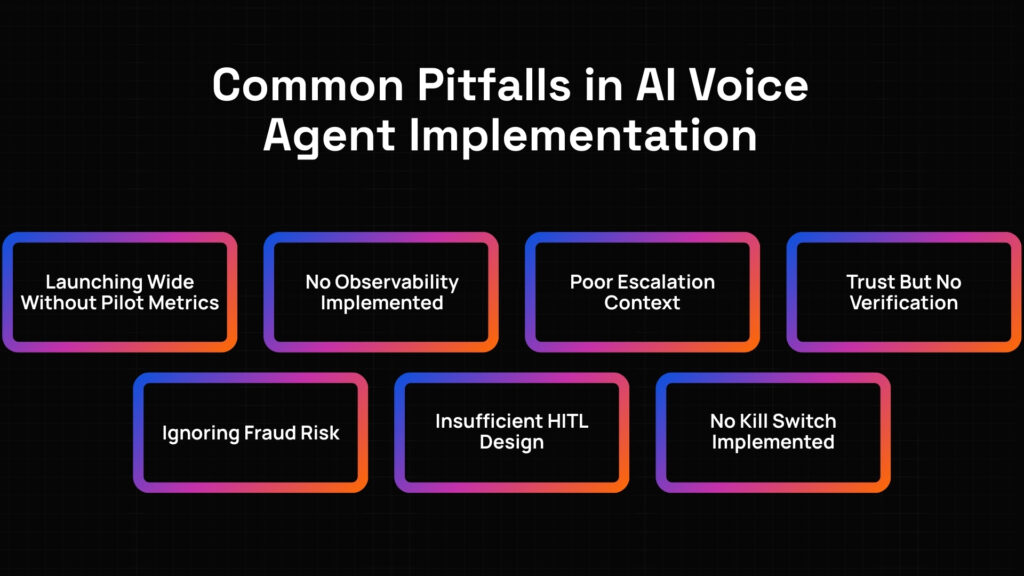
Common Pitfalls in AI Voice Agent Implementation
Voice assistant software promises efficiency and improved response time, but poor planning and inadequate validation can create customer frustration instead of satisfaction improvements. Many contact center organizations make avoidable mistakes during deployment that delay value realization and erode both customer and agent trust. To discover proven methodologies tailored for your voice workflows and contact center requirements, explore our AI Workflow Automation Services page for detailed AI voice agent frameworks and real-world implementation guidance.
- Launching Wide Without Pilot Metrics: Organizations deploying to all traffic without validation discover quality issues after customer impact. Pilot on 5 to 10 percent traffic for 4 to 6 weeks measuring containment, AHT, escalation quality, and CSAT establishing performance under real conditions before full rollout as McKinsey shows quality gains require human oversight during validation.
- No Observability Implemented: Launching without call traces and transcript exports faces invisible quality degradation. Require comprehensive observability dashboards tracking volume, containment, escalation reasons, and call recordings in contract enabling quality review, root cause analysis, and continuous optimization as Gartner projects 30 percent cost reduction requiring measurement proving performance.
- Poor Escalation Context: Deploying AI agent without comprehensive handoff payload creates agent frustration and customer repetition. Send transcript plus AI summary plus entity list on every handoff ensuring representatives receive complete conversation history, detected intent, collected information, and attempted solutions enabling informed continuation without starting over.
- Trust But No Verification: Organizations accepting vendor claims without validation face production surprises. Run paired A/B or shadow mode validating responses before live rollout comparing AI voice assistant performance to human baseline measuring accuracy, customer satisfaction, and operational efficiency as Deloitte reports 20 to 30 percent gains requiring proof not promises.
- Ignoring Fraud Risk: Teams overlooking security face voice spoofing and caller impersonation. Add voice authentication flags and anomaly detection as Business Insider emphasizes voice cloning accessibility creates risk requiring proactive security controls preventing fraud losses exceeding automation savings undermining business case.
- Insufficient HITL Design: Launching without confidence thresholds and human escalation creates overconfident errors. Route to human when confidence falls below threshold, as Gartner shows 64 percent prefer companies not use AI requiring appropriate human involvement when situations exceed automation capabilities through ambiguity, emotion, or complexity.
- No Kill Switch Implemented: Deploying without operational disable capability creates risk when automation degrades. Require kill switch flipping bot to human-only handling in minutes enabling immediate response when voice assistant software produces incorrect outputs, mishandles sensitive situations, or experiences technical failures threatening customer relationships.
Evaluating AI Agent ROI and Cost Considerations
Quantifying the benefits of AI voice assistant helps secure executive buy-in and refine future investments in contact center technology. Measuring ROI goes beyond simple call deflection; it captures gains in handle time, agent capacity, cost efficiency, and customer satisfaction. Without clear financial modeling during evaluation, voice assistant software projects risk becoming unclear implementations that fail to justify ongoing operational expenses and licensing costs.
Key considerations for financial analysis include:
- Pricing Model Understanding: Costs usually mix one-time integration plus ongoing per-minute or per-call inference, TTS, and transcription expenses. Clarify pricing structure understanding fixed versus variable components, and how usage scales affecting total cost as Gartner projects 30 percent cost reduction requiring accurate baseline and projection modeling.
- Operational Cost Reduction: Gartner projects up to 30 percent cost reduction by automating common issues as agentic AI autonomously resolves large share of routine problems, while Deloitte reports organizations achieving 20 to 30 percent workforce-equivalent gains via intelligent automation providing optimistic targets requiring validation through controlled pilots before enterprise commitments.
- Sensitivity Modeling: Small increases in escalation rate can negate expected savings requiring detailed analysis. Model how containment rate variations affect total cost understanding break-even thresholds and financial risk as voice assistant software performance fluctuates across call types, customer segments, and time periods affecting realized returns.
- Agent Capacity Release: Calculate freed representative time redirected to complex issues and relationship management, with McKinsey showing quality gains when AI voice agent handles routine work enabling human focus on situations requiring judgment, creativity, and empathy that machines cannot replicate effectively.
- Customer Experience Impact: Monitor CSAT comparing AI-handled to human baseline measuring whether automation improves or degrades satisfaction, as Zendesk shows 51 percent prefer bots for immediate service while Gartner indicates 64 percent prefer companies not use AI requiring quality validation proving customer acceptance not just operational efficiency.
- Security Investment Requirements: Include fraud prevention and voice authentication costs in total investment as Business Insider emphasizes voice cloning risk requiring security controls. Factor anomaly detection, caller verification, and monitoring expenses into comprehensive TCO analysis preventing situations where security incidents eliminate automation gains.
Zendesk shows 51 percent prefer bots for immediate service. Gartner indicates 64 percent prefer companies not use AI requiring transparency and projects 30 percent cost reduction from automation. Deloitte reports 20 to 30 percent workforce-equivalent gains. McKinsey shows quality improvements with human oversight. Business Insider emphasizes voice cloning fraud risk. When every AI voice agent interaction logs call transcript, intent classification, confidence scores, escalation triggers, and security flags, every deployment validates through controlled pilot before full rollout, and every escalation provides representatives with complete context including transcript and extracted entities, organizations build trusted contact center operations that scale without sacrificing service quality, customer satisfaction, or security posture.
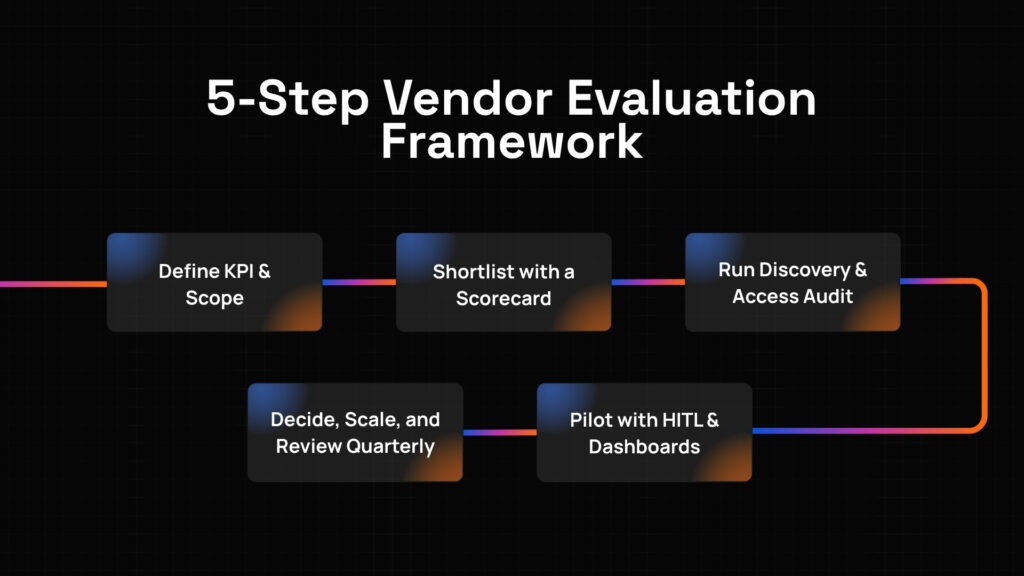
5-Step Vendor Framework for AI Voice Agent
Selecting voice assistant software vendor should follow a disciplined, structured process that aligns with your organization’s contact center goals while accounting for both technological depth and long-term operational sustainability. Instead of focusing solely on impressive demonstrations or cost claims, evaluation should weigh how well the AI agent solution supports measurable outcomes, integrates with existing systems, and maintains customer satisfaction through appropriate guardrails.
1. Define KPI & Scope
Start by identifying specific measurable outcomes with narrow scope enabling quick value proof. Defining concrete targets helps align all stakeholders including contact center leadership, workforce management, quality assurance, and IT operations. Your goal might be reducing AHT by 15 percent for billing calls while keeping FCR steady, improving containment rate, or decreasing cost per contact, but it must be quantifiable with clear operational impact.
Example: A telecommunications company defined its KPI as “reducing average handle time by 15 percent for billing calls while keeping first-call resolution at or above baseline within 90 days and maintaining CSAT above 4.0 out of 5.0.” This metric guided every AI voice agent discussion, shaped pilot design with clear operational benchmarks, and became the success measurement. Limit scope to one call type proving approach.
Pro Tip: Document one primary contact center outcome before requesting proposals. Focus on AHT reduction, containment rate improvement, or cost per contact tied to operational efficiency rather than vanity metrics like total calls handled, and define specific percentage improvement targets with timelines enabling objective go/no-go decisions during pilot evaluation.
2. Shortlist with a Scorecard
Once objectives are clear, move to structured vendor comparison using a weighted scorecard evaluating AI voice assistant providers. This tool allows teams to quantify how well each vendor aligns with priorities including integration depth, observability and logs, HITL and escalation, security and anti-fraud, pricing transparency, and exit portability.
Example: One enterprise assigned 25 percent weight to integration depth with telephony, IVR, and CRM, 20 percent each to observability including call traces and transcripts and HITL escalation design, 15 percent to security and anti-fraud controls, 10 percent each to pricing transparency and exit portability. Example weight: Integration 25, Observability 20, HITL 20, Security 15, Pricing 10, Portability 10.
Pro Tip: Turn evaluation criteria into numeric scoring so decisions remain defendable beyond subjective demonstration impressions. Score integration, HITL, observability, security, and pricing clarity 0 to 5. Weight integration and security appropriately as Business Insider emphasizes fraud risk and Gartner shows 64 percent prefer companies not use AI requiring trust-building security and quality. Have multiple stakeholders from operations, quality, and IT score vendors independently before group discussion to reduce bias.
3. Run Discovery & Access Audit
Before contracts are signed, a structured discovery phase maps IVR flows, telephony platform capabilities, CRM fields, recording retention policies, and legal constraints documenting every integration touchpoint and compliance requirement. During this phase, teams validate API capabilities, surface security gaps, and confirm data quality standards. Get access matrix.
Example: A healthcare contact center conducted discovery for AI agent, revealing their telephony platform used proprietary protocols requiring custom integration, their IVR flows weren’t documented creating ambiguity about automation boundaries, their CRM contained inconsistent customer status codes preventing reliable scripting, their recording retention varied by call type creating compliance complexity, and their security policies required multi-factor authentication not supported by initial vendor proposal.
Pro Tip: Map IVR, telephony, CRM fields, recording retention, and legal constraints before proposals. Get access matrix listing exact API endpoints and required permissions. Validate fraud prevention and voice authentication capabilities during discovery. Use discovery to surface integration limitations, security gaps, and compliance requirements before signing when negotiating leverage is highest.
4. Pilot with HITL & Dashboards
A well-designed pilot validates both technology performance and customer acceptance under real contact center conditions. Instead of full-scale deployment, run 4 to 6 week pilot with shadow mode, weekly KPI snapshots, and kill switch maintaining human oversight for quality assurance. Incorporating human-in-the-loop review ensures AI voice assistant outcomes align with service standards and customer experience requirements while building organizational confidence.
Example: A retail company piloted voice assistant software for order status inquiries, running 6-week evaluation with shadow mode where AI suggested responses while agents delivered actual replies, controlled traffic representing 10 percent of call type, and dashboard tracking AHT, containment, escalation quality, and CSAT, achieving 13 percent AHT reduction with 42 percent containment and 4.2 CSAT above 4.0 target. Require raw transcripts as McKinsey shows quality gains with human oversight.
Pro Tip: Execute pilots with frozen scope covering specific call type, clear success criteria comparing to baseline metrics, and measurable KPIs tracked weekly. Run 4 to 6 week pilot with shadow mode, weekly snapshots, and kill switch. Require raw transcripts for independent quality validation. Use pilot to validate security controls handle fraud scenarios and voice spoofing attempts. Include contractual kill switch enabling immediate disable if service quality degrades.
5. Decide, Scale, and Review Quarterly
After the pilot proves both operational value and customer acceptance, use findings to guide the final decision about scaling after consistent KPI wins validating sustainability and stability. Scaling should be deliberate, expanding only after demonstrating approach works reliably across representative call volumes and complexity. Continuous quarterly reviews maintain operational discipline, ensuring automation adapts as call reasons, products, and security threats evolve.
Example: A financial services company conducted quarterly reviews with its AI voice agent partner, expanding successful billing automation to account inquiries and technical support over 12 months, scaling after consistent wins, identifying optimization opportunities improving AHT by additional 7 percent, and reviewing model drift, security logs, and call reason changes as Gartner projects 30 percent cost reduction requiring ongoing governance.
Pro Tip: Treat vendor reviews as operational governance sessions focused on quality maintenance and security monitoring, not just performance metrics. Scale after consistent KPI wins proving reliability. Review model drift, security logs, and call reason changes quarterly. Use quarterly reviews to assess performance trends, fraud attempt patterns, escalation quality, and alignment with evolving products and service policies.
Next Steps in Your AI Voice Agent Evaluation
By now, you should have a clear understanding of what to prioritize when selecting AI voice assistant partners. Bringing these insights together creates a structured evaluation flow that de-risks investment and accelerates deployment while ensuring customer satisfaction and operational excellence.
- Align with contact center metrics: Ensure every voice assistant software feature connects to specific KPIs like AHT, containment rate, escalation quality, or CSAT tied to operational efficiency, not just call deflection percentages disconnected from actual service quality and customer satisfaction outcomes.
- Evaluate telephony integration: Confirm that AI agent integrates with your telephony and IVR platforms, CRM, and recording systems through native connectors or documented APIs with read-write support enabling real-time orchestration without manual intervention or disconnected systems creating data gaps.
- Focus on HITL and security: Choose vendors with clear confidence thresholds triggering human handoffs, full context transfer including transcript and extracted entities, and fraud prevention controls addressing voice cloning risk as Business Insider emphasizes, with Gartner showing 64 percent prefer companies not use AI requiring appropriate human oversight.
- Review observability capabilities: Favor partners with comprehensive call traces enabling troubleshooting, searchable transcripts supporting quality review, SLA alerts triggering proactive intervention, and quick disable path allowing immediate rollback when automation degrades service quality or creates customer frustration.
- Test with controlled pilots: Always run 4 to 6 week pilots with shadow mode, weekly KPI tracking, security scenario validation, and contractual kill switch before full deployment to validate AHT improvements, containment achievement, and operational readiness under real-world contact center conditions with actual call complexity.
With these criteria in place, you are better equipped to identify AI voice agent vendors who not only automate calls but also reduce handle time, maintain resolution quality, protect against fraud, and amplify your team’s capacity to focus on complex issues requiring human empathy and creative problem-solving that drive customer loyalty.
Vendor Questions to Ask
To make the most informed decision during your AI voice assistant evaluation, be sure to ask these essential questions:
- Which telephony and IVR platforms do you natively support, and what integration approaches exist for legacy systems?
- What exact CRM fields and events do you read and write, and can you provide access matrix documenting integration requirements?
- How do you detect low-confidence outputs requiring human escalation, and what is the agent handoff payload including context transfer?
- What observability do you provide including call traces, searchable transcripts, and SLA alerts enabling quality monitoring?
- How do you store recordings and transcripts including retention periods and export options ensuring compliance and portability?
- What anti-fraud and voice authentication controls do you offer addressing voice cloning and spoofing risks?
- What pricing model do you use including per-minute, per-call, or license plus usage structures, and what assumptions drive cost projections?
- Who owns prompts, flows, and evaluation sets on termination ensuring operational work remains with our organization?
- Can I speak to two customer references with similar call volumes who can discuss implementation challenges and ongoing partnership quality?
- What is the kill switch mechanism enabling immediate disable flipping bot to human-only handling when automation degrades?
Transform Contact Centers with AI Voice Agent
AI voice agent is not just a technological investment; it is a strategic operational capability that requires careful planning, appropriate guardrails, and continuous quality monitoring. The right implementation brings reduced handle time, improved containment, and maintained customer satisfaction, while poor execution creates frustrating experiences and security vulnerabilities that undermine confidence and damage reputation.