
The Power of AI Voice Agents: Why They Matter
AI voice agents have evolved from rigid interactive voice response systems into intelligent conversational platforms that define operational excellence in modern contact centers. Customer service teams implementing AI voice agent for customer service solutions are fundamentally reimagining how organizations handle phone support, call routing, and issue resolution workflows. Advanced AI voice assistant software now manages conversations that once required entire call center departments, enabling human agents to focus on complex escalations, relationship building, and strategic activities that drive loyalty and satisfaction scores.
The data supporting this transformation continues to strengthen across contact center environments. According to Zendesk CX Trends research, 51 percent of consumers prefer interacting with bots over humans when they want immediate service in 2025, demonstrating strong customer acceptance for automated voice interactions. The global voice AI agents market reached $2.4 billion in 2024 and is projected to surge to $47.5 billion by 2034, growing at a compound annual growth rate of 34.8 percent. However, implementation quality matters critically, as 79 percent of contact centers use voice chatbots but only 25 percent have successfully integrated AI automation into daily operations, underscoring the importance of disciplined deployment with proper system integration, human escalation pathways, and performance monitoring.
Why AI Voice Agents Matter for Contact Center Teams
What is an AI voice agent beyond simple automation? It transforms how organizations manage call volume, maintain service consistency, and ensure customer satisfaction across voice channels. Manual phone support workflows that once created bottlenecks in authentication, inquiry handling, and issue resolution can now be executed with intelligence and precision through AI voice assistant software. From caller verification and balance checks to appointment booking and guided troubleshooting, AI voice agent for customer service deployments deliver measurable outcomes that strengthen both customer experience and operational efficiency across all contact center functions.
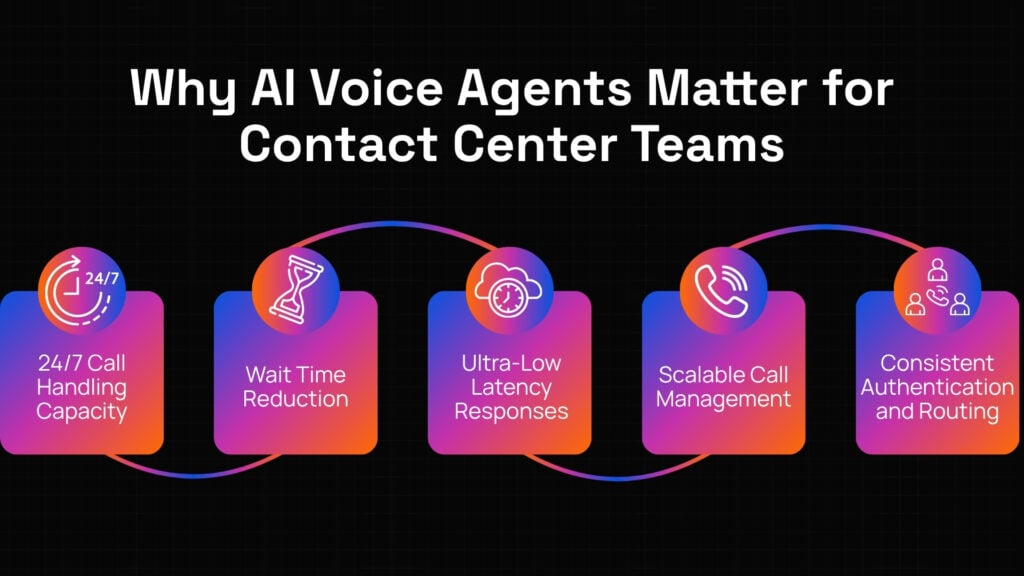
For contact center leaders evaluating AI voice agents strategies, the benefits manifest in five critical ways:
- 24/7 Call Handling Capacity: AI voice assistant software provides round-the-clock phone support across multiple languages and time zones without staffing constraints, handling inquiries instantly during nights, weekends, and holidays when human agents are unavailable, eliminating hold times and improving global accessibility while controlling labor costs.
- Dramatic Wait Time Reduction: Intelligent AI voice agent for customer service systems answer calls immediately without queue delays, as Gartner projects potential for $80 billion in annual contact center savings by 2026 through conversational AI eliminating the hold music and transfer frustration that drives 87 percent of U.S. consumers to express dissatisfaction.
- Ultra-Low Latency Responses: Modern AI voice agents achieve under 500-millisecond round-trip latency matching human conversation cadence, as Microsoft Research demonstrates that conversational quality degrades when delays creep above this threshold, enabling natural turn-taking that customers perceive as responsive and professional.
- Scalable Concurrent Call Management: AI voice assistant software handles thousands of simultaneous calls without busy signals or capacity constraints, unlike human teams limited by agent headcount, enabling organizations to manage volume spikes during launches, outages, or seasonal peaks without proportional staffing increases or service degradation.
- Consistent Authentication and Routing: Automated systems apply standardized security protocols and intelligent call routing with complete audit trails, eliminating the variability from agent experience gaps or rushed authentication during high-volume periods, while directing callers to appropriate resolution paths based on intent classification and account context.
AI voice agents are not about replacing contact center teams; they are about amplifying effectiveness, ensuring availability, and enabling human agents to focus on empathy-driven interactions that require creativity, negotiation skills, and relationship building that machines cannot replicate.
Key Considerations When Choosing AI Voice Agent Software
Selecting the right AI voice assistant software requires careful alignment between technology capabilities and contact center requirements. The most successful AI voice agent for customer service implementations are built on a foundation of low latency, deep telephony integration, and measurable impact on critical metrics like average handle time, self-service containment, and customer satisfaction scores.
Below are the core factors that should guide every AI voice agents decision:
- Business Outcomes & KPI Alignment: Every AI voice agent for customer service initiative must connect directly to tangible call center metrics, whether that is reducing average handle time, improving first-contact resolution rates, increasing self-service containment percentages, maintaining customer satisfaction scores, or lowering cost per contact. Vendors should demonstrate clear methodology for defining success targets with baseline measurements, not vague efficiency promises disconnected from operational reality.
- Integration with Existing Systems: Effective AI voice assistant software depends on seamless connectivity with your CRM, help desk platforms, telephony infrastructure, ERP systems, and authentication services. The ideal partner ensures smooth bidirectional data flow with read and write capabilities, event-driven webhooks, idempotent retry logic, and comprehensive audit logs so automated workflows can fetch customer context, execute actions like appointment booking or payment processing, and maintain compliance documentation.
- Security and Governance: AI voice agents handle highly sensitive customer data including personal identifiers, account details, payment information, and call recordings that require strict controls. Confirm that vendors maintain data residency options, PII redaction capabilities in transcripts and recordings, encryption in transit and at rest, role-based access controls, documented incident response procedures, and model risk management frameworks.
- Human-in-the-Loop (HITL) Flexibility: Successful AI voice agent for customer service platforms always include agent oversight mechanisms for decisions affecting account modifications, refunds, or sensitive information. Ensure that workflows incorporate clear confidence thresholds for automatic escalation, safe words or phrases customers can use to request human transfer immediately, intelligent queue selection routing to appropriate skill groups, and warm transfer capabilities with complete conversation transcript and context.
- Observability and Analytics: Transparency is essential when scaling AI voice assistant software across call volume. A capable vendor provides complete traces for every call turn showing speech recognition, intent classification, tool invocations, and response generation, real-time dashboards covering key metrics, conversation evaluation frameworks with quality scoring, red-flag alert systems for problematic interactions, versioned prompt management, and one-click rollback capabilities.
- Pricing Transparency and Flexibility: Insist on clear pricing models with explicit assumptions for monthly active users, call minutes, model inference usage, and telephony costs. Understanding what is an AI voice agent economically, including variable costs from speech processing and generation, helps forecast expenses accurately as call volumes scale, requiring different budgeting approaches than fixed per-agent seat licenses.
Choosing AI voice agents partners who understand these requirements ensures your investment delivers sustainable improvements rather than creating technical debt, vendor lock-in, or governance gaps that limit future flexibility when telephony platforms or business requirements change.
The Impact of Integration Readiness
Before launching any AI voice agent for customer service initiative, organizations must thoroughly assess their telephony architecture, system integration landscape, and policy documentation completeness. Integration readiness evaluates how well existing contact center platforms, authentication procedures, and knowledge structures can support intelligent voice automation without creating customer frustration or compliance risks. When contact center teams conduct integration audits in advance, they uncover API limitations early, align IT and operations stakeholders around data access requirements, and minimize wasted time during vendor discovery and pilot phases.
Example: A financial services company preparing for AI voice assistant software deployment discovered that their CRM lacked webhook support for real-time account status updates, their authentication system required manual agent intervention for multi-factor verification, and their policy documentation mixed deterministic rules suitable for automation with judgment-heavy decisions requiring human agents. Addressing these integration readiness issues before vendor engagement reduced the overall project timeline by nine weeks and improved intent classification accuracy by 47 percent during the pilot phase, while clarifying which call types needed AI voice agents versus human escalation with complete context.
Pro Tip: Create an internal integration readiness checklist that evaluates telephony API completeness with event-driven capabilities for call control, assesses authentication workflow automation potential with security team approval, confirms customer data quality across identity resolution and account systems, and documents escalation requirements for different intent types. Map complete data flows for authentication, scheduling, payment processing with sample payloads, and document data subject request and PII handling procedures before any calls go live.
Common Pitfalls in AI Voice Agents Implementations
AI voice agents promise efficiency and availability, but poor planning and inadequate customer experience design can create frustration instead of satisfaction improvements. Many organizations make avoidable mistakes during implementation that delay value realization and erode both customer and agent trust. To discover proven methodologies tailored for your contact center workflows and telephony requirements, explore our AI Workflow Automation Services page for detailed AI voice agent for customer service frameworks and real-world implementation guidance.
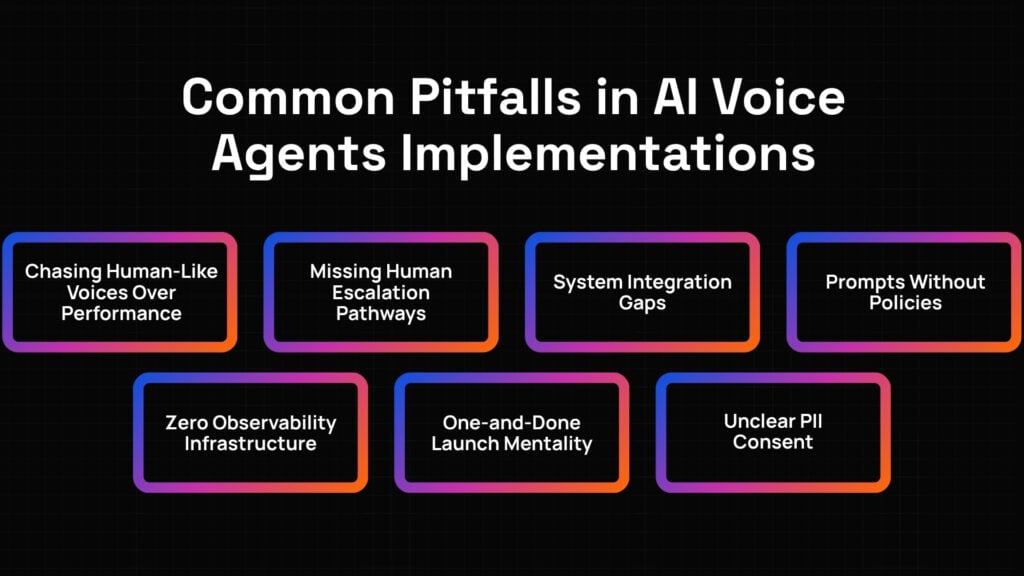
- Chasing Human-Like Voices Over Performance: Some organizations prioritize natural-sounding speech over operational metrics. Focus implementation efforts on clarity and sub-500-millisecond latency that Microsoft Research identifies as critical for conversational quality, as voice naturalness without speed creates frustration during high-volume periods when customers need fast resolutions.
- Missing Human Escalation Pathways: A technically impressive AI voice assistant software deployment can still create customer harm without clear transfer mechanisms. Add confidence thresholds that automatically route to human agents when automation struggles, plus safe words or phrases like “transfer now” that customers can use anytime to reach a person immediately.
- System Integration Gaps: Many teams deploy AI voice agents with read-only access when bidirectional write capabilities exist for case creation, appointment scheduling, and payment processing. Ship comprehensive read-write system integrations before investing in conversational polish, as accurate actions matter more than sophisticated small talk.
- Prompts Without Policies: Organizations implementing AI voice agent for customer service without machine-readable policy documentation create inconsistent outcomes. Convert business rules into explicit decision logic with automated tests, versioning, and validation against historical call recordings to ensure consistency.
- Zero Observability Infrastructure: Full automation without comprehensive logging creates troubleshooting nightmares when customer satisfaction drops. Log every conversation turn with transcripts, intent classifications, tool calls, confidence scores, and backend actions linked together, enabling root cause analysis and continuous improvement.
- One-and-Done Launch Mentality: Vendors demonstrating AI voice assistant software often position deployment as the finish line rather than the starting point. Run weekly error triage sessions analyzing failed calls, evaluate conversation quality against scoring rubrics using representative samples, and ship prompt and policy updates incrementally.
- Unclear PII Consent: Contact centers implementing AI voice agents without explicit privacy disclosures risk regulatory violations. Play consent messages informing callers about recording and AI usage, implement PII redaction in stored transcripts by default, and document data retention policies aligned with jurisdictional requirements.
Evaluating the ROI of AI Voice Agents
Quantifying the benefits of AI voice agent for customer service helps secure executive buy-in and refine future investments in contact center operations. Measuring ROI goes beyond simple call deflection; it captures gains in wait time elimination, resolution speed, agent capacity, and cost per contact. Without clear metrics during evaluation, AI voice assistant software projects risk becoming feature-heavy implementations with unclear business outcomes that fail to justify ongoing operational expenses and licensing costs.
Key metrics to monitor include:
- Average Handle Time Reduction: Track the decrease in minutes required to resolve calls when AI voice agents instantly access customer data and knowledge articles, with leading implementations achieving 20 percent or greater reductions within 90 days by eliminating search time and manual lookups that delay human agent workflows.
- Self-Service Containment Rate: Measure the percentage of calls resolved autonomously without human agent transfer following AI voice assistant software implementation, with successful deployments containing 60 percent or more of targeted intent types while maintaining satisfaction scores above baseline performance levels.
- Wait Time Elimination: Evaluate the impact of immediate call answering versus queue delays, as Gartner projects conversational AI could save contact centers $80 billion annually by 2026 largely through eliminating the hold times and transfers that frustrate 87 percent of U.S. consumers and drive abandonment.
- First-Contact Resolution Improvement: Compare the percentage of issues resolved in initial interaction before and after AI voice agent for customer service deployment, as automated access to complete customer context and accurate knowledge sources reduces callbacks and repeat contact patterns.
- Cost Per Contact Reduction: Review total operational costs including infrastructure, licensing, telephony expenses, and remaining agent touches divided by handled calls to calculate unit economics, with research showing AI interactions costing $0.18 compared to $4.32 for human-handled customer service representing 95.8 percent cost reduction.
- Agent Capacity Release: Assess improvements in complex case handling capacity when AI voice assistant software contains routine inquiries, measured through tickets per agent, occupancy rates, and time allocated to escalations requiring empathy, negotiation skills, and creative problem-solving that justify human expertise.
According to Zendesk research, 51 percent of consumers prefer bots for immediate service showing acceptance readiness for voice automation. The voice AI agents market reached $2.4 billion in 2024 with projections of $47.5 billion by 2034 demonstrating massive investment momentum. When every AI voice agents interaction logs speech recognition confidence, intent classification accuracy, knowledge source citations, tool execution results, and escalation triggers, every policy change maintains version history with rollback capabilities, and every customer has clear human escalation options through safe words or confidence thresholds, organizations build trusted voice operations that scale without sacrificing experience quality or creating regulatory risk.
5-Step Framework for Vendor Evaluation
Selecting an AI voice assistant software vendor should follow a disciplined, structured process that aligns with your organization’s contact center goals while accounting for both technological depth and long-term partnership potential. Instead of focusing solely on impressive voice quality demonstrations or lowest price, evaluation should weigh how well the vendor’s AI voice agent for customer service solution supports service standards, integrates with telephony infrastructure, and adapts to evolving customer expectations.
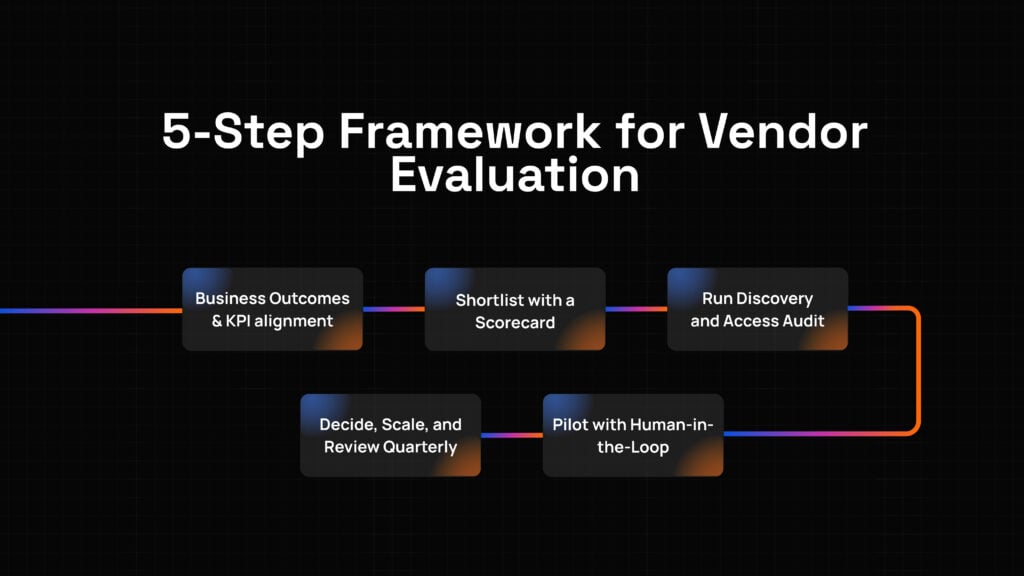
1. Business Outcomes & KPI Alignment
Start by clearly outlining what success looks like with 2 high-volume, low-risk call types and specific performance targets. Defining primary KPIs helps align all stakeholders including contact center leadership, agent teams, IT departments, and customer experience officers. Your goals might include reducing average handle time by 20 percent for password resets and order status calls, achieving 60-plus percent self-service containment, or maintaining customer satisfaction at or above baseline levels, but they must be measurable. This clarity becomes the foundation for every subsequent decision about AI voice agents, shaping both vendor conversations and internal buy-in.
Example: A telecommunications company defined its KPI as “reducing average handle time by 25 percent for account balance inquiries and payment reminder calls within 90 days while maintaining customer satisfaction scores at 4.0 out of 5.0 or higher.” This metric guided every vendor discussion, shaped pilot design, and became the benchmark for success measurement. Start with intents that make up 20 percent of call volume with low policy risk. McKinsey research shows most organizations using generative AI report cost reductions within deploying units.
Pro Tip: Document 3 to 5 measurable contact center outcomes before requesting proposals. Pick call types that need 1 to 2 system integrations, not five complex connections, so evaluation stays grounded in operational impact rather than technology feature lists, and helps vendors tailor demonstrations to your actual call patterns and telephony environment.
2. Shortlist with a Scorecard
Once objectives are clear, move to structured vendor comparison using a weighted scorecard for evaluating AI voice agent for customer service providers. This tool allows teams to quantify how well each vendor aligns with priorities including system integrations, observability capabilities, security controls, business outcomes delivery, and pricing transparency. By assigning weights to each factor, decision-makers can balance technical capability with operational risk management and long-term flexibility. A disciplined scorecard approach removes subjectivity and ensures that even non-technical contact center operations stakeholders understand trade-offs.
Example: One insurance company assigned 30 percent weight to telephony and CRM integration depth, 20 percent to observability with trace-level visibility and conversation evaluation frameworks, 20 percent to security controls including PII redaction and encryption, 20 percent to KPI alignment methodologies, and 10 percent to pricing transparency, helping eliminate vendors lacking comprehensive system integration or real-time monitoring early.
Pro Tip: Keep the scorecard fully quantitative to ensure fairness. Rate each criterion on a defined scale such as 1 to 5 so decisions are driven by contact center requirements rather than sales presentation quality. Ask for sandbox access to your actual CRM environment and a live telephony test number to validate integration claims and latency performance under realistic conditions.
3. Run Discovery and Access Audit
Before contracts are signed, a structured discovery phase maps complete data access requirements including authentication flows, scheduling systems, payment processing with sample payloads and expected response formats. During this phase, teams document data subject request procedures, PII handling flows including redaction requirements, and breach notification contacts. Running an access audit verifies API capabilities, security controls, and least-privilege access boundaries, preventing governance gaps and costly change orders later when production requirements surface unexpectedly.
Example: A healthcare organization mapped their “appointment scheduling” intent requirements as bidirectional calendar API access with conflict detection, patient demographic lookup for verification, insurance eligibility checks, and SMS confirmation delivery, creating comprehensive data flow diagrams and documenting HIPAA compliance requirements before vendor contract negotiations.
Pro Tip: Ask vendors to deliver a brief “readiness summary” document at discovery conclusion that identifies technical blockers like missing webhook support or incomplete authentication integration, data quality issues in customer masters, security requirements for PII handling and recording retention, and realistic timeline estimates. Document all data subject request and PII flows before a single call goes live to avoid compliance gaps.
4. Pilot with Human-in-the-Loop and Dashboards
A well-designed pilot validates both technology performance and service quality under real call center conditions. Instead of full-scale deployment, focus on limited scope with 4-week duration, daily office hours for issue triage, and live dashboards tracking average handle time, self-service containment, customer satisfaction, and cost per contact. Incorporating human-in-the-loop oversight ensures AI voice assistant software outcomes align with brand standards and regulatory requirements, while dashboards provide quantifiable visibility into latency percentiles, escalation patterns, and conversation quality scores.
Example: A retail bank piloted AI voice agents for balance inquiry calls, processing 2,000 calls over 4 weeks and achieving 64 percent self-service containment with 89 percent caller satisfaction, sub-400-millisecond average latency, and identification of 5 policy edge cases requiring human review rules. Evaluate 50 random calls weekly with a 5-point quality rubric, automate red-flag alerts for problematic patterns.
Pro Tip: Use pilots to gather customer and agent feedback through post-call surveys and weekly listening sessions with representative conversation samples. Track unit economics per resolved call including telephony costs, inference expenses, and system API usage. Expand to top 5 call intents only once containment holds above 60 percent for 2 consecutive weeks with stable satisfaction metrics.
5. Decide, Scale, and Review Quarterly
After the pilot proves value, use findings to guide the final decision and create a phased expansion plan for AI voice agent for customer service deployment. Scaling should be deliberate, expanding to additional intent types only after performance metrics remain stable and team confidence builds. Continuous quarterly reviews between your contact center operations team and the vendor maintain alignment, ensuring the technology evolves alongside policy changes, system upgrades, and telephony platform migrations. These sessions re-baseline KPIs after seasonality shifts, retire underperforming intents, and refresh prompts and tools with each release.
Example: A software company conducted quarterly business reviews with its AI voice assistant software vendor, expanding successful authentication and billing inquiry automation to technical troubleshooting and license management calls, identifying prompt optimization opportunities that improved containment by 11 percentage points and reduced inference costs by 34 percent over the first year.
Pro Tip: Treat vendor reviews as strategic sessions focused on expanding successful AI voice agents use cases to adjacent call types and adding intelligent routing capabilities, not just maintenance calls about system uptime. Refresh prompts, policies, and tool integrations with every release to capture business rule changes and incorporate learnings from failure pattern analysis.
Next Steps in Your Evaluation Process
By now, you should have a clear understanding of what to prioritize when selecting an AI voice agents partner. Bringing these insights together creates a structured evaluation flow that de-risks investment and accelerates deployment while ensuring long-term customer satisfaction and operational excellence.
- Align with contact center goals: Ensure every feature connects to specific KPIs like average handle time, self-service containment, first-contact resolution, and customer satisfaction, not just generic automation capabilities or impressive voice quality demonstrations disconnected from actual call pattern distributions.
- Evaluate telephony and system integrations: Confirm that AI voice assistant software works smoothly with your phone infrastructure, CRM, help desk, authentication systems, and knowledge bases through event-driven webhooks and bidirectional updates without requiring extensive custom development or ongoing maintenance overhead.
- Focus on customer experience and security: Choose vendors with documented decision traces, clear escalation pathways with safe words and confidence thresholds, PII redaction controls in transcripts and recordings, and robust human-in-the-loop capabilities that enforce agent oversight for sensitive decisions while respecting that 51 percent prefer bots for immediate service.
- Review enablement and operations support: Favor partners who provide continuous training for agents and supervisors, quality assurance scorecards with conversation evaluation rubrics, operations handover documentation, on-call escalation procedures, and ongoing optimization support, not one-time technical onboarding sessions.
- Test with a controlled pilot: Always run a controlled pilot with real customer calls and actual contact center workflows before full deployment to validate latency performance, containment accuracy, satisfaction maintenance, and unit economics under real-world conditions with representative call volumes and intent distributions.
With these criteria in place, you are better equipped to identify AI voice agent for customer service vendors who not only automate routine calls but also improve customer satisfaction, reduce operational costs, strengthen agent capacity for complex escalations, and amplify your team’s ability to deliver empathetic service that builds loyalty.
Vendor Questions to Ask
To make the most informed decision during your AI voice assistant software evaluation, be sure to ask these essential questions:
- What are your target KPIs for average handle time, self-service containment, and customer satisfaction by week 2 and week 6 of deployment, and how do you establish baselines?
- What end-to-end latency can you guarantee for 95th percentile calls during peak volume, and how does performance degrade under load?
- Show me complete read-write data flows for our CRM and help desk including idempotency guarantees, retry logic, and audit logging capabilities?
- How do you redact personally identifiable information in call transcripts and recordings, and which specific data fields are automatically redacted by default?
- What are your exact confidence thresholds and escalation rules for transferring calls to human agents, and can customers use safe words to request immediate transfer?
- Can we export prompts, policies, evaluation sets, conversation traces, and integration configurations if we decide to switch vendors or bring capabilities in-house?
- What is your observability technology stack and how do supervisors review call quality, access real-time dashboards, and receive alerts for problematic interaction patterns?
- Share three customer references with similar call volumes and telephony infrastructure who can discuss what broke during implementation and how you fixed it?
- What is your typical implementation timeline from contract signing to production deployment, and what are the main factors that accelerate or delay go-live?
Transform Contact Centers with AI Voice Agents
AI voice agents are not just technological investments; they are strategic contact center capabilities that require careful planning, vendor selection, and continuous optimization. The right implementation brings consistency, availability, and scalability across your voice channels, while poor execution creates frustration and agent resistance that undermines adoption and customer trust.
Ready to transform your contact center with AI voice agents? Book a Free Strategy Call with us to explore the next steps and discover how we can help you scope, pilot, and scale the right AI voice assistant software solution for your unique call patterns, telephony environment, and customer experience requirements.