
The Power of AI Voice Assistant Software: Why It Matters
AI voice assistant software has evolved from experimental voice menus into intelligent conversation systems that define operational excellence in modern contact centers. Support teams implementing professional AI voice agents are fundamentally reimagining how phone interactions get handled, how representatives spend their time, and how customers experience voice support across every channel. Advanced AI call center automation now manages conversations that once required entire agent departments, enabling human teams to focus on complex escalations, emotional situations, and relationship building that drive customer loyalty and satisfaction scores.
The data supporting this transformation continues to strengthen across voice support functions. According to AIMultiple research, voice assistant users in the United States are projected to reach 153 million by 2025, demonstrating massive consumer adoption and comfort with voice-based AI interactions. Businesses deploying AI voice automation reduce average handle times substantially, freeing agents for higher-value work requiring human judgment, empathy, and creative problem-solving that machines cannot replicate effectively. Organizations that skip rigorous vendor evaluation around AI voice assistant software face re-work, integration chaos, or worse: failed rollouts that damage customer relationships, waste budgets, and erode leadership confidence in automation investments, making disciplined partner selection critical for success.
Why AI Voice Assistant Software Matters for Contact Centers
AI voice agents go beyond simple automated menus; they transform how organizations manage call volume, maintain service consistency, and ensure customer satisfaction across voice channels. Manual phone support workflows that once created bottlenecks in triage, authentication, and routine inquiries can now be executed with intelligence and precision through AI call center automation. From reducing handle times and standardizing responses to capturing structured data automatically, AI voice automation delivers measurable outcomes that strengthen both operational efficiency and customer experience across all contact center functions.
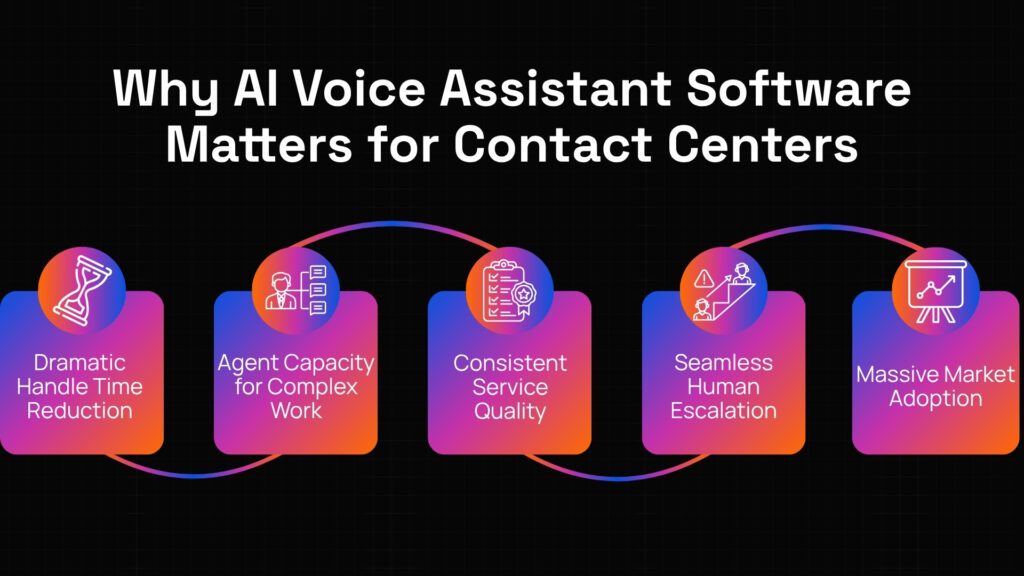
For contact center leaders evaluating AI voice assistant software strategies, the benefits manifest in five critical ways:
- Dramatic Handle Time Reduction: AI voice agents resolve routine inquiries including password resets, account verification, and status checks in minutes rather than the longer durations required when human representatives manually navigate systems, look up information, and document interactions, with leading implementations achieving 20 percent or greater handle time reductions within six months.
- Agent Capacity for Complex Work: Intelligent systems handle high-volume routine calls autonomously, freeing human representatives for higher-value interactions requiring negotiation skills, emotional intelligence, and technical expertise that provide job satisfaction and professional development opportunities while improving customer outcomes on difficult cases.
- Consistent Service Quality: AI call center automation applies standardized response protocols and policy interpretations across all shifts, locations, and experience levels, eliminating the variability that comes from training gaps, rushed answers during volume spikes, or inconsistent application of evolving procedures that create customer confusion.
- Seamless Human Escalation: Best AI voice assistant software maintains complete conversation context including authentication completed, information gathered, and customer sentiment signals, enabling smooth handoffs to human agents with confidence triggers and fallback phrases ensuring customers never feel trapped in automation loops without escape paths.
- Massive Market Adoption: With 153 million projected voice assistant users in the United States by 2025 according to AIMultiple, customer comfort and expectation for voice AI interactions has reached mainstream levels, reducing resistance and enabling successful deployments across demographics and industries that once viewed voice automation skeptically.
AI voice assistant software is not about replacing contact center teams; it is about amplifying their effectiveness, ensuring service availability, and enabling agents to focus on emotionally charged conversations, complex troubleshooting, and relationship building that require human judgment and empathy that machines cannot replicate.
Key Considerations When Choosing AI Voice Agents Partners
Selecting the right AI call center automation requires careful alignment between technology capabilities and operational requirements. The most successful AI voice automation implementations are built on a foundation of transparency, deep system integration, and measurable impact on critical metrics like customer satisfaction scores, handle time, and cost per contact.
Below are the core factors that should guide every AI voice assistant software decision:
- Business Outcomes & KPI Alignment: Every AI voice agents initiative must connect directly to tangible contact center metrics you care about including customer satisfaction scores, average handle time reduction, first-call resolution improvements, or cost per contact optimization. Vendors should demonstrate clear methodology for tying voice automation to these specific metrics with attribution models, not vague efficiency promises disconnected from measurable impact.
- Integration with Existing Systems: Effective AI call center automation depends on seamless connectivity with your CRM, help desk platforms, phone systems, treasury management systems, and ERP. Look for vendors offering native connectors with read-write capabilities and event-driven triggers so automated workflows can authenticate callers, look up account information, create tickets, and log interactions without manual data entry.
- Security and Governance: AI voice assistant software handles highly sensitive customer data including personal identifiers, account details, payment information, and call recordings that require strict controls. Confirm that data handling, conversation logging, and compliance protocols are clearly defined with documented procedures, encryption standards, and audit capabilities supporting regulatory requirements.
- Human-in-the-Loop (HITL) Flexibility: Successful AI voice automation always includes agent oversight mechanisms for conversations requiring human judgment, empathy, or specialized expertise. Ensure that voice agents hand off to humans smoothly when confidence drops below thresholds or customers request representatives, passing complete conversation context without forcing customers to repeat information.
- Observability and Analytics: Transparency is essential when scaling AI voice agents across call volume. A capable vendor provides comprehensive dashboards tracking performance metrics, complete trace logs showing conversation flow and decision logic, evaluation frameworks measuring accuracy and satisfaction, and rollback paths for voice workflows when prompt or model updates degrade quality.
- Pricing Transparency and Flexibility: Demand clarity around pricing assumptions including call minutes, concurrent channel counts, model inference costs, and telephony integration expenses. Understanding AI call center automation economically helps forecast costs accurately as volumes scale, and confirm whether you own or can export prompt sets, voice flows, and training data so intellectual property remains with your organization.
Choosing AI voice assistant software partners who understand these requirements ensures your investment delivers sustainable improvements rather than creating technical debt, vendor lock-in, or governance gaps that limit future flexibility when contact center strategies or technology stacks evolve.
The Impact of Integration Readiness
Before launching any AI voice agents initiative, organizations must thoroughly assess their telephony architecture, system integration landscape, and call flow documentation completeness. Integration readiness evaluates how well existing phone systems, CRM platforms, and knowledge structures can support intelligent voice automation without creating caller frustration or operational chaos. When contact center teams conduct integration audits in advance, they uncover API limitations and data quality gaps early, align IT and operations stakeholders around connectivity requirements, and minimize wasted time during vendor discovery and pilot phases.
Example: A healthcare organization preparing for AI call center automation discovered that their phone system lacked modern API support for real-time call control, their CRM contained 35 percent incomplete contact records undermining personalization, and their authentication procedures required manual override for specific scenarios. Addressing these integration readiness issues before vendor engagement reduced the overall project timeline by seven weeks and enabled successful pilot launch with measurable handle time reductions.
Pro Tip: Map integrations up-front to avoid surprises during implementation. Give vendors sandbox access to your actual data including voice call logs, CRM flows, and representative authentication scenarios so they can validate assumptions with real complexity rather than idealized demo environments. Use real logs, not just sanitized sample data, to surface edge cases early.
Common Pitfalls in AI Voice Assistant Software Selection
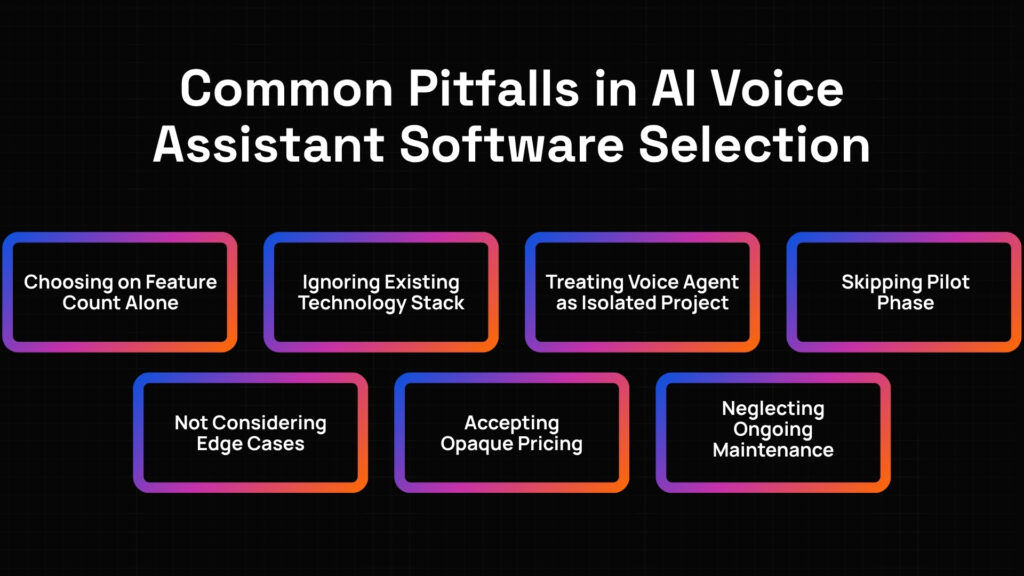
AI voice automation promises efficiency and availability, but poor vendor selection and inadequate planning can create implementation failures instead of operational improvements. Many contact center organizations make avoidable mistakes during evaluation that delay value realization and erode both team and leadership trust. To discover proven methodologies tailored for your contact center workflows and telephony requirements, explore our AI Workflow Automation Services page for detailed AI voice assistant software frameworks and real-world implementation guidance.
- Choosing on Feature Count Alone: Some organizations select AI voice agents based on impressive capability lists rather than measurable business outcomes. Focus on outcomes and real metrics including handle time reduction percentages, satisfaction score maintenance, and cost per contact optimization rather than feature checklists disconnected from operational impact.
- Ignoring Existing Technology Stack: A technically advanced AI call center automation can still fail without proper system integration. Map integrations to CRM, help desk, and phone systems up-front documenting read-write requirements, event triggers, and data flow to avoid surprises during implementation when timelines and budgets are committed.
- Treating Voice Agent as Isolated Project: Organizations implementing AI voice automation without considering broader workflows create operational gaps. Plan for seamless handoff to human agents, human-fallback procedures when automation struggles, and governance frameworks covering compliance, quality monitoring, and continuous improvement from day one.
- Skipping Pilot Phase: Full-scale AI voice assistant software deployment without controlled testing creates impossible risk concentration. Prior to broad rollout, test with small scope focusing on specific call types and measurable KPIs like handle time or satisfaction to validate technology performance and team readiness under real conditions.
- Not Considering Edge Cases: Deploying AI voice agents trained only on ideal scenarios creates poor experiences for callers with accents, background noise, or complex inquiries. Include diverse usage scenarios in evaluation including multilingual requirements, regional accent variations, and low-confidence situations requiring graceful degradation to human assistance.
- Accepting Opaque Pricing: Organizations signing contracts without pricing clarity face budget surprises as call volumes scale. Demand explicit assumptions around call minutes, concurrent channels, model costs, and telephony integration expenses, plus clarification on IP ownership for prompt sets and voice flows developed during implementation.
- Neglecting Ongoing Maintenance: Successful AI call center automation requires continuous optimization as call patterns, products, and policies evolve. Plan for periodic review cycles, prompt tune-ups addressing new objection patterns, dashboard monitoring identifying quality degradation, and quarterly performance assessments with vendor partners.
Evaluating the ROI of AI Voice Assistant Software
Quantifying the benefits of AI voice agents helps secure executive buy-in and refine future investments in contact center technology. Measuring ROI goes beyond simple call deflection; it captures gains in handle time, agent capacity, customer satisfaction, and cost efficiency. Without clear metrics during evaluation, AI call center automation projects risk becoming feature-heavy implementations with unclear business outcomes that fail to justify ongoing operational expenses and licensing costs.
Key metrics to monitor include:
- Handle Time Reduction: Track the decrease in average call duration when AI voice assistant software handles routine inquiries, with leading implementations achieving 20 percent or greater handle time reductions within six months by eliminating manual system navigation, lookup delays, and documentation during active calls.
- Agent Capacity Release: Measure the improvement in complex cases handled per agent when AI voice automation contains high-volume routine calls like password resets and status checks, freeing representatives for escalations requiring empathy, negotiation, and specialized technical expertise that provide higher job satisfaction and customer value.
- Customer Satisfaction Maintenance: Compare post-call survey scores before and after AI voice agents deployment to ensure automation maintains or improves experience quality, as speed gains without accuracy or poor escalation experiences create frustration that damages brand perception and loyalty despite efficiency improvements.
- Cost Per Contact Optimization: Evaluate total operational costs including telephony expenses, AI inference fees, and remaining agent touches divided by calls handled to calculate unit economics, demonstrating substantial savings compared to fully-staffed human-only models especially during volume spikes and off-hours coverage.
- First-Call Resolution Improvement: Assess the percentage of issues resolved in initial contact without callbacks when AI call center automation provides complete answers from integrated knowledge bases and system access, eliminating the incomplete information that requires follow-up interactions and compounds customer frustration.
- Market Readiness Validation: With 153 million projected voice assistant users in the United States by 2025 according to AIMultiple, customer comfort with voice AI has reached mainstream adoption levels, reducing resistance and enabling successful deployments that once faced skepticism from demographics unfamiliar with automated voice interactions.
When every AI voice assistant software interaction logs call reason classification, confidence scores, system actions taken, escalation triggers, and PII access with redaction, every prompt change maintains version history with rollback capabilities, and every caller has clear phrases to reach human agents immediately, organizations build trusted voice operations that scale without sacrificing experience quality or creating compliance vulnerabilities.
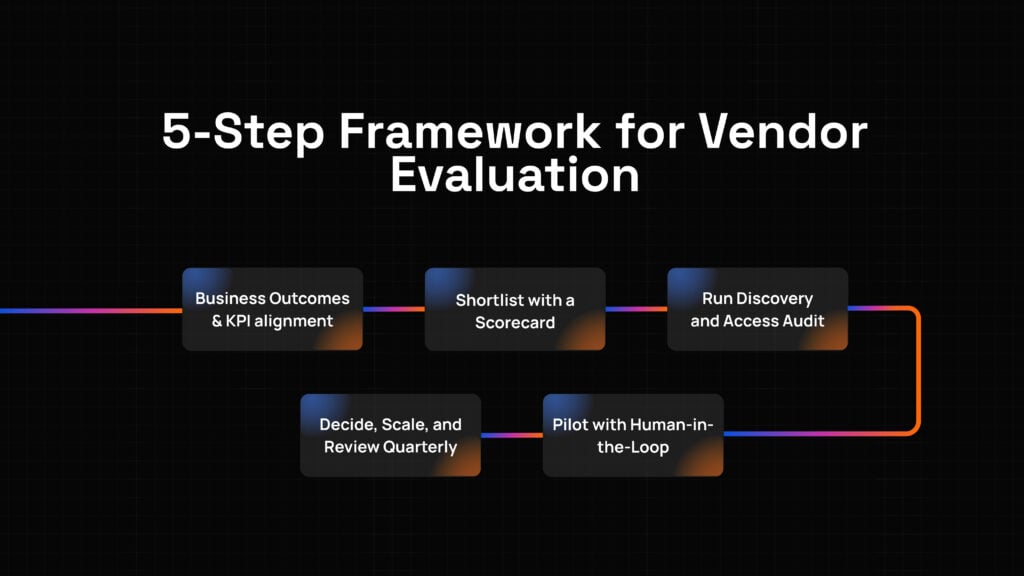
5-Step Framework for Vendor Evaluation
Selecting an AI voice agents vendor should follow a disciplined, structured process that aligns with your organization’s contact center goals while accounting for both technological depth and long-term partnership potential. Instead of focusing solely on impressive voice quality demonstrations or lowest price, evaluation should weigh how well the vendor’s AI call center automation solution supports operational metrics, integrates with telephony infrastructure, and adapts to evolving caller expectations.
1. Define KPI & Scope
Start by clearly outlining what success means with 2 to 3 key metrics to stay focused. Defining specific targets helps align all stakeholders including contact center leadership, quality assurance teams, IT departments, and agent representatives. Your goal might be reducing average call handle time for inbound support by 20 percent within six months, improving first-call resolution rates, or maintaining customer satisfaction above baseline thresholds, but it must be quantifiable. This clarity becomes the foundation for every subsequent decision about AI voice assistant software, shaping both vendor conversations and internal buy-in.
Example: A telecommunications company defined its KPI as “reducing average call handle time for inbound technical support by 20 percent within six months while maintaining customer satisfaction scores at 4.2 out of 5.0 or higher.” This metric guided every vendor discussion, shaped pilot design, and became the benchmark for success measurement. Limit to 2 to 3 key metrics so evaluation stays focused on outcomes.
Pro Tip: Document one primary operational metric and one to two guardrail metrics before requesting proposals. Focus on handle time reduction, cost per contact optimization, or first-call resolution tied to efficiency rather than vanity metrics like total calls handled, and define exactly which call types are in scope for automation versus requiring human agents permanently.
2. Shortlist with a Scorecard
Once objectives are clear, move to structured vendor comparison using a weighted scorecard for evaluating AI voice agents providers. This tool allows teams to quantify how well each vendor aligns with priorities including integration depth with telephony and CRM systems, governance frameworks, human-in-the-loop design, analytics capabilities, and data portability. By assigning weights to each factor, decision-makers can balance technical capability with operational impact and long-term flexibility. A disciplined scorecard approach removes subjectivity and keeps evaluation objective.
Example: One financial services company assigned 30 percent weight to integration depth with phone system and CRM, 20 percent to governance and security protocols, 40 percent to proven outcomes with reference customers, and 10 percent to exit portability, helping eliminate vendors lacking production-ready telephony connectors early in evaluation.
Pro Tip: Create a vendor comparison table using the evaluation criteria including integration, governance, outcomes, human-in-the-loop design, observability, delivery plan, references, pricing, and portability. Assign weights like integration 30 percent, governance 20 percent, outcomes 40 percent to keep scoring objective. Rate each vendor 1 to 10 per criterion for quantitative comparison.
3. Run Discovery & Access Audit
Before contracts are signed, a structured discovery phase gives vendors sandbox access to your data including voice call logs, CRM flows, and authentication procedures so they can validate assumptions with real complexity. During this phase, teams test integration capabilities with actual system versions and configurations, surface edge cases including multilingual requirements and accent variations, and confirm security controls including PII handling and audit logging. Running an access audit with real logs rather than demo data uncovers gaps early.
Example: A retail company provided vendors with 1,000 anonymized call recordings representing typical inquiries, edge cases, and escalation scenarios, discovering that two finalists struggled with regional accent recognition requiring custom training that would have delayed launch by eight weeks if discovered after contract signing when negotiating leverage was lost.
Pro Tip: Give vendors controlled sandbox access to representative data including actual voice logs showing accent variations, background noise, and complex scenarios, not just sanitized demo recordings. Validate that claimed integrations work with your specific phone system, CRM version, and help desk configuration. Use real complexity to surface limitations early before committing budgets and timelines.
4. Pilot with Human-in-the-Loop & Dashboards
A well-designed pilot validates both technology performance and operational readiness under real contact center conditions. Instead of full-scale deployment, execute a small-scale voice agent pilot with clear scope covering specific call types, include live metrics tracking handle time and satisfaction, implement hand-off logic with escalation triggers, and establish monitoring procedures. Incorporating human-in-the-loop oversight ensures AI voice assistant software outcomes align with service standards and brand expectations.
Example: A healthcare payer piloted AI call center automation for eligibility verification calls, running 6-week evaluation with 10 percent of inbound volume and achieving 18 percent handle time reduction, 4.0 out of 5 satisfaction scores, and identification of 5 policy clarification needs requiring knowledge base updates. Treat pilot as built-in training for your team and refinement opportunity for vendor’s workflow.
Pro Tip: Execute pilots with frozen scope, clear success criteria, and measurable KPIs comparing performance to baseline metrics. Include hand-off logic, escalation monitoring, and live dashboards showing handle time, satisfaction, and escalation appropriateness. Use pilot period to train agents on new workflows, refine voice prompts based on actual caller language, and validate integration stability under production load.
5. Decide, Scale, and Review Quarterly
After the pilot proves value, use findings to guide the final decision and create a phased expansion plan for AI voice automation deployment. Scaling should be deliberate, rolling out in phases to additional call types only after performance metrics remain stable and operational procedures prove effective. Continuous quarterly reviews between your contact center operations team and the vendor maintain alignment, ensuring the technology evolves alongside policy updates, product launches, and caller expectation shifts.
Example: A financial services company conducted quarterly business reviews with its AI voice agents vendor, expanding successful account verification automation to include fraud reporting and payment inquiries over 12 months, identifying prompt optimization opportunities that improved handle time by additional 8 percent and reduced escalation rates by 14 percent through continuous refinement. Set quarterly checkpoints to refresh prompts, voice flows, and usage patterns.
Pro Tip: Treat vendor reviews as strategic sessions focused on expanding successful AI voice assistant software use cases to adjacent call types and optimizing quality, not just maintenance calls about system uptime. Use quarterly reviews to refresh prompts addressing new caller objection patterns, update voice flows reflecting policy changes, and assess performance against evolving market benchmarks.
Next Steps in Your Evaluation Process
By now, you should have a clear understanding of what to prioritize when selecting an AI voice assistant software partner. Bringing these insights together creates a structured evaluation flow that de-risks investment and accelerates deployment while ensuring long-term caller satisfaction and operational excellence.
- Align with operational metrics: Ensure every feature connects to specific KPIs like handle time reduction, cost per contact optimization, or first-call resolution tied to efficiency, not just call volume handling disconnected from customer experience quality or agent capacity improvements.
- Evaluate integration architecture: Confirm that AI voice agents work smoothly with your phone system, CRM, help desk, and authentication platforms through native connectors with read-write capabilities and event triggers enabling seamless data flow without manual intervention or disconnected systems.
- Focus on escalation design: Choose vendors with documented hand-off logic including confidence thresholds triggering human transfer, complete context passage, conversation transcripts, and fallback phrases customers can use, ensuring smooth escalation without forcing callers to repeat information or feel trapped.
- Review governance frameworks: Favor partners with clearly defined data handling procedures, conversation logging protocols, compliance certifications, PII masking capabilities, and audit trails supporting regulatory requirements and internal quality monitoring without ambiguity.
- Test with realistic pilots: Always run controlled pilots with small scope, clear KPIs, human-in-the-loop monitoring, and live dashboards before full deployment to validate handle time improvements, satisfaction maintenance, and operational readiness under real-world contact center conditions with actual caller patterns.
With these criteria in place, you are better equipped to identify AI call center automation vendors who not only automate routine calls but also improve operational efficiency, reduce costs, strengthen customer satisfaction, and amplify your team’s capacity to focus on complex escalations requiring human empathy and creative problem-solving.
Vendor Questions to Ask
To make the most informed decision during your AI voice assistant software evaluation, be sure to ask these essential questions:
- How does your voice agent integrate with our phone system and CRM including read-write capabilities, event triggers, and authentication workflows?
- What hand-off logic do you model when the voice agent encounters low confidence, customer frustration signals, or explicit requests for human agents?
- Can we export voice flow scripts, evaluation sets, prompt libraries, and conversation data if we decide to switch vendors or bring capabilities in-house?
- What dashboards and logging do you provide for voice interactions including handle time, satisfaction, escalation patterns, and quality metrics?
- How do you support multilingual conversations and accent or regional variants, and does that require custom training or is it included?
- What governance policies do you enforce around voice data capture, storage, retention, and compliance with regional privacy regulations?
- What typical timeframe do you see from pilot launch to production deployment for clients with similar contact center volumes and system complexity?
- Can I speak to two customer references with similar call types and integration requirements who can discuss measured handle time improvements and implementation challenges?
Transform Contact Centers with AI Voice Assistant Software
AI voice assistant software is not just a technological investment; it is a strategic contact center capability that requires careful vendor selection, disciplined planning, and continuous optimization. The right implementation brings consistency, efficiency, and scalability across your voice workflows, while poor vendor selection creates implementation failures, integration chaos, and operational disruption that undermines trust and wastes investment.
Ready to transform your contact center with AI voice assistant software? Book a Free Strategy Call with us to explore the next steps and discover how we can help you scope, pilot, and scale the right AI voice agents solution for your unique call patterns, telephony environment, and measurable business outcomes.